EFFECTS O F HUMAN BLOOD PLASMA O N T H E CLEARING REACTION BY T H E LIPOPROTEIN LIPASE I O F
PSEUDOMONAS SP M-12-33 Tciiti NARASAKI and Akira KONDO
I n 1966 ARIMA and his co-workers(l.2) reported the isolation of microorganisms which produce lipoprotein lipases with properties vcry similar to, if not identical with, those of the lipoprotein lipases of post-heparin plasma and other animal tissues in regard to the substrate specificities and behaviors against the specific inhibitors. 'The following exarninationcz) found that Pjeu- domoar sp M- 12-33 and Mucor lavanzcur IAM 6108 werc supei ior mic~obcs for the production of lipoprotein lipases
Effects of culture conditions on the production of lipoprotein lipascs by these microbes were examined(3.4) and the obtained lipoprotein lipases were successfully purified to give electro- phoretically or ultracentrifugally homogerleous preparations(5.6) All the purified lipoprotein lipases were shown to be lipoproteins themselves(527) These results seem to support the conclu- sion that these microbial lipoprotein lipases are really lipoprotein lipases but not ordinary lipases. Extensive studies have been d,one on the characteristics and physiological roles of animal lipoprotein lipases(s,g~lO) It seems probable that the lipoprotein lipase has a n important func- tion in the lipid metabolism zn vzvo, though there are considerable coiltradictjons in the results obtained by different research groups by using only crude enzyme preparations available
K o R N ( ~ ~ ) demonstrated that hydrolysis of triglyceride emulsions by a lipoprotein lipase, an ammonium hydroxide extract of acetone powder from rat heart, occurred only when tr iglycer die emulsions had been exposed to human serum high density lipoproteins He claimed that a true substrate, which he called "activated substrate", was formed by the interaction of serum lipo- proteins and triglycerides SCANU and PAGE(^^) confirmed KORN'S work and S C A N U ( ~ ~ ) further showed that apoprotein-phospholipid complexes derived from human serum high density lipo- protein could also activate trigIyceride emulsions to a true substrate for the lipoprotein lipase obtained from chicken adipose tissue
BIER and H A V E L ( ~ ~ ) examined the role of serum lipoproteins in the formation of enzyme- substrate complex and found that very low density lipoproteins, whoes triglycerides are a substrate for lipoprotein lipases, had 13 times the activity of high density lipoproteins as estimated per unite weight of component proteins. This observations seem to suggest that one or more of the major apoproteins of very low density lipoproteins, present as a minor constituent of high density lipoproteins, may be required for the activation process CHUNG, SCANU, and RE MAN(^^) examin- ed the effect of various phospholipids on the lipoprotein lipase of rat adipose tissue, and showed that phospholipids appear to be important determinants in the action of lipoprotein lipase zn uztro and that a certain degree oi specificity of phospholipids in their action apparently dependent on both polar and non-polar moieties of these components.
The purpose of present experiment is to make clear unambiguously the role of human blood plasma in the clearing reaction by lipoprotein lipases, because it must be important to elucidate the mechanism of clearing reaction by using the pure lipoprotein lipase 1 of P~eudomonas sp M-12-33, which is now made available by the present authors
138 Tech. Bull Fac Agr Kagawa Univ.
of high density lipoproteins for the activation of triglyceride emulsion to a true substrate for lipoprotein lipase and the other is a function of plasma albumin as an acceptor of free fatty acids liberated by the action of lipoprotein lipase.
Materials and Methods Estimation of Lipoprotein Lipase Activity.
The turbidity method(l6) was employed to estimate the lipoprotein lipase activity throughout the present study.
Determination of Protein Concentration.
Protein was estimated by the absorbance at 280 rnp with a Hitachi photoelectric spectropho- tometer Model 139 by using bovine serum albumin as a reference protein.
Preparation of the Pure Lipoprotein Lipase I.
The pure lipoprotein lipase I was prepared by gel filtration with Sephadex G 2 0 0 followed by ion-exchange chromatography on DEAE-cellulose as reported by NARASAKI et a1 (5) from a crude enzyme powder of Pseudomonas sp. M-12-33. The lipoprotein lipase I was further purifi- ed by chromatography on DEAE-Sephadex A-50 and lyophilized to be stored in a desiccator at -20°C.
Disc Electrophoresis.
Discontinuous electrophoresis in 7 5% polyacrylamide gels was carried out according to the method of ORNSTEIN and D A V I S ( ~ ~ - ~ ~ ) by the use of a n Emuesu disc electrophoretic apparatus Type-8 (Emuesu Kiki Co
,
Ltd,
Osaka) Electrophoresis was performed at pH 8 3 with the Tris-glycine buffer system and a t a constant current of 5 mA per gel for 40 min Gels were stained with Amido schwarz for 1 hr and destained electrolytically with 8% acetic acid a t a con--- stant current of 10 mA per gel for 1 hr.Materials.
A crude lipoprotein lipase powder of Pseudomonas sp M-12-33 was produced by Amano Seiyaku Co
,
Ltd., Nagoya, by the procedure of NARASAKX et a1 (3) Human normal blood wasobtained from a blood bank, Takamatu, and centrifiuged at 12000 rpm for 20 min to obtain plasma. The blood plasma was then taken into test tubes and stored in a freezer at -20°C. Wheat albumin was extracted from wheat germ (Nissin Seihun Co
,
Ltd., Sakaide), and purifed by fractional precipitation with (NH4)$04 and chromatography on DEAE-Sephadex A-50 Olive oil was a specific preparation for lipase assay (Nakarai Kagaku Yakul~in Co., Ltd,
Kyoto). Egg white albumin was a product of Nutritional Biochemical Co,
U S A Sephadex G-200 and DEAE-Sephadex A-50 were the products of Pharmacia Fine Chemicals, Sweden. DEAE- cellulose was obtained from Brown Co,
U S A Bovine serum albumin was Bovine Albumin Powder, Fraction V, of Armour Pharmaceutical Co,
EnglandResults and Discussion
Activation of an Olive Oil-Emulsion with Various Proteins.
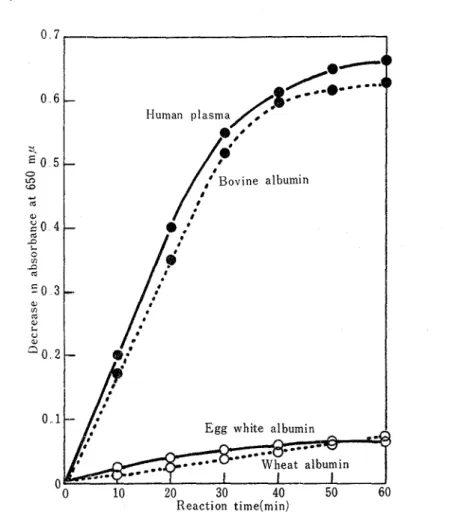
A 10% olive oil-emulsion (0 2 ml) was activated with 9.8 ml each of human blood plasma, 5% bovine albumin, 5% egg white albumin, or 5% wheat albumin at 35OC for 30 min to be used as a substrate for the lipoprotein lipase I (57/ml, or 420 unitslml).
Vol.. 25, No. 1 (1973)
Fig. 1. Activation powers of various proteins
As shown in Fig 1, egg albumin and wheat albumin had actually no activation power, but bovine albumin showed the same activity as that oi human blood plasma Therefore, it may be said that an albumin fraction of blood plasma contains all the factors required for the clearing of an olive oil-emulsion by the lipoprotein lipase I.
Isolation of Active Factors in the Human Normal Blood Plasma by Fractional Precipitation with Ammonium Sulfate.
The human blood plasma was dialyzed against deionized water through a cellulose tubing (Visking Co., U.S A ) for 2 days a t 2OC and the formed precipitate was removed by centrifuging a t 12000 rpm for 20 min The active factors were all recovered in the supernatant solution and the precipitate had no activity
Table I shows that the active factors were collected in a fraction precipitating with 40-60% saturated (NH4)$04 a t an yield of 98% This fraction contained 5804 of protein in the dialyzed plasma consisting mainly of albumin and a-lipoprotein, as revealed by disc electrophoresis. Thus, the activation power was concentrated into this fraction 1 7-foId
Purification of the Concentrated Active Factors by Chromatography on DEAE- Sephadex A-50.
Tech Bull I'ac Agr Kagawa Univ
Table 1 Isolation of active factors in the human normal blood plasma by fractional precipitation with ammonium sulfate
-
--
Fractions Protcin* Yicld of Activity Relativc activity pptg with (NH,),SO, (% satn ) (mglml) (%) (O/b lprotcin base)
*
The precipitated proteins wctc dissol\td in dcjonized watei amount to the volumc of the original blood plasmab r a c t ~ o n numbel ( 1 0 m l i
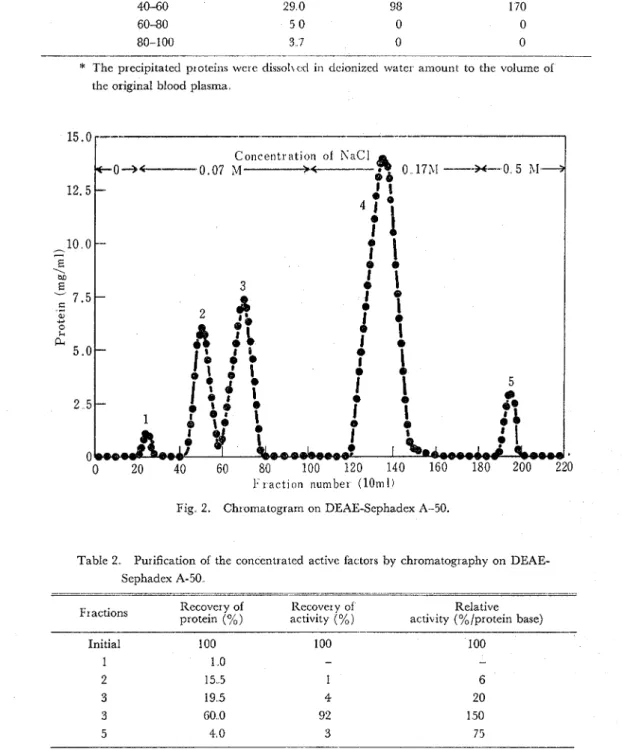
Fig. 2. Chromatogram on DEAE-Sephadex A-50.
Table 2 Purification of the concentlated active factors by chromatography on DEAE- Sephadex A-50
F~actions Recovery of protein
(x)
activity Recovery of Relative(O/,) acticity (%/protein base)
Initial 100 100 1 1.0 - 2 15 5 1 3 19 5 4 3 GO 0 92 5 4 0 3
Vol, 25, No. 1 (1973) 141
80 mglml) was dialyzed against 0 02 M phosphate buffer a t PI-I 6 6 and then put on a column of DEAE-Sephadex A-50 (200 ml, buffered a t pH 6.6 with 0 02
M
phosphate buffer) The column was then washed with NaC1-containing 0 02 M phosphate buffers to obtaine 5 fractions.The results are given in Fig 2 and Table I1
The active factors were concentrated into the fraction 4. This fraction showed about 4 times as high activity as that of the feeded active fraction of human normal blood plasma. The fraction 4 contained albumin and a-lipoprotein, the fraction 3 consisted practically only of albumin, and the fraction 5 contained a-lipoprotein, respectively
O n the basis of these results, it may be presumed that the active factors are included in albumin and a-lipoprotein fractions of the normal blood plasma
Separation of Active factors of the Normal Blood Plasma by Ultracentrifugation. The fractions 3, 4, and 5, which were obtained by chromatography on the DEAE-Sephadex A-50 column, were combined and concentrated to give 50 mg/ml of protein A density of the concentrated active fraction was brought to 1 21 with NaBr and NaCl Then the solution was centrifuged in a Hitachi preparative ultracentrifuge Model 40-P, with the use of a RP-40 rotor a t an average centrifuging force of 105400
x
g for 24 hr a t 15OC. The top fraction was collected, and diluted with two volumes of a NaBr-NaCI solution ol density I 21, and then centrifuged twice in a RP-40 rotor at 105400x
g for 24 hr at 15OC The washed top fraction was dialyzed142 Tech Bull. Fac. Agr. Kagawa Univ
against dcionized water and concentratrated to give 5 mg/ml of protein to be used as a n a- lipoprotein fraction of the human normal blood plasma The bottom fraction was dialyzed against deionized water and then concentrated to give 50 mg/ml of protein to be used as a n albumin fraction The both fractions were proved to be practically homogeneous by disc electrophoresis, corresponding to a-lipoprotein and albumin, respectively.
Fig 3 shows a mixture of the a-lipoprotein and the albumin fraction was most active, followed by the a-lipoprotein fraction The albumin fraction showed only 116 activity of the a-lipoprotein fraction. Possibility that the albumin fraction is contaminated with a-lipoprotein could not be excluded in the present experiment Therefore, whether the albumin fraction has some ac- tivation power or the observed activity of the albumin fraction is the result of contamination of a-lipoprotein is not yet clear
An apparent increasing falling off of the activity of the a-lipoprotein fraction with the in- creasing reaction time seems to indicate that a n inactivation of the lipoprotein lipase I was brought about with free fatty acids liberated during the clearing reaction This inference was further strengthened by a addition test of oleic acid to the reaction mixture
Thus, it can be concluded that a-lipoprotein is esscntial for the activation of triglyceride emulsions to a true substrate for lipoprotein lipases and albumin is required for protecting lipoprotein lipases from the inactivation with free fatty acids liberated during the clearing reaction.
Summary
The role of human normal blood plasma in the clearing reaction was examined by the use of the pure lipoprotein lipase I of P~eudomonar sp. M-12-33.
The active factors in the human normal blood plasma were separated into the a-lipoprotein and the albumin fractions by combining chromatography and ultracentrifugatioii
The experiments suggest that a-lipoprotein is essential for the activation of triglyceride emul- sions to a true substrate for lipoprotein lipases and albumin is required for protecting lipoprotein lipases from the inactivation with free fatty acids liberated during the clearing reaction by lipoprotein lipases
Acknowledgement
The authors wish to thank Prof Kei ARIMA of The University of Tokyo ibr his kind guidance and for his support of this work
The crude enzyme powder used in this work was kindly supplied by Amano Seiyaku Co., Ltd., Nagoya
The work was supported in part by the research fund donated by the Ministry of Education to T. NARASAKI (Studies on the lipoprotein lipases of microorganisms, 1965, 1966).
References
( 1 ) ARIMA, K
,
NARASAKI, T , NAKAMURA, Y , ( 4 ) SAIKI, T,
NARASAKI, T,
ARAMAKI, K,
TAMURA,TAMURA, G : Agr Bzol Chem
,
30, 515 ( 1966) G,
ARIMA, K : Zbzd, 32, 1458 (1968)( 2 ) A R I M ~ , K , NARASAKI, T., NAKAMURA, Y , ( 5 ) NARASAKI, T
,
SAIKI, T,
TAMURA, G,
ARIMA, TAMURA, G.: Zbzd, 31, 924 (1967) K : Ibid, 31, 993 (1967)( 3 ) NARASAKI, T
,
TAMURA, Go, ARIMA, K : Zbid, ( 6 ) SAIKI, T , TAKAGI, Y , SUZUKI, T., NARASAKI,Vol. 25, No. 1 (1973) 143
(1969)
( 7 ) SAIKI, T , SUZUKI, T , TAKAGI, Y , NARASAKI, T
,
TAMIIRA, G , ARIMA, K : Ibzd , 33, 1 101 (1969)( 8 ) ROBINSON, D S
,
FRENCH, J I5 : PharmacolRevr
,
12, 241 (1960)( 9 ) KORN, E D.: Methods of Biochemical Analy- sis, VII, 145-192, New York, Interscience Pub- lishers Inc (1959)
(10) ROBINSON, D S : Advances in Lipid Research, I, 133-182, New York, Academic Press Inc. (1963)
(1 1) KORN, E D : J Bzol Chem., 215, 15 (1955) (12) SCANU, A , PAGE, I H : J EX# M e d , 109,
239 (1959)
(13) SCANU, A : J Bzol Chem ,242, 71 1 (1967) (14) BIER, D M , HAVEI, R J : J Lzpzd Rer , 11,
565 (1970)
(1 5) CHUNG, J
,
SCANU, A M,
REMAN, F : BzochzmBiophyr Acta, 296, 116 (19 73)
(1 6) NARASAKI, T : Kagawa Dazgaku Nogakubu
Gakuzyutu Hokoku, 20, 49 (1968)
(1 7) ORNSTEIN, L.: Ann New York Acad Scz , 121, Art. 2, 321 (1964).
(18) DAVIS, B J.: Ibzd
,
121, Art 2, 404 (1964) (19) NAGAI, Y.: Tanpaku~itu Kakurnn Koro, 11, 744(1966).
Pseudomonas sp.
M-12-33
@a&&?
f-Y
$7' D "a5.
YY
II.."- -t?I
Cr& f-?3BEEtr%kff-Ad~~5E~B%
I- 13" 1 + Ij 1-*2L%o 1 $'70of.4 ~ 1 j ~ * , - . e ~ . : . d : a t g g E K t z 7 b ~ @ , % { s @ % $ i a $ n , r % f : $ r , F n b O H % M , I%JDlL~P&-93llEEk;B@88h~% t 731, -n\,* I) y . & & % ~ d n % 2 b.3 f:,
q
( 9 ) T s d 2,Q 4' $1 %&itp@@%C.Ed:8%%?"i&8f:&C.E, 1H@%k:$L9%#8kE@BP~14A5$8.
?? L,E, i # H R T @ , Pseudomonas sp M-12-33
ag)l$f&@$~
b @ b$tf:$@+h 1 s.7"~ f.4 ;/ I) ,.".--+?I Q@B]L.,-C,
%i%?EBkEk138 A d n 4 8 % % Q t & 8 Lf:.@ i % ? ~ ~ k ~ ~ % ] ~ ~ % ~ & @ & $ ' k $ . , a-1 $ 7 ' D ' f . 4 Yk'7,V7'$ Y'T&8&%@%'T&f:. a-I) $ 7 " ~ 7 4 Y u , b 1 ? * I j 1 1 'IYL%Qt&B4CL.r, 9 % f a 7 4 7 I)~Q--Eogs2&gE&8~&kk-3i1 s 7 O D 7 4 Y Q & . & $ - 8 9 i Z
~ s r ~ ' % ~ z & , b , Y I V . ~ ' : Y U , ~ ~ % ? E K C . E ~ , T ~ . P S ~ ~ ~ ~ ~ I I E ~ ~ ~ W ~ ~ ~ : ~ ~ L T , 1 f 7 ° 0 . ~ 4 ~ y , ~ . - . e s # g ~ f f i C @ S l l Q % L T b 8
~bs
t ~ a ~ t : . .
$ @ % 9 % B O - ~ t @ % % 1 N , % H % R (fkVll40, 41QE%%@%%, & I I ~ T ~ T , %%&%Jo 'I $ 7 " ~ 7 4 2 9 I * -
.+
iEH$-&@%) tEd: b k+Lhl2f:,$@%%&E&? ;tz%b~@ts"OB7 - c b b R S t ' k P t .%B%EC.ei%