A Consideration on the Relationship between In-role and
Organizational Citizenship Behaviors
Yutaka Ueda
AbstractThis study examined whether and how in-role behavior (IRB) has a relationship with organizational citizenship behavior (OCB). After alternative models regarding a causal relationship between them are proposed, the specification search of Structural Equation Modeling (SEM) was utilized to analyze the data collected from 312 workers working with others. As a result of the comparison of alternative models, different models become the highest measures of fit depending on antecedents; when job satisfaction is considered, the model assuming the effect of job satisfaction on OCB is fully mediated by IRB became the best one. If organizational identification is considered to be an antecedent, the other model considering an effect of organizational identification on IRB is fully mediated by OCB is adopted as the best one. A probable reason for such difference is proposed.
Keywords: in-role behavior, organizational citizenship behavior, job satisfaction,
organizational commitment, organizational identification
Introduction
Organizations cannot or should not specify all the behaviors of employees formally because they face environmental uncertainty making it impossible to determine all the employees’ behaviors required to attain their goal in advance. Organizations have to depend on employees’ free will to decide on their extra-role behaviors for the organization beyond their formal obligation, at least to some extent.
As is well known, those discretionary behaviors contributive to the organization have been termed as organizational citizenship behavior (OCB), and have been paid much attention since the 1980s by researchers in organizational behavior (OB) (Organ, Podsakoff, & MacKenzie, 2006; Ueda, 2004, 2010, 2016, 2019 for a review). In most cases, compared to employees’ formal behaviors, although concrete behaviors classified into OCB are small or subtle, they can have a big impact on the functioning of an organization if they are accumulated over a long period of time.
Extra-role behaviors like OCB are performed by employees of their own free will and different from in-role behaviors (IRB) that are defined as what is expected of them in advance by the organization. However, it is not clear whether or how OCB has a relationship with IRB. This might seem quite a simple question but has not been argued clearly. William and Anderson (1991), who have been often cited as the research which established the terms OCB-I (OCB for individuals in the organization) and OCB-O (OCB for the organization), also collected the data of IRB in addition to OCB. According to their study (Table 4), the correlation between IRB and OCB-I was 0.52, while that between IRB and OCB-O was 0.55, and both values were significant at a 5% level. Although they reviewed some past studies which empirically dealt with both OCB and IRB, they did not find mention of a causal relationship between them. However, as described later, OCB performed during IRB is factually dependent on the latter to some degree and, as some researchers have argued, OCB sometimes has an impact on IRB.
As is well known, OCB research started with the motive to discover a different kind of behavior that is more influenced by job satisfaction than IRB. However, if there is a causal link between OCB and IRB, another perspective on the effect of factors on these behaviors might be necessary, hence this study introduces several views on a causal relationship between IRB and OCB. It also provides the results of a preliminary empirical study to compare alternative models assuming a different relationship between them.
Alternative Views on the IRB and OCB Relationship
As far as we know, although there has been much data collected regarding IRB and OCB, there are few researches which explicitly consider the relationship between them. However, these past researches are considered to have one of the following implicit assumptions regarding the causal relationship between them.
No Direct Relationship
Dr. Dennis Organ, the first advocate of OCB, argued that job satisfaction does not have a strong effect on IRB because the latter is specified by various situational contingencies, and employees are often given a little discretion to change the level of IRB. Organ (1977) stated that, “(t)echnology often tends to exert a leveling effect such that the amount of work to be done per unit time and per person holds roughly constant
or varies only within a narrow range” (p.50). He further noted that outstanding IRB of employees is not desirable in such situations. “They may be more desirous of such things as regular attendance, predictability, following the rules, not making waves, avoidance of hassles, cooperation, and generalized tendencies toward compliance” (p.50). These behaviors were later conceptualized as OCB though at that point he had not embodied these behaviors into one concept.
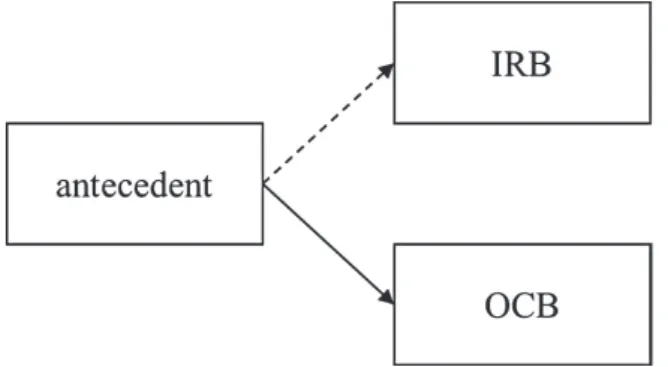
Thus, although Organ (1977) did not assume a causal relationship between IRB and OCB, he considered both to be influenced by job satisfaction as an antecedent, and the effect of job satisfaction is stronger on OCB than IRB. If the technology constraint is strong, theoretically the performance level of IRB could be close to constant independently from job satisfaction, while discretionary OCB could increase when job satisfaction is enhanced. This means a correlation between IRB and OCB would be close to zero, and no causal relationship between them would be observed. His argument is displayed in Figure 1. A dotted line from an antecedent to IRB shows that this effect is, if at all, much weaker than a solid line from an antecedent to OCB, and no line is drawn between IRB and OCB. Even if a significant correlation is observed between IRB and OCB (Ali & Aziz, 2018, Lv, Lv, Xu, Ning, & Li, 2018, Williams & Anderson, 1991), this correlation is spurious due to a common factor influencing both IRB and OCB.
Figure 1 Organ’s (1977) Framework
IRB influencing OCB
It is also true that some OCBs, particularly those performed in the process of IRB, are factually conditioned on the level of IRB. In other words, if IRB is not practiced, some OCBs cannot be exhibited. For example, active participation in a meeting is often
considered as an OCB, and if employees do not attend a meeting, they cannot actively participate in it. Similarly, helping someone, a typical OCB, requires conditions in order to work properly, as a coworker in need of assistance must be found at the worksite. Even a coworker in need is not confident that they will receive help from a person who does not perform IRB properly.
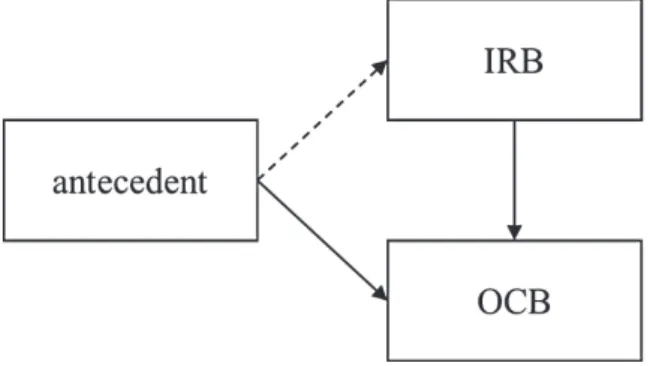
The model that assumes an effect of IRB on OCB is depicted in Figure 2. According to this model, OCB is influenced directly and indirectly by an antecedent. If IRB fully mediates the relationship between antecedent and OCB, the direct effect of antecedent on OCB is not significant.
Figure 2 Assuming an Effect of IRB on OCB
OCB influencing IRB
In contrast to the previous argument, some types of OCB are considered to have an effect on IRB. For example, an employee who helps other employees is indirectly engaging in the improvement of his or her own skill for task performance. It is expected that their task performance will be enhanced with the presence of highly skilled coworkers because interactive relationships with such coworkers are necessary in most work situations.
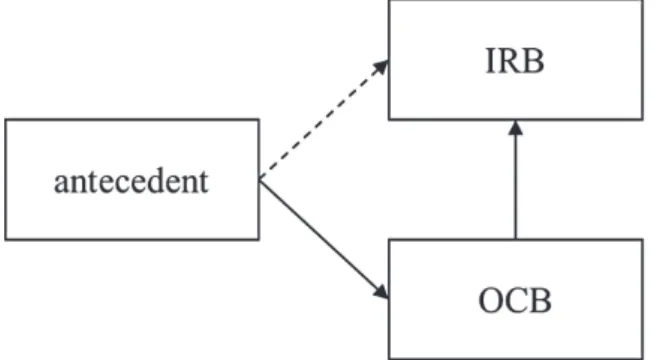
However, an employee performing too much OCB might pay insufficient attention and commitment to IRB, in which case OCB might have a negative impact on IRB. According to Bergeron’s (2007) resource-allocation framework, the human resource of each employee is finite and fixed for a short time. If this resource is allocated excessively to OCB, the resource that should be used for IRB is reduced. Therefore, he argued that OCB is not always desirable for an organization. Although this framework is very interesting, an implied causal relationship between OCB and IRB is not clear. Similar to
the way in which OCB robs the human resource from IRB, the latter can also utilize the resource intended for OCB. Further, if an employee is encouraged to perform OCB in order to keep a reciprocal relationship with the organization, it is unusual that he or she performs more OCB by utilizing the energy and time that should have been devoted to IRB benefiting the organization. Further, as previously described, most past studies have revealed that the correlation between IRB and OCB is positive. Thus, this framework indicating the possibility that OCB has a negative impact on IRB is only applicable in a rather exceptional situation.
Figure 3 Bergeron’s (2007) Resource-allocation Framework Alternative Models and Hypotheses
This study aims to empirically examine the validity of multiple models that assume the relationships between IRB and OCB. Here, the common factors influencing IRB and OCB, namely, job satisfaction, organizational commitment, and organizational identification are taken up as common antecedents because it is known they are the most basic factors that affect employees’ behaviors (Organ et al. 2006; Ueda, 2004, 2010, 2016, 2019).
Job satisfaction is one of the most basic antecedents of employees’ behaviors. As described above, what behavior of employees is more strongly impacted by job satisfaction becomes an important cue to pay attention to discretionary behaviors such as OCB. The earliest researches regarding OCB were those which attempted to establish the impact of job satisfaction on OCB (Bateman & Organ, 1983; Smith, Organ, & Near, 1983).
Organizational commitment has also been considered as one of the basic antecedents of OCB. Although Meyer and Allen (1984, 1991) distinguished three
different components of organizational commitment (affective, continuance, and normative organizational commitment), affective organizational commitment has been perceived to be the most important predictor of employees’ behaviors. Affective organizational commitment is emotional attachment to the organization, and past studies have revealed that the higher the affective organizational commitment held by employees, the more proactive they tend to be in performing OCB.
Organizational identification is employees’ definition of themselves in terms of their membership within the organization. If employees identify with the organization to which they belong, they are more likely to incorporate the organization’s way of thinking, values, and interests in their own self-concept. Organizational identification is different to organizational commitment. In the words of Van Knippenberg and Sleebos (2006), “(w)hereas identification is a cognitive/perceptual construct reflecting the extent to which the organization is incorporated into the self-concept, commitment is more typically viewed as an attitude toward the organization” (p.573). Although organizational identif ication is conceptually closely related to organizational commitment, their measures could produce very different results empirically (Riketta, 2005).
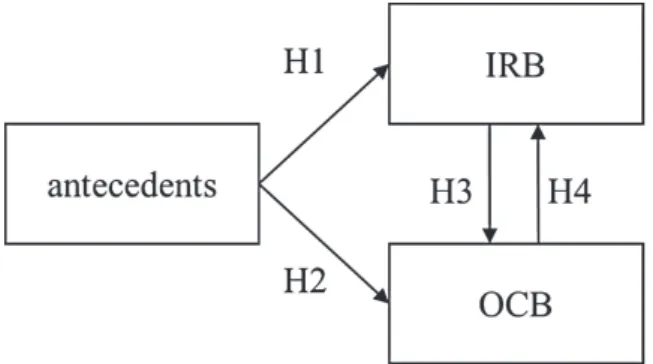
Obviously this study does not aim to reveal the significant effect of these factors on such employees’ behaviors because these relationships have already been recognized in past studies. Rather, this study statistically compares measures of fit of the models differently, assuming an effect of these factors on IRB and OCB. In this study, the following four hypotheses are provided:
H1-1: Job satisfaction will have a positive impact on IRB.
H1-2: Organizational commitment will have a positive impact on IRB. H1-3: Organizational identification will have a positive impact on IRB. H2-1: Job satisfaction will have a positive impact on OCB.
H2-2: Organizational commitment will have a positive impact on OCB. H2-3: Organizational identification will have a positive impact on OCB.
H1-1 to H1-3 and H2-1 to H2-3 are based on the findings of past researches. First, as previously described, due to technological and various constraints, the impact of job satisfaction or other antecedents on IRB is generally weak. However, in most work situations, employees have some leeway for choice regarding how hard they attain task performance, and such task performance is considered to receive an effect of these
antecedents. Moreover, a positive impact of job satisfaction on OCB has been consistently confirmed by many OCB researches.
H3: IRB will have a positive impact on OCB. H4: OCB will have a positive impact on IRB.
Although a significant positive correlation between IRB and OCB has been found in past studies, a causal relationship between them has not been empirically confirmed. As a matter of fact, because both causal relationships could be logically established, the more important problem here is to discover which causal relationship is more valid as the ideal model, than simply to examine whether or not the path relationships of a model are significant.
Figure 4 The Hypothetical Model
Research Method Sample
This study utilized the net research service of Macromill, Inc. on which many people had registered as potential respondents. We requested the company to collect data from people who, as regular or non-regular workers, work with someone else in their workplace because we were interested in respondents’ human relationships with their supervisors and coworkers, and negative behaviors toward them. The final sample size of the survey consisted of 312 individuals (177 males, 135 females). The age of the respondents varied from 20–65, with a mean age of 38.23 years. Of the 312 respondents, 169 were married and 143 unmarried; 178 were childless, while 134 had at least one child. Although the nationality of the respondents was not requested, as the questionnaire was written in Japanese it was assumed that most of the respondents are
Japanese. The data included a wide range of behavioral and attitudinal factors such as OCB, ORB, IRB, job satisfaction, organizational commitment, and organizational identification. This study utilizes the following data in particular.
Measures
All original English items of measures were translated by the author into Japanese. In-role behaviors (IRB). The 7-item IRB scale developed by Williams and Anderson (1991) was utilized. Cronbach’s alpha for these seven items was 0.777.
Organizational citizenship behavior (OCB). Past research has found that OCB has some distinctive dimensions. Among them, OCB-I and OCB-O are known as the most basic OCB dimensions. In this study, the 7-item OCB-I scale developed by Williams and Anderson (1991) was utilized as representative of OCB as we believed that some items of OCB-O scale might not be considered discretionary behaviors but IRB to many Japanese workers. This OCB-I scale includes various types of helping behaviors toward a supervisor, coworkers, and newcomers. While we translated each item into Japanese, the expression “a personal interest in other employees” in one of the original items was changed to “empathetic to other employees” as the former might give a false impression to Japanese people. Cronbach’s alpha for these seven items was 0.825.
Job satisfaction. Spector (1985) developed 36 items to measure nine aspects of job satisfaction (four items per aspect). Here, we adopted four items to measure satisfaction with work. Cronbach’s alpha for these four items was 0.755.
Organizational commitment: We used the 6-item overall organizational commitment scale introduced by Marsden, Kalleberg, and Cook (1993). Among Meyer and Allen’s (1984) three components, this scale can be closely related to affective organizational commitment. Cronbach’s alpha for the six items was 0.829.
Organizational identification. The 6-item organizational identification scale developed by Mael and Ashforth (1992) was utilized. This scale assumed that teachers were respondents and used the expression “school” as the subject with which teachers would identify. We changed the term “school” to “your organization (tsutomesaki in Japanese)” in the items. Cronbach’s alpha for the six items was 0.724.
Gender. Although this study did not aim to find out the effect of gender on various employees’ behaviors, gender was also listed for the purpose of reference in a correlation analysis. Males were assigned 1, and 2 allocated to females.
Analytical Method
SEM was utilized for this study as it is an appropriate technique to judge the validity of a model. Particularly, in order to compare the validity of various models, the specification search of SEM was adopted to compare models with/without a causal arrow. We first formulated a basic model that assumed direct causal arrows among IRB, OCB (ORB), and job satisfaction, and compared it to other models by unlinking each of the arrows.
Results
Means, Standard Deviations, and Inter-correlations regarding Variables
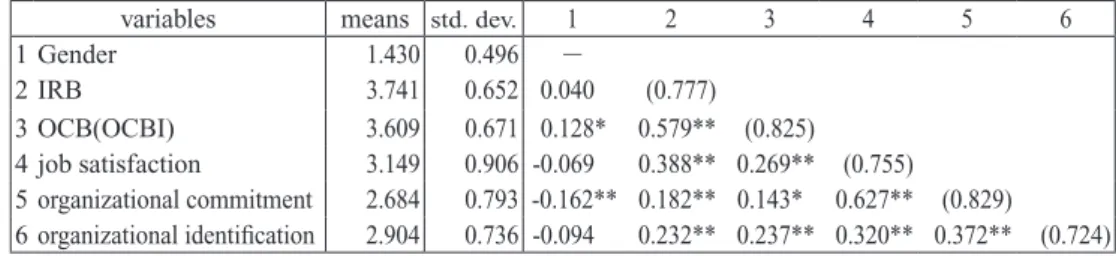
Table 1 shows the means, standard deviations, and inter-correlations with regard to the variables. The figures in parentheses placed diagonally are the values of Cronbach’s alpha. According to this table, most of the inter-correlations regarding variables are as expected.
IRB has a positive correlation with OCB (γ = 0.579, p < 0.01), which means Bergeron’s (2007) resource-allocation framework is not applicable to this current situation. IRB also shows a positive correlation with job satisfaction (γ = 0.388, p < 0.01), organizational commitment (γ = 0.182, p < 0.01), and organizational identification (γ = 0.232, p < 0.01). Positive correlations of OCB with job satisfaction (γ = 0.269, p < 0.01), organizational commitment (γ = 0.143, p < 0.05), and organizational identification (γ = 0.237, p < 0.01) are also as expected.
A signif icant correlation of gender with OCB (γ = 0.128, p < 0.05) and organizational commitment (γ = -0.162, p < 0.01) means that female employees exhibit more OCB despite less organizational commitment. Although we did not propose any hypotheses about the effect of gender, this is an interesting result.
Table 1 Means, Standard Deviations, and Inter-correlations regarding Variables
variables means std. dev. 1 2 3 4 5 6
1 Gender 1.430 0.496 − 2 IRB 3.741 0.652 0.040 (0.777) 3 OCB(OCBI) 3.609 0.671 0.128* 0.579** (0.825) 4 job satisfaction 3.149 0.906 -0.069 0.388** 0.269** (0.755) 5 organizational commitment 2.684 0.793 -0.162** 0.182** 0.143* 0.627** (0.829) 6 organizational identification 2.904 0.736 -0.094 0.232** 0.237** 0.320** 0.372** (0.724) n= 312, * : p < 0.05, **: p < 0.01
Hypotheses Testing Regarding the IRB and OCB Relationship
SEM is usually utilized not to explore the best model but to confirm the validity of a model with hypothetical relationships. However, when multiple models with different causal relationships between variables seem to be equally established, the specification search of SEM is convenient to compare various models and identify which is best. By this method, we compared twelve different models that assume causal relationships among attitudinal factors, IRB, and OCB differently. First, Table 2 shows the measures of fit for these twelve models including work satisfaction as a job satisfaction measure.
Table 2 SEM Results of Alternative Models (work satisfaction)
Models Parameters df C C-df C / df CFI TLI RMSEA
1 No Arrows 54 135 487.138 352.138 3.608 0.822 0.799 0.092 2 IRB->OCB 55 134 312.206 178.206 2.330 0.910 0.897 0.065 3 WS->IRB 55 134 453.124 319.124 3.382 0.839 0.816 0.088 4 WS->OCB 55 134 470.170 336.17 3.509 0.830 0.806 0.090 5 WS->IRB->OCB 56 133 276.524 143.524 2.079 0.928 0.917 0.059 6 WS, IRB->OCB 56 133 312.047 179.047 2.346 0.910 0.896 0.066 7 WS->IRB, OCB 56 133 425.916 292.916 3.202 0.852 0.830 0.084
8 WS->IRB, OCB; IRB->OCB 57 132 276.194 144.194 2.092 0.927 0.916 0.059
9 OCB->IRB 55 134 312.206 178.206 2.330 0.910 0.897 0.065
10 WS->OCB->IRB 56 133 289.279 156.279 2.175 0.921 0.909 0.061
11 WS, OCB->IRB 56 133 293.808 160.808 2.209 0.919 0.907 0.062
12 WS->IRB, OCB; OCB->IRB 57 132 276.194 144.194 2.092 0.927 0.916 0.059 WS: work satisfaction
According to Table 2, No.5 model has the best measures of fit (C/df = 2.079, CFI = 0.928, TLI = 0.917, RMSEA = 0.059). Although the value of RMSEA of this model is slightly higher than a criterion (0.05), the remaining measures are sufficiently good. This model supposes that the effect of job satisfaction is sequential; work satisfaction first influences IRB, which in turn affects OCB. This means only H1-1 and H3 are supported. Interestingly, this model does not assume an effect of work satisfaction on OCB. Table 2 shows No.8 and No.12 models also have fairly good measures of fit. Although both models assume an effect of work satisfaction on OCB, a path representing this direct effect is actually not significant in these models. Figure 5 depicts the best model. Two positive path coefficients in the model are significant at a 5% level.
Figure 5 The Best Model (work satisfaction)
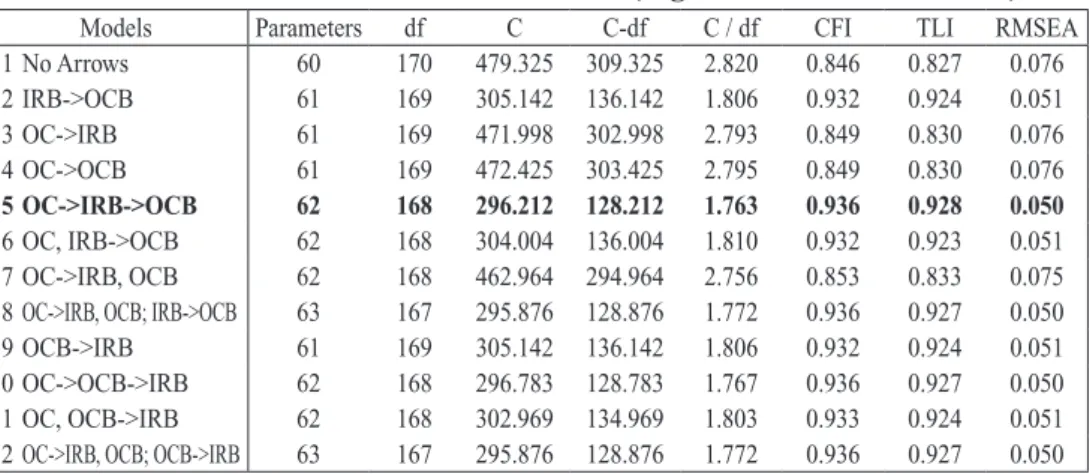
Table 3 SEM Results of Alternative Models (organizational commitment)
Models Parameters df C C-df C / df CFI TLI RMSEA
1 No Arrows 60 170 479.325 309.325 2.820 0.846 0.827 0.076 2 IRB->OCB 61 169 305.142 136.142 1.806 0.932 0.924 0.051 3 OC->IRB 61 169 471.998 302.998 2.793 0.849 0.830 0.076 4 OC->OCB 61 169 472.425 303.425 2.795 0.849 0.830 0.076 5 OC->IRB->OCB 62 168 296.212 128.212 1.763 0.936 0.928 0.050 6 OC, IRB->OCB 62 168 304.004 136.004 1.810 0.932 0.923 0.051 7 OC->IRB, OCB 62 168 462.964 294.964 2.756 0.853 0.833 0.075
8 OC->IRB, OCB; IRB->OCB 63 167 295.876 128.876 1.772 0.936 0.927 0.050
9 OCB->IRB 61 169 305.142 136.142 1.806 0.932 0.924 0.051
10 OC->OCB->IRB 62 168 296.783 128.783 1.767 0.936 0.927 0.050
11 OC, OCB->IRB 62 168 302.969 134.969 1.803 0.933 0.924 0.051
12 OC->IRB, OCB; OCB->IRB 63 167 295.876 128.876 1.772 0.936 0.927 0.050 OC: organizational commitment
Second, Table 3 displays measures of fit for another 12 models using organizational commitment as an independent variable. As with Table 2, the best model is No.5, which represents a sequential effect from organizational commitment through IRB to OCB. The measures of fit (C/df = 1.763, CFI = 0.936, TLI = 0.928, RMSEA = 0.050) of this model are sufficiently good. However, the No.10 model, which assumes a causal relationship from organizational commitment through OCB to IRB, also has very good measures of fit (C/df = 1.767, CFI = 0.936, TLI = 0.928, RMSEA = 0.050). It might actually be difficult to say which, No.5 or No.10, is better. Figures 6 and 7 show path coefficients of these two models, all of which are significant at a 5% significant level. This means that, depending on which of the two models we adopt, either a combination of H1-2 and H3, or that of H2-2 and H4 is supported.
Figure 6 The Best Model (organizational commitment)
Figure 7 The Second-best Model (organizational commitment)
Finally, Table 4 shows measures of fit of the 12 models with organizational identification. Contrary to the above findings, the best measures of fit are attached to the No.10 model showing that an impact of organizational identification on IRB is fully mediated by OCB (C/df = 1.874, CFI = 0.912, TLI = 0.901, RMSEA = 0.053). This means that H2-3 and H4 are supported (Figure 8).
Table 4 SEM Results of Alternative Models (organizational identification)
Models Parameters df C C-df C / df CFI TLI RMSEA
1 No Arrows 60 170 509.872 339.872 2.999 0.797 0.773 0.08 2 IRB->OCB 61 169 335.689 166.689 1.986 0.9 0.888 0.056 3 OI->IRB 61 169 491.549 322.549 2.909 0.806 0.781 0.079 4 OI->OCB 61 169 493.804 324.804 2.922 0.807 0.783 0.078 5 OI->IRB->OCB 62 168 315.83 147.83 1.88 0.911 0.9 0.053 6 OI, IRB->OCB 62 168 331.172 163.172 1.971 0.902 0.89 0.056 7 OI->IRB, OCB 62 168 462.047 294.047 2.75 0.824 0.801 0.075
8 OI->IRB, OCB; IRB->OCB 63 167 313.857 146.857 1.879 0.912 0.9 0.053
9 OCB->IRB 61 169 335.689 166.689 1.986 0.9 0.888 0.056
10 OI->OCB->IRB 62 168 314.801 146.801 1.874 0.912 0.901 0.053
11 OI, OCB->IRB 62 168 332.469 164.469 1.979 0.902 0.889 0.056
12 OI->IRB, OCB; OCB->IRB 63 167 313.857 146.857 1.879 0.912 0.9 0.053 OI: organizational identification
Figure 8 The Best Model (organizational identification) Discussion
This study revealed two important findings. The first is that antecedents are linked either to IRB or OCB due to a high positive correlation between IRB and OCB. The model that assumes antecedents of both kinds of behaviors does not have better measures of fit than sequential causal models.
The second finding is that, depending on antecedents, the different model assuming a relationship between IRB, and OCB becomes the best one. More concretely describing the latter point, when job satisfaction is picked up as an antecedent, the model assuming the order from job satisfaction through IRB to OCB becomes the best one. In contrast, if organizational identification is adopted as an antecedent, the best model is that which considers the order from organizational identification through OCB to IRB. When organizational commitment is considered as an antecedent, either model (organizational
commitment through IRB to OCB, or organizational commitment through OCB to IRB) has almost the same level of good measures of fit.
Although this study attempted to examine a causal relationship between IRB and OCB, the empirical results show the causal relationship between them differs depending on antecedents. Thus, it is important to discover why such different results are produced by different antecedents.
Here, we have to focus on the characteristics of antecedents that influence OCB. Williams and Anderson (1991) showed that factors close to personality traits, such as positive arousal, job cognition intrinsic, and job cognition extrinsic had significant correlations with OCB-I, but not with IRB (Williams & Anderson’s (1991) Table 4, p. 610). On the other hand, Ali and Aziz (2018) revealed that managerial coaching had a stronger correlation with IRB than with OCB, although they did not provide information regarding whether a difference between the two correlations is significant. This antecedent is an assessment of a rather concrete objective like a manager’s skill.
In this study, while job satisfaction is about attitude toward a concrete objective such as “work”, organizational identification is not attitude toward a recognizable objective, but perceived self-image. That is, the latter is close to a personality factor. Organizational commitment is also an attitude factor, but here the target employees feel commitment is “the whole organization”, and thus is rather ambiguous.
Thus, we can infer from these findings that when personality factors and general attitude toward the organization become antecedents of employees’ behaviors, their effect directly impacts OCB, not IRB. In contrast, when attitude toward concrete objectives, such as satisfaction with work or a supervisor, is considered as an antecedent of employees’ behaviors, it affects IRB more strongly than OCB. Unlike personality, satisfaction with a manager or work is attitude toward very limited targets related to formal jobs. It is a little difficult to causally link this kind of attitude toward concrete targets on the job to the motivation to help coworkers. Rather, attitude toward targets on the job facilitates formal behaviors on the job. Then, enhanced IRB can give employees a new opportunity to recognize coworkers in need, or increase employees’ interest in work, and as a result, OCB is also facilitated. However, at this point, this is just inference; more detailed data and analysis is required to examine whether this holds true.
Conclusion
This study aimed to discover a causal relationship between IRB and OCB. Although this causality has proved a common problem in OCB research, little empirical research has so far been conducted. The empirical results revealed that different antecedents have different effects on the IRB and OCB relationship depending on the characteristics of these antecedents. If an antecedent is associated with work, such as job satisfaction, it affects IRB more than OCB. On the other hand, an antecedent that is not related to work directly has more effect on OCB than IRB. Future study is expected to reveal this different effect of different antecedents on IRB and OCB by using more rigorous methods and detailed data. For example, in this study, although the distinction of IRB and OCB is conformable to traditional scales established by past studies, in reality, it is often difficult to classify employees’ behaviors into IRB or OCB (Vey & Campbell, 2004). As is well known, some research has found that many behaviors that were considered as OCB were recognized by employees and their managers as IRB (Morrison, 1994). It might be desirable to consider the possibility that employees face a trade-off between various behaviors with a different degree of sense of obligation.
(Professor, Faculty of Business Administration, Seikei University) *This work was supported by JSPS KAKENHI Grant Number 19H01520.
Acknowledgements
This study includes some of my presentations at the 79th national conference of Japan
Society for Information and Management (JSIM). Effective comments from Prof. Kotaro Kuwata (Tokyo Metropolitan University), Dr. Sachiko Yanagihara (Toyama University), and Dr. Kenji Yoshimi (Bukkyo University at that time) are really appreciated.
References
Ali, M. and Aziz, S. (2018). Relationship between managerial coaching and employee role behaviors: Moderating role of South Asian culture, A Research Journal of South Asian
Studies, 33(1), 221-238.
Bateman, T. S. and Organ, D. W. (1983). Job satisfaction and the good soldier: The relationship between affect and employee “citizenship”. Academy of Management Journal, 26(4),
587-595.
Bergeron, D. M. (2007). The potential paradox of organizational citizenship behavior: Good citizens at what cost? Academy of Management Review, 32(4), 1078-1095.
Lv, A., Lv, R. Xu, H., Ning, Y., and Li, Y. (2018). Team autonomy amplifies the positive effects of proactive personality on work engagement. Social Behavior and Personality, 46(7), 1071-1082.
Mael, F. and Ashforth, B. E. (1992). Alumni and their alma mater: A partial test of the reformulated model of organizational identification. Journal of Organizational Behavior, 13(2), 103-123.
Marsden, P. V., Kalleberg, A. L., and Cook, C. R. (1993). Gender differences in organizational commitment: Influences of work positions and family roles. Work and Occupations, 20(3), 368-390.
Meyer, J. P. and Allen, N. J. (1984). Testing the “side-bet theory” of organizational commitment: Some methodological considerations. Journal of Applied Psychology, 69(3), 372-378. ─ (1991). A three-component conceptualization of organizational commitment. Human
Resource Management Review, 1, 61-89.
Morrison, E. W. (1994). Role definitions and organizational citizenship behavior: The importance of the employee’s perspective. Academy of Management Journal, 37, 1543-1567.
Organ, D. W. (1977). A reappraisal and reinterpretation of the satisfaction-cause-performance hypothesis. Academy of Management Review, 2(1), 46-53.
Organ, D. W., Podsakoff, P. M., and MacKenzie, S. B. (2006). Organizational Citizenship
Behavior: Its Nature, Antecedents, and Consequences, Sage.
Riketta, M. (2005). Organizational identification: A meta-analysis. Journal of Vocational
Behavior, 66(2), 358-384.
Smith, C. A., Organ, D. W., and Near, J. P. (1983). Organizational citizenship behavior: Its nature and antecedents. Journal of Applied Psychology, 68(4), 653-663.
Spector, P. (1985). Measurement of human service staff satisfaction: Development of the job satisfaction survey. American Journal of Community Psychology, 13(6), 693-713.
Ueda, Y. (2004). A preliminary review of researches on organizational citizenship behavior. Journal of Faculty of Economics, Seikei University, 34(3), 1-87. (in Japanese)
─ (2010). Recent trends of research on contextual performance: How differently has it been treated from organizational citizenship behavior? Journal of the Faculty of
─ (2016). Recent trends in organizational citizenship behavior research: 2010-2015. The
Journal of the Faculty of Economics, Seikei University, 47(1), 9-41.
─ (2019). Recent trends in research on organizational citizenship behavior: From January 2016 to December 2019. The Journal of the Faculty of Economics, Seikei University, 50(2), 19-43
Van Knippenberg, D., and Sleebos, E. (2006). Organizational identification versus organizational commitment: Self-definition, social exchange, and job attitudes. Journal of Organizational
Behavior, 27, 571-584.
Vey, M. A. and Campbell, J. P. (2004). In-role or extra-role organizational citizenship behavior: Which are we measuring? Human Performance, 17(1), 119-135.
Williams, L. J., and Anderson, S. E. (1991). Job satisfaction and organizational commitment as predictors of organizational citizenship and in-role behaviors. Journal of Management, 17(3), 601-617.