Matroids on Convex Geometries (cg-matroids)
SATORU
FUJISHIGE
Research Institute for Mathematical Sciences
Kyoto University, Kyoto 606-8502, Japan
GLEB
A. KOSHEVOY
Central Institute of Economics and Mathematics
Russian Academy of Sciences
Nahimovskii pr. 47, Moscow, 117418, Russia
[email protected]YOSHIO
SANO
Research Institute for Mathematical Sciences
Kyoto University, Kyoto 606-8502, Japan
April 2006
Abstract
We consider matroidal structures on convex geometries, which we call cg-matroids. The concept of a cg-matroid is closely related to but different from that of a super-matroid introduced by Dunstan, Ingleton, and Welsh in 1972. Distributive superma-troids or poset masuperma-troids are supermasuperma-troids defined on distributive lattices or sets of order ideals of posets. The class of cg-matroids includes distributive supermatroids (or poset matroids). We also introduce the concept of a strict cg-matroid, which turns out to be exactly a cg-matroid that is also a supermatroid. We show characterizations of cg-matroids and strict cg-matroids by means of the exchange property for bases and the augmentation property for independent sets. We also examine submodularity structures of strict cg-matroids.
1.
Introduction
Dunstan, Ingleton, and Welsh [6] introduced the concept of a supermatroid in 1972 as a generalization of the concept of an ordinary matroid and integral polymatroid ([29, 8]; also see [26, 27, 28, 22]). Supermatroids have been investigated in the literature such as [9, 10, 12, 14, 17, 18, 19]. Distributive supermatroids or poset matroids are super-matroids defined on distributive lattices or sets of order ideals of partially ordered sets (posets). Faigle [11] investigated their geometric strucure and examined a greedy algo-rithm on them. Tardos [25] showed a matroid-type intersection theorem for distributive supermatroids, and Peled and Srinivasan [23] also considered a generalization of the ma-troid independent matching problem for distributive supermama-troids. Moreover, Barnabei, Nicoletti, and Pezzoli [3, 4] studied distributive supermatroids in more detail. Also see a related general framework in [13].
We generalize the concept of a distributive supermatroid (or a poset matroid) by con-sidering a convex geometry, instead of a poset, as the underlying combinatorial structure on which we define a matroidal structure, which we call a cg-matroid. For a cg-matroid we define independent sets, bases, and other related concepts, and examine their combi-natorial structural properties. We show characterizations of cg-matroids by means of the exchange property for bases and the augmentation property for independent sets. We also introduce the concept of a strict cg-matroid; strict cg-matroids will turn out to be exactly cg-matroids that are also supermatroids. In other words, strict cg-matroids are exactly su-permatroids defined on the lattices of closed sets of convex geometries. We also examine submodularity structures of strict cg-matroids.
In Section 2 we give definitions and some preliminaries on convex geometries. We de-fine a cg-matroid and associated concepts of bases, independent sets, etc. of a cg-matroid in Section 3. Moreover, in Section 4 we introduce the concept of a strict cg-matroid and give a characterization of strict cg-matroids. We also give some remarks on the dual exchange property for cg-matroids in Section 5.
2.
Definitions and Preliminaries on Convex Geometries
In this section we give some definitions and preliminaries on convex geometries (see [7, 15] for more details).
Let E be a nonempty finite set and F be a family of subsets of E. The pair (E, F ) is called a closure space on E if it satisfies the following two conditions:
(F0) ∅, E ∈ F .
The set E is called the ground set of the closure space (E, F ), and each member of F is called a closed set. Moreover, we call the closure space (E, F ) a convex geometry if it satisfies the following condition:
(F2) ∀X ∈ F \ {E}, ∃e ∈ E \ X: X ∪ {e} ∈ F .
Condition (F2) is equivalent to the following chain condition:
(F2)0 Every maximal chain ∅ = X0 ⊂ X1 ⊂ · · · ⊂ Xn= E in F has length n = |E|.
Next we define an operator τ : 2E → 2E associated with the closure space (E, F ). For any X ∈ 2E define
τ (X) =\{Y ∈ F | X ⊆ Y }. (2.1) That is, τ (X) is the unique minimal closed set containing X. The operator τ satisfies the following properties (cl0)∼(cl3):
(cl0) τ (∅) = ∅.
(cl1) X ⊆ τ (X) for X ∈ 2E (Extensionality).
(cl2) X ⊆ Y =⇒ τ (X) ⊆ τ (Y ) for any X, Y ∈ 2E (Monotonicity). (cl3) τ (τ (X)) = τ (X) for any X ∈ 2E (Idempotence).
In general, any operator τ : 2E → 2Esatisfying the four conditions given above is called a
closure operator. Conversely, given a closure operator τ , define F = {X ∈ 2E | τ (X) =
X}. Then F forms a closure space on E. Hence, for a finite set E and a closure operator τ on E we also call the pair (E, τ ) a closure space.
In terms of closure operator, a closure space (E, τ ) is a convex geometry if and only if it satisfies the following property, called the anti-exchange property:
(AE) X ⊆ E, p ∈ E \ τ (X), q ∈ τ (X ∪ {p}) \ {p} =⇒ p 6∈ τ (X ∪ {q}). Example 2.1.
(a) Given a finite set E of points in a Euclidean space Rk, the convex hull operator in
Rkgives a closure operator τ on 2E. We then get a convex geometry on E, called
a convex shelling.
(b) Let E be the vertex set of a tree T . The vertex sets of subtrees of T form the closed sets of a convex geometry, called a tree shelling.
(c) For a poset P, (order) ideals of P gives the closed sets of a convex geometry, called a poset shelling. It is well-known that a convex geometry (E, F ) is a poset shelling if and only if F is closed with respect to set union.
Every convex geometry forms a graded lattice with respect to set-inclusion, where the lattice operations join ∨ and meet ∧ are given by
X ∨ Y = τ (X ∪ Y ), X ∧ Y = X ∩ Y (2.2) for any X, Y ∈ F .
Now, we define dual operators ex : 2E → 2E and ex∗ : 2E → 2E, associated with a convex geometry (E, F ) or, more generally, a closure space (E, τ ). The first one, ex, is the extreme-point operator of the closure space (E, τ ) defined by
ex(X) = {e | e ∈ X, e 6∈ τ (X \ {e})} (2.3)
for any X ∈ 2E. An element in ex(X) is called an extreme point of X. The second operator, ex∗, is the co-extreme-point operator of (E, τ ) defined by
ex∗(X) = {e | e ∈ E \ τ (X), τ (X) ∪ {e} = τ (X ∪ {e})} (2.4)
for any X ∈ 2E.
The extreme-point operator ex satisfies the following properties (ex0)∼(ex4). (ex0) ex({e}) = {e} for every e ∈ E (Singleton Identity).
(ex1) ex(X) ⊆ X for every X ∈ 2E (Intensionality).
(ex2) X ⊆ Y ⊆ E =⇒ ex(Y ) ∩ X ⊆ ex(X) (Chernoff property). (ex3) X ⊆ E, p, q ∈ E \ X, p 6∈ ex(X ∪ {p}), q ∈ ex(X ∪ {q})
=⇒ q ∈ ex(X ∪ {p} ∪ {q}).
(ex4) ex(Y ) ⊆ X ⊆ Y ⊆ E =⇒ ex(X) ⊆ ex(Y ) (Aizerman’s Axiom).
It is known (see [2]) that conditions (ex0)∼(ex3) completely characterize the extreme-point operator ex for closure spaces, while conditions (ex0)∼(ex2) and (ex4) completely characterize the point operator ex for convex geometries. Note that extreme-point operators are also investigated as choice functions; see [1, 16, 21, 5] (also see [7, 24]).
The following facts are fundamental, but their proofs are easy so that we omit them. Let (E, F ) be a closure space on E.
• For any closed set X ∈ F
• For any closed set X ∈ F
ex∗(X) = {e | e ∈ E \ X, X ∪ {e} ∈ F}. (2.6)
• Let (E, τ ) be a closure space. For any X ∈ 2E and e ∈ ex(τ (X)) ,
τ (X \ {e}) ⊆ τ (X) \ {e}, (2.7)
ex(τ (X)) \ {e} ⊆ ex(τ (X) \ {e}), (2.8)
ex(τ (X)) ⊆ X, (2.9)
τ (X ∪ {e0}) = τ (X) (e0 ∈ τ (X)). (2.10)
The following two lemmas are useful and will be used in the following argument. Lemma 2.2. Let (E, F ) be a convex geometry. For any X, Y ∈ F , ex(τ (X ∪ Y )) ⊆
ex(X) ∪ ex(Y ).
Proof. From (2.9),
ex(τ (X ∪ Y )) ⊆ X ∪ Y. (2.11)
Also, from (ex2)
ex(τ (X ∪ Y )) ∩ X ⊆ ex(X), ex(τ (X ∪ Y )) ∩ Y ⊆ ex(Y ). (2.12)
Hence, from (2.11) and (2.12) we have ex(τ (X ∪ Y )) ⊆ ex(X) ∪ ex(Y ).
Lemma 2.3. Let (E, F ) be a convex geometry. For any X, Y ∈ F with X * Y , we have
ex(τ (X ∪ Y )) ∩ ex(X) * Y .
Proof. For any X, Y ∈ F with X * Y there exists an element e ∈ ex(τ (X ∪ Y )) such
that e /∈ Y . Such an element e must belong to ex(X), due to (2.9) and Lemma 2.2.
3.
Matroids on Convex Geometries (cg-matroids)
In this section we define a matroid on a convex geometry, called a cg-matroid. The concept of a cg-matroid is closely related to but different from that of a supermatroid introduced by Dunstan, Ingleton, and Welsh [6]. Their relationship will be made clear in Section 4.
3.1.
Definition
Let E be a nonempty finite set and (E, F ) be a convex geometry on E with a family F of closed sets. Let τ : 2E → F be the closure operator associated with convex geometry
(E, F).
Definition 3.1 (Matroid on a convex geometry). For a convex geometry (E, F ) and a family B ⊆ F , suppose that B satisfies the following three conditions:
(B0) B 6= ∅.
(B1) B1, B2 ∈ B , B1 ⊆ B2 =⇒ B1 = B2.
(BM) (Middle Base Property)
For any B1, B2 ∈ B and X, Y ∈ F with X ⊆ B1, B2 ⊆ Y , and X ⊆ Y ,
there exists B ∈ B such that X ⊆ B ⊆ Y .
Then we call (E, F ; B) a matroid on the convex geometry (E, F ) (or a cg-matroid for short). Each B ∈ B is called a base, and B the family of bases of cg-matroid (E, F ; B).
Note that a cg-matroid (E, F ; B) is an ordinary matroid when F = 2E and that
(E, F; B) is a poset matroid (or a distributive supermatroid) when F is the set of order
ideals of a poset on E.
Example 3.2. For a convex geometry (E, F ), let k be an integer such that 0 ≤ k ≤ |E|, and define
B(k) = {X | X ∈ F, |X| = k}. (3.1) We can easily see that (E, F ; B(k)) satisfies (B0), (B1), and (BM) and is a cg-matroid on
(E, F), which we call a uniform cg-matroid of rank k. A uniform cg-matroid of rank 0 is
called trivial and that of rank |E| free.
The family of subtrees, of fixed size, of a tree is an example of such a uniform cg-matroid.
3.2.
Bases and an exchange property
We examine properties of bases of a cg-matroid (E, F ; B) on a convex geometry (E, F ). Theorem 3.3. For any cg-matroid (E, F ; B) all the bases in B have the same cardinality,
i.e.,
Proof. Let B1, B2 ∈ B. Suppose |B1| ≥ |B2|. We show the present theorem by induction
on k = |τ (B1∪ B2)| − |B2|.
First, suppose k = 0. Then, since |B2| = |τ (B1∪ B2)| and B2 ⊆ τ (B1∪ B2), we have
B2 = τ (B1∪ B2). Since B2 is a closed set, i.e., τ (B2) = B2, it follows that B1 ⊆ B2.
Hence, B1 = B2 (due to (B1)) and |B1| = |B2|.
Next, for an integer k ≥ 0 suppose that |B1| = |B2| holds for any B1, B2 ∈ B such
that |τ (B1∪ B2)| − |B2| = k. Consider any distinct B1, B2 ∈ B such that |τ (B1∪ B2)| −
|B2| = k + 1. Since B1 6⊆ B2, we see from Lemma 2.3 that there exists an element
ˆ
e ∈ ex(τ (B1∪ B2)) ∩ ex(B1) \ B2. Then, from (2.5),
B1\ {ˆe} ∈ F, τ (B1∪ B2) \ {ˆe} ∈ F. (3.2)
Note that
B1\ {ˆe} ⊆ B1, B2 ⊆ τ (B1∪ B2) \ {ˆe}, (3.3)
and also
B1\ {ˆe} ⊆ τ (B1∪ B2) \ {ˆe}. (3.4)
It follows from (3.2)∼(3.4) and (BM) that there exists ˆB ∈ B such that
B1\ {ˆe} ⊆ ˆB ⊆ τ (B1∪ B2) \ {ˆe}, (3.5)
where note that ˆe 6∈ ˆB.
Now, from (3.5) and the monotonicitity property (cl2) of τ we have
τ ( ˆB ∪ B2) ⊆ τ (B1∪ B2). (3.6)
Since ˆe ∈ ex(τ (B1∪ B2)) and from (3.5) ˆe 6∈ τ ( ˆB ∪ B2), we have from (3.6)
|τ ( ˆB ∪ B2)| < |τ (B1∪ B2)|. (3.7)
It follows from the induction assumption that | ˆB| = |B2|.
Furthermore, since ˆe 6∈ ˆB and ˆe ∈ B1, from (3.5) and (B1) we have B1 \ {ˆe} ( ˆB.
Consequently, |B1| ≤ | ˆB|. Since |B1| ≥ |B2| = | ˆB|, we thus have |B1| = |B2|.
Theorem 3.4 (Exchange Property). A cg-matroid (E, F ; B) satisfies (BE) (Exchange Property)
For any B1, B2 ∈ B and any e1 ∈ ex(τ (B1∪ B2)) \ B2,
there exists e2 ∈ τ (B1∪ B2) \ B1such that (B1\ {e1}) ∪ {e2} ∈ B.
Proof. Consider any B1, B2 ∈ B and any e1 ∈ ex(τ (B1∪ B2)) \ B2. Here note that
e1 ∈ ex(τ (B1∪ B2)) \ B2 =⇒ e1 ∈ ex(B1), (3.8)
due to Lemma 2.2. Then, by the same argument as in (3.2)∼(3.5), there exists B ∈ B such that B1\ {e1} ⊆ B ⊆ τ (B1∪ B2) \ {e1}. Since from Theorem 3.3 we have |B1| = |B|, it
To get the converse of Theorem 3.4 we first show the following.
Lemma 3.5. Let (E, F ) be a convex geometry. If B ⊆ F satisfies (B0) and (BE), then it
also satisfies (B1)0, i.e., all elements of B as subsets of E have the same cardinality.
Proof. The proof given here is similar to that of Theorem 3.3. Consider any B1, B2 ∈ B
such that |B1| ≥ |B2|. We show the present lemma by induction on the number k =
|τ (B1∪ B2)| − |B2|.
First, when k = 0, we have B1 = B2 as in the proof of Theorem 3.3, and hence
|B1| = |B2|.
Next, for some k ≥ 0, suppose that |B1| = |B2| holds for any B1, B2 ∈ B such
that |τ (B1 ∪ B2)| − |B2| ≤ k. Consider any B1, B2 ∈ B such that |B1| ≥ |B2| and
|τ (B1∪ B2)| − |B2| = k + 1. From Lemma 2.3, there exists an element e1 ∈ ex(τ (B1 ∪
B2)) ∩ ex(B1) \ B2. Then, from (BE) there exists an element e2 ∈ τ (B1∪ B2) \ B1 such
that
B0 ≡ (B
1\ {e1}) ∪ {e2} ∈ B. (3.9)
Since e1 ∈ ex(τ (B1∪ B2)) ∩ ex(B1) \ B2 and e2 ∈ τ (B1∪ B2) \ B1, we have
τ (B0∪ B
2) = τ (B1∪ B2∪ {e2} \ {e1})
⊆ τ (τ (B1∪ B2) ∪ {e2} \ {e1})
= τ (τ (B1∪ B2) \ {e1})
= τ (B1∪ B2) \ {e1}. (3.10)
Hence we have |τ (B0∪ B2)| < |τ (B1∪ B2)|, which implies |B2| = |B0|(= |B1|) due to
the induction assumption. Consequently, (B1)0 holds. Now, we have
Theorem 3.6. Let (E, F ) be a convex geometry. If B ⊆ F satisfies (B0) and (BE), then
it also satisfies (B0), (B1) and (BM), and hence (E, F ; B) is a cg-matroid.
Proof. Lemma 3.5 implies (B1), so that we show (BM) by induction on the number k =
|τ (B1∪ B2) \ Y |.
Consider any B1, B2 ∈ B and X, Y ∈ F such that X ⊆ B1, B2 ⊆ Y , and X ⊆ Y .
Suppose |τ (B1 ∪ B2) \ Y | = 0, i.e., τ (B1 ∪ B2) ⊆ Y . Then we have X ⊆ B1 ⊆
τ (B1∪ B2) ⊆ Y and take B = B1.
Next, for an integer k ≥ 0, suppose that for any B1, B2 ∈ B and X, Y ∈ F such that
there exists B ∈ B such that X ⊆ B ⊆ Y . Consider any B1, B2 ∈ B and X, Y ∈ F such
that X ⊆ B1, B2 ⊆ Y , and X ⊆ Y , and suppose |τ (B1∪ B2) \ Y | = k + 1. There are
two cases, (Case I) and (Case II), to be considered.
(Case I) If ex(τ (B1∪ B2)) ∩ ex(B1) ⊆ Y , then from Lemma 2.2 and B2 ⊆ Y we have
ex(τ (B1∪B2)) ⊆ Y , so that τ (B1∪B2) ⊆ Y . We thus have X ⊆ B1 ⊆ τ (B1∪B2) ⊆ Y ,
and take B = B1.
(Case II) Suppose that ex(τ (B1∪ B2)) ∩ ex(B1) \ Y 6= ∅. Choose any e1 ∈ ex(τ (B1∪
B2)) ∩ ex(B1) \ Y . Note that e1 6∈ B2 and e1 6∈ X since e1 6∈ Y . It follows from (BE)
that there exists
e2 ∈ τ (B1∪ B2) \ B1 (3.12)
such that
B0 ≡ (B
1\ {e1}) ∪ {e2} ∈ B. (3.13)
Also note that B0∪ B2 ⊆ τ (B1∪ B2) and e1 ∈ τ (B1∪ B2) \ (B0∪ B2), where recall that
e1 ∈ ex(τ (B1∪ B2)) and e1 ∈ B/ 0∪ B2. Hence we have
τ (B0∪ B2) ⊆ τ (B1∪ B2) \ {e1}. (3.14)
Since e1 6∈ Y , we have from (3.14)
τ (B0 ∪ B
2) \ Y ( τ (B1 ∪ B2) \ Y. (3.15)
Since e1 ∈ X and hence X ⊆ B/ 0, it follows from the induction assumption that there
exists B ∈ B such that X ⊆ B ⊆ Y . This completes the proof.
Combining the preceding two theorems, we have one of our main results.
Theorem 3.7. For any convex geometry (E, F ) and B ⊆ F , (E, F ; B) is a cg-matroid if
and only if B satisfies (B0) and (BE).
Moreover, we have the following.
Theorem 3.8 (Multiple-Exchange Property). For any cg-matroid (E, F ; B), we have (BmE) (Multiple-Exchange Property)
For any B1, B2 ∈ B and any S ⊆ B1\ B2such that τ (B1∪ B2) \ S ∈ F,
there exists T ⊆ τ (B1∪ B2) \ B1 such that |T | = |S| and (B1\ S) ∪ T ∈ B.
Proof. We prove this theorem by induction on the number k = |S|.
When k = 1, (BmE) is just (BE), and hence (BmE) holds.
Next, suppose that (BmE) holds when k = n(≥ 1). Consider the case when k = n+1. For any B1, B2 ∈ B and any S ⊆ B1\ B2such that |S| = n + 1 and τ (B1∪ B2) \ S ∈ F,
considering a maximal chain of F that includes τ (B1∪ B2) and τ (B1∪ B2) \ S, we see
that there exists e ∈ S ∩ τ (B1 ∩ B2) such that (τ (B1 ∪ B2) \ S) ∪ {e} ∈ F. Hence,
putting S0 = S \ {e}, we have τ (B1 ∪ B2) \ S0 ∈ F, S0 ⊆ B1 \ B2, and |S0| = |S| − 1.
From the induction assumption, there exists T0 ⊆ B2 \ B1 such that |T0| = |S0| and
B0
1 ≡ (B1\ S0) ∪ T0 ∈ B. Note that e ∈ B10 \ B2and e ∈ ex(τ (B1∪ B2) \ S0).
Now, we show
τ (B0
1 ∪ B2) ⊆ τ (B1 ∪ B2) \ S0. (3.16)
Because B2 ∩ S0 = ∅, we have B2 ⊆ τ (B1∪ B2) \ S0 ∈ F. Also, using S0∩ T0 = ∅ and
T0 ⊆ τ (B
1∪ B2), we have B10 = (B1\ S0) ∪ T0 = (B1∪ T0) \ S0 ⊆ τ (B1∪ B2) \ S0. So
we have B10 ∪ B2 ⊆ τ (B1∪ B2) \ S0 ∈ F, from which the desired relation follows.
Then from (ex2) we have
ex(τ (B1∪ B2) \ S0) ∩ τ (B10 ∪ B2) ⊆ ex(τ (B10 ∪ B2)). (3.17)
Here, e belongs to the set in the left-hand side, so that e ∈ ex(τ (B10 ∪ B2)). Since B10,
B2, and e satisfy the condition of (BE), there exists e0 ∈ τ (B10 ∪ B2) \ B10 such that
(B0
1\ {e}) ∪ {e0} ∈ B.
Then, since e0 6∈ B10, we have e0 6∈ T0. And note that S0 ∩ T0 = ∅, e ∈ B1\ S0. Hence
we have (B10 \ {e}) ∪ {e0} = (((B1\ S0) ∪ T0) \ {e}) ∪ {e0} = (B1\ S) ∪ (T0∪ {e0}) ∈ B,
where note that S = S0 ∪ {e}. Putting T = T0 ∪ {e0}, we get T ⊆ τ (B1 ∪ B2) \ B1,
|T | = |T0| + 1 = |S0| + 1 = |S|, and (B
1\ S) ∪ T ∈ B.
The present theorem thus holds.
It follows from the above theorem that (BE) and (BmE) are equivalent under (B0).
3.3.
Independent sets
Let us define a family of independent sets for a cg-matroid, similarly as for ordinary matroids.
Definition 3.9 (Independent set). Let (E, F ) be a convex geometry and (E, F ; B) be a cg-matroid with a family B of bases. For a closed set I ∈ F , if there exists a base B ∈ B such that I ⊆ B, then we call I an independent set of the cg-matroid (E, F ; B).
Denote by I the family of independent sets of a cg-matroid (E, F ; B).
Theorem 3.10. The family I of independent sets of a cg-matroid (E, F ; B) with a family
B of bases satisfies the following three conditions:
(I0) ∅ ∈ I.
(IA) (Augmentation Property)
For any I1, I2 ∈ I with |I1| < |I2| and I2being maximal in I,
there exists e ∈ τ (I1∪ I2) \ I1 such that I1∪ {e} ∈ I.
Proof. We can easily see from (B0) and the definition of independent sets that (I0) and
(I1) hold. Let us show (IA). For any I1, I2 ∈ I with |I1| < |I2| and I2 being maximal
in I there exists a base B1 such that I1 ( B1, and I2 itself is a base because of its
maximality. Hence, by the middle base property (BM) there exists a base B such that
I1 ( B ⊆ τ (I1 ∪ I2). Since there exists a chain of subsets in F containing I1, B, and
τ (I1∪ I2)), there exists e ∈ B \ I1(⊆ τ (I1∪ I2) \ I1) such that I1∪ {e} ⊆ B. Hence (IA)
holds.
Remark 3.11. It should be emphasized that in Condition (IA) the maximality of I2 is
required. The maximality is not necessary for characterizing independent sets of ordinary matroids, but (IA) without the maximality of I2does not always hold for cg-matroids. In
Section 4 we consider cg-matroids whose families of independent sets satisfy (IA) without the maximality of I2.
Conversely,
Theorem 3.12 (I → B). Let (E, F ) be a convex geometry. Suppose that I ⊆ F satisfies (I0), (I1) and (IA). Define
B = {I ∈ I | I is maximal in I}. (3.18)
Then, B is a family of bases of a cg-matroid on (E, F ).
To show this theorem we employ the following lemma.
Lemma 3.13. The family B given by (3.18) is equicardinal, i.e., it satisfies
(B1)0 B1, B2 ∈ B =⇒ |B1| = |B2|.
Proof. If we have |B1| < |B2| for some B1, B2 ∈ B, then from (IA) there exists e ∈
τ (B1 ∪ B2) \ B1 such that B1 ∪ {e} ∈ I, which contradicts the maximality of B1 in
I.
Proof of Theorem 3.12. Property (B0) follows from (I0), and (B1) from (B1)0. We show (BE). Consider any B1, B2 ∈ B and e1 ∈ ex(τ (B1∪ B2)) ∩ ex(B1) \ B2. We see from
(I1) that B1 \ {e1} ∈ I. Since from (B1)0 |B1 \ {e1}| < |B2|, it follows from (IA) that
there exists e2 ∈ τ ((B1 \ {e1}) ∪ B2) \ (B1 \ {e1}) such that (B1 \ {e1}) ∪ {e2} ∈ I.
Here since e1 ∈ ex(τ (B1∪ B2)) ∩ ex(B1) \ B2, we have
τ ((B1\ {e1}) ∪ B2) \ (B1\ {e1}) = τ ((B1∪ B2) \ {e1}) \ (B1\ {e1})
= (τ (B1∪ B2) \ {e1}) \ (B1\ {e1})
And we have (B1\ {e1}) ∪ {e2} ∈ B because of its maximum cardinality. We thus have
(BE).
From Theorems 3.10 and 3.12, if I satisfies (I0), (I1), and (IA), we also denote by
(E, F; I) a cg-matroid with a family I of independent sets.
4.
Strict cg-matroids
It seems to be difficult to define the rank function of a general cg-matroid in a meaningful way, so that we shall introduce a subclass of cg-matroids, called strict cg-matroids, for which we define rank functions.
4.1.
The strict augmentation property
Let us consider the following augmentation property that is stronger than (IA) given in Theorem 3.10. Note that we do not require that I2is maximal in I.
(IsA) (Strict Augmentation Property) For any I1, I2 ∈ I with |I1| < |I2|,
there exists e ∈ τ (I1∪ I2) \ I1such that I1∪ {e} ∈ I.
Definition 4.1 (Strict cg-matroid). Let (E, F ) be a convex geometry. If I ⊆ F sat-isfies (I0), (I1) and (IsA), then we call (E, F ; I) a strict cg-matroid with a family I of independent sets.
By definition, any strict cg-matroid is a cg-matroid. It should also be noted that in the case of matroids, i.e., when F = 2E, the set of axioms (I0), (I1), and (IA) and that of (I0), (I1), and (IsA) are equivalent. But in the case of cg-matroids they are not equivalent; the following example shows a cg-matroid that is not a strict cg-matroid.
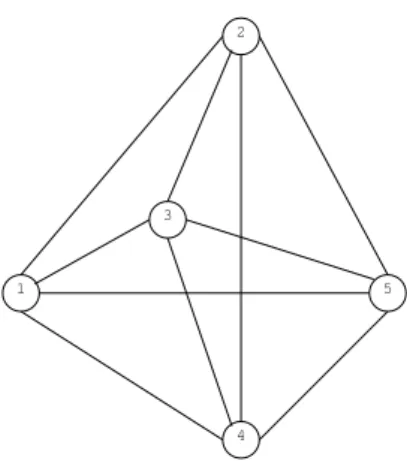
Example 4.2. Let E = {1, 2, 3, 4, 5} and (E, F ) be the convex shelling of the five points in the plane given in Figure 1. Define B = {{1, 2, 3}, {2, 4, 5}, {2, 3, 4}, {2, 3, 5}}. Then
(E, F; B) satisfies the conditions of the cg-matroid with a family B of bases. But this
is not a strict cg-matroid. For, I1 = {1} and I2 = {4, 5} are, respectively, subsets of
B1 = {1, 2, 3} and B2 = {2, 4, 5}, so that they are independent sets, i.e., I1, I2 ∈ I.
Since |I1| < |I2| and τ (I1 ∪ I2) \ I1 = {4, 5}, it follows from (IsA) that {1, 4} or {1, 5}
should be an independent set. But neither {1, 4} nor {1, 5} is included in any member of
B. Hence the present cg-matroid does not satisfy (IsA).
2
5
4 3 1
Figure 1: An example of five points in the plane.
First, we show the following characterization.
Theorem 4.4 (Local Augmentation Property). Let (E, F ) be a convex geometry.
Sup-pose that I ⊆ F satisfies (I0) and (I1). Then the strict augmentation property (IsA) is equivalent to the following property.
(ILA) (Local Augmentation Property)
For any I1, I2 ∈ I with |I1| + 1 = |I2|,
there exists e ∈ τ (I1∪ I2) \ I1such that I1∪ {e} ∈ I.
Proof. The implication, (IsA) ⇒ (ILA), is trivial. We show the converse, (ILA) ⇒ (IsA).
Consider I1, I2 ∈ I with |I1| < |I2|. Then there exists I ∈ F such that I ⊆ I2 and
|I| = |I1|+1. From (I1), we have I ∈ I. Hence, from (ILA), there exists e ∈ τ (I1∪I)\I1
such that I1∪ {e} ∈ I. Since I ⊆ I2, we have τ (I1∪ I) \ I1 ⊆ τ (I1∪ I2) \ I1, and hence
e ∈ τ (I1∪ I2) \ I1. We thus have (IsA).
Next, we give another characterization of the strict cg-matroids, which reveals the exact relationship between the concept of a strict cg-matroid and that of a supermatroid introduced by Dunstan, Ingleton, and Welsh [6].
Lemma 4.5. Let (E, F ; I) be a strict cg-matroid with a family I of independent sets.
Then I satisfies the following property.
(IS) For each X ∈ F , all the maximal elements of I(X) ≡ {X ∩ I | I ∈ I} have the
same cardinality (as subsets of E).
Proof. Take any X ∈ F . Suppose that X ∩ I1 and X ∩ I2 (I1, I2 ∈ I) are maximal in
I(X)and that |X ∩ I
1| < |X ∩ I2|. Since X ∩ Ii ∈ F and X ∩ Ii ⊆ Ii (i = 1, 2), we have
such that I0 ≡ (X ∩ I1) ∪ {e} ∈ I, which contradicts the maximality of X ∩ I1 in
I(X), since e ∈ X \ I
1. (Here note that τ ((X ∩ I1) ∪ (X ∩ I2)) ⊆ τ (X) = X and
X ∩ I1 ( (X ∩ I1) ∪ {e} = X ∩ ((X ∩ I1) ∪ {e}) = X ∩ I0 ∈ I.)
Conversely, we have the following.
Lemma 4.6. Let (E, F ) be a convex geometry. Suppose that I ⊆ F satisfies (I0), (I1),
and (IS). Then, I also satisfies (IsA), and hence (E, F ; I) is a strict cg-matroid.
Proof. Suppose that I1, I2 ∈ I and |I1| < |I2|. Consider X = τ (I1∪ I2) in (IS). Then,
Ii = τ (I1 ∪ I2) ∩ Ii ∈ I(τ (I1∪I2)) (i = 1, 2). From the assumption that |I1| < |I2|, we
see that I1 is not maximal in I(τ (I1∪I2)). Hence, there exists e ∈ τ (I1∪ I2) \ I1 such that
I1∪ {e} ∈ I(τ (I1∪I2)) ⊆ I, where the last inclusion follows from (I1).
Axioms (I0), (I1), and (IS) are exactly those for what is called a supermatroid [6] when restricted on the lattices of closed sets of convex geometries. Hence the above two lemmas establish the following.
Theorem 4.7. The concept of a strict cg-matroid is equivalent to that of a supermatroid
on the lattice of closed sets of a convex geometry.
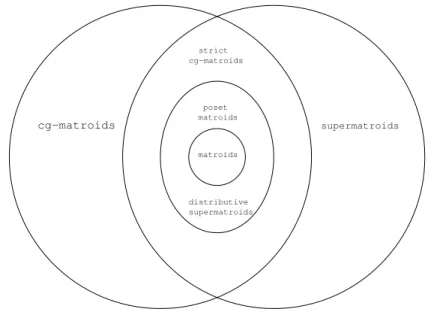
matroids poset matroids distributive supermatroids strict cg-matroids cg-matroids supermatroids
Figure 2: Generalizations of matroids.
Recall that for a convex geometry (E, F ), if F is closed with respect to the set union, then it is distributive and is represented as the set of ideals of a poset. Also note that the class of distributive cg-matroids (or poset matroids) is strictly included in the class of strict cg-matroids.
4.2.
Rank functions
Now we define rank functions of strict cg-matroids. Since strict cg-matroids are super-matroids, some of the following results on rank functions are subsumed by those in [6].
We denote the set of nonnegative integers by Z+.
Definition 4.8 (Rank function of a strict matroid). Let (E, F ; I) be a strict cg-matroid with a family I of independent sets. Define a function ρ : 2E → Z+as
ρ(X) = max{|I| | I ∈ I, I ⊆ X} (X ∈ 2E). (4.1)
We call the function ρ the rank function of the strict cg-matroid (E, F ; I). We call ρ(X) the rank of X.
We examine some properties of the rank function ρ : F → Z+such as submodularity,
which is a fundamental and crucial property of rank functions of ordinary matroids (see for more details [8, 13, 20]).
We first show a useful property of strict cg-matroids.
Theorem 4.9. A strict cg-matroid (E, F ; I) with a family I of independent sets satisfies
the following property.
(IE) (Extension Property)
For any X ∈ F and I ∈ I with I ⊆ X,
there exists I+ ∈ I such that I ⊆ I+ ⊆ X and ρ(I+) = ρ(X).
Proof. Suppose that |I| < ρ(X) and ρ(X) = |IX| for an IX ∈ I with IX ⊆ X. Since
I, IX ⊆ X and X ∈ F, we have τ (I ∪ IX) ⊆ X. Hence, applying (IsA) |IX \ I| times,
we get a desired independent set I+.
Then we consider the following “local” properties. (RL0) ρ(∅) = 0.
(RL1) X ∈ F , e ∈ ex∗(X) =⇒ ρ(X) ≤ ρ(X ∪ {e}) ≤ ρ(X) + 1. (RLS) (Local Submodularity)
For any X ∈ F and e1, e2 ∈ ex∗(X) such that X ∪ {e1, e2} ∈ F,
if ρ(X) = ρ(X ∪ {e1}) = ρ(X ∪ {e2}), then ρ(X) = ρ(X ∪ {e1, e2}).
Theorem 4.10. The rank function ρ : F → Z+of a strict cg-matroid (E, F ; I) satisfies
Proof. (RL0) follows from (I0).
Next we show (RL1). Suppose that ρ(X) = |I| for an I ∈ I. Since I ⊆ X ∪ {e}, we have ρ(X) ≤ ρ(X ∪ {e}). Also suppose that ρ(X ∪ {e}) = |I0| for an I0 ∈ I. If ρ(X ∪ {e}) > ρ(X) + 1(= |I| + 1), then we have e ∈ I0 (otherwise I0 ⊆ X and
|I0| > |I|, which contradicts the definition of ρ(X)). Now, e ∈ ex∗(X) implies e ∈
ex(X ∪ {e}). It follows from (ex2) that ex(X ∪ {e}) ∩ I0 ⊆ ex(I0), and hence e ∈ ex(I0).
This implies I00 ≡ I0 \ {e} ∈ I and I00 ⊆ X, which contradicts the assumption that
ρ(X) < ρ(X ∪ {e}) − 1. We thus have property (RL1).
Finally, we show (RLS). Suppose that ρ(X) = ρ(X ∪ {e1}) = ρ(X ∪ {e2}). Then,
from (RL1), we have ρ(X) ≤ ρ(X ∪ {e1, e2}) ≤ ρ(X) + 1. Suppose to the contrary
that ρ(X ∪ {e1, e2}) = ρ(X) + 1. Then there exist I, I0 ∈ I such that (1) I ⊆ X and
ρ(X) = |I| and (2) I0 ⊆ X ∪ {e
1, e2} and ρ(X ∪ {e1, e2}) = |I0|(= |I| + 1). Since
|I0| > |I|, from (IsA) there exists ˆe ∈ τ (I0 ∪ I) \ I such that I00 ≡ I ∪ {ˆe} ∈ I. Here,
since τ (I0 ∪ I) ⊆ X ∪ {e1, e2}, we must have ˆe ∈ X or ˆe = e1 or ˆe = e2, which leads
us to I00 ⊆ X or I00 ⊆ X ∪ {e1} or I00 ⊆ X ∪ {e2}. This contradicts the assumption on
ρ(X) or ρ(X ∪ {e1}) or ρ(X ∪ {e2}). We thus have shown (RLS).
For any function ρ : F → Z+that satisfies (RL0), (RL1), and (RLS), let us define
I(ρ) = {X ∈ F | ρ(X) = |X|}. (4.2) We may expect that I(ρ) would give a strict cg-matroid. But, unfortunately, this is not true as seen from the following example.
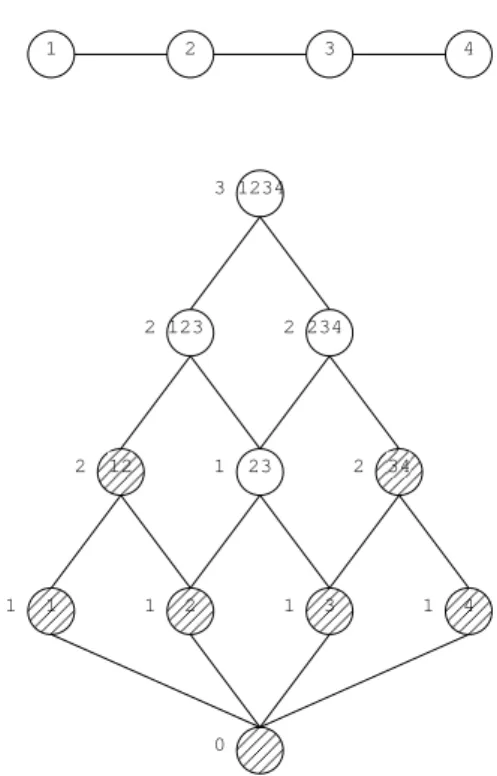
Example 4.11. Let E = {1, 2, 3, 4}. Consider a tree with a vertex set E and an edge set
{{1, 2}, {2, 3}, {3, 4}} that forms a path of length three. See Figure 3. Let (E, F) be the
tree shelling of the tree, i.e., F = {∅, {1}, {2}, {3}, {4}, {1, 2}, {2, 3}, {3, 4}, {1, 2, 3},
{2, 3, 4}, {1, 2, 3, 4}}. Define a function ρ : F → Z+ as follows: ρ(∅) = 0, ρ({1}) =
ρ({2}) = ρ({3}) = ρ({4}) = ρ({2, 3}) = 1, ρ({1, 2}) = ρ({3, 4}) = ρ({1, 2, 3}) = ρ({2, 3, 4}) = 2, ρ({1, 2, 3, 4}) = 3. Then the function ρ : F → Z+ satisfies (RL0),
(RL1), and (RLS), and we have I(ρ) = {∅, {1}, {2}, {3}, {4}, {1, 2}, {3, 4}}. But the obtained I(ρ) is not a strict cg-matroid.
Next, we consider some “global” properties. (RG0) 0 ≤ ρ(X) ≤ |X| for any X ∈ F . (RG1) X, Y ∈ F , X ⊆ Y =⇒ ρ(X) ≤ ρ(Y ). (RGS) (Global Submodularity)
For any X, Y ∈ F such that X ∪ Y ∈ F ,
1234 123 234 12 23 34 1 2 3 4 1 3 4 1 1 1 1 0 2 1 2 2 2 3 2
Figure 3: A path of length three and its tree shelling.
Theorem 4.12. The rank function ρ : F → Z+ of a strict cg-matroid (E, F ; I) satisfies
properties (RG0), (RG1), and (RGS).
Proof. We can easily see that the definition of rank function ρ implies (RG0) and (RG1).
We show (RGS). Consider any X, Y ∈ F such that X ∪ Y ∈ F . Then X ∩ Y ∈ F , and there exists I ∈ I such that ρ(X ∩ Y ) = |I| and I ⊆ X ∩ Y . The extension property (IE) implies the following (1) and (2).
(1) There exists J1 ⊆ X \ I such that I ∪ J1 ∈ I, ρ(X) = |I ∪ J1| and I ∪ J1 ⊆ X.
(2) There exists J2 ⊆ E \ X such that I ∪ J1∪ J2 ∈ I, ρ(X ∪ Y ) = |I ∪ J1 ∪ J2|,
and I ∪ J1∪ J2 ⊆ X ∪ Y .
Then, from (I1) and the definition of ρ(X), we have J2 ⊆ Y \ X. Therefore, we get
ρ(X ∪ Y ) − ρ(X) + ρ(X ∩ Y ) = |I| + |J1| + |J2| − (|I| + |J1|) + |I| = |I| + |J2|.
Next, consider ρ(Y ). Since τ (I ∪ J2) ⊆ Y and τ (I ∪ J2) ⊆ I ∪ J1 ∪ J2 ∈ I, from
(I1) we get τ (I ∪ J2) ∈ I. We thus have ρ(Y ) ≥ |τ (I ∪ J2)| ≥ |I ∪ J2| = |I| + |J2|.
Hence, we have ρ(X ∪Y )−ρ(X)+ρ(X ∩Y ) = |I|+|J2| ≤ ρ(Y ), i.e., ρ(X)+ρ(Y ) ≥
ρ(X ∩ Y ) + ρ(X ∪ Y ).
Again the above-mentioned three properties do not completely characterize rank func-tions of strict cg-matroids. In fact, consider Example 4.11 again. The function ρ : F →
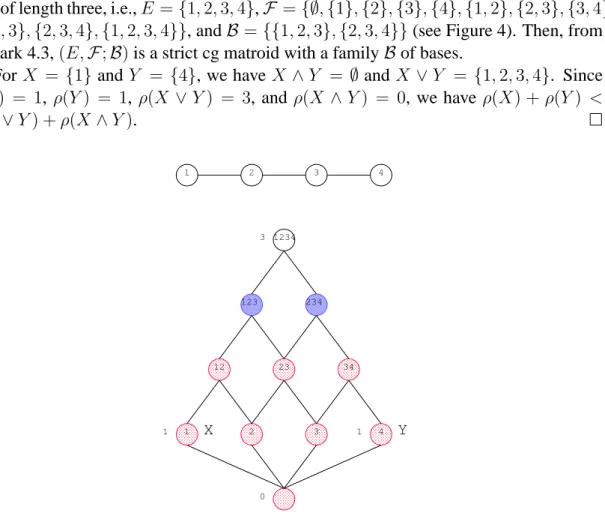
Example 4.13. Let (E, F ; B) be a unirorm cg-matroid of rank 3 on the tree shelling of a path of length three, i.e., E = {1, 2, 3, 4}, F = {∅, {1}, {2}, {3}, {4}, {1, 2}, {2, 3}, {3, 4},
{1, 2, 3}, {2, 3, 4}, {1, 2, 3, 4}}, and B = {{1, 2, 3}, {2, 3, 4}} (see Figure 4). Then, from
Remark 4.3, (E, F ; B) is a strict cg matroid with a family B of bases.
For X = {1} and Y = {4}, we have X ∧ Y = ∅ and X ∨ Y = {1, 2, 3, 4}. Since
ρ(X) = 1, ρ(Y ) = 1, ρ(X ∨ Y ) = 3, and ρ(X ∧ Y ) = 0, we have ρ(X) + ρ(Y ) < ρ(X ∨ Y ) + ρ(X ∧ Y ). 1234 123 234 23 34 1 2 3 4 1 2 3 4 X Y 3 1 1 0 12
Figure 4: A strict cg-matroid that does not satisfy the submodularity on the lattice.
Remark 4.14. It follows from Example 4.13 that the rank function ρ of a strict cg-matroid
(E, F; I) does not always satisfy the submodularity on the lattice F:
• ρ(X) + ρ(Y ) ≥ ρ(X ∨ Y ) + ρ(X ∧ Y ) for any X, Y ∈ F,
where X ∨ Y = τ (X ∪ Y ) and X ∧ Y = X ∩ Y . Hence strict cg-matroids are not submodular supermatroids which are defined in [12].
5.
Concluding Remarks
We have introduced the concept of a cg-matroid, a matroidal structure defined on a con-vex geometry, and have shown characterizations of cg-matroids by means of an exchange
property for bases and an augmentation property of independent sets. We have also de-fined a strict cg-matroid, which turns out to be a cg-matroid that is at the same time a supermatroid on the lattice of closed sets of the undelying convex geometry, and exam-ined the submodularity property of the rank function of a strict cg-matroid.
The problem of linear and nonlinear optimization over cg-matroids is left for future work. Also we should examine how polyhedral characterizations of (a special class of) cg-matroids would be possible.
Finally, we give some remarks on dual exchange properties for cg-matroids. The fam-ily of bases of an ordinary matroid (E, B) satisfies the following dual exchange property. (BE*) (Dual Exchange Property for ordinary matroids)
For any B1, B2 ∈ B and e2 ∈ B2\ B1,
there exists e1 ∈ B1\ B2 such that (B1∪ {e2}) \ {e1} ∈ B.
We can show the following for cg-matroids (we omit its proof). (Dual Exchange Property) Any cg-matroid (E, F ; B) satisfies
(BE*1) For any B1, B2 ∈ B and any e2 ∈ ex∗(B1) ∩ B2,
there exists e1 ∈ ex(B1) \ B2such that B1∪ {e2} \ {e1} ∈ B.
(BE*2) For any B1, B2 ∈ B and any e2 ∈ ex∗(B1) ∩ τ (B1∪ B2),
there exists e1 ∈ (ex(B1) ∪ {e2}) \ B2such that (B1∪ {e2}) \ {e1} ∈ B.
(BE*3) For any B1, B2 ∈ B and any e2 ∈ ex+(B1) ∩ τ (B1 ∪ B2),
there exists e1 ∈ ex(B1) such that (B1∪ {e2}) \ {e1} ∈ B,
where the operator ex+: B → 2E is defined by
ex+(B) = {e | e ∈ E \ B, e ∈ B0 ⊆ B ∪ {e} for some B0 ∈ B}
for any base B ∈ B.
(BE*3)0 For any B1, B2 ∈ B with B1 6= B2,
we have ex+(B1) ∩ τ (B1∪ B2) 6= ∅.
Unfortunately the dual exchange properties given above do not characterize cg-matroids as seen from the following examples.
Example 5.1. Let (E, F ) be the convex shelling of nine points in the plane given in Figure 5. Define B = {{1, 2, 3}, {7, 8, 9}}. Then B satisfies conditions (BE*1) and (BE*2), but it is not a cg-matroid.
Example 5.2. Let (E, F ) be the convex shelling of eight points in the plane given in Fig-ure 6. Define B = {{1, 2, 3}, {1, 2, 4}, {5, 7, 8}, {6, 7, 8}}. Then B satisfies conditions (BE*3) and (BE*3)0, but it is not a cg-matroid.
1 2 3 4 5 6 7 8 9
Figure 5: An example of nine points in the plane. 1 3 5 7 2 4 6 8
Figure 6: An example of eight points in the plane.
Remark 5.3. A shortcoming of (BE*1) is that if ex∗(B1) ∩ B2 = ∅, then condition
(BE*1) is void, while that of (BE*2) is that there is a possibility of e1 = e2, which makes
condition (BE*2) trivial.
It is still open to characterize cg-matroids by means of a dual exchange property.
References
[1] M. A. Aizerman and A. M. Malishevski: General theory of best variants choice: some aspects, IEEE Transactions on Automatic Control 26 (1981) 1030–1040. [2] K. Ando: Extreme point characterization of closure spaces, S¯urikaisekikenky¯usho
K¯oky¯uroku 1371 (2004) 125–133.
[3] M. Barnabei, G. Nicoletti, and L. Pezzoli: Matroids on partially ordered sets,
Ad-vances in Applied Mathematics 21 (1998) 78–112.
[4] M. Barnabei, G. Nicoletti, and L. Pezzoli: The symmetric exchange property for poset matroids, Advances in Mathematics 102 (1993) 230–239.
[5] V. I. Danilov and G. A. Koshevoy: Mathematics of Plott choice functions,
[6] F. D. J. Dunstan, A. W. Ingleton, and D. J. A. Welsh: Supermatroids, Combinatorics (Proc. Conf. Combinatorial Math., Math. Inst., Oxford, 1972) (1972) 72–122. [7] P. H. Edelman and R. E. Jamison: The theory of convex geometries, Geometriae
Dedicata 19 (1985) 247–270.
[8] J. Edmonds: Submodular functions, matroids, and certain polyhedra. Proceedings of
the Calgary International Conference on Combinatorial Structures and Their Appli-cations (R. Guy, H. Hanani, N. Sauer and J. Sch¨onheim, eds., Gordon and Breach,
New York, 1970) 69–87.
[9] V. A. Emelichev and V. G. Ovchinnikov: Symmetric supermatroids (in Russian),
Doklady Akademii Nauk BSSR 27 (1983) 389–391.
[10] V. A. Emelichev and V. G. Ovchinnikov: On the theory of optimization on an-tichains having the Steinitz exchange property (in Russian), Otdelenie Matematiki,
Mekhaniki i Kibernetiki Akademii Nauk Ukrainsko˘ı SSR. Kibernetika (1985) No. 2
55–58.
[11] U. Faigle: Geometries on partially ordered sets, Journal of Combinatorial Theory,
Ser. B 28 (1980) 26–51.
[12] U. Faigle: On supermatroids with submodular rank function, Algebraic methods in
graph theory, Vol. I (Szeged, 1978), Colloq. Math. Soc. J´anos Bolyai 25
(North-Holland, Amsterdam, 1981) 149–158.
[13] S. Fujishige: Submodular Functions and Optimization, Second Edition, Annals of Discrete Mathematics 58 (Elsevier, Amsterdam, 2005).
[14] R. Hildenbrandt: Parametric properties of the transportation problem and relations to supermatroids, Optimization 39 (1997) 165–189.
[15] B. Korte, L. Lov´asz, and R. Schrader: Greedoids, Algorithms and Combinatorics 4 (Springer-Verlag, Berlin, 1991).
[16] G. A. Koshevoy: Choice functions and abstract convex geometries, Mathematical
Social Sciences 38 (1999) 35–44.
[17] M. M. Koval¨ev: The partial-order method (in Russian), Doklady Akademii Nauk
BSSR 24 (1980) 113–116.
[18] M. M. Koval¨ev: Maximization of convex functions on supermatroids (in Russian),
[19] M. M. Koval¨ev and P. Milanov: Monotone functions of multi-valued logic and su-permatroids (in Russian), Akademiya Nauk SSSR. Zhurnal Vychislitel’no˘ı
Matem-atiki i Matematichesko˘ı Fiziki 24 (1984) 786–790.
[20] L. Lov´asz: Submodular functions and convexity. In: Mathematical Programming—
The State of the Art (A. Bachem, M. Gr¨otschel and B. Korte, eds., Springer, Berlin,
1983) 235–257.
[21] H. Moulin: Choice functions over a finite set: a summary, Social Choice and Welfare 2 (1985) 147–160.
[22] J. Oxley: Matroid Theory (Oxford University Press, Oxford, 1992).
[23] U. N. Peled and M. K. Srinivasan: Poset matching—a distributive analog of inde-pendent matching, Discrete Mathematics 114 (1993) 403–424.
[24] J. L. Pfaltz: Closure lattices, Discrete Mathematics 154 (1996) 217–236.
[25] ´E. Tardos: An intersection theorem for supermatroids, Journal of Combinatorial
Theory. Series B 50 (1990) 150–159.
[26] D. J. A. Welsh: Matroid Theory (Academic Press, London, 1976).
[27] N. White (ed.): Theory of Matroids (Encyclopedia of Mathematics and Its Applica-tions 26, Cambridge University Press, Cambridge, 1986).
[28] N. White (ed.): Combinatorial Geometries (Encyclopedia of Mathematics and Its Applications 29, Cambridge University Press, Cambridge, 1987).
[29] H. Whitney: On the abstract properties of linear dependence, American Journal of