Society of Japan
Vo!. 34, No. 1, March 1991
ANALYSIS OF BATCH ARRIVAL CYCLIC SERVICE
MULTIQUEUE SYSTEMS WITH LIMITED SERVICE DISCIPLINE
Yutaka Babl
Yokohama National University
(Received October 6, 1989; Fim,l February 14, 1991)
Abstract In this paper, the batch arrival cyclic service multiqueue system is studied. For a compound Poisson arrival cyclic service multiqueue system, we derive useful equalities with respect to the weighted sum of the mean waiting times for E-limited and G-limited service disciplines. Using these equalities, the upper bound of the mean waiting time at each queue is derived j()r symmetric system. Further, for general batch arrival cyclic service multi queue system, an approximate formula with respect to the weighted sum of the mean waiting times is derived. For symmetric system, this approximate formula reduces to the approximate formula of the mean waiting time for exhaustive, gated, E-limited and G-limited service disciplines. In numerical results, these characteristic quantities are evaluated by comparing those to simulation results and other approximate resu\t,s.
1. Introduction
Cyclic service multiqueue systems are frequently used to model token ring and token bus local area networks. In the system under consideration, there are N queues with infinite waiting rooms served in cyclic order by a single server. Customers arrive at each queue according to general arrival process. Until now, four main service disciplines have been analyzed: exhaustive, gated, E-limited and G-limited service disciplines. They differ in the instants at which the server moves from one queue to another. "Exhaustive" means that the server continues to serve each queue until it is emptied. "Gated" means that the server serves only those customers present at the server's arrival epoch to that queue. "E-limited" means that the server serves until either kj customers have been served or the
queue becomes empty when the server visits queue i. "G-limited" means that if the server encounters nj customers upon arriving to queue i, the server serves min(nj, kj ) customers
before the server departs queue i. Note that when ki tends to infinity, E-limited service approaches exhaustive service, while G-limited service approaches gated service. Also note that E-limited service and G-limited service are identical if kj
=
1. The special case kj == 1is often called "nonexhaustive service". For a detajled discussion of these systems and other multiqueue systems, see Takagi [10], [11].
For a Poisson arrival cyclic service multiqueu€ system
(M/C/1
type multiqueue) with E-limited and G-limited service, Fuhrmann [6] derived an upper bound for a weighted sum of the mean waiting times at the various queues. Fuhrmann and Wang [7], and Everitt [4] derived approximate formulae of the mean waiting times at each queue. Further in Everitt [5] and Takagi [11], a pseudo-conservation law is derived. This pseudo-conservation law is represented by using the second moment for the number of customers served at each queue per visit of the server.This paper studies the batch arrival cyclic service multiqueue system. For a compound Poisson arrival cyclic service multiqueue system, we derive useful equalities with respect to
the weighted sum of the mean waiting times for E-limited and G-limited service disciplines.
By u~ing these equalities, the upper bound of the mean waiting time at each queue is derived
for symmetric system. Further, for general batch arrival cyclic service multiqueue system, an approximate formula with respect to the weighted sum of the mean waiting times is derived. For symmetric system, this approximate formula reduces to the approximate formula of the mean waiting time for exhaustive, gated, E-limited and G-limited service disciplines.
The organization of the rest of the paper is as follows. In section 2, we consider the compound Poisson arrival cyclic service multiqueue system and give the notation for this system. In section 3, we extend a stochastic decomposition theorem by Boxma and Groe-nendijk [1] to the system described in section 2. By using the pseudo-conservation law which holds for the system in section 2, we obtain useful equalities with respect to the weighted sum of the mean waiting times for E-limited and G-limited service disciplines. Further, for symmetric system, we obtain the upper bound of the waiting time at each queue. In section 4, for general batch arrival cyclic service multiqueue system, the approximate formula with respect to the weighted sum of the mean waiting times is derived. Further, for symmetric system, the approximate formula of the mean waiting time is derived for exhaustive, gated, E-limited and G-limited service disciplines. In section 5, for symmetric system, the upper bound of the mean waiting time for compound Poisson arrival system and the approximate formula of the mean waiting for general batch arrival system obtained in section 3 and 4, respectively, are evaluated by comparing those to simulation results and the approximate results by Yanagiya and Takahashi [14].
2. Model description
The multi queue model considered in section 2 and 3 can be characterized by the following assumptions.
(1) The server walks around among N queues. Assuming that the server arrives at queue i, the server serves customers depending on the service discipline at queue i (exhaustive service, gated service, E-limited service or G-limited service) and then moves on to the subsequent queue i+ 1, 1 :~ i ~ N (when the server is in the queue N, it moves on to queue 1).
(2) At queue i, customers arrive in batch according to independent Poisson processes with rate Ai (1 ~ i ~ N). Batch sizes (the number of customers in the arriving batches) are i.i.d. random variables with mean gi, a finite second moment g;2) and probability generating
function (pgf)
Gi(z).
(3) At each queue, customers are served nonpreemptively in an order that does not depend on their service times. The service times for customers arriving at queue i are i.i.d. random variables with a distribution
Bl)'
meanf3i
and a finite second moment f3F).(4) The walking times from queue i to queue i + 1 are i.i.d. random variables with mean s, and a second moment s~2), We further define Pi = ).,gif3i as the server utilization at queue
i, P = E~l Pi as the total server utilization, and sand S(2) as mean and the second moment of the total walking time during a cycle of the server, respectively. Based on Kuhen's terminology [9], this is referred to as
M
XIG/1
type multiqueue.For future reference, we define the cycle time Gi for queue i as the time between two successive arrivals of the server at queue i. It is well known that E( Gi) is independent of i and is also independent of the particular service discipline as long as all the queues are
stable. If we denote this common value by E(C). we have
E(C) =
---':~-.
1 _. p (1)
Now some remarks about the conditions for ergodicity of these cyclic service multiqueue systems are in order. Clearly p
<
1 is a necessary condition. For exhaustive and gated service, this condition is also sufficient. For E-limited and G-limited service, it can be seen thatAj9jS 1
--<~:i
1-p
is an additional necessary condition for the stability of queue i (1 ::; i ::;
N).
3. An extension of a pseudo-conservation law
(2)
In this section, we first consider the cyclic service multiqueue system whose walking times are taken to be zero. For this system, a conservation law holds for the total amount of work in the system since the server works whenever there is work in the system and is idle when there is no work in the system. Total amount of work in cyclic service multiqueue system does not depend on the order of service, and should hence equal the amount of work in an MX
/0/1
queue with batch arrival rate A := L~1 Ai and the distribution of sum of service time in an arriving batchN
A
BG (-) =
L
~O,(Bi('))' i=1(3)
This system is denoted as the "corresponding"
M
X/0/1
queue and the amount of work in this system is denoted by VM X/G/l' If we call ,'l,n arriving batch in the "corresponding" MX /G/1 queue a snpercustomer, then VMx /G/l is the waiting time of the first customer of an arbitrary supercustomer, since Poisson arrivals see time averages (PASTA) (see Wolff [13]). If we denote B to be the random variable with distribution BGU, then by using well known results of MX/0/1
queue (see, e.g. Cooper [3] or Kleinrock [8]) and (3), we haveE(V ) _ AE(B2) _ ~ Aj9,/S'P)
+
~ Ai{gr 2) - g;}(3;
MX/G/I - - ~ - - - - ~
2(1 -
p)
i=1 2(1 --p)
i=1 2(1 -p)
.
(4)
By treating an arriving batch in the "corresponding" MX
/0/1
queue as a supercustomer, we have the next Theorem which is evident from Boxma and Groenendijk [1], [2].Theorem 1. Consider a single server cyclic service multiqueue system described in section 2. Assume that the system is ergodic and stationary. Then the amount of work in this system at an arbitrary epoch, Vc, is distributed as the sum of the amount of work in the "corresponding" MX /G/1 system at an arbitrary epoch, VMX/G/l, and the amount of work, Y in the cyclic serV1:ce system at an arbitrary epoch in a walking time. In other words,
(5)
where
g
stands for equality in distribution. Moreover VMx /G/I and Y are chosen to beindependent. 0
Next we explain a pseudo-conservation law for a cyclic service multiqueue system de-scribed in section 2in the case of exhaustive and gated service disciplines, which is derived
in [2]. Further we derive related results for two limited service disciplines (E-limited and G-limited) .
From Theorem 1, we have
(6) Let Wi denote the waiting time of an arbitrary customer at queue i and U, the amount of work the server leaves behind at queue i when the server departs from queue i. Then from [1],
N S(2) s N
E(Y) =
~
E(U,)+
PT;+
2(1-
p) (p2 -~p:).
(7)
If we let Xi to be the number of type i customers waiting at an arbitrary epoch, then we haveN N !f.2)
=
"L E (Xi)f3i+
"LPi~
i=l i=l
13.
N N f3~2)
=
~PiE(Wi)
+
EPi 2f3i'By using (4), (6), (7) and (8), we have
N N
"L
PiE(W;) = A+
"L
E(Ui), i=l i=l where ",N A' .(3(2) ",NA.{
(2) . }f32 (2) A=
p L...i=l .g. i+
L...i=l • gi - g. i+
P--
s 2(1-p) 2(1-p) 2s N+
2(1~P)(p2-Epn.
For exhaustive and gated services, the following formulae have been derived in [1]. For exhaustive service at queue i,
E(Ui ) = 0 and for gated service at queue i,
2
E(Ui)
=
p2E(C)=~.
, 1-P
For E-limited and G-limited service disciplines, the following useful equalities hold.
Theorem 2. Consider a cyclic service multi queue system.
(A)
Suppose that queue i is served by E-limited service discipline with limit k;. ThenA { ( 2 ) } 2
E(Ui) = Pi igi8 E(Wi)
+
Pi gi - gi s+
Pi s ki(l - p) 2kigi(1 - p) ki(l - p)(1- Pi)f3icp;2) 2ki
(B)
Suppose that queue i is served by G-limited service discipline with limit ki • Then (8) (9)(10)
(11)(12)
(13){ (2) } 2 ( ) (2) E(U;)
=
PiAigis E(Wi)+
Pi gi - gi S+
~
_
1+
Pi (3i<Pi ,ki(l - p) 2kigi(1 -- p) 1 - P 2ki
(14)
where <p~2) is the second factorial moment for the number of customers served at queue i per visit of the server.
Proof: Proof of (A). Let Li denote the number of customers present at queue i when the server arrives, Mi the number of customers present at queue i just after an arbitrary customer departs from queue i and Ni the number of customers served per visiting queue 1 by
the server. Note that E(Ni) = AigiE(C). On the average E(Ni) customers are served during the visit of the server, and another PiE(Ni) customers arrive while the server is present. Therefore, when the server departs from queue i, there are on average E(Li) - (1-pi)E( Ni)
customers remaining. This gives the mean unfinished work as
E(Ui) = {E(Li) - (1 --Pi)E(Ni)}(3i.
(15)
Define Rij(Z) to be the pgf of the queue lengtfl of queue i at the end of the jth service attempt in a cycle. If the LST of the service time distribution at queue i is defined by B;(
s),
then the pgf at the end of the(j
+
l)th service oLttempt is calculated from the recurrence formula whose technique is derived in vacation and polling model analysis (e.g., see [5], [10] and [11])R,,)+l(Z) = [Ri)(Z) - Ri)(O)]
B;(\ -
\Gi(z))+
Rij{O).Z
(16)
If we define Pin to be the probability that n customers are served at queue i, we have
)
Rij(O) =
L:
Pin·(17)
n=O
Then solving recursively for Rij(Z) starting from RiO(Z) = 1/Ji(Z), where 1/Ji(Z) is the pgf of Li , we have
(18)
Differentiating and setting Z = 1, we have the mean queue length at the end of the jth
service attempt in a cycle as
)-1 )-1
R:)(I)
=
E(Li) - (1 - p,)[L: npin+
j(l -L:
Pin)]. (19)n=O n=O
After tedious calculations, we have
E(M) =
2:;::1
R:)(I) = k.E(L.) ___ k (1 _ )+
(1 - p.)<p;2) • E(N.) E(Nt) t Pt 2E(Nt)(20)
Also note that
gF) - gi E(Mi) = Aigi{E(Wi)
+
(3;}
+
.
Equation (21) follows from Little's theorem and the interpretation that the second term of the right-hand side of equation (21) is the mean number of customers that. had arrived together with the tagged customer in one batch but that were behind the tagged customer. From equations (15), (20) and (21), the equality (13) holds.
Proof of (B). Let Li, Mi and Ni be defined as in (A). Also let M;* and Rij(z) be defined analogously, but to include only those customers already present when the server arrives to queue L Similarly to (A), we have
R~ (z) - R* (0)
Ri,j+l(Z) = 'J z 'J
+
Ri)(O). (22)If we define gin to be the probability that n customers are present at queue i when the server arrives, we have
)
Rij(O) =
L
gin'n=O
Then solving recursively for Ri)(z), we have
./, ( ) ,,)-1 n )-1
R*( ) = 'f'i Z - L..m=O ginZ
+ '"' .
.) Z zj L.. gm'
n=O
Differentiating and setting z = 1, it follows that
j-l j-l
R::(1) = E(Li) -
L
ngin - j(l -L
gin)'n=O n=O
Also we have
E(M*) =
L;~1
R:;(1) = k.E(L.) _ k+
<p~2)
•• E(N.) E(N.) • 2E(Ni)
(23)
(24)
(25)
(26)
Next let Y; denote the number of customers who arrive after the server arrives but before the tagged customer is served and Zi the number of customers who arrive while the tagged customer is served. Then we haveE(Z;) = Pi.
(27)
Let li) denote the probability that an arbitrary chosen customer is the jth customer served after the server arrives to queue i. Then it is clear that
Thus we have P(Ni ~
j)
li) = E(N,) (j = 1, ... , ki ), ki E(Y;) PiL(j -
l)li) j=1 = PiI:
(j - l)P(Nj~
j)
j=1 E(Ni) (2) <Pi(28)
(29)
Since E(Mi) = E(Mt)
+
E(Y;)+
E(Zi), we haveE(M) = kiE(Li) _ k
+
~~1
+
Pi)<p~2)
+ .
, E(Ni) , 2E(Ni) p,.
(:30)
From (15), (21) and (30), we finally get the equality (14). 0 Remark 1. For
M IG/1
type multiqueue, the conservation laws for E-limited and G-limited disciplines are obtained in Everitt [5] and Takagi [11]. The equalities (13) and (14) are an extension of the conservation law to the batch arrival case.Corollary 3.
(A)
Suppose that queue 1,2, ... , N are served by E-limited service discipline with limit k1' k2"'" kN! respectively. Then N )..9SL:
Pi{1- ~(; ~ ) }E(Wi) ,=1 " P N {(2) } N 2<
A+
L:
Pi 9i - 9i S+
L:
Pi 8 i=1 2ki9i(1 -p)
i=l ki(l -p)
(:U)
t
(1 - p,)(3i max{o,
()..i9i8) 2 _ )..i9i 8 } .• =1 2ki 1 - P 1 - P
(B)
Suppose that queue 1,2, ... , N are served by G-limited service discipline with limit k1' k2"'" kN, respectively. Then~
L..Pi { 1- - - - -\9i8 } E ( Wi )i=1 ki(l -
p)
N {(2) } N 2
<
A+
L:
Pi 9i - 9i 8+
L:
~ i=l 2ki9i(1 -p)
i=l 1 - P(:J2)
t
(1+
p,)(3i max{o,
()"i9i 8)2 _
Ai9i 8 }.i=1 2k, 1 - P 1 - P
Proof: Since <p~2) == E[Ni(N. - 1)] ~ {E(Ni)P - E(Ni), we have
(2) { ( )..;9i8 ') 2 )..i9i 8 } <Pi ~ max 0, - - - .
1-p. 1-p (:J3)
The equality (31) is obtained from (9), (13) and (33). Similarly, the inequality (32) is
ob-tained from (9), (14) and (33). 0
Remark 2. If the cyclic service multiqueue system is symmetric (i.e., the defining parame-ters are same at each queue), then an upper bound of the mean waiting time of an arbitrary customer at each queue is got via Corollary 3.
4. An approximate formula for general batch arrival system
In this section, we propose an approximate formula of the weighted sum of waiting times for general batch arrival cyclic service multiqueue system by extending the results obtained in section 3.
Suppose that customers arrive in batch to queue i. Interarrival times of batches to queue i are i.i.d. random variables with mean
)..i
1 and a coefficient of variationCA.' Other
param-eters are same as the
M
XIG/1
type multiqueue described in section 2. Based on Kuehn's terminology [9], the model in this section is referred to asG/x IG/1
type multiqueue.Similarly to the discussion in section 3, we consider the cyclic service multiqueue system whose walking times are taken to be zero. Further we define a new queueing system called as
~ x ~
"corresponding" Cl jCj1 system. The arrival process of this system is the superposition of N arrival processes in cyclic service multiqueue system. The service time distribution of type-i customer is Bi (·).
~ X ~
Let VdJx /C/1 denote the amount of work in the "corresponding" Cl jCj1 system at an arbitrary epoch. Recently Takahashi [12] proposed an approximate formula for E(VdJ x /0/1) by using diffusion approximation with elementary return boundary. According to [12],
N {(2) }(3 N A (3(2)
L
Pi 9i - 9i i+
L
i9i ii=l 29i i=l 2
(34)
P N 9(2) _ 92
+
2(1 _ )L
Pi(3i{9iC~.
+
c~.
+' . '},
P
,=1 ~where Cs. is the coefficient of variation of the service time of type-i customer, and is given by cs. =
J
{(3?) - (3n j (3t.... x ... x
-By assuming that Theorem 1 holds for Cl jCj1 system and E(Y) in Cl jCjl system is approximately equal to E(Y) in MX jCj1 type multiqueue system, we finally propose the
following approximate formula for the weighted sum of the waiting times.
N N {(2)}(3 N (2) 2
' " PiE(Wi) ;:::: '" p, 9, - 9, ,
+
P ' " .(3.{ . 2+
2+ f!.i.- -
9i} (35)L... L... 2 2(1- ) L...P. • 9.cA. cs.
i=l ,=1 9. P .=1 9i
S12) S N N
+
P~:-;
+
2(1-p) (p2 -
~pn
+
~
E(Ui ).Remark 3. For exhaustive and gated service disciplines, E(U;) is explicitly given by (11) and (12), respectively. For E-limited and G-limited service disciplines, E(Ui) is approx-imated by the right-hand side of (13) and (14), respectively. Furthermore, by using the right-hand sides of (31) and (32), the weighted sum of the mean waiting times for E-limited and G-limited services. That is, for E-limited service,
~
{ Ai9i S } )L... Pi 1 - k (1 ,- E(Wi
i=l i - P)
and for G-limited service,
N ).;9iS
~P;{l-
k i(l- pj}E(Wi ) N {(2) }(3 ' " Pi 9i - 9i i ;:::: L... i=l 29i P N g<2) _ 92+
2(1 _ )L
Pi(3;{9iC~.
+
c~.
+ · . '}
P ,=1 9, S(2) S N+
Pz;-
+
2(1 _ )(p2 -
L>;)
P .=1 N {9(2) _ 9.}S N p2s+
LPi'
·
+
L
----'-:'--:'----,-i=l 2ki9i(1 -
p)
i=l ki{1- p)
t
(1 - Pi)(3i max{o,
(Ai9i S ) 2 _ Ai9;S} ,;=1 2ki 1 - P 1 -- P N {(2) }(3 ' " Pi 9i - 9i i ;:::: L... i=l 29i (36)
(37)
N (2) 2 P .~
{ 2
2
g. - g.+
2(1- ) ,~pd3. g,CA;+
cs;+
. }
P .=1 g. 8(2) 8 N+
P -+ ____
(p2 -L
pn 28 2(1 -p)
.=1 N {g(2) _ g'}8 N p28+
LP.'
· +L-·-·
,=1 2ki9i(1 -p)
i=l 1 - Pf.
(1+
P.)!3.
max {O,(>...g'S)2 _
>".9i
S} .
• =1 2k, 1 - P 1 - p
For symmetric multiqueue system, an approximate formula of the mean waiting time at each queue is obtained via (36) for E-limited service and (37) for G-limited service, respectively.
Also note that when the input process at ea,ch queue is compound Poisson, that is,
c~; = 1, the right-hand sides of (36) and (37) correspond to the right-hand sides of (31) and (32), respectively.
5. Numerical results
In this section, for symmetric multiqueues with G-limited service discipline, the upper bound of the mean waiting time derived in section 3 and the proposed approximate for-mula of the mean waiting time derived in section 4 are numerically validated by comparing those to simulations and an approximate formula. by Yanagiya and Takahashi [14] (Y-T). Throughout this section, it is assumed that the number of queues,
N,
is equal to 10(N =10),
the mean service time at queue i,!3i,
is equal to 1.0(!3i
=
1.0) and the arrival batch size to queue i is constant and its mean is 4 (9;=
4,9i
2)=
16). The walking time from queue i to queue i+
1 is constant and is equal to 0.1, that is Si=
0.1, S=
1, s(2)=
1. Further, the simulation results represent 95% confidence intervals.In Table 1 and 2, we show the upper bounds of the mean waiting times for MX /M/l
type multiqueue and M x /
E4/1
type multiqueue. It is found from Table 1 and 2 that our upper bounds are very tight and can be used as an approximate formula of the mean waiting time, especially when the limit,k.,
is large. Also note that the upper bounds are exact for the case k.=
1 or k,=
00.Table 1. Mean waiting time in the M x/M /1 type multiqueue system
p = 0.4 p
=
0.6k.
Baba Y-T Simulationk
•
Baba Y-T Simulation1 7.00 6.71 6.87±0.25 1 12.15 11.6 11.9±0.4 2 5.47 5.16 4.93±0.22 2 9.14 8.45 8.33±0.29 3 4.98 4.86 4.46±0.16 3 8.24 7.84 7.45±0.26 5 4.59 4.82 4.02±O.14 5 7.55 7.72 6.68±O.23 10 4.31 4.80 3.99±0.15 10 7.06 7.69 6.57±0.24 00 4.28 00 6.95
p = 0.8
ki Baba Y-T Simulation
1 36.17 33.7 35.1±2.6 2 22.44 19.8 20.3±1.2 3 19.27 17.2 17.1±0.9 5 17.07 16.2 14.9±0.8 10 15.57 16.1 14.0±0.6 00 14.95
Table 2. Mean waiting time in the
M
X/
E4/1
type multiqueue systemp = 0.4 p = 0.6
ki Baba Y-T Simulation k
•
Baba Y-T Simulation1 6.73 6.42 6.67±0.17 1 11.49 11.2 l1.0±0.3 2 5.21 4.87 4.71±0.11 2 8.53 8.08 7.60±0.28 3 4.72 4.57 4.22±0.09 3 7.65 7.48 6.71±0.28 5 4.34 4.52 3.77±0.09 5 6.97 7.36 5.96±0.23 10 4.06 4.51 3.74±0.O8 10 6.49 7.34 5.85±0.23 00 4.03 00 6.38 P = 0.8
ki Baba Y-T Simulation 1 33.67 32.9 31.5 ±2.2 2 20.56 19.2 18.1±1.1 3 17.54 16.7 15.3±1.1 5 15.44 15.7 13.3±1.0 10 14.01 15.7 12.6±0.9 00 13.45
In Table 3 and Table 4, we show the proposed approximate formula of the mean wait-ing times for
Ef / E4/1
type multiqueue andHf / H2/1
(c~.=
c}.
=
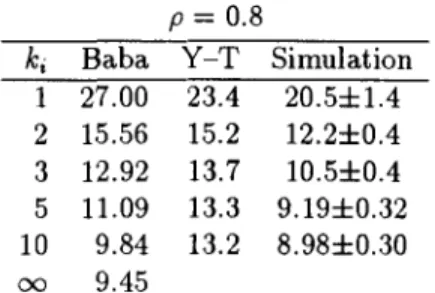
1.5 with symmetry condition) type multiqueue, respectively. It is found from Table 3 that the accuracy of our approximation is better than that of [14], when the total server utilization, p, is large and the limit, ki' is large. But the accuracy of our approximation is worse than that of [14], whenki is small or p is small. Also note that our approximation gives overestimation. In Table
4, it is found that our approximation always gives overestimation, but the approximation of [14] gives overestimation for some parameters and underestimation for different parameters.
Table 3. Mean waiting time in the
Ef / E4/1
type multiqueue systemp = 0.4 p = 0.6
ki Baba Y-T Simulation k
•
Baba Y-T Simulation1 6.02 4.17 4.39±0.03 1 9.72 9.63 8.64±0.16 2 4.52 3.20 3.16±0.04 2 6.90 7.30 6.09±0.12 3 4.04 3.00 2.86±0.04 3 6.07 6.86 5.50±0.11 5 3.67 2.95 2.56±0.04 5 5.43 6.86 4.91±0.10 10 3.39 2.95 2.56±0.04 10 4.96 6.79 4.90±0.10 00 3.37 00 4.89
p
=
0.8k
•
Baba Y-T Simulation 1 27.00 23.4 20.5±1.4 2 15.56 15.2 12.2±0.4 3 12.92 13.7 1O.5±0.4 5 11.09 13.3 9.19±0.32 10 9.84 13.2 8.98±0.30 00 9.45Table 4. Mean waiting time in the
Hf / Hd1
type multi queue systemp
=
0.4 p=
0.6k
•
Baba Y-T Simulation k•
Baba Y-T Simulation1 7.83 7.35 7.81±0.32 1 14.35 13.4 14.3±1.2 2 6.38 5.60 5.61±0.25 2 11.16 9.48 9.91±0.86 3 5.83 5.26 5.06±0.22 3 10.21 8.70 8.82±0.77 5 5.44 5.21 4.58±0.20 5 9.48 8.51 7.96±0.70 10 5.15 S.17 4.53±0.20 10 8.96 8.47 7.72±0.66 00 5.12 00 8.83 p
=
0.8k
•
Baba Y-T Simulation 1 44.50 43.4 40.5±5.1 2 28.69 24.1 27.5±4.4 3 25.04 20.5 23.4±3.8 5 22.50 18.9 20.6±3.4 10 20.78 18.7 19.3±3.0 00 19.95 6. ConclusionIn this paper, for
M
x/0/1
type multiqueue systems, we present an upper bound of the weighted sum of the mean waiting times for E-limited and G-limited service disciplines. ForOIx
/0/1
type multiqueue systems, we present an ,;j.pproximate formula of the weighted sumof the mean waiting times for exhaustive, gated, E-limited and G-limited service disciplines. Especially, for symmetric multiqueue systems, an upper bound of the waiting time and an approximate formula of the waiting time at each queue are derived for MX
/0/1
type andOIx
/0/1
type, respectively. Numerical results show that the accuracy of our upper boundsand approximate formulae seems to be good enough for practical use.
For future study, if the second factorial moment for the number of customers served at queue i per visit of the server, <p;2), is tightly approximated, then a new approximate formula of the mean waiting time can be obtained. Further, for asymmetric batch arrival multiqueue systems such as MX /0/1 type and OI x /0/1 type, it is important to derive an
approximate formula of the mean waiting time at each queue for various service disciplines.
Acknowledgment
The author wishes to thank the referees for their helpful comments and suggestions. He also wishes to thank Prof. H. Takahashi and Mr. M. Yanagiya, University of Electro-communications, who kindly offered part of simula,tion results in section 5.
References
[1]
Boxma, O. J. and Groenendijk, W. P., " Pseudo-conservation laws in cyclic-service systems". Journal of Applied Probability, Vol. 24, 949-964, 1987.[2]
Boxma, O. J. and Groenendijk, W. P., "Waiting times in discrete-time cyclic-service systems". IEEE Transactions on Communications, Vo!. COM-36, 164-170, 1988.[3]
Cooper, R. B., Introduction to Queueing Theory, Second Edition, North-Holland, 1981.[4]
Everitt, D., "An approximation procedure for cyclic service queues with limited service".Proc. of International Seminar on Performance of Distributed and Parallel Systems,
eds. H. Hasegawa, et al., 149-156, 1988.
[5]
Everitt, D., "A note on. the pseudoconservation laws for cyclic service systems with lim-ited service disciplines", IEEE Transactions on Communications, Vol. COM-37, 781-783, 1989.[6]
Fuhrmann, S. W., "Inequalities for cyclic serVIce systems with limited disciplines",GLOBECOM'87, 182-186, 1987.
[7] Fuhrmann, S. W. and Wang, Y. T., "Analysis of cyclic service systems with limited service: bounds and approximations", Performance Evaluation, Vol. 9, 35-55, 1988.
[8]
Kleinrock, L., Queueing Systems, Val. 1, Wiley, New York, 1976.[9]
K uhen, P. J., "Multiqueue systems with nonexhaustive cyclic service", Bell SystemTechnical Journal, Vol. 58, 671-698, 1979.
[10]
Takagi, H., Analysis of Polling Systems, The MIT Press, 1986.[11]
Takagi, H. "Queueing analysis of polling models: an update", in Stochastic Analysis of Computer and Communication Systems, 267-318, North-Holland, 1990.[12]
Takahashi, Y., "Diffusion approximation for the single server system with batch arrivals of multi-class calls" (in Japanese), Trans. IEICE, Vol. J69-A, 317-324, 1987.[13]
Wolff, R. W., "Poisson arrivals see time averages", Operations Research, Vol. 30, 223-231, 1982.[14]
Yanagiya, M. and Takahashi, H., "Diffusion approximation for queueing systems with nonexhaustive cyclic service" (in Japanese), Trans. IEICE, Vol. J72-B,1, 623-631, 1989.Yutaka Baba
Department of Mathematics Faculty of Education
Yokohama National University 156 Tokiwadai, Hodogaya-ku, Yokohama 240,