〈
Case Report
〉
Effectiveness of combination therapy with ampicillin
and gentamicin for a 2-month-old boy with group B
streptococcal meningitis
Marie Mitani1,2, *, Miyuki Morozumi3, Masahiro Bamba1,
Makoto Anzo1, Kimiko Ubukata3 and Satoshi Iwata3 1 Department of Pediatrics, Kawasaki Municipal Hospital, Kanagawa, Japan
2 Department of Pediatrics, Saitama Municipal Hospital, Saitama, Japan 3 Department of Infectious Diseases, Keio University School of Medicine,
Tokyo, Japan
(Received for publication October 22, 2018)
Group B Streptococcus (GBS, or Streptococcus agalactiae) is among the most common causes of severe bacterial infections in early infancy. Combination therapy with ampicillin (AMP) plus gentamicin (GM) is recommended for such GBS infections, although this therapeutic approach has been based on relatively old in
vitro and in vivo studies. Recently, a synergistic effect from this combination was
found to involve ribosomal binding by GM allowed to enter bacterial cells by cell wall damaged from AMP. Here we report a 2-month-old boy with meningitis caused by GBS, against which AMP plus GM proved clinically effective. GBS isolated from his cerebrospinal fluid and blood belonged to capsular type III and sequence type 17, and possessed hypervirulent GBS adhesin (HvgA); GBS isolated from maternal vaginal samples was the same type. In vitro determinations of time-kill kinetics for the patient s isolate showed enhancement of bactericidal activity by combining AMP with a small amount of GM. This case report provides clinical and laboratory evidence supporting effectiveness of combination therapy of AMP plus GM for severe GBS infection in early infancy.
Introduction
Group B Streptococcus (GBS, or Streptococcus agalactiae) is among the most common causes of severe bacterial infections in early infancy1). While early-onset GBS infection has been decreased
by maternal perinatal prophylaxis, late-onset GBS infection continues to occur unabatedly2).
Conventionally, a penicillin (PEN) has been the first-line agent for treatment of invasive GBS infections. In the 1980s, combined treatment of PEN-susceptible GBS in culture with PEN and an aminoglycoside, typically gentamicin (GM), was found to enhance bactericidal activity3,4). Addi-tion of GM to ampicillin (AMP) to treat invasive GBS infecAddi-tions is prompted by results of studies showing accelerated killing of GBS when GM is added to AMP, which is termed a synergistic ef-fect. This synergistic effect has been proven by experiments in vitro and in animals5∼7). Deveikis
et al.7) reported that administration of AMP plus GM to GBS-infected mice improved the survival rate and accelerated clearing of bacteremia beyond treatment with AMP alone. Presently, combina-tion therapy with AMP plus GM is recommended for treatment of invasive GBS infeccombina-tions in early infancy, but the mechanism of the synergistic effect long has been incompletely understood. Re-cently, Ebara et al.8) elucidated the mechanism by measuring uptake of GM into cells with liquid chromatography-tandem mass spectrometry (LC/MS/MS) and by morphologic observations with transmission electron microscopy (TEM). The synergistic effect against GBS was characterized as involving 3 sequential steps. First, bacterial cell walls are damaged by AMP. Next, penetration of GM into the cells is enhanced by this cell walls damage. Finally, the intracellular GM binds to ri-bosomes and interferes with protein synthesis, killing the cells.
Here, we report an infant with late-onset GBS meningitis against which the combination of AMP with GM was highly effective.
Case Report
Clinical courseA Japanese boy was born to a gravida 1, para 0 mother. The mother had been treated for pre-mature labor since the 28th week of gestation. Vaginal GBS colonization was identified at a ges-tational age of 32 weeks when premature rupture of membranes occurred, and intravenous ce-fazolin was initiated. Two days later, the patient was born at a gestational age of 32 weeks and 6 days with a birth weight of 2082 g (0.76 standard deviation). GBS colonization was not detected by culture of skin swab or gastric juice specimens. He was discharged from the hospital at a mod-ified gestational age of 37 weeks; 32-day-old. He was fed with breast milk.
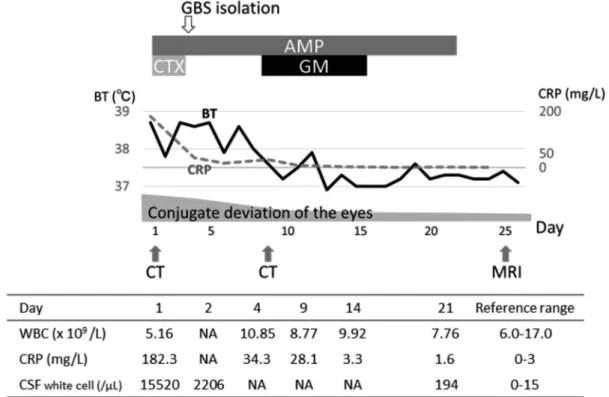
When he was 2 months old, he presented to our hospital with a 4-day history of fever. He also had conjugate deviation of the eyes to the right. His activity and appetite were worsening. On physical examination, his temperature was 38.7°C; heart rate 180 beats/min; and respiratory rate 40 /min. He appeared pale and hardly moved or cried except upon painful stimulation. The anterior fontanelle was flat. No signs of meningeal irritation such as Brudzinski s sign were ap-parent. Conjugate deviation of the eyes to the right was occasionally seen. Laboratory results on admission were as follows: white blood cell count, 5.16×10⁹/L, including 25% bands and 20%
segmented cells; hemoglobin, 9.2 g/dL; platelet count, 596×109/L; C-reactive protein (CRP), 182.3 mg/L (reference, 0–3); and serum glucose, 91 mg/dL. Serum immunoglobulin and comple-ment concentrations were normal. Cerebrospinal fluid (CSF) was yellow and showed pleocytosis with a white cell count of 15520/μL (lymphocytes: neutrophils, 3520: 12000); a protein concen-tration of 484 mg/dL; and a glucose concenconcen-tration of 6 mg/dL. Microscopic examination of CSF after Gram staining showed Gram-positive diplococci with phagocytosis. The rapid latex aggluti-nation test was positive for GBS. Cranial computed tomography showed a left subdural effusion.
The patient was diagnosed with bacterial meningitis. Intravenous AMP (400 mg/kg/day) and cefotaxime (CTX; 200 mg/kg/day) were started immediately. On the third hospital day, GBS was isolated from CSF and blood cultures of the day of admission. Since the isolates were susceptible to β-lactam antibiotics (minimum inhibitory concentration or MIC; 0.125 μg/mL for AMP, 0.031 μg/mL for PEN, and 0.063 μg/mL for CTX, as opposed to 64 μg/mL for GM), CTX was dis-continued and AMP was dis-continued alone. The patient s general condition improved by the second day, when repeat CSF examination also showed improvement with a white cell count of 2206/μL (lymphocytes: neutrophils, 203: 2003); protein, 268 mg/dL; and glucose, 34 mg/dL. GBS was no longer detectable in the CSF by Gram staining. CRP had decreased. However, the patient s
tem-Figure 1. Clinical course of the patient, whose temperature normalized soon after administration of gentamicin. Abbreviations: BT, body temperature; CRP, C-reactive protein; WBC, white blood cells; NA, not available
perature remained elevated at 38.0°C (Figure 1). We added intravenous GM (5 mg/kg/day) on the eighth day. On the ninth day, his temperature declined. We gave AMP for a total of 21 days and GM for 7 days. The left sided subdural effusion observed on day 8 had decreased on day 25. We discharged the patient on day 26. Conjugate deviation of the eyes to the right had decreased by day 10 and had disappeared completely at 3 months after onset. Hearing and psychomotor devel-opment remain intact to at least 3 years old.
Bacteriologic examination
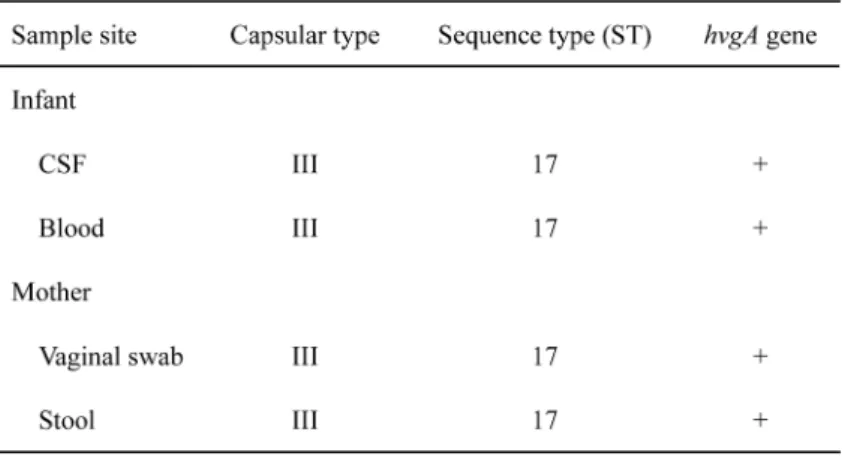
As shown in Table 1, capsular types of all isolates from the patient and his mother were identified as serotype III using a real-time PCR method devised by Morozumi et al.9). Multilocus sequence typing (MLST) was performed additionally with reference to the MLST website (https://http//pubmlst.org/sagalactiae/), assigning the isolates to sequence type (ST) 17. The hy-pervirulent gene (hvgA) encoding the surface protein HvgA was detected by PCR amplification as described previously10).
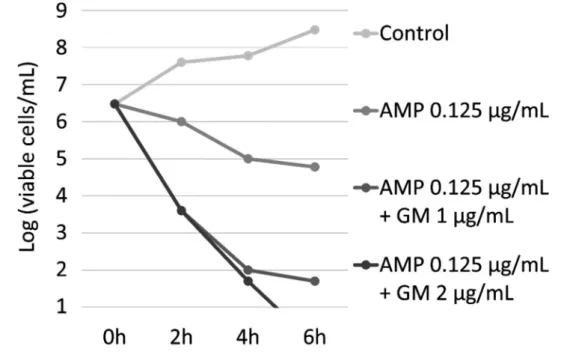
We measured time-kill curves for AMP alone and for the combination of AMP with GM in the causative isolate using methods described previously8). As shown in Figure 2, viable cell counts of GBS were decreased more rapidly by the combination than by AMP alone. With the combination, bactericidal activity was enhanced, showing a greater decrease in viable cells on the order of 103/mL at 2 h and 104/mL at 4 h.
Discussion
We presented an infant with late-onset GBS meningitis in whom a combination of AMP and GM was highly effective. The patient s temperature normalized soon after addition of GM. In
vitro measurement of time-kill kinetics for the isolate demonstrated enhancement of bactericidal
activity by adding a small amount of GM to AMP. These clinical and laboratory findings suggest that combination therapy with AMP plus GM for GBS infection might be superior to AMP mono-therapy.
The synergistic effect of AMP plus GM against GBS has been demonstrated by bactericidal quantifications in vitro and by animal experiments in the past. However, details of the mecha-nisms underlying the clinical advantages were not identified. Our report provides further clinical evidence of enhanced effectiveness using combination therapy in the context of mechanisms clar-ified recently by LC/MS/MS and TEM8).
Moreover, GM has been thought to cross the blood-brain barriers (BBB) only with difficulty. In rabbits, CSF concentration ratios of GM relative to those in serum were reported to be as low as 21% to 25%11,12). In neonates with meningitis, GM concentrations in CSF following systemic administration were reported to be below 1.0 μg/mL in most patients according to a bacteriologic assay with limited sensitivity13). However, the BBB may be disrupted in the presence of menin-geal inflammation, permitting greater penetration by antibiotics14). Regrettably, we were not able to measure the AMP and GM concentrations in CSF of this case, but we suspect that GM may more readily penetrate the BBB in an inflammatory state, achieving adequate concentrations in CSF to exert the synergistic effect demonstrated in vitro. GM concentrations in CSF should be studied using a sensitive assay in the future.
Figure 2. Time-kill curves of the isolated GBS strain were measured in vitro for ampicillin (AMP) and for the combination of AMP with gentamicin (GM) at 2 concentrations. Time-kill curves were measured at 2-hour intervals from time zero until 6 h. Bactericidal activity of AMP increased when GM was included.
Prolonged fever in our patient may have resulted from subdural effusion, with defervescence reflecting resorption of the effusion. Subdural effusion has been detected in 27% to 42% of pa-tients with meningitis and prolonged fever (over 10 days)15,16). In our patient, however, subdural effusion seems unlikely to be the cause of prolonged fever, since our patient defervesced before the effusion fully resolved.
One important finding in this patient is that the causative GBS was assigned to ST17 by MLST analysis. GBS of ST17 in capsular type III exhibits hypervirulence17). Specifically, GBS of ST17 is particularly associated with late-onset infection believed to involve an oral route of infec-tion. An ST17-specific surface-anchored protein termed hypervirulent GBS adhesin (HvgA) was identified by Tazi et al.18). HvgA enhances ability to adhere to intestinal epithelial cells and also the microvascular endothelial cells that constitute the BBB. Combination therapy was effective in the treatment of GBS infection despite this hypervirulence protein.
In this case, horizontal transfer of GBS from mother to infant might exist by the identical capsular type and ST in GBS isolates from the mother and the infant. Such horizontal transmis-sion is considered the main cause of late-onset GBS infection in early infancy, which cannot be prevented by maternal prophylaxis. Toyofuku et al.19) demonstrated more GBS positivity in 1-month-olds than in younger infants. Close observation of neonates with GBS-carrying mothers is warranted even after perinatal prophylaxis.
According to a nationwide survey of children with GBS infection in Japan, the mortality rate is showing improvement in both early-onset and late-onset cases. However, since sequelae of meningitis still are frequent, use of GM together with β-lactam antibiotics should be considered an option from the early stages of infection in these infants20∼23).
Acknowledgements
We thank all colleagues of Kawasaki Municipal Hospital for helpful discussions.
Conflicts of interest
The authors declare no conflict of interest. This research did not receive any specific grant from funding agencies in the public, commercial, or not-for-profit sectors.
References
1) Thigpen MC, Whitney CG, Messonnier NE, et al.: Bacterial meningitis in the United States, 1998–2007. N Engl J Med. 2011; 364: 2016–25.
2) Verani JR, McGee L, Schrag SJ: Prevention of perinatal group B streptococcal disease—revised guidelines from CDC, 2010. MMWR Recomm Rep. 2010; 59: 1–36.
3) McCracken GH, Jr: New concepts in the management of infants and children with meningitis. Pe-diatr Infect Dis. 1983; 2: S51–5.
Pennsylvania; Elsevier: 2017.
5) Schauf V, Deveikis A, Riff L, Serota A: Antibiotic-killing kinetics of group B streptococci. J Pedi-atr. 1976; 89: 194–8.
6) Swingle HM, Bucciarelli RL, Ayoub EM: Synergy between penicillins and low concentrations of gentamicin in the killing of group B streptococci. J Infect Dis. 1985; 152: 515–20.
7) Deveikis A, Schauf V, Mizen M, Riff L: Antimicrobial therapy of experimental group B strepto-coccal infection in mice. Antimicrob Agents Chemother. 1977; 11: 817–20.
8) Ebara Y, Morozumi M, Sato M, et al.: Enhancement of bactericidal activity against group B strep-tococci with reduced penicillin susceptibility by uptake of gentamicin into cells resulting from combination with β-lactam antibiotics. J Infect Chemother. 2017; 23: 312–8.
9) Morozumi M, Chiba N, Igarashi Y, et al.: Direct identification of Streptococcus agalactiae and capsular type by real-time PCR in vaginal swabs from pregnant women. J Infect Chemother. 2015; 21: 34–8.
10) Teatero S, McGeer A, Low DE, et al.: Characterization of invasive group B Streptococcus strains from the greater Toronto area, Canada. J Clin Microbiol. 2014; 52: 1441–7.
11) Lutsar I, McCracken GH, Jr., Friedland IR: Antibiotic pharmacodynamics in cerebrospinal fluid. Clin Infect Dis. 1998; 27: 1117–27, quiz 28–9.
12) Ahmed A, Paris MM, Trujillo M, et al.: Once-daily gentamicin therapy for experimental
Esche-richia coli meningitis. Antimicrob Agents Chemother. 1997; 41: 49–53.
13) Richards ML, Prince RA, Kenaley KA, Johnson JA, LeFrock JL: Antimicrobial penetration into cerebrospinal fluid. Drug Intell Clin Pharm. 1981; 15: 341–68.
14) Bennett JE, Dolin R and Blaser MJ: Mandell, Douglas, and Bennett s Principles and Practice of Infectious Diseases, 8th ed. Pennsylvania; Elsevier: 2015.
15) Lin TY, Nelson JD, McCracken GH, Jr: Fever during treatment for bacterial meningitis. Pediatr Infect Dis. 1984; 3: 319–22.
16) Daoud AS, Zaki M, al-Saleh QA: Prolonged and secondary fever in childhood bacterial meningi-tis. Eur J Pediatr. 1989; 149: 114–6.
17) Morozumi M, Wajima T, Kuwata Y, et al.: Associations between capsular serotype, multilocus se-quence type, and macrolide resistance in Streptococcus agalactiae isolates from Japanese infants with invasive infections. Epidemiol Infect. 2014; 142: 812–9.
18) Tazi A, Disson O, Bellais S, et al.: The surface protein HvgA mediates group B streptococcus hy-pervirulence and meningeal tropism in neonates. J Exp Med. 2010; 207: 2313–22.
19) Toyofuku M, Morozumi M, Hida M, et al.: Effects of intrapartum antibiotic prophylaxis on neo-natal acquisition of group B streptococci. J Pediatr. 2017; 190: 169–73.e1.
20) Matsubara K, Hoshina K, Kondo M, et al.: Group B streptococcal disease in infants in the first year of life: a nationwide surveillance study in Japan, 2011–2015. Infection. 2017; 45: 449–58. 21) Shinjoh M, Yamaguchi Y, Iwata S: Pediatric bacterial meningitis in Japan, 2013–2015–3–5 years
after the wide use of Haemophilus influenzae type b and Streptococcus pneumoniae conjugated vaccines. J Infect Chemother. 2017; 23: 427–38.
22) Shinjoh M, Iwata S, Yagihashi T, et al.: Recent trends in pediatric bacterial meningitis in Japan–a country where Haemophilus influenzae type b and Streptococcus pneumoniae conjugated vaccines have just been introduced. J Infect Chemother. 2014; 20: 477–83.
23) Sakai F, Hanaki H, Ikeda-Dantsuji Y, et al.: Trends in empirical chemotherapy of bacterial menin-gitis in children aged more than 4 months in Japan: a survey from 1997 through 2008. J Infect Chemother. 2011; 17: 358–62.