*Department of Molecular Chemistry & Biochemistry, Faculty of Science & Engineering, Doshisha University, 1-3 Tatara Miyako dani, Kyo-tanabe, Kyoto 610-0321, Japan, E-mail:[email protected]
The Study of Physicochemical Properties of Antibacterial ZnO Powder – Impurity Doping, Elution and Catalytic Properties –
NGUYEN Phuong Thi Minh, Yuki TOKUOKA, Wakana IMAI, Ken HIROTA*, Masaki KATO, Kazuhiko TSUKAGOSHI (Received April 19, 2019)
Recently developed sustainable anti-germ ZnO powder which shows antibacterial effect under dark conditions has been investigated from viewpoints of physicochemical properties1,2); that is, Li+, Mg2+, Ga3+ and Al3+ impurities doping to ZnO, elution to water, and catalytic properties using acetaldehyde and compared with that of TiO2. i) A small amount of Mg only can form solid solution, revealing around 5% increase of chemiluminescence values, ii) 0.3mass% CNF addition could bring to fabricate the granules which showed high CL and low elution to water, and iii) it has been cleared that these anti-germ ZnO powders can play a role of catalytic properties for decomposition of acetaldehyde even under dark conditions.
Key words:ZnO, additives, granules, elution, catalytic properties
1.Introduction
With the recent health-oriented and lifestyle changes, research and development of materials to remove and kill harmful bacteria for human body is energetically carried out1-4). The main antibacterial agents are quaternary ammonium salts and phenols.
There are organic antibacterial agents, composite materials in which silver ions and silver nano particles having antibacterial properties which are supported on zeolite and activated carbon, and inorganic antibacterial agents such as TiO2 utilizing optical activity3-6). Antibiotics, anticancer agents, oxidizing agents, etc. can be mentioned as organic antibacterial agents, which can be divided into 19 series of alcohol type, phenol type, ester type, epoxy type, organic metal type etc. according to the chemical structures3,4). These antibacterial activities are used as preservatives, pesticides, and cleaners for cosmetics because they could directly
contact and absorb microorganisms and act on them.
However, in recent years there are substances that have been found to have adverse effects on the human body and the environment, and it is necessary to review their use and to be noticed. Inorganic antibacterial agents are widely used in household goods such as mobile phones, touch panels, toilets, air conditioner filters, etc. In addition, it can be said that it is characterized by its superior heat resistance and duration compared to organic antibiotics4,5). Reactive oxygen, a type of oxygen, contributes to physiological metabolism and plays an important role in maintaining life, such as production of physiologically active substances and removal of pathogens7,8). In general, in the case of inorganic antibacterial agents that generate this active oxygen, as seen in the example of TiO2, when light energy over the band gap is irradiated to the photocatalyst. Electrons move from the valence band to
the conduction band, and electrons are generated in the conduction band, resulting in holes in the valence band6). As a result, electrons and holes possessed by the antibacterial material take part in the chemical reaction on the surface to generate active oxygen7,8). However, in the case of ZnO, since it exhibits antibacterial activity due to active oxygen without using light energy, electron e- emitted from interstitial zinc Zni and interstitial zinc Zni ++ ionized to divalent valence plays the same role as a hole that is conceivable9,10).
One of the problems with inorganic antimicrobial agents is that they require light irradiation. The presence of active oxygen is required to have antibacterial properties, but conventional major inorganic antibacterial agents such as silver zeolite antibacterial agents and titanium dioxide antibacterial agents generate active oxygen species (hydroxyl radical OH.). It is necessary to become ions and radicals by photoexcitation itself, and ultraviolet light energy is required in its generation process7). In order to excite light, they have to absorb photons with energy equivalent to the band gap, but the light in the ultraviolet region is usually less than 5% of the sunlight we receive, which will absorb sunlight sufficiently. As one improvement measure, it is possible to extend the light absorption wavelength range to lower energy with longer wavelength side by supporting the dye having absorption wavelength range from visible region to infrared region on the surface of TiO25-7). That is, instead of the direct absorption of light by an antimicrobial substance, the supported dye substance causes a reaction by absorbing light of a longer wavelength. However, this method has not been successfully put to practical use at present. As mentioned above, titanium dioxide antibacterial agents need a place where light energy can be used in order to have antibacterial activity. Also, the antibacterial mechanism of silver zeolite antibacterial agent has silver ion theory other than active oxygen theory11,12), and it has been clarified that it has antibacterial activity without light energy, but it requires
silver. The problem is that it costs a lot to produce.
Recently, ZnO is taking much attention as an antibacterial material that solves the above-mentioned problems. ZnO has the advantages of being relatively inexpensive compared to other heavy metals, and of being less susceptible to light energy for excitation and having antibacterial activity even in the dark, so it is one of advantages of ZnO compared to titanium dioxide antimicrobial agents1-4). ZnO is widely synthesized from polycrystals to single crystals, and its structure also begins in bulk or thin film, and exhibits a very diverse aspect such as nanorods and nanoballs. ZnO is noted as a material with diverse optical and electrical characteristics. It is expected to be applied to a wide range of applications such as transparent conductive films, sensors, semiconductor optical and electronic devices, optical circuits, nanodevices, and surface-treated thin films.
Our previous studies have shown that ZnO-based materials already have an antibacterial effect against E.
coli1,2). In addition, ZnO itself does not act directly on microorganisms, but it is expressed by reactive oxygen species such as superoxide anion radical (.O2-) and hydroxyl radical (OH.) generated near the powder surface of the crystal particle. Furthermore, it has been reported that the strength of the antimicrobial activity differs depending on the starting material, hydrothermal treatment conditions, and additives13-15). In this research, to obtain antibacterial ZnO powder with higher antibacterial power than before, and also to be used as a water purifier, granules of ZnO that do not dissolve in water and do not pass through the filter of the water purifier was obtained16-18). Moreover, for the evaluation of the tactile properties, the catalytic properties of ZnO are investigated by using acetaldehyde19,20).
2. Experimental procedure 2.1 Preparation of ZnO powders
2.1.1 Hydrothermal synthesis
As shown in Fig. 1 (I), fine ZnO powder
(XZ-100F, Sakai Chemical Industry Co., Ltd., Sakai, Osaka, Japan) with a BET surface area Sa of 7.83 m2/g, i.e., particle size Ps of 0.137 µm, calculated from both Sa
and its theoretical density (Dx) of 5.606 Mg/m3 (PDF:
#36-15451), was used as the starting material. In addition, an aqueous solution of 3.0 M was prepared using zinc nitrate hexahydrate Zn(NO3)2·6H2O (puritiy of 99%, Nacalai Tesque, Kyoto, Japan). 1.0×10⁻⁴ m3 of this solution was put into a Teflon wide-mouthed beaker with 2.0 × 10⁻² kg of the above ZnO powder. Next, the wide-mouthed beaker was sealed in a high-pressure vessel (autoclave: 48.0 mm in inner diameter, 78.0 mm in height), and hydrothermal synthesis was performed at 443 K for 2.52 × 10⁴ s. After hydrothermal synthesis, the powder was taken out from the autoclave, ultrasonic washing of the powder suspension obtained was performed for 6.0 × 10² s, hot water (333 K) washing was performed for 1.8 × 10³ s, then it was dried at 383 K for overnight. After drying, the powder was lightly crushed with a mortar to make it homogeneous.
2.1.2 Heat treatment
Hydrothermally synthesized and dried powders were heated at various temperatures as following conditions: from 573 K to 973 K at 25 K intervals for 3.6 × 10³ s to re-oxidize the products after just hydrothermal treatment was Zn basic chemical
compounds.
2.1.3 Ball-milling
Pulverizing of ZnO powder of 5.0 × 10⁻³ kg was performed using a planetary ball-milling apparatus (P-7, Fritsch Japan, Yokohama, Japan), zirconia 45 mL-container, and 2.0 mm diameter yttria-stabilized tetragonal ZrO2 (YTZ) balls of 5.0×10⁻² kg with a powder : ball = 1 : 10 mass ratio in 1.0×10⁻⁵ m3 ethanol, at 6.67 rounds per sec (400 rpm, gravitational acceleration unit : 10.91 g) for 3.6×10³ s.
2.1.4 Hydrothermal synthesis with additives
ZnO powder (XZ-100F) was used as the starting material. And 1.0×10⁻⁴ m3 of 3.0 M Zn(NO3)2·6H2O aqueous solution and nitrate lithium LiNO3 (purity 97%, Nacalai Tesque), gallium (III) nitrate pentahydrate Ga(NO3)3·5H2O (purity 99.9%, High Purity Chemical Laboratory, Saitama, Japan), aluminum nitrate (III) nonanhydrate Al(NO3)3·9H2O (99.9%, High Purity Chemical Laboratory) and magnesium (II) nitrate hexahydrate Mg(NO3)2·6H2O (purity 99%, High Purity Chemical Laboratory) together with 2.0 × 10⁻² kg of the starting ZnO powder were performed by hydrothermal treatment at 443 K for 2.52 × 10⁴ s. After hydrothermal synthesis, obtained powder was ultrasonically washed in hot water for 1.8 × 10³ s, and dried at 383 K in air, and lightly crushed to obtain an antimicrobial agent sample.
Fig. 1. Flowchart for preparation of antibacterial ZnO powders.
2.1.5 Preparation of granules using cellulose nanofiber (CNF)
Fig. 1 (II) shows the procedure of making ZnO granules. First, the heat treatment temperature performed described in 2.1.2 was applied to prepare granules, and 0.2 mass% CNF (Dai-ichi Kogyo Seiyaku, Kyoto, Japan, RHEOCRYSTA I-2SX) was added into ZnO powder and passed through #10 mesh filter. Then, thus obtained granules were heated at various temperatures from 373 K to 973 K at 25 K intervals in air. Next, the granules added by 0.1, 0.2, 0.3 and 0.4 mass% CNF were prepared by heating at 673 K for 3.6
× 103 s in air.
2.1.6 Addition of ZnO to porous material
1.0% CNF aqueous solution, pure water and antibacterial ZnO powder were added into a 5.0×10⁻⁴ m3 three-necked flask and stirred. While stirring the solution, Si/SiC porous filter and apatite-based porous material (BA9-800) was soaked for 60 s and then dried.
Furthermore, after repeating this step three times, heat treatment was performed at 873 K for 3.6 × 10³ s in air.
2.2 Evaluation 2.2.1 X-ray diffraction
Crystalline phase and crystallite size were investigated by performing X-ray diffraction (XRD, SmartLab, Rigaku, Osaka, Japan) equiped with a monochromator on all samples. The lattice constants were determined by XRD using high-pruity Si as an internal standard under the condition of 30° < 2θ < 90°.
2.2.2 Chemiluminescence (CL) measurement
Chemiluminescence (CL)1,2) of ZnO powders (100 mmol) in a 2.5 × 10⁻⁷ m3 aqueous luminol solution (5.0×10⁻⁹ mol·m-3) mixed with 3.0 × 10⁻⁶ m3 carbonic acid buffer solution (NaOH/NaHCO3, pH=10.8) was observed under dark conditions using a CL detector (CLD-100FC, Tohoku Electronic Industrial Co., Ltd., Sendai, Japan)6). After dropping the luminol solution in a 1.2×10² s’ warming up of the detector, the intensity of CL was integrated between 1.2~6.0×10² s.
2.2.3 Dissolution test
Dissolution test for Zn was performed under JIS S 3200-7: equipment of water supply – test method of effect to water quality, 4th edition, October 1, 2008 (Japanese Standard Association). At first we prepared an exudate fluid with the conditions of pH=7.0±0.1, hardness of water, 45±5 mg/L, alkaline level, 35.5±5 × 10⁻³ kg·m-3 and residual chlorine concentration, 0.3±0.1
× 10-3 kg·m-3.
Four ZnO test pieces were prepared; 1) antibacterial ZnO powder as a reference, 2) ZnO granules prepared as follows; after hydrothermal treatment, washed and dried powder, namely HT material, heated at 573 K for 3.6×10³ s in air, then pulverized and was added with a small amount of 0.3%
cellulose nano fiber (CNF) added and passed through
#10 filter, and then heated at 873 K for 3.6×10³ s in air as shown in Fig. 1 (II). 3) as the same as 2) except for 573 K-heating, changed into 673 K, and 4) as the same as 2) except for 573 K-heating, changed into 773 K.
The second, test pieces were put into testing vessel such as water cleaner contained the exudate fluid and hold inside it for 5.76×10⁴ s at 296 K. And then the content of Zn was measured using Inductively Coupled Plasma (ICP, AA-6800, Shimazdu, Kyoto, Japan).
3. Results and discussions 3.1 Examination of additives
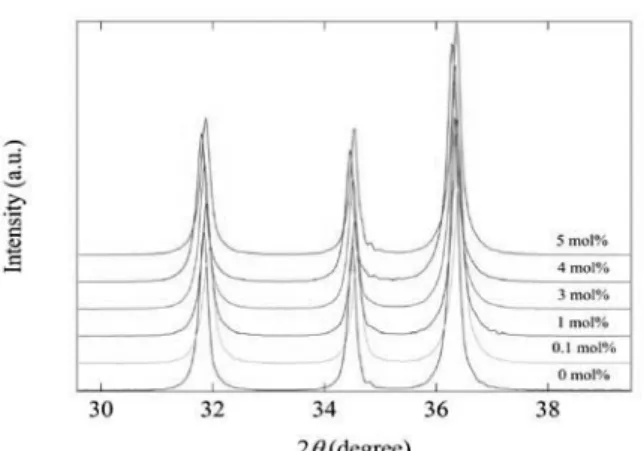
Fig. 2 shows XRD patterns of ZnO powders doped with various Mg contents from 0.1 to 5mol%. It can be seen that all samples have hexagonal Würzite structure (PDF: #36-1451). There is no second phase beside ZnO and also no significant differences among them. However, there is a little change in lattice parameters when the contents of input Mg changed (Fig.
3), suggesting that ion Mg2+ could be inserted into the crystalline structure of Zn2+O; here, ionic radii of Mg2+
have been reported as 0.057 nm (CN:IV)21) and 0.0720 nm (CN:VI)21) and on the other hand, those of Zn2+are 0.060 nm (CN:IV)21) and 0.0740 nm (CN:VI)21).
Fig. 2. XRD patterns of ZnO powders doped with various amount of Mg.
Fig. 3. Lattice parameters a and c of hexagonal ZnO doped with Mg.
Fig. 4 reveals the actual amount of additives (Li, Mg) that were obtained by ICP measurement. From these graphs, it can be seen that the contents of both Li+ and Mg2+ that actual adopted into ZnO are very low. It is considered that they were structurally unsuitable, even though their ionic radii are nearly the same; i.e., radii of Li+ are 0.059 nm (CN:IV)21) and 0.0760 nm (CN:VI)21), however, crystal structure of ZnO is hexagonal, on the other hand, those of MgO and Li2O are cubic.
Also, the CL measurement results of each sample with Li and Mg as dopants are shown in Fig. 5, input additional amounts (mol%) are on the horizontal axis.
CL values were decreased with the increasing amount of dopants (Li, Mg). In other words, the antibacterial activity of those samples was decreased since CL value and antibacterial property has strong relationship. The same situation happened with Ga and Al additions (Fig.
6), the integrated CL values were lightly decreased with the increasing the content of additions. This result could
be explained based on the differences in the ionic radii and positive charges of Ga3+, Al3+ and Zn2+; radii of Ga3+ are 0.047 nm (CN:IV)21) and 0.0620 nm (CN:VI) 21), those of Al3+ are 0.039 nm (CN:IV)21) and 0.0535 nm (CN:VI), much far away from those of Zn2+. Those differences might affect to the formation of solid solutions. From these results, it could be noted that a small amount of Mg, about 0.0005 mol%, could be inserted into ZnO lattice and improve the CL value about 5%.
Fig. 4. Relationship between input and ICP-measured contents of Mg or Li in ZnO.
Fig. 5. CL values of ZnO powders doped with various contents of Li or Mg.
3.2 Examination of granule ZnO
SEM images of granule ZnO samples with various amounts of CNF are shown in Fig. 7. There are a few small differences in their morphologies and granule/particle sizes which might affect to their properties. About 0.3 and 0.4 mass% addition could produce the ZnO granules.
Fig. 8 displays the integrated CL value of ZnO granules prepared at various heat treatment temperatures (a) without and (b) with the addition of 0.2 mass% CNF. It
is clear that granule ZnO (0.2 mass% CNF) heated at 773 K gave the highest CL value compared to non-added CNF samples and the other heating conditions, and it should be noted that the highest CL temperature of CNF added sample is 100 K lower than that of no addition, suggesting that a small amount of CNF might enhance to sinter or form oxygen vacancies in ZnO lattice due to its carbon component.
Fig. 6. CL value of ZnO powder with various contents of Al or Ga.
Fig. 7. SEM images of ZnO granules prepared using aqueous CNF solutions: (a), (b): 0.2%mass CNF and (c), (d): 0.5%mass CNF.
Fig. 9 (a) shows the change in the integrated CL value of granules as a function of the amount of CNF addition under the condition that the heat treatment temperature was fixed at 773 K. From these results, it can be assumed that the addition of CNF has much effect on the CL value; 0.4 mass% CNF addition gave the highest value. It can be considered that the addition of CNF increased the amount of interstitial Zn2) during
Fig. 8. CL values of ZnO powders prepared at various re-oxidized temperatures without and with 0.2% CNF.
heating at 773 K and resulted in increasing reactive oxygen species (ROS)1-4). Therefore, this result can suggest an increase of the antibacterial activity of ZnO granules. Besides, no significant change was observed in the lattice constant, but as shown in Fig. 9 (b) and (c) crystallite sizes Xs of the granules with and without mesh filter pass increased slightly from 41~42 nm to aound 45 nm at 0.4% CNF addition.
Fig. 9. CL value and crystallite size Xs of ZnO granules as a function of contents of CNF.
Table 1 shows the eluded Zn content from the 4 test pieces: No. 1 shows 0.16 mg/L (1.6 × 10⁻⁴ kg·m-3), here, the content of elution is presented as mg/L unit because of JIS document uses this unit, No. 2; 0.09 mg/L (9.0 × 10⁻⁵ kg·m-3), No. 3; 0.05 mg/L (5.0 × 10⁻⁵ kg·m-3) and No.4; 0.08 mg/L (8.0 × 10⁻⁵ kg·m-3). These values except for 0.16 mg/L for No. 1 sample satisfied the requirement level of 0.1 mg/L of JIS S 3200-7.
This effect might be explained as follows:
Table 1. Elution of ZnO granules.
i) The products obtained just after hydrothermal treatment (0.246 M/100 mL, 3 M Zn(NO3)2
aqueous solution at 443 K for 2.52×10⁴ s) washing and drying, are fine reactive powder composed of basic Zn compounds, such as, Zn(NO3)2(H2O), Zn3(OH)4(NO3)2, Zn5(OH)8(NO3)2(H2O), and ZnO.
ii) After heating at relatively low temperature above re-oxidation temperature around 553 K, such as 573, 673 and 773 K, the products turned into fine ZnO powders.
iii) A small amount of 0.3% CNF aqueous solutions were adder to fine ZnO powders and then mixed powders became massed together, or agglomerated by passing through #10 mesh filter, open grid of 2.0 mm.
iv) These agglomerated powders turned into porous granules after heating at 873 K for 3.6×10³ s in air, consisting of marginally sintered grains.
v) These granules might show a small amount of Zn elution comparing with that of normally prepared, i.e, after hydrothermal treatment, 873 K oxidizing heating.
3.3 Evaluation of catalyst characteristics
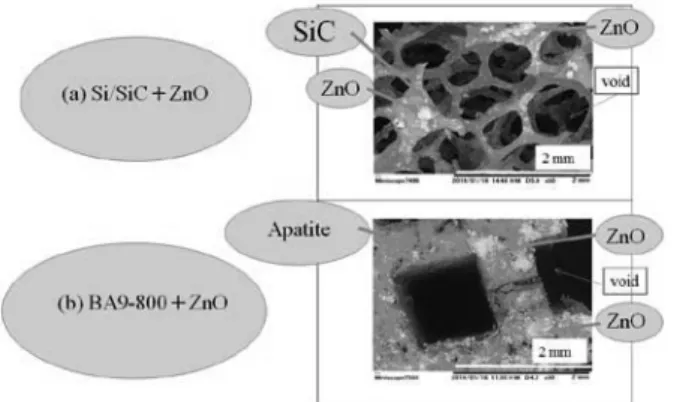
Low magnification SEM images of ZnO added porous materials, such as Si/SiC filter and apatite-based ceramics (BA9-800) are shown in Fig. 10, here black round circles and squares are voids.
Figs. 11 and 12 show XRD patterns of these Si/SiC+ZnO and BA9-800+ZnO, respectively. In Fig.
11, a few small diffraction peaks attributed from ZnO are recognized, however, in Fig. 12 no XRD peaks of
Fig. 10. Low magnification SEM photographs for (a) Si/SiC + ZnO and (b) BA9-800+ZnO.
ZnO are observed, this might be due to strong diffraction generated from relatively denser ceramics with 48% porosity than Si/SiC filter. Their microstructures observed by relatively high magnification, such as (a) Si/SiC filter, (b) Si/SiC filter + ZnO powder added, (c) Si/SiC filter + TiO2 powder added, this test piece are used as a reference and (d) BA9-800 + ZnO powder added are shown in Fig. 13. By comparison among these former tree samples, Si/SiC filter related, the latter BA9-800 + ZnO consisted of relatively small homogeneous grains and high relative density.
Fig. 11. XRD pattern of Si/SiC+ZnO.
The changes in concentration of acetaldehyde (CH3CHO, C2H4O), which measured by a gas detector tube (92M, GASTEC Corporation, Ayase, Kanagawa, Japan) using a plastic globe-back with 4.3×4.3×2.5×10-6 m3 size and 1.8×10⁻² m-3 volume are shown in Fig. 14 and 15. In Fig. 14 (a) and (b), ZnO added Si/SiC filters
#36-1451 : ZnO
#27-1402 : Si
#29-1129 : SiC
reveal rapid a concentration-decrease even under dark conditions, indicating playing a role of catalytic properties for acetaldehyde; this might be the first report on the catalytic properties of ZnO under dark conditions.
Fig. 12. XRD pattern of BA9-800+ZnO.
Fig. 13. SEM images of (a) Si/SiC porous material, (b) Si/SiC+ZnO, (c) Si/SiC+TiO2 and (d) BA9-800+ZnO.
Fig. 14. Concentration of acetaldehyde changed in each sample.
Fig. 14 (c) and (d) also show catalytic properties of TiO2 powders for acetaldehyde both in daylight and the dark, this effect has been reported only in sunshine.
When the results are compared between Si/SiC filter + ZnO and +TiO2 powder, it seems that ZnO has strong catalytic properties. However, relatively dense BA9-800 + ZnO powder added samples did not show the catalytic properties as shown in Fig. 14 (e).
Fig. 15. Time-dependent change in catalytic capacity F in each sample: F=(C-Co)/(Co*wtcatalyst).
The next, time-dependent changes in catalytic capacity F in each sample, here F=(C-Co)/(Co*wtcatalyst), C and Co are the concentration of acetaldehyde at time t and stating 0, wtcatalysit mass of ZnO and TiO2. From these results, it could be confirmed that the catalytic properties of ZnO is activated even under light shielding, even though relatively low by comparing the same mass of TiO2.
4. Conclusion
From this study, it was found from the results of CL measurement that the antibacterial activity was increased by the addition of CNF, and from the results of SEM images that powder close to granules was obtained. Furthermore, from the experiments using acetaldehyde, it could be confirmed that zinc oxide exhibits catalytic properties even in the dark conditions.
References
1) K. Hirota, M. Sugimoto, M. Kato, K. Tsukagoshi, T.
Tanigawa, H. Sugimoto, “Preparation of Zinc Oxide Ceramics with a Sustainable Antibacterial Activity under
Dark Conditions”, Ceram. Inter., 36, 497-506 (2010).
2) T. M. P. Nguyen, S. Hirota, Y. Suzuki, M. Kato, K.
Hirota, H. Taguchi, H. Yamada, K. Tsukagoshi,
“Preparation of ZnO Powders with Strong Antibacterial Activity under Dark Conditions”, J. Jpn. Soc. Powder Powder Metall., 65, 316-324 (2018).
3) V. V. Kumar, S. P. Anthony, “Antimicrobial Studies of Metal and Metal Oxides Nanoparticles”, Surface Chemistry of Nanobiomaterials, 9, 265-300 (2016).
4) G. Applerot, A. Lipovsky, R. Dror, N. Perkas, Y. Nitzan, R. Lubart, A. Gedanken, “Enhanced Antibacterial Activity of Nanocrystalline ZnO Due to Increased ROS-Mediated Cell Injury”, Adv. Funct. Mater., 19, 842-852 (2009).
5) L. K. Adams, D. Y. Lyon, P. J. J. Alvarez, “Comparative Eco-Toxicity of Nanoscale TiO2, SiO2, and ZnO Water Suspensions”, Water Res., 40, 3527-3532 (2006).
6) C. Karunakaran, G. Abiramasundari, P. Gomathisankar, G. Manikandan, V. Anandi, “Preparation and Characterization of ZnO-TiO2 Nanocomposite for Photocatalytic Disinfection of Bacteria and Detoxification of Cyanide under Visible Light”, Mater. Res. Bull., 46, 1586-1592 (2011).
7) S. Ranjan, C. Ramalingam, “Titanium Dioxide Nanoparticles Induce Bacterial Membrane Rupture by Reactive Oxygen Species Generation”, Environ. Chem.
Lett., 14, 487-494 (2016).
8) M. Ohira, H. Liu, D. He, Y. Hirata, M. Sano, T. Suzuki, T.
Miyake, “Catalytic Performance and Reaction Pathways of Cu/SiO2 and ZnO/SiO2 for Dehydrogenation of Ethanol to Acetaldehyde”, J. Jpn. Petroleum Institute, 61, 205-212 (2018).
9) A. R. Petosa, S. J. Brennan, F. Rajput, N. Tufenki,
“Transport of Two Metal Oxide Nanoparticles in Saturated Granular Porous Media: Role of Water Chemistry and Particle Coating”, Water Res., 46, 1273-1285 (2012).
10) H. J. Fan, P. R. Anderson, “Copper and Cadmium Removal by Mn Oxide-Coated Granular Activated Carbon”, Separation and Purification Technology, 45, 61-67 (2005).
11) O. Yamamoto, M. Komatsu, J. Sawai, ZE. Nakagawa,
“Effect of Lattice of Zinc Oxide on Antibacterial Characteristics”, Journal of Materials Science, 15, 847-851 (2004).
12) B. T. Zhang, L. X. Zhao, J. M. Lin, “Study on Superoxide and Hydroxyl Radicals Generated in Indirect Electrochemical Oxidation by Chemiluminescence and
UV-Visible Spectra”, Journal of Environmental Sciences, 20, 1006-1011 (2008).
13) M. Ohtaki, K. Araki, K. Yamamoto, “High Thermoelectric Performance of Dually Doped ZnO Ceramics”, J. Electronic Materials, 38, 1234-1238 (2009).
14) J. Sawai, “Quantitative Evaluation of Antibacterial Activities of Metallic Oxide Powders (ZnO, MgO and CaO) by Conductimetric Assay”, Journal of Microbiological Methods, 54, 177-182 (2003).
15) E. Hoseinzadeh, M-Y. Alikhani, M-R. Samarghandi, M.
Shirzad-Siboni, “Antimicrobial Potential of Synthesized Zinc Oxide Nanoparticles against Gram Positive and Gram Negative Bacteria”, Desalination and Water Treatment, 52, 4969-4976 (2014).
16) S. H. Lin, C. L. Lai, “Catalytic Oxidation of Dye Wastewater by Metal Oxide Catalyst and Granular Activated Carbon”, Environment International, 25, 497-504 (1999).
17) G. Singh, E. M. Joyce, J. Beddow, T. J. Mason,
“Evaluation of Antibacterial Activity of Zn Nanoparticles Coated Sonochemically onto Textile Fabrics”, Journal of Microbiology, Biotechnology and Food Sciences, 2, 106-120 (2012).
18) J. Fan, R. Freer, “The Roles Played by Ag and Al Dopants in Controlling the Electrical Properties of ZnO Varistors”, J. Appl Phys, 77, 4795-4800 (1995).
19) Y.W. Wang, L.D. Zhang, G.Z. Wang, X.S. Peng, Z.Q.
Chu, C.H. Liang, “Catalytic Growth of Semiconducting Zinc Oxide Nanowires and Their Photoluminescence Properties”, J. Crystal Growth, 234, 171-175 (2002).
20) R. D. Shanon, “Revised Effective Ionic Radii and Systematic Studies of Interatomic Distances in Halides and Chalcogenides,” Act. Crystallogr., Sec. A, 32, 751-767(1976).