著者 浅川 希洋志, チクセントミハイ ミハイ
出版者 Springer‑Verlag
journal or
publication title
Journal of Youth and Adolescence page range 121‑145
year 2000‑04
URL http://hdl.handle.net/10114/4787
doi: info:doi/10.1023/A:1005146914355
Feelings of Connectedness and Internalization of Values in Asian American Adolescents
Kiyoshi Asakawa1 and Mihaly Csikszentmihalyi2
ABSTRACT
This study is an attempt to examine a possible mechanism for the high academic achievements of Asian Americans by comparing the quality of experience of Asian American and Caucasian American
adolescents. The Experience Sampling Method (ESM) was used to record subjective experiences.
Subjects were 34 Asian American and 392 Caucasian American adolescents in the sixth, eighth, tenth, and twelfth grades. The ESM analyses revealed interesting differences between the two groups in their psychological functioning. The levels of Asian Americans' perceived importance of activities to future goals and happiness, enjoyment, self-esteem, and activeness covaried more positively and strongly, as compared to those of Caucasian American adolescents. The physical presence of others also affected the quality of experience of Asian American adolescents more strongly and positively than that of Caucasian American adolescents. The implications of these findings are discussed in terms of Asian adolescents‟ readiness for internalization of cultural values, which may promote academic excellence.
INTRODUCTION
The academic achievements of Asian Americans have received considerable attention from educators and psychologists in recent decades. To explain the educational success of Asian Americans,
This study is part of a longitudinal study of youth and social development supported by a grant given to the second author, Charles Bidwell, Larry Hedges, and Barbara Schneider by the Alfred P. Sloan Foundation.
1Professor, Shikoku Gakuin University, Japan. Received Ph.D. in psychology (human development) from The University of Chicago. Major research interests include influences of the self-conceptions on daily experience and academic motivation of adolescents. To whom correspondence should be addressed at Department of Education, Shikoku Gakuin University, 3-2-1 Bunkyo-cho, Zentsuji-shi, Kagawa 765-8505, Japan.
2Professor, Peter F. Drucker Graduate School of Management, Claremont Graduate University. Received Ph.D. in psychology (human development) from The University of Chicago. Major research interests include the psychology of adolescence and the study of optimal experience, creativity, and intrinsic motivation.
many studies have been conducted, mostly on relationships between Asian cultural values and academic performance. An underlying hypothesis of this research involves “cultural advantages,” which assume that Asian cultural values and practices promote academic excellence (See Sue and Okazaki, 1990, for review). In particular, Asian family values and practices, such as the importance of hard work, respect for education, and high expectations for achievement, have been identified by investigators as promoting high educational attainments (Kitano, 1984; Mordkowitz and Ginsburg, 1987; Sue and Kitano, 1973;
Sue and Okazaki, 1990; Vernon, 1982). If this is true, then it may be argued that Asian Americans‟
high achievement is a result of internalization of cultural values. In the relation to this argument, Asakawa and Csikszentmihalyi (1998b) examined the quality of experience of Asian American and Caucasian American adolescents and reported that Asian American adolescents have more positive experiences relative to Caucasian American adolescents when they are engaged in academic activities.
The same study also showed that when studying, Asian American adolescents are more likely to enjoy the activity and at the same time, to perceive its importance to their long-term goals.
During socialization, children acquire an attitude, belief, or behavioral regulation in the socializing environment and progressively transform it into a personal value, goal, or organization.
Thus, socialization is the issue of internalization. In their theory of internalization, Deci and Ryan (1985) pointed out that internalization is the developmental process through which external regulations are gradually integrated into the realm of self-determination. Moreover, the researchers argued that as the integrated regulations that resulted from the process of internalization are now operative by personal importance and values coherent to the sense of the self, people who have an advanced level of
internalized regulations engage in relevant activities more willingly and have more positive experiences.
Education is highly valued in Asian cultures, and therefore, the quality Asian American adolescents showed in Asakawa and Csikszentmihalyi's study (i.e., high momentary enjoyment and high long-term, goal-directed involvement in academic activities) may be a product of internalization of their cultural values (Asakawa and Csikszentmihalyi, 1998b).
However, what factors would promote the process of internalization? Regarding this question, Ryan and his colleagues (Deci and Ryan, 1985; Deci, et al., 1991; Ryan, 1991; Ryan and Connell, 1989;
Ryan, Connell, and Grolnick, 1992; Ryan and Powelson, 1991) have proposed three basic psychological needs: (1) autonomy, (2) competence, and (3) relatedness, as primary factors that promote the process.
Autonomy refers to self-initiation and self-regulation of one's own actions. When people perceive that they are autonomous, they experience freedom in initiating and regulating behavior (Deci and Ryan, 1985, 1987). Competence involves understanding how to attain intended goals and being effective in activities related to those goals. Thus, competence may induce a sense of control of the situation. Finally, relatedness refers to the experience of feeling connected to others in one's social milieu, that is, “the emotional and personal bonds and attachments between persons” (Ryan, 1991, p. 210).
Concerning the first and second factors for promoting the process of internalization, Asakawa (1995) suggested that autonomy support of Asian American parents for their children and the children‟s perceived competence in academic activities appear to be more conducive to enhancing the
internalization of values concerned with education than their Caucasian American counterparts. That is, if compared to Caucasian American parents, Asian American parents provide their children with more freedom in actual academic activities, and at the same time, they structure their children's lives more to facilitate academic success (see also Asakawa and Csikszentmihalyi, 1998a). Moreover, when studying, Asian American adolescents feel more in control than Caucasian American adolescents, and this result appears to indicate that Asian American adolescents perceive themselves to be more competent than Caucasian American adolescents when they are engaged in academic activities (see also Asakawa and Csikszentmihalyi, 1998b).
Concerning the third factor for promoting the process of internalization, Deci and Ryan (1985) pointed out that it is the need for relatedness that provides a major impetus for that process. Moreover, internalization can be a function of the need for relatedness (Parsons, 1952; Ryan, 1991; Ryan, Connell, and Grolnick, 1992). That is, if a child feels related to his or her significant others, he or she will be more likely to identify with, and thus, internalize beliefs, values, and behavioral styles of the significant others. Interestingly, many anthropological and psychological studies reported that Asians have a stronger tendency to seek connectedness to others (DeVos, 1985; Hsu, 1985; Kondo, 1982; Markus and Kitayama, 1991; Shweder and Bourne, 1984). It is this psychological functioning of Asians that will be
given a special attention in this study.
According to the relevant literature, many Asian cultures insist on the fundamental connectedness of human beings to each other, and emphasize harmonious interdependence among individuals (see Markus and Kitayama, 1991, for review). In these cultures, the self is viewed “not as separate from the social context but as more connected and less differentiated from others” (p. 227). In contrast,
American culture generally has a different conception of the self that emphasizes independence from others by focusing on the individual and by expressing its unique inner attributes. Comparing these two culturally different groups, Markus and Kitayama referred to the former view of the self as interdependent and the latter as independent, and argued that those with interdependent selves have a stronger tendency to seek connectedness to others and interpersonal harmony, while those with independent selves have a stronger tendency to maintain independence and separateness. According to their argument, if Asian Americans grew up and still live with Asian cultural values, they may have the interdependent conception of the self and, thus, are more likely to have a relatively strong tendency to seek connectedness to
significant others, such as their parents. If this is the case, Asian American adolescents with such a tendency toward connectedness would probably more easily internalize educational values of their parents with whom they would like to feel connected. This may be a scenario that explains the high academic success of Asian American adolescents.
Drawing on these theories, we examined two major questions in this study by using the Experience Sampling Method (ESM), which allows repeated measurement of the subject‟s everyday activities, thoughts, and accompanying psychological states in natural settings (Csikszentmihalyi and Larson, 1987; Csikszentmihalyi, Larson, and Prescott, 1977; Larson and Csikszentmihalyi, 1983). First, we examined how adolescents‟ quality of experience changed as their perception of importance of
activities to future goals changed. In order to do so, we calculated correlation coefficients between the levels of perceived importance of activities for future goals and other experiential dimensions, such as happiness and enjoyment, for each adolescent. Here we treated these correlation coefficients as personality characteristics of each person. Then, we compared average correlation coefficients between Asian American and Caucasian American groups. We predicted that if Asian American
adolescents had internalized cultural values such as high expectations for achievements, their perception of importance of activities for their future goals and other experiential dimensions such as happiness, enjoyment, and self-esteem might covary more positively and strongly than those of Caucasian
American adolescents. Second, we examined whether Asian American adolescents were more likely to have characteristics of the interdependent self. In order to do so, we compared subjective experiences of Asian American adolescents with those of Caucasian American adolescents when they were alone, as well as when they were not alone. Lebra (1976) suggested that people who have the interdependent construal of the self are most “fully human” when they are in the context of others. Thus, we predicted that if Asian American adolescents had interdependent selves, their subjective experiences would be significantly affected by whether or not they were with others, as compared to Caucasian American adolescents. In addition, we examined student interviews to complement the results of the ESM analyses.
Although there has been no study that focuses on Asian Americans‟ psychological functioning as a main factor for promoting their academic success, it may be quite possible that the Asian Americans‟
high academic attainments are promoted by their psychological tendencies that have been shaped by their cultural environment. We believe that the examination of how the psychological functioning of Asian American adolescents differs from that of Caucasian American adolescents might provide a deeper understanding of the connection between cultural values and academic success of Asian Americans.
METHODS
Sample
A total of 1,109 students in the sixth, eighth, tenth, and twelfth grades participated in a 5-year longitudinal study of career development being conducted by the University of Chicago and the National Opinion Research Center‟s Ogburn-Stouffer Center (Bidwell, Csikszentmihalyi, Hedges, and Schneider,
1992). The students were selected from 33 public schools around the nation chosen to reflect the full range of socioeconomic environments, from upper-class suburbs to below poverty-line urban
neighborhoods. Students were, in turn, randomly chosen with the aim of obtaining representative samples of their respective schools in terms of gender, race and ethnicity, and scholastic ability level.
Of these students, 856 completed at least 15 Experience Sampling Forms (ESFs; the minimum required for inclusion in the database). For the purpose of this study, 34 Asian students whose first language is not English (an Asian Language) and 392 Caucasian students whose first language is English were further selected with the aim of obtaining two culturally different groups of adolescents. Although 28 out of the 34 Asian students mostly speak English now in their daily lives, and we administered no instrument to measure their levels of acculturation to American culture and the length of being in the United States, considering their first languages, those Asian students are presumably first and second generations. In addition, we believe that their first socialization phase in an Asian language sufficiently exposed them to their native culture to the extent that they may still preserve their cultural identities.
Among those 34 Asian American adolescents, Pacific Islanders (e.g., Samoan, Guaminian, etc.), West Asians (e.g., Iranian, Afghan, Turkish, etc.), and Middle Easterners (e.g., Iraqi, Israeli, Lebanese, etc.) were not included. The selected Asian students in this sample include 14 Chinese, 3 Filipino, 2
Japanese, 5 Korean, 7 Southeast Asian (e.g., Vietnamese, Laotian, Cambodian/Kampuchean, Thai, etc.), 2 South Asian (e.g., Asian Indian, Pakistani, Sri Lanka, etc.), and 1 student whose parents are Chinese and Vietnamese.
Some may argue that there may be diversity within this Asian American sample. For example, it is reported that there are differences in academic attainment between first wave Vietnamese and Laotian and Cambodian students, although they are all Southeast Asians (Ima and Rumbaut, 1989).
However, it is also reported that such differences are in large part explained by the SES of the sample.
Thus, we believe that if we control for the effects of the confounding factors, we may get much clearer role that culture plays in Asian Americans‟ psychological functioning, process of internalization, and high academic performance. Moreover, treating the diverse ethnic groups under the single heading of
“Asian American” in this study is due to the theoretical assumption elaborated by Markus and Kitayama
(1991) discussed earlier.
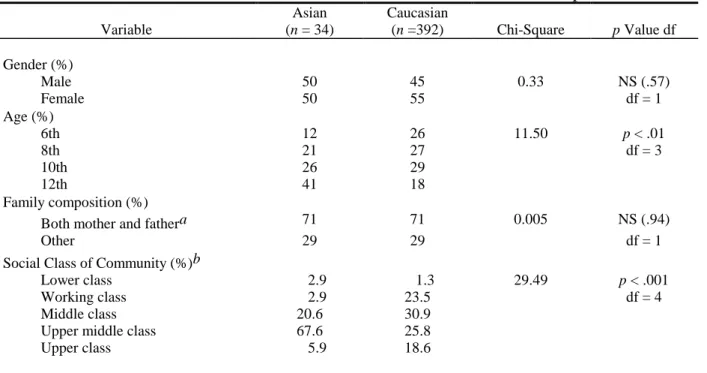
The characteristics of the Asian and Caucasian groups are shown in Table I. In terms of gender and family composition, these two groups are similarly represented. However, in this sample Asian American adolescents are overrepresented in the twelfth grade and underrepresented in the sixth grade, as compared to Caucasian American adolescents. In terms of the Social Class of Community (SCC), which is the census characteristics of the neighborhood in which the adolescents live (Bureau of the Census, 1993), Asian American adolescents are more likely to come from upper-middle-class
communities, and less likely to come from working-class and upper-class communities, as compared to their Caucasian American counterparts. Hence, in all statistical analyses age (grade) and SCC will be controlled for when the two groups are compared by using analysis of covariance (ANCOVA) with regression approach.
_____________________
Insert Table I about here ______________________
Procedure
The subjects met in small groups with a member of the research team for the ESM orientation.
They were given preprogrammed wristwatches that would randomly signal over a week and were
instructed to fill out an ESF each time the watch signaled. At the meeting, students were provided with the ESF booklets and asked to fill out a sample ESF to make sure that the procedures were understood.
They were also asked to complete during the upcoming week three other questionnaires: NELS (a modified version of the National Education Longitudinal Study of 1988: NELS:88), COS (a Career Orientation Scale), and FRIENDS (a peer network form). At the end of the week, a debriefing meeting was held and the wristwatches, ESFs, and all questionnaires were returned. In addition, students were interviewed soon after the debriefing session. Each student met one-on-one with a team member for an in-depth 40-minute interview that focused on family, friends, and future goals.
Measures
The ESM was the main research tool of this study, the reliability and validity of which have been demonstrated in several studies (Csikszentmihalyi and Larson, 1987). Students carried a
preprogrammed signaling wristwatch, which would signal them 8 times daily for a weekly total of 56 signals, and filled out the ESFs whenever they were signaled. The wristwatches were programmed to beep students at a random time during every 2-hour block from 7:30 a.m. to 10:30 p.m. daily, with the restriction that no two signals would be less than 30 min apart.
In order to obtain a consistent and reliable ESM database, incomplete responses and those ESFs that were filled out more than 15 minutes after the signal were discarded and only students who
completed at least 15 ESFs were included in the database. For the present study, 426 students completed a total of 14,274 ESFs (1,113 for the Asian and 13,161 for the Caucasian sample), which amounts to a response rate of about 60 % (8 signals a day for 7 days x 426 students): 58 % for Asians and 60 % for Caucasians. According to Csikszentmihalyi and Larson (1987), the response rate of blue- collar workers for the ESM was 73%, while some clerical and managerial workers responded up to 85%.
High school students had a median response rate of 70%. Thus, the response rate for the ESM in this study is relatively low, as compared to those reported in previous ESM studies. One possible reason for this low response rate might be that the students in this study were generally younger than those used for other ESM studies. Because they were young, we might assume that they had a more difficult time adhering to the program.
Quality of Experience
The quality of experience was examined with five experiential items on the ESF: happiness, enjoyment, feeling good about yourself, activeness, and self-consciousness. These represent some of the most important dimensions of the quality of experience (Csikszentmihalyi and Larson, 1984). Two
experiential variables, happiness and activeness, were measured by 7-point semantic differential items:
happy-sad and active-passive. The other variables - enjoyment (“Did you enjoy what you were doing?”), feeling good about yourself (“Did you feel good about yourself?”), unself-consciousness (“How self-conscious were you?” recoded so that a high score implies not at all self-conscious) - were measured by a 10-point scale ranging from not at all to very much. The levels of Cronbach‟s alpha for these five experiential variables were 0.64 for the whole sample, and 0.68 for Asian Americans and 0.63 for Caucasian Americans.
For the following analyses, we standardized raw scores around individual means to eliminate individual response biases, and we aggregated the z scores for each experiential variable within each person, and we used the scores to measure the quality of experience in various activities and situations.
Students’ Perceptions of Activities
We measured perceived importance of activities to future goals by the question, “How important was it (the main activity) in relation to your future goals?” Responses were given on a 10-point rating scale ranging from not at all to very much. We also measured perceived momentary importance of activities to students by the question, “Was this activity important to you?” Responses were also given on a 10-point rating scale ranging from not at all to very much. Then, we standardized these responses by individual mean score and used the z scores for the ESM analyses.
RESULTS
How Do the Experience Dimensions Covary in Each Adolescent?
In their theory of internalization, Deci and Ryan (1985) argued that people with an advanced level of internalized regulations engage in relevant activities more willingly and have more positive experiences. Based on this argument, we predicted that if Asian American adolescents had internalized
cultural values of hard work and high expectations for achievements, their levels of perceived
importance of activities for future goals and other experiential dimensions such as happiness, enjoyment, and self-esteem might covary more positively and strongly, as compared to those of Caucasian American adolescents.
Before examining this hypothesis, however, it would be interesting to see whether there were differences between Asian American and Caucasian American adolescents in the overall future
importance they ascribed to various activities. For this purpose, we performed ANCOVAs controlling for the effects of age and SCC and compared both groups‟ average levels of perceived future importance when they were engaged in different types of activities. The target activities we examined include studying, socializing, hobbies, life-planning, TV viewing, sports, work, and maintenance activities.
Both groups of adolescents spent approximately 85 % of their time on these activities over a 1-week period of the ESM study. According to the results, there was no significant difference between the two groups in the overall levels of future importance in any of those activities. It appears that both Asian American and Caucasian American adolescents perceived future importance quite similarly in each activity we examined. However, what about subjective experiences when they were engaged in activities they thought were important for their future goals?
As discussed earlier, we predicted on the basis of the theory of internalization that Asian American adolescents‟ levels of perceived future importance of activities and other experiential
dimensions such as happiness, enjoyment, and self-esteem would covary more positively and strongly as compared to those of Caucasian American adolescents. In order to examine how adolescents‟ quality of experience changed as their perception of importance of activities to future goals changed, first we calculated correlation coefficients between the levels of perceived future importance of activities and other experiential dimensions for each adolescent. Then, we performed ANCOVAs controlling for the effects of age and SCC to compare average correlation coefficients between Asian American and
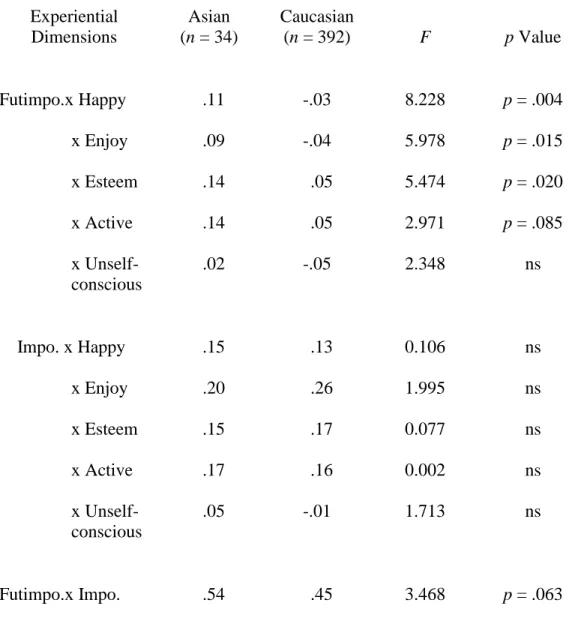
Caucasian American groups. Table II shows the two groups‟ average correlation coefficients between several experiential dimensions. For example, Asian American adolescents‟ perception of importance of activities for their future goals and happiness (Futimpo. x Happy) covaried positively with average of
0.11 correlation coefficient. This means that Asian American adolescents‟ level of happiness was more likely to go up as their level of perceived importance of activities for their future goals went up.
According to the results in Table II, although the correlations among future importance and other experiential dimensions were relatively low for both groups, Asian Americans‟ perception of future importance and happiness (Futimpo. x Happy), enjoyment (Futimpo. x Enjoy), self-esteem (Futimpo. x Esteem), and activeness (Futimpo. x Active) covaried more positively and strongly, as compared to those of Caucasian American adolescents; happiness, F(1,414) = 8.23, p = .004; enjoy, F(1,419) = 5.98, p
= .015; self-esteem, F(1,413) = 5.47, p = .020; and activeness, F(1,413) = 2.97, p = .085 (marginal significance). On the other hand, there was no significant difference between Asian American and Caucasian American groups in average correlation coefficients between adolescents‟ perceived
momentary importance of activities to them and happiness (Impo. x Happy), enjoyment (Impo. x Enjoy), self-esteem (Impo. x Esteem), activeness (Impo. x Active), and unself-consciousness (Impo. x Unself- conscious). This means that if Asian American and Caucasian American adolescents had a similar level of perceived momentary importance of activities, they were more likely to have similar experiences in terms of these experiential dimensions. Moreover, both groups‟ average correlation coefficients between perceived momentary importance and happiness, enjoyment, self-esteem, and activeness, were positive. These are interesting findings because if they perceived activities at hand as important to them at the moment, both Asian American and Caucasian American adolescents were more likely to have positive experiences when engaged in the activities.
Interestingly, however, Caucasian Americans‟ average correlation coefficients between perceived future importance and happiness, enjoyment, self-esteem, and activeness were negative or positive but very small, while those of Asian Americans were all positive (Caucasian Americans‟ correlation coefficients: -.03 for Futimpo. x Happy; -.04 for Futimpo. x Enjoy; .05 for Futimpo. x Esteem; .05 for Futimpo. x Active). It appears that for Caucasian American adolescents "important to their future goals" had somewhat different meaning from “important to them at the moment.” This point may be further supported by the comparison between these two groups on average correlation coefficient between their perceived future importance and perceived momentary importance. Table II indicated
that Asian American adolescents‟ average correlation coefficient between perceived importance for their future goals and perceived momentary importance for them (Futimpo. x Impo.) was relatively larger than that of Caucasian American adolescents (0.54 for Asian Americans and 0.45 for Caucasian Americans);
F(1,421) = 3.47, p = .063 (marginal significance). This means that although the correlation is high for both groups, Asian American adolescents had a stronger tendency to perceive activities that were highly important for their future goals also as highly important to them at the moment, as compared to their Caucasian American counterparts. It appears that Asian American adolescents valued the activities relevant to their future goals more highly, as compared to Caucasian American adolescents.
_____________________
Insert Table II about here _____________________
Quality of Experience When Adolescents Were Alone and Not Alone
In order to examine how the quality of experience of Asian American and Caucasian American adolescents who might have different construals of the self would differ when they were alone and when they were with someone, we classified all ESM responses into situations of being alone and situations of not being alone. Then, we performed a series of ANCOVAs with situation (A: alone vs. not alone) and group (B: Asian vs. Caucasian) as factors on each experiential variable by controlling for the effects of age and SCC. Table III shows the two groups‟ average z scores on the five dimensions of experience in the two situations. The value “zero” for average z score for each experiential variable indicates the weekly average. Thus, for example, if the variable “happy” is positive when being alone, the students feel happier when they are alone than they feel on average during the week. According to the results, there were significant situation effects (A: alone vs. not alone) for the levels of happiness, feeling good about themselves, and activeness. When they were not alone (with someone), both Asian American and Caucasian American adolescents were significantly happier, felt better about themselves, and were more active than when they were alone; happiness, F(1,820) = 43.19, p < .001; feeling good about
themselves, F(1,819) = 5.11, p < .05; and activeness, F(1,820) = 43.24, p < .001. We also found group effects (B: Asian vs. Caucasian) for happiness and unself-consciousness. However, these main effects are an artifact of the procedure for the person level ESM analysis and do not have substantial meanings for the purpose of analyses of this section.3
An interesting pattern that emerged is an interaction effect for the level of happiness. Although both Asian American and Caucasian American adolescents' level of happiness went up as the situations changed from “being alone” to “not being alone,” Asian American adolescents‟ level of happiness improved more dramatically (-0.33 to 0.08) than that of Caucasian American adolescents (-0.11 to 0.03), which caused the significant interaction effect, happiness, F(1,820) = 10.93, p < .001. Moreover, when Asian American adolescents were alone, their levels of happiness was very low, as compared to that of Caucasian American adolescents (-0.33 for Asian Americans and -0.11 for Caucasian Americans).
Another interaction effect was found for the level of unself-consciousness, F(1,728) = 21.88, p < .001.
When they were alone, Caucasian American adolescents were less self-conscious than their weekly average, and when they were with someone, they were more self-conscious than their weekly average.
However, Asian American adolescents‟ level of unself-consciousness changed in an interesting way as the situations changed from “being alone” to “not being alone.” When they were alone, Asian
American adolescents were more self-conscious than their weekly average, and when they were not alone, they were less self-conscious than their weekly average.
A situation effect was also found for the level of unself-consciousness, F(1,729) = 89.96, p
3These main effects were caused by the unbalanced numbers of responses in situations of being alone and situations of not being alone. That is, if the beep level ESM analyses are performed with “z” score, both groups’ average “z” scores should be zero. However, for this study the person level ESM analyses were performed. Thus, for each student, average “z” score of happiness when he was alone and average “z” score of happiness when he was not alone were calculated separately. And if each situation has different number of responses, then situation that has a small number of responses with extremely high values of “z” scores will have more significance than the situation that has a large number of responses with very low values of “z” scores. Suppose that a student responds 5 times when he is alone and his average “z” score of happiness in these situations is -1.0, and that the student also responds 50 times when he is not alone and his average “z” score of happiness in these situations is 0.1. It should logically follow then that this student's average “z” score of happiness over a week is zero.
However, for the person level ESM analysis, average “z” score of happiness when alone and average “z” score of happiness when not alone are calculated separately (average “z” score when alone: -1.0; when not alone: 0.1). Therefore, if we calculate average of these two “z” scores (average “z” score of two situations), it will be (-1.0 + 0.1)/2 = -0.9/2, but not zero. These calculations by SPSS-program for the person level ESM analysis sometimes cause a major main effect, which is seen in this section of analyses.
< .001. Although Asian American and Caucasian American adolescents showed different patterns of unself-consciousness, because of the small sample size of Asian American adolescents, it is likely that the change in the level of unself-consciousness of the whole sample reflected that of the Caucasian American adolescents. In general, adolescents were less self-conscious when they were alone, as compared to when they were not alone.
____________________
Insert Table III about here ____________________
Activities When Adolescents Were Alone and Not Alone
The examination of quality of experience when the adolescents were alone and when they were not alone showed interesting differences between Asian American and Caucasian American adolescents in the levels of happiness and unself-consciousness. As the situations changed from “being alone” to
“not being alone,” Asian American adolescents‟ level of happiness improved more dramatically than that of Caucasian American adolescents. Moreover, when they were alone, Caucasian American
adolescents were less self-conscious than their weekly average, and when they were not alone they were more self-conscious than their weekly average. Interestingly, however, when Asian American
adolescents were alone, they were more self-conscious than their weekly average, and when they were not alone they were less self-conscious than their weekly average.
Some may argue that these differences might have resulted from the fact that Asian American and Caucasian American adolescents were engaged in different kinds of activities in these situations.
Thus, as a next step, we examined what activities these two groups of adolescents were engaged in when they were alone and when they were not alone.
Table IV shows the activities that Asian American and Caucasian American adolescents were engaged in when they were in these situations. When they were alone, about 29% of the time both Asian American and Caucasian American adolescents were engaged in maintenance activities, such as
eating meals, sleeping, personal care, and grooming. However, Asian American adolescents spent more time on studying and hobbies, and less time on TV viewing and socializing (e.g., talking on the phone or writing letters, but no one was around) when they were alone, as compared to Caucasian American adolescents.
When they reported that they were not alone, about 50% of the time both Asian American and Caucasian American adolescents were studying or doing maintenance activities (52.6% for Asian Americans and 47.9% for Caucasian Americans). However, Asian American adolescents spent more time on hobbies, and spent less time on socializing and TV viewing than their Caucasian American counterparts when they were not alone.
_____________________
Insert Table IV about here _____________________
One interesting question to answer here is why Asian American adolescents were more self- conscious than their weekly average when they were alone. Is it because these two groups spent their time on different activities when they were alone‟ or is there any other reason for this outcome? In order to answer this question, we examined adolescents‟ level of unself-consciousness when they were engaged in activities that were more often mentioned by both groups of adolescents when they were alone. These activities include maintenance activities (eating, grooming, personal care, resting,
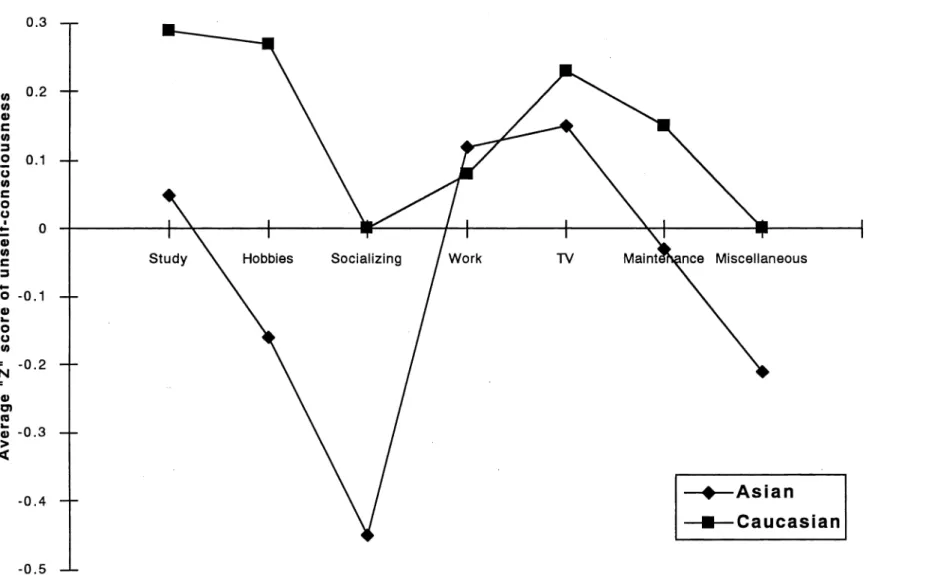
walking from one place to another, sitting, and standing), studying, hobbies, TV viewing, miscellaneous activities (thinking about meaning of life, dying, or religion; daydreaming; crying; waiting; driving; and smoking or using drugs or alcohol), working, and socializing (“socializing when alone” means talking with someone on the phone, or reading or writing letters, but no one is around). Figure 1 shows the average level of unself-consciousness when Asian American and Caucasian American adolescents were engaged in these activities by themselves (alone). The value “zero” for average z score of unself- consciousness indicates the weekly average of the level of unself-consciousness. According to the results, Asian American adolescents were more self-conscious than their weekly average when they were alone, socializing, doing hobbies, doing maintenance activities, and doing miscellaneous activities. On
the other hand, when they were alone and engaged in these activities, Caucasian American adolescents did not become more self-conscious than their weekly average at all. Moreover, Asian American adolescents‟ average level of unself-consciousness was always lower than that of Caucasian American adolescents when they were engaged in these activities by themselves, except when they were working.
It seems that Asian American adolescents‟ high level of self-consciousness when they were alone was not due to the activities they were engaged in, but probably a result of their psychological functioning, which was operative when they were alone.
_____________________
Insert Figure 1 about here _____________________
Quality of Experience When Studying (Alone vs. Not Alone)
The comparison between Asian American and Caucasian American adolescents on the level of unself-consciousness when engaged in the same activities by themselves (alone) suggested that Asian American adolescents‟ high level of self-consciousness when they were alone might be the result of their psychological functioning operative in these situations. We now turn to another interesting topic to examine. That is how physical presence of others would raise the quality of the experience of Asian American adolescents. Although we already found that as situations changed from “being alone” to
“not being alone,” Asian Americans‟ level of happiness went up more dramatically than that of Caucasian American adolescents, it is still possible that the observed pattern resulted from the
differences in the activities these two groups of adolescents were engaged in when they were alone and when they were not alone. Thus, in order to eliminate this possibility, we selected “studying” as a control activity, and examined how the quality of experience of Asian American and Caucasian
American adolescents would differ when they were studying by themselves and when they were studying
in the presence of others. For the purpose, we performed a series of ANCOVAs controlling for the effects of age and SCC with situation (A: alone vs. not alone) and group (B: Asian vs. Caucasian) as factors on each experiential variables. Table V shows the two groups‟ average “z” scores on the five dimensions of experience in the two situations (alone vs. not alone). The value “zero” for average “z”
score for each experiential variable again indicates the weekly average of the experiential dimension.
According to the results, there were significant situation effects (A: alone vs. not alone) for the levels of happiness, feeling good about themselves, and activeness. When they were studying in the presence of others, both Asian American and Caucasian American adolescents were happier, felt better about
themselves, and were more active than when they were studying by themselves (alone); happiness, F(1,623) = 23.12, p < .001; feeling good about themselves, F(1,626) = 8.49, p < .01; and activeness, F(1,624) = 8.66, p < .01.
Another situation effect was also found for the level of unself-consciousness, F(1,560) = 7.11, p
< .01. Although Asian American and Caucasian American adolescents showed different patterns of unself-consciousness, because of the small sample size of Asian American adolescents, it is likely that the change in the level of unself-consciousness of the whole sample reflected that of the Caucasian American adolescents. In general, adolescents were more self-conscious when they were studying in the presence of others, as compared to when they were studying by themselves. An interaction effect was also found for the level of unself-consciousness, F(1,560) = 8.98, p < .01. While Asian American adolescents‟ level of unself-consciousness did not change much as the situations changed from “studying alone” to “studying not alone (in the presence of others),” Caucasian American adolescents' level of unself-consciousness dropped dramatically (0.29 to -0.13) as the situations changed.
Main effects for group (B: Asian vs. Caucasian) were also found for happiness and enjoyment.
However, as pointed out before, these main effects are an artifact of the procedure for the person level ESM analysis and do not have substantial meanings for the purpose of analyses of this section. Thus, no interpretations will be given here (see footnote 3).
The most interesting patterns that emerged in these analyses are interaction effects for the levels of happiness and feeling good about themselves. Although both Asian American and Caucasian
American adolescents‟ levels of happiness and feeling good about themselves went up as the situations changed from “studying alone” to “studying with others,” Asian American adolescents‟ levels of happiness and feeling good about themselves improved more dramatically (happiness: -0.46 to 0.09;
feeling good about themselves: -0.32 to 0.14) than those of Caucasian American adolescents (happiness:
-0.46 to -0.22; feeling good about themselves: -0.07 to -0.04), which caused the interaction effects for happiness; F(1,623) = 3.77, p = .053 (marginal significance) and feeling good about themselves;
F(1,626) = 6.77, p < .05. It appears that when studying, the physical presence of others helped raise Asian American adolescents‟ levels of happiness and self-esteem (feeling good about themselves) more than those of Caucasian American adolescents.
_____________________
Insert Table V about here _____________________
DISCUSSION
This study attempted to examine a possible mechanism for the high academic success of Asian Americans adolescents. Based on the theories of the self and internalization, we suggested that Asian American adolescents, who are more likely to have a strong tendency toward connectedness to
significant others, would more easily internalize educational values of their parents, and as a result, they would attain academic excellence. Although we still cannot draw a decisive conclusion concerning this possible scenario, we found interesting differences between Asian American and Caucasian American adolescents in their psychological functioning, which may open the door to further investigation into the reasons for the high academic achievements of Asian Americans.
First of all, this study appears to suggest that Asian American adolescents were more likely to have internalized values that emphasize the importance of achievement, relative to their Caucasian American counterparts. The results indicated that Asian Americans‟ perception of future importance and happiness, enjoyment, self-esteem, and activeness covaried more positively and strongly than those
of Caucasian American adolescents. This means that if the level of perceived importance to future goals goes up, Asian Americans‟ levels of happiness, enjoyment, self-esteem, and activeness also go up in a stronger manner, as compared to those of Caucasian Americans. As mentioned earlier, Deci and Ryan (1985) argued that people with an advanced level of internalized regulations engage in relevant activities more willingly and have a more positive experience. Thus, Deci and Ryan‟s description of people with internalized motives appears to apply more to Asian American adolescents than to
Caucasian American adolescents in situations that are relevant to the future.
This point might be further supported by the examination on how adolescents‟ perception of future importance covaried with their perception of momentary importance in their daily activities over a week. According to the results, although the correlation is high for both groups, Asian American adolescents‟ average correlation coefficient between perceived importance to their future goals and perceived momentary importance to them was relatively larger than that of Caucasian American adolescents. That is, Asian American adolescents‟ perception of importance to their future goals and perception of momentary importance covaried positively and more strongly than those of Caucasian American adolescents. It appears that Asian American adolescents had a stronger tendency to perceive activities that were highly important for their future goals as highly important to them at the moment as well, as compared to their Caucasian American counterparts. This is probably another indication that Asian American adolescents had a strong inner sense of achievement.
Ryan and his colleagues provide us with a theoretical framework to further explore the possibility that the internalization is an important factor for promoting Asian Americans‟ academic success.
According to the motivation theorists, the process of internalization is promoted by the three basic psychological needs for autonomy, competence, and relatedness. Although the first two factors are important for promoting the process of internalization, it is the need for relatedness that provides a major impetus for that process (Deci and Ryan, 1985). Moreover, internalization can be a function of the need for relatedness (Parsons, 1952; Ryan, 1991; Ryan, Connell, and Grolnick, 1992). That is, if a child feels related to his or her significant others, he or she will be more likely to identify with, and thus, internalize the beliefs, values, and behavioral styles of the significant others. Therefore, if Asian
American adolescents were more likely to have the interdependent self with a relatively strong tendency to seek connectedness to others, they would probably more easily internalize the values of those with whom they would like to feel connected.
To examine whether the Asian American adolescents in this sample are such people who have the interdependent self, we compared their subjective experiences with those of the Caucasian American adolescents when they were alone and when they were not alone. According to the results, although both Asian American and Caucasian American adolescents‟ level of happiness improved as the situations changed from “being alone” to “not being alone,” Asian American adolescents‟ level of happiness went up more dramatically than that of the Caucasian American adolescents. Moreover, when Asian American adolescents were alone, their levels of happiness were very low, as compared to their Caucasian American counterparts. It seems that solitary situations are much more detrimental for Asian American adolescents than Caucasian American adolescents. In summary, the physical presence of others appears to affect the level of happiness of Asian American adolescents more strongly than that of Caucasian American adolescents.
However, some may argue that the observed pattern might have resulted from the differences in the activities these two groups were engaged in when they were alone and when they were not alone. In order to eliminate the possibility, we selected “studying” as a control activity, and examined how the quality of experience of Asian American and Caucasian American adolescents would differ when they were studying by themselves and when they were studying in the presence of others. Interestingly, even after controlling for the effect of activities, the presence of others affected more positively the quality of experience of Asian American adolescents than that of Caucasian American adolescents. With regard to these findings, Markus and Kitayama (1991) cited Lebra‟s argument about the Japanese (1976) as an example of how people with interdependent self function. As pointed out above, according to Lebra, the Japanese are most “fully human” when they are in the context of others. Even mere physical togetherness without emotional closeness provides some sense of belongingness to the Japanese. This sense of belongingness in turn energizes them to feel more fully human. Although Asian American adolescents in this study include many other Asian groups besides the Japanese, their reported pattern of
quality of experience, especially the level of happiness, seems to fit the functioning of people with interdependent selves described by Markus and Kitayama. It is as if our Asian American adolescents were “fully functioning” as interdependent selves in the context of others.
Another interesting pattern was seen in the level of self-consciousness. When they were alone, Asian American adolescents were more self-conscious than their weekly average, while Caucasian American adolescents were less self-conscious than their weekly average. On the other hand, when they were not alone (in the presence of others), Asian American adolescents were less self-conscious than their weekly average, while Caucasian American adolescents were more self-conscious than their weekly average. An intriguing and relevant question to ask here is why Asian American adolescents were more self-conscious than their weekly average when they were alone. To answer this question, we examined the level of unself-consciousness when adolescents were doing activities that both groups of adolescents were engaged in often when they were alone. According to the results, Asian American adolescents were more self-conscious than their weekly average when they were socializing, doing hobbies, and engaging in maintenance activities and miscellaneous activities. Interestingly, however, Caucasian American adolescents on average did not become more self-conscious than their weekly average when they were engaged in any of these activities by themselves. Moreover, Asian American adolescents‟ average level of unself-consciousness was always lower than that of Caucasian American adolescents when they were engaged in these activities by themselves, except when they were working.
It appears that Asian American adolescents have a tendency to become relatively more self-conscious when they are alone than when they were not alone. This pattern may suggest another characteristic of Asian American adolescents‟ psychological functioning. It is said that people with interdependent selves are more likely to have a tendency to seek harmonious interdependence among individuals by
“attending to and fitting in with others.” Thus, it might be the case that even when they were alone, Asian American adolescents were evaluating or reflecting on their activities and thoughts based on others‟ expectations or opinions in certain situations. In other words, Asian American adolescents might create more interpersonal situations psychologically and, as a result, they became relatively more self-conscious even when they were alone. This argument may also suggest why Asian American
adolescents were relatively less self-conscious when they were in the presence of others. When they were with others, Asian American adolescents were functioning by more naturally and more
automatically attending to and fitting in with others‟ desires and expectations without losing the flow of consciousness, and thus they could be focusing more on the activities at hand, as compared to Caucasian American adolescents. As a result, they were relatively less self-conscious in the presence of others.
Relating to this discussion, Chang (1996) reported that the heightened pessimism of Asian American college students was positively associated with their employment of greater problem solving coping strategies, whereas the reverse was true for their pessimistic Caucasian American counterparts.
From a clinical standpoint, the researcher urged caution for assessing Asian Americans to differentiate depressive from nondepressive but pessimistic patients, because pessimism is usually considered as a strong index of clinical depression. Although the Asian Americans‟ heightened self-consciousness reported in our study and the Asian Americans‟ heightened pessimism in the Chang‟s study are somewhat different psychological tendencies of the cultural group, an underlying psychological
functioning may be quite similar. In other words, those psychological tendencies of Asian Americans may be the secondary processes of their much deeper psychological functioning of directing attention inwardly and evaluating own activities and thoughts based on others‟ criteria and expectations.
Because they are more likely to evaluate themselves not by their own criteria but by others‟ in certain situations, they tend to become self-conscious and pessimistic in their daily lives. Although this argument needs further research, the findings of this study, at least, appear to suggest that Asian American adolescents have some characteristics of people with the interdependent self. The ways in which Asian American adolescents‟ levels of happiness and self-consciousness changed appeared to reflect their tendency to find ways to function in connection with others.
In summary, the ESM analyses of this study seem to suggest two things: (a) Asian American adolescents value activities related to their future goals more highly than Caucasian American adolescents, and (b) Asian American adolescents have some characteristics of those who have the interdependent self. Then, what do these findings tell us about how Asian American adolescents can achieve academic excellence? As discussed before, education and high achievement are highly valued
in Asian cultures and are emphasized through parental socialization. Indeed, our Asian American parents expected their children to attend a higher level of school after graduating from college on average and their children also expected themselves to continue to study beyond college education (Asakawa and Csikszentmihalyi, 1998b). Moreover, the Asian American parents were more likely to decide whether their children should go to college and also discussed ACT/SAT plans and preparation with their children more often, as compared to their Caucasian American counterparts (Asakawa and Csikszentmihalyi, 1998a). Although we administered no instrument to measure educational values of the parents, it appears that the Asian American parents valued academic achievement very highly.
Thus, if our Asian American adolescents had a stronger tendency to seek connectedness to their
significant others, it may be possible that they would relatively easily internalize the educational values of their parents, with whom they would like to feel connected. And this may be a scenario that explains the high academic achievements of Asian Americans.
Although this study did not go beyond suggesting the internalization as an important factor for Asian Americans‟ academic success and how it works, the mechanism we proposed may be supported by the interviews with the Asian American adolescents of this sample. The interviews clearly show that Asian American adolescents‟ academic motivation and future goals were strongly affected by their special feelings toward their parents. For example, when a female twelfth grade Asian American was asked whether schoolwork related to her future, she answered, “Definitely. I enjoy school a lot, and I do have ambition, and I think an education is very important [for] my future goals. I like school.” To a question: “How important are your goals to you right now?”, she told us, “Extremely important.
That‟s one of the major reasons that I tried to do well in school, to be honest.” It seems that this
student has a strong inner sense of the importance of education and high achievement. Moreover, when she talked about her mother, the student said, “She [mother] expects the best out of me, and I can‟t blame her because, I mean, she's worked really hard to get me where I am and to pay for college and I definitely want to make her happy and I do want to excel for her and for me. ... She wants me to work, definitely, go to college, and that’s what I want.” It appears that her academic motivation has been shaped through her relationship with her mother, and her feelings toward her mother seem to have
encouraged favorable attitudes toward academics.
Another male twelfth grade Asian American student‟s attitudes toward academics and desires for success in his future career also appear to be shaped by his strong feelings toward his parents. In fact, his attitudes toward schoolwork clearly reflected his parents‟ values relevant to the importance of
education. When he was asked how school related to his future, he answered, “All right, well, school‟s gonna help me determine if I get a good job or not. That‟s what, how I feel. Like if I do well in school, I don‟t know, that‟s something my parents taught me, maybe that‟s why I kinda believe, that‟s why I tend to believe „em that if you do well in school, you‟ll probably depending on, you‟ll probably have a better opportunity getting a better job.” And indeed he was doing very well in school. When asked how his parents helped him, he expressed his special feelings toward his parents in a similar way other Asian American students also did to show their appreciation for their parents‟ hard work. He said,
“Yeah, they, well, well, they don‟t help me out on my homework, but I know they work really, really hard, and they work really late hours just so that they can save up enough money for my going, for me going to college, I guess that‟s a lot, I consider that a lot of help.” Moreover, when he talked about his parents, he said, “... I wanna, I wanna be able to like make enough money so that my parents won‟t have to work. So they, they can like feel free to not do anything, „cuz they, they work really hard, and I can see why I have to do a lot better. ... Well, my parents want me to do the best, they don‟t really expect me to oh, when I grow up to work or get so much money that you don‟t have to work. They don‟t want to be like that. But I want it, but I want to like be able to like, like make, like be so successful that they won‟t have to do anything at all.... They do too much already.” This male Asian American student‟s attitudes and motivation toward schoolwork and future success clearly have their origins in his feelings toward his parents. His desire to succeed in school, as well as in his future career, is not only for himself, but also for his parents.
Although these excerpts are from interviews with two Asian American students, the importance of education and achievement, as well as strong feelings about making their parents happy or working hard for their parents, are pervasive themes in the interviews with the Asian American adolescents in this sample. Here we clearly see that Asian American adolescents‟ strong feelings toward their parents had
been playing a very important role in shaping their motivation and attitudes toward academics as well as their future goals. Moreover, those special feelings of Asian American adolescents are the kind that was not observed in the interviews with the Caucasian American adolescents of this study. Thus, it may not be so difficult to imagine that the Asian American adolescents‟ strong feelings toward their parents are originated from their self-conceptions and tendencies to seek connectedness to their parents.
This study proposed a possible process that explains how Asian American adolescents achieve academic excellence. Although this attempt appears to be too preliminary to draw a decisive
conclusion, the authors believe that further investigation on the internalization of parents‟ values relevant to education by Asian American children will facilitate a deeper understanding of the connection between cultures and academic success of Asian Americans.
Finally, it is necessary to consider in what way the limitations of this study must induce caution in the interpretation of its results. First, we did not administer any instruments to measure Asian American adolescents‟ levels of acculturation to American culture and the length of being in the United States.
Thus, although we attempted to obtain a culturally uniform sample of Asian Americans by using their first languages as a criterion for sample selection, our Asian American sample could possibly include those with diverse degrees of acculturation to the mainstream American society. Second, we treated diverse ethnic groups under one heading of the Asian American based on the theoretical assumption elaborated by Markus and Kitayama (1991), but there may be much variation within the Asian American sample. This possibility should have been tested. However, a very small sample size of our Asian American students made it difficult to disaggregate the different Asian Americans and to test the possibility. Therefore, one should exercise caution in generalizing our findings obtained from the diverse Asian American sample to all Asian American students.
ACKNOWLEDGMENTS
We wish to thank Dr. Charles Bidwell, Dr. Larry Hedges, and Dr. Barbara Schneider for their helpful comments and advice on earlier versions of this article. We also thank the entire Sloan Project
members for their help in organizing the study, and collecting and coding the data. Finally, the first author wishes to give special thanks to Dr. Laszlo Cseresnyesi at Shikoku Gakuin University for his helpful suggestions and comments on this work.
REFERENCES
Asakawa, K. (1995). The quality of experience and internalization of values of Asian American adolescents. Paper presented at the annual meeting of the American Educational Research Association, San Francisco.
Asakawa, K., and Csikszentmihalyi, M. (1998a). The quality of experience of Asian American adolescents in activities related to future goals. Journal of Youth
and Adolescence, 27: 141-163.
Asakawa, K., and Csikszentmihalyi, M. (1998b). The quality of experience of Asian American adolescents in academic activities: An exploration of educational achievement. Journal of Research on Adolescence, 8: 241-262.
Bidwell, C. E., Csikszentmihalyi, M., Hedges, L., and Schneider, B. (1992). Studying Career Choice, Volume I: Overview and Analysis. Ogburn-Stouffer Center,
NORC, Chicago.
Bureau of the Census. (1993). Social and Economic Characteristics: 1990 Census of Population. U.S. Department of Commerce, Washington, DC.
Chang, E. C. (1996). Cultural differences in optimism, pessimism, and coping:
Predictors of subsequent adjustment in Asian American and Caucasian American college students. Journal of Counseling Psychology, 43: 113-123.
Csikszentmihalyi, M., and Larson, R. (1984). Being Adolescent: Conflict and Growth in the Teenage Years. Basic Books, New York.
Csikszentmihalyi, M., and Larson, R. (1987). Validity and reliability of experience- sampling method. Journal of Nervous and Mental Diseases, 175: 526-536.
Csikszentmihalyi, M., Larson, R., and Prescott, S. (1977). The ecology of adolescent activity and experience. Journal of Youth and Adolescence, 6: 281-294.
Deci, E. L., and Ryan, R. M. (1985). Intrinsic Motivation and Self-determination in Human Behavior. Plenum, New York.
Deci, E. L., and Ryan, R. M. (1987). The support of autonomy and the control of behavior. Journal of Personality and Social Psychology, 53: 1024-1037.
Deci, E. L., Vallerand, R. J., Pelletier, L. G., and Ryan, R. M. (1991). Motivation and education: The self-determination perspective. Educational Psychologist, 26
(3 and 4): 325-346.
DeVos, G. (1985). Dimensions of the self in Japanese culture. In Marsella, A. J., DeVos, G. and Hsu, F. L. K. (eds.), Culture and Self. (pp. 141-184). Tavistock, New York.
Hsu, F. L. K. (1985). The self in cross-cultural perspective. In Marsella, A. J., DeVos, G. and Hsu, F. L. K. (eds.), Culture and Self. (pp. 24-55). New York: Tavistock.
Ima, K. and Rumbaut, R. G. (1989). Southeast Asian refugees in American schools:
A comparison of fluent-English-proficient and limited-English-proficient student. Topics in Language Disorder, 9: 54-75.
Kitano, M. K. (1984). Early education for Asian-American children. In Saracho, O.
N., and Spodek, B. (eds.), Understanding the Multicultural Experience in Early Childhood Education. National Association for the Education of Young Children, Washington, DC.
Kondo, D. (1982). Work, Family and the Self: A Cultural Analysis of Japanese Family Enterprise. Unpublished doctoral dissertation, Harvard University.
Larson, R., and Csikszentmihalyi, M. (1983). The experience sampling method. In Fiske, D. W., and Reis, H. T. (eds.), Naturalistic Approaches to Studying Social Interaction (pp. 41-56). Jossey-Bass, San Francisco.
Lebra, T. S. (1976). Japanese Patterns of Behavior. University of Hawaii Press,
Honolulu.
Markus, H. R., and Kitayama, S. (1991). Culture and self: Implications for cognition, emotion, and motivation. Psychological Review, 98: 224-253.
Mordkowitz, E. R., and Ginsburg, H. P. (1987). Early academic socialization of successful Asian- American college students. The Quarterly Newsletter of the Laboratory of Comparative Human Cognition, 9: 285-91.
Parsons, T. (1952). The superego and the theory of social systems. Psychiatry, 15: 15- 25.
Ryan, R. M. (1991). The nature of the self in autonomy and relatedness. In Strauss, J., and Goethals, G. R. (eds.), The Self: Interdisciplinary Approaches (pp. 208- 238). Springer-Verlag, New York.
Ryan, R. M., and Connell, J. P. (1989). Perceived locus of causality and
internalization: Examining reasons for acting in two domains. Journal of Personality and Social Psychology, 57: 749-761.
Ryan, R. M., Connell, J. P., and Grolnick, W. S. (1992). When achievement is not intrinsically motivated: A theory and assessment of self-regulation in school.
In Boggiano, A. K., and Pittman, T. S. (eds.), Achievement and Motivation: A Social-Developmental Perspective (pp. 167-188). Cambridge University Press, Cambridge.
Ryan, R. M., and Powelson, C. L. (1991). Autonomy and relatedness as fundamental to motivation and education. Journal of Experimental Education, 60: 49-66.
Shweder, R. A., and Bourne, E. J. (1984). Does the concept of the person vary cross- culturally? In Shweder, R. A., and LeVine, R. A. (eds.), Culture Theory: Essays
on Mind, Self, and Emotion (pp. 158-199). Cambridge University Press, Cambridge.
Sue, S., and Kitano, H. (1973). Stereotypes as a measure of success. Journal of Social Issues, 29: 83- 98.
Sue, S., and Okazaki, S. (1990). Asian-American educational achievements: A phenomenon in search of an explanation. American Psychologist, 45: 913-920.
Vernon, P. E. (1982). The Abilities and Achievements of Orientals in North America.
Academic Press, New York.
Table I. Characteristics of Asian and Caucasian Groups
Variable
Asian (n = 34)
Caucasian
(n =392) Chi-Square p Value df
Gender (%)
Male 50 45 0.33 NS (.57)
Female 50 55 df = 1
Age (%)
6th 12 26 11.50 p < .01
8th 21 27 df = 3
10th 26 29
12th 41 18
Family composition (%)
Both mother and fathera 71 71 0.005 NS (.94)
Other 29 29 df = 1
Social Class of Community (%)b
Lower class 2.9 1.3 29.49 p < .001
Working class 2.9 23.5 df = 4
Middle class 20.6 30.9
Upper middle class 67.6 25.8
Upper class 5.9 18.6
aFamilies that consist of mothers and fathers who are not divorced, separated, or remarried.
bSocial class of community is the census characteristics of the neighborhood in which adolescents live. This information is obtained from the 1990 census.
Table II. How Do the Experiential Dimensions Co-vary in Each Person? (Comparison between Asian American and Caucasian American Groups on Average Correlation Coefficient between Two
Experiential Dimensions)a Experiential
Dimensions
Asian (n = 34)
Caucasian
(n = 392) F p Value
Futimpo.x Happy .11 -.03 8.228 p = .004
x Enjoy .09 -.04 5.978 p = .015 x Esteem .14 .05 5.474 p = .020 x Active .14 .05 2.971 p = .085 x Unself-
conscious
.02 -.05 2.348 ns
Impo. x Happy .15 .13 0.106 ns
x Enjoy .20 .26 1.995 ns
x Esteem .15 .17 0.077 ns x Active .17 .16 0.002 ns x Unself-
conscious
.05 -.01 1.713 ns
Futimpo.x Impo. .54 .45 3.468 p = .063
aValues represent correlation coefficient between two experiential dimensions.
Futimpo. = students‟ perceived importance to their future goals, Impo. = students‟ perceived importance to them at the moment, Esteem = feeling good about themselves.
Table III. Quality of Experience When Alone and Not Alonea
Situation
Alone Not alone ANCOVA
Happy
Asian -0.33 0.08 A p < .001 Caucasian -0.11 0.03 B p < .05
A x B p < .001 Enjoy
Asian -0.04 0.03
Caucasian 0.01 -0.01 NS
Feel good
Asian -0.10 0.05
Caucasian -0.04 0.02 A p < .05 Active
Asian -0.24 0.09
Caucasian -0.22 0.08 A p < .001 Unself-conscious
Asian -0.10 0.02 B p < .01 Caucasian 0.18 -0.06 A x B p < .001
aReported p levels are the results of 2 x 2 ANCOVAs, controlling for the effects of age and social class of community, with Situation (A) and Group (B) as factors. Asian n = 34, Caucasian n = 392.