九州大学学術情報リポジトリ
Kyushu University Institutional Repository
A taxonomic study of Lithocarpus (Fagaceae) in Vietnam based on molecular phylogeny and
morphological observations
グエン, ヴァン, ゴック
https://doi.org/10.15017/1931742
出版情報:九州大学, 2017, 博士(理学), 課程博士 バージョン:
権利関係:
KYUSHU UNIVERSITY
Graduate school of Systems Life Sciences
Ph.D. Thesis
A taxonomic study of Lithocarpus (Fagaceae) in Vietnam based on molecular phylogeny
and morphological observations
Author: Nguyen Van Ngoc
Supervisor: Professor Tetsukazu Yahara Study: Botany Ecology
Fukuoka, 2018.03
0
1 Contents
Pages
Preface ... 3
Acknowlegement ... 5
Abstract ... 7
Chapter I: Lithocarpus dahuoaiensis (Fagaceae), a new species from Lam
Dong Province, Vietnam. ... 9
Introduction ... 9
Materials and Methods ... 11
Taxonomy ... 11
Acknowledgements ... 13
References ... 14
Legends ... 16
Chapter II: Two new species of Lithocarpus (Fagaceae) from Bidoup-Nui Ba
National Park, Vietnam. ... 20
Introduction ... 20
Materials and Methods ... 21
Results ... 24
Discussion ... 25
Taxonomic treatment ... 26
Acknowledgements ... 29
References ... 31
Legends ... 35
Chapter III: Lithocarpus vuquangensis (Fagaceae), a new species from Vu
Quang National Park, Vietnam ... 46
Introduction ... 46
Material and Methods ... 47
Results ... 49
2
Discussion ... 50
Taxonomy ... 51
Acknowledgements ... 53
References ... 54
Legends ... 58
Chapter IV: A taxonomic study of Lithocarpus vestitus complex (Fagaceae)
based on next-generation sequencing and morphological observation. ... 63
Introduction ... 63
Material and Methods ... 65
Results ... 68
Discussion ... 70
Key to species of L. vestitus complex ... 72
Taxonomic treatment ... 73
Acknowledgements ... 79
References ... 81
Legends ... 85
Chapter V: A taxonomic study of Lithocarpus elegans, L. hancei and its
relatives (Fagaceae) in Southeast Asia, based on next generation DNA barcodes and morphological observations. ... 93
Introduction ... 94
Material and Methods ... 96
Results ... 101
Discussion ... 104
Key to the species of L. elgans complex and L. hancei complex ... 110
Toxonomic treatment ... 111
Acknowledgements ... 124
References ... 126
Legends ... 131
3 Preface
This dissertation is the main outcome of my doctoral program under the supervision of Professor Tetsukazu Yahara in Laboratory of Ecological Science, Graduate School of Systems Life Sciences, Kyushu University. This research was granted by Project no. 911 of Vietnam International Education and Development (VIED), Ministry of Education and Training of Vietnam and also supported by the Environment Research and Technology Development Fund (S9, 4-1601) of the Ministry of the Environment, Japan.
My study focuses on the taxonomic study of Lithocarpus (Fagaceae) in Vietnam based on molecular phylogeny and morphological observations using our new collections from Vietnam and its surrounding countries. Through five chapters of this thesis, I reviewed three complexes of Lithocarpus, L. elegans complex, L. hancei complex, and L.
vestitus complex and recognized nine new species. The photographs, illustrations, DNA barcodes of the sequences of rbcL, matK and ITS, and preliminary conservation assessments are provided for these new species. In addition, eight species are lectotypified in this study.
In Chapter I, I report Lithocarpus dahuoaiensis Ngoc & L.V.Dung which we discovered from our field surveys in Lam Dong Province, Central Highland of Vietnam.
This new species was published in the PhytoKeys (doi: 10.3897/phytokeys.69.9821).
In Chapter II, I report two new species, Lithocarpus hongiaoensis Ngoc & Binh and Lithocarpus bidoupensis Ngoc & Tagane, which were found during our floristic inventories in Bidoup-Nui Ba National Park, Lam Dong Province in 2015–2016.
In Chapter III, I report Lithocarpus vuquangensis Ngoc & Hung from Vu Quang National Park, North Central of Vietnam. It was recognized by the morphological comparison and phylogenyetic study based on rbcL, matK and ITS.
In Chapter IV, I examine the taxonomy of the Lithocarpus vestitus complex and its close relatives in Vietnam, Laos, Cambodia, and Thailand using our field observations,
4 morphological studies of dried specimens in various herbaria, and molecular analyses. In our molecular approach, we employed genome-wide sequences obtained using next- generation sequencing (MIG-seq; Suyama and Matsuki 2015) to reconstruct phylogenetic relationships among species in the L. vestitus complex. Based on the evidence from morphological observations and the MIG-seq-based phylogenetic tree, we recognized 13 species in the L. vestitus complex in the four countries including three new species: L.
chinhii Ngoc & Binh, L. pierreioides Ngoc, Tagane & Yahara, and L. pseudoannamensis Ngoc & Binh.
In Chapter V, I describe results from molecular phylogenetic analyses and morphological observations and revise the taxonomy of the Lithocarpus elegans complex, the L. hancei complex and their closely related species in Southeast Asia. The results supported that six and four species are distinguished in the L. elegans complex and the L.
hancei complex, respectively. In the L. elegans complex, two new species, L. bokorensis Ngoc, Tagane & Yahara, and L. monoromensis Ngoc, Tagane & Yahara. were recognized from Cambodia.
Nguyen Van Ngoc Graduate School of Systems Life Sciences, Kyushu University 2018/01
5 Acknowledgments
I would like to express my sincere gratitude to many people; without their precious supports, it would be impossible to complete my research or perhaps even start it. First of all, I would like to thank Dalat University and Vietnam International Education and Development (VIED), that provided me an excellent opportunity to study overseas in Japan.
Dedicated to my “Sensei”, Prof. Tetsukazu Yahara, his great personality and the conscientiousness in science has an enormous influence on my research career not only in the present but also in the future. I would like to thank him for his immense knowledge, insightful guidance, and encouragement as well as his teaching on many things from methods of data analyses to skills of technical writing in all the time of research.
In particular, I am grateful to Dr. Shuichiro Tagane, Dr. Hironori Toyama, and Ms.
Keiko Mase in the Center for Asian Conservation Ecology, Faculty of Science who gave me kind help on many academic activities such as botanical inventories, collecting specimens, identifying the plant species, examining specimens at herbaria, and laboratory works as well as a lot of invaluable comments on my manuscripts. Also, with their help, my living in Japan was more comfortable and enjoyable.
Great thanks should be given also to my coleagues in the following institution:
Biology Department of Dalat University, Institute of Ecology and Biological Resources, Institute of Tropical Biology, Vietnamese Academy of Forest Sciences, Vietnam National University of Forestry and various of National Park in Vietnam. I could not get enough specimens for my project without their support in the field survey and collecting specimens.
Special thanks are also extended to Prof. Yoshihisa Suyama and Dr. Mituyuki Chika from Kawatabi Field Science Center, Graduate School of Agricultural Science, Tohoku University for their help during the MIG-seq analysis and helpful comments on my manuscripts. Also, I would like to thank Dr. Joeri Sergej Strijk of College of Forestry,
6 Guangxi University, China for his examination of specimens in the Muséum national d'Histoire naturelle (P) and his invaluable comments on all of my manuscripts. I must express my sincere thanks to Prof. Hidetosi Nagamasu of The Kyoto University Museum, Kyoto University and Dr. Akiyo Naiki at Tropical Biosphere Research Center, University of the Ryukyus, Japan for their collaborations during the fieldworks and in writing articles by making many meaningful comments on my manuscripts.
My sincere thanks also go to all of Professors, Assistant Professors, Posdoctoral fellows, and labmates at Laboratory of Ecological Sciences, Kyushu University for their kind help, stimulating discussions, helpful comments and all the fun we had throughout my course work. I wish to thank Ms. Hiromi Murakami in Prof. Yahara’s office and the staffs of the Department of Biology, Facluty of Science, and Graduate School of Systems Life Sciences for providing much assistance on a series of procedures during the course of this study.
Most importantly, my special thanks are due to my dearest family: my parents and my sisters for their love, spiritual encouragement, and infinite support to me. Millions of thanks should be given to my special friend – my wife, who always be my side, providing constant care, encouragement, and support, and sharing pleasures throughout our time in Japan.
Nguyen Van Ngoc Graduate School of Systems Life Sciences, Kyushu University 2018/01/12
7 Abstract
Lithocarpus is the second largest genus of the family Fagaceae, with approximately 350 species in the world. The centre of species diversity is mainly in continental Southeast Asia, especially in China (123 spp.) and Vietnam (117 spp.). In Vietnam, almost all the species of Lithocarpus were described by French botanists until 1920s and some other were until 1950s. Since then, the taxonomic inventories of Lithocarpus in Vietnam were disrupted until recently. Therefore, updating our taxonomic knowledge on the species of Lithocarpus using new collections and new techniques such as phylogenetic analysis based on DNA markers are required.
In this dissertation, our morphological observations and molecular phylogenetic analyses based on both classic DNA sequencing of two cpDNA (rbcL and matK) and one nrDNA (ITS) regions and multiplexed inter-simple sequence repeat genotyping by sequencing (MIG-seq) were employed to revise three complexes of Lithocarpus in Vietnam: L. elegans complex, L. hancei complex, and L. vestitus complex.
The NJ tree based on MIG-seq data provided the evidence of species delamination. Among species of the L. elegans complex, L. blaoensis was clustered not with the other species of the L. elegans complex and more close to the L. hancei complex.
Three other species previously reduced to or identified as L. elegans were distinct and an additional new species was confirmed. Thus, “L. elegans s. lat.” previously considered as a widespread polymorphic species included at least five distinct species.
In the L. hancei complex, both the MIG-seq tree and a population genetic analysis supported that it includes at least three distinct species. However, there was no diagnostic morphological difference between L. hancei and L. jacksonianus in spite that the two species co-occur in the same habitat of northern Vietnam. The third species L. yersinii distributed in souther Vietnam was morphologically distinct.
8 In the L. vestitus complex, the MIG-seq tree and morphological observations showed that “L. vestitus s. lat.” previously considered as a widespread polymorphic species included many cryptic species. As a result, we recognized 13 distinct species including three new species.
Through our study, nine new species are recognized and described: L.
bidoupensis, sp. nov., L. chinhii, sp. nov., L. dahuoaiensis sp. nov., L. hongiaoensis, sp.
nov., L. pseudoannamensis, sp. nov., and L. vuquangensis, sp. nov. from Vietnam, and L.
bokorensis, sp. nov. L. monoromensis, sp. nov., and L. pierreioides, sp. nov. from Cambodia. The photographs, illustrations, DNA barcode sequences, and the description of preliminary conservation status are also provided for the new species. Additionally, eight species are lectotypified in this study.
By applying both molecular and morphological approaches, we could resolve a long-standing problem on the taxonomy of polymorphic species complexes of Lithocarpus in Vietnam.
9 Chapter I
Lithocarpus dahuoaiensis (Fagaceae), a new species from Lam Dong Province, Vietnam
Abstract
Lithocarpus dahuoaiensis Ngoc & L.V. Dung, a new species from the Central highland of Vietnam, is described and illustrated. The new species is morphologically similar to Lithocarpus macphailii (M. R. Hend.) Barnett or Lithocarpus encleisocarpus (Korth.) A. Camus in having completely entire leaf margin, solitary cupule, long stalks of fruits, deeply cup-shaped or turbinate cupules, with a number of horizontal filiform lines.
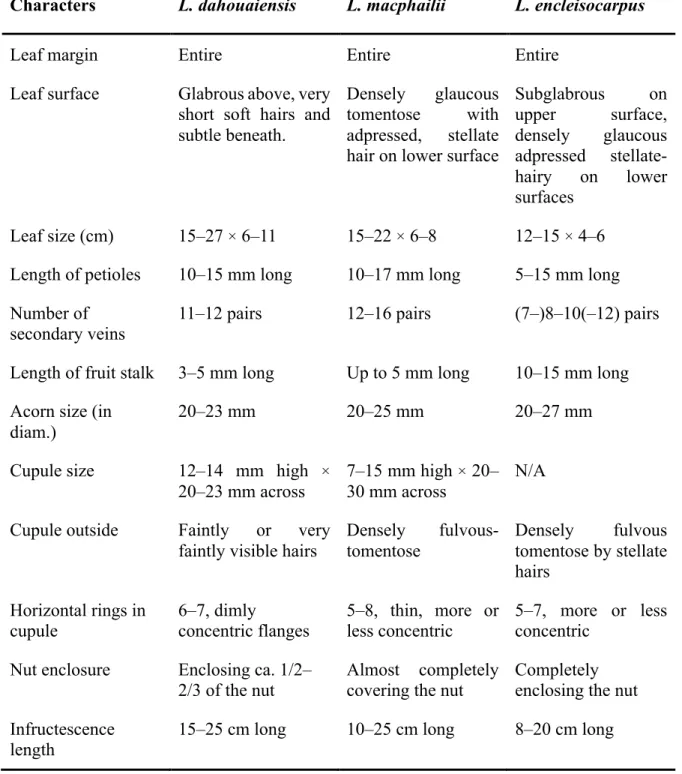
The species differs in its nut enclosure ca. 1/2 – 2/3 of the nut, adaxially glabrous leaf blades, secondary veins 11–12 pairs and faintly to very faintly visible hairs on the outside of the cupule. A table showing the morphological comparison of Lithocarpus dahouaiensis with Lithocarpus macphailii and Lithocarpus encleisocarpus is also provided.
Key words
Da Huoai, Fagaceae, Lam Dong Province, Lithocarpus, Lithocarpus dahuoaiensis, Vietnam
Introduction
Lithocarpus Blume is the second largest genus of the family Fagaceae, comprising 341 species (The Plant List 2013). The genus is commonly known as Stone Oaks and widely distributed throughout the tropical and sub-tropical broad-leaved evergreen forests in East and Southeast Asia, extending to New Guinea (Cannon 2001, Phengklai 2008). In North America, one species of Lithocarpus, L. densiflorus (Hook. & Arn.) had been known, but has recently been treated as a member of a new monotypic genus Notholithocarpus (Manos et al. 2008). The center of diversity is in East to Southeast Asia, where 123 species
10 are enumerated in China (Huang et al. 1999), 58 species in Thailand (Phengklai 2008, Strijk et al. 2014) and 115 species in Vietnam (Ban 2005, Ho 2003).
In Vietnam, the species of Fagaceae are highly diversified and can be seen in various forest types, from dry evergreen forest at lowland to montane evergreen forest at high mountains. A total of 216 species and two varieties in six genera have been recorded in the country (Ho 1999, Ban 2005, Linh et al. 2013, Vuong and Xia 2014), which represents 66% of the total world genera and 24% of the total world species diversity in this family. One species of Fagus L., two species of Castanea Mill, 54 species of Castanopsis (D. Don) Spach., 43 species of Quercus L., one species of Trigonobalanus Forman and 115 species with two varieties of Lithocarpus have been found, indicating that Lithocarpus is the largest and most diversified genus of the family in Vietnam. Recently, several taxonomic works on Fagaceae of Vietnam were published (Deng et al. 2010; Linh et al. 2013, Vuong and Xia 2014), indicating that taxonomic studies of the family Fagaceae in Vietnam are still required.
Lam Dong Province is located in Central highland of Vietnam (Fig. 1.1) and has long been known as one of the biodiversity hotspots in Vietnam. In June 2015, the International Coordinating Council of UNESCO’s Man and the Biosphere Program added 20 new sites to the World Network of Biosphere Reserves, among which Langbiang biosphere reserve in Lam Dong Province was one of the sites selected (UNESCO 2015).
In the region, 3,490 species of vascular plants have been recorded, including 131 and 45 threatened species which are listed in Vietnam’s Red Book and IUCN Red List Categories, respectively (Ban et al. 2007, IUCN 2012). As for Fagaceae, 90 species, including 30 species of Lithocarpus, are recorded from Lam Dong Province (Ho 2003, Ban 2005, Dung 2007).
During our floristic inventory in Lam Dong Province in 2015, we discovered
11 several individuals resembling species of the genus Lithocarpus. Further study revealed that these did not resemble any species described previously. Here, it is described and illustrated as Lithocarpus dahuoaiensis Ngoc & L. V. Dung, sp. nov.
Materials and methods
The new species was discovered through literature review, as well as undertook a thorough examination of specimens in the herbaria at ANDA, BKF, DLU, FU, HN, K, KYO, L, P, VNM and digital images of specimens on JSTOR Global Plants, Herbier National de Paris, Muséum National d'Histoire Naturelle (P).
Taxonomy
Lithocarpus dahuoaiensis Ngoc & L. V. Dung, sp. nov.
Figs. 1.2, 1.3
Diagnosis. Lithocarpus dahouaiensis is morphologically similar to Lithocarpus macphailii (M.R.Hend.) Barnett and Lithocarpus encleisocarpus (Korth.) A. Camus in having completely entire leaf margin, solitary cupule, long stalks of fruits, deeply cup-shaped or turbinate cupules with the number of horizontal filiform lines. But L. duhouaiensis is distinct by its cupules enclosing ca. 1/2–2/3 of the nuts (vs. cupules almost completely covering the nut in L. macphailii and L. encleisocarpus), surface of the cupule densely tomentose inside and subtle hairy to very subtle hairy outside (vs. outside densely fulvous tomentose in L. macphailii and outside densely fulvous tomentose by stellate hairs in L.
encleisocarpus), leaf blades glabrous adaxially, undersides covered with very short soft hairs and subtle (vs. densely glaucous tomentose with adpressed, stellate hairs abaxially in L. macphailii, pubescent then glabrescent abaxially in L. encleisocarpus), secondary veins 11–12 pairs (vs. 12–16 pairs in L. macphailii and 8–10 pairs in L. encleisocarpus) (Table 1.1).
12 Type. VIETNAM. Lam Dong Province, Da Huoai, along the 20 National Highway, in the lowland evergreen forest, alt. 225 m, 11°23'32.5” N, 107°33'56.3”' E, 14 June 2015, N.
Nguyen, D. Luong, B. Hoang, T. Nguyen. V3194 (holotype: KYO!; isotype: DLU!, FU!, HN!, K!, P!, VNM!).
Description. Evergreen tree, up to 35 m tall; young branchlets pubescent with white hairs, soon glabrous, greyish green in vivo and blackish brown in sicco; terminal buds ca. 10–12 mm long, bud scale 4–6 mm long, densely covered with whitish hairs. Stipules not seen.
Leaves alternate, blades broadly elliptic to slightly obovate, ca. 15–27 × 6–11 cm, thickly coriaceous, base cuneate, margin entire, slightly recurved, apex acuminate or caudate, acumen ca. 5–10 mm long, glabrous adaxially, subtle short soft hairs abaxially; midrib slightly raised above, distinctly raised below glabrous, greenish yellow in vivo, reddish brown in sicco; secondary veins 11–12 pairs, clearly visible on both sides, flat to slightly prominent adaxially, prominent abaxially, veins curving smoothly and disappearing near margins, at an angle of 55–65 degree from the midrib, tertiary veins scalariform, invisible to faintly visible on both surfaces; petioles ca. 10–15 mm long, rounded, thickened, pubescent when young, glabrescent later. Flowers not seen. Infructescences erect, woody, 25 cm long, rachis densely adpressed hairy. Acorn solitary, ovoid or turbinate, 13–15 mm in height, 20–23 mm in diam. (including cupule); fruiting stalk 3–5 mm long, densely fulvous tomentose hair; Cupules, turbinate, base a little broader than the upper part, densely tomentose inside and invisible or subtle hairy outside, lamellate, wall woody, sometimes crackled, enclosing ca. 1/2–2/3 of the nut, 19–22 mm in diam., 12–14 mm in height;
bractlets triangular, obscure, forming 6–7 dimly concentric flanges. Mature nut 20–23 mm in diam., 19–22 mm in height, densely white tomentose; scar created by cupule at the base is deeply concave, ca. 13–15 mm in diam.; wall woody, crackled; apex abruptly acuminate, ca. 1.5–2 mm in height.
Phenology. Mature fruits were collected in June.
13 Distribution and habitat. Vietnam (so far known from Lam Dong Province and Dong Nai Province split by a boundary along National highway 20). (Figure 1.1)
Etymology. The specific epithet is derived from the type locality, Da Huoai, Lam Dong Province, Central Highland Vietnam.
Conservation status. Data Deficient (DD). Three fruiting individuals were found at the type locality, along the Chuoi pass of the 20 National highway. In addition, a staff of Dong Nai Culture and Nature Reserve had collected this species at Ma Da, Vinh Cuu, Dong Nai Province, indicating its wide distribution around the type locality. However, at present we have no reliable information on its population size. Further investigations are needed to determine the conservation status and actual population size in its natural habitat.
Acknowledgements
The authors wish to thank the colleagues in Department of Biology, Dalat University for their help collecting samples in the field. Our gratitude goes to the curators and staff of the following herbaria, ANDA, BKF, DLU, FU, HN, K, KYO, L, P and VNM for making their materials accessible. This study was supported by the Environment Research and Technology Development Fund (S9) of the Ministry of the Environment, Japan.
14 References
Ban NT (2000) Flora of Vietnam, Vol. 1. Science and Technics Publishers, Hanoi.
Ban NT, Ly DT, Tap N, Dung VV, Thin NN, Tien VN, Khoi KN (2007) Vietnam Red Book Part II. Plants. Natural Sciences and Technology Publishers, Hanoi. (In Vietnamese) Cannon CH (2001) Morphological and molecular diversity in Lithocarpus (Fagaceae) of
Mount Kinabalu. Saban Parks Nature Journal 4: 45–69.
Deng M, Zhou ZK, Coombes A (2010) Lectotypification and new synonymy in Quercus subg. Cyclobalanopsis (Fagaceae). Novon: A Journal for Botanical Nomenclature 20(4):
400–405.
Dung LV (2005) Fagaceae in Bidoup National Park. Published by author. (In Vietnamese) Ho PH (2003) An Illustrated Flora of Vietnam Vol. 2. Young Publishing House, Ho Chi
Minh City, 951 pp. [In Vietnamese]
Huang CJ, Zhang YT, Bartholomew B (1999) Fagaceae. In: Zhengyi W, Raven PH, Deyuan H (Eds) Flora of China Vol. 4: pp. 333–369. http://www.efloras.org
IUCN (2012) IUCN Red List Categories and Criteria: Version 3.1. Second edition. Gland, Switzerland and Cambridge, UK: IUCN. iv + 32pp.
Lam Dong Province Peoples’ Committee (2008) Biodiversity conservation action plan 2008 – 2020. (In Vietnamese; published by author)
Linh DT, Thanh NT, Cuong NT, Hai DV, Hoan DT (2013) Basis of taxonomy for Lithocarpus Blume (Fagaceae Dumort.) in Vietnam. In: Proceeding of The 5-th National conference on Ecology and Biological resources. Institute of Ecology and Biological resources, Hanoi: 127–131.
Manos PS, Cannon CH, Oh S-H (2008) Phylogenetic Relationships and Taxonomic Status Of the Paleoendemic Fagaceae Of Western North America: Recognition Of A New Genus, Notholithocarpus. Madroño 55, 181–190. doi:10.3120/0024-9637-55.3.181.
Phengklai C (2008). Fagaceae. In: T. Santisuk & K. Larsen (eds.), Flora of Thailand 9 (3).
15 The Forest Herbarium, Bangkok.
Soepadmo E (1972) Fagaceae. In: Dransfield, John van Steenis, C. G. G. J., Flora Malesiana Series I, Volume 7 (2), 339. Noordhoff-Kolff N.V., Djakarta.
Strijk J, Sirimongkol S, Rueangruea S, Ritphet N, Chamchumroon V (2014) Lithocarpus orbicarpus (Fagaceae), a new species of Stone Oak from Phang Nga province, Thailand.
PhytoKeys 34: 33–46. doi:10.3897/phytokeys.34.6429.
The Plant List (2013) Version 1.1. Published on the Internet. http://www.theplantlist.org/
[accessed 10th March, 2016]
UNESCO (2015) Twenty new sites added to UNESCO’s World Network of Biosphere Reserves. http://www.unesco.org/new/en/member-states/single- view/news/twenty_new_sites_added_to_unescos_world_network_of_biosphere_reser ves/#.Vu-QIMcpp8f [accessed 10th March, 2016]
16 Legends
Table 1.1: Morphological comparison between Lithocarpus dahouaiensis Ngoc & L.V.
Dung, sp. nov. with Lithocarpus macphailii (M.R.Hend.) Barnett and Lithocarpus encleisocarpus (Korth.) A.Camus.
Characters L. dahouaiensis L. macphailii L. encleisocarpus
Leaf margin Entire Entire Entire
Leaf surface Glabrous above, very short soft hairs and subtle beneath.
Densely glaucous tomentose with adpressed, stellate hair on lower surface
Subglabrous on upper surface, densely glaucous adpressed stellate- hairy on lower surfaces
Leaf size (cm) 15–27 × 6–11 15–22 × 6–8 12–15 × 4–6 Length of petioles 10–15 mm long 10–17 mm long 5–15 mm long Number of
secondary veins 11–12 pairs 12–16 pairs (7–)8–10(–12) pairs Length of fruit stalk 3–5 mm long Up to 5 mm long 10–15 mm long Acorn size (in
diam.)
20–23 mm 20–25 mm 20–27 mm
Cupule size 12–14 mm high × 20–23 mm across
7–15 mm high × 20–
30 mm across
N/A
Cupule outside Faintly or very faintly visible hairs
Densely fulvous- tomentose
Densely fulvous tomentose by stellate hairs
Horizontal rings in
cupule 6–7, dimly
concentric flanges 5–8, thin, more or
less concentric 5–7, more or less concentric
Nut enclosure Enclosing ca. 1/2–
2/3 of the nut
Almost completely covering the nut
Completely enclosing the nut Infructescence
length 15–25 cm long 10–25 cm long 8–20 cm long
17 Figure 1.1: Distribution map of Lithocarpus dahouaiensis Ngoc & Dung. Black
triangle, Da Houai, Lam Dong Province (Type locality); White triangle, Dong Nai Culture and Nature Reserve, Dong Nai Province.
18 Figure 1.2: Lithocarpus dahouaiensis Ngoc & Dung: (A) Leafy twig, (B) Buds, (C) Petiole, (D) Abaxial surface of mature Leaf, (E) Infructescence, (F) Mature fruit, (G) Cupule (left) and bottom of nut (right), (H) Vertical sections of nut.
19 Figure 1.3: Line drawing of Lithocarpus dahouaiensis Ngoc & Dung: (A) Leafy twig, (B) Infructescence, (C) & (D) Cupule, (E) Vertical section of mature nut, (F) & (G) Mature nut. Scale bars (A) & (B) = 5 cm; (C)-(G) = 10 mm.
20 Chapter II
Two new species of Lithocarpus (Fagaceae) from Bidoup-Nui Ba National Park, Vietnam.
Abstract
Two new species, L. bidoupensis and Lithocarpus hongiaoensis are described and illustrated from Bidoup-Nui Ba National Park, Central Highland of Vietnam. Phylogeny based on multiplexed inter-simple sequence repeat (ISSR) genotyping by sequencing (MIG-seq) supports the distinction of those species from the previously known taxa in the region. The two new species are considered to be endemic to the Bidoup-Nui Ba national park and qualified as Critically Endangered for their conservation status.
Key words
DNA barcoding, Fagales, Indochina, taxonomy
Introduction
The family Fagaceae Dumortier (1829: 11) is highly diversified in Vietnam and 216 species of 6 genera have been reported in various forest types, from dry evergreen forest at lowlands to montane evergreen forest in the higher elevation (Ban 2003, Ho 2003, Ngoc et al. 2016). Recently, three species of Fagaceae were newly described from Vietnam: Castanopsis grandicicatrica Vuong & Xia (2014: 31) Castanopsis multiporcata Vuong & Xia (2014: 34) and Lithocarpus dahuoaiensis Ngoc et al. (2016: 25).
Lithocarpus Blume (1826: 526) is the largest and most diversified genus of the family in Vietnam, including 118 species and two varieties, among which 44 species are endemic (Ban 2003, Ho 2003, Linh et al. 2013, Ngoc et al. 2016). However, we often
21 encounter species of Lithocarpus that are difficult to be identified at species level, indicating we need more efforts for clarifying its diversity and taxonomy accurately.
Bidoup-Nui Ba National Park is the core zone of the Langbiang biosphere reserve, which is located in Lam Dong Province on Central highland of Vietnam. The national park of ca. 70,038.45 ha covers almost the entire Langbian Plateau (Bidoup-Nui Ba National Park 2016), harboring 1933 species of vascular plants (Bidoup-Nui Ba National Park 2016) including 62 threatened species (Ban et al. 2007, IUCN 2012), and 29 endemic species (Bidoup-Nui Ba National Park 2016, Tagane et al. 2017). For Fagaceae, 25 species of Lithocarpus, nine species of Castanopsis (Don 1825: 56) Spach (1841: 185), nine species of Quercus Linnaeus (1753: 994), and a species of Trigonobalanus Forman (1962: 140) have been recorded from Bidoup-Nui Ba National Park (Dung 2005, Ngoc et al. 2016).
During our floristic research in Bidoup-Nui Ba National Park (Fig. 2.1) from 2015–
2016, we found two undescribed species of the genus Lithocarpus. We here describe and illustrate them as Lithocarpus bidoupensis Ngoc & Tagane, sp. nov and Lithocarpus hongiaoensis Ngoc & Binh, sp. nov., based on comparisons of morphology and phylogeny based on genome-wide short DNA sequences determined using the next generation sequencing platform (MIG-seq; Suyama and Matsuki 2015) with related species.
Materials and methods
Taxon Sampling
In the present study, we conducted botanical inventories in Bidoup-Nui Ba National Park and surroundings areas and collected 18 samples of the genus Lithocarpus including seven described species: L. coalitus (Hickel & Camus, 1923: 606) Camus (1931: 39) (voucher specimen no. V4191), L. dahuoaiensis (V3194) L. giantophyllus (Hickel &
Camus, 1921: 398) Camus (1931: 40) (V3185), L. lemeeanus Camus (1943: 84) (V4273),
22 L. licentii Camus (1942: 359) (V3205), L. pseudomagneinii Camus (1942: 360) (V3223), L. stenopus (Hickel & Camus, 1928: 365) Camus (1931: 42) (V3187), and two undescribed species V4320 and V3235, hereafter we named as Lithocarpus bidoupensis Ngoc &
Tagane, sp. nov. and Lithocarpus hongiaoensis Ngoc & Binh, sp. nov., respectively. In addition, the species having similar morphological characteristics to L. bidoupensis and L.
hongiaoensis were collected from the other areas in Vietnam: L. hancei (Bentham, 1861:
322) Rehder (1919: 127) (V4800, V4924 & V5111) from Hoang Lien National Park, L.
longipedicellatus (Hickel & Camus, 1928: 365) Camus (1931: 41) (V3813) and L.
vinhensis Camus (1948: 112) (V3787) from Vu Quang National Park, L. ombrophilus Camus (1945: 82) (V3000) from Bach Ma National Park, L. ochrocarpus Camus (1938:
182) (V3115) from Ba Na Nature Reserve, L. aggregatus Barnett (1938: 104) (V6288) from Ngoc Linh Nature Reserve and L. dahuoaiensis (V5404) from Dong Nai Culture and Nature Reserve. Two species of Castanopsis: C. cerebrina (Hickel & A.Camus 1921: 408) Barnett (1944: 183), C. piriformis Hickel & A.Camus (1921 publ. 1922: 395), three species of Quercus: Q. helferiana A.DC. (1864: 101), Q. poilane Hickel & A.Camus (1921: 384), Q. langbianensis Hickel & A.Camus (1921: 382) and T. verticillata Forman (1962: 140) were included in the phylogenetic analysis as outgroups (Fig. 2.1, Supplementary 2.S1).
Morphological observations
We compared morphological traits of the unknown species with those of related species using taxonomic literature (Bentham 1861, Camus 1938 & 1943, Chun 1947, Hu 1951, Soepadmo 1972, Huang et al. 1999, Ban 2003, Ho 2003, Phengklai 2008), specimens kept in the herbaria ANDA, BKF, DLU, HN, KYO, P, and VNM, and digitized plant specimen images available on the web of JSTOR Global Plants (https://plants.jstor.org/) and Chinese Virtual Herbarium (http://www.cvh.org.cn/).
DNA extraction and MIG-seq analysis
23 Leaf pieces were dried using silica-gel in the field and DNA was isolated by the CTAB method (Doyle & Doyle 1987) with minor modifications described in Toyama et al. (2015). The DNA extracted from 18 taxa of Lithocarpus including two new species and six taxa of outgroup were diluted to ca. 10 ng/µl and used as templates to amplify thousands of short sequences (loci) from a wide variety of genomes with a standard PCR protocols according Suyama and Matsuki (2015). MIG-seq library was constructed as described in Suyama and Matsuki (2015) with a minor update by using dual-indexed primers. The 1st PCR, multiple non-repetitive regions from various inter-simple-sequence repeats (ISSRs) were amplified from genomic DNA by multiplexed PCR with tailed ISSR forward and reverse primers sets: (ACT)4TG, (CTA)4TG, (TTG)4AC, (GTT)4CC, (GTT)4TC, (GTG)4AC, (GT)6TC, and (TG)6AC. The first PCR product were diluted and used as the templates for the 2nd PCR (tailed PCR). Then, 3 µl of each 2nd PCR product was pooled in equimolar concentrations as single mixture library. The mixture was then purified and the size range of 350–800 bp were isolated by a Pippin Prep DNA size selection system (Sage Science, Beverly, MA, USA). Quantitative PCR was performed to measure final concentration of size-selected library with approximately 10 pM and then used for sequencing on an Illumina MiSeq Sequencer (Illumina, San Diego, CA, USA), using a MiSeq Reagent Kit v3 (150 cycle, Illumina).
Fastx-Toolkit (http://hannonlab.cshl.edu/fastx_toolkit/) and TagDust program (Lassmann et al. 2009) were used to remove the primer regions and control quality of the raw data from 24 samples following Suyama and Matsuki (2015). Stacks software package version 1.35 (Catchen et al. 2011) is then used to assemble loci from the quality-filtered reads data with the de novo map pipelines (ustacks, cstacks, sstacks). Later, a table of presence/absence of loci in each individual was prepared after the population pipeline with parameters setting as described by Binh et al. (2018). The presence/absence (1/0) data of loci were used to infer the phylogenetic tree using PHYLYP ver. 3.695 (Felsenstein 2005)
24 as follows; Fist we used Seqboot for 1000 times resampling from presence/absence data of loci. Second, distance matrices were computed with Restdist program. Third, the distance matrices are used to infer the phylogenetic trees with Neighbor program. Finally, a consensus tree was constructed with Consense. The software FigTree v1.4.3 (http://tree.bio.ed.ac.uk/software/figtree/) was used to visualized resulted tree.
Results
Morphological observation
Two unknown species of Lithocarpus were not assignable to any of the species recognized in Vietnam and its surrounding countries. According to the key in the Flora of China (Huang et al. 1999), L. bidoupensis is most similar to L. hancei in having leaf blade not very narrow, adaxially glabrous, green and shining on both surfaces, margin entire, base neither auriculate nor rounded, secondary veins 10 or more, cupules in clusters of 3 along rachis, sessile and enclosing almost 1/3 of nut, cupule bracts not linear, nut glabrous and nut scar concave. Lithocarpus hongiaoensis corresponds to L. elmerrillii Chun (1947:
232) in having leaf margin entire, cupules not completely enclosing, almost sessile pedicel, cupule scales imbricate, nut glabrous with basal scar concave. From Vietnam, species most consistent with the above diagnostic features of L. bidoupensis is L. licentii, whereas species having the above diagnostic features of L. hongiaoensis are L. lemeeanus and L.
ochrocarpus. Thus, we morphologically compared L. bidoupensis with L. hancei and L.
licentii, and L. hongiaoensis with L. elmerrillii, L. lemeeanus and L. ochrocarpus.
After the examination of the morphology among these species, L. bidoupensis is distinguished from L. hancei by its much shorter petioles, longer infructescences, bigger cupules and larger scar of the nut. Also, L. bidoupensis is distinguished from L. licentii in having shorter petioles, fewer number of secondary veins, much shorter infructescences,
25 clustered cupule (vs. solitary), cupule cover ing less than 1/3 of the nut (vs. 1/2–2/3 of the nut in L. licentii), and concave basal scar (Table 2.1).
Lithocarpus hongiaoensis differs from L. elemerrilii of China in having longer petioles and infructescences, smaller nuts and the ratio of cupule/nut height more than 1.5 (vs. ca. 0.4). Lithocarpus hongiaoensis is distinct from both L. lemeeanus and L.
ochrocarpus in having longer petioles and infructescences, cupule solitary (vs. 3 cupules clustered), covering less than 1/2 of the nut, and the ratio of cupule/nut height more than 1.5 (vs. ca. 0.9 and 1.1 in L. lemeeanus and L. ochrocarpus, respectively) (Table 2.2).
A phylogenetic tree using MIG-seq
In the NJ consensus tree based on presence/absence data of 24,731 MIG-seq loci (Fig. 2.2), except outgroup, two sister clades, Clade 1 and Clade 2, were supported by bootstrap value 77 and 100%, respectively. While L. hancei, a species is morphologically similar to L. bidoupensis was clustered with L. gigantophyllus in Clade 1, L. bidoupensis was placed in Clade 2c. L. hongiaoensis was sister to L. ochrocarpus and L. coalitus in Clade 2a, the monophyly of these species was supported by 80% bootstrap value.
Lithocarpus licentii, another species morphologically similar to L. bidoupensis, was placed in Clade 2b and sister to L. pseudomagneinei, L. lemeeanus and L. dahuoaiensis with 100%
bootstrap value. Lithocarpus bidoupensis was clustered with three other species L.
longipedicelatus, L. vinhensis, and L. ombrophilus and was supported by 94 % bootstrap value, and then these species were sister to two other species L. stenopus and L. aggregatus in Clade 2c.
Discussion
26 The morphological comparison and phylogenetic analysis provided evidence of the validity of two new species. Lithocarpus bidoupensis is most similar to L. hancei that was collected in Hoang Lien National Park, and also similar to L. licentii that occurred in the same locality with L. bidoupensis. However, the new species is clearly different from both in many traits (Table 2.1). The molecular phylogenetic tree also supported this disjunction in that L. bidoupensis was sister to neither of L. hancei and L. licentii. Among Vietnamese species, L. hongiaoensis is most similar to L. lemeeanus and L. ochrocarpus, of which the latter showed the sister relationship to L. hongiaoensis in the molecular phylogenetic tree.
However, L. hongiaoensis is distinct from L. ochrocarpus in solitary cupule having a distinct stalk and covering 1/3–1/2 of nut (Table 2.3). We collected both L. hongiaoensis and L. lemeeanus in Bidoup-Nui Ba National Park, but the two species differed in many traits summarized in Table 2.2. We need further molecular phylogenetic studies to clarify the relationship between L. hongiaoensis and a Chinese species L. elmerrillii. However, morphological differences are distinct enough to distinguish them as different species (Table 2.2).
Taxonomic treatments
Lithocarpus bidoupensis Ngoc & Tagane, sp. nov. (Figs. 2.3 & 2.4).
Type:—VIETNAM. Lam Dong Province: Bidoup-Nui Ba National Park, in hill evergreen forest dominated by the species of Fagaceae, 1,698 m elev., 12°09′52.95″N, 108°32′00.38″E, 24 February 2016, Tagane S., Toyama H., Nagamasu H., Naiki A., Dang V.S., Nguyen V.N. & Wai J. V4320 (holotype KYO!, isotypes DLU!, FU!, HN!, K!, P!, VNM!).
Diagnosis:—L ithocarpus bidoupensis is similar to L . hancei but differ s mainly in its shorter petioles, much bigger cupules and larger basal scar of the nut. The new species is distinguished fr om L . licentii in having shor ter petioles, fewer number of secondar y
27 veins, much shor ter infr uctescences, cluster ed cupule, cupule cover ing less than 1/3 of the nut, concave basal scar .
Description:—Evergreen tree, up to 27 m tall. Branches yellowish green when young, turning greyish brown when old, glabrous, sparsely lenticellate. Terminal and lateral buds ovoid, up to 7 mm long. Leaves alternate; petiole 3–5 mm long, glabrous; blade elliptic to oblong-elliptic, obovate-elliptic, 6–11.6 × 3.1–5.1 cm, coriaceous, apex acuminate or attenuate, acumen up to 0.9 cm long, base cuneate, rarely obtuse, margin completely entire, glabrous, glossy green on both surfaces; midrib prominent on both surfaces, secondary veins 10–12 pairs, prominent abaxially, at an angle of 55–70° from the midrib; tertiary veins scalariform-reticulate, visible abaxially. Inflorescences not seen. Infructescences a woody spike, 8.4–11.5 cm long, rachis 0.6–0.8 cm thick. Cupules usually in cluster of 3, sessile to 6 mm stalked, fused or adnate at the base each other, depressed obconical or saucer-shaped, 0.8–1.4 cm high, 2.3–2.8 cm in diam., enclosing 1/3 of the nut, pubescent with short grayish indumentum outside; wall woody, ca. 2 mm thick, with brown triangular scales outside, the scales up to 4 × 4 mm, imbricated scales or arranged in 3 or 4 interrupted concentric rings. Nut broadly ovoid-conical to depressed ovoid-globose, 1.5–1.6 cm high, 2.1–2.3 cm in diam., glabrous, brown to blackish brown; basal scar slightly concave, 1.4–
1.9 cm in diam.
Phenology:—Unknown. Fallen fruits were collected in February.
Distribution:—Vietnam (so far known only from Bidoup-Nui Ba National Park, Lam Dong Province). (Fig. 2.1)
Etymology:—The specific epithet is derived from the type locality, Bidoup-Nui Ba National Park, Lam Dong Province, Vietnam.
28 GenBank accession No.:—Tagane et al. V4320: LC318961 (rbcL) LC318547 (matK), KY940070 (ITS)
Conservation status:—Critically Endangered (CR). During our field surveys in the protected areas of Bidoup-Nui Ba National Park for 10 days from the elevation 1500–1850 m, only one individual of Lithocarpus bidoupensis with a number of fallen fruits was collected at 1,698 m alt., and later, numerous of last year fruits were also collected in another area inside the National Park. Based on criterion D of the IUCN Red List criteria (IUCN 2012), this species is qualified as CR.
Lithocarpus hongiaoensis Ngoc & Binh, sp. nov. (Figs. 2.5 & 2.6).
Type: VIETNAM. Lam Dong Province, Bidoup-Nui Ba National Park, edge of evergreen forest at roadside, 1,580 m elev., 12°10′35.9″N 108°42′25.1″E, 19 June 2015, N. Nguyen, D. Luong, B. Hoang V3235 (holotype KYO!; isotypes DLU!, FU!, HN!, K!, P!, VNM!).
Diagnosis:—Lithocarpus hongiaoensis is similar to L . elm errillii but distinct in having more longer petioles and infructescences, smaller nuts and the ratio of cupule height/nut height more than 1.5 (vs. ca. 0.4). The new species also similar to L. lemeeanus and L.
ochrocarpus but differs in having longer petioles and infructescences, cupule solitary and covering less than 1/2 of the nut, the ratio of cupule /nut height more than 1.5 (vs. ca. 0.9 and 1.1 in L. lemeeanus and L. ochrocarpus, respectively).
Description:—Evergreen tree, up to 25 m tall. Twigs blackish gray, glabrescent, densely lenticellate. Stipules narrowly triangular, ca. 5 × 1 mm, covered with dense indumentum outside, almost glabrous inside. Leaves alternate; petiole 2.1–3 cm long, glabrous; blade narrowly elliptic to lanceolate, 9.6–14.5 × 2.5–3.8 cm, coriaceous, apex acuminate with acumen up to 1.5 cm long, base attenuate and decurrent on petiole, margin entire, glabrous adaxially, adherent waxy scale abaxially; midrib flat or slightly prominent near base
29 adaxially, prominent abaxially, greenish yellow in vivo, reddish brown in sicco; secondary veins 8–11 pairs, prominent abaxially, at an angle of 35–45° from the midrib, tertiary veins scalariform, faintly visible or invisible. Young inflorescences terminal, ca. 5–7 cm long.
Infructescences terminal, erect, 12.5–16.5 cm long, 0.4–0.6 cm thick at base, grayish brown, lenticellate, covered with indumentum. Cupules solitary, sessile to 2 mm stalked, obconical to saucer-shaped, 1.2 cm high, 2.1 cm in diam., enclosing 1/3–1/2 of the nut;
wall woody, ca. 2 mm thick, with triangular scales not united into concentric rings; the scales up to 4 mm long, apex shortly acuminate, covered with dense grayish indumentum.
Nut strongly depressed ovoid, 0.6–0.8 cm high, 1.2–1.5 cm in diam., glabrous, reddish brown to grayish brown; basal scar slightly concave, ca. 1.4 cm in diam.
Phenology:—Mature fruits were collected in June.
Distribution:—Vietnam (so far known only from Mt. Hon Giao of Bidoup-Nui Ba National Park, Lam Dong Province). (Fig. 2.1)
Etymology:—The specific epithet is derived from the type locality, Mt. Hon Giao of Bidoup-Nui Ba National Park, Lam Dong Province, Vietnam.
GenBank accession No.:—Ngoc et al. V3235: LC318956 (rbcL) LC318542 (matK), KY851759 (ITS)
Conservation status:—We found only three individuals of Lithocarpus hongiaoensis along the road inside the protected area of Bidoup-Nui Ba National Park. According to the criterion D of the IUCN Red List criteria (IUCN 2012), this species is qualified as CR.
Acknowledgements
The authors thank the colleagues from the Department of Biology, Dalat University for their help in collecting samples, and the directors and staff of the following herbaria
30 ANDA, BKF, DLU, HN, KYO, P and VNM for allowing us to examine their collections.
This study was supported by the Environment Research and Technology Development Fund (S9 & 4–1601) of the Ministry of the Environment, Japan and MEXT/JSPS KAKENHI (Grant Number JP15H02640).
31 References
A.DC. (1864) Pars Decima sexta, Sectio Posterior: Sistens Cupuliferas, Salicineas, Gymnospermas, etc. Prodromus systematis naturalis regni vegetabilis, sive, Enumeratio contracta ordinum generum specierumque plantarum huc usque cognitarium, juxta methodi naturalis, normas digesta, volume 16 (part 2), Parisiis. 691 pp.
Ban, N.T. (2003) Fagaceae. In: Ban, N.T. (Ed.) Checklist of plant species of Vietnam 2.
Agricultural Publishing House, Hanoi, pp. 227–271.
Ban, N.T., Ly, D.T., Tap, N., Dung, V.V., Thin, N.N., Tien, V.N. & Khoi, K.N. (2007) Vietnam Red Data Book Part II. Plants. Natural Sciences and Technology Publishers, Hanoi, 563 pp.
Barnett, E.C. (1938) Contributions to the Flora of Siam. Additamentum XLVII. Bulletin of Miscellaneous Information (Royal Botanic Gardens, Kew), 1938(3): 98–106.
Barnett, E.C. (1944) Keys to the Species Groups of Quercus, Lithocarpus, and Castanopsis of Eastern Asia, with Notes on their Distribution. Transactions of the Botanical Society of Edinburgh 34(1): 159–204. doi: 10.1080/13594864409441557
Bentham, G. (1861) Flora hongkongensis: A description of the flowering plants and ferns of the island of Hongkong. London (Lovell Reeve), 482 pp.
Bidoup–Nui Ba National park (2016 onwards). An overview of Bidoup-Nui Ba National Park. Available from http://bidoupnuiba.gov.vn/en/introduction-menu.html (Accessed 15th December, 2016)
Binh, H.T., Ngoc, N.V., Bon, T.N., Tagane, S., Yahara, T. (2018) A new species and two new records of Quercus (Fagaceae) from northern Vietnam. PhytoKeys 92: 1–15.
https://doi.org/10.3897/phytokeys.92.21831
Blume, C.L. (1826) Bijdragen tot de flora van Nederlandsch Indië /uitgegeven door C.L.
Blume. Batavia [Jakarta], Ter Lands Drukkerij, 636 pp.
32 Catchen, J.M., Amores, A., Hohenlohe, P., Cresko, W., Postlethwait, J.H. (2011) Stacks:
Building and genotyping loci de novo from short-read sequences. G3 Genes, Genomes, Genetics 1(3): 171– 182. doi: 10.1534/g3.111.000240
Camus, A. (1931) Sur quelques genres de Fagacees. Riviera Scientifique 18: 37–42.
Camus, A. (1938) Fagacées nouvelles de l'asie orientale. Notulae systematicae (Paris) 6(4):
178–185.
Camus, A. (1942) Fagacées asiatiques nouvelles. Bulletin du Muséum national d'histoire naturelle Series II, volume 14(5): 357–360.
Camus, A. (1943) Lithocarpus (Fagacées) nouveaux d'Annam. Bulletin de la Société Botanique de France, 90: 84–85. doi: 10.1080/00378941.1943.10837497
Camus, A. (1945) Espèces et variétés nouvelles du genre Lithocarpus. Bulletin de la Société Botanique de France, 92: 82–84. doi: 10.1080/00378941.1945.10834409 Camus, A. (1948) Les Chênes: Monographie du genres Quercus et Lithocarpus. Chênes
Atlas, volume 3. Paul Lechevalier & fils, 1314 pp.
Chun, W.Y. (1947) New and noteworthy Chinese Fagaceae. Journal of the Arnold Arboretum 28: 230–244.
Don, D. (1825) Prodromus Florae Nepalensis, sive Enumeratio Vegetabilium, quae in Itinere per Nepaliam Proprie Dictam et Regiones Conterminas, Ann. 1802–1803.
Detexit atque legit D. D. Franciscus Hamilton, (olim Buchanan) M. D., London, 256 pp. http://dx.doi.org/10.5962/bhl.title.86
Doyle, J.J. & Doyle, J.L. (1987) A rapid DNA isolation procedure for small quantities of fresh leaf tissue. Phytochemical Bulletin 19: 11–15.
Dumortier, B.C. (1829) Analyse des familles des plantes. Tournay:Impr. de J. Casterman, Ainé, 104 pp.
Dung, L.V. (2005) Fagacae in Bidoup–Nui Ba National Park. Published by author, 68 pp.
Felsenstein J (2005) PHYLIP (phylogeny inference package) version 3.6. Distributed by Author. Department of Genome Sciences, University of Washington, Seattle.
33 Forman, L.L. (1962) A new genus in the Fagaceae. Taxon 11: 139–140.
Hickel, M.R. & Camus, A. (1921) Les Chênes D’Indo-Chine. Annales des Sciences Naturelles, Series 10, volume 3: 377–409.
Hickel, M.R. & Camus, A. (1921 publ. 1922) Note sur les Castanopsis d’Indo-Chine.
Bulletin de la Société Botanique de France 68: 390–401.
Hickel, M.R. & Camus, A. (1923) Fagacées nouvelles d'Indo-Chine: Genre Pasania Oerts.
Bulletin du Muséum national d'histoire naturelle, Volume 29: 602–606.
Hickel, M.R. & Camus, A. (1928) Pasania nouveaux D’Indo-Chine. Bulletin du Muséum national d'histoire naturelle volume 34: 363–366.
Ho, P.H. (2003) An Illustrated Flora of Vietnam Vol. 2, Young Publisher, Ho Chi Minh, 951 pp.
Hu, H.H. (1951) Additional notes on the Fagaceae of Yunnan I. Acta Phytotaxonomica Sinica 1: 103–118.
Huang, C.C. & Chang, Y.T. (1988) Notes on Fagaceae (III). Guihaia. Yanshan, Guilin 8(1): 1–42.
Huang, C.C., Chang, Y.T. & Bartholomew, B. (1999) Fagaceae. In: Wu, Z.Y. & Raven, P.H. (Eds.) Flora of China 4. Science Press, Beijing & Missouri Botanical Garden Press, Saint Louis, pp. 314–400.
IUCN (2012) IUCN Red List Categories and Criteria: Version 3.1. Second edition. Gland,
Switzerland and Cambridge, UK. Available from:
http://jr.iucnredlist.org/documents/redlist_cats_crit_en.pdf (accessed 15th December
2016).
Lassmann, T., Hayashizaki, Y., Daub, C.O. (2009) TagDust-a program to eliminate artifacts from next generation sequencing data. Bioinformatics 25(21): 2839–2840.
doi: 10.1093/bioinformatics/btp527
34 Linh, D.T., Thanh N.T., Cuong N.T., Hai, D.V. & Hoan, D.T. (2013) Basis of taxonomy for Lithocarpus Blume (Fagaceae Dumort.) in Vietnam. Proceeding of the 5th National conference on Ecology and Biological resources: 127–131.
Linnaeus, C. von (1753) Species Plantarum, Impensis Laurentii Salvii, Holmiae, 1231 pp.
http://dx.doi.org/10.5962/bhl.title.669
Ngoc, N.V., Dung, L.V., Tagane, S., Binh, H.T., Son, H.T., Trung, V.Q. & Yahara, T.
(2016) Lithocarpus dahuoaiensis (Fagaceae), a new species from Lam Dong Province, Vietnam. PhytoKeys 69: 23–30. doi: 10.3897/phytokeys.69.9821
Phengklai, C. (2008) Fagaceae. In: Santisuk, T. & Larsen, K. (Eds.) Flora of Thailand 9(3).
The Forest Herbarium, Bangkok, pp. 179–410.
Spach, E. (1841) Histoire Naturelle des Végétaux. Phanérogames 11. Imprimerie Schneider et Langrand, Paris, 444 pp. http://dx.doi.org/10.5962/bhl.title.44839 Soepadmo, E. (1972) Fagaceae. In: Van Steenis, C.G.G.J. (Ed.) Flora Malesiana Series 1,
Vol. 7(2). Wolters-Noordhoff Publishing, Groningen, pp. 265–403.
Suyama, Y., Matsuki, Y. (2015) MIG-seq: an effective PCR-based method for genome- wide single-nucleotide polymorphism genotyping using the next-generation sequencing platform. Scientific Reports 5: 16963. doi:10.1038/srep16963
Rehder, A. (1919) New species, varieties and combinations from the herbarium and the collections of the Arnold Arboretum. Journal of the Arnold Arboretum volume 1: 121–
146
Tagane, S., Dang, V.S., Ngoc, N.V., Binh, H.T., Komada,N., Wai, J.S., Naiki, A., Nagamasu, H., Toyama, H. & Yahara, T. (2017) Macrosolen bidoupensis (Loranthaceae), a new species from Bidoup Nui Ba National Park, southern Vietnam.
PhytoKeys 80: 113–120. doi.org/10.3897/phytokeys.80.13338
Toyama, H., Kajisa, T., Tagane, S., Mase, K., Chhang, P., Samreth, V., Ma, V., Sokh, H., Ichihasi, R., Onoda, Y., Mizoue, N. & Yahara, T. (2015) Effects of logging and recruitment on community phylogenetic structure in 32 permanent forest plots of
35 Kampong Thom, Cambodia. Philosophical Transactions of the Royal Society B:
Biological Sciences 370(1662): 20140008.
Vuong, D.H. & Xia, N.H. (2014) Two new species in Castanopsis (Fagaceae) from Vietnam and their leaf cuticular features. Phytotaxa 186(1): 29–41. doi:
10.11646/phytotaxa.186.1.2
36 Legends
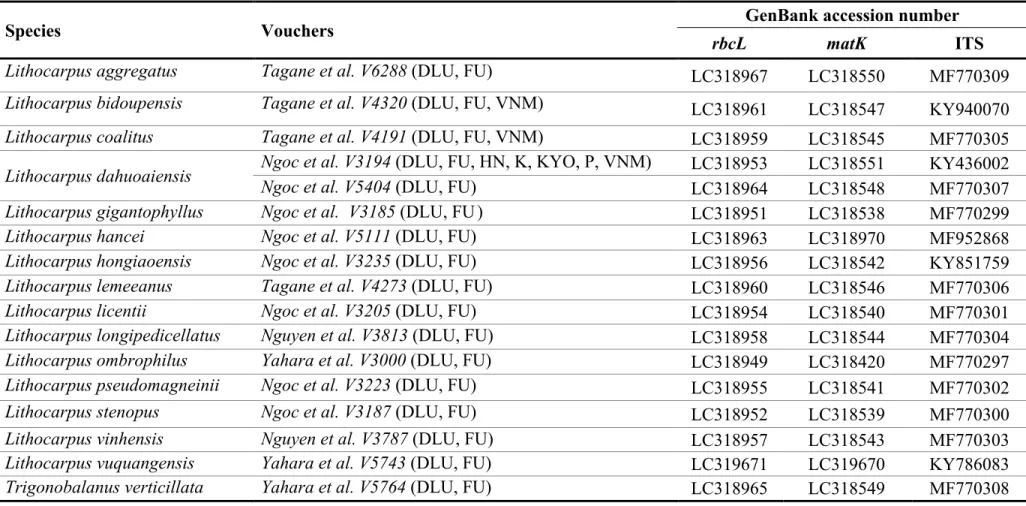
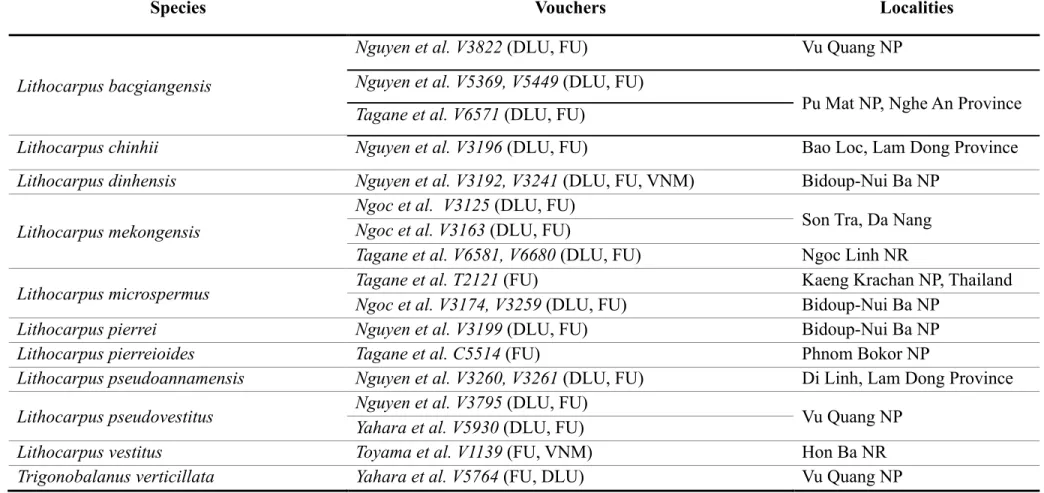
SUPPLEMENTARY 2.S1. List of taxa sampled in this study with vouchers and GenBank accession number.
Species Vouchers Localities GenBank accession number
rbcL matK ITS
L. aggregatus Tagane et al. V6288 (DLU, FU) Ngoc Linh NR LC318967 LC318550 MF770309
C. cerebrina Ngoc et al. V5503 (DLU, FU) Pumat NP N/A N/A N/A
C. piriformis Tagane et al. V6689 (DLU, FU) Ngoc Linh NP N/A N/A N/A
L. bidoupensis Tagane et al. V4320 (DLU, FU, VNM) Bidoup-Nui Ba NP LC318961 LC318547 KY940070 L. coalitus Tagane et al. V4191 (DLU, FU, VNM) Bidoup-Nui Ba NP LC318959 LC318545 MF770305 L. dahuoaiensis Ngoc et al. V3194 (DLU, FU, HN, K, KYO, P, VNM) Bidoup-Nui Ba NP LC318953 LC318551 KY436002
Ngoc et al. V5404 (DLU, FU) Dong Nai CNR LC318964 LC318548 MF770307
L. gigantophyllus Ngoc et al. V3185 (DLU, FU ) Bidoup-Nui Ba NP LC318951 LC318538 MF770299
L. hancei
Ngoc et al. V5111 (DLU, FU) Hoang Lien NP LC318963 LC318970 MF952868
Ngoc et al. V4800 (DLU, FU) Hoang Lien NP LC318962 LC318968 MF770304
Ngoc et al. V4924 (DLU, FU) Hoang Lien NP LC321977 LC318969 MF952867
L. hongiaoensis Ngoc et al. V3235 (DLU, FU) Bidoup-Nui Ba NP LC318956 LC318542 KY851759
L. lemeeanus Tagane et al. V4273 (DLU, FU) Bidoup-Nui Ba NP LC318960 LC318546 MF770306
L. licentii Ngoc et al. V3205 (DLU, FU) Bidoup-Nui Ba NP LC318954 LC318540 MF770301
L. longipedicellatus Nguyen et al. V3813 (DLU, FU) Vu Quang NP LC318958 LC318544 MF770304
L. ochrocarpus Tagane et al. V3115 (DLU, FU) Ba Na NR LC318950 LC318421 MF770298
L. ombrophilus Yahara et al. V3000 (DLU, FU) Bach Ma NP LC318949 LC318420 MF770297
L. pseudomagneinii Ngoc et al. V3223 (DLU, FU) Bidoup-Nui Ba NP LC318955 LC318541 MF770302
L. stenopus Ngoc et al. V3187 (DLU, FU) Bidoup-Nui Ba NP LC318952 LC318539 MF770300
L. vinhensis Nguyen et al. V3787 (DLU, FU) Vu Quang NP LC318957 LC318543 MF770303
37
Q. helferina* Ngoc et al. V3169 (DLU, FU) Lam Dong LC318781 LC318501 MF770279
Q. langbianensis* Tagane et al. V3962 (DLU, FU) Bidoup-Nui Ba NP LC318790 LC318510 MF770285
Q. poilanei* Yahara et al. V2986 (DLU, FU) Bach Ma NP LC318774 LC318494 MF770273
T. verticillata Yahara et al. V5764 (DLU, FU) Vu Quang NP LC318965 LC318549 MF770308
NP = National Park; NR = Nature Reserve; CNR = Culture and Nature Reserve; (*) From Binh et al. (2018).
38 TABLE 2.1. Morphological comparison of Lithocarpus bidoupensis with its relatives.
Characters L. bidoupensis3 L. hancei1,2,3 L. licentii1,2,3
Leaf margin Entire Entire Entire
Leaf surface Glabrous, glossy green on both surfaces
Glabrous, green and shining on both sides
Glabrous
Leaf blade shape Elliptic to oblong- elliptic or obovate- elliptic
Variable in shape:
ovate, broadly elliptic, obovate-elliptic, narrowly elliptic, or lanceolate
Oblanceolate or ovate-lanceolate
Leaf blade size 6–11.6 × 3.1–5.1 cm 5–10 x 2.0–5 cm 8–16 x 3.5–7 cm Petiole length 3–5 mm long 10–22 mm long 5–15 mm long Number of
Secondary veins
10–12 pairs 6–13 pairs 12–15 pairs
Infructescences length
8.4–11.5 cm long 6–8 cm long 15–20 cm long
Cupule Clusters of 3, depressed obconical or saucer- shaped
Clusters of 3–5,
shallowly bowl-shaped to plate-shaped
Solitary
Cupule size 0.9–1.3 cm high x 2.3–
2.7 cm in diam.
0.3–0.7 cm high x 0.6–
0.8 cm in diam.
1.2–1.4 cm high x 2.2–2.3 cm in diam.
Scales
arrangement Imbricate or arranged in 3 or 4 interrupted concentric rings
Imbricate and
appressed or connate into a few concentric rings
Imbricate
Nut shape Broadly ovoid-conical to depressed ovoid- globose
Depressed globose, subglobose, or broadly conical
Depressed
Nut size 1.5–1.6 cm high × 2.1–
2.3 cm across 1.4–1.8 cm high ×
0.6–1.0 cm across 1.2–1.3 cm high x 2–2.3 cm across
Nut enclosure by cupule
1/4–1/3 of the nut 1/3 of the nut 1/2–2/3 of the nut Basal scar of the
nut 1.4–1.7 cm in diam.,
slightly concave 0.5–1.0 cm in diam.,
concave 1.7–1.8 cm in
diam., convex
1Derive from original description; 2Derive from digitized type specimen image, 3Derive from this study collection.
39 TABLE 2.2. Morphological comparison of Lithocarpus hongiaoensis Ngoc & Binh, sp.
nov. with its relatives.
Characters L. hongiaoensis3 L. elmerrillii1,2 L. lemeeanus1,2,3 L. ochrocarpus1,2,3
Leaf margin Entire Entire Entire Entire
Leaf surface Glabrous upper, adherent waxy scale abaxially
Glabrous upper, adherent waxy scale abaxially
Glabrous upper, adherent waxy scale abaxially
Glabrous upper, adherent waxy scale abaxially Leaf size 9.6–14.5 × 2.5–3.8
cm
7–15 × 2.5–6 cm 6–15 × 2.5–4.5 cm
9–11 × 2.5–4 cm
Petiole 2.1–3 cm long 1–1.3 cm long 0.8–1 cm long 1.2–2 cm long Secondary
veins
8–11 pairs 7–9 pairs 10–11 pairs 7–8 pairs
Infructescences
length 12.5–16.5 cm long Up to 7 cm long 8–12 cm long 8–10 cm long Fruit-stalk Sessile to ca. 2 mm
long
Almost sessile Almost sessile Almost sessile
Cupule Solitary, 1–1.2 cm high by 1.8–2.1 cm in diam.
Solitary, 0.8–1 cm high, by 1.5–
2.4 cm in diam.
Clustered, 1.2–
1.6 cm high, by 2–2.5 cm in diam.
Clustered, 0.7–0.8 cm high, by 0.8–
1.2 cm in diam.
Nut size 0.6–0.8 cm high by 1.2–1.5 cm in diam.
1.8–2.4 cm high by 1.8 cm in diam.
1.5 cm high by 2 cm in diam.
0.6–0.7 cm high by 0.6–0.7 in diam.
Ratio of cupule height/nut height
More than 1.5 Ca. 0.4 Ca. 0.9 Ca. 1.1
Nut enclosure Enclosing ca. 1/3–1/2
of the nut Enclosing ca.
1/3 – 1/2 of the nut
More than 1/2 of
the nut Covering more than 1/2 of the nut
Scar of the nut Slightly concave, 12–
14 mm in diam. Concave, 12–14
mm in diam. Subconvex, 12–
15 mm in diam. N/A
1Derive from original description; 2Derive from digitized type specimen image, 3Derive from this study collection.
40 FIGURE 2.1. Collection sites in this study: (HL) Hoang Lien National Park, (PM) Pu Mat National P, (VQ) Vu Quang National Park, (BM) Bach Ma National Park, (BN) Ba Na Nature Reserve, (NL) Ngoc Linh Nature Reserve, (BD) Bidoup-Nui Ba National Park (type locality of L. bidoupensis and L. hongiaoensis), (DN) Dong Nai Culture and Nature Reserve.
41 FIGURE 2.2. MIG_seq tree of 18 samples of Lithocarpus and outgroup based on presence/absence data of 24,731 MIG-seq loci. Branches are labeled with bootstrap support (% of 1000 replicates).
200.0 8 0
5 0
9 9
1 0 0
6 5
1 0 0 1 0 0
1 0 0
1 0 0
1 0 0
1 0 0
1 0 0
1 0 0
9 4
1 0 0
8 3
1 0 0
1 0 0
1 0 0
9 9
0
7 7
9 4
V4320 L. bidoupensis V3000 L. ombrophilus
V6288 L. stenopus V3787 L. vinhensis
V3187 L. aggregatus
V5111 L. hancei
V6885 C. piriformis V3962 Q. langbianensis V3205 L. licentii
V3194 L. dahuoaiensis
V5764 T. verticillata V4191 L. coalitus
V3235 L. hongiaoensis
V4924 L. hancei V3115 L. ochrocarpus
V3185 L. gigantophyllus V4273 L. lemeeanus
V5503 C. cerebrina V3169 Q. helferiana V5404 L. dahuoaiensis
V2986 Q. poilanei V3223 L. pseudomagneinii
V4800 L. hancei
V3813 L. longipedicellatus
Clade 1 Clade 2 2c
2b
2a
42 FIGURE 2.3. Lithocarpus bidoupensis Ngoc & Tagane: A Leafy twigs, B Abaxial leaf surface, C Holotype (Tagane et al. V4320, KYO), D Mature fruit, E Cupule, F Mature nut, G Section of mature nut.
43 FIGURE 2.4. Illustrated of Lithocarpus bidoupensis Ngoc & Tagane: A Leafy twig, B Bud, C Infructescence, D Mature nut, E Vertical section of mature nut. Scale bars A, C
= 5 cm; B = 3 mm, D& E = 1 cm. Drawn by Nguyen Van Ngoc & Hoang Thi Binh.
44 FIGURE 2.5. Lithocarpus hongiaoensis Ngoc & Binh: A Habit, B Twig with young inflorescences, C Leaves, D Young inflorescence, E Infructescence, F Mature cupule.
45 FIGURE 2.6. Illustrated of Lithocarpus hongiaoensis Ngoc & Binh: A Fruiting twigs, B Mature fruit, C Mature nut, D Cupule scales. Scale bars A = 5 cm, B = 1 cm, C = 0.5 cm, D = 2 mm. Drawn by Nguyen Van Ngoc & Hoang Thi Binh.
46 Chapter III
Lithocarpus vuquangensis (Fagaceae), a new species from Vu Quang National Park, Vietnam
Abstract
Lithocarpus vuquangensis Ngoc & Hung is described from Vu Quang National Park, North Central Vietnam. The morphological comparison and phylogenetic analysis based on rbcL, matK and ITS provided evidence that the new species was not assignable to any of the previously known taxa in Vietnam and its surrounding countries. The description, photographs, preliminary conservation status and DNA barcode sequences are also provided for the new species.
Key words
Fagaceae, Lithocarpus, new species, phylogeny, taxonomy, Vietnam, Vu Quang National Park.
Introduction
It has been known that species richness of the genus Lithocarpus Blume (Fagaceae Dumorier) is high in Vietnam where 120 species and two varieties have been reported including the recently published species, L. dahuoaiensis Ngoc & L. V. Dung (Ban 2003, Ho 2003, Ngoc et al. 2016). Here, we describe an additional new species of Lithocarpus from Vu Quang National Park located in Ha Tinh Province, North Central Vietnam (Fig.
3.1).
Vu Quang National Park covers an area of ca. 56,000 ha from lowlands (alt. 10–
300 m) to the highlands (the highest peak of Rao Co, alt. 2,286 m). Two new species of mammals (Sao La - Pseudoryx nghetinhensis, Artiodactyla; and the world’s largest
47 muntjac -Muntiacus vuquangensis, Cetartiodactyla) were discovered from this national park in the 1990s (Dung et al. 1993, 1994). The vegetation is diverse along the elevation gradient and five major forest types are recognized: lowland forests (alt. 10–300 m), hill forest (alt. 300–1,000 m), medium montane forest (alt. 1,000–1,400 m), montane forest (alt. 1,400–1,900 m) and upper montane forest (alt. 1,900–2,100 m) (Kuznetsov 2001, Vu Quang National Park Management Board 2014). Until now, 1,678 species of vascular plants including many endemic and rare species have been reported (Vu Quang National Park Management Board 2014, Tagane et al. 2016). As for Fagaceae, one species of Castanea Mill, nine species of Castanopsis (D. Don) Spach., 12 species of Quercus L., and 37 species of Lithocarpus Blume have been recorded from the National Park, among which ten species have been listed in Viet Nam Red Data Book (Ban et al. 2007, Hung et al. 2014). In addition, natural populations of Trigonobalanus verticillata Forman were discovered during our recent botanical surveys in the National Park in 2016 (voucher specimens: Yahara et al. V5764 & V5766, DLU, FU, the herbarium of Vu Quang National Park), which brings the number of Fagaceae genera in the region up to five.
From 2015 to 2016, floristic expeditions were carried out in Vu Quang National Park, and trees of the genus Lithocarpus were discovered that did not match any described species. Here, we describe and name it as Lithocarpus vuquangensis Ngoc & Hung, sp.
nov. accompanying with its photographs and the morphological comparison with related species. In addition to the morphological examination, DNA sequences and phylogenetic analysis are extremely helpful for identifying and delimiting species (Hebert and Gregory 2005, Dick and Webb 2012). Here, we sequenced parts of the DNA barcode regions rbcL, matK (CBOL Plant Working Group 2009) and ITS (China Plant BOL Working Group 2011), and examined the phylogenic relationship of L. vuquangensis and its related taxa.
Materials and methods