Synchronization Phenomena in Coupled Cubic Maps
Yumiko Uchitani Yoshifumi Nishio (Tokushima University)
1. Introduction
Synchronization phenomena in complex systems are very good models to describe various higher-dimensional nonlin- ear phenomena in the field of natural science. Studies on chaos synchronization in coupled chaotic circuits are exten- sively carried out in various fields [1]. On the other hand, chaotic maps are generally used for several approaches to investigate chaotic phenomena on coupled chaotic systems.
Especially, a logistic map, a circle map, a tent map, a cubic map are well known and popular. In this study, we inves- tigate synchronization phenomena in coupled cubic maps.
2. Cubic map
xn xn+1
xn xn+1
(a) (b)
Figure 1: Cubic map. (a)α=−3.451.(b)α=−3.70.
x(n+1)=αx3n−(α+ 1)xn (1) Figure 1 shows the cubic map Eq. (1) wherenis an itera- tion,αis a parameter which determines the chaotic feature.
We can easily confirm that it generates various periodical solutions and chaos. Figure 1(a) shows asymmetric 3 pe- riodic solution and Fig. 1(b) shows symmetric 6 periodic solution.
3. Coupled cubic maps
In this study, we consider two coupled cubic maps. The followings are the equations of coupled cubic maps where
²is a coupling parameter.
{ f(x(n)) =αx3n−(α+ 1)xn
x1(n+1)= (1−²)f(x1(n)) +²(f(x2(n))) x2(n+1)= (1−²)f(x2(n)) +²(f(x1(n)))
(2)
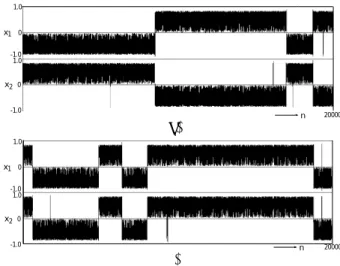
Figure 2 shows examples of the computer simulated results of Eq. (2). Figure 2(a) shows the timewaveform obtained with the parameter near that giving the periodic solution in Fig. 1(a). In the same way, Fig. 2(b) shows the time- waveform obtained with the parameter near that giving the periodic solution in Fig. 1(b). From the coupled cu- bic maps, we can observe interesting state synchronization phenomena. The two maps synchronized in anti-phase in Fig. 2(a) and synchronized in in-phase in Fig. 2(b). We could confirm that the two maps synchronize only for the parameters near that giving periodic solutions. However, we do not understand the relationship between the obtain- able synchronization states and symmetry property of the original solutions.
20000 0
1.0
1.0 -1.0
0
-1.0 x
x 1
2
n
(a)
0 1.0
1.0 -1.0
0
-1.0 x
x 1
2
20000 n
(b)
Figure 2: Timewaveform of coupled cubic maps. (a)α=
−3.45043, and ²=−0.0477. (b)α =−3.69964, and ²= 0.0508.
Figure 3 shows how the sojourn times between the state transitions change as the coupling parameter ² changes.
The horizontal axis is coupling parameter²and the verti- cal axis is the average lengths of the iterationsn. From this figure, we can see that the sojourn time between the transi- tions becomes longer as increasing the coupling parameter
².
0 500 1000 1500 2000 2500 3000 3500 4000 4500 5000
-0.0485-0.0484 -0.0483-0.0482-0.0481 -0.048 -0.0479 -0.0478-0.0477 -0.0476
iteration
epsilon
0 500 1000 1500 2000 2500 3000 3500 4000 4500
0.05 0.0501 0.0502 0.0503 0.0504 0.0505 0.0506 0.0507 0.0508
iteration
epsilon
(a) (b)
Figure 3: Sojourn time between state transitions. (a)α=
−3.45043. (b)α=−3.69964.
4. Conclusions
In this study, we have investigated the synchronization phenomena of two coupled cubic maps. We could observe interesting synchronization phenomenon. We confirmed that the two maps synchronized for the parameters near that giving periodic solutions. And, the sojourn time be- tween the transitions became longer as increasing the cou- pling parameter. Clarifying the mechanism is our future work.
References
[1] P. Ashwin, J. Buescu and I. Stewart, “Bubbling of At- tractors and Synchronization of Chaotic Oscillators,” Phys.
Lett. A, 193, pp. 126-139, 1994.
平成21年度電気関係学会四国支部連合大会