Ⅰ Introduction
Complete surgical resection is the only modality that offers a chance for long-term survival for bili
ary tract carcinoma (BTC). However, long-term out
comes of patients treated with surgery alone remain unsatisfactory, with a reported 5-year survival rate of 28-48 % for intrahepatic cholangiocarcinoma (ICC)1)-3), 24-50 % for extrahepatic bile duct carcinoma (EBC)4)-8),
7-53 % for gallbladder carcinoma (GBC)9)-11), and 50-68 % for carcinoma of the ampulla of Vater (CAV)12)-14). The main reason for this is the high rate of cancer recurrence, which occurs even after curative resec
tion15)-17), and once the disease recurs, the prognosis is extremely poor. To this end, adjuvant radiation therapy or chemotherapy, or both, have been explored as a means of reducing the rate of disease re
lapse16)18)-21).
So far, data supporting adjuvant chemotherapy for BTC are sparse. There was one phase III trial, eval
uating the efficacy of the adjuvant chemotherapy using 5-FU and mitomycin C on long-term outcomes for patients with pancreatobiliary malignancies.
This study showed that the adjuvant chemotherapy
Adjuvant Chemotherapy with Gemcitabine for Resected Biliary Tract Cancer : A Single-Arm Phase 2 Study
Noriyuki Kitagawa1)†, Hiroaki Motoyama1)†, Akira Kobayashi1)*, Takahide Yokoyama1)
Akira Shimizu1), Tsuyoshi Notake1), Kentaro Fukushima1), Hitoshi Masuo1)
Takahiro Yoshizawa1), Teruomi Tsukahara2) and Shin-ichi Miyagawa1)
1) First Department of Surgery, Shinshu University School of Medicine 2) Department of Preventive Medicine and Public Health, Shinshu University School of Medicine
Objective: This phase 2, single-arm trial aimed to evaluate the efficacy and safety of gemcitabine in the adjuvant setting for patients with biliary tract carcinoma (BTC).
Method: Patients undergoing surgery subsequently received 6 cycles of adjuvant gemcitabine (1000 mg/m2) intravenously over 30 minutes on days 1, 8, and 15 every 4 weeks. The primary end point was a two-year disease-free survival (DFS) rate and secondary end points were a two-year overall survival (OS) rate, tolerability, and the frequency of grade 3 or 4 toxicity.
Results: A total of 55 patients were enrolled. Primary tumor sites were intrahepatic bile duct in 14, extrahepatic bile duct in 34, gallbladder in 3, and ampulla of Vater in 4. During median follow-up of 40 months, 34 patients developed disease recurrence. Two-year DFS and OS rates were 47.7 % and 78.2 %, and median DFS and OS were 23 months and 46 months, respectively. The long-term outcomes in patients with extrahepatic bile duct carcinoma were similar compared with a historical cohort who underwent surgery alone. The completion rate and total dose intensity were 61.8 % and 70.3 %, respectively. Twenty-six patients (47.3 %) had grade 3 or 4 toxicity, none of which culminated in a fatal event.
Conclusion: The present study failed to show significant benefits of gemcitabine in the adjuvant setting for patients with resected BTC, although the regimen was well tolerated. Shinshu Med J 65 : 99―111, 2017
(Received for publication September 8, 2016 ; accepted in revised form December 20, 2016) Key words: biliary tract cancer, adjuvant chemotherapy, gemcitabine
* Corresponding author : Akira Kobayashi
First Department of Surgery, Shinshu University School of Medicine, 3-1-1 Asahi, Matsumoto, Nagano 390-8621, Japan E-mail : [email protected]
† Noriyuki Kitagawa and Hiroaki Motoyama contributed equally to this work
significantly prolonged the 5-year survival rate in patients with stage II or greater gallbladder cancer, whereas no significant difference was observed be
tween patients with and without the adjuvant thera
py in pancreatic cancer, bile duct cancer, and CAV.
Gemcitabine is a key drug of chemotherapy for pancreatic carcinoma. Previous study showed that administration of gemcitabine in an adjuvant setting significantly delayed the development of recurrent disease compared with surgery alone22). However, there have been few published prospective studies of adjuvant gemcitabine chemotherapy for resected BTC. We therefore conducted a phase 2, single-arm trial aimed at evaluating the efficacy and safety of gemcitabine in the adjuvant setting for patients with BTC.
Ⅱ Method A Patient selection
Patients with histologically verified BTC were eli
gible if they had undergone macroscopically curative resection and no prior chemotherapy and/or radio
therapy. Additional eligibility requirements includ
ed : 20 years ≤ age < 80 years ; Eastern Cooperative Oncology Group performance status of 0-2 ; adequate bone marrow function (leucocyte count ≥ 4,000/mm3, neutrophil count ≥ 2,000/mm3, hemoglobin ≥ 10 g/dl, and platelet count ≥ 100,000/mm3), adequate liver function (serum albumin ≥ 3.0 g/dl, total bilirubin ≤ 2 times the upper limit of normal (ULN) and aspar
tate aminotransferase (AST)/alanine aminotransfer
ase (ALT) ≤ 3 times ULN) ; adequate renal function (creatinine ≤ 1.0 mg/dL) ; and life expectancy ≥ 3 months. All patients provided written informed con
sent. Exclusion criteria included contracting active infection, synchronous cancer, pregnancy or lacta
tion, a history of severe drug allergy and other se
vere comorbid diseases. The protocol was approved by the institutional review board at Shinshu Univer
sity. All procedures were performed in accordance with the 1964 Declaration of Helsinki. Clinical trials identification number was UMIN000014018.
B Adjuvant chemotherapy with gemcitabine Patients received adjuvant chemotherapy with 6
cycles of gemcitabine every 4 weeks, primarily with
in 8 weeks following surgery. Each chemotherapy cycle consisted of 3 weekly infusions of gemcitabine 1,000 mg/m2 given by intravenous infusion during a 30-minute period, followed by a 1-week rest. No premedication was administered in each gemcitabine treatment. The treatment regimen was terminated in the case of disease progression, intolerable ad
verse events or patient refusal.
C Toxicity and dose modification
The toxicities were graded according to the Com
mon Terminology Criteria for Adverse Events ver
sion 3.023). Gemcitabine doses should be interrupted in cases of grade 2 or higher events and treatment should be delayed until complete recovery or until the adverse event improves to grade 0 or 1. Gemcit
abine was decreased by 20 % in subsequent cycles at the first occurrence of a grade 4 toxicity, and it was reduced by 40 % at the second occurrence of a given grade 4 toxicity. Treatment with gemcitabine was permanently stopped if, despite dose reduction, a grade 4 toxicity occurred for the third time.
D Study end points
The primary end point was a two-year disease- free survival (DFS) rate and secondary end points were a two-year overall survival (OS) rate, tolerability, and the frequency of grade 3 or 4 toxicity. Tolerability was further analyzed after the stratification of the patients according to whether they had undergone a major hepatectomy, defined as the resection of three or more Couinaud’s segments24).
E Statistical analyses
The trial was designed to have 80 % power to de
tect an increase in two-year DFS rate from 40 % in the historical cohort with surgery alone at our insti
tution to 60 % in patients receiving adjuvant gemcit
abine chemotherapy. A total of 48 patients would be required with a two-sided significance level of 5 %.
To allow for dropouts and to ensure that we had sufficient evidence to meet the trial objectives, we aimed to recruit 55 patients. All analyses were per
formed on an intention-to-treat basis. Data were ex
pressed as medians with range. The significance of differences between the groups was assessed by the
chi-square test, Fischer’s exact test, unpaired Stu
dent’s t-test, Welch’s t-test, Mann-Whitney U test, log-rank test and Cox’s proportional hazard model as appropriate. A p value less than .05 was used to indicate a significant difference. All statistical analy
ses were made using the JMP software version 10.0 (SAS Institute, Cary, North Carolina, USA).
Ⅲ Results A Patient characteristics
Between April 2006 and February 2010, a total of 55 patients were enrolled in the present study with the diagnosis of intrahepatic cholangiocarcinoma (ICC) in 14, extrahepatic bile duct carcinoma (EBC) in 34, gallbladder carcinoma (GBC) in 3, and carcino
ma of the ampulla of Vater (CAV) in 4. The back
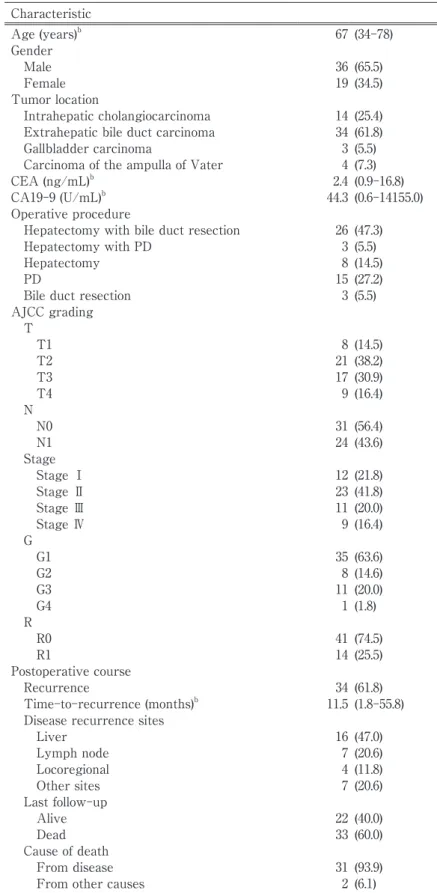
ground characteristics are summarized in Table 1. The median age was 67 (34-78) years. A median pre
operative CEA and CA19-9 values were 2.4 ng/mL and 44.3 U/ml, respectively. The most frequently performed surgical procedure was hepatectomy with bile duct resection (26 patients ; 47.3 %), followed by pancreaticoduodenectomy (15 patients ; 27.2 %). In pathologic staging based on 7th edition American Joint Committee on Cancer (AJCC) classification, al
most three fourths were categorized as having T2 (n
=21, 38.2 %) or T3 (n=17, 30.9 %) primary tumors.
Lymph node involvement was observed in 24 pa
tients (43.6 %). An R0 resection was achieved in 41 patients (74.5 %).
B Treatment administration
Thirty-four patients (61.8 %) received the full 6 cycles of adjuvant chemotherapy. The reasons for withdrawal from treatment included tumor recur
rence (8 patients ; 38.1 %), adverse events (8 patients ; 38.1 %), and patient preference (5 patients ; 23.8 %).
The median relative dose intensity (RDI) was 70.3 % (range, 9.9-100 %). The completion rate and the RDI tended to be lower among patients who had under
gone a major hepatectomy, compared with those who had not (p=0.199 and 0.103, respectively) (Table 2).
C Adverse events
The incidence of adverse events is shown in Table 3. The grade 3 or 4 toxicities included leucopenia
(23.6 %), neutropenia (45.5 %), thrombocytopenia (1.8
%), and fatigue (1.8 %). There were no treatment-re
lated deaths.
D Long-term outcomes
During a median follow-up period of 40 months, a total of 34 patients (61.8 %) developed tumor recur
rence with median time to recurrence of 11.5 months (range, 1.8-55.8 months). Liver was the most common recurrence site (47.0 %) (Table 1). The 2-year DFS rate and OS rate was 47.7 % and 78.2 % (Fig. 1A, B), and median DFS and OS were 23 months and 46 months, respectively.
We analyzed the effectiveness of adjuvant chemo
therapy for patients with EBC in comparison with the historical cohort of surgery alone (n=187), be
cause of the relatively smaller number of patients with ICC, GBC and CAV. No significant difference was observed in clinicopathological data between pa
tients with and without adjuvant chemotherapy ex
cept for preoperative carcinoembryonic antigen (CEA) (Table 4). There was no statistically significant difference in DFS (two-year DFS rate of 42.5 % vs.
49.8 %, p=0.495) and OS (two-year OS rate of 76.5 % vs. 64.4 %, p=0.568) between patients with and with
out adjuvant chemotherapy (Fig. 2A, B). No signifi
cant survival advantage was observed in EBC pa
tients receiving adjuvant chemotherapy when the patients were stratified according to the presence or absence of lymph node involvement or curability (Fig. 3A-D).
Ⅳ Discussion
This study tested the null hypothesis that adju
vant gemcitabine chemotherapy increases two-year DFS rate from 40 % to 60 %. However, we failed to show a significant survival benefit of adjuvant che
motherapy. In a subgroup analysis, no significant dif
ference was observed in DFS and OS between EBC patients with and without adjuvant chemotherapy.
Although a recent meta-analysis showed a survival benefit of adjuvant therapy for patients with lymph node involvement or those undergoing R1 resec
tion25), adjuvant chemotherapy did not prolong the survival of such high-risk patients in the present
Table 1 Background characteristics and perioperative data of the patients who received adjuvant chemotherapy (n=55)a
Characteristic
Age (years)b 67 (34-78)
Gender
Male 36 (65.5)
Female 19 (34.5)
Tumor location
Intrahepatic cholangiocarcinoma 14 (25.4) Extrahepatic bile duct carcinoma 34 (61.8)
Gallbladder carcinoma 3 (5.5)
Carcinoma of the ampulla of Vater 4 (7.3)
CEA (ng/mL)b 2.4 (0.9-16.8)
CA19-9 (U/mL)b 44.3 (0.6-14155.0)
Operative procedure
Hepatectomy with bile duct resection 26 (47.3)
Hepatectomy with PD 3 (5.5)
Hepatectomy 8 (14.5)
PD 15 (27.2)
Bile duct resection 3 (5.5)
AJCC grading
T T1 8 (14.5)
T2 21 (38.2)
T3 17 (30.9)
T4 9 (16.4)
NN0 31 (56.4)
N1 24 (43.6)
Stage
Stage Ⅰ 12 (21.8)
Stage Ⅱ 23 (41.8)
Stage Ⅲ 11 (20.0)
Stage Ⅳ 9 (16.4)
GG1 35 (63.6)
G2 8 (14.6)
G3 11 (20.0)
G4 1 (1.8)
R
R0 41 (74.5)
R1 14 (25.5)
Postoperative course
Recurrence 34 (61.8)
Time-to-recurrence (months)b 11.5 (1.8-55.8) Disease recurrence sites
Liver 16 (47.0)
Lymph node 7 (20.6)
Locoregional 4 (11.8)
Other sites 7 (20.6)
Last follow-up
Alive 22 (40.0)
Dead 33 (60.0)
Cause of death
From disease 31 (93.9)
From other causes 2 (6.1)
aValues in parentheses are percentages unless indicated otherwise.
bValues in parentheses are ranges.
CEA, carcinoembryonic antigen ; CA19-9, carbohydrate antigen 19-9 ; PD, pancreaticoduodenectomy ; AJCC, American Joint Committee on Cancer.
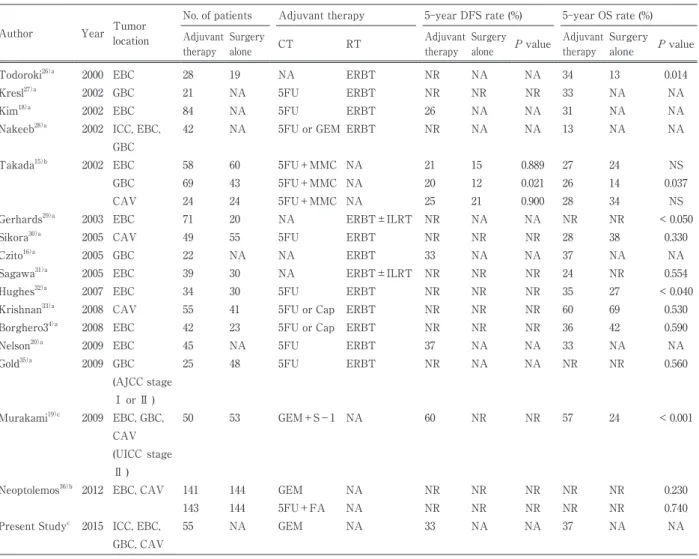
study. Previous studies on postoperative adjuvant treatment of BTC are summarized in Table 515)16)
18)-20)26)-36). Although some studies have suggested hopeful effects of adjuvant treatment, others could not reveal that adjuvant treatments contribute to delaying the development of recurrence and prolonged survival.
In particular, 2 RCTs failed to demonstrate signifi
cant benefit for adjuvant chemotherapy in patients with curatively resected BTC15)36). Thus, at present, the evidences seems to be insufficient support this treatment strategy, in spite of its worldwide adop
tion in many major institutions37).
Previous study demonstrated that the incidence of serious adverse events was significantly lower in pa
tients treated with adjuvant gemcitabine alone than that in patients treated with fluorouracil plus leucov
orin (30 % vs. 49 %, p < 0.01) for resected periampul
lary carcinoma36). In the present study, adjuvant gem
citabine could be safely administered to patients with resected BTC. Although 47.3 % of patients experienced grade 3 or 4 neutropenia during the treatment, most
of these toxicities were transient, and no fatal event occurred. Furthermore, the occurrence rate was compa
rable to that of the previously reported phase 3 trial of adjuvant gemcitabine for resected pancreatic carci
noma in Japan, JSAP-02 (70.0 %)38).
Considering that gemcitabine is rapidly deaminat
ed to its inactive metabolite, 2, 2-difluorodeoxyuri
dine, by cytidine deaminase, which abounds in the liver39)40), the removal of a large amount of liver pa
renchyma might enhance the toxicity of gemcit
abine, making the continuation of chemotherapy dif
ficult. Indeed, two recent phase I studies examining adjuvant gemcitabine monotherapy in patients with BTC undergoing a major hepatectomy revealed that the recommended dose of gemcitabine was much lower than the regular dose for unresectable and re
current BTC21)41). In line with these findings, the present study showed that the completion rate and the RDI tended to be lower among patients who had undergone a major hepatectomy, compared with those who had not.
Table 2 Tolerability of adjuvant chemotherapy stratified according to whether a major hepatectomy had been performeda
Major hepatectomyb (n=28)
Other operative procedures
(n=27) P value
Completion rate (%) 57.1 77.8 0.103
Relative dose intensity (%) 65.2 (9.9-100.0) 92.1 (10.7-100.0) 0.054
aValues in parentheses are ranges.
bMajor hepatectomy was defined as removal of three or more Couinaud segments24.
Table 3 Adverse events as evaluated according to the Common Terminology Criteria for Adverse Events (version 3.0) Adverse event Any grade (%) Grade 3 or 4 (%) Hematological
Leucopenia 43 (78.2) 13 (23.6)
Neutropenia 42 (76.4) 25 (45.5)
Anemia 24 (43.6) 0 (0.0)
Thrombocytopenia 25 (45.5) 1 (1.8) Non-hematological
Liver dysfunction 6 (10.9) 0 (0.0)
Fatigue 5 (9.1) 1 (1.8)
Anorexia 13 (23.6) 0 (0.0)
Nausea 7 (12.7) 0 (0.0)
Rash 6 (10.9) 0 (0.0)
An analysis of initial recurrence site in the pres
ent study showed that distant metastasis occurred more frequently than local recurrence, and the most prevalent site of distant metastasis was the liver.
Our results are in line with the previous studies of hilar cholangiocarcionoma42), distal cholangiocarcino
ma32)43), and carcinoma of the ampulla of Vater14)44)45). Considering these results, although it remains con
No. at risk 55 55 51 48 44
B
Fig. 1 The disease-free survival (DFS) (A) and overall survival (OS) (B) curves for patients receiving adjuvant chemothera
py using gemcitabine. The 2-year DFS and OS rates were 47.7 % and 78.2 %, respectively.
No. at risk 55 48 38 32 26
A
Table 4 Clinicopathological data of patients with extrahepatic biliary carcinoma stratified according to whether adjuvant chemotherapy was performeda
Characteristic Adjuvant chemotherapy (n=34)
Surgery alone
(n=187) P value
Age (years) 67 (34-78) 69 (39-84) 0.302
Gender (male/female) 29/5 135/52 0.108
AJCC grading
T (T1/T2/T3/T4) 5/16/12/1 29/91/49/18 0.497
N (N0/N1) 20/14 106/81 0.817
Stage (I/II/III/IV) 9/15/9/1 43/76/50/18 0.631
G (G1/G2/G3/G4) 20/7/7/0 103/57/26/1 0.555
R (R0/R1) 26/8 161/26 0.152
aValues in parentheses are ranges.
AJCC, American Joint Committee on Cancer.
troversial whether systemic chemotherapy or radio
therapy is suitable for adjuvant treatment for resect
ed BTC, systemic therapy could play a role as an adjuvant treatment modality. Indeed, a meta-analy
sis demonstrated that patients receiving chemother
apy or chemoradiotherapy showed better long-term outcomes than those undergoing radiotherapy alone25).
Although gemcitabine monotherapy was used for advanced BTC as the community standard in the 2000s46)-48), the first-line chemotherapeutic regimen for advanced BTC is, at present, considered to be
gemcitabine-based combined therapy49)50) because of its superior anti-tumor effect51). In the adjuvant set
ting, there was no previous study in the English lit
erature except for a report from Murakami et al.
They retrospectively studied the effect of gemcit
abine plus S-1 chemotherapy for resected BTC, and showed that the combined regimen contributed to improved long-term outcomes in patients with In
ternational Union Against Cancer stage II BTC19). Further studies are needed to develop the effective regi
men of adjuvant chemotherapy for resected BTC.
No. at risk
Adjuvant chemotherapy 34 29 23 19 15
Surgery alone 187 163 129 103 91
p= 0.495 A
Fig. 2 Comparison of DFS and OS between extrahepatic bile duct carcinoma patients with and without adjuvant chemotherapy. There was no statistically significant difference in 2-year DFS and OS rates between two groups (42.5 % vs. 49.8 %, p=0.495, and 76.5 % vs. 64.4 %, p=0.568, respectively).
No. at risk
Adjuvant chemotherapy 34 34 31 29 27
Surgery alone 187 180 161 136 118
p= 0.373
j B
u ger
Adjuvant chemotherapy Surgery alone
Adjuvant chemotherapy Surgery alone
No. at risk Adjuvant chemotherapy2018171410 Surgery alone10699827368
p = 0.167
)6 21 = n( 0 N
A No. at risk 8165473124p = 0.679
)5 9 = n( 1 N
Surgery aloneAdjuvant chemotherapy1412766B
p = 0.585
)7 81 = n( 0 R
No. at risk Adjuvant chemotherapy2623181511 Surgery alone1611441159282C
p = 0.964
)4 3 = n( 1 R
No. at risk 2620151210Adjuvant chemotherapy87655 Surgery aloneD Fig. 3Effects of adjuvant chemotherapy in patients with extrahepatic bile duct carcinoma stratified according to their N or R categories. No significant prolongation of the DFS was observed among patients receiving adjuvant chemotherapy in all the subgroups. A) N0 (n=126);B) N1 (n=95);C) R0 (n=187);D) R1 (n=34).
There were several limitations in this study. The study design was single-arm. The most important limitation of the present study was the heterogene
ity of the study population, consisting of all types of BTC including ICC, EBC, GBC, and CAV. Some re
searchers have reported that the biological behavior might be different among the tumor types based on the results of sensitivity to non-surgical treatments
36)52)-54) or survival profile after surgery36)55)56). There
fore, a stratified analysis according to tumor type may reveal the true impact of adjuvant treatment in
each tumor type of BTC. Despite these limitations, however, we believe that our results are of interest, because there have been so few reports in the En
glish literature of a phase 2 trial of adjuvant gemcit
abine monotherapy for resected BTC.
In conclusion, the present study failed to show sig
nificant benefits of gemcitabine in the adjuvant set
ting for patients with resected BTC, although the regimen was well tolerated. Further investigation of adjuvant treatments might be needed to improve long- term outcomes in BTC patients.
Table 5 Literature review of long-term outcomes of patients with resected biliary tract cancer who received adjuvant therapy (published after 2000)
Author Year Tumor location
No. of patients Adjuvant therapy 5-year DFS rate (%) 5-year OS rate (%) Adjuvant
therapy
Surgery
alone CT RT Adjuvant
therapy Surgery
alone P value Adjuvant therapy
Surgery alone P value
Todoroki26)a 2000 EBC 28 19 NA ERBT NR NA NA 34 13 0.014
Kresl27)a 2002 GBC 21 NA 5FU ERBT NR NR NR 33 NA NA
Kim18)a 2002 EBC 84 NA 5FU ERBT 26 NA NA 31 NA NA
Nakeeb28)a 2002 ICC, EBC, GBC
42 NA 5FU or GEM ERBT NR NA NA 13 NA NA
Takada15)b 2002 EBC 58 60 5FU+MMC NA 21 15 0.889 27 24 NS
GBC 69 43 5FU+MMC NA 20 12 0.021 26 14 0.037
CAV 24 24 5FU+MMC NA 25 21 0.900 28 34 NS
Gerhards29)a 2003 EBC 71 20 NA ERBT±ILRT NR NA NA NR NR < 0.050
Sikora30)a 2005 CAV 49 55 5FU ERBT NR NR NR 28 38 0.330
Czito16)a 2005 GBC 22 NA NA ERBT 33 NA NA 37 NA NA
Sagawa31)a 2005 EBC 39 30 NA ERBT±ILRT NR NR NR 24 NR 0.554
Hughes32)a 2007 EBC 34 30 5FU ERBT NR NR NR 35 27 < 0.040
Krishnan33)a 2008 CAV 55 41 5FU or Cap ERBT NR NR NR 60 69 0.530
Borghero34)a 2008 EBC 42 23 5FU or Cap ERBT NR NR NR 36 42 0.590
Nelson20)a 2009 EBC 45 NA 5FU ERBT 37 NA NA 33 NA NA
Gold35)a 2009 GBC (AJCC stage
Ⅰ or Ⅱ )
25 48 5FU ERBT NR NA NA NR NR 0.560
Murakami19)c 2009 EBC, GBC, CAV (UICC stage
Ⅱ )
50 53 GEM+S-1 NA 60 NR NR 57 24 < 0.001
Neoptolemos36)b 2012 EBC, CAV 141 144 GEM NA NR NR NR NR NR 0.230
143 144 5FU+FA NA NR NR NR NR NR 0.740
Present Studyc 2015 ICC, EBC, GBC, CAV
55 NA GEM NA 33 NA NA 37 NA NA
aA retrospective study
bA prospective randomized controlled trial
cA prospective study compared to historical control
DFS, disease-free survival ; OS, overall survival ; CT, chemotherapy ; RT, radiation therapy ; EBC, extrahepatic bile duct carcinoma ; NA, not applicable ; ERBT, external-beam radiation therapy ; NR, details not reported ; GBC, gallbladder carci
noma ; ICC, intrahepatic cholangiocarcinoma ; 5FU, 5-fluorouracil ; GEM, gemcitabine ; MMC, mitomicin C ; NS, not signifi
cant ; CAV, carcinoma of the ampulla of Vater ; ILRT, intraluminal radiation therapy ; Cap, capecitabine ; AJCC, American Joint Committee on Cancer ; UICC, International Union Against Cancer ; FA, folinic acid.
References
1) Tamandl D, Herberger B, Gruenberger B, Puhalla H, Klinger M, Gruenberger T : Influence of hepatic resection mar
gin on recurrence and survival in intrahepatic cholangiocarcinoma. Ann Surg Oncol 15 : 2787-2794, 2008
2) Jonas S, Thelen A, Benckert C, Biskup W, Neumann U, Rudolph B, Lopez-Haanninen E, Neuhaus P : Extended liver resection for intrahepatic cholangiocarcinoma : A comparison of the prognostic accuracy of the fifth and sixth edi
tions of the TNM classification. Ann Surg 249 : 303-309, 2009
3) Ercolani G, Vetrone G, Grazi GL, Aramaki O, Cescon M, Ravaioli M, Serra C, Brandi G, Pinna AD : Intrahepatic chol
angiocarcinoma : primary liver resection and aggressive multimodal treatment of recurrence significantly prolong survival. Ann Surg 252 : 107-114, 2010
4) Miyazaki M, Ito H, Nakagawa K, Ambiru S, Shimizu H, Okaya T, Shinmura K, Nakajima N : Parenchyma-preserving hepatectomy in the surgical treatment of hilar cholangiocarcinoma. J Am Coll Surg 189 : 575-583, 1999
5) Sakamoto Y, Kosuge T, Shimada K, Sano T, Ojima H, Yamamoto J, Yamasaki S, Takayama T, Makuuchi M : Prog
nostic factors of surgical resection in middle and distal bile duct cancer : an analysis of 55 patients concerning the significance of ductal and radial margins. Surgery 137 : 396-402, 2005
6) Hemming AW, Reed AI, Fujita S, Foley DP, Howard RJ : Surgical management of hilar cholangiocarcinoma. Ann Surg 241 : 693-699 ; discussion 699-702, 2005
7) Murakami Y, Uemura K, Hayashidani Y, Sudo T, Ohge H, Sueda T : Pancreatoduodenectomy for distal cholangiocar
cinoma : prognostic impact of lymph node metastasis. World J Surg 31 : 337-342 ; discussion 343-334, 2007
8) Furusawa N, Kobayashi A, Yokoyama T, Shimizu A, Motoyama H, Miyagawa S : Surgical treatment of 144 cases of hilar cholangiocarcinoma without liver-related mortality. World J Surg 38 : 1164-1176, 2014
9) Chijiiwa K, Tanaka M : Carcinoma of the gallbladder : an appraisal of surgical resection. Surgery 115 : 751-756, 1994 10) Yamaguchi R, Nagino M, Oda K, Kamiya J, Uesaka K, Nimura Y : Perineural invasion has a negative impact on sur
vival of patients with gallbladder carcinoma. Br J Surg 89 : 1130-1136, 2002
11) Sasaki R, Itabashi H, Fujita T, Takeda Y, Hoshikawa K, Takahashi M, Funato O, Nitta H, Kanno S, Saito K : Signifi
cance of extensive surgery including resection of the pancreas head for the treatment of gallbladder cancer--from the perspective of mode of lymph node involvement and surgical outcome. World J Surg 30 : 36-42, 2006
12) Allema JH, Reinders ME, van Gulik TM, van Leeuwen DJ, Verbeek PC, de Wit LT, Gouma DJ : Results of pancreati
coduodenectomy for ampullary carcinoma and analysis of prognostic factors for survival. Surgery 117 : 247-253, 1995 13) Duffy JP, Hines OJ, Liu JH, Ko CY, Cortina G, Isacoff WH, Nguyen H, Leonardi M, Tompkins RK, Reber HA : Im
proved survival for adenocarcinoma of the ampulla of Vater : fifty-five consecutive resections. Arch Surg 138 : 941- 948 ; discussion 948-950, 2003
14) Kim RD, Kundhal PS, McGilvray ID, Cattral MS, Taylor B, Langer B, Grant DR, Zogopoulos G, Shah SA, Greig PD, Gallinger S : Predictors of failure after pancreaticoduodenectomy for ampullary carcinoma. J Am Coll Surg 202 : 112- 119, 2006
15) Takada T, Amano H, Yasuda H, Nimura Y, Matsushiro T, Kato H, Nagakawa T, Nakayama T, Study Group of Sur
gical Adjuvant Therapy for Carcinomas of the pancreas and biliary tract : Is postoperative adjuvant chemotherapy useful for gallbladder carcinoma ? A phase III multicenter prospective randomized controlled trial in patients with resected pancreaticobiliary carcinoma. Cancer 95 : 1685-1695, 2002
16) Czito BG, Hurwitz HI, Clough RW, Tyler DS, Morse MA, Clary BM, Pappas TN, Fernando NH, Willett CG : Adju
vant external-beam radiotherapy with concurrent chemotherapy after resection of primary gallbladder carcinoma : a 23-year experience. Int J Radiat Oncol Biol Phys 62 : 1030-1034, 2005
17) Murakami Y, Uemura K, Sudo T, Hashimoto Y, Nakashima A, Sakabe R, Kobayashi H, Kondo N, Nakagawa N, Sue
da T : Adjuvant chemotherapy with gemcitabine and S-1 after surgical resection for advanced biliary carcinoma :
outcomes and prognostic factors. J Hepatobiliary Pancreat Sci 19 : 306-313, 2012
18) Kim S, Kim SW, Bang YJ, Heo DS, Ha SW : Role of postoperative radiotherapy in the management of extrahepatic bile duct cancer. Int J Radiat Oncol Biol Phys 54 : 414-419, 2002
19) Murakami Y, Uemura K, Sudo T, Hayashidani Y, Hashimoto Y, Nakamura H, Nakashima A, Sueda T : Adjuvant gemcitabine plus S-1 chemotherapy improves survival after aggressive surgical resection for advanced biliary car
cinoma. Ann Surg 250 : 950-956, 2009
20) Nelson JW, Ghafoori AP, Willett CG, Tyler DS, Pappas TN, Clary BM, Hurwitz HI, Bendell JC, Morse MA, Clough RW, Czito BG : Concurrent chemoradiotherapy in resected extrahepatic cholangiocarcinoma. Int J Radiat Oncol Biol Phys 73 : 148-153, 2009
21) Yamanaka K, Hatano E, Kanai M, Tanaka S, Yamamoto K, Narita M, Nagata H, Ishii T, Machimoto T, Taura K, Ue
moto S : A single-center analysis of the survival benefits of adjuvant gemcitabine chemotherapy for biliary tract cancer. Int J Clin Oncol 19 : 485-489, 2013
22) Oettle H, Post S, Neuhaus P, Gellert K, Langrehr J, Ridwelski K, Schramm H, Fahlke J, Zuelke C, Burkart C, Gutber
let K, Kettner E, Schmalenberg H, Weigang-Koehler K, Bechstein WO, Niedergethmann M, Schmidt-Wolf I, Roll L, Doerken B, Riess H : Adjuvant chemotherapy with gemcitabine vs observation in patients undergoing curative-in
tent resection of pancreatic cancer : a randomized controlled trial. JAMA 297 : 267-277, 2007
23) Trotti A, Colevas AD, Setser A, Rusch V, Jaques D, Budach V, Langer C, Murphy B, Cumberlin R, Coleman CN, Ru
bin P : CTCAE v3.0 : development of a comprehensive grading system for the adverse effects of cancer treatment.
Semin Radiat Oncol 13 : 176-181, 2003
24) Couinaud C : Le foie ; études anatomiques et chirurgicales. Paris, Masson, 1957
25) Horgan AM, Amir E, Walter T, Knox JJ : Adjuvant therapy in the treatment of biliary tract cancer : a systematic review and meta-analysis. J Clin Oncol 30 : 1934-1940, 2012
26) Todoroki T, Ohara K, Kawamoto T, Koike N, Yoshida S, Kashiwagi H, Otsuka M, Fukao K : Benefits of adjuvant ra
diotherapy after radical resection of locally advanced main hepatic duct carcinoma. Int J Radiat Oncol Biol Phys 46 : 581-587, 2000
27) Kresl JJ, Schild SE, Henning GT, Gunderson LL, Donohue J, Pitot H, Haddock MG, Nagorney D : Adjuvant external beam radiation therapy with concurrent chemotherapy in the management of gallbladder carcinoma. Int J Radiat Oncol Biol Phys 52 : 167-175, 2002
28) Nakeeb A, Tran KQ, Black MJ, Erickson BA, Ritch PS, Quebbeman EJ, Wilson SD, Demeure MJ, Rilling WS, Dua KS, Pitt HA : Improved survival in resected biliary malignancies. Surgery 132 : 555-563 ; discission 563-554, 2002 29) Gerhards MF, van Gulik TM, González González D, Rauws EA, Gouma DJ : Results of postoperative radiotherapy
for resectable hilar cholangiocarcinoma. World J Surg 27 : 173-179, 2003
30) Sikora SS, Balachandran P, Dimri K, Rastogi N, Kumar A, Saxena R, Kapoor VK : Adjuvant chemo-radiotherapy in ampullary cancers. Eur J Surg Oncol 31 : 158-163, 2005
31) Sagawa N, Kondo S, Morikawa T, Okushiba S, Katoh H : Effectiveness of radiation therapy after surgery for hilar cholangiocarcinoma. Surg Today 35 : 548-552, 2005
32) Hughes MA, Frassica DA, Yeo CJ, Riall TS, Lillemoe KD, Cameron JL, Donehower RC, Laheru DA, Hruban RH, Abrams RA : Adjuvant concurrent chemoradiation for adenocarcinoma of the distal common bile duct. Int J Radiat Oncol Biol Phys 68 : 178-182, 2007
33) Krishnan S, Rana V, Evans DB, Varadhachary G, Das P, Bhatia S, Delclos ME, Janjan NA, Wolff RA, Crane CH, Pis
ters PW : Role of adjuvant chemoradiation therapy in adenocarcinomas of the ampulla of vater. Int J Radiat Oncol Biol Phys 70 : 735-743, 2008
34) Borghero Y, Crane CH, Szklaruk J, Oyarzo M, Curley S, Pisters PW, Evans D, Abdalla EK, Thomas MB, Das P, Wistuba, II, Krishnan S, Vauthey JN : Extrahepatic bile duct adenocarcinoma : patients at high-risk for local recur
rence treated with surgery and adjuvant chemoradiation have an equivalent overall survival to patients with stan
dard-risk treated with surgery alone. Ann Surg Oncol 15 : 3147-3156, 2008
35) Gold DG, Miller RC, Haddock MG, Gunderson LL, Quevedo F, Donohue JH, Bhatia S, Nagorney DM : Adjuvant ther
apy for gallbladder carcinoma : the Mayo Clinic Experience. Int J Radiat Oncol Biol Phys 75 : 150-155, 2009
36) Neoptolemos JP, Moore MJ, Cox TF, Valle JW, Palmer DH, McDonald AC, Carter R, Tebbutt NC, Dervenis C, Smith D, Glimelius B, Charnley RM, Lacaine F, Scarfe AG, Middleton MR, Anthoney A, Ghaneh P, Halloran CM, Lerch MM, Olah A, Rawcliffe CL, Verbeke CS, Campbell F, Buchler MW, European Study Group for Pancreatic C : Effect of adjuvant chemotherapy with fluorouracil plus folinic acid or gemcitabine vs observation on survival in patients with resected periampullary adenocarcinoma : the ESPAC-3 periampullary cancer randomized trial. JAMA 308 : 147-156, 2012
37) Nakeeb A, Pitt HA : Radiation therapy, chemotherapy and chemoradiation in hilar cholangiocarcinoma. HPB (Oxford) 7 : 278-282, 2005
38) Ueno H, Kosuge T, Matsuyama Y, Yamamoto J, Nakao A, Egawa S, Doi R, Monden M, Hatori T, Tanaka M, Shima
da M, Kanemitsu K : A randomised phase III trial comparing gemcitabine with surgery-only in patients with resect
ed pancreatic cancer : Japanese Study Group of Adjuvant Therapy for Pancreatic Cancer. Br J Cancer 101 : 908-915, 2009
39) Camiener GW, Smith CG : Studies of the enzymatic deamination of cytosine arabinoside. I. Enzyme distribution and species specificity. Biochem Pharmacol 14 : 1405-1416, 1965
40) Ho DH : Distribution of kinase and deaminase of 1-beta-D-arabinofuranosylcytosine in tissues of man and mouse.
Cancer Res 33 : 2816-2820, 1973
41) Kobayashi S, Nagano H, Sakai D, Eguchi H, Hatano E, Kanai M, Seo S, Taura K, Fujiwara Y, Ajiki T, Takemura S, Kubo S, Yanagimoto H, Toyokawa H, Tsuji A, Terajima H, Morita S, Ioka T : Phase I study of adjuvant gemcitabine or S-1 in patients with biliary tract cancers undergoing major hepatectomy : KHBO1003 study. Cancer Chemother Pharmacol 74 : 699-709, 2014
42) Kobayashi A, Miwa S, Nakata T, Miyagawa S : Disease recurrence patterns after R0 resection of hilar cholangiocar
cinoma. Br J Surg 97 : 56-64, 2010
43) Takao S, Shinchi H, Uchikura K, Kubo M, Aikou T : Liver metastases after curative resection in patients with distal bile duct cancer. Br J Surg 86 : 327-331, 1999
44) Todoroki T, Koike N, Morishita Y, Kawamoto T, Ohkohchi N, Shoda J, Fukuda Y, Takahashi H : Patterns and pre
dictors of failure after curative resections of carcinoma of the ampulla of Vater. Ann Surg Oncol 10 : 1176-1183, 2003 45) de Castro SM, Kuhlmann KF, van Heek NT, Busch OR, Offerhaus GJ, van Gulik TM, Obertop H, Gouma DJ : Recur
rent disease after microscopically radical (R0) resection of periampullary adenocarcinoma in patients without adju
vant therapy. J Gastrointest Surg 8 : 775-784 ; discussion 784, 2004
46) Gallardo JO, Rubio B, Fodor M, Orlandi L, Yanez M, Gamargo C, Ahumada M : A phase II study of gemcitabine in gallbladder carcinoma. Ann Oncol 12 : 1403-1406, 2001
47) Lin MH, Chen JS, Chen HH, Su WC : A phase II trial of gemcitabine in the treatment of advanced bile duct and periampullary carcinomas. Chemotherapy 49 : 154-158, 2003
48) Okusaka T, Ishii H, Funakoshi A, Yamao K, Ohkawa S, Saito S, Saito H, Tsuyuguchi T : Phase II study of sin
gle-agent gemcitabine in patients with advanced biliary tract cancer. Cancer Chemother Pharmacol 57 : 647-653, 2006
49) Andre T, Tournigand C, Rosmorduc O, Provent S, Maindrault-Goebel F, Avenin D, Selle F, Paye F, Hannoun L, Houry S, Gayet B, Lotz JP, de Gramont A, Louvet C, Group G : Gemcitabine combined with oxaliplatin (GEMOX) in advanced biliary tract adenocarcinoma : a GERCOR study. Ann Oncol 15 : 1339-1343, 2004
50) Cho JY, Paik YH, Chang YS, Lee SJ, Lee DK, Song SY, Chung JB, Park MS, Yu JS, Yoon DS : Capecitabine com
bined with gemcitabine (CapGem) as first-line treatment in patients with advanced/metastatic biliary tract carcino
ma. Cancer 104 : 2753-2758, 2005
51) Valle J, Wasan H, Palmer DH, Cunningham D, Anthoney A, Maraveyas A, Madhusudan S, Iveson T, Hughes S, Pereira SP, Roughton M, Bridgewater J, Investigators ABCT : Cisplatin plus gemcitabine versus gemcitabine for bil
iary tract cancer. N Engl J Med 362 : 1273-1281, 2010
52) Knox JJ, Hedley D, Oza A, Feld R, Siu LL, Chen E, Nematollahi M, Pond GR, Zhang J, Moore MJ : Combining gem
citabine and capecitabine in patients with advanced biliary cancer : a phase II trial. J Clin Oncol 23 : 2332-2338, 2005 53) Riechelmann RP, Townsley CA, Chin SN, Pond GR, Knox JJ : Expanded phase II trial of gemcitabine and capecit
abine for advanced biliary cancer. Cancer 110 : 1307-1312, 2007
54) Lee J, Park SH, Chang HM, Kim JS, Choi HJ, Lee MA, Jang JS, Jeung HC, Kang JH, Lee HW, Shin DB, Kang HJ, Sun JM, Park JO, Park YS, Kang WK, Lim HY : Gemcitabine and oxaliplatin with or without erlotinib in advanced biliary-tract cancer : a multicentre, open-label, randomised, phase 3 study. Lancet Oncol 13 : 181-188, 2012
55) Woo SM, Ryu JK, Lee SH, Yoo JW, Park JK, Kim YT, Jang JY, Kim SW, Kang GH, Yoon YB : Recurrence and prog
nostic factors of ampullary carcinoma after radical resection : comparison with distal extrahepatic cholangiocarcino
ma. Ann Surg Oncol 14 : 3195-3201, 2007
56) Heron DE, Stein DE, Eschelman DJ, Topham AK, Waterman FM, Rosato EL, Alden M, Anne PR : Cholangiocarci
noma : the impact of tumor location and treatment strategy on outcome. Am J Clin Oncol 26 : 422-428, 2003
(2016. 9. 8 received;2016. 12. 20 accepted)