Japan Advanced Institute of Science and Technology
JAIST Repository
https://dspace.jaist.ac.jp/
Title Ziegler‑Natta触媒の構造と重合性能の相関解明に向け
ての新規アプローチ法の確立
Author(s) 舟子, 俊幹
Citation
Issue Date 2015‑03
Type Thesis or Dissertation Text version ETD
URL http://hdl.handle.net/10119/12774 Rights
Description Supervisor:寺野 稔, マテリアルサイエンス研究科,
博士
Doctoral Dissertation
Novel Approaches to Elucidate Structure-Performance Relationship in Ziegler-Natta Olefin Polymerization
TOSHIKI FUNAKO
Supervisor: Professor Dr. Minoru Terano
School of Materials Science
Japan Advanced Institute of Science and Technology
March 2015
Contents
Chapter 1 General Introduction 1
1.1 Introduction 2
1.2 Catalyst 3
1.2.1 Catalysis in Chemical Reaction 5
1.2.2 Variety of Catalyst 8
1.2.3 Multifunctional Catalyst 11
1.3 Ziegler-Natta Catalysts 16
1.3.1 Polyolefin 17
1.3.2 Hysterical Development of Ziegler-Natta Catalysts 23 1.3.2.1 First and Second Generation 24 1.3.2.2 Third Generation 25 1.3.2.3 Fourth and Fifth Generation 26 1.3.3 Structure Performance Relationship in Olefin Polymerization 30 1.3.3.1 Role of MgCl2 31
1.3.3.2 Role of electron donor 34
1.3.3.3 Particle morphology 37
1.4 Statistical analysis 41
1.4.1 Correlation coefficient 42
1.4.2 Principal component analysis 43
1.4.3 Genetic function approximation 44 1.4.4 Application for chemistry 45
1.5 Objective of this study 46
References 48
Chapter 2 Multilateral Characterization for Industrial Ziegler-Natta Catalysts toward Elucidation of Structure-Performance Relationship 55
2.1 Introduction 56
2.2 Experimental 60
2.2.1 Materials 61
2.2.2 Mg(OEt)2 synthesis 61
2.2.3 Catalyst preparation 62
2.2.4 Polymerization 62
2.2.5 Characterization 63
2.3 Results and discussion 66
2.3.1 Mg(OEt)2 synthesis 66
2.3.2 Catalyst preparation 68
2.3.2.1 Morphology evaluation 68
2.3.2.2 Pore structure evaluation 70
2.3.2.3 Chemical composition 75
2.3.3 Polymerization test 76
2.4 Conclusion 79
References 80
Chapter 3 The statistical approaches for elucidation of structure performance relationship in Ziegler-Natta
olefin polymerization 83
3.1 Introduction 84
3.2 Experimental 88
3.2.1 Materials 88
3.2.2 Mg(OEt)2 synthesis 88
3.2.3 Catalyst preparation 89
3.2.4 Polymerization 90
3.2.5 Characterization 90
3.2.6 Statistical analysis 94
3.3 Results and discussion 96
3.2.1 Catalyst preparation and characterization 96 3.2.1.1 Mg(OEt)2 synthesis and their characteristics 96 3.2.1.2 Catalyst preparation and their characteristics 100
3.2.1.3 Olefin polymerization test 109
3.2.2 Dataset evaluation based on statistics 111
3.2.2.1 Dataset evaluation 111
3.2.2.2 One-to-one correlation evaluation using correlation coefficient
113
3.2.2.2 Correlation matrix of structure performance relationship
116
3.4 Conclusion 117
References 119
Chapter 4 Pore Architecture Engineering of Magnesium Alkoxide based Olefin polymerization Catalysts
122
4.1 Introduction 123
4.2 Experimental 127
4.2.1 Materials 127
4.2.2 Mg(OEt)2 synthesis 127
4.2.3 Catalyst preparation 128
4.2.4 Polymerization 129
4.2.5 Characterization 129
4.3 Results and discussion 133
4.3.1 Screening of second alcohol for pore architecture control 133
4.3.2 i-Propanol incorporation effect on particle structure 138
4.3.2.1 Mg(OR)2 including i-propanol 138 4.3.2.2 Catalyst made from Mg(OR)2 including i-propanol 144 4.3.3 Polymerization test 150
4.4 Conclusion 153
References 154 Chapter 5 Multivariate Analysis of Structure-Performance Relationships in Heterogeneous Ziegler-Natta olefin Polymerization 157
5.1 Introduction 158
5.2 Experimental 163
5.2.1 Materials 163
5.2.2 Mg(OEt)2 synthesis 164
5.2.3 Catalyst preparation 167
5.2.4 Polymerization 167
5.2.5 Characterization 168
5.2.6 Statistical analysis 172 5.3 Results and discussion 174
5.3.1 Sample preparation and parameterization 174 5.3.1.1 Catalyst structure characterizations 174
5.3.1.2 Polymerization performances 177 5.3.2 Statistical analysis to elucidate structure performance relationship
179
5.3.2.1 Outlier removal 179
5.3.2.2 Multivariate analysis 184
5.3.2.3 Examination of prediction preciseness 190
5.4 Conclusion 192 References 193
Chapter 6 General Conclusion 196
6.1 General summary 197
6.2 Conclusion 199
Abstract of Minor Research Theme 201
Achievements 216
Acknowledgments 219
1
Chapter 1
General Introduction
2
1.1 Introduction
Catalyst is a substance which increases the chemical reaction rate and selectivity. It is able to reduce energy of chemical reaction and improve rate of atom efficiency drastically in the progress of objective chemical reaction. Various catalysts have been used in industrial manufacturing as helpful substances and been made growth along with the industrial expansions by vigorous researches and developments, because of those attractive and important features. Various investigations have been conducted, and enormous kinds of catalysts have been invented and used in industrial manufacturing up to the present time for to satisfy various demands. Therefore, catalysts are working important roles in various industrial fields such as petroleum refining, gas refining, petroleum chemistry, food chemistry, biochemistry, fine chemistry and so on. Thus catalysts are crucial substances which produces from commodities to energies for conservation of our life.
Catalyst is recently focused on not only economic importance by improvement of industrial production efficiencies but also environmental importance by decrease energy and reduction of environmentally hazard substances. Therefore, much further improvement of catalytic performances and addition of novel functions are desired. Thus various catalyst investigations such as elucidation of catalysis mechanism, exploring of
3
materials which has novel catalysis, designs of catalyst architectures, establishment of preparation methods etc. have been conducted enthusiastically and novel catalysts have been reported continually.
1.2 Catalyst
Catalyst is generic name of substance which can promote chemical reaction without any reduction itself. The definitions of catalyst are as follows [1]:
i) It is a substance which can promote chemical reaction with relatively less amount than reaction and not consume itself during reaction
ii) It is a substance which increase the speed of chemical reaction and not appear in stoichiometric equation
iii) It is a substance which possesses ability of decrease activation energy and makes new route of atom reconstruction.
The substance which can meet the above definitions is regarded as catalyst in scientific field. Thus, the catalyst can be consist of any materials such as organic chemical, inorganic chemical, biochemical and so on. Moreover, it can be any state such as solid, liquid and gas.
Catalyst was used broadly in industrial manufacturing and make enormous benefits by
4
those helpful features. The growth of industrial benefit which relates to catalyst is shown in Figure 1-1 [1]. Obviously, few production was conducted by using catalyst in the early 1900. Subsequently, inventions and improvements of new catalyst were performed in turn and made industrial range broad. Thus, various new catalysts not only made explosive profits but also these products made our life richness around that time. The enthusiastic developments and researches have been conducted until now. These results progress catalyst chemistry such as improvement of performance, invention of new catalyst, elucidation of catalysis and so on. The current catalyst has been used in most of industrial manufacturing processes by previous enormous efforts.
Figure 1-1. Increase of chemical production output related to catalyst using process
5
1.2.1. Catalysis in chemical reactions
The catalyst does not appear in stoichiometric equation because it never consumes itself during reactions. Originally, the equilibrium of chemical reaction is decided by difference of the state between before reaction and after reaction. It means that equilibrium of chemical reaction independent on reaction route. Hence, the function of catalyst is the acceleration of the reaction speed for closing to equilibrium without change equilibrium state. This phenomena is occurred by decrease of activation energy because the catalyst makes new route of chemical reaction.
This phenomena is explained with the reaction between hydrogen and iodine as example.
The stoichiometric equation of this reaction is as follows;
) 1 . 1 (
2 2
2 I HI
H
In the case of progress this reaction without catalyst, it need the temperature more than 300˚C. This high temperature is used for acquisition of higher thermal agitation energy than activation energy, because this reaction is occurred by conversion from transitional state of hydrogen and iodine. Therefore, high temperature is necessary to progress this reaction.
In the case of progress reaction with catalyst, reaction proceeds via successive reaction which was showed below,
6
) 2 . 1 (
2 2H
H
) 3 . 1 (
2 2I
I
) 4 . 1 ( HI
I H
The catalyst can proceed the reaction with greatly lower temperature than non-using catalyst. This is because the catalyst makes activation energy low by generation of new reaction pathway of hydrogen and iodine. The relationship between activation energy and reaction heat at any state is shown in Figure 1-2.
Figure 1-2. Activation energy and reaction heat in chemical reaction with catalyst or noncatalyst
7
As can be seen from Figure 1-2, conversion of hydrogen and iodine need over Ea(homo)
in the reaction without catalyst. However, catalyst decrease activation energy to Ea(cat) to proceed conversion. Thus, existence of catalyst in chemical reaction makes activation energy low and help to proceed reaction to equilibrium state.
The activity energy change in different condition which presence or absence of catalyst and different chemical reaction was shown in Table 1-1. As can be seen, the existence of catalyst in chemical reaction decreases activation energy regardless of reaction species.
Moreover, different catalyst change degree of activation energy, even if the reaction is same.
Table 1-1. Activation energy of various reactions and conditions [1]
Noncatalytic reaction Catalytic reaction Reaction Activation energy
(kJ·mol‒1)
Activation energy
(kJ·mol‒1) Catalyst
2HI → H2 + I2 184 59 Pt
105 Au
2N2O → 2 N2+3H2 245 134 Pt
121 Au
2NH3 → N2 + 3H2 326
197 Os 134 ~ 176 Mo
163 W 159 ~ 176 Fe
8
The rate of chemical reaction also related to activation energy. The reaction rate constant k is explained by following equation which is used activation energy.
) 5 . 1 (
exp
RT
A E
k a
This equation (1.5) is called Arrhenius equation and often used prediction of the chemical reaction rate. A is pre-exponential factor, Ea is activation energy, R is gas constant and T is temperature. As can be seen from this equation, high temperature and/or low activation energy make rate constant increase. Hence, usage of catalyst not only reduces energy for progress reaction but also increases constant rate of reaction.
1.2.2 Variety of Catalyst
Catalyst is general term of special substance which can improve efficiencies of chemical reaction. It can be identified any state such as solid, liquid and gas phase.
Moreover, organic, inorganic and even a living being such as microbe are identified in a broad sense. Therefore, there are welter of catalyst spices in the world.
Catalyst is classified type of process as homogeneous catalyst and heterogeneous catalyst. Homogeneous catalyst was defined catalyst which does not have boundary
9
surface between catalyst and reaction substrates in a chemical reaction. In the same way, heterogeneous catalyst has boundary surface between substrates. Each of them have available features respectively.
The reaction, which does not have boundary surface between catalyst and substrate, is homogeneous catalytic reaction. Generally, combination is gas-gas or liquid-liquid. The catalyst which is used in homogeneous catalytic reaction is called homogeneous catalyst.
Solved metal complex and solid acid-base solid are typical substance as homogeneous catalyst. A lot of technical innovations and inventions were produced in the following rapid and enormous growth of petrochemical industry. For example, olefin polymerization using Ziegler-Natta catalyst (combination of titanium chloride and alkyl aluminum) [2] and alkene hydrogenation using Wilkinson catalyst (Rh complex coordinated by phosphine) [3,4] were one of great inventions and had a big impact on industrial chemistry.
After 1980 decade, homogeneous catalyst came to be used for fine chemicals which has high additional value because of its high controllability of performance. Various accurately designed catalyst which has high selectivity were develop and used for the manufacture the difficult product of separation like a product made by asymmetric synthesis. Those invention makes l-DOPA [5,6], chrysanthemic acid [7], l-menthol [8.9]
10
and so on were produced in industry by accurate designed catalyst [10]. Thereby, homogeneous catalyst came to be essential substance for synthesis not only fine chemicals but also medicinal product and functional polymer. As stated above, homogeneous catalyst has important roles for synthesis precise synthesis and is expected to use and develop more for produce various chemicals.
On the other hand, the reaction which has boundary between catalyst and substrate were heterogeneous catalytic reaction. And the catalyst which is used in heterogeneous catalytic reaction is called heterogeneous catalyst. Contents of heterogeneous catalyst is various solid species such as transition metal, transition metal compound, metal sulfate, metal salt and so on. [1] Thus, it is not rare that heterogeneous catalyst consisted of multicomponent. Moreover, porous material such as zeolite and aerogel, and unique crystal structure like a perovskite are often used for getting high and/or novel performance.
In comparison with heterogeneous catalyst and homogeneous catalyst, heterogeneous catalyst has better feature such as low cost for operation, easiness of using, easiness of separation with substrate, activity and lifetime than homogeneous catalyst. Synthesis ammonium using Haber–Bosch process (Fe3O4 including small amount of K2O and Al2O3) [11], high stereoregularity propylene production using Ziegler-Natta process (TiCl4/InD/MgCl2 + AlEt3 + ExD) [12, 13] are one part of most famous solid catalyst
11
which innovated industrial manufacturing at that time. Other various reactions such as hydrogenation, dehydrogenation, oxidation, reduction, alkylation, isomerization, purification and etc. support industrial manufacturing by wide variety of applicable heterogeneous catalyst.
1.2.3 Multifunctional Catalyst
Various industrial catalyst generated profits and change our life more rich by a lot of energetic research and development after industrial innovation. In recently, industrial process has been strongly desired more economic efficiency in the following rising of a newly emerging country which is represented and more reduction space for reaction to expand to micro reactor like a private electric generator. Application of multifunctional catalyst for processes is one of solution. Multifunctional catalyst is one of a catalyst spices which has more than one performances. Applications of this catalyst for chemical reaction are expected not only improvement of process efficiency but also reduction of additional operation and the plural number of reactor.
The plural number of performances are established by catalyst structure designs.
Multifunctional catalyst is generally designed and prepared with “multicomponent”
and/or ”designing hierarchical structure”.
12
Multicomponent means that more than one active spices are used for preparation catalyst as active sites. These catalyst has some kinds of active sites which can progress different reaction respectively and makes performances higher and/or progress consecutive reaction which need some active species with a reactor and a step. For example, Al2O3 supported Pt catalyst is one of multifunctional catalyst for catalytic reforming of naphtha [14]. Reforming is a chemical process used to convert naphtha (low octane products) into high octane products for giving additional values. Various reaction such as dehydrogenation, isomerization, cyclization and hydrogenation are conducted in this process. Therefore, catalyst was desired various performances at same phase. Table 1-2 shows the catalytic activity and selectivity of methylcyclopentane reforming by combination of Pt catalyst and acid support as example [15]. Silica/alumina supports did not progress any reaction, and Pt catalyst itself progress only dehydrated products.
However, benzene is generated by existence of Pt and Silica/alumina at same catalyst.
Hence, Pt/Alumina for catalytic reforming is bifunctional catalyst whose Pt has function of dehydration and Aluminum has function of isomerization [16]. From above reports, multicomponent catalyst comes to have multisite which can progress successive reaction with one step.
13
Table 1-2. Mechanism of bifanctional catalyst in reforming reaction of C6 paraffin Catalyst
Production (mol%)
⇋ ⇋ ⇋
SiO2-Al2O3 98 0 0 0.1
Pt/ SiO2 62 20 18 0.8
SiO2-Al2O3 + Pt/ SiO2 65 14 10 0.4
A hierarchical structure means an organizational architecture of catalyst substances like an assembled toy building blocks. These structures such as pore, surface, crystal structure and particle sharp were much bigger scales than active site. However, these can improve catalyst performance such as selectivity [17], activity [18-20] and life time [21,22] so on.
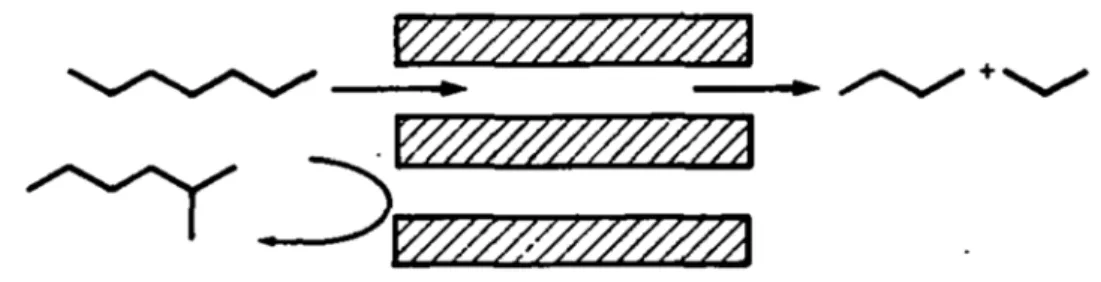
For example, the control of reactant selectivity by architectonics of porous zeolite is introduced as an example. The zeolite pore improves not only activity by increase active specific surface area but also selectivity of reactant by molecular shape selectivity. The selectivity is derived from correlation between reactant and pore, however various reaction mechanism is conducted [17]. Three mechanism is explained as an example. The compound which has eight-membered pore such as Ca-A and H-erionite decomposes only liner alkane without reaction of alkane which has methyl side chain [24]. Figure 1-3 shows the image of its reaction. This phenomena is called reactant selectivity which is decided correlation size between molecular and pore. The cause of reactive difference
14
between reactant is derived from reaction inside pore [25]. Next phenomena is called product selectivity which is selectivity derived from diffusion limitation of reactant in pore.
Figure 1-3. Images of molecular shape selectivity derived from reactant selectivity
The images of disproportionation of toluene using ZSM-5 is depicted in Figure 1-4. As can be seen, small reactant such as p-xylene and benzene is obtained selectively by reaction in ZSM-5 pore [26]. Various reactant were generated in the pore, however big reactant is not able to diffuse freely and trapped until become small molecules. Therefore, this catalyst makes small molecules selectively. Last phenomena is called restricted transition state selectivity which is selectivity derived from limitation of transition form.
Figure 1-4. Images of molecular shape selectivity derived from product selectivity
15
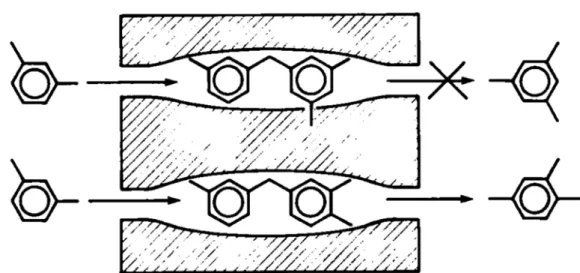
The image of disproportionation of m-xylene using H-mordenite is shown in Figure 1- 5 as example. In the case of this reaction, 1,3,5 trimethylbenzen is able to go through pore channel, however transition state of compounds for production of 1,3,5-trimethylbenzen is too bulky to form in pore [27]. Thus, 1,3,4 trimethylbenzen, whose intermediate is not bulky compound, is obtained selectively. As mentions above, catalyst hierarchical structure has important role for control catalytic functions.
Figure 1-5. Images of molecular shape selectivity derived from restricted transition state selectivity
Multifunctional catalyst has excellent performance and improve processes drastically.
Thus, a lot of investigation is conducted energetically to respond industrial demands.
However, it is hard work that accomplishment of accurate designing and prepare desired multifunctional catalyst whose architecture ranges micro to macro scales. Hence, the
16
reaction which is unclear structure performance relationship and the preparation methods which is not able to accurate control make multifunctional catalyst development difficult.
Therefore researches and developments of multifunctional catalyst are not only synthesis and performance test but also elucidation of structure performance relationship and exploring method for accurate architecture synthesis.
1.3 Ziegler-Natta catalysts
Ziegler-Natta catalyst is a one of industrial catalyst for polyolefin manufacturing.
Especially, this catalyst is used for 99% of polypropylene production in industry. From the following importance of polypropylene in the world, this catalyst comes to have very important role of industrial field.
The first report of this catalyst was success of ethylene polymerization without high pressure and temperature using combination of TiCl4 and alkylaluminum compounds at first in 1953 by Karl Ziegler [2]. Subsequently, propylene polymerization was also succeeded by combination of TiCl3 and alkylaluminium compounds in 1954 by Giulio Natta [12]. These techniques were able to liner polyolefin without high temperature and pressure, and innovated industrial polyolefin manufacture drastically. Therefore, this catalyst is named by implementer who are Ziegler and Natta. After invention, enormous
17
researches and developments have been conducted and those catalytic performances have kept improving in following industrial importance of polyolefin [28]. Thereby, various polyolefin such as wide variety of commodity grade, copolymer grade which polymerized with higher α-olefine and so on were invented by enormous efforts and produced in industry for sell. In recent year, specialty grade which has high additional values like ultra-high molecular weight polyethylene and impact copolymer was invented and produced. Therefore various Ziegler-Natta catalysts are developed to produce the wide range of polyolefin grade.
1.3.1 Polyolefin
Polyolefin is generic term of synthesized polymer made from alkene as monomer.
Especially, polyethylene and polypropylene are well known as commodity plastics.
Polyolefin possesses not only great mechanical property but also easiness of fabrication, cheap process cost from synthesis to molding. Therefore, polyolefin is used in broad wide of field as material and product more than 200 million tons every year in the following its industrial and practical conveniences [29]. Moreover, the fact that polyolefin is a material which processes low impact on environment is acknowledged again because polyolefin is composed by only carbon and hydrogen without any toxic material such as
18
chloride and aromatic groups. From these backgrounds, the increase of polyolefin usage is predicted. The trends of polyolefin production amount were shown in Figure 1-6 [30].
This data suggested that demands of polyolefin keep growth about 5% every year nevertheless a huge amounts of production. [31] Therefore, improvement of production efficiencies and material properties are strongly desired.
Figure 1-6. Past and future trends of polyolefin production
Polyethylene is a polymer of ethylene and produced the largest amount in the plastics spices. Polyethylene is synthesized by various kinds of catalyst because mechanical property is depends on those structure of molecular chain such as length and branches.
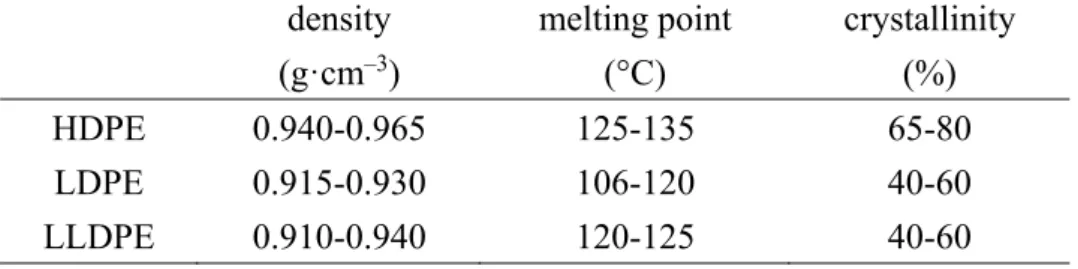
Polyethylene is classified according to their molecular chain structure into three categories. The images of molecular structure of classified polyethylene is shown in
0 50 100 150 200 250 300
Production amount (million ton)
Year
Polypropylene Polyethylene
19
Figure 1-6 and those general properties are shown in Table 1-3 [32].
Figure 1-7. Images of molecular structure of polyethylene;
(a) HDPE, (b) LDPE, (c) LLDPE
Table 1-3. Approximate range of properties of different types of PE [32]
density (g·cm‒3)
melting point (°C)
crystallinity (%)
HDPE 0.940-0.965 125-135 65-80
LDPE 0.915-0.930 106-120 40-60
LLDPE 0.910-0.940 120-125 40-60
First, high density polyethylene (HDPE) is liner polyethylene without any branches and able to be synthesized by Ziegler-Natta catalyst or fillips catalyst. Properties were dependent of molecular weight and molecular weight distribution. These trend to become different using catalyst spices and polymerization conditions. The features of this polymer is higher crystallinity and density than the other polyethylene spices. Thus this possesses
(a) HDPE
(b ) LDPE
(c) LLDPE
20
higher righty and opaque state. Taking advantage of those features, this is used film, plastic bag, some case, pipe and so on. Second, low density polyethylene possesses long chain branches and is synthesized by Philips catalyst. The feature of LDPE is lower density and crystallinity than HDPE. Mechanical properties are dependent not only information of main molecular chain structure but also amount and length of branches.
Thus, this mechanical property is flexible and soft. Additionally molding fabrication is easier than the other polyethylene. Form those features, LDPE is used as a material for making film, plastic bags. Third, linier low density polyethylene is liner polyethylene with some amount of short branches and is synthesized by copolymerization between ethylene and α-olefin spices using various catalysts. Mechanical properties are dependent of molecular weight, α-olefin incorporation amount and spices. Therefore selection for α- olefin is one of important factor. Basically metallocene catalysts is able to make LLDPE with high contents ofα-olefin and narrow molecular weight distributions. Thus this possesses is the middle of HDPE and LDPE. From those features, LLDPE is used as a material for making for films and cases. Thus, Polyethylene spices are used broad range by changing these structures and properties.
Polypropylene is polymer made from propylene and synthesized huge amount as an available material all over the world. 99% of propylene is produced by Ziegler-Natta
21
catalysts in industrial manufacturing although one part of metallocene spices can synthesis polypropylene. Because propylene synthesized by Ziegler-Natta catalysts is cheaper and able to possess broad range of mechanical properties by using different catalyst type. Mechanical properties are dependent not only molecular weight and molecular weight distribution but also stereoregurarity. Stereoregurarity is orientation of polymer decided by coordination of molecules. The images of three kinds of polypropylene with different stereoregurarity is shown in Figure 1-8 [33].
Figure 1-8. Images of stereoregularity of polypropylene; (a) isotactic polypropylene, (b) syndiotactic polypropylene, (c) atactic polypropylene
m m m m m m m
r r r r r r r
r m m r m r r
(a)
(c) (b )
22
Isotactic is state that all methyl groups are positioned at the same side with respect to the main chain. Syndiotactic is state that position of methyl group is alternative. Atactic is state that position of methyl group is random [34]. Generally, ratio of isotactic part is called tacticity as degree of molecular orientation. It is one of most important factor to effect on mechanical properties. The higher tacticity polypropylene is, higher rigidity it possesses. From those background, Wide range of polypropylene grades are produced and used for support any request using various type of Ziegler-Natta catalyst
Most of polyolefin products are generic and cheap. However some kinds of polyolefin grade possess excellent property which put out additional values. For example, ultra high molecular weight polyethylene (UHMWPE) has great rigidity, self‐lubricating, abrasion resistance regardless of high temperature conditions [35]. This polymer is one part of HDPE with extremely high molecular weight. This is made from polymerization using Ziegler-Natta catalyst [36,37] or metallocene [38] with reduction of chain transfer reaction frequency as little as possible. Nevertheless difficulty of molding fabrication because of its rigidity and high melting temperature [39], it is used as special materials for gear, fiber, film, artificial bone and so on . Impact copolymer is also well known as high value added polyolefin. It is made by multistep polymerization which process is propylene polymerization as first step and propylene-ethylene polymerization as second
23
step [39,40]. This multistep process makes polypropylene particles with high dispersed ethylene-propylene rubber [41,42]. This polymer possesses high shock resistance under low temperature conditions without loss of propylene properties. Because of its excellent properties, impact polypropylene is used as a materials for bumper of automobile, sporting goods, construction materials and so on.
1.3.2 Hysterical development of Ziegler-Natta catalysts
Ziegler-Natta catalyst is industrial catalyst to product various kinds of polyolefin materials. Especially, this catalyst is used for 99% of polypropylene production in industry. From the following importance of polyolefin in the world, this catalyst comes to have very important role of industrial field and has kept to be conducted researches and developments for improvement catalyst performances since invention. The performance improvements of Ziegler-Natta catalyst for propylene polymerization is shown in Figure 1-9. As can been seen, its performances has kept to improve and continue to grow from now on.
Here, the history of Ziegler-Natta catalyst developments are explained in this section.
24
Figure 1-9. The performance improvements of Ziegler-Natta catalyst for propylene polymerization
1.3.2.1 First and second generation
In 1953, Karl Ziegler found out that the combination of TiCl4 and alkylaluminum compound can synthesize polyethylene under ordinary temperature and pressure [2].
Subsequently, Giulio Natta succeeded to obtain polypropylene using TiCl4 and AlEt2Cl under ordinary temperature and pressure [12]. These catalysts which are simple combination of titanium chloride and alkylaluminum were called first generation catalyst.
These inventions contributed polyolefin industrial manufacturing drastically. However, the catalyst of those days is too low activity and stereoregularity to sell out polymers without any post treatments. Hence, decalcification of catalyst residues and separation of
Stereoregularity(%)
0 10 20 30 40 50
’60 ’70 ’80 ’90 ’00 100
Catalyst activity (kg‐PP/g‐cat.)
95 90 85
70 60 80
’10 ’20
25
atactic part must be conducted to sell. By the way, regioselectivity was high sufficiently and was not investigated about more control from the early stage because originally only 1-2 insertion is occurred by polymerization of titanium catalyst [43,44]. Therefore, improvement of activity and stereotacticity was tired to improve. In order to increase catalyst stereospecificity, various electron donating compounds were tired to coordinate in titanium chloride spices. As results, it is found that amine and ester compounds can increase catalyst stereospecificity. Thus, taking advantage of the features, high surface area and stereospecific Ziegler-Natta catalyst was developed by cogrinding with TiCl3
and donor compounds. Like these catalysts which were electron doner added Ziegler- Natta catalyst were called second generation catalyst. This catalyst performances were improved. Activity became so high that decalcification was not necessary by combination of bulk polymerization. Additionally, rate of atactic part were reduced only 3-4% by improvement of tacticity [28].
1.3.2.2 Third Generation
In early 1960, support material was started to use in Ziegler-Natta catalyst. At the most early stage, some materials which had high specific surface area such as silica, alumina, magnesium hydroxide and chlorinated magnesium oxide were used as supports and
26
coordinated with TiCl4. These developed catalysts were used as ethylene polymerization catalyst [45]. Soon after, the combination of TiCl4 and activated MgCl2 were found out and used as high activity catalysts [46,47]. However, this catalyst possessed too low activity and stereoselectivity to use industrial manufacturing in propylene polymerization.
The investigation for exploring high performances lewis base as donor in order to solve problem of low performance for propylene polymerization. In 1970s, it was achieved to develop novel solid catalyst which was made by grinding among TiCl4, MgCl2 and lewis base compounds (called internal donor). And this catalyst was activated by alkylaluminum compound and another lewis base (external donor), and showed high activity and stereoselectivity in propylene polymerization. This catalyst systems came to be used in industrial manufacturing from 1978 and catalyst performances were increased drastically [45]. These catalytic systems which is TiCl4 / Internal donor / MgCl2 + alkylaluminum + external donor is used as fundamental combination even now.
1.3.2.3 Fourth and Fifth Generation
Development of Ziegler-Natta catalyst was mainly conducted by exploring new donor and morphological control after invention of combination which was MgCl2 supported TiCl4 and Internal donor activated by alkylaluminum and external donor before
27
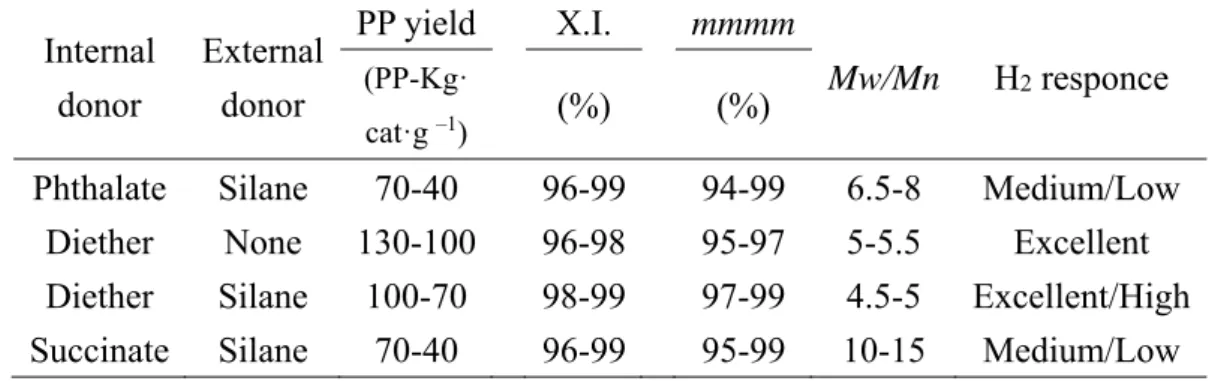
polymerization. The general performances of Ziegler-Natta catalyst with different donor were shown in Table 1-4 [13,44].
Table 1-4. General performances of Ziegler-Natta catalyst with different systems Internal
donor
External donor
PP yield X.I. mmmm
Mw/Mn H2 responce
(PP-Kg·
cat·g ‒1) (%) (%)
Phthalate Silane 70-40 96-99 94-99 6.5-8 Medium/Low Diether None 130-100 96-98 95-97 5-5.5 Excellent Diether Silane 100-70 98-99 97-99 4.5-5 Excellent/High Succinate Silane 70-40 96-99 95-99 10-15 Medium/Low
The industrial catalyst which used by Montecatini company at first in 1978 is used ethyl benzoate and methyl-p-toluate as internal and external donor respectively. Ester compounds were often used like this in early stage of using MgCl2 supported Ziegler- Natta catalyst. Especially ethylbenzoate was often used as internal and external donor.
Then, the combination of phthalate compounds and alkoxysilane was founded out as internal and external donor. This combination possessed superior activity and stereoselectivity than combination of ester compounds. From development of this combinations, activity and steroreguratiry came to become high enough. Therefore, new donor is demanded various performances with good balances which are activity, steroselectivity, lifetime, molecular weight length and molecular weight distributions.
28
After that, new donor kept to be explored and founded out. For example, diether compounds (especially 1,3 diether) can show higher activity and narrower molecular weight distribution than the other donor without using any external donor [48].
Additionally, succinate compounds can synthesis polypropylene which has broader molecular weight distribution than any other donors [49]. As mentions above, improvements and developments of donor comes to not only improve efficiency of industrial processes but also synthesize desired polypropylene structure in order to control property from first order structure. From its usefulness, exploring new donor is currently also performed to control polymer structures accurately.
On the other hand, more efficient and simplified processes were desired in early 1970s after polymer which is high yield and tacticity could be acquired constantly. Therefore improvement of these properties were also conducted by control of catalyst particle morphology apart from donor improvement. This catalyst is made by grinding among solid catalyst compositions and those particle morphologies were irregular and small at that time. Thus, these catalyst performances were high activity and seteroselectivity, however low activity stability and irregular morphology made operation difficult.
Therefore improvement of catalyst performances is demanded and tried to control morphology. In early 1980s, precipitation method [50] and chemical reaction method [51]
29
were developed and used for control catalyst morphology. Precipitation method is one of methods which prepare catalyst by precipitation from solved catalyst in solution.
Especially, the method which precipitation from MgCl2/alcohol solution is often used because of high performances of resultant catalyst. The features of this catalyst are particle density and stiffness. Thus, this catalyst is often used in homo polymerization by bulk process and gas process. Other method is chemical reaction methods which prepare catalyst by conversion from magnesium precursor to MgCl2 and coordination TiCl4 and donor. Mg(OEt)2 is often used for chemical reaction method. The features of this catalyst are high morphology control ability because catalyst morphology depends on precursor morphology. Thus, catalyst has high control ability of polymer morphology ability.
Additionally, it has high comonomer insertion ability in copolymerization because catalyst has high porosity. From these features, catalyst made by chemical reaction method is better suited production of copolymer, Impact copolymer and so on.
As mentions above, Ziegler-Natta catalyst developments were mainly conducted by exploring new donor and control particle morphologies and made performances higher.
Development of catalyst achieved not only to improve production efficiency but also to product high added value polyolefin like UHMWPE and impact copolymer. Current catalyst developments keep to be conducted with same objective which are exploring new
30
donor and control particle morphologies for more improvements of Ziegler-Natta catalyst.
1.3.3 Structure performance relationship in olefin polymerization
Ziegler-Natta catalyst was simple combination of TiCl3 and alkylaluminum compounds at first invention. However, usage of donor and MgCl2 made structure complex instead of improvement performances. Therefore, elucidation of correlation between structures and performances became difficult. The main causes were three. First is difficulty of characterization on catalyst structure. Ziegler-Natta catalyst is composed of multicomponent and irregularly hierarchic structures which ranges from angstrom scale to millimeter. Second is difficultly of systematic change of catalyst morphology because current industrial preparation methods are not able to control only one structure parameters. Third is difficulty of quantitative elucidation of structure effect because catalytic performances were determined by various structural parameters with concerted or opposed mechanism. Therefore elucidation of structure performance relationship is very difficult task from above problem. However, a lot of investigation reported role of structures for performances by importance of Ziegler-Natta catalyst. Here, the role of catalyst structural information is explained.
31
1.3.3.1 Role of MgCl2
In 1970s, Ziegler-Natta catalyst which was called third generation came to use MgCl2
as support material. It worked not only immobilization of active species and increase active surface like other catalyst systems but also electron donation effect to active species.
The effect of various metal chloride (MnCln) in propylene polymerization activities were compared from Ti(OBu)4/AlEt2Cl systems which active site is not easy to change by Soga and coworkers. As a results, correlation between activity and electronegativity of Mn+ (χn
= χ0(1+2n) ; χ0 = electronegativity of metal, n=oxidation number) were founded out. This correlation is shown in Figure 1-10 [52]. As can be seen, MgCl2 had the highest activity and lowest electronegativity. Therefore, MgCl2 is best support for Ziegler-Natta catalyst.
Figure 1-10. Correlation between activity and electronegativity of metal ion
32
δ-MgCl2 is used for Ziegler-Natta catalyst as support [53,54]. It is called activated MgCl2 and those crystalline structures are different between usually used MgCl2. XRD patterns for various MgCl2 are shown in Figure 1-11 [55]. As can be seen, only δ-MgCl2
spectra is broad. It means that crystal size is small and peak is too broad to identify crystal structure [56]. Therefore, characterization of MgCl2 is very difficult, especially TiCl4 and donor supported MgCl2 is not able to determine those crystalline structures perfectly now.
Figure 1-11. XRD pattern of various MgCl2; (a) α -MgCl2 (b) δ-MgCl2 activated from α -MgCl2 by ballmilling, (c) δ-MgCl2 activated α -MgCl2 by chemical reaction method
33
δ-MgCl2 has high energy surface which are (110) and (104). This images are shown in Figure 1-12 [57]. TiCl4 and donor are considered to adsorb these surface. When TiCl4 is adsorbed to MgCl2, structure is changed from tetrahedral to octahedral and coordinated with TiCl4 mononuclear and/or Ti2Cl6 dinuclear. Thus, it is considered that titanium can be coordinated any site and form various state irregularly. This is causes that Ziegler- Natta catalyst has multisite.
Figure 1-12. Model of mono and dinuclear TiCl4 species on the (104) surface and mononuclear TiCl4 species on the (110) lateral surfaces
34
As mentions above, the role of MgCl2 in Ziegler-Natta catalyst is immobilization of titanium species, increase active surface area, regulation of active site symmetry and electron donation. All effects are important role for preparation high performance Ziegler-Natta catalyst.
1.3.3.2 Role of electron donor
Olefin polymerization using Ziegler-Natta catalyst is progressed by coordinate anionic polymerization which is showed in Figure 1-13 [58].
Figure 1-13. Cossee Mechanism. R and X indicate a growing chain and chlorine atom respectively.
The state of titanium spices effect on polymerization performance greatly. A donor is a substance to which the state of titanium and MgCl2 structure can be changed and improves catalytic performance. Catalyst performances were improved by donor property not only electro donation for active site but also stabilization of activated MgCl2 surface and steric hindrance. The role of donor in Ziegler-Natta polymerization is as follows
35
Role of internal donor [28]
1. stabilization of activated MgC12, resulting in an enhancement of the effective surface area
2. preventing formation of non-stereospecific sites by adsorbing on the MgC12 surface, where TiCI4 is supported to form non-stereospecific sites
3. taking part in the formation of highly isospecific sites 4. replaced by external donors, to form more isospecific sites.
Roles of external donors [28]:
1. poisoning of non-stereospecific sites selectively;
2. conversion of non-stereospecific sites into highly isospecific sites 3. conversion of isospecific sites into more highly isospecific sites 4. increase the reactivity of the isospecific sites.
The elucidation of effect on performance was difficult to identified because characterization difficulty of irregular active site. Nevertheless, enormous effort to elucidate, it has not resulted to clarify quantitative structure performance relationship until now by only experimental results. However, Busico and coworker propose active site model by obtained enormous data. This model is called three site model and shown
36
in Figure 1-14 [59]. This model describes that the stereospecificity is not determined TiCl4
coordinated surface such as (110) or (104) and nuclearity (mono- or dinuclear), and according to coordinate or not of bulky regents (donor,Cl) in L1,2 site at near the coordinated metal sites (Mg, Ti, or Al). After, Terano and coworker improve more expansive and accurate this model [60].
Figure 1-14. Three-site model of active Ti species for highly isospecific (a), poorly isospecific (b), and syndiospecific (c). M = Ti, Mg, or Al, L1,2 = donor or Cl, □ = vacant site, and Pn = growing polymer chain.
Recently, cluster DFT calculation comes to be powerful tools for investigation of accurate micro active site structure following great development of computer science. this method proved that adsorption of two succinate compounds at the L1 and L2 site can convert the aspecific titanium species into isospecific active site on the MgCl2 (110) surface [61]. Additionally, Taniike reported that monoester donor is adsorbed to (110) surface with TiCl4 and improve not only stereospecificity but also regioregularity and
37
polymer molecular weight which are proved by obtained experimental results [62,63].
1.3.3.3 Particle morphology
The performances of Ziegler-Natta catalyst was desired not only activity and stereospecificity but also operation easiness and application other polymerization method from usage of MgCl2 as a support. Therefore, many researcher tried to improve performance such as stability of activity, copolymerization performance, catalyst stiffness, control ability of synthesized polymer and so on. Thus, precipitation method and chemical reaction method which can control catalyst morphology were developed to satisfy demands [50,51]. Recently, control of particle morphology comes to be demanded not only shape but also inner hierarchical structure because more accurate control of performance. Then correlation between particle structures and performances to obtain design criteria of particle morphology.
The cause which MgCl2 morphology has more number of roles than other catalyst is changed morphology by fragmentation during polymerization. Fragmentation is a phenomenon which is particle braking by internal pressure from generated polymer inside pore [64,65]. The image of fragmentation progress is shown in Figure 1-15 [66].
38
Figure 1-15. Two limiting modes of the fragmentation of catalyst carriers:
(a) shrinking core, (b) continuous bisection
The fragmentation behavior is decided by size of pore, stiffness of catalyst particle and polymer generation speed. Fragmentation behaver is roughly divined by shrinking pore model and continues bisectional model. Shrinking pore model is fragmentation form outside of particle to inside gradually. This fragmentation behavior tends to be occurred when particle pore is small and particle stiffness is high. On the other hand, continues bisectional model is fragmentation from inside and fragment particle gradually became small. This fragmentation tends to be occurred when particle stiffness is low and polymer is easily synthesis inside pore by low diffusion limitation. In practice case, fragmentation is occurred with combination of both models and strongly depends on not only particle structure but also polymerization species and conditions [67].
The behavior of fragmentation has strong effect on stability of activity behavior.
Catalyst activity is determined by active site number with balance of activations and
39
deactivations by alkylaluminium compounds. Some active sites are deactivated by excessive oxidization and some active sites are generated from new surface by fragmentation. Therefore control of activate and deactivate balance by fragmentation process is very important role of control activity behavior [68]. The activity behaviors which is performed by irregular shaped catalyst and shape controlled catalyst is shown in Figure 1-16 [69]. As can been seen, the activity behavior of irregular shaped catalyst is confirmed rapid activation and deactivation. The cause of this phenomena is derived from preparation method. Irregular shaped catalyst is made by cogrinding method and most of active site is placed on near surface. Therefore active site is activated and deactivated at one time. As results, activity become increase rapidly and decrease soon. On the other hand, activity of morphology controlled catalyst is stable because the balance of activation and deactivation is maintain.
Figure 1-16. Kinetic profiles of propylene polymerization using catalyst whose morphology was different; (a) Irregular shaped catalyst,
(b)Morphology controlled catalyst
40
Additionally, catalyst has an ability to control synthesized polymer morphology. This ability is derived from phenomena which the morphology of polymer is dependence on catalyst morphology in Ziegler-Natta olefin polymerization. This phenomena is said replication phenomenon. The mechanism of replication phenomenon is shown in Figure 1-17 [70,71]. At the initial stage of polymerization, catalyst fragments are dispersed uniformly in polymer particle. As polymerization proceeds, polymer subparticle growth with fragmented catalyst. As polymerization proceeds further, fragmented catalyst fragment more and growth new subperticle. Polymer particle is grown by these mechanism in olefin polymerization. Thus, polymer grows with keeping catalyst morphology. From these reason, the morphology of industrial catalyst is demanded spherical shape and narrow particle size distribution because demanded polymer morphology is spherical shape and narrow particle size distribution for ease operations.
41
Figure 1-17. Polymer growth mechanism with Ziegler-Natta catalyst fragmentation
As mentioned above, the performance of Ziegler-Natta catalyst is dependent on not only micro structure such as chemical composition and active site structure, but also catalyst morphology such as pore, particle size, shape and stiffness. Therefore, morphology control method keeps to be investigated for improvement of Ziegler-Natta catalyst.
1.4 Statistical analysis
Statistics is the study of big data processing which are collection, analysis, interpretation, presentation and organization using applied mathematics. This study comes to be used in a broad filed such as medical science, industrial science, social
catalyst
Polymer glowth
polymer globule
primary polypropylene particle
catalyst crystallite Polymer glowth
42
problem and so on in accordance with growth of an information-oriented society by development of computer and popularization of Internet. Currently, this becomes indispensable study in the various field. Statistical analysis is data treatment process based on statistics. This is a generic term of the methods which analysis the enormous and complex data to obtain right information by various ways. Here, statistical analysis is explained.
1.4.1 Correlation coefficient
Correlation coefficient is statistical indicator which indicates liner correlation between two variable. Generally, the value approaches +1 or ‒1, the correlation extent becomes higher in a positive or negative direction, respectively. And the value approaches 0, the correlation extent becomes lower.
Correlation coefficient is determined by covariance of two variable and variance of each variable. The correlation coefficient r, between two variables (x and y) is defined as
, (1.6)
y x
y x
V V r C
C(x,y), Vx and Vy are the covariance and the variances for x and y, respectively. They are defined as
43
(1.7)1
,
n
i
i i y
x n
y y x C x
(1.8)1
2
n
i i
x n
x V x
(1.8)1
2
n
i i
y n
y
V y ,
where n is the number of data.
1.4.2 Principal component analysis
Principal component analysis (PCA) is one of multivariate analysis which can reduce large number of variables to smaller number without any information losses. This method was invented in 1901 by Karl Pearson [72], and investigated various investigators for made improvement of itself [73,74] and development of new analysis systems like a Principal Component Regression (PCR) [75,76] . This analysis is reduction of variables identification of the plural number of variables within multi-dimensional state which explain the maximum value of variances in the whole data set in the minimum number of dimensions for easy to understand big data. Using this analysis results has great information as follows [77];
1. Reduction of the dimensions of dataset, enabling a greater quantity of information to be visualized.
44
2. Study of the relation between different descriptors
3. Preparation data for further analysis for removing descriptor or samples which has collinearity.
From this merit, PCA is used only conforming of sample features and classification of dataset [78] but also finding out outlier [74,79] and collinearity descriptor combinations [80] for pretreatment of other multivariate analyses.
1.4.3 Genetic function approximation
Genetic function approximation (GFA) is one of multivariate analysis which can construct quantitative structure-performance relationship with genetic algorithm. This method was established by Rogers and Hopfinger in 1994 [81]. GFA is not the method which is calculation from partial regression coefficient and residual parameters of assigned descriptors like a Multi Linear Regression (MLS), but a method which is search and determination by checking large number of equation models based on genetic algorism.
Genetic algorism [82] is a search algorism which models on natural genetics and evolutions. This algorithm works with a group of variables which called population. This population is evolved to next generation in processes which are selection, crossover and mutation. Where selection is determination of residual variables by fitting degree like a
45
survival in nature, crossover is blend between survived variables each other and creation new variables which has inherit features from both of last variables like a making child, mutation is creation variables randomly in order to avoid algorithm stuck suboptimal point, generation is the number of trial. These processes are conducted until model fitness value becomes convergence [77].
This method can approach to best fitting model equation with selection of a plenty number of models which has various descriptor combinations. Therefore, this method appropriates the cases that there are poor information about influence degree of each descriptors to performance. It can determine best fitness model efficiently from infinity number of descriptors information.
1.4.4 Application for material science
Statistics is the study for investigation about population and economics originally and started to be use in the 17th century. In the later part of 20th century, growth of an information-oriented society by development of computer and popularization of Internet made this study more useful for other field. The material science was one of them, and pharmaceutical chemistry was first example to use statistics for material science.
Statistical analysis was used as screening of new chemical about evaluation in
46
investigation for new medicine development and performed big contributions to increase efficiency of experiment. Its utility became more important by introduction of high- throughput techniques and used more fields including material science. There are few report and example of usage is limited, however statistical analysis becomes to be used for prediction about rigidity of polymer material [79], prediction of chemical property [83,84], prediction of homogeneous catalyst activity [85,86]and so on.
In recently, usage of statistical analysis was admitted for Registration of Toxic Substances Control Act database (TSCA) and application Registration, Evaluation, Authorisation and Restriction of Chemicals (REACH restriction) because validity and utility of this study becomes well known. Additionally, new chemistry which set high-through put technique and statistical analyses as principal techniques for automatic and efficient development of new materials are proposed and developed [87]. Form those background, usage of statistical analysis will be developed itself and used in more broad fields.
1.5 Objective of this study
Multifunctional catalyst is one of a catalyst spices which has more than one performances. Applications of this catalyst for chemical reaction are expected not only improvement of catalytic performances but also reduction of additional operation and the
47
plural number of reactor.
Ziegler-Natta olefin polymerization catalyst is one of multifunctional catalyst. This catalyst has been improved by usage of multicomponent and construction of hierarchical structure to enhance their properties until now. However, its catalyst structure becomes complex and irregular. Structure performance of current catalyst systems relationship is not elucidated clearly. Therefore, catalyst development has been conducted by only experimental developments with enormous try and error, and performance increase rate becomes low recently. The cause of this problem is mainly three. First is difficulty of characterization on catalyst structure. Ziegler-Natta catalyst is composed of multicomponent and irregularly hierarchic structures from micro to macro. It is hard to characterize structures only one measurement. Second is difficultly of systematic change of catalyst morphology because current industrial preparation methods are not able to control only one structure parameters. Third is difficulty of quantitative elucidation of structure effect because catalytic performances were determined by various structural parameters with concerted or opposed mechanism. Therefore elucidation of structure performance relationship is very hard task from above problem
From those backgrounds, the purpose of this study was elucidation of structure performance relationship by multilateral characterization which is a variety of
48
characterization methods in order to achieve structural parameterization over multi scales and statistical analysis which is the powerful tool for elucidation of multivariate factor form enormous datasets. The results of this study will be expected to contribute not only establishment of systematic Ziegler-Natta catalyst development but also preparation of tailor-made catalyst, proposal of new catalyst construction indications which has novel performance and so on.
References
[1] E. Kikuchi, K. Segawa, A. Tada, Y. Imizu, H. Hattori, "Atarashii shokubaikagaku (新 しい触媒化学)" 1988 sankyo shuppan (三共出版)
[2] K. Ziegler, E. Holzkamp, H. Breil, H. Martin, Angew. Chem., 67 (1955) 541
[3] J. A. Osborn, F. H. Jardine, J. F. Young. G. Wilkinson, J. Chem. Soc. A, (1966) 1711–
1732.
[4] A. J. Birch, D. H. Williamson, Org. React., 24 (1976) 1-95.
[5] W. S. Knowles, M. J. Sabacky, B. D. Vineyard, US patent, (1974) 4008281 A (monsanto company)
[6] W. S. Knowles, Adv. Synth. Catal., 345 (2003) 3-13
[7] Susan B. Rivera*, B. D. Swedlund, G. J. King, R. N. Bell, C. E. Hussey, Jr., D. M.
Shattuck-Eidens, W. M. Wrobel, G. D. Peiser, and C. D. Poulter, Proc. Natl. Acad. Sci. U.
49 S. A., 98 (2001) 4373-4378
[8] S. Akutagawa, Appl. Catal., A, 128 (1995) 171-207
[9] H. Kumobayashi, Recl. Trav. Chim. Pays- Bas 115 (1996) 201-210
[10] H.U. Blaser, F. Spindler, M. Studer, Appl. Catal., A, 221 (2001) 119–143 [11] A. Nanicini, "synthesis of ammmonia" (D.J. Borgars ed.) (1961) MacMillan [12] G. Natta, P. Pino, P. Corradini, F. Danusso, E. Mantica, G. Mazzanti, G. Moraglio, J.
Am. Chem. Soc., 77 (1955) 1708.
[13] J. C. Chadwick, Macromol. React. Eng., 3, (2009) 428-432 [14] F. G. Ciapettaa, D. N. Wallacea, Catal. Rev., 5 (1972) 67-158
[15] P. B. Weisz, Actes 2me Congr, Int. Catal., Edition Technip (1961) Paris
[16] G. A. mills, H. Heinemann, T. H. Milliken and A.G. Oblad, Ind. Eng.Chem. 45, 1953 134-137
[17] S. M. Csicsery, Zeolites, 4, (1984) 202-213
[18] T. Tatsumi, N. Jappar, J. Phys. Chem. B 102 (1998) 7126-7131.
[19] N. van der Puil, F.M. Dautzenberg,H. van Bekkum, J.C. Jansen. Microporous Mesoporous Mater. 27, (1999) 95-106
[20] M. V. Tweigg, Catal. Chem. Processes, (1981) 11
[21] M. Andersson, L. Ӧsterlund, S. Ljungstrӧm, A. Palmqvist, J. Phys. Chem. B, 106