JAIST Repository
https://dspace.jaist.ac.jp/
Title ODMクライアントの新製品開発における意思決定支援の
ための顧客指向アプローチ
Author(s) Suprasongsin, Sirin Citation
Issue Date 2018‑09
Type Thesis or Dissertation Text version ETD
URL http://hdl.handle.net/10119/15517 Rights
Description Supervisor:Huynh Nam Van, 知識科学研究科, 博士
A Customer-Oriented Approach for Decision Support on New Product Development for ODM Clients
Sirin Suprasongsin
Japan Advanced Institute of Science and Technology
Doctoral Dissertation
A Customer-Oriented Approach for Decision Support on New Product Development for ODM Clients
Sirin Suprasongsin
Supervisor: Associate Professor Van-Nam Huynh
School of Knowledge Science
Japan Advanced Institute of Science and Technology
September 2018
Abstract
Due to a rising of online marketing, there are abundant of Original Design Manufacturer (ODM) clients existing in the market. To capture the market share, it is necessary for them to launch a customer- oriented product, which leads to the customer satisfaction and a success of the product at the end. In doing so, ODM clients need decision supports on their tasks to keep customers’ focuses in all stages of the new product development (NPD) processes. However, ODM clients’ tasks receive little attention in the literature and there is no decision support for ODM clients in NPD.
Motivated from these limitations, a customer-oriented linguistic approach for decision support on NPD for ODM clients is proposed in this study. The study focuses on three ODM clients’ tasks for developing a new beverage product. Those tasks are 1) identifying customer-oriented product concept, 2) providing product specification to ODM manufacturers, and 3) screening an evaluation on go/no-go product. To support these three ODM clients’ tasks, three models are developed.
For the first ODM clients’ task, a model for prioritizing customer-oriented product concepts is de- veloped so that a set of suitable product concepts is identified. In this model, a linguistic computation approach based on membership functions is applied to prioritize customer-oriented product concepts.
For the second ODM clients’ task, a model for translating customer requirements to manufacturing requirements is introduced so that ODM clients are able to provide a product specification to their ODM manufacturers for supporting the manufacturing process. In this model, a linguistic computation based on term index is used to analyze customers’ preferences on product characteristics.
For the third ODM clients’ task, a model for evaluating customer-oriented product performance is developed so that ODM clients are able to screen go/no-go product. Here, the product performance is determined from the difference between the interval target linguistic terms and the interval perceived linguistic terms. In this model, a linguistic computation based on term index is used to analyze the interval perceived linguistic terms from customers.
The critical challenge in developing these three models is the loss of information from the approxi- mation process in retranslating computed linguistic information to its initiated domain. Generally, the results of computing linguistic information do not match with their initial linguistic terms. Thus, the ap- proximation process is needed to retranslate the computational linguistic results into their initial domain.
However, the approximation process usually leads to the loss of information.This loss of information im- plies a lack of precision in the final results. Hence, it is important to develop models for supporting ODM clients’ tasks that can avoid the loss of information during the evaluation processes. In this study, such an issue is the main concern in developing three models.
To demonstrate the effectiveness and applicability of the proposed models, a case study of developing a new soy milk beverage product is used. Consequently, all models show their abilities over the existing models. In summary, the effort in this study is to analyze linguistic information existed in ODM clients’
tasks in order to provide a recommendation on NPD for ODM clients.
Keywords: Multiple criteria group decision making; Interval linguistic assessment; Probability dis- tribution; Manhattan distance measure; New product development; ODM clients
Acknowledgments
First and foremost, I would like to express my sincere gratitude to my supervisor Prof.
Van Nam Huynh from Japan Advanced Institute of Science and Technology (JAIST), for his patience, motivation, and immense knowledge. His guidance helped me in all the time of research and writing of this thesis. I could not have imagined having a better supervisor for my Ph.D study.
I would like to acknowledge my examination committee: Prof. Youji Kohda, Prof.
Tsutomu Fujinami, and Prof. Takaya Yuizono, who gave me a lot of suggestions to im- prove my thesis. Especially, I would like devote my deepest gratitude to Prof. Pisal Yenradee from Sirindhorn International Institute of Technology (SIIT), Thammasat Uni- versity, for his guidance, papar revision, and encouragement through my Ph.D. study.
I gratefully acknowledge the funding source that made my Ph.D study possible. I received a scholarship from JAIST-SIIT-NECTEC dual degree doctoral program. In ad- dition, my work was also supported by the National Science and Technology Development Agency (Stem workforce program).
My time at JAIST was made enjoyable in large part due to many friends and groups that become a part of my life’s journey. Thanks to Huynh-lab members for their friend- ship, advices and collaboration. I am also grateful for time spent with my roommate (Janthorn Sinthupundaja) and Thai friends, for being my backpacking buddies to dis- cover many places in Japan. Those memorable trips enrich my life in Japan a lot.
Lastly, I would like to thank my family for all their encouragements and supports in all my pursuits. And specially thank to my boyfriend, Panumate Chetprayoon, for his support, patience and understanding during my final stage of Ph.D and job hunting. I honestly appreciate and embrace all the things come to my life, which make me become
‘ME’ today.
Thank you, Sirin Suprasongsin September 2018
Table of Contents
Abstract i
Acknowledgments ii
Table of Contents iii
List of Figures vi
List of Tables viii
Abbreviation and Terminology xi
1 Introduction 1
1.1 Research background and Research motivation . . . 1
1.2 Scope of work . . . 3
1.3 Research goal . . . 4
1.3.1 Model 1 . . . 4
1.3.2 Model 2 . . . 4
1.3.3 Model 3 . . . 5
1.4 Research significance . . . 6
1.5 Research challenge . . . 7
1.6 Overview of the Thesis . . . 8
2 Background on fuzzy linguistic approaches 9 2.1 Linguistic decision making problems . . . 9
2.2 Linguistic computation approaches . . . 10
2.2.1 Linguistic computation approach based on membership functions
and their techniques in developing models for ODM clients . . . 12
2.2.2 Linguistic computation approach based on ordinal scales (term in- dex) and their techniques in developing models for ODM clients . . 17
2.2.3 2-tuple linguistic representation model . . . 17
2.2.4 Probabilistic uncertain linguistic model . . . 18
2.2.5 Distance measures between linguistic terms . . . 20
2.3 Summary . . . 22
3 Decision model for prioritizing customer-oriented product concepts 23 3.1 Model’s background and its challenges . . . 23
3.2 3-dimension fuzzy linguistic representation model . . . 25
3.2.1 A concept of 3-dimension fuzzy linguistic representation . . . 25
3.2.2 A normalization of the 3-dimension fuzzy linguistic representation . 26 3.2.3 Some aggregation operators for the 3-dimension fuzzy linguistic rep- resentation model . . . 27
3.2.4 Defuzzifying fuzzy numbers . . . 28
3.3 An MCGDM evaluation model with 3-dimension fuzzy linguistic represen- tation . . . 29
3.4 A case study . . . 31
3.4.1 Implementation of the proposed model . . . 31
3.4.2 Comparative study . . . 37
3.5 Concluding remarks . . . 39
4 Decision model for providing product specification to ODM manufac- turers 40 4.1 Model’s background and its challenges . . . 40
4.2 Polar manhattan distance measure . . . 43
4.3 MCGDM model for encouraging manufacturing process on customer-oriented product . . . 45
4.4 A case study . . . 53
4.4.1 Data collection . . . 53
4.4.2 Design of experiment . . . 53
4.4.3 Gathering (1) customer preferences on Thai tea characteristics (at- tributes) (xnk) . . . 54
4.4.4 Gathering (2) the change of customer perception on adjusting an attribute at a time (xnk0) . . . 55
4.4.5 A result of applying the proposed model . . . 55
4.4.6 Conclusion and future work . . . 60
5 Decision model for screening an evaluation of go or no-go product 65 5.1 Model’s background and its challenges . . . 65
5.2 A 3-tuple linguistic distance-based model . . . 67
5.2.1 Concept of a 3-tuple linguistic distance-based model . . . 67
5.2.2 Computational process . . . 68
5.3 MCGDM model for screening a new product’s go/no-go . . . 73
5.4 A case study on Thai-tea soy milk beverage . . . 75
5.4.1 Data collection . . . 76
5.4.2 Result of the proposed model’s implementation . . . 79
5.4.3 Comparison and discussion . . . 87
5.5 Concluding remark . . . 91
6 Conclusion 93 6.1 The main contribution . . . 93
6.2 Contribution to knowledge science . . . 95
6.3 Direction for future work . . . 95
Appendix 97 A Questionnaire on customer-oriented evaluation for ODM clients in sup- port of ODM clients’ activity 1 97 A.1 A general information of respondents for ODM client’s activity 1 (Part 1) . 97 A.2 An evaluation on customer-oriented product concept for Thai-tea beverage product (Part 2) . . . 97
B Questionnaire on customer-oriented evaluation for ODM clients in sup-
port of ODM clients’ activity 2 100
B.1 A general information of respondents for ODM client’s activity 2 (Part 1) . 100 B.2 An evaluation on customer-oriented taste for Thai-tea beverage product
(Part 2) . . . 100 C Questionnaire on customer-oriented evaluation for ODM clients in sup-
port of ODM clients’ activity 3 105
C.1 A general information of respondents for ODM client’s activity 3 (Part 1) . 105 C.2 An evaluation on customer perception on packaging design regarding cri-
teria (Part 2) . . . 106
Biblography 106
Publications 119
List of Figures
1.1 Value creation on customer-oriented product . . . 1
1.2 A framework for Task 1 . . . 5
1.3 A framework for Task 2 . . . 5
1.4 A framework for Task 3 . . . 6
2.1 A linguistic decision making resolution scheme [1] . . . 9
2.2 A flow diagram for the reviewed linguistic computation approaches . . . . 11
2.3 Approaches in developing models for ODM client’s tasks . . . 12
2.4 The multiplication of two membership functions under extension principle (.. ..) and function principle (-) [2] . . . 13
2.5 Coefficients of Pascal triangle numbers . . . 15
2.6 A 2-tuple representation model [1] . . . 18
2.7 Graph representation of linguistic hierarchy corresponding to g=5 [3] . . . 21
2.8 Injection ψ :L−→Z2 [3] . . . 21
3.1 Probability distribution pkgj of linguistic term g on criterionj . . . 35
4.1 A non-polar assessment . . . 44
4.2 A polar assessment . . . 44
4.3 Notations of effects on an attribute changed: fk=1 . . . 47
4.4 Steps of the proposed model 2 . . . 47
4.5 Product prototype with its attribites and its dependent attributes . . . 52
4.6 A diagram of six product prototypes . . . 54
4.7 Question for gathering customer preferences on Thai tea smell . . . 54
4.8 Question for gathering customer perception on affected attributes . . . 55
5.1 Procedures for the proposed 3-tuple linguistic distance-based evaluation
model . . . 74
5.2 Framework of a new product’s go/no-go screening . . . 76
5.3 G-point scale for gathering kansei data . . . 77
6.1 TACIT knowledge → EXPLICIT knowledge . . . 95
6.2 The work illustrated by SECI model . . . 96
A.1 A general information of respondents for ODM client’s activity 1 . . . 98
A.2 An evaluation on customer-oriented product concept for Thai-tea beverage product . . . 99
B.1 A general information of respondents for ODM client’s activity 2 . . . 101
B.2 An evaluation form of formula A . . . 102
B.3 An evaluation form of formula B . . . 103
B.4 An evaluation form of formula C . . . 104
C.1 A general information of respondents for ODM client’s activity 3 . . . 106
C.2 An evaluation on customer perception on packaging design regarding cri- teria . . . 106
C.3 An evaluation on customer perception on packaging design regarding cri- teria (Cont) . . . 107
List of Tables
1.1 An example of the distribution of tasks for new product development among
OEM, ODM, and OBM [4] . . . 3
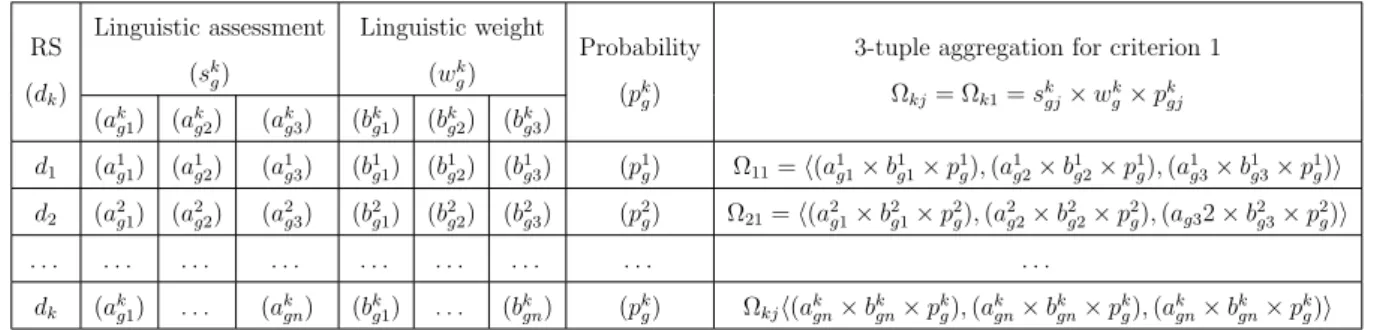
3.1 A 3-tuple fuzzy linguistic matrix ( ˆRk) on criterion j, wherej = 1 . . . 27
3.2 Linguistic information of respondents dk . . . 33
3.3 A set of triangular fuzzy numbers for linguistic weight wgk and linguistic assessmentskgj . . . 34
3.4 Triangular fuzzy numbers of (wgk) and (skgj) . . . 34
3.5 Importance weight (IMj) . . . 34
3.6 Probability distributionpkgj . . . 35
3.7 A comparative study . . . 37
4.1 A matrix for RSs’ expression . . . 48
4.2 A matrix of reliability weight of RSs . . . 48
4.3 The change of customer perception on attribute fk0 when attribute fk is changed . . . 51
4.4 Linguistic assessment provided by respondents on each formula . . . 56
4.5 Linguistic assessment provided by respondents on each formula (Cont) . . 57
4.6 Weight ˆwnk, Distance dnkης, and ˆwnk ×dnkης . . . 61
4.7 Weight ˆwnk, Distance dnkης, and ˆwnk ×dnkης (Cont) . . . 62
4.8 Distance dnkης0 (Step 8) . . . 63
4.9 Distance dnkij 0 (Step 8) (Cont) . . . 64
5.1 Perception on criteria fk assessed by respondents rm is defined by interval perceived linguistic terms (IPLTs)xmk . . . 69
5.2 Vertex coordinators of linguistic term setS, G= 7 . . . 70
5.3 3-tuples decision matrix, rm =hxmk, αmkης i, pmk . . . 71
5.4 An evaluation form evaluating product concepts for packaging design . . . 78
5.5 Linguistic assessment by respondents xmk (r1−r45) . . . 80
5.6 Linguistic assessment by respondents xmk (r46−r61) . . . 81
5.7 Reliability weights of respondentspmk (r1 −r27) . . . 82
5.8 Reliability weights of respondentspmk (r28−r61) . . . 83
5.9 Difference between two linguist terms (tk and xmk); αηςok of r1 −r23 . . . 84
5.10 Difference between two linguist terms (tk and xmk); αηςok of r24−r48 . . . . 85
5.11 Difference between two linguist terms (tk and xmk); αηςok of r49−r61 . . . . 86
5.12 Expected distance degree (EDk), Ranking, and Threshold with adjustable β 88 5.13 Results of comparative model (Pang et al.’s model) [5] . . . 89
5.14 A comparative result of expected distance degree, ranking, and threshold with adjustableβ from Pang et al.’s model [5] . . . 90
Abbreviation and Terminology
Abbreviation Terminology
DM Decision Maker: The one who make a decision such as managers, shareholders, committee, etc.
NPD New Product Development: It covers all processes rang- ing from product identification through product launch- ing. In other words, it is a complete process bringing a product to the market.
ODM Original Design Manufacturer: It is a company that designs and manufactures the actual product based on specification from its clients. It does not have its own brand product.
OEM Original Equipment Manufacturer: It is a company that manufactured parts or equipments, which are markets by other companies, but it owns its brand product.
OBM Original Brand Manufacturer: It is a company that sells an entire product made by a second company. It does not have its own brand product.
PLTS Probabilistic Linguistic Term Set:
PULTS Probabilistic Uncertain Linguistic Term Set:
RS Respondent: The one who provides opinion on subject.
In this thesis, it is the one who assess the questionnaire for gathering product perception on various aspects.
SD Semantic Differential: It is a method mostly used in Kansei engineering technique.
Chapter 1 Introduction
In this chapter, a research background, a research motivation, a scope of work, a research goal, a research significance, and a research challenge are demonstrated. Finally, the structure of this thesis is presented.
1.1 Research background and Research motivation
A rising of online marketing increases an opportunity for Original Design Manufacturer (ODM) clients in expanding their sales and making an advertisement. Currently, there exists abundance of ODM clients in the market. To capture the market shares, a customer- oriented product is a key tool. The customer-oriented product is a product produced based on an understanding of customers’ needs. Indicated by Ulrich and Eppinger [6], a company’s success depends on the abilities to identify customer needs and to quickly create customer-oriented products. Generally, the customer-oriented product creates a customer satisfaction. Then, the satisfied customers create the customer loyalty, which leads to the steady stage of future cash flow. Finally, the cash flow will ensure the success of the company. The chain of value creation on customer-oriented product is presented in Figure 1.1.
Figure 1.1: Value creation on customer-oriented product
However, it is difficult for ODM clients to research a whole process for a new customer- oriented product because it requires a high investment and specialties. Cooperation among organizations in supply chain, e.g. manufacturers, suppliers, and customers, may be a great strategy for ODM clients in developing a new customer-oriented product [7], [8].
A collaborative R&D network within organizations can be generally classified into three main modes based on their knowledge and specialty, which are Original Equip- ment Manufacturer (OEM), Original Design Manufacturer (ODM), and Original Brand Manufacturer (OBM). The knowledge flows among them are summarized in Table 1.1 [4].
OEM (Original Equipment Manufacturer) owns the brand name and markets the final products [9]. It manufactures the products that will be bought by a company and then sold under the purchasers brand name. OEM has a responsibility to produce the product they are assigned to make. The products have to meet the needs of the customers.
OBM (Original Brand Manufacturer) is a company that retails their own branded products that are either the entire products or component parts produced by a second company. They sell the goods under their own brand name in order to add value. The OBM will be responsible for everything including the production and development, supply chain, delivery and the marketing [10].
ODM (Original Design Manufacturer) is responsible for designing and manufacturing a product. ODM manufacturers sell the products that they design and produce to its clients, they do not sell directly to the market [10]. For example, HTC manufactures the Google Nexus One smartphone for Google. In ODM business, HTC acts as ODM manufacturer, while Google is an ODM clients [11], [12] .
From Table 1.1, ODM business consists of three parties, which are client, manufacturer, and supplier. Two main roles of ODM clients in new product development (NPD) are (1) providing product ideas to manufacturers for manufacturing a client-based product, and then (2) verifying a finished product. For example, a company has concepts for a ‘new smart car’ not only as fast, stable, and comfortable, but also as a driving trainer training the driving habits, i.e. economic drive, safe drive, etc. ODM clients have done the market research and know that they can market such a product with these concepts. Then, ODM clients provide their concepts to their contract ODM manufacturers to manufacture the actual product according to the given concepts. In some cases, ODM clients or ODM
manufactures may outsource ODM suppliers for product development services, product designing services, etc, based on their own capabilities.
Table 1.1: An example of the distribution of tasks for new product development among OEM, ODM, and OBM [4]
Task for new product development
OEM ODM OBM
Client Manufacturer Supplier Client Manufacturer Supplier Client Manufacturer Supplier
1. Product idea X X X
2. Electrical, Mechanical, Safety design X X X
3. Design of modification, BOM producing X X X
4. Concept, exterior design for parts X X X
5. Sample trying, mold development X X X
6. Sample design, RD test X X X
7. Function verification X X X
8. Pilot production X X X
9. Market production X X X
In summary, this section has discussed the characteristics of developing new product for ODM clients. Firstly, ODM clients need to provide product ideas to ODM manufac- turers, and then verify the actual product from them.
These ODM clients’ tasks involve with qualitative information and multiple attributes in evaluating customers’ preferences and presenting them in the actual products. In MCDM problems with qualitative information, the main issues are how to represent and aggregate linguistic information. Fuzzy set theory proposed by Zadeh [13] is widely ap- plied to deal with linguistic information. Basically, the results of computing linguistic information do not match with their initial linguistic terms. Thus, the approximation process is needed to retranslate the computational linguistic results into their initial do- main. However, the approximation process usually leads to the loss of information. This loss of information implies a lack of precision in the final results. Hence, it is important to develop models for supporting ODM clients’ tasks that can avoid the loss of information during the evaluation processes.
1.2 Scope of work
Despite the high growth rate of ODM clients, there are limited works developing the de- cision support models on new customer-oriented product development (NPD) for ODM
clients. Taking this consideration into account, this research aims at proposing deci- sion models for supporting ODM clients’ tasks in developing the new customer-oriented product.
To scope the work, this research focuses only three tasks of ODM clients for developing a new Thai-tea soy milk beverage product. The three focused tasks are as follows.
1. Identifying customer-oriented product concepts
2. Providing product specification to ODM manufacturers 3. Screening an evaluation on go/no-go product
1.3 Research goal
The goal of this research is to develop decision models that can avoid the loss of infor- mation in linguistic computational processes for supporting three ODM clients’ tasks in developing a new customer-oriented beverage product. To obtain this goal, three models are developed in support of three ODM clients’ tasks as explained in details as follows.
1.3.1 Model 1
Task 1: Identifying customer-oriented product concept
To accomplish the first ODM clients’ task, the proposed model prioritizes the customer- oriented product concepts. To do so, firstly, ODM clients provide the list of product con- cepts. Then, the target customers are asked to express their preferences on the product concepts from the list through a questionnaire survey using the interval linguistic terms.
Next, the decision model is applied to analyze customers’ preferences. Finally, a ranking of preferable product concepts is identified. The framework for ODM clients’ task 1 is depicted in Figure 1.2.
1.3.2 Model 2
Task 2: Providing product specification to ODM manufacturers
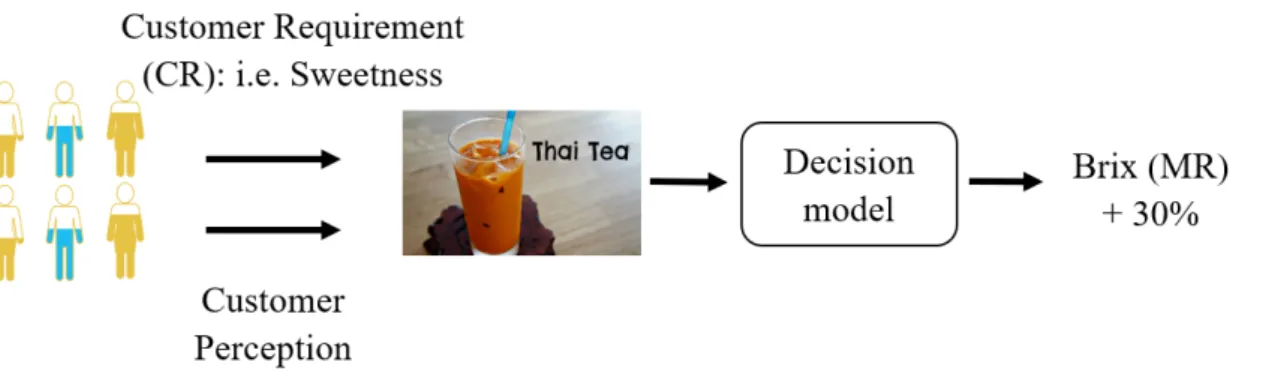
To accomplish the second ODM clients’ task, the proposed model translates customer requirements (CRs) on the beverage taste to manufacturing requirements (MRs). To do
Figure 1.2: A framework for Task 1
so, customers are first asked to provide their preferences on the product prototype based on the given aspects, i.e. sweetness degree, creamy degree, and Thai-tea smell degree, by using the questionnaire survey. Then, the differences on aspects between CRs and the product prototype are determined by the proposed model. Moreover, the proposed model is able to convert CRs to MRs by using some relative equations. Finally, the proposed decision model will encourage manufactures better understand customer needs by providing a technical product specification to ODM manufacturers. The framework for ODM clients’ task 2 is depicted in Figure 1.3.
Figure 1.3: A framework for Task 2
1.3.3 Model 3
Task 3: Screening an evaluation of go or no-go product
To accomplish the last ODM clients’ task for this research, the proposed model deter- mines the fitness degree of the target product concepts and the perceived product con- cepts. Here, the target product concepts refer to the given concepts from ODM clients, while the perceived product concepts refer to the actual customers’ perceptions on prod- uct concepts. To do so, two sets of linguistic information are gathered at the beginning
by using a questionnaire survey.
• The first one, called ‘Interval target linguistic terms ’ , is gathered from ODM clients for targeting the product concepts.
• The second one, called ‘Interval perceived linguistic terms ’ , is collected from cus- tomers for assessing customers’ perceptions on concepts from the actual product.
Having collected two sets of information, a decision model is applied to evaluate the difference between ‘Interval target linguistic terms ’ and ‘Interval perceived linguistic terms ’ . The differences are represented by the fitness degree. Obtaining the fitness degree can further support the decision on launching a new customer-oriented product.
If the fitness degree passes the ODM clients’ acceptable levels, it means that the actual product is able to reflect ODM clients’ requirements, and it is ready to be launch to the market. The framework for ODM clients’ task 3 is depicted in Figure 1.4.
Figure 1.4: A framework for Task 3
1.4 Research significance
New product development (NPD) project generally composes of many processes rang- ing from product-concept identification through product launch [14], [15]. As stated by Calatone [16], initially screening the product ideas significantly encourages managers to eliminate the risky product ideas at the beginning stage before high investment are made and opportunity cost incurred. In addition, Lin et al. [17] also indicated that initial screening the product ideas has a highest correlation with new product prior to com- mercialization resulting in resource consumption. Thus, a process of screening product ideas is a very important task in NPD project [18]. In practice, knowing what are the
important product ideas may not enough to gain competitive advantages for NPD. It is also necessary to keep those ideas through product launch.
In short, the significances of this research can be summarized as the following points.
• The proposed models are able to smoothen the work flow between ODM clients and ODM manufacturers.
• The proposed models are able to support ODM clients’ tasks.
• The proposed models are able to suggest a manufacturing department in specifying manufacturing requirements for manufacturing a product.
• The proposed models are able to support marketing department to (1) clarify the product identity, and (2) ensure the product concepts on the actual product.
1.5 Research challenge
The issue on identifying product ideas and keeping those product ideas through product launch have some challenges as the following.
• Product ideas are subjective and qualitative information, which are uncertain and ambiguous in nature. In other words, it is the customers’ tacit knowledge. Thus, it is difficult to represent them as the explicit knowledge.
• It is a multiple criteria group decision making (MCGDM) problem. Thus, it is difficult to aggregate individual customers’ opinions, and provide a compromised recommendation to ODM clients.
• Normally, there are some losses of information during the approximation process when several linguistic information are computed. It is also challenging in developing a model that can avoid those losses.
In this research, the challenges and difficulties addressed above will be alleviated. The proposed models are able to accomplish three focused ODM clients’ tasks for developing new Thai-tea soy milk beverage product. The solutions importantly encourages ODM clients to make a further campaign, promotion, and other marketing strategies.
1.6 Overview of the Thesis
A structure of thesis is divided into six chapters, as illustrated in Figure , and are explained in details as follows.
• Chapter 1 describes the research background and research motivation. In the re- search background, the characteristics of new product development (NPD) for ODM clients are defined. Next, the scope of work in NPD for ODM clients’ tasks is ad- dressed. Then, the research goals, research significances and research challenges are presented. Finally, a thesis organization is provided.
• Chapter 2 presents a research background and some literature reviews on linguis- tic approaches for multiple criteria decision making problems including linguistic approaches based on approximation models and term-based models. In addition, other related knowledge are also recalled.
• Chapter 3 proposes a model for achieving ODM clients’ task 1. Here, a linguistic approach based on approximation model is exploited. A new model called 3-tuple fuzzy linguistic model is proposed to prioritize the customer-oriented product con- cepts. Next, the normalization and aggregation processes for 3-tuple fuzzy linguistic model is introduced. Finally, a case study in a private company in Thailand is pre- sented to show the applicability of the proposed model.
• Chapter 4 presents a model for achieving ODM clients’ task 2. A new 3-tuple linguistic distance-based model is proposed to support decision on manufacturing a new customer-oriented product. The proposed model is based on linguistic term- index based approach. The effectiveness of the proposed model is presented through a case study in a private company in Thailand.
• Chapter 5 presents a model for achieving ODM clients’ task 3. Similar to ODM clients’ task 2, a 3-tuple linguistic distance based model is proposed to evaluate customer-oriented product performance. The proposed model is compared with the existing model to shows its effectiveness. In addition, the proposed model is also illustrated through a case study in a private company in Thailand.
• Chapter 6 contains some concluding remarks and suggestion for the future works.
Chapter 2
Background on fuzzy linguistic approaches
2.1 Linguistic decision making problems
In linguistic decision making problems, there are abundant decision models for represent- ing, aggregating, and exploiting linguistic information. Stated by Rodriguez et al. [1] and Herrera et al. [19], a common decision resolution scheme consists of three main phases, as depicted in Figure 2.1.
Figure 2.1: A linguistic decision making resolution scheme [1]
1. Selecting the linguistic term set with its semantics: It organizes the linguistic ex- pression domain in which experts subjectively provide their linguistic assessment on criteria among several alternatives.
2. Developing the aggregation operator: It is about selecting the most suitable aggrega- tion operator for aggregating linguistic information. A suitability of the aggregation operators depends on a data type and a problem identification.
3. Selecting the best alternative: In this phase, a ranking technique is assigned to select the best alternative from the linguistic collectives preferences.
In the next section, some linguistic computational approaches for aggregating linguistic information are reviewed.
2.2 Linguistic computation approaches
In linguistic computation approaches, a common problem is how to represent and aggre- gate linguistic information. So far, there are many proposed linguistic computation ap- proaches in the literatures. In this research, only some linguistic computation approaches are focused and reviewed, as illustrated in Figure 2.2. From Figure 2.2, linguistic compu- tation approaches can be classified into two folds:
1. An approach based on membership functions 2. An approach based on ordinal scales (term index)
For the rest of this chapter, these two approaches and their associated techniques are reviewed.
The approach based on membership functions is used for ODM clients’ task 1, while the approach based on ordinal scales is used for ODM clients’ tasks 2 and 3. It is because the problems for ODM clients’ task1 and ODM clients’ task 2,3 are formulated differently.
For ODM clients’ task 1, translating linguistic terms into membership functions can handle the uncertainty more than ordinal scales since the arithmetic operation is needed in fusing information. For example, a respondent provides s3, thens3 can be represented as follows.
• Basing on membership functions; s3 : (0.25,0.50,0.75) (Triangular fuzzy numbers)
• Basing on ordinal scales; s3 : 3 (Crisp value)
In this case, it can be noticed that representing s3 by means of membership functions can handle uncertainty better than by means of ordinal scales because the minimum and maximum values of s3 are also taken into account.
For ODM clients’ tasks 2 and 3, the difference between two linguistic terms is de- termined. Linguistic terms are mapped as a point in a space. Then, the difference is determined corresponding to the coordinates. Mapping linguistic terms into a space can handle more uncertainty than translating them into numbers since numbers may not be appropriate to represent human being’s perception. The perception of human being is naturally imprecision and vagueness. Thus, avoiding the interpretation of human being’s perceptions by numbers can increase the efficiency of information fusion.
The approaches for each ODM client’s task are depicted in Figure 2.3.
Figure 2.2: A flow diagram for the reviewed linguistic computation approaches
Figure 2.3: Approaches in developing models for ODM client’s tasks
2.2.1 Linguistic computation approach based on membership functions and their techniques in developing models for ODM clients
The linguistic computational approach based on membership functions makes operations on the membership functions that supports the semantics of linguistic terms. It is de- veloped based on a concept of the extension principle [20], [21]. Generally, the extension principle is a basic concept in the fuzzy sets theory [22]. It is used to generalize crisp mathematical concepts to fuzzy sets. However, the use of extended arithmetic based on the extension principle increases the vagueness of the results. The results are fuzzy num- bers and may not match with any linguistic terms in the initiated linguistic domain. To deal with such a problem, the results may be approximated to a particular format or fuzzy number themselves [23]. However, it is important to note here that the approximation process generally lead to the loss of information, which may lead to invalid result at the end. Thus, the issue of how to manage the loss of information is the critical issue for the linguistic computation approach based on membership functions.
Next, some techniques used with the linguistic computation approach based on mem- bership functions are reviewed. These techniques will be used for formulating decision models for ODM clients’ tasks.
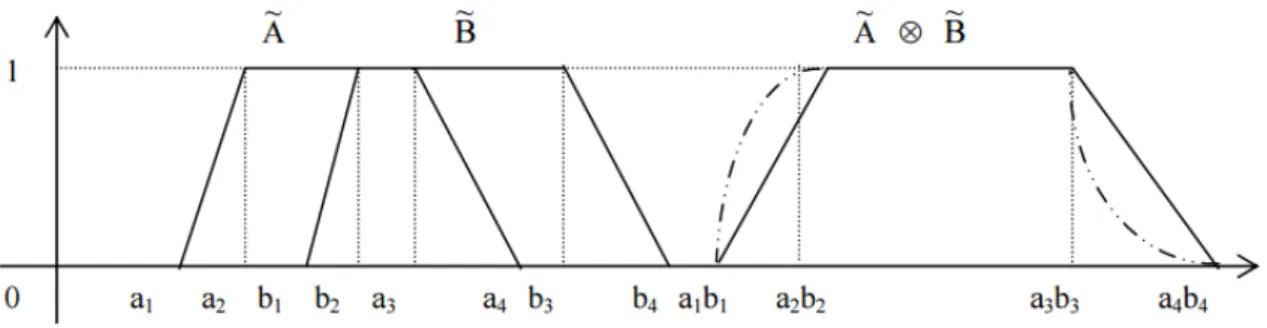
Figure 2.4: The multiplication of two membership functions under extension principle (.. ..) and function principle (-) [2]
Function principle for operating fuzzy linguistic terms
Linguistic terms can be generally represented by membership functions, which are useful for representing the uncertainty. In 1975, Zadeh introduced a concept of extension prin- ciple for operating two membership functions [24]. Later in 1985, Chen [25] proposed a function principle, which is extended from the extension principle. The main difference is that the extension principle uses convolution to multiply membership functions, while the function principle uses pointwise product. By using pointwise multiplication, the function principle can handle more membership functions than the extension principle. The exten- sion principle can multiply up to only four membership functions: ( ˜A⊗B˜⊗C˜⊗D). In˜ some problems, it may be necessary to consider more than four fuzzy information (mem- bership functions). The difference on multiplication is graphically explained in Figure 2.4. The arithmetical operation under function principle can be defined as follows.
Definition 2.2.1. [26] Let A˜ = (a1, a2, a3) and B˜ = (b1, b2, b3) be two triangular fuzzy numbers. Then, the fuzzy arithmetic operation can be defined as follows.
1. The addition of A˜and B˜
A˜+ ˜B = (a1, a2, a3) + (b1, b2, b3)
= (a1+b1, a2+b2, a3+b3) 2. The subtraction of A˜ and B˜
A˜−B˜ = (a1, a2, a3)−(b1, b2, b3)
= (a1−b1, a2−b2, a3−b3)
3. The multiplication of A˜ and B˜ is A˜×B˜ = (c1, c2, c3)
where T =a1b1, a1b3, a3b1, a3b3; c1 = min T, c2 = a2b2, c3 = max T However, if a1, a2, a3, b1, b2, b3 are positive real numbers, then
A˜×B˜ = (a1, a2, a3)×(b1, b2, b3)
= (a1b1, a2b2, a3b3)
4. The division of A˜ and B˜ is A˜˜
B = (c1, c2, c3) where T = ab1
2,ab1
3,ab3
1,ab3
3
c1 = min T, c2 = ab2
2, c3 = max T
However, if a1, a2, a3, b1, b2, b3 are non-zero positive real numbers, then
A˜
B˜ = (a1, a2, a3)÷(b1, b2, b3) = (ab1
1,ab2
2,ab3
3)
Graded mean integration representation approach
Naturally human beings better perceive a crisp value than fuzzy numbers. Thus, the final results of fuzzy operations are usually represented by a crisp value, instead of fuzzy num- bers [27]. In 1998, Hsieh et al. [28] proposed a Graded Mean Integration Representation (GMIR) approach to defuzzify triangular fuzzy numbers into a crisp number [29]. For more details, see [30]. In 2006, Chen [31] introduced the properties of the representa- tion of fuzzy numbers under extension principle by using GMIR approach. The GMIR approach can by generalized by the following formulation.
Definition 2.2.2. [28] Let assume that L−1 and R−1 are inverse functions of func- tion L and R, respectively and the graded mean h-level of generalized fuzzy number A = (a1, a2, a3 : w) is h[L−1(h)+R2 −1(h)]. Then the defuzzified value P(A) based on the integral value of graded mean h-level can be defined using Eq. 2.1
P(A) = Rh
0 [L−1(h)+R2 −1(h)]dh Rw
0 h dh (2.1)
where h is in between 0 and w, 0 < w ≤ 1. The representation of fuzzy numbers can be formulated in eqs. 2.2 and 2.3. For example, assume that A˜ = (a1, a2, a3) is triangular fuzzy numbers. Then, A˜can be defuzzified by:
P(A) = 1 2
R1 0
R h[a1+h(a2−a1)−h(a3 −a2)]dh R1
h dh (2.2)
Figure 2.5: Coefficients of Pascal triangle numbers
P(A) = a1+ 4a2+a3
6 (2.3)
Pascal Triangular Graded Mean Approach
Similar to GMIR approach, pascal triangular graded mean approach is an alternative tool for defuzzifying fuzzy numbers to a crisp number [2]. It is extended from GMIR approach [28]. Due to their ease and ability in defuzzification, both approaches are applied in several research domains [26], [32], [33]. Basically, a concept of pascal triangle graded mean approach is taken from the coefficients of Pascal’s triangle, as depicted in Figure 2.5.
In this approach, the coefficients of Pascal triangle numbers are used as weights assigned for each fuzzy variable. The defuzzifying formula can be formulated as follows.
Definition 2.2.3. [34] Let A˜ = (a1, a2, a3) and C˜ = (c1, c2, c3, c4) are triangular fuzzy numbers and trapezoidal fuzzy number, respectively. Then the coefficient of fuzzy numbers from Pascal triangle numbers are described by the following equations:
P(A) = a1+ 2a2+a3
4 (2.4)
P(C) = c1+ 3c2+ 3c3+c4
8 (2.5)
Probabilistic linguistic model
Linguistic terms are usually more human-friendly than numbers in assessing the values on objects. Normally, they are finite and totally ordered. It can be generally defined in a form of linguistic term set, e.g. S = {s1, s2, . . . , sG}, where G is a cardinality of S. The semantics of terms can be represented by fuzzy numbers in the interval of [0,1], as described by membership functions [35], [36]. For example, a set of five symmetrical linguistic terms can be defined as follows:
S ={s1 :V ery Bad, s2 :Bad, s3 :N eutral, s4 :Good, s5 :V ery Good}
where the triangular fuzzy numbers of a linguistic term set are defined by:
s1 = (0.00,0.00,0.25), s2 = (0.00,0.25,0.50), s3 = (0.25,0.50,0.75), s4 = (0.50,0.75,1.00), s5 = (0.75,1.00,1.00)
Recently, Pang et al [5] proposed a probabilistic linguistic term set (PLTS) model aim- ing to deal with a multiple criteria group decision making problem, which corresponding to linguistic information. Their model can be formulated as follows.
Definition 2.2.4. [5] Let S ={s1, . . . , sg, . . . , sG} be a set of linguistic terms.
S(p) ={skg(pk)|sg ∈S, pk ≥0} (2.6)
K
X
k=1
pk = 1 (2.7)
where skg(pk) is a linguistic term skg associated with probabilistic linguistic pk. g is an index of a linguistic term set S. S(p) is the ordered probabilistic linguistic term set S. If rg is a subscript of linguistic term skg and S(p) is arranged according to the value of rg, then skg(pk) is ordered in an descending order.
Example 2.2.1. Suppose that 10 respondents participate in a film’s performance evalu- ation. They provide their preferences by using linguistic terms, as shown below.
S ={Extremely boring(s1),very boring(s2),boring(s3),neutral(s4),interesting(s5), very interesting(s6),extremely interesting(s7)}
Four respondents feel that the film is ‘Extremely interesting’[s7]. Two respondents think that the film is ‘Interesting’[s5]. Three respondents feel that it is ‘Neutral’[s4]. One respondent feel that it is ‘Extremely boring ’[s1]. In this case, the probability of each linguistic term is as follow.
S(p) = {h[s1],101i,h[s4],103i,h[s5],102i,h[s7],104i}
2.2.2 Linguistic computation approach based on ordinal scales (term index) and their techniques in developing models for ODM clients
In this approach, linguistic expressions are computed based on the indices of linguistic terms using an ordered structure of the linguistic term set to accomplish symbolic compu- tation. Some useful techniques for computing linguistic information based on term index are discussed as follows.
2.2.3 2-tuple linguistic representation model
A 2-tuple linguistic representation model is first introduced by Herrera and Martinez [36]
in 2000. It is proposed to deal with the loss of information, which usually occurs from an approximation process when retranslate the computed linguistic information to its initial linguistic domain [37], [38]. Since its introduction, this model is widely applied in many applications, e.g. engineering management [18], information filtering [39], group decision making [35], and product design [40], [41]. The 2-tuple linguistic representation model consists of two components [42]: (sg, α).
1. sg: It represents the linguistic term in set S.
2. α: It is a real number representing a symbolic translation parameter. It denotes a deviation of computed linguistic term from its closet linguistic term sg, so that it can improve the accuracy of the linguistic computation.
Figure 2.6 shows the concept of 2-tuple representation: (sg, α). From Figure 2.6, sg
is ‘Medium ’, and α is ‘0.25 ’. The notions of 2-tuple representation model are further defined as follows.
Figure 2.6: A 2-tuple representation model [1]
Definition 2.2.5. [36], [43] Let S = {s1, s2, . . . , sG} be a linguistic term set with car- dinality G. β ∈ [1, G] is the value representing the result of index aggregation operation in linguistic term set S. Then, a 2-tuple expressing the equivalent information to β is defined as:
∆ : [1, G]−→S×[−0.5,0.5)
∆(β) = (si, α),with
si, i=round(β) α =β−i, α∈[−0.5,0.5)
where si has the closest index label to β. α is the value of symbolic translation.
Example 2.2.2. Suppose that β = 3.1 is the result of index aggregation operation in linguistic term set S. Then, the 2-tuple expressing the equivalent information to β is (s3,0.1). It is also equivalent to ∆−1(s3,0.1).
2.2.4 Probabilistic uncertain linguistic model
In 2016, Pang et al [5] introduced a probabilistic linguistic model, as shown below.
Definition 2.2.6. [5] Let S ={s1, . . . , sg, . . . , sG} be a set of linguistic terms, then the probabilistic linguistic model can be defined as:
L(p) ={Ln(pn)|Ln ∈S, pn ≥0, n= 1,2, . . . , N} (2.8)
whereLn(pn)is the linguistic termLnassociated with probabilitypn, withPN
n=1pn≤1.
N is the number of all different linguistic terms.
Later, in 2017, Lin et al. [44] extended Pang’s model to allow respondents assess by more than one linguistic term. In other words, their model is able to deal with interval linguistic terms. Lin et al.’s probabilistic uncertain linguistic model can be defined as follows.
Definition 2.2.7. [44] Let S ={s1, s2, . . . , sg} be a set of linguistic terms.
S(p) ={h[sk, s0k], pki |pk ≥0, k = 1,2, . . . , K, PK
k=1pk ≤1}
where h[sk, s0k], pkidenotes the uncertain linguistic term[sk, s0k], which are correspond- ing to its probabilistic linguistic value pk. sk, s0k ∈S and sk ≤s0k
Remark 2.2.1. If respondents are certain on their assessment, they provide only [sk]. In contrast, if respondents hesitate or are uncertain on their assessment, they are allowed to assess by interval linguistic term [sk, s0k].
Example 2.2.3. Suppose that 10 respondents are asked to express their impression on a hotel service by using linguistic term sets with cardinality g = 7 as defined below.
S ={extremely good,very good,good,neutral,bad,very bad,extremely bad}
Two respondents feel that the service is in between good and neutral [s3, s4]. Five respondents think that the service is very good [s2]. One respondents feel that it is neutral [s4]. Two respondents feels that it is extremely good [s1]. Here, S(p) can be written by
S(p) ={h[s11],102 i,h[s22],105 i,h[s33, s34],102i,h[s44],101i}
Motivated by the above observations, in this study, an alternative approach to deal with multiple criteria group decision making problem under fuzzy environment is de- veloped. The proposed alternative approach can handle with uncertainty effectively by providing a flexible method for respondents. The explanation is explained in the next section.
2.2.5 Distance measures between linguistic terms
Most of the previous works on distance measure between linguistic terms were done based on deviation degree [45] and similarity degree [46]. Recently, Rosello et al. [47] introduced a new distance measurement method, which was able to measure the distances in the space of qualitative assessment. The distances are defined from geodesic distance in a graph theory. Three main advantages over deviation and similarity degrees are 1) experts are able to judge different alternatives over different order-of magnitude spaces, 2) qualitative assessments can be made with imprecision, and 3) the distance concerns the number of change needed to move from one term to another [47]. In addition, Rosello et al’s method also takes the confident levels of respondents into account. When a respondent is confident on his subjective opinion, he votes only one linguistic term. In contrast, when a respondent is not confident on his subjective opinion, he is able to vote by using linguistic term set [s, s0]. Due to its essential advantages over existing methods, it is interesting to extend geodesic distance in determining the distances between linguistic terms.
Definition 2.2.8. [3] [48] Distance between two linguistic terms is defined as the geodesic distance in the graph GL (see Figure 2.7) with the injectionψ :L−→Z2 (see Figure 2.8).
The distance is denoted by d(η, ς), where η and ς are linguistic vertices in a graph. If the weights of all vertices in the graph are equal, geodesic distance can be expressed as follows.
Suppose η= [s, s0] = (x, y) and ς = [(s)0,(s0)0] = (x0, y0).
d(η, ς) = dM anhattan([s, s0],[(s)0,(s0)0]) = d((x, y),(x0, y0)) = |x−x0|+|y−y0| (2.9) Remark 2.2.2. With the advantage of graph injection in Figure 2.8, the geodesic distance measure, which measures points in a space, can be viewed as the Manhattan distance measure, which measuring points in X-Y scales.
Example 2.2.4. Taking into account the distance between vertex η = [l1, l3] and ς = [l4, l5], the shortest path can be computed as
d(η, ς) =dManhattanψ(η), ψ(ς) = dManhattan((2,0),(4,3)) =|2−4|+|0−3|= 5
Figure 2.7: Graph representation of linguistic hierarchy corresponding to g=5 [3]
Figure 2.8: Injectionψ :L−→Z2 [3]
2.3 Summary
In this chapter, some related approaches, which will be used further in the thesis are recalled, including linguistic computation approach based on membership functions and linguistic computation approach based on term index. As mentioned above, this research aims at developing decision models for supporting ODM client’s tasks.
Firstly, the linguistic computation approach based on membership functions and its corresponding techniques are comprehensively reviewed. The proposed model for sup- porting ODM client’s task 1 will be developed based on this approach.
Secondly, the linguistic computation approach based on term index and its corre- sponding techniques are discussed because their applications will be further exploited to develop decision models for ODM client’s task 2 and 3.
These approaches will be used to develop three customer-oriented models on new product development for supporting three ODM client’s tasks. The proposed models will be discussed further in Chapters 3-5. An applicability and effectiveness of the proposed models are also presented through case studies from the Thai beverage company.
Chapter 3
Decision model for prioritizing
customer-oriented product concepts
In this chapter, the first ODM clients’ task is addressed. Firstly, the background and challenges of models developing for prioritizing a new customer-oriented product concepts are stated. In this model, a concept of probabilistic linguistic model [5] is comprehensively extended to this task. In addition, some conventional models and techniques of linguistic computation approach based on membership functions addressed previously in Chapter 2, are briefly analyzed, i.e. probabilistic linguistic model, and fuzzy operation rules. Next, a concept of the proposed model and its normalization process, and its aggregation process are explained. Then, the a new model is developed and illustrated through a case study.
Some concluding remarks are also provided at the end of this chapter.
3.1 Model’s background and its challenges
A Multiple criteria group decision making (MCGDM) is a common activity found in our daily life [49]. In a decision making process, people normally use linguistic terms, which are their natural language, such as ‘Good’, ‘Attractive’, ‘Bad’, etc, for expressing their mental perceptions [50]. This means that linguistic expressions are more in line with people’s thinking habits [51]. However, linguistic expression is imprecise and uncertain in nature [52]. The issue of how to represent and aggregate them is challenging. This issue draws scholars’ attentions to improve the effectiveness of computing linguistic terms
for decades. In addition, since linguistic information is uncertain, a fuzzy set theory proposed by Zadeh [13], is usually applied to deal with it. Since its development, it has been extensively used for handling uncertain environment in various research domains, especially for decision making problem; [53], [54], [55], [56].
Up to now, many models have been proposed for dealing with MCGDM problems with fuzzy linguistic information. Delego et al. [57] focused on convex combination of linguistic labels. However, their results on linguistic interval numbers do not match with the initial linguistic levels, which leads to the loss of information [58]. To cope with the loss of information from an approximation process, Herrera and Martinez [36] proposed a 2-tuple fuzzy linguistic representation model. For more details on 2-tuple bases, see [42], [59], and [60]. Taking a different track, recently in 2016, Pang et al. [5] introduced a probabilistic linguistic term set (PLTS) model based on the idea that several possible linguistic terms with different weights may be considered at the same time (probabilities). Some new operational laws and aggregation operators for PLTS are also proposed. However, PLTS limits respondents to provide only one linguistic term for expressing their preference. To allow more flexibility for respondents’ decision, Lin et al. [44] proposed a probabilistic uncertain linguistic term set (PULTS) model. The model allows respondents to provide more than one linguistic terms on their criteria assessment. Liu and You [61] extended the probabilistic linguistic term set (PLTS) and TODIM method (prospect theory-based method) to take respondent’s cognitive behavior into account. For more related works on probabilistic linguistic-based group decision making models, see also [51], [62], and [63].
However, these existing probabilistic linguistic-based models assume that all respon- dents have an equal importance degree or indicate their importance degrees by a scalar value. Practically, respondents have different background, knowledge, culture, and spe- cialization. For example, experts may have more importance degrees than general cus- tomers because they have more specific knowledge on that product than general customers.
Moreover, the relative importances of respondents are also uncertain and imprecise [64].
Therefore, it is difficult to define them by a precise value.
In light of the above observation, it is necessary to develop a model considering three issues to improve the deficiencies in probabilistic linguistic-based models. The three issues can be briefly explained as follows.
• Respondents assess the criteria by a linguistic expression.
• Respondents have different relative importance. Their importance degrees are pro- vided by linguistic expression.
• Linguistic terms have different importance degrees.
To improve the existing probabilistic linguistic-based model, a fuzzy linguistic model with the above three issues is proposed. Firstly, a symmetric triangular fuzzy number is used to represent the value of linguistic terms. We assume that a linguistic criterion assessment is provided with a probability distribution of the group respondents. In addi- tion, we also assume that each respondent has different relative importances. Secondly, a normalization process, an aggregation process, and a defuzzifying process are proposed for processing the linguistic information in the 3-dimension fuzzy linguistic model. Thirdly, the applicability and advantages of the proposed model are shown through a case study from a beverage company in Thailand. Finally, the results are compared with the existing models.
3.2 3-dimension fuzzy linguistic representation model
In this section, a new concept called 3-dimension fuzzy linguistic representation is pro- posed. Then, the normalization, the aggregation process, and the defuzzifying process are investigated.
3.2.1 A concept of 3-dimension fuzzy linguistic representation
In some cases, respondents may prefer some of linguistic terms. Thus, the set of possible values may have a different relative importance resulting in the probability distribution.
In addition, respondents may also have different importance degrees. Thus, information from each respondent (RS) can be represented by 3 dimensions:
h Linguistic assessment (sg), Respondent’s weight (wk), Probabilistic linguistic (pkg) i Taking these notation into account, we generally extend probabilistic linguistic model [5] and other existing models by the following definition.
Definition 3.2.1. Let S={s1, . . . , sg. . . , sG}andW ={w1, . . . , wk, . . . , wK} be two lin- guistic term sets. pkg is a scalar value. Then, the 3-dimension fuzzy linguistic information can be represented using 3 tuples as below.
s(p)k ={hskg, wgk, pkgi |k = 1,2, . . . , K} (3.1) where skg is a linguistic term g expressed by respondent k, and wkg is a linguistic term g for the importance degree of respondent k. pkg is the corresponding probability of sg to the group decision making.
3.2.2 A normalization of the 3-dimension fuzzy linguistic repre- sentation
In a group decision making, a probabilistic linguistic term setSis normalized byPK
k=1pkg = 1. It means that a complete linguistic assessment information is provided, as exemplified in Example 2.2.1. pkg is normalized by the definition belows.
Definition 3.2.2. Letpkg be a probability of linguistic term associated with linguistic term sg and respondent k.
pkg =p(skg|S) = PK
k=1|sg|
K (3.2)
Example 3.2.1. Assume that three respondents vote s1, while two respondents vote s2. Thus, the probabilistic pk1 and pk2 can be defined below.
pk1 =
PK k=1|s1|
K = 3+23 = 35 = 0.6 pk2 =
PK k=1|s2|
K = 3+22 = 25 = 0.4
and the total probabilistic linguistic term is
P5
k=1pkg =P5
k=1pk1 +pk2 = 0.6 + 0.4 = 1.0
![Table 1.1: An example of the distribution of tasks for new product development among OEM, ODM, and OBM [4]](https://thumb-ap.123doks.com/thumbv2/123deta/6101332.1076418/20.892.106.800.262.478/table-example-distribution-tasks-product-development-oem-odm.webp)
![Figure 2.1: A linguistic decision making resolution scheme [1]](https://thumb-ap.123doks.com/thumbv2/123deta/6101332.1076418/26.892.156.758.718.929/figure-a-linguistic-decision-making-resolution-scheme.webp)