The Problem and Its Solving of Teaching Quality in
Kindergarten Visual Arts Education and Kindergarten Teacher Education: Based on the Exploration of Pedagogical Content
Knowledge
FENG Wanzhen(Faculty of Education, Beijing Normal University)
Abstract: Nowadays, many institutions of teacher education set plenty of art skill curriculum for kindergarten teachers, some kindergartens specially employ teachers majored in visual arts, for higher quality of arts education in kindergarten. Is this necessary? Researcher observed 47 kindergarten teachers’ teaching activity in visual arts with the tool named Evaluation Form Focused On Visual Arts Education, found there were obvious differences of teaching quality in visual arts education among three groups of teacher. The highest teaching quality is belonged to teachers majored in Early Childhood Education with bachelor’s degree. The lowest teaching quality is belonged to teachers majored in Early Childhood Education without bachelor’s degree. Teachers majored in Visual Arts perform middle level in teaching quality. This reflected it was not useful to only enhance teachers’ learning in arts subject for assuring the teaching quality. At the same time, researcher evaluated teachers’ pedagogical content knowledge(PCK) in visual arts by interview and test. Teachers’ PCK in visual arts who majored in Early Childhood Education with bachelor’s degree shows balanced structure and relatively high level. Teachers graduated from Visual Arts has the highest level of content knowledge, but know little of children development and pedagogy. Teachers who majored in Early Childhood Education without bachelor’s degree has the lowest level of content knowledge, and their level of children and pedagogy knowledge was relatively low. Research suggests teacher education institutions should rationally recognize arts subject, and set comprehensive and well-structured curriculum according to the need of conformation of teachers’ PCK, to guarantee and improve teaching quality in visual arts education in kindergarten.
Key Words: teaching quality , teacher education , pedagogical content knowledge(PCK),kindergarten teachers,visual arts
1. Introduction
How to cultivate early childhood teacher for teaching visual arts in kindergarten with a high quality was the problem confronted by teacher education institutions (TEIs) and kindergartens. In the last ten years, there were two drastic increases in China, one
was the amount of kindergartens, the other one were the number and scale of teacher education institutions for early childhood education. It became urgent to find the right way to construct teacher education curriculum about visual arts education.
In teacher education, there was a clear difference between university and school about how to set curriculum concerning visual arts in the whole curriculum of early
childhood education (ECE). In university, visual arts curriculum always belonged to general education courses which made up no more than ten percentage, and it emphasized on having a good knowledge and appreciation of visual arts. In normal school and vocational school, arts curriculum was a separate part, whose proportion is heavy, even sometimes up to a half, and arts skill training was the main
implementation way.
In kindergarten, there was a common pursuit of higher quality of visual arts education.
A plenty of kindergartens were not satisfied with arts teaching quality showed by teachers graduated from ECE. For this, many kindergartens set plenty of art skill evaluation and training for servicing teachers. And some kindergartens directly employed teachers majored in visual arts. Their choices were adding on art subject learning for teachers to improve the quality of visual arts education in kindergarten.
How to arrange teacher education curriculum was better for teacher preparation relating to visual arts teaching in kindergarten? There were a lot of debates in teacher education practice concerning this question, but no special research to answer it until now. In essence, that was about how to deal with the conflict between academic and pedagogical character of teacher education. This topic had been discussed for a long time around the world (YE Lan, 1999). Especially, there were different curriculum organization concerned with subject knowledge and pedagogy knowledge in teacher education curriculum(DAI Weifen, 2012). Existing literature suggested to integrate two kinds of course, but there was little useful suggestions for kindergarten teacher education with arts teaching.
Despite there were a lot of research into children’s artistic development, visual arts education had been largely ignored (Suzannie Leung, 2018 ), teacher education for visual arts education also had been neglected. In a small size of literature concerning kindergarten teacher education, the main focus was about how to enhance the
collaboration between TEIs and kindergartens. Teacher education for visual arts education been mentioned few times.
2. Research Question and Aim
This research would find out: (1) How about the arts teaching quality in kindergarten nowadays in China? (2)How about teachers’ PCK of visual arts teaching? (3) How
teachers’ arts education experience influenced their visual arts teaching quality and PCK? Then, we would testify if it is useful to only adding on art subject learning for teachers to improve the quality of arts education in kindergarten.
On the base of this investigation, we would discuss how to set teacher education curriculum to make it best for teaching visual arts in kindergarten, including of (1) how to integrate visual arts subject learning and pedagogy learning, and (2) how to construct visual arts subject courses itself. Following the discussion, we would aim to find the right way to set teacher education curriculum for visual arts teaching in kindergarten.
3. Research Design
3.1 Participants
47 kindergarten teachers worked in Beijing participated in this research by stratified random sampling and purposeful sampling. Among 47 teachers, 1 is male, others are female. Teachers’ years of experience are M=10.04, SD=7.259. Teachers came from 18 kindergartens, including of public and private settings, which located in city, town and rural areas, and distributed in 7 districts in Beijing. Each kindergarten chose 3 teachers at most who worked in K1,K2 and K3 respectively.
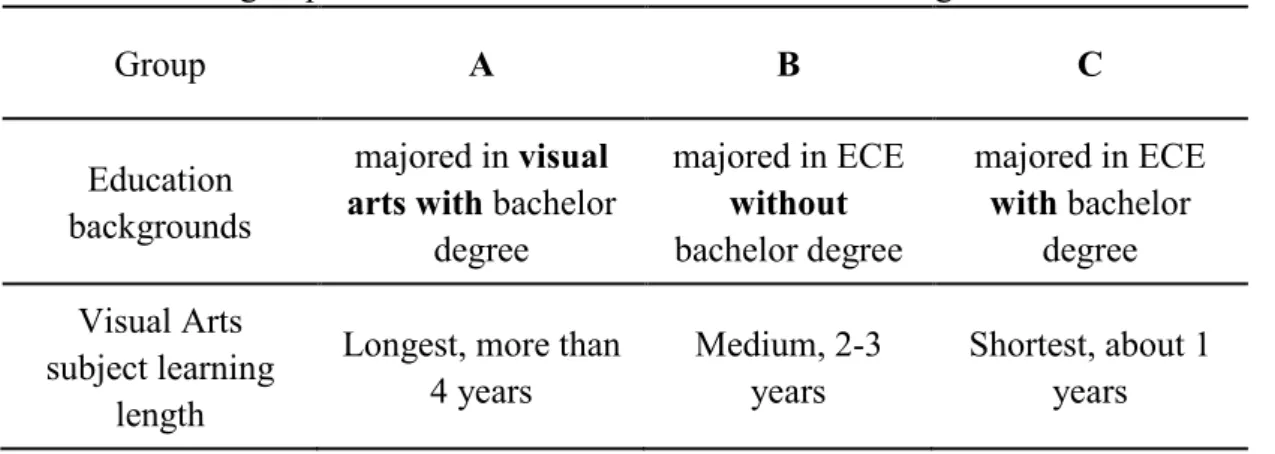
They came from 3 different education backgrounds listed in table 1 (just considering teachers’ preservice education experience, for their in-service education experience were similar in one kindergarten). And the distribution of 3 groups of teachers in this research was corresponded to the whole structure of teaching staff in Beijing.
Teachers majored in ECE without bachelor degree is the main group in the whole staff in kindergarten like Group B.
Table 1 Three groups of teachers with different education backgrounds
Group A B C
Education backgrounds
majored in visual arts with bachelor
degree
majored in ECE without bachelor degree
majored in ECE with bachelor
degree Visual Arts
subject learning length
Longest, more than 4 years
Medium, 2-3 years
Shortest, about 1 years
Visual Arts subject learning
way
Knowing and
making art Making art Knowing art
Table 2 The distribution of three groups of teachers
Group Number Percentage Years of experience M S.D. Mix Max
A 5 10.6% 2.80 1.924 1 6
B 36 76.6% 11.94 7.071 2 25
C 6 12.8% 4.67 4.320 1 13
3.2 Measures and procedures
In the process of research, we invited every participant to teach an visual arts activity in their own class with no limit on the content and process. Among 47 visual arts teaching activity, there were different kinds and contents, including of arts appreciation and arts creation, and drawing and crafts.
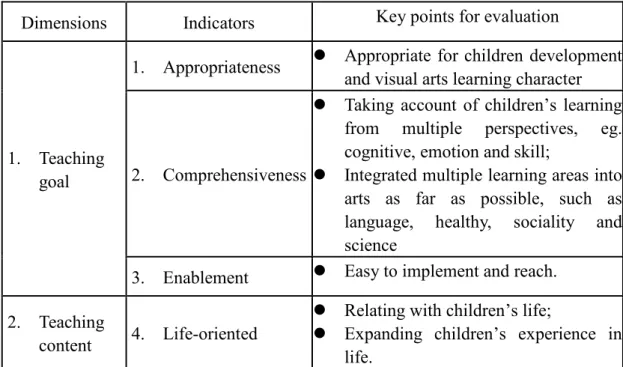
Then researchers observed every activity and assessed its teaching quality using self- adapted Evaluation Form Focused On Visual Arts Education. The form has 5 dimensions including of teaching goal, content, preparation, process and results, and 13 indicators(see in appendix 1). For example, the dimension of teaching results included of two indicators, which were enjoyment and appreciation, and expression and creation. Scores on the evaluation range from 1-5, with 1 indicating “minimal”
quality, 3 indicating “medium” quality, and 5 indicating “good” quality.
After the arts teaching activity, researchers assessed teachers’ PCK (Pedagogical Content Knowledge) in visual arts education and investigated teachers’ preservice education experience through interview. Pedagogical content knowledge (PCK) is the intersection of a teacher’s knowledge of content, pedagogy, and of the context of the learning situation, including her students. (Morrison, A. D., Luttenegger, K.C., 2015)When assessed PCK in visual arts education, we use the Questionnaire of PCK adapted from the research of Erikson Institute (ZHONG Yang, 2010). Teachers answered 9 questions after teaching around their own teaching activity, nor others’
teaching video like previous researches. There were 3 parts in 9 questions which corresponding to knowledge of what (content knowledge), who (child development knowledge) and how (pedagogy knowledge concerning special content) in PCK. For example, what are the core ideas (or experiences) this activity meant to teach?
Research recoded the answer of every part from teachers into 0-18. 0-6 represented
teachers can’t understand PCK or vaguely; 6-12 represented teachers explain PCK generally or limitedly; 12-18 represented teachers having a clear and fully
comprehension of PCK.
4. Results
4.1 Quality of arts teaching in kindergarten
According to observed results, all the teachers got a relatively low grade in visual arts teaching quality (M=1.5660, SD=0.8888). The average score is below 3. This means the visual arts teaching quality need to be improved in the whole. Among three groups of teachers, there were obvious difference, X2=15.941, df=2, P=.000∗∗∗<0.001. Group C of kindergarten teachers performed best in visual arts education, M=3.0667,
SD=1.5422. Then, group A performed better than group B.
Table 3 The score of visual arts teaching quality
Group N M S.D. Mix Max
A 5 2.1200 .6870 1.20 2.80 B 36 1.2389 .3236 0.80 2.60 C 6 3.0667 1.5422 1.20 4.60 sum 47 1.5660 0.8888 0.80 4.60
Specifically, the difference of teaching quality among three groups could be found in five dimensions listed in table 4. And every group performed their own characteristic in teaching activity. (1) In those visual arts teaching activity performed by group A, the goal always was seen single and a little difficult for children compared with other two groups. Teachers majored in visual arts inclined to choose content mainly from the logic of subject, and consider the logic of children’s life insufficiently. But their preparation was sufficient and attractive, their teaching process was fluent, and the results were well. The experience of children grew obviously. (2) Among group B, their teaching goal always was vague. Teachers could choose content relating with children’s life closely, but having no space for children’s aesthetic exploration.
Although their teaching preparation was sufficient for whole class, but not attractive.
The teaching process looked fluent in teachers’ organization, but made some
confusion in the perspective of children’s learning. So, in the result, children didn’t learn obviously. (3) In group C, teachers could design appropriate and comprehensive goal for children , which was different from group A and B. Teaching content had clear contact with children’s life, as well as could support all children exploring aesthetically. Teaching preparation was sufficient for every child and attractive
enough. Except for the process was fluent, teachers could make the atmosphere positive and almost support every child effectively in the process of visual arts teaching activity. In the result, children felt pleasing and preformed creatively in the learning process, not only well like group A.
Table 4 The characteristic of three groups’ teaching activity
Group A Group B Group C
teaching
quality medium low high
teaching goal
ingle, a little difficult for
children
vague appropriate and
comprehensive
teaching content
little contact with children’s
life
relating with children’s life, but no
space for children’s aesthetic exploration
having contact with children’s life, and support all children exploring aesthetically teaching
preparation
sufficient and attractive
sufficient for whole class and not
attractive
sufficient for every child and attractive enough
teaching
process fluent
confusion in the perspective of every
child’s learning
fluent, positive atmosphere, support
individually teaching
results well no obvious learning pleasing and creative
4.2 Teachers’ PCK in arts teaching
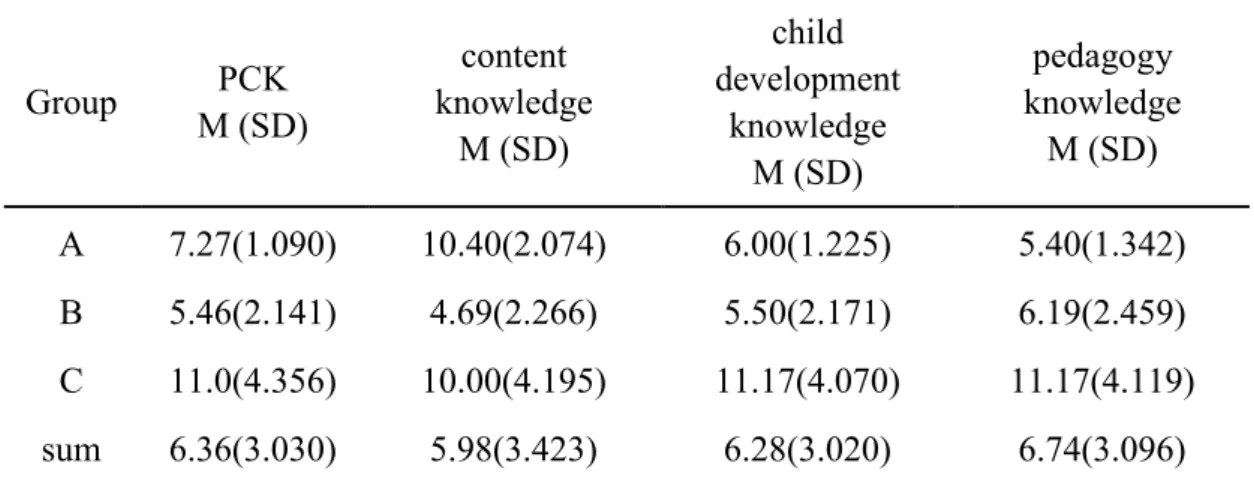
Pedagogical content knowledge is teachers’ practical knowledge influencing teaching activity importantly, which is the mixture of content knowledge, child development knowledge and pedagogy knowledge. When teachers’ PCK had a balanced structure and a high level, teachers can teach with a high quality. After recorded teachers’ PCK in visual arts teaching, we found: (1) Teachers’ PCK overall halted on the low level which imposing restrictions on teaching quality in visual arts education. And the knowledge of content was the lowest one among three parts. This was consistent with previous research findings obtained in Shanghai.(SHEN Jiao, 2012) (2)There were
obvious difference among three groups in PCK score, X2=13.019, df=2,
P=.001∗∗<0.01. (3)The PCK of group A was unbalanced (see graph 1). Group A had the highest level of content knowledge, but lack of knowledge of child development and pedagogy. Then their teaching had little attraction for children. (4) Group B had a balanced and low-level PCK, then their teaching had little contribution for children.
(5) Group C had a balanced and high-level PCK, then their teaching had attraction and contribution for children.
Table 5 The score of teachers’ PCK in arts teaching
Group PCK
M (SD)
content knowledge
M (SD)
child development
knowledge M (SD)
pedagogy knowledge
M (SD) A 7.27(1.090) 10.40(2.074) 6.00(1.225) 5.40(1.342) B 5.46(2.141) 4.69(2.266) 5.50(2.171) 6.19(2.459) C 11.0(4.356) 10.00(4.195) 11.17(4.070) 11.17(4.119) sum 6.36(3.030) 5.98(3.423) 6.28(3.020) 6.74(3.096)
Graph 1 Teachers’ PCK of arts teaching structure and level
4.3 Teachers’ arts education experience
The structure of teachers’ PCK was corresponding with teachers education
experience. Group A learned most in visual arts subject, but learned least in children psychology and pedagogy concerning kindergarten. So their PCK structure was unbalanced and their teaching activity was subject-oriented. Group C owned a balanced structure of PCK and teacher education curriculum. They learned more children psychology and pedagogy and less arts subject than group A. They integrated
0 2 4 6 8 10 12 14 16 18
group A group B group C whole
content knowledge child development knowledge pedagogy knowledge
these knowledge into a high level of PCK, then they could gave children a pleasing and attractive teaching activity.
When analyzing teachers’ PCK in arts teaching, we found the score of content knowledge of group B is the lowest one , but they received a medium term of arts subject learning which is more than Group C. Why the arts subject learning didn’t result in high score of content knowledge? Research utilized the theory of Discipline- Based Arts Education to explain it. The discipline-based approach is a conceptual framework that expands teaching and learning in the arts beyond production (in the visual arts) and performance (in the other arts) to include aesthetics, history, and criticism.(Ed Asmus et al., 1997) Arts education wasn’t equal to arts production. But group B mainly learned how to produce arts through training and imitation, knowing little of the other three aspects. This made teachers from group B could not understand visual arts right and deep.
Graph 2 The framework of discipline-based arts education
Graph 3 The composition of teachers’ educational experience in three groups
Discipline-Based Arts Education
aesthetics arts history arts criticism arts production
Group B
aesthetics history criticism production others
Group C
aesthetics history criticism production others
Group A
aesthetics history criticism production others
5. Conclusion
Group C of teachers majored in early childhood education with bachelor degree performed best in teaching quality in visual arts education. This was closely related with teachers’ PCK of visual arts teaching who have a balanced structure and high- level. Compared with other two groups, group C was the least one in respect of arts subject learning. This conversely testified it was not useful to only adding on art subject learning for the quality of arts education in kindergarten.
At the same time, we found all three groups’ score of arts teaching quality were not up to 4 or 5. This meant we need improve arts teaching quality in the whole. Then, How to improve the quality of arts teaching? what are the needs for different group of teachers in preparing for visual arts education from the perspective of PCK?
Obviously, teachers in group A should know more about children psychology and strive to combine three aspects of knowledge into PCK in the practice. Teachers in group B should enhance all three aspects of knowledge contributing into PCK, including of children psychology, pedagogy and arts content. Especially, they not only need to learn arts production, but also need to approach the combination of aesthetics, arts history and arts appreciation and criticism. Of course, teachers in group C would improve PCK with existing structure to learn more about visual arts, children’s visual arts development and pedagogy concerning visual arts.
When the structure and teaching way of teacher education curriculum could be right for the conformation of teachers’ PCK in arts teaching, the quality of arts teaching in kindergarten could be promised. In turn, we should improve the structure of teacher education curriculum to better the quality of arts teaching. In teacher education for ECE, the visual arts courses should be set comprehensively including of 4 parts of content, namely aesthetics, history of visual arts, appreciation and critic of visual arts , and visual arts creation. And, the arts subject should combined with courses of
pedagogy and child development, for the formation of PCK in visual arts education and the need of teaching in kindergarten.
References
Asmus, Ed, et al., 1997, Discipline-Based Arts Education: A Conceptual Framework for Learning and Teaching the Arts, Visual Arts Research, Vol. 23, No. 2, pp. 114–
123.
DAI Weifen, 2012, The Academic or the Pedagogical: Evolution of American Teacher Education Curriculum Thought. Teacher education research, Vol. 24, No.
1,pp. 93-96, 92.
Morrison, A. D., Luttenegger, K.C., 2015, Measuring Pedagogical Content
Knowledge Using Multiple Points of Data, Qualitative Report, Vol. 20, No. 6, pp.
804-U246
SHEN Jiao, 2012, Study on Present Situation of Pedagogical Content Knowledge in the Field of Early Childhood Visual Art Education Among Early Childhood Teachers in Shanghai, East China Normal University, pp.1
Suzannie Leung, 2018, An Exploratory Study of Early Visual Arts Education in Two Hong Kong Kindergartens, Journal of Research in Childhood Education, Vol. 32, No.
4, pp. 392-403
YE Lan, 1999,A true pseudo question: Analysis of conflict between academic and pedagogical character, Teacher education research, Vol. 2, pp. 11-17.
ZHONG Yang, 2010, A Exploratory Study on Mathematics PCK of 30 Early Childhood Teachers in Shanghai, East China Normal University, pp.20
Appendix
Table 6 Evaluation Form Focused On Visual Arts Education Dimensions Indicators Key points for evaluation
1. Teaching goal
1. Appropriateness Appropriate for children development and visual arts learning character
2. Comprehensiveness
Taking account of children’s learning from multiple perspectives, eg.
cognitive, emotion and skill;
Integrated multiple learning areas into arts as far as possible, such as language, healthy, sociality and science
3. Enablement Easy to implement and reach.
2. Teaching
content 4. Life-oriented
Relating with children’s life;
Expanding children’s experience in life.
5. Clear layer Having clear layer to suit children’s divers learning needs
6. aesthetical Influencing children aesthetically 3. Teaching
preparation
7. Material preparation
Sufficient for every child and aesthetical
8. Context preparation Serving for content and aesthetical
4. Teaching process
9. Teaching organization
Fluent;
Clear logic and layer;
Leading children’s learning in the stand of children.
10. Teaching atmosphere
Positive;
Respect children’s autonomy, imagination and creation;
11. Teachers’ action
Language is professional;
Pay attention to every child closely;
Support every child effectively.
5. Teaching result
12. enjoyment and appreciation
Children approach arts initiatively and pleasantly;
Children imagine emotionally.
13. expression and creation
Children produce arts with creation.
Children express themselves aesthetically.