論 文
Practice of a teaching method with active learning and classroom involvement in IPU New Zealand
アクティブ・ラーニングを使用した教授法の実践と考察
― ニュージーランドの日本語教育事情において ―
YAMAMOTO, Junko 山本 純子 IPU New Zealand
Abstract:The object of this research is to consider the effectiveness of active learning used within a higher education institute in Japanese-language education in New Zealand.
It is necessary to examine the contents and process of the class from the point of learner’s view,
“What can be done after studying the subject?” Taking this point into consideration, the whole curriculum needed to be considered and set up the attainment target in each area of study.
In Japanese institutes, there are many cases of students learning Japanese not only passively, but also actively, expressing their opinions, and asking questions, however, in New Zealand the learning styles also consisted of the experience and projects with team work. Thus, it should be no surprise that a curriculum starting from elementary school that emphasized leadership, relationships with others and cooperativeness has such a positive influence on learning.
Therewith, it could be said that the quality of the education as well as the amount of learning are important to discover the problem or improving points in the class and select independent cooperative learning as a solution (so-called active learning).
(1)The researcher tried to practice the classes using an active learning method in the first semester of Japanese classes at IPU New Zealand.
Keywords:Active Learning, Japanese Education, Teaching Method, New Zealand
要旨:各科目の授業は,学習者の立場に立ち「何ができるようになるのか」という観点から,学習者 を中心とした目的や到達レベルを考慮して,その内容や流れが構成されなければならない。そこで,
文部科学省が提唱する「課題の発見・解決に向けた主体的・協働的な学び(いわゆる「アクティブ・
ラーニング」)」
(1)について,学びの量とともに,質や深まりを重要視する教授法を,ニュージーラン
ドという私自身にとっての新天地で担当する日本語クラスで採択することにした。日本でも,各教育 機関の質的転換に向けて座学ではない授業形式を取り入れている場合が多く見られるが,ニュージー ランドの教育内容は実験やプロジェクトを組み,チームワークで課題に取り組むことが多く,机に 座って講義を聴くだけではなく,学生が積極的に質問や意見を述べることが,圧倒的にアジア諸国よ りも多く見受けられる。初等教育から,協調性は基より,リーダーシップや対人関係に比重を置いた カリキュラムが組まれていることが特徴であり,学内での役割に多くの学生達が積極的に喜んで参加 する姿は驚く程である。
本稿では,ニュージーランドの実際の教育現場での日本語教育における,アクティブ・ラーニング の教育手法を用いた授業の活性化を目標として,実際の日本語クラスで実践したことが,ニュージー ランド人学生の日本語能力向上のために,どのように効果があったか考察することを目的とする。
キーワード:アクティブ・ラーニング,日本語教育,教授法,ニュージーランド
1.Introduction
In 2012 as an outcome from a deliberative committee entitled the Central Education Council, the Ministry of Education, Culture, Sports, Science and Technology had released the policy for university education and set the status as, “Continuing to study through life and enhancing the ability to think independently for building the new vision of the future.”
(2)Hence, active learning, which secures independent cooperative learning and encourages and enhances the ability to think independently.
After that, each of the educational institutes were encouraged to be reformed and revitalized regarding the lecture’s methodology and the ideal basic education of Japan, and because of this more educators in the institutes tried to incorporate the student centered learning method, or active learning. Accordingly, students are learning to utilize a computer in the foreign language systems. For example, the e-learning system is not only the role for the Course Management System,
(3)but it can also be used as a communication medium between the learners for the foreign languages. The active learning method was frequently used in the class after the Ministry of Education proposed its use, which included the CMS. Their relevancy is learning the language in their own pace. Mizoguchi (2014)
(4)defined active learning as including all types and conditions of student-centered learning, and this moves beyond transfer type lectures known as passive learning. Active learning is accompanied with the externalization of cognitive thought processes such as writing, speaking and presentation in the class activity.
After having taught the students the basics for the stimulation of learning, Bonwell and Elison (1991) pursued their objective for using this educational system, which is centered around the students practice of Japanese. Materials were incorporated using sight or sound, for example, online games. Also using class instruction for collaborative learning such as role playing, games and discussion among the students could be classified as active learning.
Active learning which is the method enhancing the
ability to think independently, was implemented in a class that was thought to have no interest in passive learning. The reason for this is that the majority of New Zealand students had received education in a New Zealand environment that is totally different from the Asian students. Specifically, online games like Quizlet and Kahoot were adopted where students learn new vocabulary and grammar while enjoying games. Also introduced occasionally, were effective learning Japanese YouTube videos. This was to make it possible to naturally master pronunciation and the Japanese accent, by working in pairs for Japanese conversation. In order to answer the questions for an examination in JLPT style, not only do online games make the students studying easier, it’s appropriate material for all students regardless of their Japanese proficiency level.
In addition, appreciation of the Japanese drama while watching with English subtitles helped to acquire linguistic ability naturally, and speak like a native Japanese speaker, which would not be possible by only using the example conversations that use formal Japanese in the textbook. After an examination, students appreciated watching dramas.
While they were watching, the marking of the examination took place, and careful consideration of wrong answers or misunderstood grammar were thoroughly checked. Through this method, class time was used effectively and students could recognize their mistakes because feedback was given.
This paper’s purpose is to examine the effects of active learning for the improvement of the student’s Japanese proficiency that is used in the class as a new method of educational style, which was undertaken based on the results of a Google Survey that was executed at the end of the teaching semester.
1-1. Japanese Education Circumstances in New Zealand
(5)In 1973 the New Zealand Qualification Association
(NZQA) introduced the Japanese language as one of
the subjects of secondary education, as an optional
subject. Students were able to gain a completion
certificate of Japanese language and qualify for
further studies in a university within New Zealand.
According to the rapid economic growth in Japan from the late 1980s to 1996, Japanese language learners continued to increase rapidly. As a result, Japanese become the largest number of learners of a foreign language, more than the numbers studying French from 1994 through to 1998, in New Zealand.
However, over-time with the stagnation of the Japanese economy, the number of Japanese learners had decreased as well. As of 2018 the number of the Japanese learners comes third behind French, and Spanish respectively. As a characteristic of the New Zealand foreign language education system, Japanese learners occupies 90% of the secondary education. This shows apparently that the society in New Zealand has become a multilingual society which can be the opportunity for the national language education to become more diverse in the primary and secondary education in the future.
In addition, the ministry of education does not set which foreign language is available to each school in New Zealand. Thus, it may be said that the genuine connection and relationship with the local primary, intermediate and high schools is important to increase the number of the Japanese learners, or to maintain the number of them. Moreover, there is no doubt that the priority of language for learning might differ depending on the educational policy of the New Zealand government. For example, the students who were wanting to learn an Asian language dramatically increased as subsidies were granted to each school for learning Japanese, Chinese and Korean in 2014.
On the other hand, the number of Chinese learners are still increasing, and this is due to the growing importance of finance and business as making the partnership for import and export based on the trade liberalization with China in 2008. Recently, a current trend is developing, of which Chinese speakers might have an advantage for recruitment among New Zealanders. Moreover, the international economic conditions continue to change over time.
For example, the GDP ranking of Japan was second place in the world however, over the years China has caught up and has overtaken Japan in 2010. The U.S. National Intelligence Council (NIC) described the
future of Asia and Japan and emphasized that the economy of China is expected to surpass and become the largest economic power in the world by 2030.
(6)Regarding Japan, it is expected that the potential growth will decline thereafter in the long-term due to the rapid aging and declining of the population.
It is analyzed that the economic dominance of Japan will lessen over a new international economic system and will cause a long lasting economic slump in Western nations which will bring an end to the economic power of the United States.
(7)Over time, these are the characteristics that will keep changing international relationships.
During the 1980s to 1990s bubble boom, Japan achieved significant economic growth. In accordance with this situation, the revision of the immigration control and refugee recognition act triggered the numbers of Japanese learners to increase rapidly including the foreigners who went to work in Japan.
However, it is significant that Chinese language learners are increasing much more in numbers compared with Japanese learners, and this is a reflection on the population of China which is about 13 billion, 12 times more than Japan. There is no doubt that the common understanding from the economical side of Japan has had an influence on choosing the Japanese language paper.
According to the present conditions of the Japanese education in foreign countries listed in the Japanese education-related documents, the Japan Foundation announced in 2017 the number of Japanese learners in New Zealand in 2015 was 29,925 which has decreased 0.4% when compared to the 30,041 learners in 2012. On the contrary, the number of Japanese learners in Australia occupied 90% of the Japanese learners in the Oceania area. In 2012 it was 296,672 learners and by 2015, 357,348 which was an increase of 20.5%.
(8)Pursuant to the “Japanese organization
investigations” executed by the Japan Foundation
every three years, there are significant differences in
the number of Japanese language learners between
each area and region.
(9)Investigation indicates that
the changes in the number of Japanese language
learners has a big difference between each area and
region. Within the education system in New Zealand it depends on the school as to if they adopt foreign language education or not.
1-2.Definitions of Active Learning
Active learning is known as an educational method used in reference to student centered learning. As described in section 1-1, a class style that used active learning in New Zealand, a remote country on the other side of the world from Japan, was undertaken in order to devise the best method of making progress with the Japanese language proficiency of the students. The researcher in exploring the most effective method to improve Japanese proficiency, observed in New Zealand elementary schools, children without individual desks and chairs working autonomously on projects. Also, the children of the lower grades had a good command of using computers and could express their ideas well. Ii (2007) explains that the utilizing of electronic information media for the Japanese language learners had started under circumstances which enabled learners to carry out independently and systematically from the teacher to learner in a so-called paradigm shift.
(10)In the current curriculum in universities, students are encouraged within each educational program to take a part in communication activities in order to develop the ability for solutions of any problems.
Ana (2015) explains that such a curriculum can lead to accurate and practical results which included the active role in the process of learning for analyzing and reaching the conclusion.
(11)The bottom line is to encourage the problem resolution type curriculum that is capable of improving efficiency of learning in order to learn actively and positively, and change the conventional language learning which is by memorization.
The purpose of active learning method is being able to exhibit their language learning ability and knowledge effectively, by for example; participation in workshops or being a debater on a discussion panel, and thereby are capable of acquiring the practical experience of study involved. From this point of view, active learning is defined as a general term of learning method which involved learner’s
participation actively, and is far removed from passive lessons of lectures. The purpose is to train individuals in improving their cognitive, ethical, social adaptability, intelligence and knowledge through learning actively. Examples of active learning that enables a student to discover language for themselves are solving problems, learning by experience and investigative learning.
(12)Specifically, these can be considered as a discussion in the group, debates and working with a team. Matsushita (1991)
(13)classified the definition of active learning citing the above examples. Active learning is advocated in detail below.
a. To participate in the class more than just listening to lecture
b. To support the skill enhancement of learner and not only the transfer of information
c. To involve in high-level thinking including analysis and evaluation
d. To focus on a quest for having a sense of value and self-attitude
e. To involve in performing such actions as reading, discussing and writing.
f. To externalize of the cognitive process
(14)In other words, the learners do not only listen to the lecture in the class room but also active learning is required to enable the opportunity for the learners to practice the acquired knowledge and further to apply that knowledge to practice.
Based on the patterns above, which include working in a team, discussions, presentations, making the report and feedback of the quiz, these are all called a student-participation style class. Once they have been adopted and applied in class, these activities provide the foundation for active learning.
2.Previous Studies
2-1.Previous Studies of Active Learning
The lecturer needs to take into account that
receiving reviews from students based on objective
criteria of the class is mandatory, so that reflection
can take place. Fumino (2010)
(15)states that such
empirical data can be used from the class to analyze the results. Furthermore, the feedback leads to capable and more confident lectures in order to further understand the direction of the class.
Especially, the acquisition of advanced expertise could be acquired by the recognition of interpretation from a different viewpoint based on the assumption of receiving the feedback from learners who have no chance to speak Japanese on a daily basis in New Zealand. Cambell (2011)
(16)explains that although going abroad and interacting with local people is important, it is still essential for second language learners to understand the elements for acquiring the language overseas. Even those that do go to study abroad for their language development need to be in constant touch with the language through constant communication.
Smooth communication with the local people will be possible after acquiring new skills and knowledge of Japanese. What the student has learnt when studying Japanese will be critical at this time.
To acquire the language which is spoken as the standard language in a country for learners, the class curriculum will be a necessary component to enhance learning, including appropriate class materials.
Furthermore, the educational institutes should provide the necessary educational environment based on policy that is conducive for students to attain success.
Thus, the meaning of active learning is to learn in the class that involved the general principal from the point of view for learners who want to understand
and speak in Japanese. Learners will be able to make good progress as a result of active learning because the lectures were interesting, that enabled the learners to engage in mutual exchange, helping to supplement any deficiencies in learning.
The following diagram implements the rates of retention in learning to display the results of the study by Kara (2015), known as the learning Pyramid.
The following classified items indicate each rate of retention in learning.
1. 5% of what they learn when they’ve learned from lecture
2. 10% of what they learn when they’ve learned from reading
3. 20% of what they learn from audio-visual
4. 30% of what they learn when they see a demonstration
5. 50% of what they learn when engaged in a group discussion
6. 75% of what they learn when they practice what they learned
7. 90% of what they learn when they teach someone else/use immediately
Concerning the order of the rates of retention in learning within the pyramid,
1. Listening to the lecture
2. Reading the documents and materials 3. Utilizing the audiovisual, audio or visual work 4. Appreciating a demonstration
The above items are known as passive teaching methods
5. Discussing with others
6. Learning and practicing something through experience
7. Teaching something previously learned to another Above 5.6.7. are considered participatory teaching
methods, which are known as an active learning.
In New Zealand, rather than classes consisting of reading textbooks and listening to lectures in their seats, the curriculum is more commonly based around having students discuss the content, debate, experiment for themselves and to work together in a team. In class, students are not expected to purely Figure 1: The Learning Pyramid
(17)The Learning Pyramid*
Average Retention Rates
Lecture Reading
I
Passive Teaching
Methods 20% Audio‑Visual
/ 30% Demonstration
PTeaartcichiipnag tory
I
50% Group DiscussionMethods / 75% Practice .I
90% Teaching Others
•Adapted from National Training Laboratoires. Bethel, Maine
sit down and listen but also to raise questions and respond to them during class time.
For the New Zealand students brought up through an educational system in which they are expected to take a more active role in class activities where, for example, rather than purely reading a book, they are also expected to write reports and debate on it, they find it far more effective in helping them retain the knowledge they have learned. Even in Japan, rather than having curriculums based around memorization, the shift of focus to more practical methods that better apply to actual society in tertiary institutes could naturally be attributable to the impact of declining birth rates.
2-2. Practice Japanese classes using an active learning method
Within the scheduled time of a 120-minute class, for the purpose of increasing the continued concentration of the students throughout the lesson, the researcher changed the methodology of the lessons from a seated-teaching style into an “active learning” style of student-lecturer interaction. The class made up of predominantly New Zealand students were, for the most part, beginners and were looking to attain intermediate level proficiency. They were taught the four basic Japanese skills through a total of 50 lectures over two terms, with each lecture being a total of 110 minutes. Each unit of study consisted of 3 lessons of 110 minutes and the contents of the class consisted of kanji practice, grammar and conversation practice. The structure of each lesson encompassed the introduction to example sentences which involved newly earned kanji and vocabulary, and then the basic sentence style and grammar were explained in detail.
Method: It was important to make time for both questions and answers in order to clarify and consolidate grammar. This was done via power point or google slides. Newly learnt vocabulary and kanji were incorporated into quizzes and online games.
It was essential to create multi-choice quizzes that modelled the Japanese language proficiency test questions. The following is an example quiz question that was developed.
Question: ( ) I will go on a trip in Japan.
1. the week before last 2. the year before last 3. two days before yesterday 4. two days after tomorrow
An online game was also used that comprised questions, and students had 5 to 10 seconds to answer them. The entertainment game provided students practice on structure of the Japanese language and also enabled them to learn kanji efficiently without boredom.
Points of attention: To encourage the learners to attempt various sentences and practice spoken Japanese by creating an atmosphere conducive to communication.
The aim was to consolidate the vocabulary and kanji that had been learnt at the beginning of the class and practice the dialog in the textbook with pair work, and then present the pair work in Japanese.
Finally, the latter part of the class was taken up with listening practice.
Method: To practice speaking Japanese in pairs while watching the dialog of the power point file in English.
Points of attention: There are a variety of ways to explain the answers to the students. Also, the lecturer made the student pairs, but these are interchangeable.
To help solve the exercise question, the remaining portion of class practice is used as study time in order to learn the kanji, phrases and idioms.
Method: In order for the students not to have any doubts regarding the contents of the class, the lecturer needs to be prepared to answer in detail any questions in order to prepare for each unit held exam every end of the week on Friday.
Furthermore, it is essential to explain the mistaken points in the weekly unit exam to learners as soon as it has been marked.
Point of attention: Principally, it is crucial that the understanding of kanji being learnt needs to be confirmed on an individual basis for each student.
Also, students need to be guided from the course
outline as to what page numbers from the text should be studied, in order to undertake self-study out of class.
2-3.Course Evaluation
The semester 2 2018 student evaluation was
executed at the end of the term, and submitted to the IPUNZ administration office. These are then summarized by administration and sent out via email to the lecturers. Also, for the lecturer’s reference an excel sheet was sent as an attachment of the questions and the student comments.
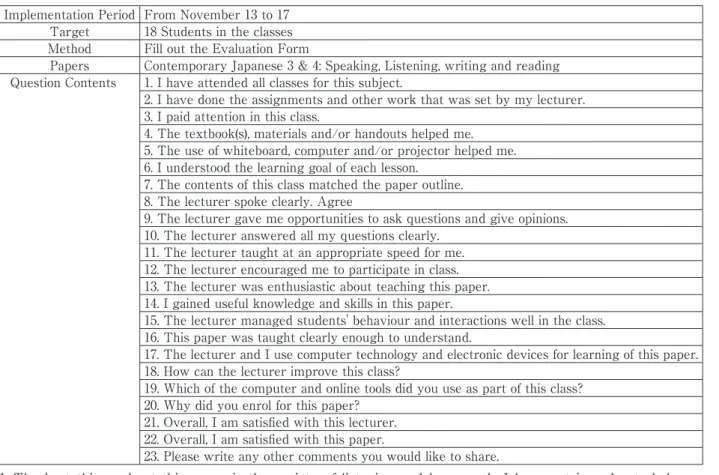
Table 1:Questions regarding the class Implementation Period From November 13 to 17
Target 18 Students in the classes Method Fill out the Evaluation Form
Papers Contemporary Japanese 3 & 4: Speaking, Listening, writing and reading Question Contents 1. I have attended all classes for this subject.
2. I have done the assignments and other work that was set by my lecturer.
3. I paid attention in this class.
4. The textbook(s), materials and/or handouts helped me.
5. The use of whiteboard, computer and/or projector helped me.
6. I understood the learning goal of each lesson.
7. The contents of this class matched the paper outline.
8. The lecturer spoke clearly. Agree
9. The lecturer gave me opportunities to ask questions and give opinions.
10. The lecturer answered all my questions clearly.
11. The lecturer taught at an appropriate speed for me.
12. The lecturer encouraged me to participate in class.
13. The lecturer was enthusiastic about teaching this paper.
14. I gained useful knowledge and skills in this paper.
15. The lecturer managed students' behaviour and interactions well in the class.
16. This paper was taught clearly enough to understand.
17. The lecturer and I use computer technology and electronic devices for learning of this paper.
18. How can the lecturer improve this class?
19. Which of the computer and online tools did you use as part of this class?
20. Why did you enrol for this paper?
21. Overall, I am satisfied with this lecturer.
22. Overall, I am satisfied with this paper.
23. Please write any other comments you would like to share.
1. The best things about this paper is the variety of listening and homework. I have got in order to help me improve my Japanese knowledge and skill.
2. Class atmosphere and lecture are very good.
3. Answering all questions with a lot of detail and explanation.
4. I like the all contents within this paper.
5. The lecturer is very knowledgeable and is able to answer any question I have in class.
6. Maybe have more class time because it has been quite difficult keeping up with the volume of content whilst having other papers to worry about.
7. I love Japanese, so everything kanji and radicals.
8. All the notes are displayed in an easy to read manner, and all the essential information.
9. The lecturer always explains everything in depth. For example, each radical in the kanji, she answers all my questions, too, of which there are a lot.
10. The small class size gives us a chance to have one-on-one learning. Also, the lessons are fun, interactive and challenging.
11. I feel the lecturer has a great understanding of our abilities and can give us equal focus and attention.
12. I find the Minna No Nihongo textbook sometimes difficult to follow my problem is that in some cases, the vocab
2-4.Examination of the class evaluations After I received the evaluation of my teaching methods, the main outcome for my classes is that students do not lose attention and remain focused throughout the time period of class. For example, every Friday I test the students and mark it straight away. After giving the test back in the same period I discuss and explain where the mistakes were. While I am marking the students test, I play a Japanese drama on the screen with English subtitles to keep them entertained and experience Japanese language, culture and drama. Students motivation is reflected in its comment, which is『4. I like the all contents within this paper.』
After exams I mark the test straight away because I can help the students to understand where they went wrong or did not have any confidence in certain sections. By giving feedback after the test fast, it allows the students to learn from the mistakes.
Furthermore, where a section everyone did not understand or pass, I often explain it to everyone in front of the entire class. For individual and smaller mistakes, I call the students one by one during the drama to show them the correct answers.
『1. The best things about this paper is the variety of listening and homework. I have got in order to help me improve my Japanese knowledge and skill.』
It can be deduced from the above comment that to
introduce the Japanese online game Kahoot and to provide useful Youtube channel are efficient. The below comment is due to encourage the learners to attempt various sentences and practice spoken Japanese by creating an atmosphere conductive to communication.
『2. Class atmosphere and lecture are very good.
7. I love Japanese, so everything kanji and radicals.
16. If I do something wrong, the lecturer does not make may feel bad about it. She is encouraging and wants us to succeed. 18. Encouraging everyone to practice examples and all have an opportunity to practice speaking. 19. Her easygoing attitude and attentiveness to her students. 』
It is necessary that to provide the opportunity to speak for every learner equally in the process for correcting erroneous grammar, words and sentence structures.
『6. Maybe have more class time because it has been quite difficult keeping up with the volume of content whilst having other papers to worry about.
13. I would say maybe there are times when the lecturer wants to keep the class moving on quickly, but sometimes we are still need more time to understand. 14. I would really benefit from having visual aids and also if possible having native Japanese speakers come to a lesson and do conversational practice, so we get a chance to analyze and break is so random and does not follow any structure.
13. I would say maybe there are times when the lecturer wants to keep the class moving on quickly, but sometimes we are still need more time to understand.
14. I would really benefit from having visual aids and also if possible having native Japanese speakers come to a lesson and do conversational practice, so we get a chance to analyze and break down the Japanese language with local people.
15. There is a lot of contest we learn at once, so it would be easier to learn it little by little.
16. If I do something wrong, the lecturer does not make may feel bad about it. She is encouraging and wants us to succeed.
17. We are the beginner class, but there is a huge gap between our abilities, maybe for the people who are progressing quicker, here could be extra work set.
18. Encouraging everyone to practice examples and all have an opportunity to practice speaking.
19. Her easygoing attitude and attentiveness to her students.
20. I would really like to be able to have individual lessons us sometimes I feel that the class room can be in a
competition, making learning difficult.
down the Japanese language with local people. 17.
We are the beginner class, but there is a huge gap between our abilities, maybe for the people who are progressing quicker, here could be extra work set.
20. I would really like to be able to have individual lessons us sometimes I feel that the class room can be in a competition, making learning difficult. 』These comments need to address will be considered for the future semester.
3.Conclusion
It seems, New Zealand learners can learn Japanese language effectively in the more practical learning environment introduced by the method of active learning. However, even though over time the social and economic conditions may change, then the method and systems of education in New Zealand will take the appropriate measures indicative to these changes. McKeachie (1998) explains active learning is a teaching strategy that drives the learners to the learning process.
The Ministry of Economy, Trade and Industry proposed the Japan Revitalization Strategy as part of the evaluation of education as a part of the Japan Revitalization Strategy, “To carry out drastic governance reform, including amendment of laws and ordinances, such as the School Education Act, and submit the necessary bill to the Diet during the next ordinary session. Review necessary systems and establish the internationally competitive Super Global University.”
(18)As society transforms over time, especially with regards values of marriage, birthrate and the cost of bringing up children, education needs to keep up with these changes.
Through the positive results obtained from the google questionnaire at the end of the academic term, the active learning method seemed to be acceptable for the students. As a result, based on the student evaluation in the end of the term 2 2018, the learners gave the researcher a good evaluation on the Japanese papers which involved the method of the active learning. It is imperative that lecturers provide a teaching environment that the students are satisfied with, as high tuition fees are paid by them.
In New Zealand society it seems that education doesn’t carry as much importance as in Asian countries. As an example, most school children have a much longer school holiday than those in Asia. People in New Zealand seem to value their private life with family and friends more. The purpose of university is to develop a practical knowledge for future work.
As a consequence of this, efforts have been made to improve the teaching for classes in the university.
Increasing the number of Japanese learners in New Zealand will depend on a high reputation for providing a progressive, liberal and high-quality education. The moral is that things do not come easily and often a steady effort and continuous patience can lead to success. It is important that each lecture offers and guides their way for learners to acquire execution ability, judgement and leadership qualities, which are as abilities considered strengths for future individuals.
3-1.Challenges and Prospects
Further enhancing mutual understanding among New Zealand students regarding Japanese language and culture in the class, will hopefully lead to improving the quality of Japanese language education and increasing the number of Japanese learners, which has been on a declining trend.
Japan is at an advantageous situation in which
national events will be held such as the Rugby
World Cup in 2019 and the Tokyo Olympics in
2020. For improving the capability of professional
Japanese educators, it will be necessary to engage
in the following points. Refine or enhance the
classes, conduct the workshops positively, exchange
of information among the Japanese lecturers in
New Zealand, reevaluation of classes by peer review
and observing the other classes. Japan as a whole,
in order to demonstrate its power of economy and
national reliability, needs to work to improve the
domestic economic environment in order to boost its
international credibility. For example, the Japanese
yen is recognized as the most reliable currency in
the world, and moreover, the quality of its car, food,
cosmetics and electronic devices are guaranteed
in the world. Thus, the Japan government shall
collaborate with educators for enhancing the quality of Japanese education.
New Zealand society is multicultural and now at the tertiary education institutes in New Zealand multi-languages can be heard, so it is important to attract the learners from a variety of countries by developing engaging lectures that apply new information and incorporating digital learning to a conventional class room.
It seems that the results of the effectiveness of active learning in Japanese language classes in New Zealand are undeniably positive. As a Japanese language educator living in New Zealand, even by just a little, it is desirable to contribute to develop Japanese education for the future.
Notes
(1)
The active learning refers to independent cooperative learning for expecting enhancing the ability to think independently
(2)
Ministry of Education, Culture, Sports, Science and Technology-Japan
http://www.mext.go.jp/b_menu/shingi/chukyo/
chukyo0/toushin/1325047.htm
(3)
Course Management System (CMS) and Learning Management System(LMS) refers to the system for support the learners in the environment education system
(4)
Mizogami, S. (2014) Akuthibu larning to kyouju gakushu paradigm no tankan [Active learning and shift of leaning teaching paradigm]. Toshindo, pp.1-196
(5)
According to a survey by Japan Foundation, Japanese become the biggest number of learners more than the numbers of studying French from 1994 through 1998, in New Zealand. As of 2018, the number of the Japanese learners comes third next to French, and Spanish respectively
https://www.jpf.go.jp/j/project/japanese/
survey/area/country/2016/newzealand.html
(6)
PWC released that shift of global economic power to emerging economies set to continue, despite marked showdown in China after 2020
https://www.pwc.com/jp/en/press-room/world-
in-2050-150227.html
(7)
A number of studies as of March 2018 in the Nihon Keizai Shinbun indicate that the relationship in terms of economy which continue to change
(8)
Within the education system in New Zealand it depends on the school as to if they adopt foreign language education or not
(9)
The Japan Foundation in New Zealand FY 2016 <https://www.jpf.go.jp/j/project/japanese/
survey/area/country/2016/newzealand.html>
(5 Feb. 2018)
(10)
Ii, Mizumachi and Chou (2007) indicate that the utilizing of electronic information media for the Japanese language learners had started in the paradigm shift
(11)
Ana Serrano Tierz, Anna Maria Biedermann (2015) Roles and Groups Dynamic as a Systematic Approach to Improve Collaborative Learning in Classroom. Creative Education Vol. 6, 2105-2116
(12)
Ministry of Education, Culture, Sports, Science and Technology-Japan
http://www.mext.go.jp/b_menu/shingi/chousa/
koutou/46/siryo/__icsFiles/afieldfile/2012/05/
11/1320909_11.pdf
(13)
Matsushita, K. (1991) Deep Active Learning;
daigaku jyugyo wo shinka saseru tameni [Deep Active Learning; To deepen the efforts at the lecture]. Keisou shobou, 1-27
(14)
To apply that knowledge to practice and presenting
(15)
Fumino (2010) mentions that empirical data can be used from the class to analyze the results
(16)
Rikki Cambell (2011) states that although going abroad and interacting with local people is important
(17)
Adopted from National Training Laboratories.
Bethel, Marine
(18)
Ministry of Economy, Trade and Industry, Japan Revitalization Strategy -JAPAN is BACK-, pp. 1-98
https://www.meti.go.jp/shingikai/sankoshin/
sangyo_gijutsu/chikyu_kankyo/chikyukankyo_
godo/pdf/036_s04_00.pdf
References
(1)
Aoki, K. (2005). Gakushu sutairu no gainen to riron – oubei no kenkyu kara manabu [Concept and theory of learning style – learn in the western study]. Research for Media Study, 1, 197-212
(2)
I, T., & Mizutani I., & Cho, C, (2007). Nihongo e-learning jittusen no tame no kyoshi shien system no kaihatsu – kurasu kanri to gakushu rireki ni shouten wo oite- [Development the teaching support system for e-learning in Japanese].
Hiroshima University Study for Japanese Language, 17
(3)
Ministry of Foreign Affairs of Japan
Regarding promotion and spread of Japanese Language overseas, Final report (2013)
(4)
Japan Foundation (2017). The 8
thconference documents for promotion of Japanese education, Current status and issues of the Japanese education overseas
http://www.nkg.or.jp/wp/wp-content/uploads/
2017/06/20170615_JF.pdf (2018年1月15日)
(5)
Nippon Keizai Shimbun, China, the World’s Largest Economic Power in 2030, America NIC Prediction
h t t p s : / / w w w . n i k k e i . c o m / a r t i c l e / DGXNASGM1007P_Q2A211C1FF1000/ (2017年 12月29日)
(6)
Bunno, M. (2010). Kyoshi no seichou to jyugyou bunseki [Teacher Development and Classroom Observation] Journal of Japanese Language Teaching. 144, 15-25
(7)
The Ministry of Education (2015). The target for the coexistence of education guideline
http://www.mext.go.jp/b_menu/shingi/chukyo/
chukyo3/siryo/attach/1364316.htm (2018年3月 1日)
(8)
Bonwell, Charles C, and Eison, James A. (1991) Active Learning: Creating Excitement in the Classroom. ASHE-ERIC Higher Education Report No. 1, Washington, D.C. George Washington University, 5-9
(9)
Dale,Edgar. (1946) Audio-Visual Methods in Teaching. NY: Dryden Press, 2-51
(10)
Jeremy Harmer (2004) The Practice of English
Language Teaching, Third Edition Completely Revised and Updated, Longman, 114-124
(11)
Kare Letrud (2015) A rebuttal of NTL Institute’s learning pyramid. Education Vol. 133. 117-124
(12)
Wilbert J. McKeachie (1998) Teaching tips:
Strategies, research and theory for college and university teachers. Houghton-Mifflin. 30-35
(13)