Acta Med. Nagasaki 34 : 257-264
Change in Circulating Immune Complex and Its Clinical Significance in Malignancy of Gastrointestinal Tract and Liver
Hisakuni OOE
The First Depertment of Surgery Nagasaki University School of Medicine Received for publication, December 26, 1987
SUMMARY : Forty-seven patients with digestive tract malignancy and some benign diseases (cholelithiasis, duodenal ulcer) disease were subject to this study to clarify the changes in immunologic state in terms of complements. It has been often reported that circulating immune complex (CIC) was detected in infections disease.
But CIC is also able to be detected in malignant disease without infection. The blood level of CIC changes regularly in perioperative period at the time of surgical resec- tion of malignancy. In fact, preoperative value returned to normal in absolute cura- tive operation for gastric cancer. Meanwhile, it was. variable during 7 days after ope- ration in either benign or malignant diseases of gastrointestinal tract. The reason is that early period of surgery tends to be affected by operation insult, induced catabolic metabolism, nutritional defect and infection. After surgery to the liver, the changes in CIC were characteristic and CRA was suppressed coutinuously. Comple- ment. protein C3, which is the most important component in CRA reaction, is generated in the liver. Therefore, it is considered that blood level of CRA is easily affected when hepatic surgery is made.
INTRODUCTION
Immunological depression of the host to surgical stress may be one of the most impor- tant problem to improve the outcome of surgery. There are many studies on cellular immunity in association with operation, but it is very rare on CIC and CRA. Serum level of CIC is often measured in order to assess the curability of collagen diseases. And it also rises in infectious diseases. But its value may be utilized in assessment of severity of malig- nant disease which is not complicated with collagen disease and has no infection.
KL'SAKAWA7) proved high level of CIC in advanced cancer in 1983. While CRA was able to assay without radioisotope in 1980 by TAKATASI-11 ).
He has proved that complement protein C3 was
the most important element in reaction of CRA. NISHIKAWA8) reported that C3 increased as developement of malignant disease in 1976. So, CRA may also change due to severity of cancer or surgical intervension. Then, it is of value to clarify the immune mechanism to know the changes in CIC and CRA in relation to surgery and advancing the cancer stages. The purpose of this study is to clarify their postoperative changes and clinical significances.
MATERIAL AND METHOD
Forty-seven patients with gastrointestinal
cancer, hepatoma and some benign diseases
were eligible for this study. There were 24 men
and 23 women. The mean age was 60.8 years,
with a range of 26-79 years. CIC was measured
by polyethylene glycol complement consumption
Fig. 1.
test. CRA was measured by AMnrro's method.
Nutritional status was assesed by weight, arm circumference (AC), arm muscle circum- ference (AMC ), triceps skinfold thickness (TSF) and rapid turnover protein which was retinol binding protein (RBP ), prealbumin (P A) and transferine (TF). The measurement of CIC was as follows.
Borate buffer, EDTA and PEG 6000 were mixed properly. It was kept at 4°C for 90 min, centrifuged at 1700 G for 10 min and washed by 2.5% PEG, followed by spun again at 1700 G for 15 min at 4°C. The pellect was added by GVB2+ and NHS, incubated at 37°C for 30 min.
It was maintained at 37°C for 60 min after the addition of EA, and was mixed with cold isotonic saline. The absorbance was measured at O.D. 450nm by spectrophotometry. The measurement of CRA was as follows. Precipi- table immune complex produced by horseradish peroxidase and anti-PO rabbit IgG for an hour at 37°C was left overnight at 4°C, followed by wash out by ASA. PO-IC and sample sera incubated and centrifuged. After addition of ASA, it was incubated at 37°C, The reaction was discontinued by NaOH. The value of* absor- bance at O.D. 450nm were regarded as the value of CRA. (Fig. 1)
RESULT
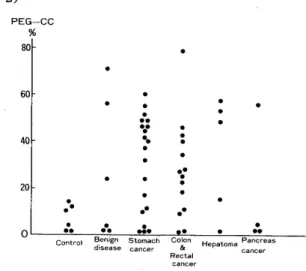
The two patients with elevated CIC in 6 benign diseases were complicated with infec- tious diseases. Blood level of CIC in the
presence of malignant disease rose more than that in normal adult. But one with a large size hepatoma had minimal value of CIC. Its value in all early gastric cancers and colon cancers were almost within normal limit. (Fig.
2)
cancer