Acta Med. Nagasaki 59: 63−65−
Introduction
Irinotecan (CPT-11), a camptothecin analog with potent
anticancer activity by the inhibition of topoisomerase I, is applied for a broad spectrum of solid tumors, including col- orectal, lung, and gastric cancer [1]. However, it causes side- effects such as severe diarrhea and neutropenia in 20-35% of patients [2]. Irinotecan is metabolized by carboxylesterase to form an active metabolite, 7-ethyl-10-hydroxycamptothecin (SN-38), which is subsequently conjugated by UDP- glucuronosyltransferase 1A1 (UGT1A1) [3].
Polymorphism of the UGT1A1 gene is known to play an
important role in irinotecan pharmacokinetics and severe toxicity [4]. Here we describe severe toxicity in a patient with UGT1A1*6 genotypes after chemoradiotherapy includ- ing irinotecan.
Clinical summary
The patient was a 71-year-old man with a heavy smoking
history, in whom an abnormal shadow was noted on chest images. He was admitted to our hospital for further examina- tion and management of the shadow. Chest radiography and a computed tomography (CT) scan demonstrated a nodule on the right S3 and enlarged mediastinal lymph node. The patient was diagnosed with lung cancer (squamous cell car- cinoma cT2aN3M0 stage IIIB) with an ECOG performance status (PS) of 1 based on transbronchial lung biopsy and sys- temic workups. He received chemotherapy consisting of iri- notecan (50mg/m
2on days 1, 8 and 15) and cisplatin (60mg/
m
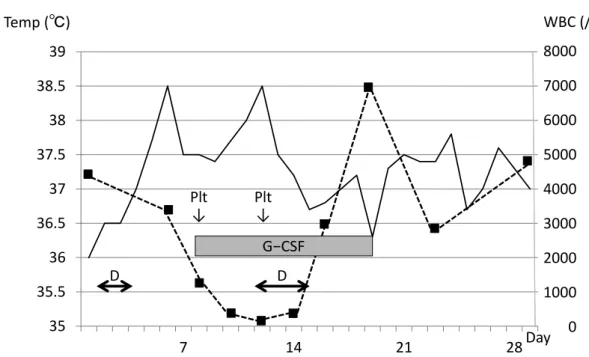
2on day 1) with concurrent thoracic radiotherapy, which confirmed feasibility [5]. A chart of his body temperature and white blood cells is shown in Figure 1. Because he had
MS#AMN 07156
Case Report
Life-threatening toxicity in a patient with UGT1A1*6 heterozygous polymorphism after irinotecan-based chemotherapy: a case report
Daiki O
gawara1, Minoru F
ukuda1,2, Yoichi N
akamura1, Katsumi N
akatomi1, Kohei M
otoshima1, Hiroaki S
enju1, Kousuke M
izoguchi1, Shinnosuke T
akemoto1, Takuya H
onda2, Kazuto A
shizawa2, Yoshinori H
asegawa3, Shigeru K
ohno11 Second Department of Medicine, Nagasaki University Hospital, Nagasaki, Japan
2 Clinical Oncology Center, Nagasaki University Hospital, Nagasaki, Japan
3 Department of Respiratory Medicine, Nagoya University Hospital, Nagasaki, Nagoya, Japan
Polymorphism of the UGT1A1 gene is known to play an important role in irinotecan pharmacokinetics and severe toxicity. A 71-year-old man with lung cancer (squamous cell carcinoma cT2aN3M0 stage IIIB) received irinotecan and cisplatin with concurrent thoracic radiotherapy. Although all treatments were discontinued after day 7, severe leukopenia, neutropenia, fe- brile neutropenia, thrombocytopenia, and diarrhea developed. His life was at risk, and his ECOG performance status (PS) fell to 4. He had UGT1A1*6 heterozygous and UGT1A1*28 wild-type gene polymorphisms. Considering its frequency in Asians, we should take care when using irinotecan to treat patients with UGT1A1*6 heterozygous polymorphism.
ACTA MEDICA NAGASAKIENSIA 59: 63−65, 2014 Key words: UGT1A1*6 polymorphism, irinotecan, lung cancer
Address correspondence: Minoru Fukuda, MD, PhDClinical Oncology Center, Nagasaki University, 1-7-1 Sakamoto, Nagasaki 852-8501, Japan
Phone: +81-(95)-819-7779; Fax: +81-(95)-819-7776;E-mail: [email protected] Received May 7, 2014; Accepted June 4, 2014
64 Daiki Ogawara et al.: UGT1A1*6 heterozygous life-threatening toxicity
a high fever and severe toxicity after day 7, all treatments were discontinued. During the first cycle, grade 4 leukope- nia, grade 4 neutropenia, grade 3 febrile neutropenia, grade 4 thrombocytopenia, and grade 2 diarrhea developed accord- ing to the Common Terminology Criteria for Adverse Events Version 3.0 (CTCAE v3.0). Myelotoxicity peaked on day 12 with white blood cells 200/µl, neutrophils 12/µl, and plate- lets 9,000/µl, respectively. These life-threatening toxicities persisted and PS fell to 4. The patient was treated with gran- ulocyte-colony stimulating factor and cefepime antibiotic, and was given a platelet transfusion. His status resolved on day 19 after intensive care. He then intended to move to an- other hospital for supportive care. We obtained his consent to perform genetic testing, and he was found to have UG- T1A1*6 heterozygous and UGT1A1*28 wild-type gene polymorphisms.
Discussion
SN-38, an active metabolite of irinotecan, is detoxified by
glucuronidation with UGT1A isoforms, 1A1, 1A7, 1A9, and 1A10. Clinical pharmacogenomic studies of irinotecan were conducted in cancer patients. Lyer revealed that patients with the UGT1A1*28 polymorphism had a significantly lower SN-38 glucuronidation rate than those with the normal allele and suffered more severe diarrhea and neutropenia [6].
Innocenti revealed that homozygosity for UGT1A1*28 and total bilirubin levels are strongly associated with severe neu- tropenia and could be used to identify cancer patients predis- posed to the severe toxicity of irinotecan [7]. Therefore, UGT1A1*28 polymorphisms were taken into consideration by the US Food and Drug Administration (FDA) as predic- tors of irinotecan toxicity in 2005. However, the distribution of polymorphisms shows large interethnic differences. The frequency of UGT1A1*28 is high in Caucasians, whereas it is low in Asians [8].
In Asian studies, UGT1A1*6 allele is associated with low
glucuronidation activity and severe toxicity. Minami ana- lyzed Japanese cancer patients treated with irinotecan for as- sociation between genetic polymorphisms and toxicities and demonstrated that homozygotes and double heterozygotes of
*6 and *28 were significantly associated with severe neutro- penia [9]. Incidences of grade 3 or 4 neutropenia for patients with wild, heterozygous, and homozygous of UGT1A1*6 or
*28 were 14.3% (3/21), 24.1% (7/29), and 80.0%(4/5) in iri- notecan monotherapy and 57.1%(20/35), 70.0%(14/20), and 100%(7/7) in irinotecan with cisplatin therapy, respectively.
Han demonstrated homozygosity for UGT1A1*6 was asso- ciated with a high risk of severe neutropenia during irinote- can treatment [10]. Incidences of grade 4 neutropenia for patients with wild or heterozygous, and homozygous of UG- T1A1*6 were 24%(18/75), and 67%(4/6), respectively. On- oue also demonstrated homozygosity for UGT1A1*6 was 35
35.5 36 36.5 37 37.5 38 38.5 39
7 14 21 28 0
1000 2000 5000 4000 3000 6000 7000 8000 Figure 1
WBC (/µL) Temp ( ℃ )
Day
↓
↓
G−CSF Plt Plt
D D
Figure 1. Chart of body temperature (solid line) and white blood cells (dashed line). D, appearance of diarrhea.
Plt, platelet transfusion. G-CSF, daily hypodermic injection of granulocyte colony-stimulating factor.
65 Daiki Ogawara et al.: UGT1A1*6 heterozygous life-threatening toxicity
associated with a high risk of severe neutropenia [11]. Inci- dences of grade 3 or 4 neutropenia for patients with wild, heterozygous, and homozygous of UGT1A1*6 were 11%(9/70), 35%(17/48), and 50%(3/3), respectively. Al- though UGT1A1*6 homozygosity is associated with severe toxicity, its frequency is low. In three papers [12-14], 212 Japanese patients were analyzed for UGT1A1*28 and *6.
The frequency of *6/*6, *28/*28 and *6/*28 was only 2.8%, 3.3% and 1.9%, respectively, whereas *6/- was 26.4%. In the present case, a patient heterozygous for UGT1A1*6 ex- perienced life-threatening toxicity involving neutropenia, thrombocytopenia, febrile neutropenia and diarrhea after iri- notecan plus cisplatin chemotherapy. In our prospective phase II study and recent meta-analysis of Asian patients, UGT1A1*6 polymorphism including homozygotes and heterozygotes was associated with severe neutropenia [15, 16]. Considering the frequency and the present severe case, we should use irinotecan carefully for patients with UG- T1A1*6 heterozygous polymorphism. There might be an ad- ditional unknown factor. Regarding efficacy, Han reported an association with UGT1A1 polymorphism that patients with UGT1A1*6/*6 had a lower tumor response, and shorter progression-free and overall survival [10]. In the present case, the patient refused to continue chemotherapy or radio- therapy after recovery and transferred to supportive care.
Markedly severe toxicity led to decreased therapeutic effi- cacy.
References
1. Meyerhardt JA, Mayer RJ. Systemic therapy for colorectal cancer. N Engl J Med 352: 476-87, 2005
2. Chabot GG, Abigerges D, Catimel G, et al. Population pharmacokinet- ics and pharmacodynamics of irinotecan (CPT-11) and active metabo- lite SN-38 during phase 1 trials. Ann Oncol 6: 141-51, 1995
3. Slatter JG, Su P, Sams JP, et al. Bioactivation of the anticancer agent CPT-11 to SN-38 by human hepatic microsomal carboxylesterases and the in vitro assessment of potential drug interactions. Drug Metab Dispos 25: 1157-64, 1997
4. de Forni M, Bugat R, Chabot GG, et al. Phase 1 and pharmacokinetic study of the, camptothecin derivative irinotecan, administered on a weekly schedule in cancer patients. Cancer Res 54: 4347-54, 1994 5. Fukuda M, Soda H, Fukuda M, et al. Irinotecan and cisplatin with
concurrent split-course radiotherapy in locally advanced nonsmall- cell lung cancer. A multiinstitutional phase 2 study. Cancer 110: 606- 13, 2007
6. Lyer L, Das S, Janisch L, et al. UGT1A1*28 polymorphism as a deter- minant of irinotecan disposition and toxicity. Pharmacogenomics J 2:
43-7, 2002
7. Innocenti F, Undevia SD, Iyer L, et al. Genetic variants in the UDP- glucuronosyltransferase 1A1 gene predict the risk of severe neutrope- nia of irinotecan. J Clin Oncol 22: 1382-8, 2004
8. Ando Y, Chiba M, Nakayama K, et al. The UGT1A1*28 allele is rela- tively rare in a Japanese population. Pharmacogenetics 8: 357-60, 1998 9. Minami H, Sai K, Saeki M, et al. Irinotecan pharmacokinetics/phar- macodynamics and UGT1A1 genetic polymorphisms in Japanese:
roles of UGT1A1*6 and *28. Pharmacogenet Genomics 17: 497-504, 10. Han JY, Lim HS, Shin ES, et al. Comprehensive analysis of UGT1A 2007 polymorphisms predictive for pharmacokinetics and treatment out- come in patients with non-small-cell lung cancer treated with irinote- can and cisplatin. J Clin Oncol 24: 2237-44, 2006
11. Onoue M, Terada T, Kobayashi M, et al. UGT1A1*6 polymorphism is most predictive of severe neutropenia induced by irinotecan in Japa- nese cancer patients. Int J Clin Oncol 14: 136-42, 2009
12. Ando Y, Saka H, Ando M, et al. Polymorphisms of UDP-glucurono- syltransferase gene and irinotecan toxicity: a pharmacogenetic analy- sis. Cancer Res 60: 6921-6, 2000
13. Araki K, Fujita K, Ando Y, et al. Pharmacogenetic impact of polymor- phisms in the coding region of the UGT1A1 gene on SN-38 glucuroni- dation in Japanese patients with cancer. Cancer Sci 97: 1255-9, 2006 14. Sai K, Saito Y, Sakamoto H, et al. Importance of UDP-glucuronosyl-
transferase 1A1*6 for irinotecan toxicities in Japanese cancer patients.
Cancer Lett 261: 165-71, 2007
15. Nakamura Y, Soda H, Oka M, et al. Randomized phase II trial of iri- notecan with paclitaxel or gemcitabine for non-small cell lung cancer:
association of UGT1A1*6 and UGT1A1*27 with severe neutropenia. J Thorac Oncol 6: 121-7, 2011
16. Han F, Guo C, Yu D, et al. Associations between UGT1A1*6 or UG- T1A1*6/*28 polymorphisms and irinotecan-induced neutropenia in Asian cancer patients. Cancer Chemother Pharmacol 73: 779-88, 2014