• 検索結果がありません。

Arg tyrosine kinase is involved in homologous recombinational DNA repair

N/A
N/A
Protected

Academic year: 2021

シェア "Arg tyrosine kinase is involved in homologous recombinational DNA repair"

Copied!
21
0
0

読み込み中.... (全文を見る)

全文

(1)

Arg tyrosine kinase is involved in homologous recombinational DNA repair

著者 Li Yingzhu, Shimizu Hiroko, Xiang Shuang‑Lin, Maru Yoshiro, Takao Noriaki, Yamamoto Ken‑ichi journal or

publication title

Biochemical and biophysical research communications

volume 299

number 5

page range 697‑702

year 2002‑12‑01

URL http://hdl.handle.net/2297/1650

(2)

Arg tyrosine kinase is involved in homologous recombinational DNA repair

Yingzhu Li, Hiroko Shimizu, Shuang-Lin Xiang, #Yoshiro Maru, Noriaki Takao, and Ken-ichi Yamamoto§

Department of Molecular Pathology, Cancer Research Institute, Kanazawa University, Kanazawa, Ishikawa 920-0934, and the #Department of Pharmacology, Tokyo Women s Medical University, 8-1 Kawada-cho, Shinjuku-ku,, Tokyo 162-8666, Japan.

§To whom requests for reprints should be addressed, at Department of Molecular Pathology, Cancer Research Institute, Kanazawa University, 13-1 Takaramachi, Kanazawa, Ishikawa 920-0934, Japan. Phone, 81-76-265- 2755; Fax, 81-76-234-4516; E-mail, [email protected];

The Abbreviations used are: A-T, ataxia telangiectasia; ATM, ataxia telangiectasia mutated; DSB, double

stranded break; HR, homologous recombination; IR, ionizing radiation; PI, phosphatidylinositol

(3)

Abstract

c-Abl plays important roles in cellular response to DNA damage. However, possible roles for Arg (Abl-related gene) in DNA damage response are unknown. Here we show that ionizing radiation (IR)-induced Rad51 focus formation is reduced in Arg-deficient cells generated from a chicken B cell line by targeted disruption. This is consistent with the findings that Arg-deficient cells display hypersensitivity to IR, elevated frequencies of IR-induced chromosomal aberrations, and reduced targeted integration frequencies. All of these abnormalities in DNA damage repair are also observed in ATM-deficient cells but not in c-Abl-deficient cells. Finally, we show that Arg interacts with and phosphorylates Rad51 in 293T cells. These results suggest that Arg plays a role in homologous recombinational (HR) DNA repair by phosphorylating Rad51.

Key Words:, c-Abl family, tyrosine phosphorylation, double strand break, homologous

recombinational DNA repair, Rad51 focus

(4)

Introduction

Ataxia telangiectasia (A-T) is an autosomal recessive disease characterised by radiosensitivity and chromosomal instability. The 350 kDa product of ATM, the gene responsible for A-T, is related to a family of large phosphatidylinositol 3 (PI3)-kinase domain-containing proteins involved in cell cycle control and/ or DNA repair. The other members of this family include ATR and DNA-dependent protein kinase. Recent work has shown ATM to act on a number of important effector proteins involved in the cellular reaction to DNA damage, including c-Abl(1). c-Abl is an ubiquitously expressed nonreceptor-type tyrosine kinase(2) and is activated by DNA damage in an ATM-dependent manner(3, 4). It plays important roles in growth arrest(5, 6) and apoptosis(7-10), and may also function in DNA repair through the phosphorylation of Rad51(11, 12), a key molecule in homologous recombinational (HR) DNA repair(13, 14).

Arg (Abl-related gene), the only other known member of the c-Abl family, shares considerable structural and sequence homology with c-Abl in the N-terminal SH3, SH2, and tyrosine kinase domains(15), and abnormal variants of Arg are implicated in some human lymphoid malignancies(16, 17). However, the roles played by Arg in the cellular response to DNA damage are unknown. In the present study, we show that Arg-deficient cells generated from the chicken B cell line by targeted disruption display various abnormalities in HR DNA repair. We further show that Arg associates with and phosphorylates Rad51 in vivo. Our study thus provides evidence for an Arg-Rad51 link in DNA repair.

Materials and Methods

(5)

Expression plasmids. The full-length human Arg cDNA was constructed from partial and overlapping cDNA clones, which were isolated by library screening and RT-PCR based on the published human cDNA sequences(15). The full-length Arg, c-Abl(5), and Rad51(18) cDNA expression vectors with Flag- or HA-tags (Flag-Arg-wt, Flag-c-Abl-wt, and HA-Rad51) were prepared by inserting the entire Arg, c-Abl, or Rad51 coding sequences in the correct orientation into Flag- or HA-tagged eukaryotic expression vectors driven by a human elongation factor-1 promoter (the tag sequences were located upstream of the coding sequences). The conserved lysine residues in the Arg (amino acid 337) and c-Abl (amino acid 290) tyrosine kinase domains were mutated to arginine using a PCR strategy. These kinase-dead c-Abl and Arg mutant cDNAs were then inserted into the expression vector (Flag-Arg-kd and Flag-c-Abl-kd).

Gene targeting. A partial chicken Arg cDNA was obtained by degenerative RT-PCR methods

from mRNA extracted from DT40 cells. Using this cDNA fragment as a probe, chicken Arg

genomic clones were isolated by screening an EMBL3 SP6/T7 library of genomic DNA from the

liver of adult male Leghorn chicken (Clontech, Palo Alto, CA) by standard procedures. As shown

in Figure 1A, about 1000 bp of the genomic sequence encoding the N-terminal portion of the

chicken Arg kinase domain was replaced with selection marker gene cassettes under the control

of the b-actin promoter. To generate the Arg

-/-

mutant clones, cells were transfected with a

targeting vector that carried the neomycin gene, and selected in medium containing 2 mg/ml

neomycin (Sigma) after the first transfection. The cells were then transfected with a histidinol-

resistance cassette, and selected with both 1 mg/ml histidinol (Sigma) and 0.5 mg/ml neomycin

after the second transfection. RT-PCR analysis of chicken Arg mRNA expression was performed

using the following primers: 5’-AATCTGGTGCAGTTATTAGGTGTGTGTACC-3’ and 5’-

(6)

AATGCCTGGGTATGGTGACATCCCATAGGT-3’.

Immunoprecipitation and immunoblotting. 293T cells were grown in Dulbecco's Modified Eagle's Medium (DMEM, Gibco-BRL, Life Technologies) supplemented with 10% heat- inactivated fetal calf serum (FCS, Gibco-BRL), 50 units/ml penicillin G, and 50 mg/ml streptomycin sulfate (Gibco-BRL) in a 5% CO

2

humidified incubator. The cells were transiently transfected with 0.5 mg of the various expression vectors as indicated in the Figures, using the calcium precipitation method. At 48 hours after transfection, whole-cell lysates were prepared and were immunoprecipitated with mouse anti-Flag (M5, Sigma) or rat high-affinity anti-HA (Roche) antibodies. Mouse anti-Flag, rat anti-HA, or mouse monoclonal anti-phosphotyrosine (4G10, Upstate) antibodies were used as the primary antibodies for immunoblotting; horse anti- mouse IgG HRP-linked (New England Biolabs) or goat anti-rat IgG HRP-linked (Funakoshi) antibodies were used as the secondary antibodies.

Immunofluorescent visualization of Rad51 foci. Rad51 foci were visualized using confocal microscopy (LSM510, Carl Zeiss Co., Ltd.) of cells stained with an anti-Rad51 antibody, as described previously(19, 20). Following microscopy and image processing with Adobe Photoshop v5.0, color-inverted images were printed and distinct Rad51 foci were counted.

Colony survival assay, karyotype analysis, and measurements of targeted integration

frequencies. The measurement of surviving colonies and chromosomal aberrations following X-

ray irradiation were carried out as described previously(21). Targeting with various constructs as

shown in Table 2 and the subsequent analysis of drug-resistant clones were done as described

previously(21). Targeting vectors for the chicken Atr and JSAP2  loci will be described elsewhere.

(7)

Results and Discussion

To study possible roles for Arg in the cellular response to IR, we generated Arg

-/-

cells from a chicken B cell line (DT40) by targeted disruption. The Arg locus was disrupted by sequential transfection of the cells with two targeting vectors (Figure 1A; see Methods). The successful targeted integration was confirmed by Southern blot analysis as the appearance of mutant 8-kbp and 9-kbp KpnI genomic fragments (Figure 1B), and the disruption of the Arg gene was verified by RT-PCR analysis (Figure 1C).

Previous studies showed that c-Abl interacts with and phosphorylates Rad51 on tyrosine

in response to DNA damage. However, the biological significance of these findings in HR DNA

repair is not yet clear, as c-Abl-mediated phosphorylation negatively affected Rad51's activity in

one set of experiments, but enhanced its association with Rad52 in another(11, 12). More

recently, the BCR/ABL oncogenic tyrosine kinase has been shown both to enhance Rad51

expression and to phosphorylate it, resulting in drug resistance(22). On the other hand, we have

recently shown that Rad51 focus formation and DSB repair capacity in c-Abl

-/-

DT40 cells is not

grossly impaired(19), although various DSB repair defects have been well documented in ATM

-/-

DT40 cells(19-21). These results indicate that, while ATM are indispensable in DSB repair in

eukaryotic cells, there must be redundant functions for c-Abl in DSB repair, at least in chicken

DT40 cells and mouse fibroblasts(23). One possibility is that Arg substitutes for c-Abl in the

genome maintenance of the c-Abl

-/-

cells. To clarify this issue, we analyzed the appearance of

Rad51 foci in Arg

-/-

, c-Abl

-/-

, and ATM

-/-

DT40 cells following IR. Rad51 foci are subnuclear

aggregates, believed to represent intermediate structures formed during the recombination

required to repair radiation-induced or replication-associated DNA damage(24). As shown in

(8)

Figure 2, the disruption of Arg as well as of ATM led to impairment in the formation of Rad51 foci, although Rad51 focus formation was normal in c-Abl

-/-

DT40 cells.

To analyze further the DSB DNA repair capacity of Arg

-/-

DT40 cells, wild-type and mutant clones that were plated on methylcellulose were irradiated with 4 or 8 Gy of X-ray, and the percentage of surviving clones was determined relative to the numbers of colonies arising on untreated plates. As shown in Table 1, ATM

-/-

DT40 cells were extremely X-ray sensitive, as we reported previously(19-21), and Arg

-/-

DT40 cells were moderately sensitive; c-Abl

-/-

DT40 cells did not exhibit hypersensitivity to X-rays, in agreement with our recent results(19). To confirm the results of this X-ray sensitivity assay, we examined chromosomal aberrations in Arg

-/-

DT40 cells following IR treatment. As we reasoned and reported previously, an increase in induced chromosomal aberrations observed within 3 hours after IR (i.e., cells irradiated during the S-G

2

phase of the cell cycle) would reflect a defect in the HR repair pathway, and ATM

-/-

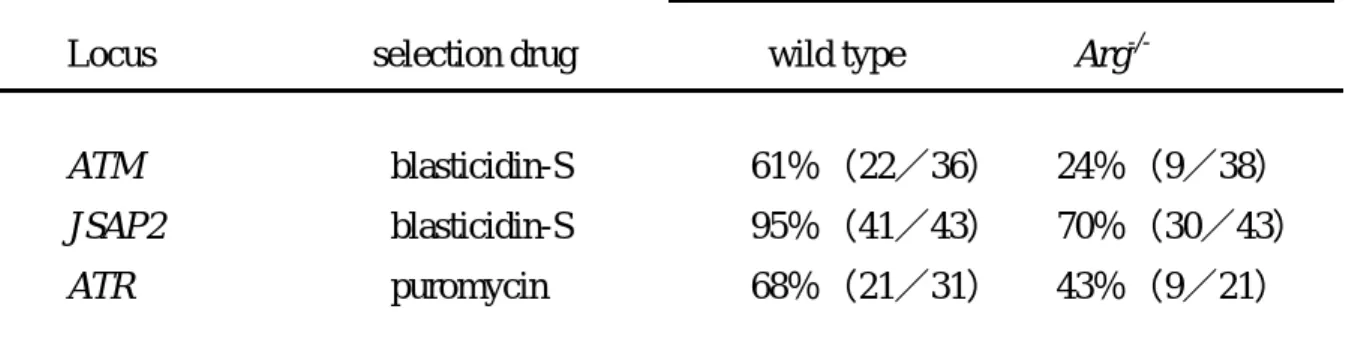
DT40 cells displayed highly increased levels of chromosomal aberrations within 3 hours of X-ray irradiation(19-21). Interestingly, disruption of Arg but not c-Abl resulted in a significant increase in chromosomal aberration frequencies (Figure 3). We further observed a slight but significant reduction in targeted integration frequencies in Arg

-/-

DT40 cells (Table 2), as we reported previously for ATM

-/-

DT40 cells(21). Consistent with these defects in DNA repair, enhanced IR- induced apoptosis was observed in Arg

-/-

DT40 cells (data not shown), as in ATM

-/-

DT40 cells(19). However, unlike in ATM

-/-

DT40 cells(21), IR-induced mitotic delay was normal in Arg

-

/-

DT40 cells (data not shown). G

1

/M checkpoint control has also been shown to be normal in

embryonic fibroblasts derived from Arg

-/-

/c-Abl

-/-

mice(25). These results thus preclude the

possible involvement of cell-cycle checkpoint control abnormalities in the defective DNA repair

(9)

and apoptotic response observed in Arg

-/-

DT40 cells.

The above results indicate that Arg

-/-

DT40 cells have some HR DNA repair defects, as observed in ATM

-/-

DT40 cells. Furthermore, c-Abl has been shown previously to interact with and phosphorylate Rad51(11, 12). It is therefore plausible that, like c-Abl, Arg is involved in HR DNA repair through the phosphorylation of Rad51. To study this possibility, and because we had some difficulties in detecting tyrosine-phosphorylated Rad51 in DT40 cells, we transiently expressed Flag-tagged wild-type or kinase-dead Arg as well as c-Abl with HA-tagged Rad51 in 293T cells. As shown in Figure 4, the results of co-immunoprecipitation experiments showed that immunoprecipitation of wild-type but not kinase-dead Arg with an anti-Flag antibody brought down Rad51 (first row, lanes 1 and 2), indicating that Arg can interact with Rad51 in vivo.

Consistent with these results, only wild-type Arg tyrosine-phosphorylated Rad51 in vivo (second

row, lanes 1 and 2), indicating that the kinase activity of Arg is required for the observed

tyrosine-phosphorylation of Rad51. The ineffective interaction between kinase-dead Arg and

Rad51 suggests an interesting possibility that the interaction between Rad51 and Arg is further

enhanced by the tyrosine-phosphorylation of Rad51 by Arg. However, we cannot rule out a

possibility that this is due to a conformational change induced by the substitution of the

conserved lysine residue. As reported previously(11, 12), wild-type c-Abl phosphorylated Rad51

in vivo, albeit less effectively than Arg (second row, lane 3). However, we were unable to detect

the in vivo association of c-Abl with Rad51 under the conditions used in the present experiments

(first row, lane 3). These results therefore indicate that Arg interacts with and phosphorylates

Rad51 more effectively than does c-Abl. There have been some discrepancies about what

tyrosine residues in Rad51 are phosphorylated by c-Abl; although Tyr-54 was identified in one

(10)

previous study(11), others provided evidence for Tyr-315(12, 22). In the present system, however, Arg effectively phosphorylated Rad51 with mutations at either Tyr-54 or Tyr-315 in 293T cells (unpublished data). We are working at present to identify the Arg-dependent tyrosine- phosphorylation sites in Rad51.

It has been reported previously that Arg is detected mainly in the cytoplasm(26). However, the results presented in this study indicate that disruption of Arg results in defective HR DNA repair functions, including reduced IR-induced Rad51 focus formation. We also showed that Arg associates with and phosphorylates Rad51. These results suggest that Arg functions in HR DNA repair through the tyrosine-phosphorylation of Rad51 in the nucleus. It is therefore possible that a small fraction of Arg might be localized and function in the nucleus, as suggested above, or that Arg might move from the cytoplasm to the nucleus, transducing signals in response to DNA damage, as c-Abl(27).

Since both of Arg

-/-

and ATM

-/-

DT40 cells display abnormalities in HR DNA repair, as

shown in the present study, and since c-Abl is activated by DNA damage in an ATM-dependent

manner(3, 4), it is very possible that Arg is activated by DNA damage in an ATM-dependent

manner. The results of preliminary experiments in various DT40 gene-knockout cells using an

antibody to human c-Abl which cross-reacts with chicken c-Abl and Arg showed that Arg is

activated by IR in an ATM-dependent manner (unpublished data). However, we have been unable

so far to detect the direct phosphorylation of Arg by ATM (unpublished data). The dependency of

Arg activation on ATM may therefore be more complex. Further study is required to clarify this

issue.

(11)

Acknowledgments

We thank Y. Shiloh for discussion and for performing the ATM phosphorylation experiments, S.

Takeda for discussion, K. Yoshioka for the JSAP2 targeting vector, and A. Shinohara for human Rad51 cDNA and the antibody to human Rad51. This work is supported by in part by Grants-in- Aid from the Ministry of Education, Science and Culture of Japan.

References

1 Shiloh, Y. and Kastan, M. B. (2001) ATM: genome stability, neuronal development, and cancer cross paths. Adv. Cancer Res. 83, 209-254

2 Goff, S. P., Gilboa, E., Witte, O. N. and Baltimore, D. (1980) Structure of the Abelson murine leukemia virus genome and the homologous cellular gene: studies with cloned viral DNA.

Cell 22, 777-85

3 Baskaran, R., Wood, L. D., Whitaker, L. L., Canman, C. E., Morgan, S. E., Xu, Y., Barlow, C., Baltimore, D., Wynshaw-Boris, A., Kastan, M. B. and Wang, J. Y. (1997) Ataxia telangiectasia mutant protein activates c-Abl tyrosine kinase in response to ionizing radiation.

Nature 387, 516-519

4 Shafman, T., Khanna, K. K., Kedar, P., Spring, K., Kozlov, S., Yen, T., Hobson, K., Gatei, M., Zhang, N., Watters, D., Egerton, M., Shiloh, Y., Kharbanda, S., Kufe, D. and Lavin, M. F.

(1997) Interaction between ATM protein and c-Abl in response to DNA damage. Nature 387, 520-523

5 Sawyers, C. L., McLauphlin, J., Goga, A., Havlik, M. and Witte, O. N. (1994) The nuclear tyrosine kinase c-Abl negatively regulates cell growth. Cell 77, 121-131

6 Yuan, Z. M., Huang, Y., Whang, Y., Sawyers, C., Weichselbaum, R., Kharbanda, S. and Kufe, D. (1996) Role for c-Abl tyrosine kinase in growth arrest response to DNA damage. Nature 382, 272-274

7 Yuan, Z. M., Huang, Y., Ishiko, T., Kharbanda, S., Weichselbaum, R. and Kufe, D. (1997) Regulation of DNA damage-induced apoptosis by the c-Abl tyrosine kinase. Proc Natl Acad Sci U S A 94, 1437-1440

8 Agami, R., Blandino, G., Oren, M. and Shaul, Y. (1999) Interaction of c-Abl and p73a and

(12)

their collaboration to induce apoptosis. Nature 399, 809-813

9 Gong, J., Costanzo, A., Yang, H.-Q., Melino, G., Kaelin, W. G. J., Levrero, M. and Wang, J.

Y. J. (1999) The tyrosine kinase c-Abl regulates p73 in apoptic response to cisplatin-induced DNA damage. Nature 399, 806-809

10 Yuan, Z., Shioya, H., Ishiko, T., Sun, X., Gu, J., Huang, Y., Lu, H., Kharbanda, S., Weichsekbaum, R. and Kufe, D. (1999) p73 is regulated by tyrosine kinase c-Abl in the apoptotic response to DNA damage. Nature 399, 814-817

11 Yuan, Z.-M., Huang, Y., Ishiko, T., Nakada, S., Utsugisawa, T., Kharbanda, S., Wang, R., Sung, P., Shinohara, A., Weichselbaum, R. and Kufe, D. (1998) Regulation of Rad51 function by c-Abl in response to DNA damage. J. biol. Chem. 273, 3799-3802

12 Chen, G., Yuan, S. S., Liu, W., Xu, Y., Trujillo, K., Song, B., Cong, F., Goff, S. P., Wu, Y., Arlinghaus, R., Baltimore, D., Gasser, P. J., Park, M. S., Sung, P. and Lee, E. Y. (1999) Radiation-induced assembly of Rad51 and Rad52 recombination complex requires ATM and c- Abl. J Biol Chem 274, 12748-12752

13 Shinohara, A. and Ogawa, T. (1995) Homologous recombination and the roles of double- strand breaks. Trends Biochem. Sci. 20, 387-391

14 Sonoda, E., Sasaki, M. S., Buerstedde, J.-M., Bezzubova, O., Shinohara, A., Ogawa, H., Takata, M., Yamaguchi-Iwai, Y. and Takeda, S. (1998) Rad51-deficient vertebrate cells accumulate chromosomal breaks prior to cell death. EMBO J. 17, 598-608

15 Kruh, G. D., Perego, R., Miki, T. and Aaronson, S. A. (1990) The complete coding sequence of arg defines the Abelson subfamily of cytoplasmic tyrosine kinases. Proc. Natl. Acad. Sci. USA 87, 5802-5806

16 Cazzaniga, G., Tosi, S., Aloisi, A., Giudici, G., Daniotti, M., Pioltelli, P., Kearney, L. and Biondi, A. (1999) The tyrosine kinase Abl-related gene ARG is fused to ETV6 in an AML-M4Eo patient with a t(1;12)(q25;p13): molecular cloning of both reciprocal transcripts. Blood 94, 4370- 4373

17 Iijima, Y., Ito, T., Oikawa, T., Eguchi, M., Eguchi-Ishimae, M., Kamada, N., Kishi, K., Asano, S., Sakai, Y. and Sato, Y. (2000) A new ETV6/TEL partner gene, ARG (ABL-related gene or ABL2), identified in an AML-M3 cell line with a t(1;12)(q25;p13) translocation. Blood 95, 2126-2131

18 Shinohara, A., Ogawa, H., Matsuda, Y., Ushio, N., Ikeo, K. and Ogawa, T. (1993) Cloning of human, mouse and fission yeast recombinant genes homologous to Rad51 and RecA. Nat.

Genet. 4, 239-243

(13)

19 Takao, N., Mori, R., Kato, H., Shinohara, A. and Yamamoto, K. (2000) c-Abl tyrosine kinase is not essential for ataxia telangiectasia mutated functions in chromosomal maintenance. J.

Biol. Chem. 275, 725-728

20 Morrison, C., Sonoda, E., Takao, N., Shinohara, A., Yamamoto, K. and Takeda, S. (2000) The controlling role of ATM in recombinational repair of DNA damage. EMBO J. 19, 463-471 21 Takao, N., Kato, H., Mori, R., Morrison, C., Sonoda, E., Sun, X., Shimizu, H., Yoshioka, K., Takeda, S. and Yamamoto, K. (1999) Disruption of ATM in p53-null cells causes multiple functional abnormalities in cellular response to ionizing radiation. Oncogene 18, 7002-7009 22 Slupianek, A., Schmutte, C., Tombline, G., Nieborowska-Skorska, M., Hoser, G., Nowicki, M. O., Pierce, A. J., Fishel, R. and Skorski, T. (2001) BCR/ABL regulates mammalian RecA homologs, resulting in drug resistance. Mol. Cell 8, 795-806

23 Liu, Z.-G., Baskaran, R., Lea-Chou, E. T., Wood, L. D., Chen, Y., Karin, M. and Wang, J. Y.

J. (1996) Three distinct signalling responses by murine fibroblasts to genotoxic stress. Nature 384, 273-276

24 Haaf, T., Golub, E. I., Reddy, G., Radding, C. M. and Ward, D. C. (1995) Nuclear foci of mammalian Rad51 recombination protein in somatic cells after DNA damage and its localization in synaptonemal complexes. Proc. Natl. Acad. Sci. U.S.A. 92, 2298-2302

25 Koleske, A. J., Gifford, A. M., Scott, M. L., Nee, M., Bronson, R. T., Miczek, K. A. and Batimore, D. (1998) Essetial roles for the Abl and Arg tyrosine kinases in neurulation. Neuron 21, 1259-1272

26 Wang, B. and Kruh, G. D. (1996) Subcellular localization of the Arg protein tyrosine kinase.

Oncogene 13, 193-197

27 Van Etten, R. A. (1999) Cycling, stressed-out and nervous: cellular functions of c-Abl.

Trends in Cell Biol. 9, 179-186

Figure Legends

Figure 1 Targeted disruption of the Arg gene.

(A) Schematic representation of part of the chicken arg locus and configuration of the targeted

loci. Solid boxes indicate the positions of exons encoding the N-terminal portion of the chicken

Arg tyrosine kinase domain. (B) Southern blot analysis of the chicken Arg locus. KpnI-digested

(14)

genomic DNA from wild-type, heterozygous Arg mutant (Arg

+/-

), and homozygous Arg mutant (Arg

-/-

) DT40 cells was hybridized with the probe shown in panel (A). (C) RT-PCR analysis of Arg mRNA expression in wild-type and homozygous Arg mutant (Arg

-/-

) DT40 cells.

Figure 2 IR-induced Rad 51 focus formation in Arg-deficient cells.

(A) Immunofluorescence visualization of Rad51 foci in cells of the genotypes indicated, before and 3 hours after 4 Gy X-ray irradiation. (B) Quantitation of Rad51 focus formation in the wild-type and mutant DT40 cells following irradiation. The cumulative numbers of Rad51 foci are presented per 100 cells and show representative results from three separate experiments.

Figure 3 IR- induced chromosomal aberrations in Arg-deficient cells.

Cells were subjected to 2 Gy X-ray irradiation, then incubated with colcemid for 3 hours, and harvested. The cumulative numbers of chromosomal aberrations are presented as macrochromosomal (1-5 and Z) gaps and breaks per 100 metaphase spreads. Each value represents the mean ± S.D. (n = 3).

Figure 4 Arg associates with and phosphorylates Rad51 in vivo

293T cells were cotransfected with 0.5 mg of Flag-tagged expression vectors encoding wild- type (wt, lane 1) or kinase-dead (kd, lane 2) Arg and 0.5 mg of the HA-tagged Rad51 expression vector; as controls, wt (lane 3) or kd (lane 4) c-Abl expression vectors were also cotransfected with HA-tagged Rad51 expression vectors. Forty-eight hours after transfection, cellular lysates were immunoprecipitated (IP) with anti-Flag (first row) or anti-HA (second row) antibodies, and the immunoprecipitates were subjected to immunoblot (IB) analysis using anti-HA (first row) or anti-phosphotyrosine (P-Tyr) (second row) antibodies. To check the protein expression levels, 4%

of the cellular lysates were directly subjected to immunoblot analysis using either anti-Flag (third

(15)

row) or anti-HA (fourth row) antibodies.

(16)

Table 1 Radiosensitivity of wild-type and mutant DT40 cells as assessed by clonogenic survival following X-ray irradiation

Survival(%)

Genotype control 4Gy 8Gy

Wild type 100 10.4 ± 0.35 0.82 ± 0.08

ATM

-/-

100 2.2 ± 0.11 0.027 ± 0.001

c-Abl

-/-

100 12.0 ± 0.61 0.65 ± 0.07

Arg

-/-

100 6.9 ± 0.59 0.37 ± 0.04

Each value represents the mean ± S.D. (n = 3) for at least three separate experiments.

(17)

Table 2 Targeted integration frequencies in Arg-deficient DT40 cells

Targeted integration frequencies

Locus selection drug wild type Arg

-/-

ATM blasticidin-S 61%(22/36) 24%(9/38)

JSAP2 blasticidin-S 95%(41/43) 70%(30/43)

ATR puromycin 68%(21/31) 43%(9/21)

Values shown are percentage of clones containing targeting constructs relative to the total

number of drug-resistant clones analyzed (absolute numbers are given in parentheses).

(18)

neo R

his R

exon5 exon8

KpnI KpnI KpnI

KpnI KpnI

KpnI

BmHI

BmHI probe

6Kb

8Kb

9Kb

Arg locus

pArg-neo recombinant locus

pArg-his recombinant locus

Wild type Wild type Arg +/- Arg -/- Arg -/-

6Kb 8Kb 9Kb

0.42 0.93

B C

A

(19)

c-Abl -/-

wild-type ATM -/- Arg -/-

0Gy

4G, 3hr

A

B

0 100 200 300 400 500

0 3

wild-type ATM-/- c-Abl-/- Arg-/-

hr after radiation

Rad51 foci (number/100 nuclei)

(20)

0 20 40 60 80 100 120

Control After IR

wild-type ATM-/- c-Abl-/- Arg-/-

Chromosome aberrations (number/100 nuclei)

(21)

Rad51 P-Tyr-Rad51

Arg/c-Abl Rad51

IP : anti-Flag

IP : anti-HA IB : anti-HA

IB : anti-HA IB : anti-P-Tyr IB : anti-Flag Arg c-Abl

wt kd wt kd

1 2 3 4

Table 1 Radiosensitivity of wild-type and mutant DT40 cells as assessed by clonogenic survival following X-ray irradiation
Table 2 Targeted integration frequencies in Arg-deficient DT40 cells

参照

関連したドキュメント

However, many researchers also have reported the risk of weight bearing in the early phase after surgery 22,23,39,40). In a previous study, we reported on the risk of weight bear-

According to immunohistochemical studies of gastric carcinomas, MT-MMP-1 is predominantly localized in and on carcinoma cells {30). On the other hand, gelatinase A is

The purpose of the present study was to clarify the role of P-gp in drug disposition in skin, focusing on transdermal drug permeation from the epidermal side and on drug

The purpose of this study is to clarify how utilized public support system for reconstructing or repairing of damaged houses in a case of Noto Peninsula Earthquake.. Repair of

On the other hand, if p is in a long plane P that is not the octoplane of p, then the image of P in the residual at p is a two-dimensional code containing four rays of weight 7, one

An important problem in the theory of quadratic forms is to determine when an anisotropic quadratic form ' over F becomes isotropic over the function eld F ( ) of another form.

We investigated a financial system that describes the development of interest rate, investment demand and price index. By performing computations on focus quantities using the

Atherosclerosis is a disease of the vasculature that is characterized by an accumulation of lipid-laden immune cells and apoptotic cells in the arterial wall.. Recently, the