Print edition : ISSN 2188-3602 Received : Jan. 26, 2014 Accepted : Mar. 4, 2014 Published online : Mar. 31, 2014
Glycative Stress Research 2014; 1 (1): 8-13 (c) Society for Glycation Stress Research
Yoshikazu Yonei, MD, PhD Anti-Aging Medical Research Center, Graduate School of Life and
Original Artcle
Masayuki Yagi
1), Akihiko Shimode
1), Kiyoshi Yasui
2), Umenoi Hamada
1), Junko Naito
1), Yoshikazu Yonei
1)1) Anti-Aging Research Center/Glycation Stress Research Center, Graduate School of Life and Medical Sciences, Doshisha University 2) Koseikai Yotsubashi Clinic.
KEY WORDS: Glycation stress, vinegar beverage, dietary fiber, postprandial hyperglycemia
Abstract
Objective: In search of a dietary therapy to reduce glycation stress, we investigated the effects of different types of vinegar beverages on postprandial blood glucose levels.
Methods: A total of 15 Japanese women ate rice (Sato-no-Gohan, 200 g, Sato Foods) as the standard diet and then checked their blood glucose levels with a self-monitoring blood glucose meter (GT-1670, ARKRAY). Four women with a postprandial rise in blood glucose level of less than 50 mg/dL were excluded from further testing, and a total of 11 women (mean age 48.7 ± 5.4 years) continued with the study. On the test day, subjects consumed a vinegar beverage containing 2.5g indigestible dextrin and 50 mg mixed herbal extract (test diet (+)), the test diet deprived of indigestible dextrin (test diet (
‒)), or a commercially available black (control diet B) or red (control diet R) vinegar beverage before eating a standard diet and then underwent an oral glucose tolerance test (OGTT). OGTT results were compared between diet groups. Fibersol-2H
TM(Matsutani Chemical Industry) was used as the source of indigestible dextrin. AG herb mix
TM(ARKRAY) was used as the mixed herbal extract and consisted of a mixture of powdered hot water extracts of Houttuynia cordata, Crataegus laevigata (C.oxyacantha), Anthemis nobilis, and grape leaf (Vitis vinifera). The study was approved by an appropriate ethical review process.
Results: Intake of test diet (+) with the standard diet resulted in a significantly slower rise in blood glucose level over the first 15 minutes after eating compared to control diets B or R (p < 0.05). In addition, the slope of the blood glucose curve between 1 and 15 minutes after intake of test diet (+) was significantly smaller than that after intake of control diets B or R (p < 0.05). No significant difference was observed between test diet (+) and test diet (
‒). No significant difference was observed between the patterns of blood glucose change after intake of test diet (
‒) or control diets B or R. No significant differences were found in the area under the blood glucose curve (AUC) among the four groups.
Conclusion: Intake of a vinegar beverage containing indigestible dextrin and a mixed herbal extract before eating rice results in a slower initial rise in blood glucose level than after preprandial intake of a commercially available black or red vinegar beverage.
This effect was probably due to the difference in the amount of carbohydrates (sugars, dietary fiber) contained in these beverages.
The observation that vinegar slows the rise in blood glucose level is consistent with previous reports, although the mechanism of action could not be elucidated in the present study. Further study is needed to determine whether the slowed rise in blood glucose level affects subsequent insulin secretion or leads to a reduction in glycation stress.
Effect of a vinegar beverage containing indigestible dextrin and a mixed herbal extract on postprandial blood glucose levels: A single-dose study.
Introduction
Glycation stress is a series of reactions triggered when reducing sugars, organic acids or aldehydes react with protein- derived amino acids to form post-translational modification products, such as carbonyl compounds, succinyl compounds or advanced glycation endproducts (AGEs). The accumulation of these products causes stress to cells and tissues and leads to the functional decline of proteins which can bind to AGEs, inducing or aggravating inflammation via cytokine production
1,2). Glycation stress is considered a major risk factor for accelerated aging. Although diabetes, including the prediabetic state, is a major predisposing factor for glycation
stress, glycation can also occur in the absence of diabetes. This type of glycation is referred to as normoglycemic glycation and is caused mainly by postprandial hyperglycemia. Other causes include hypertriglyceridemia, excessive alcohol intake, excessive fructose intake, or uremic toxin
2).
In order to reduce glycation stress and its associated
symptoms, it is important to identify factors predisposing to
and precipitating glycation stress and to develop measures
to reduce these factors. In search of a dietary measure that
prevents postprandial hyperglycemia, we evaluated the effects
of preprandial intake of four different vinegar beverages on
postprandial blood glucose levels.
Methods
Subjects
Eligible subjects were selected according to the following criteria. A total of 15 Japanese women aged 40-60 years with no impaired glucose tolerance diagnosed within the past year (fasting blood glucose <110 mg/dL) and a body mass index (BMI) of <30 were recruited. Women taking drugs or supplements that may affect the blood glucose level, smokers, or those having a short sleep duration (<5 hours) were excluded. Those meeting the last two criteria were excluded because these lifestyle factors ar e known to increase glycation stress
3). Written informed consent to participation in the study was obtained from all subjects.
Study design
This study was conducted between November 2012 and December 2012 at Koseikai Yotsubashi Clinic (Nishi-ku, Osaka, Japan). Subjects consumed only water after 10:00 pm on the day before the test and underwent the test without taking breakfast.
Blood glucose levels were measured with a self-monitoring blood glucose meter before and at 15, 30, 45, 60, 90 and 120 minutes after diet consumption. Self-monitoring of blood glucose was performed as follows. The subject's fingertip was disinfected with alcohol and then punctured with a puncture device. Blood was gently squeezed out of the punctured fingertip and then drawn through the sensor of a self-monitoring blood glucose meter (GT- 1670, ARKRAY, Kyoto, Japan). Descriptive statistics (mean and standard deviation) of the blood glucose level and the area under the blood glucose curve (AUC) were calculated for each diet group and compared between groups.Prior to intake of test diets, subjects consumed the standard diet at two independent occasions and thereafter were further screened according to the following criteria. Subjects with less than an average of 50 mg/dL increase in blood glucose level after intake of the standard diet compared to baseline values were excluded. At least 11 subjects (mean age 48.7 ± 5.4 years) were selected to minimize variation in values.
The standard, test, and control diets were administered by a unified method proposed by the Japanese Association for the Study of Glycemic Index, as detailed below:
Standard diet: 200g of ready-to-eat rice (Sato-no-Gohan, 100
%Niigata Koshihikari; Sato Foods Co., Ltd, Niigata, Japan) with 2.5g of rice seasoning (Noritama, Marumiya
Corporation, Tokyo, Japan).
Test diet (+): 120 mL of vinegar beverage containing the indigestible dextrin Fibersol-2H
(Matsutani Chemical Industry Co., Ltd, Hyogo, Japan) and a mixed
herbal extract, AG herbs mix (ARKRAY Inc., Kyoto, Japan).
Test diet (
‒): 120 mL of vinegar beverage containing AG herb mix
(ARKRAY Inc., Kyoto, Japan).
Control diet B (Black vinegar beverage):
120 mL of Kurozu-de-Genki (Melodian Co., Ltd., Osaka, Japan).
Control diet R (Red vinegar beverage):
120 mL of Honcho Zakuro-aji (Daesang Japan Inc., Tokyo, Japan),
pre-diluted to 1:3 with water.
Subjects ate the standard diet (group N) over a period of 10 minutes with 30 chews per bite. Test diet (+) (group T), test diet (
‒) (group T (dextrin-)), black vinegar beverage (group B), and red vinegar beverage (group R) were consumed within one minute, followed by the standard diet ( Table 1 ).
Prior to test start on day 1 body height, body weight, blood pressure, pulse rate, and body composition, as measured by bioelectrical impedance analysis with a body composition analyzer (BC-118D Tanita Corp., Tokyo, Japan), were determined. Physical and mental symptoms were evaluated according to a 5-point scale using the Anti-Aging QOL Common Questionnaire (AAQol), as described previously
4)1st 2nd 3rd 4th 5th 6th
N N T B R T(dextrin-)
15 15 11 11 11 11
−
−
○
−
−
−
−
−
−
−
−
○
−
−
−
○
−
−
−
−
−
−
○
−
○
○
○
○
○
○ (+)2)
Test diet1) Control diet
(‒)3) Black vinegar
beverage Red vinegar
beverage Standard4) diet Standard diet (Std)
Std Test diet (+) + Std Black vinegar beverage + Std Red vinegar beverage + Std
Test diet (‒) + Std
Test Group Diet content n
Table 1. Study design
1) Containing mixed herbal extract, 2) Containing indigestible dextrin, 3) Deprived of indigestible dextrin, 4) Rice
Composition of the standard, test, and control diets The composition of the standard, test, and control diets are shown in Tables 2-5, respectively. Indigestible dextrin, an ingredient of test diet (+), has been associated with diarrhea and other gastrointestinal symptoms when consumed in large amounts at a time. Given that the maximum non-effect level for indigestible dextrin to cause diarrhea in women is 1.0 g/kg, the dose of indigestible dextrin was set at 2.5 g/120 mL vinegar beverage in this study.
AG herb mix
TMcontained in the test diets is a mixture of powdered hot water extracts of herbs belonging to different taxonomic groups, including Houttuynia cordata, Crataegus laevigata (C.oxyacantha), Anthemis nobilis, and grape leaf (Vitis vinifera). This herbal mixture has been shown to inhibit AGE production in vitro
6), in a rat model of diabetes
6), and in clinical studies
4,6,7).
The raw materials of the herbal mixture have a long history as food ingredients and are extracted using hot water,
the same extraction method as used for herb tea. Anthemis nobilis has been shown to cause an allergic reaction in people with multiple allergies, albeit at a low frequency. Houttuynia cordata has been reported to cause photosensitivity and hyponatremia when consumed in large quantities for a long time as a folk medicine. The test diets used in this study contained only 50 mg of the herbal mixture in 120 mL vinegar beverage, and thus were not expected to cause any problems.
Moreover, the safety of the powdered mixed herbal extract has been demonstrated in various studies, including a lethal sensitivity test using rec-assay, a reverse mutation test, an acute oral toxicity study using male and female rats, and an overdose test in humans (3,000 mg/day, corresponding to 5 times the regular dose, for 4 weeks)
4,6,7).
The control products, Kurozu-de-Genki and Honcho Zakuro-aji, are commercially available food items with no reported serious adverse reactions, and thus were considered safe.
Calories (kcal) Protein ( g ) Carbohydrate ( g ) Lipid (g) Sodium (mg)
294 4.2 67.8
0 0 (Sato-no-Gohan)Rice
200g
Seasoning (Furikake Noritama)
2.5 g 11 0.57
1 0.55
87 Table 2. Nutritional facts of the standard diet.
Acetic acid (%) Citric acid (%) Indigestible dextrin (%) Mixed herbal extract1) (%) Tien-cha extract2) (%) α-G-rutin (%) Sucralose (%)
Acesulfame potassium (%) Salt (%)
Condensed tomato juice (%) Other ingredients
0.35 0.1 2.1 0.042
0.01 0.0125
0.008 0.006 0.04 0.05 flavoring
water
0.35 0.1
− 0.042
0.01 0.0125
0.008 0.006 0.04 0.05 flavoring
water Test diet (+) Test diet (‒) Table 3. Composition of the test diets.
1) Mixed herbal extract contains Anthemis nobilis, Houttuynia cordata, Crataegus laevigata, and Vitis vinifera of leaf.
2) Tien-cha extract contains Rubus suavissimus.
Calories (kcal) Protein (g) Carbohydrate (g) Lipid (g) Sodium (mg)
5 0 2.6
0 19.2
2 0 0.1
0 19.2 Table 4. Nutritional facts of the test diets.
Test diet (+) Test diet (‒)
Calories (kcal) Protein (g) Carbohydrate (g) Lipid (g) Sodium (mg)
Raw materials
21.6 0 5.5
0 0
55.6 0 13.7
0 0 Kurozu-de-Genki
120 mL Honcho Zakuro-aji1)
120 mL Table 5. Composition of the control diets
(black/red vinegar beverage).
1) Diluted to 1:3 with mineral water Black rice vinegar, apple juice, fructose-glucose syrup, honey, flavoring, sweetener (acesulfame K)
Pomegranate vinegar (pomegranate concentrate, apple concentrate, moromi mash, water-soluble dietary fiber, carrot concentrate and fish collagen), fructose, dextrin, oligosaccharide, acidulants (citric acid and malic acid), flavoring, sweetener (stevia) and hyaluronic acid (apple is also contained as a raw material)
Results
Subjects had a mean BMI of 23.9 ± 2.4, a body fat ratio of 36.6 ± 4.5
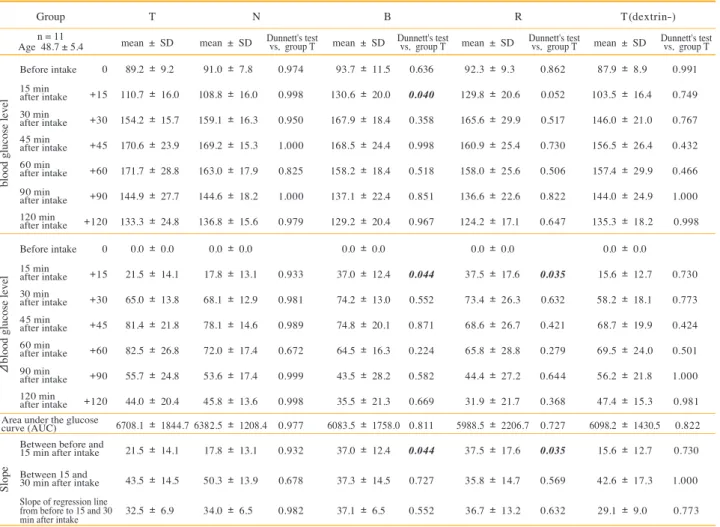
%, a systolic blood pressure of 116.8 ± 13.6 mmHg, and a diastolic blood pressure of 67.4 ± 5.8 mmHg. Subjective symptoms with the mean score of 3 or more included four physical symptoms: eye fatigue, stiff shoulders, easy to gain weight or to get gray hair, and no mental symptoms. The results of blood glucose levels, AUC values, and the slope of the blood glucose curves in each group are summarized in Table 6 .
Blood glucose levels in groups T and N were not different at any time point. Delta-blood glucose levels, representing the change from baseline values, were also not different between groups T and N. No significant difference was observed in any parameter between groups T and T (dextrin-). In contrast, the blood glucose level and delta-blood glucose level at 15 minutes after diet intake in group T was significantly lower than that in group B ( Fig. 1 ). In addition, the delta-blood glucose level at 15 minutes after diet intake in group T was significantly lower than that in group R ( Fig. 2 ). No significant difference was observed in any parameter between groups T (dextrin-) and B or between groups T (dextrin-) and R. AUC values showed no significant differences in any of the five groups. Finally, the slope of the blood glucose curve between 1 and 15 minutes after diet intake was significantly smaller in group T than in groups B and R (p < 0.05). No significant difference was found for the slope of the blood glucose curve between groups T and T (dextrin-).
Ethical considerations
This study was conducted at a third-party institution in compliance with the ethical principles based on the Declaration of Helsinki, the Private Information Protection Law and the Ministerial Ordinance on Good Clinical Practice (GCP) for Drugs (Ministry of Health, Labor and Welfare, Ordinance No.
28 of March 27, 1997). The protocol of the present study was reviewed for ethical aspects and appropriateness and approved by the human research ethics committee of the institutional review board at Tokyo Synergy Clinic (Chuo-ku, Tokyo, Japan). The study was conducted according to the approved protocol.
The principal investigator and sub investigators, in cooperation with a contract research organization, explained the details of the study to and obtained written consent from each subject before initiating the study.
Statistical analysis
All results were expressed as mean ± standard deviation.
All statistical analyses were performed using IBM SPSS Statistics 20 software (IBM Japan, Ltd., Tokyo, Japan).
Dunnett's test was used for intergroup comparison of blood glucose levels, AUC, and the slope of blood glucose curves.
P-values < 0.05 were considered statistically significant.
0.991 0.749 0.767 0.432 0.466 1.000 0.998
0.730 0.773 0.424 0.501 1.000 0.981 0.822 0.730 1.000 0.773 8.9 16.4 21.0 26.4 29.9 24.9 18.2 0.0 12.7 18.1 19.9 24.0 21.8 15.3 1430.5 12.7 17.3 9.0 87.9 103.5 146.0 156.5 157.4 144.0 135.3 0.0 15.6 58.2 68.7 69.5 56.2 47.4 6098.2 15.6 42.6 29.1
±
±
±
±
±
±
±
±
±
±
±
±
±
±
±
±
±
± Group
blood glucose level blood glucose levelSlope
n = 11
Age 48.7 ± 5.4 mean ± SD mean ± SD Dunnett's testvs. group T
0.974 0.998 0.950 1.000 0.825 1.000 0.979
0.933 0.981 0.989 0.672 0.999 0.998 0.977 0.932 0.678 0.982 7.8
16.0 16.3 15.3 17.9 18.2 15.6 0.0 13.1 12.9 14.6 17.4 17.4 13.6 1208.4 13.1 13.9 6.5 91.0 108.8 159.1 169.2 163.0 144.6 136.8 0.0 17.8 68.1 78.1 72.0 53.6 45.8 6382.5 17.8 50.3 34.0
±
±
±
±
±
±
±
±
±
±
±
±
±
±
±
±
±
± 9.2
16.0 15.7 23.9 28.8 27.7 24.8 0.0 14.1 13.8 21.8 26.8 24.8 20.4 1844.7 14.1 14.5 6.9 Before intake
15 min after intake 30 min after intake 45 min after intake 60 min after intake 90 min after intake 120 min after intake
15 min after intake 30 min after intake 45 min after intake 60 min after intake 90 min after intake 120 min after intake
Between before and 15 min after intake Between 15 and 30 min after intake Slope of regression line from before to 15 and 30 min after intake Area under the glucose curve (AUC)
Before intake
89.2 110.7 154.2 170.6 171.7 144.9 133.3 0 +15 +30 +45 +60 +90 +120
0.0 21.5 65.0 81.4 82.5 55.7 44.0 0 +15 +30 +45 +60 +90 +120
6708.1 21.5 43.5 32.5
±
±
±
±
±
±
±
±
±
±
±
±
±
±
±
±
±
±
mean ± SD Dunnett's testvs. group T
0.636 0.040 0.358 0.998 0.518 0.851 0.967
0.044 0.552 0.871 0.224 0.582 0.669 0.811 0.044
0.727 0.552 11.5 20.0 18.4 24.4 18.4 22.4 20.4 0.0 12.4 13.0 20.1 16.3 28.2 21.3 1758.0 12.4 14.5 6.5 93.7 130.6 167.9 168.5 158.2 137.1 129.2 0.0 37.0 74.2 74.8 64.5 43.5 35.5 6083.5 37.0 37.3 37.1
±
±
±
±
±
±
±
±
±
±
±
±
±
±
±
±
±
±
mean ± SD Dunnett's testvs. group T
0.862 0.052 0.517 0.730 0.506 0.822 0.647
0.035 0.632 0.421 0.279 0.644 0.368 0.727 0.035
0.569 0.632 9.3
20.6 29.9 25.4 25.6 22.6 17.1 0.0 17.6 26.3 26.7 28.8 27.2 21.7 2206.7 17.6 14.7 13.2 92.3 129.8 165.6 160.9 158.0 136.6 124.2 0.0 37.5 73.4 68.6 65.8 44.4 31.9 5988.5 37.5 35.8 36.7
±
±
±
±
±
±
±
±
±
±
±
±
±
±
±
±
±
±
mean ± SD Dunnett's testvs. group T
T N B R T(dextrin-)
Table 6. Comparison of blood glucose levels, AUC values, and the slope of blood glucose curves.
Fig.1. Comparison of blood glucose curves between groups T and B
Data are mean ± SD; .n =11; Dunnett's test
*p < 0.05: significant difference in slope
Abbreviations: group T, test diet (+); group B, black vinegar beverage diet
Fig.2. Comparison of blood glucose curves between groups T and R
Data are mean ± SD; n =11; Dunnett's test
*p < 0.05: significant difference in slope
Abbreviations: group T, test diet (+); group R, red vinegar beverage diet
Discussion
The objective of this study was to determine whether intake of test diet (+), composed of vinegar, indigestible dextrin, and a mixed herbal extract, has any effect on postprandial blood glucose levels. As a result, subjects taking test diet (+) with the standard diet showed a similar change in postprandial blood glucose levels as those taking the standard diet alone.
However, over the first 15 minutes after intake test diet (+) led to a slower rise in blood glucose levels than control diets B or R, suggesting that test diet (+) slows the rise in postprandial blood glucose level.
We then attempted to identify the component(s) of test diet (+) responsible for the slow rise in postprandial blood glucose level. The amount of carbohydrates contained in each vinegar beverage is as follows: test diet (+): 2.6 g, test diet (
‒): 0.1 g, control diet B: 5.5 g, control diet R: 13.7g. Test diet (+) and test diet (
‒) showed no significant differences in their postprandial effects, indicating that the amount of indigestible dextrin added had no effect on postprandial glucose levels. Considering the amounts of carbohydrates in the diets, the slowing of the blood glucose level after a meal by test diet (+) was potentially due to smaller amounts of sugar contained in test diet (+) as compared with control diets B or R.
Although the mixed herbal extract contains hot water extracts of Houttuynia cordata, Crataegus laevigata, Anthemis nobilis, and grape leaf (Vitis vinifera), there has been no evidence that any of these herbs has any effect on postprandial blood glucose level. In a previous clinical study
4), no effect on fasting blood glucose level of the test diet was observed.
Several studies have investigated the effect of acetic acid, the main ingredient of vinegar, on postprandial blood glucose levels
8-11). A study on the effect of vinegar on the postprandial blood glucose levels of 13 healthy female college students (mean age 21 years) showed a 30
%reduction in AUC after intake of rice mixed with pure rice vinegar compared to AUC after intake of rice alone
9). This effect was particularly evident in subjects with a postprandial blood glucose level of >140 mg/dL after eating rice. A similar effect has also been observed with apple cider vinegar and tomato vinegar
10). On the other hand, another study involving 6 healthy female students (mean age 22 years) showed no significant difference between AUC after the intake of a standard diet or a rice plus vinegar product
11). The absence of a significant difference in this study may be attributed to the small population size.
Other known effects of vinegar include cholesterol- lowering effect
12,13), blood pressure-lowering effect in humans
14)and rats
15), and iron absorption-promoting effect in rats
16). These findings indicate that the acetic acid contained in vinegar slows the absorption of lipids, carbohydrates, and minerals in the gastrointestinal tract.
Vinegar has a long history of consumption as a food and thus should have no safety concern. Although a high- dose administration of acetic acid has been shown to induce ulcer formation in the stomach
17,18), studies have shown that the intake of a typical amount (20-80 mL) of vinegar does not cause any adverse events
19-21). However, since the direct exposure of teeth to a high concentration of acetic acid may lead to dissolution of tooth enamel
22), the mouth should be rinsed after the intake of vinegar. Gargling after vinegar intake or taking vinegar before a meal is therefore recommended.
Post-ingestive time (min) 120
100
80
60
40
20
0
0 +15 +30 +45 +60 +90 +120
Self-monitored blood glucose
Group B Group T
*
Post-ingestive time (min) 120
100
80
60
40
20
0
0 +15 +30 +45 +60 +90 +120
Self-monitored blood glucose
Group R Group T
*
References
1)
Nagai R, Mori T, Yamamoto Y, et al. Significance of advanced glycation end products in aging-related disease.
Anti-Aging Medicine. 2010; 7: 112-119.
2)
Ichihashi M, Yagi M, Nomoto K, et al. Glycation stress and photo-aging in skin. Anti-Aging Medicine. 2011; 8: 23-29.
3)
Nomoto K, Yagi M, Arita S, et al. Skin accumulation of advanced glycation end products and lifestyle behaviors in Japanese. Anti-Aging Medicine. 2012; 9: 166-174.
4)
Yonei Y, Miyazaki R, Takahashi Y, et al. Anti-glycation effect of mixed herbal extract in individuals with pre- diabetes mellitus: a double-blind, placebo-controlled, parallel group study. Anti-Aging Medicine. 2010; 7: 26-35.
5)
Yonei Y, Yagi M, Hibino S, et al. Herbal extracts inhibit Maillard reaction, and reduce chronic diabetic complications risk in streptozotocin-induced diabetic rats.
Anti-Aging Medicine. 2008; 5: 93-98.
6)
Kubo M. Yagi M. Kawai H. et al. Anti-glycation effects of mixed-herb-extracts in diabetes and pre-diabetes. J Clin Biochem Nutr. 2008; 43(Suppl.1): 66-69.
7)
Tamura T, Yagi M, Nomoto K, et al. Anti-glycation effect of a novel herbal mixture made of mixed herbal extract and two crude drugs - Short and long term effect -. The Science and Engineering Review of Doshisha University. 2012; 52:
244-252. (in Japanese)
8)
Inage H, Sato Y, Sakakibara S. The effect of vinegar intake on postprandial blood glucose level in healthy women.
Journal of Japanese Society of Clinical Nutrition. 2006; 27:
321-325. (in Japanese)
9)
Endo M, Matsuoka T. The efficacy of vinegar on the suppression of postprandial glucose elevation. The Journal of the Japan Diabetic Society. 2011; 54: 192-199. (in Japanese)
10)
Endo M, Matsuoka T, Nakanishi Y. The efficacy of vinegar in suppressing postprandial hyperglycemia: Studies on the difference between vinegar and vinegar-drinks and the difference in the way of ingestion. Notre Dame Seishin University Kiyo. Studies in: Human Living Sciences, Child Welfare, Food and Nutrition. 2012; 36: 1-9. (in Japanese)
11)Sueda K, Okuda M, Yamada M. Effect of side dish on
postprandial change in blood glucose in healthy female students: dietary fiber, vinegar, butter, soybean products and dairy products. Journal of the Institute for Psychological and Physical Science. (Shinshin Kagaku) 2009; 1: 23-30. (in Japanese)
12)
Fushimi T, Kishi M, Oshima Y, et al. Investigation of the effect on serum total cholesterol and safety of drinks containing vinegar. Journal of Nutritional Food. 2005; 8:
13)
Fushimi T, Kishi M, Oshima Y, et al. Effect of a drink containing vinegar on serum total cholesterol in Japanese subjects with high serum total cholesterol levels: the relationship between the improvement effect of vinegar drink on high serum total cholesterol levels and the intake season of it. Journal of Nutritional Food. 2007; 9: 9-23. (in Japanese)
14)
Tanaka H, Watanabe K, Ma M, et al. The effects of gamma-aminobutyric acid, vinegar, and dried bonito on blood pressure in normotensive and mildly or moderately hypertensive volunteers. J Clin Biochem Nutr. 2009; 45:
93-100.
15)
Kondo S, Tayama K, Tsukamoto Y, et al. Antihypertensive effects of acetic acid and vinegar on spontaneously hypertensive rats. Biosci Biotechnol Biochem. 2001; 65:
2690-2694.
16)
Ujike S, Shimoji Y, Nishikawa Y, et al. Effect of vinegar on absorption of iron in rats. Journal of Japanese Society of Nutrition and Food Science. 2003; 56: 371-374. (in Japanese)
17)
Nakamura M, Kishikawa H, Tsuchimoto K, et al. AV shunt formation during ACETIC Acid-induced gastric ulcer healing: effect of basic fibroblast growth factor. Ulcer Research. 2000; 27: 57-59. (in Japanese)
18)
Nakashita M, Miura S, Uehara K, et al. The role of ceramide pathway in the process of acetic acid ulcer in the rat stomach. Ulcer Research. 2003; 30: 70-72. (in Japanese)
19)Kishi M, Fushimi T, Itoh A, et al. Safety evaluation of
excessive intake of vinegar drink on normal adult subjects.
Journal of Japanese Society of Clinical Nutrition. 2006; 27:
313-320. (in Japanese)
20)
Miura K, Nakao T, Tokai H, et al. Safety assessment of excessive intake of vinegar drink supplemented with xylooligosaccharide in normal volunteers. Journal of Urban Living and Health Association. (Seikatsu Eisei) 2007; 51:
85-91,112. (in Japanese)
21)
Tanaka Y, Nagata K, Masuda K, et al. Evaluation of the safety of a calcium enriched vinegar beverage in excessive ingestion. Journal of New Remedies & Clinics. 2009; 132- 144. (in Japanese)
22)