多数・多様・有用な語彙に触れられる教科書の種類について
―
大学英語教科書の語彙分析: 文学テキストとコミュニカティブなテ キストのミニ・コーパスの比較―
Which Type of Textbooks Gives Learners Exposure to a Larger, More Diverse and Useful Vocabulary?
―
A Vocabulary Analysis of University English Textbooks:
A Comparison between the Mini-corpus of Literary Textbooks and That of Communicative Ones
―佐 竹 由 帆* Yoshiho Satake
Email: [email protected]
1989 年に文部省は学校英語教育においてコミュニカティブなアプローチをとることにし、学習指 導要領において中学生・高校生が学習すべき単語数を削減した。文部省の決定は 1990 年代以来大 学英語教科書に影響し、会話やリスニングなどコミュニケーション志向の教科書が増加し、文学作 品を扱う教科書は著しく減少した。中学校・高校の教科書の延べ語数・異なり語数がコミュニカテ ィブなアプローチをとるようになって以来減少していることから、大学英語教科書についてもコミ ュニカティブな教科書の延べ語数・異なり語数は文学作品を扱う教科書より少ないと筆者は仮説を たて、検証を試みた。文学の教科書は語彙数・語彙多様性・難易度・有効語彙収録語数・単語テス トの平均点が高く、コミュニカティブな教科書はこれらの項目のすべてで文学の教科書を下回った。
文学作品の教科書はコミュニカティブなアプローチにおされて減少傾向にあるが、学生の語彙力養 成のためには、コミュニカティブな教科書に勝る長所を持つ文学作品の教科書を、コミュニカティ ブな教科書を補うために併用して使用することが望ましい。
As the need for practical English increased, in 1989 the Ministry of Education, Culture, Sports, Science and Technology (MEXT) decided to adopt the communicative approach in school English-language teaching, and to reduce the number of word types that junior and senior high school students needed to learn. MEXT’s decisions have influenced university English textbooks. If the number of word types and tokens in communication-centred university textbooks is smaller than the number of word types and tokens in textbooks covering literature, this is likely to have a negative influence on university students’
English proficiency. The author examined the vocabulary in literature and communication-centred English textbooks for university students from not only the quantitative viewpoint such as the number of word types and tokens, but also the qualitative viewpoints such as diversity, difficulty and usefulness of the vocabulary as well as the distribution of parts of speech and semantic elements. The results of the study reveal that the number of word types and tokens in communicative textbooks is smaller than the corresponding number in literature textbooks. Communicative textbooks have less diverse and easier vocabulary, fewer useful word types, more repetition of easier word types, and a greater imbalance in the distribution of parts of speech and semantic elements than do literature textbooks. The study concludes that literature textbooks should be used together with communicative textbooks because using literature textbooks would greatly help students improve their vocabulary.
―――――――――
*: 青山学院大学非常勤講師
1. Introduction
1.1 A reform of English-language education in junior and senior high schools
In 1989, the Ministry of Education, Culture, Sports, Science, and Technology (MEXT) decided to adopt the communicative approach in school English language teaching, and to reduce the number of word types which junior and senior high school students needed to learn by 50 to 2,900(1)(2)(3)(4)
. This decision was implemented in 1993, and students’ reading comprehension, vocabulary and grammatical competence have decreased ever since(5)(6). The communication-centred approach in Japan has gradually tended to move towards fun-seeking activities(7)(8). and has increasingly been considered to be not working very well(9)(10)(11)(12)
. Meanwhile, in 2002, MEXT reduced the overall school education syllabus by approximately 30% to create a more pressure-free education system. Consequently, the number of English word types that students needed to learn was further decreased by 200 to 2,700(13)(14). Because of these educational reforms, authorized school textbooks for English have become smaller in size(15). There has been a corresponding decrease in the total number of word tokens that students learn from authorized English textbooks at junior and senior high school, dropping from an average of 38,874(16) to 34,502(17). This has become inadequate for achieving the communicative competence required to give a presentation in English on a subject based on the literature survey (18), which MEXT wants students to be able to do. The decreased number of word types that school students now learn and the fewer word tokens that they encounter in textbooks are likely to lower their English proficiency.
1.2 Influence of the educational reform in schools upon university English textbooks
MEXT’s decisions have also influenced university English textbooks. According to Erikawa(19), since the 1990s, the number of communicative-centred textbooks such as conversation and listening textbooks has increased (accounting for approximately 70%
of university textbooks published in 1998), while reading textbooks and writing textbooks accounted for only approximately 7.4% and 4.6 % in 1998, respectively. In particular, the
number covering literary works has decreased (accounting for only 3.4 % of university textbooks published in 1998). This rebounded on school textbooks, which increasingly contain retold and simplified literary works rather than the originals. We may assume that original literary works are richer in vocabulary in terms of both word types and tokens, which is also indicated by the fact that a series of school English textbooks commonly used in the nineteenth and early twentieth century contained more than 12,000 word types, i.e.
more than four times the 2,700 word types required by MEXT since 2002. The last volume of the series had as many as 480 pages.
1.3 Research questions
If the number of word types and tokens in communication-centred university textbooks is indeed smaller than the number of word types and tokens in textbooks covering literature, this is likely to have a negative influence on university students’ English proficiency.
I examined the vocabulary in literature and communication-centred English textbooks for university students from not only the quantitative viewpoint such as the number of word types and tokens, but also the qualitative viewpoints such as the diversity, the difficulty and the usefulness of the vocabulary as well as the distribution of parts of speech and semantic elements because both quantitative and qualitative analyses have strengths and weaknesses(20). This would help determine whether there are any differences that could affect university students’ English proficiency.
2. Theoretical background
Research was conducted in the context of corpus linguistics. Corpus analysis is generally classified into quantitative and qualitative analyses, and both types have strengths and weaknesses. Quantitative analysis can cope with large amounts of data(21), and its findings are statistically dependable and generalisable, while quantitative analysis tends to marginalise infrequent occurrences and make it hard to consider diverse meanings of each word. Qualitative analysis can make detailed descriptions, though its results are not examined to find whether they are statistically important or accidental. Since in social science there has been a trend toward multi-method approaches that utilize a wide range of information from more than one method, I
conducted not only a quantitative analysis to compare the number of word types and tokens in communication-centred textbooks and the number of them in literature textbooks, but also a qualitative analysis to make linguistic statements.
2.1 Learners’ vocabulary size and vocabulary teaching
I converted the number of word families into the number of word types and used the latter when I considered the number of vocabulary items because a frequency list of a reference corpus is a list of word types(22).
2.1.1 Learners’ vocabulary size Skill in language use relates to vocabulary size(23). To understand a text sufficiently, learners’ vocabulary size needs to provide them with more than 95% coverage of the word tokens in the text(24)(25). The most frequent 3,000 word families supply 95%
coverage of written texts(26). Thus, it is critical to acquire the most frequent 3,000 word
families―which would be 3,000×1.6 = 4,800 word types (the conversion formula quoted in Laufer(27))―as quickly as possible(28).
When learners acquire the most frequent 7,000 word families (7,000 × 1.6 = 11,200 word types), acquiring additional words will not significantly improve learners’ reading comprehension(29). Therefore, after acquiring the most frequent 4,800 word types, it is reasonable for learners to aim at acquiring up to the most frequent 11,200 word types to improve their English proficiency. Compared to the most frequent 4,800 word types, the word types between the most frequent 4,800 and 11,200 word types can be considered low frequency word types. To expand learners’
vocabulary into low frequency words, learners have to increase inference skill and have to read and listen to formal language extensively(30). Informal spoken language is not very useful for acquiring low frequency words(31). Therefore, one can safely assume that learning vocabulary through literary works would improve learners’ vocabulary and inference skill, and learning vocabulary only through textbooks for conversation would not contribute to acquiring low frequency words.
2.1.2 Vocabulary teaching in the Japanese English language education system
In the Japanese English language education system, vocabulary has rarely been systematically taught(32). Although MEXT states that teachers should make students perform activities using basic words, phrases and idioms, there are few standards for choosing activities and vocabulary in textbooks. In an English class at junior high school, a teacher only presents the pronunciation and meaning of new words to students(33). At the senior high school level, in addition to doing the same things as in junior high school, a vocabulary notebook is often designated as supplementary material to prepare the students for university entrance examinations, but there are few instructions about how to use it(34). At university, teachers do not teach vocabulary effectively, and they only designate a vocabulary list and do the same things that junior and senior high school teachers do(35).
Since there is little effective vocabulary teaching at school, students’ vocabulary acquisition would largely depend on their learning from textbooks and vocabulary materials. Since the 2,700 word types identified by MEXT are short of the 4,800 word types necessary for reading comprehension(36), it would be useful for university students to learn from textbooks that provide them with enough vocabulary to cover the shortage.
3. Procedures
3.1 Mini-corpora of textbooks
I made a mini-corpus of literature textbooks for university students by scanning all pages of three textbooks as well as a mini-corpus of communication-centred textbooks for university students by scanning almost all pages of three textbooks to compare the two. These six textbooks are the ones that I have used in class. To make a qualitatively and quantitatively fair comparison, I selected the six textbooks from among those for a half-term upper-intermediate course. Since one of the communication-centred textbooks has three additional review units that cannot be covered during a half-term, because of time restriction, I excluded these units and did not scan those pages. In addition, since the communication-centred textbooks include one listening-centred textbook and two discussion-centred textbooks, I also made each
mini-corpus.
3.2 A concordance program
To compile the word frequency lists of the textbooks, I used AntConc 3.2.1w, which is a corpus analysis software.
3.3 Reference corpora and concordancer
As a reference corpus, I used Web Corpus 2006 (WC2006), which was compiled from linguistic data on the Web in 2006 by Web as Corpus (WaC), because WC2006 is a sufficiently large corpus with approximately a hundred million word tokens and includes both British and American English.
To analyse the way parts of speech and semantic elements are used in each corpus of the textbooks, I also referred to Ishikawa’s(37) research on the way parts of speech and semantic elements are used in the Freiburg-LOB Corpus of British English (FLOB) and Freiburg-BROWN Corpus of American English (FROWN). FLOB was compiled from publications in UK in 1991 and has approximately one million word tokens.
FROWN was compiled from publications in America in 1992 and has approximately one million word tokens.
3.4 A language processing system To analyse the way parts of speech and semantic elements are used in each corpus of the textbooks, I used Wmatrix, which supplies a Web interface to the corpus annotation tools called Constituent Likelihood Automatic Word-Tagging System (CLAWS) and University Centre for Computer Corpus Research on Language, Semantic Analysis System (USAS).
CLAWS version 7 classifies word tokens in an uploaded corpus into approximately 160 part-of-speech categories, and USAS classifies word tokens in an uploaded corpus into 21 broad semantic categories and 232 narrow semantic categories.
3.5 Analytical methods
3.5.1 On the quantity, the diversity, the difficulty and the usefulness of the vocabulary
To compare the quantity of the vocabulary in each mini-corpus of the textbooks, I used AntConc 3.2.1w to find the number of word types and word tokens in each
mini-corpus.
To compare the vocabulary diversity in each mini-corpus, I used Guiraud index (the number of word types divided by the square root of the number of word tokens(38)). Guiraud index of a text is high when its vocabulary is diverse, whereas it is low when its word types are not
diverse.
To compare the difficulty of the vocabulary, I classified the word tokens in each corpus of the textbooks into 12 categories.
According to the frequency list of WC2006, the WC2006’s most frequent 1,000 word types in each corpus of the textbooks are classified as WC1 (the easiest), the word types between the WC2006’s most frequent 1,001 and 2,000 word types in each corpus of the textbooks are classified as WC2 (the second easiest) and so forth. After classification, I calculated the percentage of the number of word tokens in each category to the total number of word tokens in each corpus and compared the distribution ratio among the corpora.
Furthermore, by referring to concordances by Web Concordancer, I examined whether any examples of words were being used for their rare meanings in the textbooks, since words used with several meanings would cause students difficulty in interpretation(39).
To examine whether the vocabulary in each corpus of the textbooks is useful, I examined the percentage of the vocabulary in each corpus that is included in the most frequent 4,800 word types in WC2006 because readers need to know them to understand the text. I also examined the percentage of the vocabulary that is included in the most frequent 11,200 word types in WC2006 since acquiring them improves reading comprehension, although acquiring more than that does not further improve reading comprehension. I evaluated the most frequent 4,800 word types in WC2006 as the most useful, the word types between the most frequent 4,801st and 11200th word types as the second most useful and the rest of the word types as less useful.
3.5.2 How parts of speech are used
To analyse the way parts of speech are
used, I used CLAWS to classify word tokens in each corpus of the textbooks into approximately 160 part-of-speech categories and compared the classified results of the
corpora, referring to the classified results of FLOB and FROWN. Next, to analyse the way parts of speech are used in broad perspective using the data from CLAWS, I reclassified word tokens in each corpus of the textbooks into six main parts of speech such as nouns, verbs, adjectives, adverbs, prepositions and interjections, and then compared the classified results of the corpora, referring to the classified results of FLOB and FROWN.
3.5.3 How semantic elements are used
To analyse the way semantic elements are used, I used USAS to classify word tokens in each corpus of the textbooks into 232 semantic categories and then compared the classified results of the corpora, referring to the classified results of FLOB and FROWN. Next, to analyse the way semantic elements are used in broad perspective using the data from USAS, I reclassified word tokens in each corpus of the textbooks into 19 semantic categories and compared the classified results of the corpora, referring to the classified results of FLOB and FROWN. The 19 semantic categories were from Ishikawa(40), who modified them based on USAS’s 21 broad semantic categories, excluding two categories because they are indefinite as semantic categories.
3.5.4 The informants
The informants were three classes of male and female Japanese university sophomores. Each class had approximately 40 students, so the total number of informants was approximately 120. One class took a compulsory English reading course and the other classes took a compulsory English listening and speaking course. Both courses consisted of a 90-minute class per week, with a total of 13 classes during the semester. All students majored in English literature and were upper-intermediate English learners. They had studied English for seven years at junior and senior high schools and at the university.
3.5.5 Word test
To investigate whether my students
could recognize the vocabulary from the textbooks and whether the results were different among students who used different kinds of the textbooks, in the last class of the semester, I conducted unannounced word tests that covered subjects of the textbook that the
students used. Each test had 12 English words that the students translated into Japanese and one point is given to one correct translation.
Each word was selected according to the frequency list of WC2006: the first word came from the WC2006’s most frequent 1,000 word types and is close to the 1000th in each corpus of textbooks, the second word came from the word types between the WC2006’s most frequent 1,001st and 2,000th word types and is close to the 2,000th in each corpus of the textbooks and so forth. Therefore, one can presume that a correct answer to the first question means acquisition of approximately 1,000 word types, correct answers to the first and the second questions mean acquisition of approximately 2,000 word types and so forth. I selected the word types in the tests whose frequency in the use is close to an average number of appearances in each category because students are more likely to remember a word when it is used frequently in a textbook whereas they may not remember a word when it is used rarely in a textbook. There is little difference in an average number of appearances in each category among three kinds of the textbooks.
4. A comparison of the vocabulary in the literature textbooks with that in the communicative textbooks
4.1 On the quantity, the diversity, the difficulty and the usefulness of the vocabularies
4.1.1 The quantity of the
vocabularies
Table 1 shows the average quantity of vocabulary per textbook.
Table 1: The Average Quantity of the Vocabulary per Textbook
Literature Communicative Listening Discussion Word
tokens 21305 14483 17737 12857
Word
types 3099 2077 2515 1859
For the category of word tokens, the literature textbooks averaged more word tokens than the communicative textbooks.
Compared to the literature textbooks, the communicative textbooks averaged only 68 percent of word tokens. To be more specific, the literature textbooks have on average the
most word tokens, the listening textbook has the second most and the discussion textbooks have the fewest. Compared to the literature textbooks, the listening textbook has approximately 83 percent of word tokens, and the discussion textbooks averaged only approximately 60 percent of word tokens.
There is a big difference in the number of word tokens between not only the literature and the communicative textbooks, but also the listening and the discussion textbooks, which are both categorized into the communicative textbooks.
Within the category of word types, the literature textbooks include a larger vocabulary than the communicative textbooks. Compared to the literature textbooks, the communicative textbooks averaged only 67 percent of word types. To be more specific, the literature textbooks have on average the most word types, the listening textbook has the second most and the discussion textbooks have the fewest.
Compared to the literature textbooks, the listening textbook has approximately 81 percent of word types, and the discussion textbooks have on average only approximately 60 percent of word types. In the category of word types as well as in that of word tokens, there is a big difference in the number of word types between not only the literature and the communicative textbooks, but also the listening and the discussion textbooks. In addition, no textbook has 4,800 word types, which is what students would need to acquire to understand a text sufficiently(41).
Based on this information, I conclude that the literature textbooks can provide students with more exposure to word tokens and word types than the communicative textbooks because the literature textbooks have a larger vocabulary. Judging from the fact that the discussion textbooks have the lowest average of word tokens and word types, they give students the least exposure to word tokens and word types. As to whether there are enough word types (4,800(42)) per textbook, no type of textbook has enough word types on average.
4.1.2 Vocabulary diversity
Figure 1: The Guiraud Index
Figure 1 shows the Guiraud index of each kind of textbook. The literature textbooks have more diverse word types than the communicative textbooks because the Guiraud index of the literature textbooks is higher than that of the communicative textbooks. Since the disparity between the Guiraud index of the literature textbooks and that of the listening and the discussion textbooks is approximately 6 to 7.1 (although the disparity between the Guiraud index of the listening textbook and that of the discussion textbooks is only approximately 1.1), the diversity of word types in the literature textbooks is remarkably higher than that in the communicative textbooks.
Because monotonous repetition of basic word types would hamper learners from acquiring various word types(43), the communicative textbooks should have more diversified word types.
24.9
20.3
18.9
17.8
0 5 10 15 20 25
Literature Communicative Listening Discussion
4.1.3 The difficulty of the vocabularies
Figure 2: The Percentage of the Number of
Word Tokens in Each Category
Figure 2 shows the percentage of the number of word tokens in each category (as to the category, see 3.5.1) to the total number of word tokens in each corpus of textbooks.
Since the vocabulary distribution ratio by difficulty of the literature textbooks and WC2006 is the same, except for the percentage in WC3 and WC12 or more, and since the percentage of the literature textbooks is closely akin to the percentage of WC2006, one may say that the literature textbooks’ vocabulary distribution ratio by difficulty is akin to the distribution ratio of the vocabulary used in real life and is well balanced.
The difficulty of the vocabulary in the communicative textbooks is lower than that in the literature textbooks and WC2006 because the percentage of the easiest two categories (WC1, WC2) in the communicative textbooks is higher than that in the literature textbooks and WC2006, and the percentage of the most difficult three categories (WC10, WC11, WC12 or more) in the communicative textbooks is
lower than that in the literature textbooks and WC2006. To be more specific, the percentage of WC1 in the listening textbook and the percentage of WC2 in the discussion textbooks are exceptionally high, and this means the vocabulary in the listening textbook is the easiest and that in the discussion textbooks is the second easiest. Compared to the literature textbooks, the communicative textbooks’
vocabulary distribution ratio by difficulty is less akin to the distribution ratio of WC2006 (the vocabulary used in real life) and less balanced.
As for the words with rare meanings being used, there are two examples (i.e. “save”
and “sound”) in the literature textbooks and no example in the communicative textbooks.
“Save” appears 17 times in the literature textbooks and “save” is used as a homonym meaning “except” three times, while it is used with a meaning of “keep safe” or “keep and store up” 11 times in the other 14 cases. Since examples with the meaning of “keep safe”,
“keep and store up” and no example with the meaning of “except” are included in the 10 examples from the first ten Webpages that Web Concordancer showed out of 729,000,000 word tokens, it follows that examples with the meaning of “except” are comparatively rare.
“Sound” appears 36 times, and is used as an adjective homonym meaning “in good condition” three times and as an adverb homonym meaning “deeply” twice, while it is used as a noun meaning “something that you hear” 30 times or a verb meaning “convey a specified impression” once. Since examples of nouns meaning “something that you hear” and a verb meaning “convey a specified impression” as well as no example of an adjective homonym meaning “in good condition” or an adverb homonym meaning “deeply” are included in 10 examples from the first 10 Webpages that Web Concordancer showed out of 427,000,000 word tokens, it follows that examples of an adjective homonym meaning
“in good condition” and an adverb homonym meaning “deeply” are comparatively rare.
From the viewpoint of rare meanings, the degree of difficulty of the literature textbooks is, therefore, higher than that of the communicative textbooks because there are a total of eight examples being used, with their rare meanings, in the literature textbooks, while there are none in the communicative textbooks.
Consequently, from the viewpoints of WC20
06 Liter ature
Com muni cativ e
Liste ning
Discu ssion
WC12 or more 8% 9% 5% 5% 5%
WC11 1% 1% 0% 0% 0%
WC10 1% 1% 0% 0% 0%
WC9 1% 1% 1% 1% 1%
WC8 1% 1% 1% 1% 1%
WC7 1% 1% 1% 1% 1%
WC6 1% 1% 1% 1% 1%
WC5 2% 2% 2% 2% 2%
WC4 3% 3% 3% 3% 3%
WC3 4% 3% 4% 4% 4%
WC2 7% 7% 9% 8% 11%
WC1 70% 70% 73% 74% 72%
0%
10%
20%
30%
40%
50%
60%
70%
80%
90%
100%
both percentage of the number of word tokens in each category and rare meanings, the degree of difficulty of the literature textbooks is higher than that of the communicative textbooks.
4.1.4 The usefulness of the vocabularies
Table 2: The Average Number of the Most Frequent 4800 Word Types and the Word Types between the 4,801st and 11,200th Most
Frequent in WC2006 per Textbook
Literature Listening Discussion
1-4800 1707 1634 1296
4801-11200 586 423 248
Total 2293 2057 1543
Table 2 shows the average number of the most frequent 4,800 word types and the word types between the 4,801st and 11,200th most frequent in WC2006 per textbook. In all categories, the number of word types in the literature textbooks is the highest, the number of the listening textbook is the second most highest and the number of the discussion textbooks is the lowest.
Figure 3: The Percentage of the Number of Word Types in the Textbooks by Considering the Number of the Word Types in the Literature Textbooks to be100 Percent
Figure 3 shows the percentage of the number of word types in the textbooks by considering the number of the word types in the literature textbooks to be 100 percent. The percentage of word types between the 4,801st and 11,200th most frequent word types in the discussion textbooks is less than half the percentage of the literature textbooks, which is particularly low.
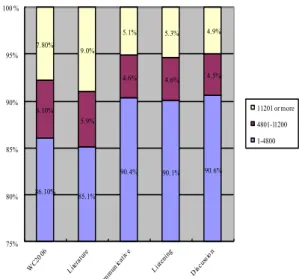
Figure 4 shows the percentage of the number of the word tokens in each kind of textbook that is included in the most frequent 4,800 word types, the word types between the 4,801st and the 11,200th most frequent word
types, and the 11,201st most frequent or more word types in WC2006. The percentage of the number of word tokens included in the most frequent 4,800 word types in the communicative textbooks is higher than that in the literature textbooks, although the communicative textbooks include a fewer number of the most frequent 4,800 word types.
This suggests that comparatively fewer word types in this category repeatedly appear in the communicative textbooks. The percentage of the number of word tokens included in the 4,801st and the 11,200th most frequent word types in the literature textbooks is higher than that in the communicative textbooks; this is linked to the literature textbooks having many more word types than do the communicative textbooks in this category. In total, the percentage of the most frequent 11,200 word types in the communicative textbooks is higher than that in the literature textbooks, although the communicative textbooks include fewer of the most frequent 11,200 word types.
Furthermore, the percentage of the number of word tokens included in the word types between the 4,801st and the 11,200th most frequent word types in the communicative textbooks is lower than that in the literature textbooks. This suggests that comparatively fewer easier word types are recycled in the
100 100 100
95.7
72.2
89.7 75.9
42.3
67.3
40 50 60 70 80 90 100
1-4800 4801-11200 Total
%
Literature Listening Discussion
86.10%
85.1%
90.4% 90.1% 90.6%
6.10%
5.9%
4.6% 4.6% 4.5%
7.80%
9.0%
5.1% 5.3% 4.9%
75%
80%
85%
90%
95%
100 %
11201 or more 4801-11200 1-4800
Figure 4: The Percentage of the Number of the Word Tokens in Each kind of Textbook that is Included in the Most Frequent 4,800 Word Types, the Word Types between the 4,801st and the 11, 200th Most frequent and the 11,201st Most frequent or More Word Types in WC2006
communicative textbooks. Since in the discussion textbooks the average number of word types is the lowest in all the categories and the percentage of the number of word tokens included in the most frequent 4,800 word types is the highest, this suggests that the fewest easier word types are recycled in the discussion textbooks. The percentage of word tokens included in the most frequent 11,201st or more word types in the literature textbooks is higher than in the communicative textbooks, which means that the literature textbooks include more useless word tokens, whereas the percentage of the literature textbooks is closely akin to the percentage of WC2006. This suggests that the percentage of the literature textbooks is akin to the percentage of the language used in real life and that these books are well balanced.
Thus, with regard to the usefulness of vocabularies, both the literature and the communicative textbooks have strong and weak points. The literature textbooks include more useful word types, but the percentage of useful word tokens is lower. This suggests less efficient exposure to useful vocabulary. The percentage of useful word tokens in the communicative textbooks is higher, which suggests more efficient exposure to useful vocabulary, but they include fewer useful word types.
4.2 How parts of speech are used Table 3 shows the number of appearances of 10 high-frequency part-of-speech tags in each corpus of textbooks.
The following names of parts of speech are from Wynne(44). Data for FLOB and FROWN are from Ishikawa(45), who uses only their section A (Press: Reportage) and K (General Fiction) (in total approximately 146,000 word tokens from each corpus) because of systematic restrictions of Wmatrix. The correspondence of 10 high-frequency part-of-speech tags in FLOB and FROWN suggests there is a pattern to the distribution of parts of speech in a natural language(46).
High-frequency part-of-speech tags in NN1, “singular common noun”; JJ, “general adjective”; AT, “article”; II, “preposition”’; VVD,
“past tense form of lexical verb”; NN2, “plural common noun” and CC, “coordinating conjunction”. This is one more than those in the communicative textbooks ( NN1, JJ, NN2, II, AT and CC)―to be more specific, two more
Table 3: Ten High-Frequency Part-of-Speech Tags
than those in the listening textbook (NN1, JJ, II, NN2 and AT) and those in the discussion textbooks (NN1, NN2, JJ, II and CC), suggesting that the distribution of parts of speech in the literature textbooks is more similar to a pattern to the distribution of parts of speech in the language used in the real world than that in the communicative textbooks.
Compared to FLOB and FROWN, PPHS1 (“she”: third person singular, subjective personal pronoun) more frequently appears only in the literature textbooks, and VVI (“infinitive base form”) and ZZ1 (“singular letter of the alphabet”) more frequently appear while VVD less frequently appears in the communicative textbooks. Since both VVI and VVD are verbs, from a viewpoint of general categories of parts of speech, there is a prominent difference in a verb category between the distribution of parts of speech in FLOB and FROWN and that in the communicative textbooks. This difference could suggest that too many infinitives are used and various tenses are not used in the communicative textbooks.
To analyse parts of speech in a broad perspective, I reclassified approximately 160 part-of-speech categories into six main part-of-speech categories and compared the percentages of them in each corpus. Table 4 shows the results. The data for FLOB and FROWN are from Ishikawa(47).
Literature Commun
icative Listening Discussion FLOB FROW
N 1 NN1 8871 NN1
6376
NN1
2154 NN1 4222 NN1
21125 NN1
21125
2 JJ 3837 JJ
2474 JJ
1037 NN2 1647 MC
17755 MC
17755 3 AT 3712 VV0
2458 VV0
985 VV0 1473 FO
16347 FO
16347 4 II 3535 NN2
2336 II
766 JJ 1437 JJ
10018 JJ 10018 5 VVD 3354 II
1885 NN2
689 II 1118 II
9421 II 9421 6 NN2 2183 VVI
1592 ZZ1
620 VVI 1038 AT
8558 AT 8558 7 VV0 1953 AT
1470 VVI
553 CC 778 NN2
7483 NN2
7483 8 CC 1890 CC
1148 AT
548 RR 591 NP1
6568 NP1
6568 9 RR 1630 RR
1137 RR
546 VM 584 VVD
5601 VVD
5601
10 PPHS1
1576 ZZ1
1101 AT1
468 PPY 516 CC
4075 CC 4075
Table 4: The Percentage of Six Main Parts of Speech
Literat
ure Commun
icative Listeni
ng Discus
sion
FLOB FRO
WN
Noun 18.5 21.9 17.5 24.9 15.5 16.6
Verb 15.3 14.7 15.2 14.4 10.0 10.1
Adjective 6.5 6.2 6.4 6.1 5.6 6.0
Adverb 2.8 2.9 3.4 2.6 2.2 2.1
Preposition 8.0 6.8 6.3 7.0 8.2 7.9
Interjection 0.3 0.5 0.9 0.2 0.1 0.1
Let us compare data from the textbooks and reference corpus. Since FLOB and FROWN are considered to show a pattern according to the distribution of parts of speech in a natural language, the limits between the upper limit and the lower limit on FLOB and FROWN can be considered standard limits for the distribution of parts of speech in a natural language(48). As to data from the literature textbooks, although the percentage of preposition is within standard limits, the percentages of nouns, verbs, adjectives, adverbs and interjections are over the limits.
As to data from the communicative textbooks, the percentage of prepositions is below standard limits, and the percentages of nouns, verbs, adjectives, adverbs and interjections are over the limits. The percentage of interjections in the listening textbook is nine times as high as that in FLOB and FROWN, and remarkably imbalanced.
Thus, we see that the distribution of parts of speech in the literature textbooks is slightly better than that in the communicative textbooks because in the literature textbooks, the percentage of prepositions is within standard limits and the percentages of three parts of speech such as nouns, adverbs and interjections are nearer to the standard limits than that in the communicative textbooks. By contrast, in the communicative textbooks, the percentages of only two parts of speech, verbs and adjectives, are nearer to the standard limits than that in the literature textbooks.
However, in neither the literature nor the communicative textbooks is the distribution of parts of speech well balanced because the percentages of all parts of speech, except one, are outside the standard limits. Since imbalanced distribution of parts of speech in textbooks can have an undesirable influence on Japanese university students’ vocabulary acquisition, it should be observed whether the
distribution of parts of speech in textbooks is appropriate.
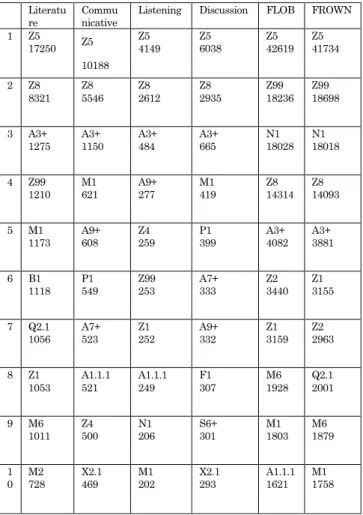
4.3 How semantic elements are used Table 5 shows the number of appearance of 10 high-frequency semantic tags in each corpus of the textbooks. The following names of semantic elements are from Archer et al.(49). Data for FLOB and FROWN are from Ishikawa(50), who uses a part of FLOB and Frown because of systematic restrictions of Wmatrix. Similarly to the correspondence of 10 high-frequency part-of-speech tags in FLOB and FROWN, the correspondence of the first to the fifth high-frequency semantic tags in FLOB and FROWN suggests that there is a pattern to the distribution of semantic elements in a natural language(51).
Table 5: Ten High-Frequency Semantic Tags
High-frequency semantic tags in the literature textbooks correspond to those in FLOB and FROWN. Eight were identified: Z5,
“grammatical bin”; Z8, “pronouns etc”; A3+,
“being”, positive; Z99, “unmatched”; M1,
“moving, coming and going”; Q 2.1, “speech etc: communicative”; Z1, “personal names”;
Literatu
re Commu
nicative Listening Discussion FLOB FROWN 1 Z5
17250 Z5 10188
Z5
4149 Z5
6038 Z5 42619 Z5
41734
2 Z8
8321 Z8
5546 Z8
2612 Z8
2935 Z99 18236 Z99
18698
3 A3+
1275 A3+
1150 A3+
484 A3+
665 N1 18028 N1
18018
4 Z99
1210 M1
621 A9+
277 M1
419 Z8 14314 Z8
14093
5 M1
1173 A9+
608 Z4
259 P1
399 A3+
4082 A3+
3881
6 B1
1118 P1
549 Z99
253 A7+
333 Z2 3440 Z1
3155
7 Q2.1
1056 A7+
523 Z1
252 A9+
332 Z1 3159 Z2
2963
8 Z1
1053 A1.1.1
521 A1.1.1
249 F1
307 M6 1928 Q2.1
2001
9 M6
1011 Z4
500 N1
206 S6+
301 M1 1803 M6
1879
10 M2
728 X2.1
469 M1
202 X2.1
293 A1.1.1 1621 M1
1758
and M6, “location and direction”. This totals three more than those in the communicative textbooks (Z5, Z8, A3+, M1 and A1.1.1,
“general actions, making etc”), which suggests that the distribution of semantic elements in the literature textbooks is more similar to a pattern to the distribution of semantic elements in a natural language than the distribution of semantic elements in the communicative textbooks, since much correspondence of high-frequency semantic tags in FLOB and FROWN suggests there is a pattern to the distribution of semantic elements in a natural language(52). Since eight of 10 high-frequency semantic tags in the listening textbook (Z5, Z8, A3+, Z99, Z1, A.1.1.1, N1, “numbers” and M1) and four of 10 high frequency semantic tags in the discussion textbooks (Z5, Z8, A3+ and M1) correspond to those in FLOB and FROWN, the communicative textbooks’ less correspondence to FLOB and FROWN than the literature textbooks is due to the discussion textbooks’
least correspondence to FLOB and FROWN.
As previously mentioned, to analyse semantic elements in a broad perspective, I reclassified approximately 232 semantic categories into 19 main semantic categories and then compared the percentages in each corpus. Table 6 shows the results. Data for FLOB and FROWN are from Ishikawa(53). Similarly, for parts of speech, to judge whether there is overuse or too little use in a semantic area, I investigated whether the percentages of semantic elements in each corpus are within the limits between the upper limit and the lower limit on FLOB and FROWN.
Comparing the literature textbooks and the communicative textbooks, the distribution of semantic elements in the literature textbooks is slightly better than that in the communicative textbooks because in the former, the percentage of one semantic area (L:
“life and living things”) is within standard limits, one semantic area (F: “food and farming”) is overused, and the percentages of eight areas (C: “arts and crafts”, G: “government and public”, I: “money and commerce in industry”, K: “entertainment, sports and games”, N:
“numbers and measurement”, S: “social actions, states and processes”, T: “time” and Y: “science and technology”) are less than half of the lowest limit, whereas in the communicative textbooks, the percentage of one semantic area (Y) is within standard limits, one semantic area (P: “education”) is overused, and the
Table 6: The Percentage of 19 Main Semantic Categories
percentages of nine areas (B: “the body and the individual”, C, G, H: “architecture, housing and the home”, M: “movement, location, travel and transport”, N, O: “substances, materials, objects and equipment”, T and W: “world and our environment”) are less than half of the lowest limit. However, to be more specific, in the listening textbook, the percentages of two semantic areas (F and Y) are within standard limits, one semantic area (P) is overused, and the percentages of seven areas (B, G, H, M, N, O and T) are less than half of the lowest limit, while in the discussion textbooks, the percentage of one semantic area (Y) is within standard limits, three semantic areas (F, I and P) are overused and the percentages of twelve areas (B, C, E: “emotion”, G, H, K, L, M, N, O, T and W) is less than half of the lowest limit.
Accordingly, the listening textbook is the best, the literature textbooks are the second best, and the discussion textbooks are the worst.
Next, let us look at the examples that are overused and underused in the textbooks.
Since the percentages of F and P in the discussion textbooks are more than twice the upper limit, the vocabulary in F is overused in the literature textbooks and the vocabulary in P is also overused in the listening textbook, one
Literat
ure Commu
nicative Lis ten ing
Discu
ssion FLOB FRO
WN B: The body and the
individual 3.0 1.0 1.2 1.0 3.4 3.6
C: Arts and crafts 0.1 0.1 0.2 0.1 0.3 0.5
E: Emotion 1.4 1.3 1.7 1.0 2.6 2.2
F: Food and farming 1.1 1.6 0.9 2.1 1.0 0.9
G: Government and public 0.3 1.3 0.5 1.8 4.1 3.8
H: Architecture, housing
and the home 1.6 0.8 0.8 0.3 2.0 2.0
I: Money and commerce in
industry 0.7 2.1 2.1 4.5 3.9 4.1
K: Entertainment, sports
and games 0.5 0.9 0.9 0.7 1.7 1.8
L: Life and living things 1.4 0.6 0.6 0.5 1.2 1.4
M: Movement, location,
travel and transport 5.9 3.2 3.2 4.3 8.8 8.8
N: Numbers and
measurement 4.4 4.9 4.9 5.4 33.2 32.3
O: Substances, materials,
objects and equipment 3.9 1.5 1.5 1.6 4.0 4.6
P: Education 0.3 1.3 0.9 1.6 0.5 0.7
Q: Language and
communication 3.3 3.4 3.5 3.3 6.4 7.1
S: Social actions, states and
processes 4.5 6.2 5.9 6.8 10.0 9.7
T: Time 3.3 2.9 3.4 2.5 8.2 7.8
W: World and our
environment 0.8 0.4 0.5 0.4 1.0 1.2
X: Psychological actions,
states and processes 4.1 5.9 6.0 5.8 7.6 7.3
Y: Science and technology 0.0 0.2 0.3 0.2 0.2 0.3
can say that the vocabulary in F and P is overused in both the literature and the communicative textbooks.
In addition, the use of the vocabulary in G and T that is less than half of the lowest limit and the extremely less use of the vocabulary in N compared to FLOB and FROWN is a tendency that all the textbooks share.
The distribution of semantic elements in neither the literature textbooks nor the communicative textbooks is well balanced because the percentages of most semantic areas are outside standard limits. Since imbalanced distribution of semantic elements in textbooks can have an undesirable influence on Japanese university students’ vocabulary acquisition, whether the distribution of semantic elements in textbooks is appropriate should be taken into consideration.
4.4 The results of the word tests The average mark of the word test is, in the order of a good score, 6.0 (literature), 5.0 (listening) and 4.5 (discussion). The number of testees were 35 (literature), 37 (listening) and 32 (discussion). The average mark for the communicative one is the average value of the results of the listening and the discussion word tests. From the viewpoint of acquisition of the essential 4,800 word types, the literature and the listening textbooks helped students acquire them because their average marks are higher than 4.8, while the discussion textbooks did not sufficiently help because the average mark is lower than 4.8 (for the relationship between marks and vocabulary acquisition, see 3.5.4).
The lowest mark for discussion could have been caused by features of the discussion textbooks such as the fewest tokens and types, the least diverse vocabulary, much repetition of high frequency vocabulary and semantically imbalanced vocabulary.
Therefore, the literature textbooks are more effective in improving students’
vocabulary than are the communicative textbooks. To be more specific, the literature textbooks are the most effective, the listening textbook are the second most, and the discussion textbooks are the least.
Figure 5: The results of the word tests
5. Discussion
Considering that the results of the word test from the literature textbooks are better than those from the communicative textbooks, it would seem that the features of the literature textbooks help students improve their vocabulary more than do the features of the communicative textbooks. The literature textbooks include more vocabulary that is diverse and more difficult as well as more useful word types, lower percentages of useful word tokens, and slightly better balanced distribution of parts of speech and semantic elements than the communicative textbooks do.
As to the literature textbooks’ lower percentage of useful word tokens, we would need to reconsider because a majority of the students (students in the literature class and the listening class) got more than 4.8 points on the word test.
This means a majority of the students required exposure to word types between the most frequent 4,801st and 11,200th word types more than they required exposure to the most frequent 4,800 word types to improve their vocabulary and English proficiency. Therefore, for expanding the students’ vocabulary, one cannot place a high value on the communicative textbooks’ higher percentage of useful word tokens that include fewer word types and a lower percentage of word tokens between the most frequent 4,801st and 11,200th word types. That is, when it comes to word tokens, the literature textbooks are more useful than the communicative textbooks because the literature textbooks have a higher percentage of word tokens that are between the most frequent 4,801st and 11,200th word types).
Accordingly, the literature textbooks are better than the communicative textbooks in all the categories.Next, let us consider the vocabulary
6.0
4.8 5.0
4.5
0.0 1.0 2.0 3.0 4.0 5.0 6.0 7.0
Literature Communicative Listening Discussion