Fabrication of monodispersed spherical thermosensitive gels and their dynamic
behavior in aqueous polymeric solutions with temperature gradient
著者 ラデン リノヴァ シスウォロ
著者別表示 RADEN RINOVA SISWORO journal or
publication title
博士論文要旨Abstract 学位授与番号 13301甲第1917号
学位名 博士(工学)
学位授与年月日 2020‑09‑28
URL http://hdl.handle.net/2297/00061336
doi: https://doi.org/10.3390/app10062016
Creative Commons : 表示 ‑ 非営利 ‑ 改変禁止 http://creativecommons.org/licenses/by‑nc‑nd/3.0/deed.ja
DISSERTATION ABSTRACT
Fabrication of monodispersed spherical thermosensitive gels and their dynamic behavior in aqueous polymeric solutions with
temperature gradient
Graduate School of Natural Science and Technology Kanazawa University
Division of Mechanical Science and Engineering
Student ID Number : 1624032018
Name : Raden Rinova Sisworo
Chief Supervisor : Professor Yukio TADA Date of Submission : 2020.6.26
Abstract
This research studied about fabrication technique of monodispersed spherical thermosensitive gels, specifically factors affecting diameter size of the resulted NIPA gels. The research also investigated swelling and shrinking phenomena of the NIPA gels at various diameters in a constant temperature fields and clarifies the dynamic behavior of the NIPA gels at various diameters inside an upper heating system of a rectangular cavity containing water and polymeric solution.
The apparatus to fabricate thermosensitive gels including the microfluidic device containing the co two-phased flows were designed and installed. Apparatus to observe swelling and shrinking phenomena, as well as the apparatus to investigate dynamic behavior of the gels inside the upper heating rectangular cavity were designed and set according to their functions.
The results showed that continuous-phase flow rate and kinematic viscosity were most influential on the size of the monodispersed thermosensitive gels, which exhibited swelling and shrinking at both low and high temperatures of the polymeric aqueous solution, respectively, and demonstrated negative thermal expansion. In a low-temperature solution, the buoyancy force acting on the gel particles exceeded the gravitational force, the size of the gels increased and the gels to ascended. At higher temperatures, the gels shrank because the gravitational force outweighed the buoyancy force, causing the gels to descend. The gels with a larger diameter tended to have longer durations of vertical movements within the aqueous polymeric solution than the smaller-sized gels. Hence, equilibrium conditions were quickly achieved by the smaller gels.
Keywords: convective heat transfer, thermosensitive gels; polymeric aqueous solution; swelling and shrinking behavior; buoyancy force; gravitational force; vertical repetitive movements
1. Introduction
Recently, due to increasing of energy consumption, global environmental problem, such as global warming and desertification and depletion of energy resource occurs. Therefore, utilization of unusable energy and improvement of efficiency of energy device. These techniques contribute the reduction of greenhouse gasses. Improvement of efficiency of energy device are important issue. In order to improve the efficiency of energy device, development of heat transfer enhancement techniques is key technology. The technique of heat transfer enhancement is classified into active method and passive method. The active method has an advantage of high controllability of heat transfer. On the other hand, passive method has an advantage of low external power and no additional devise. As typical passive method, we consider the natural convection heat transfer system. For upper heating system, heat transfer rate is small due to no convection since temperature stratification layer is formed. To improve this inconvenience, addition of thermo-sensitive particles has been proposed in this study. By using thermo-sensitive gels with negative thermal expansion, convection is generated.
Then, heat transfer enhancement without external power will be realized. In this study, fabrication of monodispersed spherical thermosensitive gels and their dynamic behavior in aqueous polymeric solutions with temperature gradient have been studied.
2. Purposes of the study
As the purposes of this study, the following issue has been studied in order to develop the new technology by utilizing thermo-sensitive gel particles: a) to study about fabrication technique of monodisperse thermo-sensitive gels; b) to clarify the swelling and shrinking phenomena of thermo- sensitive gels in constant temperature field; c) to clarify the dynamical behavior of thermo-sensitive gels in aqueous polymeric solutions with temperature gradient.
3. Fabrication of Monodisperse Thermo-sensitive Gel Particle 3.1 Method to Fabricate Mono-dispersed Thermosensitive Gels
In this study, NIPA gels were generated by the cross-linked polymerization of the monomer (NIPA) and N, N’-methylene bisacrylamide (BIS) as cross-linker (see Figure 1), with the aid of other three chemicals and water measured in a unit mass. The chemicals included 150 mg of NIPA, 5 mg of BIS, 25 mg of DDBAB as an initiator, 10µL of N, N, N’, N’-tetramethyl ethylene diamine (TEMED) as an accelerator, 6 mg of APS as an initiator, and 1.6 g of deionized water.
Figure 1. Synthesis of Cross-linked N-isopropyl acrylamide (NIPA) Gel
NIPA, BIS, DDBAB, and TEMED were dissolved in half of the deionized water (0.8 g) and loaded into the first 3-mL syringe (inner diameter = 10.1 mm). Similarly, APS was dissolved in the remaining half of the deionized water (0.8 g) and loaded into the second 3-mL syringe. Two different viscosities of silicone oil (50 × 10−6 m2/s and 300 × 10−6 m2/s) were used as continuous-phase fluids. Figure 2 shows the setup of the research apparatus. Steps to synthesize the gels are described as follows: a 3mL syringe containing NIPA components and another 3mL syringe containing APS components were prepared, the speed of both piston syringes was set to 0.002 mm/s and the linear actuator was activated.
A constant dispersed flow rate (Qd) of 3.2 × 10⁻¹⁰ m3/s was maintained throughout the study. The gel solution was then ejected from the nozzle’s tip (outside diameter = 300 µ m) while the other co- flow of silicone oil (continuous-phase flow) was simultaneously ejected in the same direction by another pump. Finally, all the gels were collected in a silicone oil reservoir on a cold plate maintained at −30 ◦C. The resulting gels were then stored in a freezer for 1 day to complete the polymerization process, and the diameter of the gel droplets flowing within the square duct was measured via image analysis. Based on the output of the diameter readings, the average diameter of the gels was calculated.
Figure 2. Schematic of Apparatus for Generating the Thermosensitive Gels 3.2 Results
The initial gel formation near the tip of the needle can be seen in Figure 3, which shows the droplet’s growth stage, its initial necking stage, and its final separation stage. Various flow rates of the silicone oil were set within a range of 3.96–15.8 ×10⁻⁹ m3/s. When the continuous-phase flow rate was gradually increased from 5.94 × 10⁻⁹ m3/s to 15.8 × 10⁻⁹ m3/s (for the both values of viscosity), the diameter of the gel droplets visibly decreased (as shown in Figure 4 with the reference letters (A–D).
The relationship between an increasing continuous-phase flow rate and the average droplet diameters for the both viscosities (50 × 10−6 m2/s and 300 × 10−6 m2/s) are shown in Table 1.
A correlation was evident between the diameter of the generated droplet (dg) and the flow rate of the continuous-phase flow (Qc) for each of the silicone oils’ viscosities, which can be expressed as:
dg = 2.2 Qc-0.32 for viscosity of 50 x 10-6 m2/s (1); and dg = 1.8 Qc-0.43 for viscosity of 300 x 10-6 m2/s (2)
Figure 3. Images Showing a Droplet's Formation: (a) Growth Stage; (b) Necking Stage;
(c) Immediately after Separation
Figure 4. Correlation between Continuous-phase Flow and Average Diameter of Gels Droplet Table 1. Average gel-droplet diameter for the two types of continuous-phase flows.
The correlations indicate that the flow rate of the continuous phase significantly affected the diameter of the generated droplets. From the graph, it is apparent that the diameter of the droplets decreased as the continuous-phase flow rate increased; the same trend was evident for both kinematic viscosity values. A key result of these results is that a higher-viscosity continuous-phase flow (300 x 10-6 m2/s) can generate smaller gel droplets than a lower viscosity flow (50 x 10-6 m2/s).
4. Swelling and Shrinking Phenomena of Thermo-sensitive Gels in Constant Temperature Field
4.1 Method to Observe Swelling and Shrinking Behavior of the Gels
In this study, the behaviors of four typical-diameter thermosensitive gels (approximately 1.3 to 0.5 mm in water at 25 °C referred to as cases A, B, C, and D, respectively) were observed in two ways.
The diameter of the gels varied because of different flow rates and viscosities of the continuous-phase flows used in the formation of the droplets. First, for each case, three gel particles were selected as samples and were submerged either in deionized water or in an 11 wt % aqueous solution of sodium
polyacrylate (PAANa). During this observation, the temperature of each solution was adjusted from 5 to 40 °C in increments of 5 °C. The recorded images were then analyzed to calculate the diameter of the three gels at different temperatures.
4.2 Results
Figure 5(a) shows the variation in gel diameter for case A, B, C, and D in water at different temperatures and Figure 3(b) shows the variations in gel diameter with the PAANa solution for the same-sized gels. The both figures show that as the temperature of the aqueous solution increased, the diameter of the gels oppositely decreased. This general correlation is an evident for both solution types.
Indeed, the exact pattern of both figures was different, especially within the range of 25-30 ° C, where the most significant volume change occurred.
Figure 5. Correlation of Average Gels Diameter and Temperature of Aqueous Solution (a) Water; (b) PAANa
For case A and B in both figures, considerable changes in gel diameter occurred at temperatures between 25 and 35 C. For the smaller-sized gels, as shown in case C and D, it is clear that the gels’
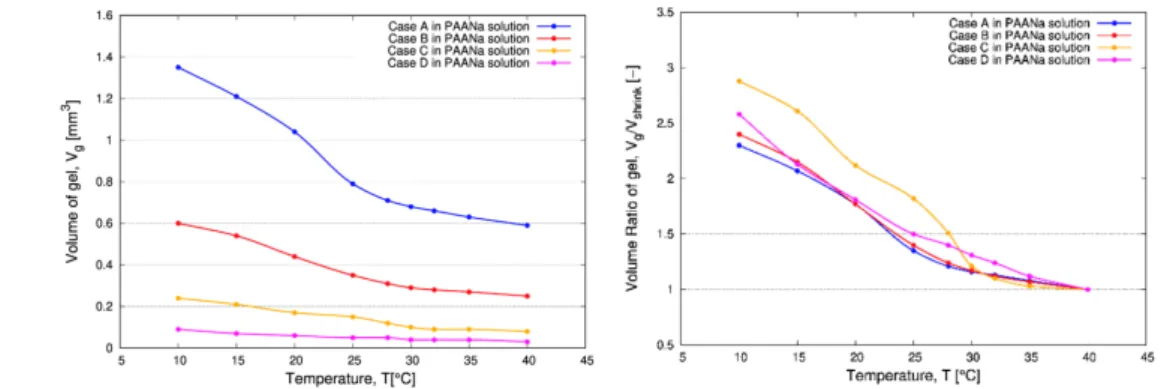
average diameters slightly decreased as the water temperature increased. Figure 5(a) clearly demonstrate that case A, which is represented by the blue line, had the biggest gel volume, followed by case B, C, and D. Figure 5(b) shows that the biggest change in gel volume occurred between 25 and 30 °C. As in Figure 5(a), the smallest gel (case D) showed no significant volume changes in the same range of temperature. In fact, by considering the volume ratio of gel Vg/Vshrink, the volume changes occurred could be clearly observed. Interestingly, as shown in Figure 5(b), all sizes of gel exhibited similar volume ratio patterns as the temperature of the aqueous solution increased. Figure 6(a) shows the correlation between gel volume and the temperature of the PAANa solution. For the PAANa solution, similar patterns of Vg–T showed by the all gel sizes were evident, as shown in the figure. As the temperature of the PAANa solution increased from 10 to 40 °C, the volume of the gels in all cases inversely decreased. Meanwhile, Figure 6(b) shows the relationship between the volume ratio and the temperature of the PAANa solution. The swelling volumes in the solution were lesser compared with those in water, while the volumes in a shrunken state at 40 °C were almost same as those in water, resulting in Vg/Vshrink values between 2.3 and 2.9. Note that the volume ratio of gels in the PAANa solution slowly decreased for the entire range as the temperature of the solution increased.
This is in contrast to water for which the volume ratio significantly decreased between 25 and 35 °C, and the ratios remained almost constant at temperatures above this range.
Figure 6. Correlation for the PAANa Solution (a) Volume of Gel and Temperature of Solution;
(b) Volume Ratio of Gel and Temperature of Solution
Figure 7(a) shows the correlation between gel volume and the temperature of the water solution.
Figure 7. Correlation for the Water Solution (a) Volume of Gel and Temperature of Solution;
(b) Volume Ratio of Gel and Temperature of Solution
This figure clearly demonstrate that case A, which is represented by the blue line, had the biggest gel volume, followed by case B, C, and D. Figure 7(b) shows that the biggest change in gel volume occurred between 25 and 30 °C. As in Figure 7(a), the smallest gel (case D) showed no significant volume changes in the same range of temperature. Thus, by considering the volume ratio of gel Vg/Vshrink, the temperatures at which significant volume changes occurred could be clearly observed.
Interestingly, as shown in Figure 7(b), all sizes of gel exhibited similar volume ratio patterns when the temperature of the aqueous solution increased.
5. Dynamical Behavior of Thermo-sensitive Gels in Aqueous Polymeric Solutions with Temperature Gradient
5.1 Methods to investigate Dynamical Behavior of Thermo-sensitive Gels
Figure 8 shows the experimental apparatus for the observation. The primary parts of the apparatus comprised heating and cooling plates and a rectangular transparent acrylic cavity. The inner dimensions of the cavity were 16 × 16 mm (horizontal area) with a height of 13 mm.
Figure 8. Schematic of the Apparatus for Mechanical Observations
Initially, the temperatures of the hot wall (above in Figure 8) and the cold wall (below in Figure 8) of the cavity were maintained at 40 and 10 °C, respectively, using water from thermostatic baths to create an upper heating system within the cavity. Eight gel particles were then inserted into the rectangular cavity, and images of their movements were captured every 20s. half (four out of eight) of the gels that exhibited active movements were then tracked in the post-processing stage.
5.2 Results
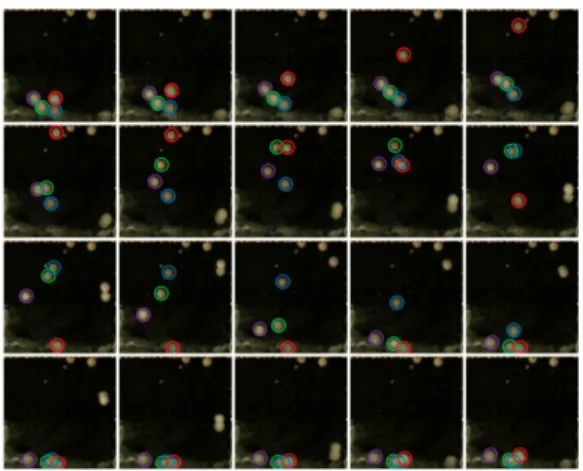
Figure 9 shows the periodic movements of the gels within the rectangular cavity. The trajectories of the particles in circles are shown in Figure 20 with the corresponding colors. Eight gels were used in the experiment, and four active gels were selected for path tracking. The four gels can be identified by different colors (green, blue, red, and violet), which correspond to the curves in the following charts. The figures run in sequence from the top left image, where all the gels were still at the bottom of the rectangular cavity, to the images on the right. Similar sequences were applied to the images in the second, third, and fourth rows. The gels were seen to be moving in vertical up-and-down cyclical patterns.
Figure 9. The Periodic Movement of Gels (Case A) in The PAANa Solution from 28-40.67 Minutes after The Start in Increments of 40 Seconds
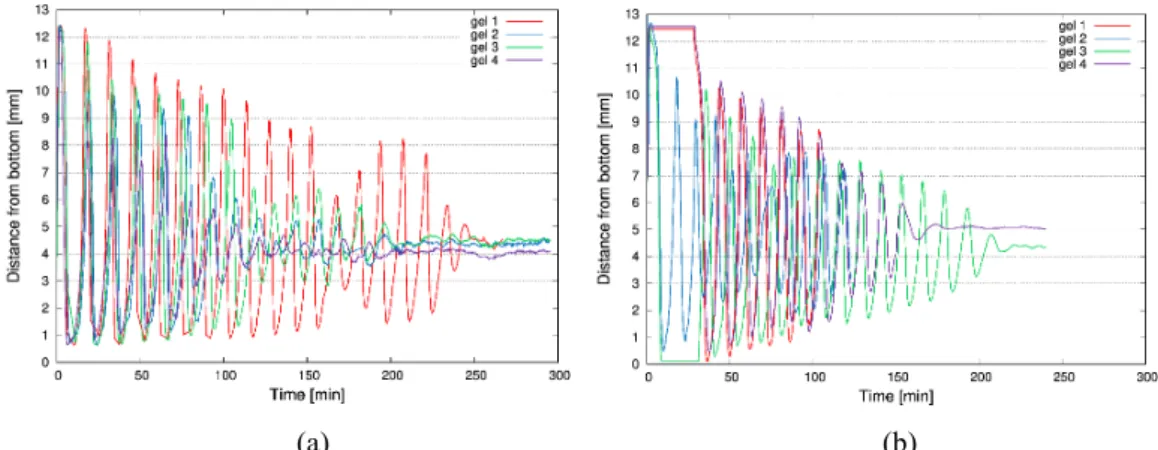
Figure 9(a) shows the repetitive up-and-down movements of the gels within the PAANa solution for case A. The figure shows that the gels moved vertically several times for a period of approximately
10 minutes before gradually damped in respect of time. When the gels were at the top of the heat transfer wall, the gels were at the shrinkage state and they moved downward as density of the gels were higher than that of the surrounding fluid. In this condition, the gravity force dominated the buoyance force. When the gels were at the bottom of the heat transfer wall, cooler temperature made the gels transformed to the swelling state, the gels’ diameter became bigger as their volume was expanded. Density of the gels at this stage was lower than that of the surrounding fluid, buoyance force domination made the gels started to moved upward. The gels’ movements were affected by the forces of buoyance, drag, and gravity, which acted on the gels in the solution.
Figure 9(b) shows the gel movements of case B. Although the amplitude of the vertical motion was small compared with case A, the gels exhibited similar movements for a period of 10 min followed by a gradual decrease in amplitude. At the start of the experiment for case B, some gels became stuck to the heat transfer surfaces (gels 1 and 4 were on top, and gel 3 was on the bottom).
Gels 1 and 2 became affixed to other gels (whose trajectories are not shown) at 100 and 120 min, respectively, and could no longer be tracked. At 140 min, gel 4 became stuck to six other gels to form a cluster of seven. Gel 3 was the only gel that individually moved until the end of the experiment.
(a) (b)
Figure 9. Vertical Repetitive Movements in PAANa Solution (a) For Case A Gels; (b) For Case B Gels
(a) (b)
Figure 10. Vertical Repetitive Movements in PAANa Solution (a) For Case C Gels; (b) For Case D Gels
Figure 10(a) shows the results of case C. At the start, gel 1 was positioned at approximately 5 mm from the bottom of the cavity in a state of shrinkage.It then started to move downward until it reached a position at 2 mm above the base of the cavity. At this level, the gel was affected by the lower temperature of the cooling source, and it started to swell; a quantity of the surrounding fluid entered the gel’s structure, and its diameter slowly increased. The gels’ density became lower than that of the surrounding PAANa solution, and it started to gradually move upward until it reached a position at 3.5 mm above the base of the cavity. In this position, the gel started to shrink again because of the higher temperature of the surrounding fluid. A specific amount of aqueous polymer solution was squeezed out of the gel’s structure, and its density became higher than that of the solution.
Consequently, the gel moved downward again until it reached a position 3mm above the base of the cavity. Over time, only very small fluctuations in position were observed, and the gel became stagnant at 2.8 mm above the base of the cavity. In this case, the up-down movement was only seen during approximately the first 20 minutes.
Similar patterns of small initial amplitudes and short continuations of up-down movements were observed for case D, as shown in Figure 10(b). There is a difference in the oscillation modes of the gels in case B and C, which could not be clarified in this study. However, the up-and-down movement continued until the gels and their surrounding fluids reached a state of equilibrium, at which point the gravitational force and buoyancy force exerted on the gels canceled each other out. This occurred more quickly for the smaller gel and is qualitatively reasonable because the smaller gels could achieve relatively quicker heat and mass transfer with their surrounding fluids.
6. Conclusions
When producing spherical gel particles, diameter of the gel droplets can be controlled by adjusting the continuous-phase flow rate and the kinematic viscosity. Both shrinking and swelling of the gels occurred after polymerization because of changes in the ambient temperature of the polymeric solution, which resulted in negative thermal expansion. The gel particles required a certain length of time to thoroughly respond to the temperature changes of the PAANa polymeric solution both swollen and shrunken states. In fact, more than 10 minutes were required for the gels to swell and shrink to their steady-state particle size. This phenomenon affected the floating behavior of the gel particles in the polymeric aqueous solution. When the temperature of the polymeric solution was 40°C, the density of the gel particles was greater than that of the surrounding polymeric solution; moreover, the gel particles tended to settle because the acting gravitational force was greater than the buoyance force.
However, when the temperature was adjusted to 10°C, the gel particle’s densities were lower than that of the aqueous solution; because buoyance force exceeded gravitational force, the particles tended to float. The gels with larger diameters tended to have longer vertical periodic movements and required more time to reach their equilibrium state compared to gels with smaller diameter.