
Synthesis and Characterization of Pd‑supported Fluoro‑dodecavanadates
著者 ミフタフル カイル
著者別表示 Khair Miftahul journal or
publication title
博士論文本文Full 学位授与番号 13301甲第4621号
学位名 博士(理学)
学位授与年月日 2017‑09‑26
URL http://hdl.handle.net/2297/00054250
doi: 10.1246/cl.170594
Creative Commons : 表示 ‑ 非営利 ‑ 改変禁止 http://creativecommons.org/licenses/by‑nc‑nd/3.0/deed.ja
D i ssertation
Synthesis and Characterization of Pd-supported Fluoro-dodecavanadates
Graduate School of
Natural Science and Technology Kanazawa University
Division of Material Chemistry
Student ID No. : 1424022006
Name : Miftahul Khair
Chief advisor : Prof. Yoshihito Hayashi
Date of Submission : June 30, 2017
TABLE OF CONTENTS
Table of Contents ... 2
Abbreviation ... 6
Abstract ... 8
Acknowledgement ... 9
Chapter 1 Introduction ... 10
1.1 Polyoxometalates ... 10
1.1.1 Structure ... 11
1.1.2 Representation... 13
1.1.3 Properties ... 15
1.1.4 Characterization of polyoxometalates ... 16
1.1.5 Application of Polyoxometalates ... 18
1.1.6 Synthesis ... 19
1.2 Polyoxovanadate ... 20
1.2.1 Introduction ... 20
1.2.2 Synthetic procedure ... 21
1.3 Mixed valence POMs ... 22
1.4 Noble Metals in Polyoxometalates ... 23
1.5 Palladium POM complexes... 24
1.6 POMOFs ... 25
1.7 Aims and Overview of the Research ... 27
Chapter 2 Experimental Method ... 29
2.1 Synthetic Procedure ... 29
2.2 Characterization techniques ... 29
2.3.1 Single Crystal X-ray Diffraction (SXRD) ... 30
2.3.2 IR Spectroscopy ... 31
2.3.3 Nuclear magnetic resonance (NMR) spectroscopy ... 32
2.3.4 UV-Vis Spectroscopy ... 33
2.3.5 Thermal Analysis TG:... 35
2.3.6 Cyclic voltammetry ... 36
2.3.7 Elemental analyses ... 37
2.4 Materials ... 37
2.4.2 Synthesis of starting materials ... 38
Chapter 3 Synthesis of Fluoride Incorporated Dodecavanadate ... 40
Abstract ... 40
3.1 Introduction ... 42
3.1.1 Fluoride incorporated POV ... 42
3.1.2 Related fluoro dodecavanadate compounds ... 43
3.2 Experimental ... 44
3.3 Characterization ... 45
3.3.1 Materials and Measurements. ... 45
3.3.2 X-ray crystallographic analysis. ... 45
3.4 Result and Discussion ... 49
3.4.1 Hydrazine monohydrate as reducing agent ... 49
3.4.2 Single Crystal X‒ray Diffraction (SXRD) Analysis ... 49
3.4.3 Bond Valence Sum (BVS) Calculation... 52
3.4.4 Cyclic Voltammetry (CV) analysis ... 52
3.4.5 UV-Vis Absorption Spectra ... 55
3.4.6 The IR spectrum ... 55
3.4.7 Thermogravimetric (TG) Analysis ... 56
3.5 Conclusions ... 57
Chapter 4 Synthesis of a reduced Palladium Supported fluoride Incorporated dodecavanadate [VO(DMSO)5]2[{Pd(DMSO)2}2V12O32(F)2].2CH3CN ... 58
Abstract ... 58
4.1 Introduction ... 60
4.2 Experimental ... 61
4.2.1 Hypothetic polymeric structure of {n-Bu4N}2Pd{V12O32(F)2}]n and serendipitous formation of compound (2). ... 61
4.2.2 Synthesis of [VO(DMSO)5]2[{Pd(DMSO)2}2V12O32(F)2] from hypothetic polymeric [(n-Bu4N)2Pd{V12O32(F)2}]n ... 62
4.2.3 Fair Yield Synthesis of [VO(DMSO)5]2[{Pd(DMSO)2}2V12O32(F)2] ... 63
4.2.4 Improved Synthesis Method ... 63
4.3 Characterization ... 64
4.4 Results and Discussion ... 68
4.4.1 Single Crystal X-ray Diffraction (SXRD) Analysis ... 68
4.4.2 The IR spectrum ... 70
4.4.3 Bond Valence Sum (BVS) Calculation... 71
4.4.4 Thermogravimetric (TG) Analysis ... 72
4.4.5 UV-Vis Absorption Spectra ... 72
4.4.5 Stability of complex 2 ... 73
4.4.6 Low solubility of complex 2 ... 73
4.5 Potential Application ... 73
4.5.1 POMOF ... 73
4.5.2 Catalysis ... 74
4.6 Conclusions ... 74
4.6.1 Future Work ... 75
Chapter 5 Synthesis of a Fully Oxidized Palladium Supported Fluoride Incorporated Dodecavanadate {n-Bu4N}4[{Pd(NO3)(DMSO)}2V12O32(F)2]·2DMSO ... 76
Abstract ... 76
Graphical Abstract ... 76
5.1 Introduction ... 77
5.2 Experimental ... 78
5.2.1 Alternative Synthetic Routes for Synthesis of Compound (3) ... 79
5.3 Characterization ... 80
5.3.1 Materials and Measurements. ... 80
5.3.2 X-ray crystallographic analysis. ... 80
5.4 Results and Discussion ... 87
5.4.1 Single Crystal X‒ray Diffraction (SXRD) Analysis ... 87
5.4.2 Bond Valence Sum (BVS) Calculation... 89
5.4.3 The IR spectrum ... 90
5.4.4 NMR Spectroscopy Analysis ... 90
5.4.5 UV-Vis Absorption Spectra ... 94
5.4.6 Cyclic voltammetry Analysis ... 95
5.4.7 Thermogravimetric (TG) Analysis ... 95
5.5 Conclusion ... 96
5.5.1 Potential Application ... 96
Concluding Remarks ... 97
Reference ... 98
ABBREVIATION
POM(s) Polyoxometalate(s)
POV(s) Polyoxovanadate(s)
DMSO Dimethyl sulfoxide
DMF Dimethylformamide
FT-IR Fourier Transform Infrared Spectroscopy
TGA Thermogravimetric analysis
NMR Nuclear magnetic resonance
UV-VIS Ultraviolet-visible
XRD X-ray diffractometry
SXRD Single Crystal X-ray diffractometry
PPhh4 Tetraphenylphosphonium
TEA Tetraethylammonium
n-Bu4N / TBA Tetra-n-butylammonium
PUBLICATION
The following article were published as a result of work undertaken over the course of this PhD programme :
Khair, Miftahul, Yuji Kikukawa, and Yoshihito Hayashi. "Synthesis and Characterization of a Palladium-Supported Fluoride-Incorporated Dodecavanadate." Chemistry Letters 46 (2017).
ABSTRACT
In Metal Organic Framework (MOF) chemistry, bidentate ligands are key factor to construct highly porous materials. To get best properties of MOF, we develop inorganic linker building unit for to substitute the organic ligand linker unit. The need of the new inorganic linker units is solved by making use of polyoxometalate functionalized with a metal.
To overcome the weak coordination ability of POM, halide anion is incorporated on a spherical polyoxovanadate (POV) because halide incorporation can reduce the surface charge and increases electronegativity. This in turn increases the coordination capability of POV.
In order to develop the intended inorganic linker, Pd is attached to the Fluoride incorporated dodecavanadate. The linker would not only be beneficial for framework (POMOF) material construction unit, but also would be beneficial for the purpose of oxidation catalysis.
Herein we report the synthesis of these types of POVs: [n- Bu4N]4[V12O30F2].CH3CN (1),
[VO(DMSO)5]2[{Pd(DMSO)2}2V12O32(F)2].2CH3CN (2), and {n- Bu4N}4[{Pd(NO3)(DMSO)}2V12O32(F)2]·2DMSO (3). Complex [1] is prepared by reduction with hydrazine of (n-
Bu4N)4[HV11O29F2]. Addition of Pd2+ to DMSO solution of [1]
gave complex [2]. Addition of nitrate salt of Pd2+ to DMSO solution of [V10O26]4- and F− ion gave complex (3).
The successfully synthesized three complexes have spherical shapes anions containing two anions F−. Anion (1) is mixed valence [VV10VIV2O30F2]4- which shows electrochemical behavior potential for electron sponge application. The reaction of precursor complex (1) with Pd2+ and DMSO afforded complex (2) which is a first mixed valence Pd supported fluorododecavanadate linker.Spherical compound (2) anion consists of ten VO5 units and two VO4 units. Two palladiums with two DMSO ligands at both sides attached on the main cage. Cation [VO(DMSO)5]+ comes from the partial decomposition of complex (1) during the reaction. By the oxidation of decavanadate {n-Bu4N}4[V10O26] in the presence of F− and Pd(NO3)2 in DMSO, a palladium-supported fluoride-incorporated dodecavanadate (3) was synthesized. Even if sharing similar main cage shapes with (2),
complex (3) is a fully oxidized form with nitrate and DMSO ligands attached to Pd.
These complexes have potential linker capabilities that can bind the connection of building units to cultivate new field of molecular inorganic frameworks.
9
ACKNOWLEDGEMENT
First of all, I would like to express my deep appreciation to Professor Yoshihito Hayashi, Dr. Yuji Kikukawa, and Dr. Keisuke Kawamoto for their supervision, patience and support. It was a pleasure and an honor to join the group and to have an opportunity to deal with great people and interesting research themes over the past three years.
I would like to express my appreciation to many people at the Inorganic Chemistry Laboratory Kanazawa University. I am very grateful to Mr. Saito Masahiro for preliminary work on underlying the synthesis procedures of some complexes I explored during his master Thesis 2004. Special thanks Mr. Sho Kuwajima and Mr.
Sugiarto for their kind help and for technical cooperation in particular. I would like to thank Prof Shigehisa Akine, Prof Hideki Furutachi, Prof. Tomonori Ida, and Prof Masahiro Mizuno as the examiners of this dissertation.
I am also very grateful to State University Padang, Indonesia for the opportunity to continue this wonderful research, and the Directorate General of Higher Education (DIKTI) Indonesia – Kanazawa University for the financial support through a joint scholarship program.
I must also admit my friends and family, especially. My parents, Chairul Amri and Asnawiyar, my wife Hafni Ziad, my kids Thariq, Syamil, Faishal, and Salman, who smile and cry that makes my world more beautiful.
10
CHAPTER 1 INTRODUCTION 1.1 Polyoxometalates
Polyoxometalate (POM) is an outstanding class of oxo-cluster materials. The first report of POM dates back to Berzelius (1826) when he noticed a yellow solid from a reaction between molybdate and phosphoric acid. The formed solid was (NH4)3(PMo12O40) compound. After that, POM had been a large and quickly growing class of compound. Researchers from synthetic/structural chemistry, physics, biology and theoretical chemistry from all over the world have been devoting themselves on the study of POM.
With the availability of new analytical methods, most POM molecular science (chemistry, biology, physics, and materials science) has been developed recently. Single Crystal X-ray Diffraction and Mass Spectroscopy are examples of methods not available before that allow the POM study to be easier nowadays.
The interdisciplinary research of synthetic/structural chemistry, theoretical chemistry, physic, and biology focuses on study of the manifold structures and properties of POMs. The outstanding compositional and structural diversity of POMs enables fine- tuning of their electronic properties, redox properties, and chemical stability together with robustness in the objective of designing future applied devices1. Today, POM chemistry is still an important emerging area where over 500 papers (not including patents) were published each year and this number is rapidly increasing2. POM is currently very attractive even in the most challenging leading research areas, e.g., water splitting, magnetism, catalysis, electronic materials and bio-medical applications.
11 1.1.1 Structure
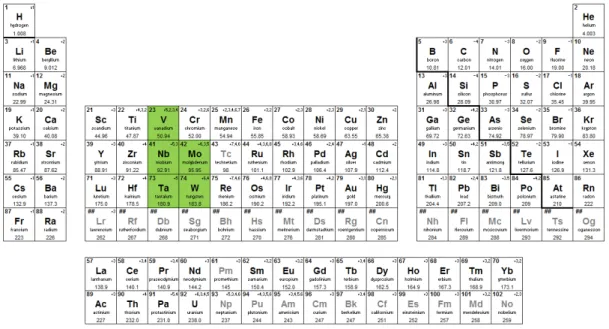
Polyoxometalates (POM) are inorganic metal oxide anions containing individual {MOx}n where M is limited to groups of 5 and 6 metals (M = vanadium, niobium, tantalum, molybdenum and tungsten, x = 4-7) (figure 1) in their highest oxidation state.
The units can be combined to form a series of groups from low to high nuclearity, ranging from 2 to 368 (for example HxMo368O1032(H2O)240(SO4)4848- anion) metal atoms in a single molecule3. The versatile nature of polyoxometalate derives from their ability to polymerize these MOx units to form highly symmetric groups. POM clusters are generally anionic and hardly coordinate with additional cations as linkers. Removal of some of the cage atoms to form vacancies that can be filled results in lacunary structure of POM .
Figure 1 Periodic Table of the Element. The elements that form p1olyoxometalates are in green.
POMs embrace certain structural motifs. The POM family is divided into iso- polyoxometalates (isopolyanion) and hetero-polyoxometalate (heteropolyanion) based on the types of transition metal atoms involved in their composition.
12
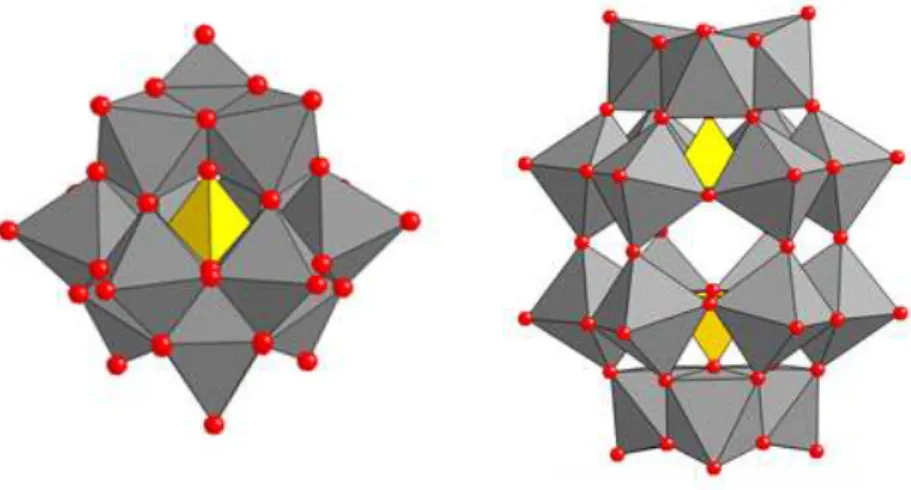
Isopolyanions only involve one type of transition metal atoms in their metal oxide framework. They have interesting properties, e.g. high charges and strongly basic oxygen surfaces, which is a good unit as a building block4. The example is illustrated by dodecavanadate [V10O28H3]3- (figure 2).
Figure 2 Decavanadate [V10O28H3]3-
The hetero-polyoxometalate type (heteropolyanions) involve more than one type of metal atoms. In the other word, heteropolyanions are metal oxide clusters that contain heteroanions. Heteropolyanions are the most studied POMs especially for catalysis, with much focus on the well-known Keggin [XM12O40]n- anions and Wells–Dawson [X2M18O62]n anions (where M= Mo or W, X is the heteroatom usually P5+, Si4+, or B3+).
Figure 3 Polyhedral Representation of Keggin Structure (LHS) and Dawson Structure (RHS)
13
The most stable POMs Keggin structure general formula is [XM12O40]n− (where X
= heteroatom, most common are P5+, Si4+, or B3+), M is the addenda atom (generally Mo and W), and O represents oxygen. The structure shows self-assembly in acidic aqueous solution. Since their properties are finely tunable by controlling the constituent elements, structures, and counter cations, POMs can be used as the unique functionalized materials, such as optical materials, single molecule magnets, electronic interfaces, adsorbents, medicine, and catalysts.
Tungsten and molybdenum dominate many polyoxometalate chemistry primarily because of its stability and rich redox chemistry. These properties enable them to be part of a class of inorganic compounds that exhibit semi-conduction, magnetic, thermal and photochemical properties. Vanadium is also interesting because it forms various structures and with various structural units and oxidation states.
1.1.2 Representation
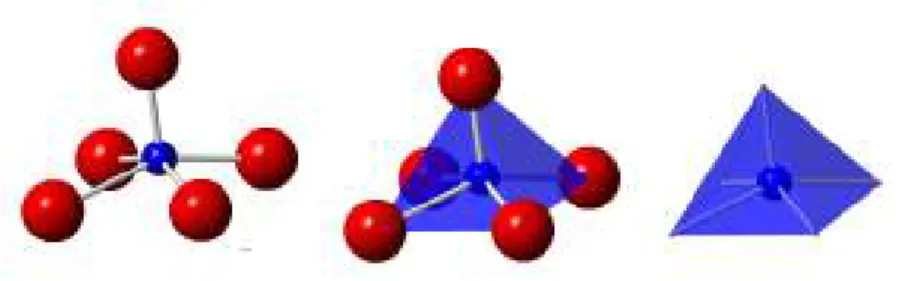
Like most of inorganic compounds, POMs’ building blocks tend to be formed from groups of atoms. The structure of POMs seems to be governed by the principle of electrostatic and radius ratios observed for extended ionic lattices. Therefore, it is easier to describe the structure and bonding of POMs by replacing this metal-oxide building block with a polyhedron where the metal ion resides at the center with oxygen ligands at the vertices (figure 4).
14
Figure 4 Ball stick (left) and polyhedral representation (middle and right) of MO5 square pyramid unit where M = V, Mo or W. M: blue, O: red.
At each case, the metal ion does not lie in the center of the polyhedra of oxide, instead it is strongly displaced outward of the POM structure, i.e. toward the vertex of the polyhedron (figure 5).
Figure 5 Ball stick and polyhedral representation of the VO6 octahedron, where V: orange, O: red. V atom is no longer sit in the center of the polyhedron.
These polyhedra are connected together through the edge sharing, corner sharing, and (rarely) faces sharing or a combination of them to build up the structure5 (figure 6).
15
Figure 6 Units for construction of POVs (LHS box), edge sharing and corner sharing types of assembled POVs from the units (RHS).
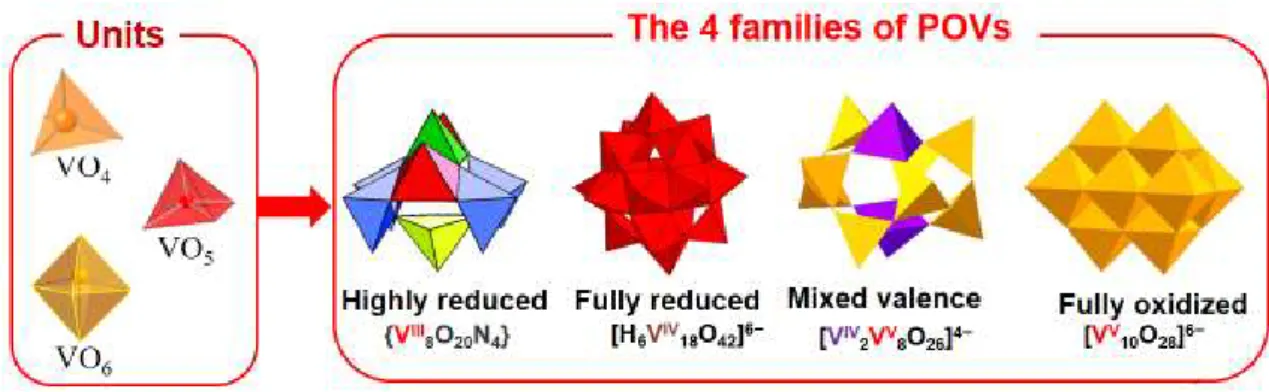
If molybdenum and tungsten with d0 anionic clusters use octahedral shaped building blocks in their construction, then vanadium in the other hand can use tetrahedral {VO4}, square-pyramidal {VO5}, and octahedral {VO6} building units. The availability of these various building units (coordination environment) make polyoxovanadates have a unique structural chemistry6 (figure 6).
1.1.3 Properties
POMs molecule in term of charge can be regarded as a conjugating system. It is because for most POMs the charge is always uniform across molecules and all units. So which atom holding up electrons cannot be indicated. POM have moieties for receiving electrons in the charge transfer system which is good for energy storage application. The donor/acceptor interactions in such charge-transfer materials are controlled by the shape and size the POMs as well as by their redox potentials, which are readily tuned by changing the metal centers and with smart synthetic methods. Cations accompanying POMs for charge balancing consideration, make salt which can be both water soluble and organic soluble, allowing POMs applications in both media.
16
POMs are robust and have large number of metallic centers, so that POMs can undergo reversible and multi- electron photoredox processes and keeping their structure intact. These properties make POMs as electron mediators in solar cell and photocatalytic process. The reversible multielectron-transfer reactions of POMs are the basis for catalytic application of POMs. Polyoxometalate-based catalysts are interesting because their acidic and redox properties can be controlled at molecular levels. In addition, POM has unique electrochemical, magnetic, photonic and chemical reactivity. While the catalysis and materials science are two main fields of applications of POMs, their biochemical and biological properties are the subject of increasing interest.7,8
1.1.4 Characterization of Polyoxometalates
There are various methods for characterization of POM both in solid state and in solution. Spectroscopy is the most common and easy to use technique. To identify the M-O bond presence one can use vibration spectroscopy. FTIR spectroscopy is a powerful and fast method to characterize POM products from established syntheses.
The characteristic absorption of infrared spectra of POM are in the region of 1100- 400 cm-1 associated with oxygen-stretching vibrational frequency. There are distinct areas where the oxygen terminal and oxygen bridging peaks can be found in that region. The infrared spectrum also gives information about the symmetry of polyoxoanion. It can be used to distinguish POMs and provide information on structures. Infrared and ultraviolet- visible spectroscopy, and also thermogravimetric and differential thermal analyses has been used for POM characterization methods since 1960s 9,10,11.
To determine the environment of specific atom in POM, one can use Nuclear Magnetic Resonance (NMR) spectroscopy. 31P NMR is used to identify POMs such as phosphotungstates and phosphomolybdates. 29Si NMR is to identify the POM structure
17
that includes non Si as P heteroatoms. Polyoxovanadate and polyoxotungstate can be characterized by 51V NMR and 183W NMR respectively.
Associated with NMR is electron paramagnetic resonance spectroscopy (EPR).
EPR can detect and identify free radical, paramagnetic centers, and geometry of atomic coordination.12 The energy dispersive x-ray spectroscopy (EDS) paired with a microscope can help to determine element composition. Transmission electron microscope (TEM) can be used to observe individual polyoxometalate clusters. Scanning Electrons Microscopy (SEM) can be used to observe crystals or bulk powder.
Mass spectrometry is a useful technique for identifying species present in solution by separating them based on mass to charge ratio. The relative percentage of each species can also be determined. Mass spectrometry can be augmented by various techniques such as chromatography, thermogravimetric analysis, ionization electrospray, etc.
The method of Electrospray Ionization Mass Spectrometry (ESI-MS) is suitable for the analysis of ionic species in aqueous and polar solvent, and as such complements the other methods for the characterization of POMs structurally and chemically13. ESI-MS has enabled the real time monitoring of the formation of a complex of organic–inorganic POM hybrid system14. X-ray photoelectron spectroscopy (XPS) can be used to identify substitution of elements into clusters and also study the surface of films stored from POMs.
Beside some of the traditional tools, non-traditional analytical tools are also used currently to characterize the aqueous inorganic clusters and POMs ions. Some examples of the techniques are nuclear magnetic resonance spectroscopy (NMR), Raman spectroscopy, dynamic and phase analysis light scattering (DLS and PALS), small angle
18
X-ray scattering (SAXS), and quantum mechanical computations (QMC). The cluster species in the solid state or in the solution can be determined with this techniques.12
Computational chemistry provides valuable information to complement characterization of polyoxometalate. Simulation data can be produced for some data different methods such as vibration spectroscopy, NMR, scattering data, etc. Computation can also determine the energetics of the group under various conditions, and can helps us to understand the speciation and formation of this attractive metal oxide cluster.
1.1.5 Application of Polyoxometalates
By extensive structural range of POMs, attractive POM applications continue to grow. The extensive application of POMs are due to (i) the ability of POM to act as a conjugated electron sponge and (ii) great variability of its molecular properties, including size, shape, redox potential, charge density, solubility, acidity, etc. Some noted area of POMs application are on the catalysis, medicine, bioanalysis and materials science15.
The group VI and vanadium POMs possess extensive redox properties relevant to catalysis and electron transfer processes. Therefore, the silico- and phospho- tungstates and molybdates are the most referenced examples for applications.
Inorganic-organic hybrid POMs can be used to synthesize new multi-functional POM materials. Hybrid POMs can be applied in enantioselective catalysis and separation by incorporating chiral organic molecules into the structure. Photo induced electron transfer in POM-porphyrin hybrids provides photosensitive systems for catalysis, photovoltaics, and for environmental applications such as depollution and recovery of valuable or toxic metals.
19 1.1.6 Synthesis
Most POM synthesis depends on the use of a conventional solution-based synthetic method such as solvent evaporation, precipitation method and crystallization technique where ambient pressure and temperature conditions have been used. The solution-based approach so far has resulted in the synthesis of a large number of POM compounds. There are also some precaution regarding the use of this method. One must take care of the low solubility of metal oxide starting materials, inclusion and co-crystallization water and solvent molecules, poor controllability of reaction parameters etc.
The experimental variables which should be controlled in the synthesis of a POM are: (1) pH, (2) type and concentration metal oxide anion, (3) ionic strength, (4) type of heteroatom and its concentration, (5) additional ligands presence, (6) temperature and pressure (7) reducing environment, (8) counter-ion and metal-ion effect and (9) processing methodology (one-pot, continuous flow conditions.16 Some of these problems are seen for obtaining high yield synthesis. Changes of acid type, solvent (aqueous or non-aqueous systems), use of a ligand, heteroatom or reducing agent, all play a role in the assembly of new clusters of POMs.5
POMs have been synthesized and isolated from both aqueous and non-aqueous solutions. In aqueous solution, the common method involves the acidification of aqueous solutions of simple oxoanions and the necessary heteroatoms as follows,
12 WO42− + HPO42− + 23 H+ → [PW12O40]3− + 12 H2O 4 VO43− + 8 H+ → V4O124− + 4 H2O
7 MoO24- + 8 H+ → [Mo7O24]6− + 4 H2O
20
In some cases, the product is crystallized at room temperature since the equilibrium constants and the rate of formation are large. Furthermore, careful temperature and pH control is required for the desired reaction to occur.
1.2 Polyoxovanadate 1.2.1 Introduction
Vanadium is group 5 transition metal which is known for production of alloys.
Vanadium also has function in biological system and plays role in bioinorganic chemistry.17 Vanadium has many oxidation states with the common oxidation state between +2 and +5 associated with certain characteristic colors. Vanadium exhibits various coordination geometries that provide more structural flexibility and have general tendency to form cluster with shell and cages like topologies. Specific reaction parameters such as temperature, pressure, reaction time, stoichiometry, solvent, concentration, and pH determine the oxovanadium ions’ nuclearity, structural motifs and net charge.
Vanadium oxide compounds have application in the field of catalysis, biochemistry, sensor,geochemistry, sorptionand intercalated layered material surface and nanoscience and perform their role in smart material for energy18. A compound containing an oxoanion of vanadium is known as a vanadate, generally with the highest +5 oxidation state of Vanadium. The simplest vanadate ion is the tetrahedral, orthovanadate, VO43− anion, and in solutions of V2O5 in strong base (pH > 13). Conventionally this ion is represented with a single double bond, however this is a resonance form as the ion is a regular tetrahedron with four equivalent oxygen atoms.
Polyoxovanadate (POV) represents an important subclass of POMs. POV’s fast growing research are motivated by the their versatile redox properties and prospective in various branch of chemical, physical and biological sciences.18
21
POVs show structural versatility due to the variety of the coordination number of vanadium. POVs have different basic types of polyhedra, ({VO4}, {VO5}, and {VO6}) building blocks (units), to form cluster shells or cages. Further, they can be divided into four families: “highly-reduced” (VIII), “fully-reduced” (VIV), mixed-valent (VV/VIV or VIV/VIII), and fully-oxidised (VV), species (figure 7).18 The cage-, basket-, and sphere-like shape of POVs enables them to entrap small guest molecules in their central cavities, to behave like a “molecular container” like e.g. fullerenes.
Figure 7 The four families of POVs (RHS) constituted by different building units (LHS) POV clusters that contain mixed valence species (VIV/V) arise from the full or partial delocalization of the single 3d electrons of the vanadium ions over either valence types or the complete localization over the paramagnetic ions. 19,20 This type of POV are highly attractive for magnetic studies.
1.2.2 Synthetic procedure
Polyoxovanadates are almost always synthesized under aqueous or hydrothermal conditions which may limit the isolation of different cluster types. A variety of POV synthetic methods have been used to construct complex molecules by considering synthetic parameters (concentration, pH, molar ratio, temperature, solvent choice and counter cation). Exploration of new synthetic routes may need long time and patience.
POV Materials doesn’t include those which do not form crystals with distinct chemical
22
compositions and the atoms must be organized in an orderly array of repeating units. The choice of counter cation and condensation method is very important for the synthesis of POVs. 21
Adjusting the pH to a specific level can give rise to POMs with different nuclearities.
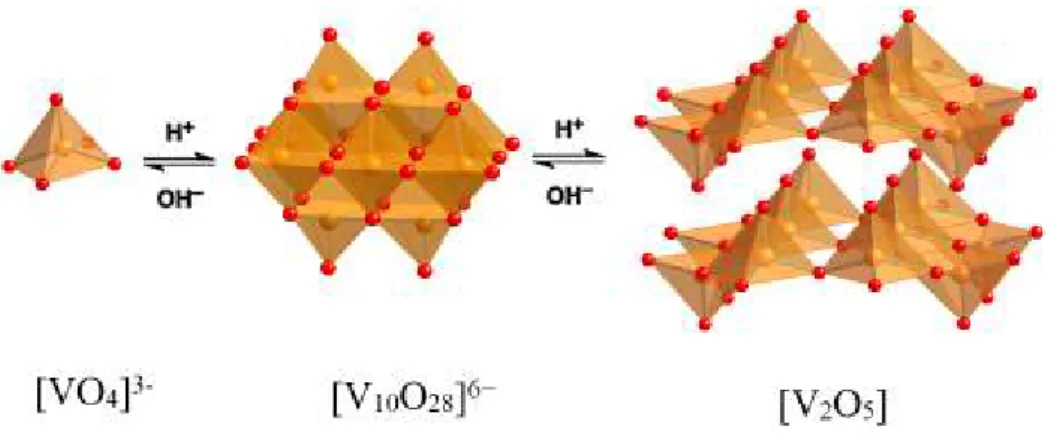
For example, in the synthesis of POVs in very alkaline conditions, the formation of polyoxo species is not easy, because only orthovanadate [VO4]3− is formed. On the acidification of solution, the protonation reaction begin against the oxido group with the formation of the intermediate [HVO4]2−, [H2VO4]−, and H3VO4. As the solution becomes more acidic, condensation reactions of orthovanadates occurs to form of various POVs species.21
At pH 8 to 13, monovanadates [HVO4]2−, divanadates [V2O7]4−, and metavanadates, [VO3]nn− (n = 3 or 4) are stable.21 Simple illustration of the effect of pH on the transformation of POVs can be seen in figure 8.
Figure 8 The effect of pH on the anions and oxides in vanadium (V) chemistry 1.3 Mixed valence POMs
The names ‘mixed valency’ or ‘intermediate valence’or ‘mixed oxidation state’ or
‘non-integral oxidation state’ are used to describe inorganic or metal-organic compounds in which an element is present in more than one oxidation state. The transfer of an electron from one metal ion to another cause the colouration. The distribution of oxidation states
23
within the molecule can exchange under the influence of light resulting in the light absorption and hence the colour. This happens very frequently in inorganic chemistry when the same element is present in different valence states in the same molecule. 22
There is a type of reduced POM, the so-called heteropoly blue, which are is stable in alkaline solutions. They are able to receive or release electrons without any change or decomposition of their structures. Moreover, since redox systems based on POMs are electrochemically fast; thus the reduced POMs can participate in numerous electrocatalytic cycles. Based on the above considerations, it is possible to use reduced POMs as a catalyst or an assistant catalyst substrate in oxidation–reduction reactions. 23 Reduced polyoxovanadates is a relatively recent development in polyoxometalates chemistry. While readily available VV isopolyvanadates are mainly limited to have decavanadate structures, mixed valent species exhibit unique structures, such as cage-like spherical clusters. The spherical vanadate clusters have been observed with encapsulating negatively charged ions.24
1.4 Noble Metals in Polyoxometalates
Noble metals are interesting to discuss in POM field especially for the catalysis purpose. The noble metals related are ruthenium, rhodium, palladium, silver, osmium, iridium, platinum and gold. The combination of noble metal with POMs can be in the form of introduction a noble metal atom in a POM structure or the complete formation of different structures.
Polyoxoanions substituted by noble metal cations are interesting due to the rich and extensive multi-electron redox chemistry displayed by noble metal elements.25 In the field of catalysis, noble-metal-substituted polyoxometalate catalysts showed high activity and selectivity in alkane and alkene epoxidations.26
24 1.5 Palladium POM complexes
Palladium is a noble metal that is difficult to oxidize because of a combination of high sublimation energy and high ionization potential. The coordination chemistry of palladium is mostly related with their oxidation states. The most common oxidation state of Pd is 0 and +2. Oxidation states of +1 and +4 are also found and the rarest one is +3.
The Pd(0) complexes cover compounds with many possible ligands (L) e.g. in [PdL2], [PdL3], and [PdL4] stoichiometries. All Pd(I) compounds have feature Pd-Pd or Pd-M bonds. Some tridentate macrocyclic ligands containing S and N as donors can stabilize mononuclear complexes of Pd(III). Pd(IV) is common oxidation state. Complexes with many different ligands, which have octahedral coordination are also identified.27
Pd(II) compounds are frequently four-coordinated square planar. Square-planar Pd(II) fragments are building blocks in the construction of extended structures. There is no report of three-coordinated Pd(II) compounds. Coordination to cis-PdL2 fragments can be used to express corners, while trans-PdL2 moieties can help build linear edges27. Some interesting features of palladium (II) chemistry are (1) formation of square-planar complexes and (2) bonding properties intermediate between the first transition series and the heavy metals28.
Palladium (II) is a class b or a soft metallic center. Therefore, it forms various stable complexes with soft ligands. A vast palladium (II) coordination chemistry is found for S-, N-, P-, and As-donor ligands. Complexes containing O–donor ligands are less abundant and monodentate ligands of this type readily undergo substitution reactions by other ligands29.
The strong motivation on research on Palladium-POM is because Pd has attractive catalytic properties beside its relatively high abundance in the Earth’s crust. Some
25
palladium- substituted polyoxometalates have been synthesized. Most palladium (II) ions in these structures are generally coordinated in a square planar geometry to oxygen atoms of lacunary Keggin, or Dawson POMs. Among few examples are reports on sandwich- type polyoxotungstates substituted by Pd.
1.6 POMOFs
Metal organic frameworks (MOFs) are complexes containing of metal ions or clusters coordinating to organic ligands (linker) to form framework structures (figure 9).
MOFs are a subclass of coordination polymers that is particularly porous. However, the organic linkers can decompose by oxidation or high temperature. Obtaining inorganic linker can overcome the problem, and POMs is potential linker for MOF chemistry.
Figure 9 Schematic view of MOF formation
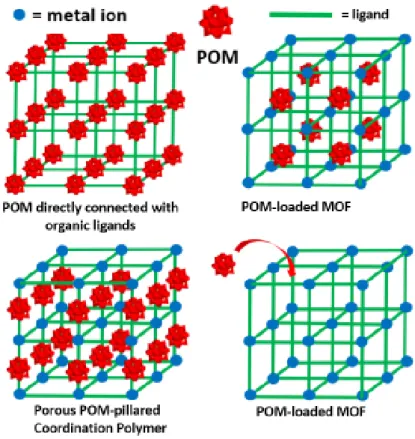
Recently, new class of POM-based Metal Organic Frameworks, so-called POMOFs has developed. The schematic connection among metal ion, ligand and POMs in POMOF is presented in figure 10. 30
26
Figure 10 Schematic POM based MOF materials 30
The POM clusters can be bridged into chain and networks by inclusion of secondary transition metals, rare-earth metals, and main group metals31 32. POMs can be regarded as inorganic multi-dentate ligands that can bind to secondary transition metals. Small metal-oxide clusters have well-defined binding sites, known oxidation states and definite solubility preferences. So in POMOF chemistry, the way one can assemble the connection of POMs to one another are by using bridging organic linkers 33 or by ligand-supported transition-metal bridges.34
The design of coordination polymers based on polyoxometalates (POMOFs), how to introduce a linker unit on the polyoxometalate frameworks, is essential. Even if the coordination ability of polyoxometalates are commonly small due to the relatively small surface electron density, the introduction of the metal binding sites with available coordination sites are suitable for inorganic functional nanoscale structures.35
27 1.7Aims and Overview of the Research
Most of POMs materials are molecular under standard conditions of pressure and temperature. There are only a few examples of 1-D POMs reported at standard condition.
The problem of the formation of POM based frameworks structure is related with the POMs’ weak ligand properties that have weak coordination ability of the POMs. Even if POMs have high negative charges, they actually have only weak coordination ability.
This problem is due to the delocalization of surface charge along the POMs clusters.
This means that the construction of POMOFs basically is not easy. This can be seen from very few publications reported for this topics. For example, SciFinder produced by Chemical Abstracts Service (CAS) that has the most comprehensive database for the chemical literature, journal articles and patent records, chemical substances and reactions only listed 38 references containing "POMOF" entry or 36 references containing "POM and MOF" entry until the writing of this thesis.
So, the aim of this project is to overcome the weak ligand POMs in the objective of constructing POM based frameworks (POMOFs) materials. This aim is approached by functionalization of POMs with introduction of transition metal on the surface of POMs.
The transition metals should be a well-known linker metal in MOF chemistry and should have definite coordination geometry. Pd2+ fulfill this criterion as it is the known superior linker metal in MOF chemistry and supramolecular chemistry. The synthesized materials would be the first Pd-POM linker which can become a building block of POM based MOFs materials via coordinative-Pd bridge.
Overview of the research
For the ease of discussion of this dissertation, we describe the overview of the synthetic scheme of this research with the three important complexes synthesized (figure
28
11). In the next chapters 3, 4 and 5, we will discuss the three complexes, compound (1), compound (2), and compound (3) subsequently in detail.
Figure 11 Research overview where a reduced inorganic linker (comp 2) is synthesised from the precursor (comp 1) and fully oxidized inorganic linker (comp 3) is prepared with
addition of oxidant
The synthesis of the three complexes is to create new inorganic ligands for supramolecular or Metal Organic Frameworks. Since POM itself is generally weak coordinator, we started from special kind of POV where Fluoride is incorporated at the center of the POV so that it can enhance the coordination ability of POV (compound 1).
Then Pd is put at both end of compound (1) to provide actual linker site (compound 2).
Compound (2) is still in reduced state so that it is air sensitive against oxidation. Therefore, we need a really stable complex which is the oxidized one. This the final product is air stable with two linkers (compound 3).
29
CHAPTER 2 EXPERIMENTAL METHOD 2.1 Synthetic Procedure
The synthesis of inorganic solids can be performed by a variety of methods. Some noted methods are the ceramic method, combustion method, precursor method, topochemical routes, intercalation compounds, ion-exchange method, sol-gel process, alkali-flux method, electrochemical methods, high pressure methods, etc.36 Chemical methods of material synthesis play an important role in designing new materials and in providing better practical methods for preparing the already known materials.
The synthesis is expected to give solids products. When the solids are formed, the next step is the characterization of the material to determine the structure, and to reveal the chemical and physical properties of these materials. For this purpose, the solid should be single crystalline form. Special attention must be taken to make sure the formation of single crystal growth which is vital for structural characterization. The most widely used characterization method of structures for crystalline solids is Single Crystal X-ray Diffraction (SXRD). After revealing the arrangement of atoms and overall structure of the solids, predictions about the characterization of potential properties can be made based on structural analysis.
2.2 Characterization techniques
The need for the synthesis of new materials is driven mainly by the potential properties that can be exploited. Knowing the arrangement atoms and or molecules in three-dimensional space (3D) is one of the most important steps in allowing ones to understand the chemical principles and processes responsible for material properties (e.g.
conductivity, energy storage, etc.). Understanding of material structures in terms of bonding and oxidation states, for example, allows researchers to discover material properties.
30
In this dissertation, we routinely focus on the characterization of newly discovered crystalline solid using Single Crystal XRD. In addition to the structural characterization, the compounds are also characterized by other appropriate characterization techniques.
These characterization methods include UV-vis spectroscopy, IR spectroscopy, CHN, S and F elemental analysis, and thermal analysis (TGA).
2.3.1 Single Crystal X-ray Diffraction (SXRD)
The atoms and molecules can be arranged in a non-periodic array to form amorphous or periodic array to form crystalline materials. Crystalline solids are most generally characterized using both single crystal and powder X-ray diffraction techniques.
SXRD method can determine the atomic positions, crystal structures, and the overall composition of a crystalline solid. Since the atomic arrangement determines the material properties, it is essential to know the structure before further doing the property characterization.
Before performing SXRD measurement, one must have a bit large (0.1 - 0.3 mm in each dimension) single crystal (not only the crystalline) material in question. The crystal lattice in a single crystal is continuous and unbroken to the edges of the crystal without any grain boundaries. It is different from polycrystalline (crystallite) that has random orientation or an amorphous structure that has atomic positions limited to short range order only. The crystal should also not be twinning which can be problematic in X-ray crystallography, because a twinned crystal produce complicated a simple diffraction pattern. The twinning itself is caused by the symmetrical intergrowths of crystals.
Once the single crystals were obtained from reaction solution, the crystals were quickly placed in mineral oil. This is to prevent the decomposition in air if the crystal is
31
moisture sensitive. The glue also functions as a protective film to prevent the possibility of single crystal decomposition in air. The crystal was then mounted on diffractometer.
X-ray crystallographic analysis measurement.
Single crystal structure analysis was performed at 90 K by using a Bruker D8 VENTURE diffractometer with graphite monochromated Cu Kα radiation (λ = 1.54178 Å). The data reduction and absorption correction were done using APEX3 program.37 The structural analyses were performed using APEX3, and WinGX38 for Windows software.
The structures were solved by SHELXS-201439 (direct methods) and refined by SHELXL-2014.39 Non-hydrogen atoms were refined anisotropically. Hydrogen atoms are positioned geometrically and refined using a riding model.
2.3.2 IR Spectroscopy
Spectroscopy is a very important tools used to investigate the structure of materials through the interaction of electromagnetic radiation with matter. Infrared spectroscopy (IR) was used for the study the vibration between atoms when infrared radiation is absorbed. By measuring the vibrational characteristics occurring in the material, information about the composition of the materials can be obtained. The infrared region of the electromagnetic spectrum is found from 400 cm-1 to 4000 cm-1.
From the study of the vibration frequencies of some synthesized POMs for years, it was found that the IR spectra of POMs result from stretching vibration frequency of the metal-oxygen. The characteristic absorption peak is 1100-400 cm-1. The infrared spectrum also has information about the symmetry of polyoxoanion. The infrared spectrum, as an analytical means, can be used to differentiate heteropolyanion. In addition, different functional groups in POMs also absorb characteristic frequencies of IR radiation.
32
IR spectrum can be obtained from samples in the forms of liquid, solid, and gas.
Pellets are used for the solid samples. The solid sample (0.5 to 1.0 mg) is finely ground and intimately mixed with approximately 100 mg of dry potassium bromide (KBr). The mixture is then pressed to be transparent disk at sufficiently high pressure. The introduction of the KBr pellet method has made possible the determination of infrared spectra of most insoluble materials.
IR spectra measurement:
FTIR were measured on Jasco FT/IR-4100 using KBr disks. The sample was mixed in with dry KBr salt. KBr was kept in a desiccator. The crystals along with KBr were ground in a mortar until the mixture is homogenous. Then, the ground mixtures were pressed into disk-like pellets using pellet press. The transparent pellets were attached to the sample holder for performing measurements. The samples, including the KBr blank, were measured in the wavenumber of 400 cm-1to 4000 cm-1.
2.3.3 Nuclear magnetic resonance (NMR) spectroscopy
NMR spectroscopy is used to determine the environments of specific atoms in a POMs either in solution or solid state. For identifying POMs such as the phosphotungstates and phosphomolybdates, 31P NMR is utilized. 29Si NMR is also used to study POMs that contain Si heteroatom. Polyoxovanadates and Polyoxotungstates can be characterized with the corresponding nuclei 51V NMR and 183W NMR respectively.
Unluckily, there are some nuclei with quadrupole moments that cause line broadening and therefore makes characterization extremely difficult (tantalum and molybdenum for example).
33
Va n a d i u m c o m p l e x e s o f VV (d0), low-spin VIII (d2), low spin VI (d4), low spin V-I (d6) and V-III (d8) are diamagnetic and vanadium NMR come to be observable.
Among the transition metal nuclei, 51V NMR have a relatively higher sensitivity because of its excellent NMR properties. Its receptivity is close to that of the proton, a consequence of the high natural abundance and the favorable magnetogyric ratio, the latter also accounting for its accessibility at a frequency close to that used for the detection of 13 C. The nuclear spin of the 51V nucleus is 7/2 . Distinctive 5 1V NMR signals can often be detected down to micromolar concentrations. Even minor variations in the electronic status at the vanadium nucleus are thus detectable through variations of the chemical shift.17
Nuclear magnetic resonance (NMR) spectroscopy measurement:
NMR spectra were performed with JEOL JNM-LA400. 1H, 51V and 19F NMR spectra were measured at 399.78, 105.15, and 376.17 MHz, respectively. All spectra were obtained in the solvent indicated, at 25ºC unless otherwise noted. 19F NMR spectra were referenced to neat CF3COOH (δ = 0.00). 51V NMR spectra were referenced using a sample of 10 mM NaVO3 in 2.0 M NaOH (−541.2 ppm).
2.3.4 UV-Vis Spectroscopy
UV-Vis spectroscopy can be used to study the electronic changes in solids or liquid samples occurring upon the absorption of UV-Vis radiation. In transition metal compounds, electronic transitions occur upon the absorption of UV-Vis radiation. For example, ligand to metal charge transfer (LMCT) and d-d transitions occur in the UV-Vis region.
34
For vanadium complexes, electronic absorption spectra from the near-infrared (NIR) to the visible (Vis) and ultraviolet (UV) region may be caused by intra-metal d–d transitions (parity forbidden), metal-to-ligand charge transfer (MLCT), ligand-to-metal charge transfer (LMCT), intra ligand transitions and, in complexes containing more than one vanadium center with the vanadium centers in different oxidation states, inter-valence charge transfer (IVCT).17
The more intriguing information on the electronic situation of the metal comes from the d–d transitions. Extinction coefficients ε for the ‘allowed’ MLCT, LMCT and IVCT transitions generally are several thousand lmol-1cm-1, whereas the ‘forbidden’ d–d transitions are between 20–200 lmol-1cm-1.17
Vanadium(V) which does not contain d electrons, obviously is restricted to intra- ligand LMCT absorptions. Simple VV compounds such as vanadate are colorless, because LMCT bands lie in the UV region. Decavanadate [VV10O28] are yellow, because the LMCT tails from the UV region into the violet range.
More complex vanadium(V) complexes can be very colorful when the LMCT shifts into the visible region. Examples are hydroxamate complexes, which can be used to for the colorimetric quantitative determination of vanadium(V), and other complexes with noninnocent ligands, such as catecholato–vanadium complexes with low-energy ligand- to-metal transitions.17
UV-Vis Absorption Spectra Measurement:
UV/Vis spectra were recorded using a JASCO V-570 spectrophotometer.The data of solid samples was collected in the absorbance mode between 300 nm and 800 nm or 1600 nm.
35 2.3.5 Thermal Analysis TG:
Thermal analysis of is used to study the new discovered compounds’ thermal stability. When the compound is heated some temperature-dependent changes can occur.
For instance, the decomposition of the compound to a more stable one is reached after certain temperature. Usually, the decomposition of the compound results in the loss of a gas species or solvent of crystallization.
In addition, we can study the phase changes and transformation by calculating the amount of heat absorbed or the heat released by the sample. For example, crystallization of solids results in the release of energy while melting requires energy input.
Thermogravimetric analysis is an essential laboratory tool used for material characterization. In thermogravimetric analysis the mass of a sample is monitored continuously as a function of temperature or time when the sample specimen is exposed to a controlled temperature in a controlled atmosphere.
TGA is used to determine the loss in mass at particular temperatures, so the information provided is quantitative. It is limited to decomposition and oxidation reactions and to such physical processes as vaporization, sublimation, and desorption. A sample purge gas controls the sample environment by flowing over the sample and exits through an exhaust. Nitrogen or argon is usually used to prevent oxidation of the sample.
TGA measurements
TGA measurements were done on ground powders (∼10 mg). The heating profile for the measurement included a heating rate of 10 °C/min starting from room temperature to 300 °C, followed by a return cooling rate of 10 °C/min in the presence of nitrogen gas flow.
36 2.3.6 Cyclic voltammetry
Applications of cyclic voltammetry have been extended to almost every aspect of chemistry, including the examination of the ligand effect on the metal complex. Cyclic voltammetry is a method in which information about the analyte is obtained from measurement of the Faradaic current as a function of the applied potential.
Cyclic voltammetry is a very useful electrochemical technique in modern analytical chemistry for the characterization of the electroactive species. This method provides valuable information regarding the stability of the oxidation states and the electron transfer rate between the analyte and the electrode.
The current response over a range of potentials is measured. The measurement starts from an initial value, varies of the potential in a linear way until a limiting value, and to reverse the direction of the potential scan at this limiting potential, and finally the same potential range is scanned in the opposite direction. Consequently, the species formed by oxidation on the forward scan can be reduced on the reverse scan. This technique is accomplished with a three-electrode arrangement: the potential is applied to the working electrode with respect to a reference electrode while an auxiliary (or counter) electrode is used to complete the electrical circuit.
Reduction-oxidation (electronic) properties of POMs can be tested in solution by cyclic voltammetry. The cyclic voltammograms contain reversible or reversible waves that correspond to the oxidation and reduction of POM anions. So it is necessary to have POMs soluble in specific solvent of choice for cyclic voltammetry measurement.
Ferrocene/ bis-cyclopentadienyl iron(II) Fe(C5H5)2 as standard
The ferrocene Fe(C5H5)2 oxidation to the ferrocenium cation Fe(C2H5)2+ is a standard one-electron transfer reversible process for CV measurement because the rate of
37
electron transfer is incredibly fast.40 The redox system Fe(C2H5)2+/Fe(C5H5)2 has received considerable attention in electrochemistry because it can be used for instrumental and reference potential calibrations in organic media 4142
Cyclic Voltammetry (CV) Measurement
An ALS/CH Instruments electrochemical analyzer (Model 600A) was used for voltammetric experiments. The working electrode was glassy carbon, the counter electrode was Pt wire, and the reference electrode was Ag/Ag+. The voltage scan rate was set at 100 mV s− 1. The potentials in all voltammetric experiments were converted using data derived from the oxidation of Fc (Fc/Fc+ Fc = ferrocene) as an external reference.
2.3.7 Elemental analyses
Elemental analyses of C, H, and N were done by the Research Institute for Instrumental Analysis, Kanazawa University. Elemental analysis of F was conducted at the Center for Organic Elemental Microanalysis Laboratory in Kyoto University.
2.4 Materials
The starting materials used in the synthesis of our new polyoxometalate in this dissertation are not sensitive to air and/or oxygen. For this reason, there is no need to use of a nitrogen-purged drybox (solvent-free glovebox). The reactants were weighed on an analytical microbalance with a precision of 0.1 mg. The chemicals and reagents were purchased from various commercial sources and were used without further purification unless otherwise stated. Table 1 reports all of the chemicals used in synthesis of compounds presented in this dissertation.
38 Table 1 Materials used
Compounds Chemical Formula Source
Hydrazine, Monohydrate NH2NH2.H2O NACALAI
Hydrogen peroxide H2O2 WAKO
Silver Nitrate AgNO3 WAKO
Tetrabutylammonium nitrate (CH3CH2CH2CH2)4N(NO3) WAKO Tetrabutylammonium fluoride
trihydrate (C4H9)4NF(H2O)3 Sigma
Aldrich
Vanadium(V) Oxide V2O5 NACALAI
Triethylamine C6H15N WAKO
Tetrabutylammonium Bromide C16H36BrN TCI
Palladium chloride PdCl2 HPC
1,5-Cyclooctadiene C8H12 KCC
Silver tetrafluoroborate AgBF4 TCI
Et-OH C2H5OH WAKO
diethyl ether (C2H5)2O WAKO
Nitromethane CH3NO2 TCI
Acetone (CH3)2CO WAKO
Acetonitrile CH3CN WAKO
Hydrochloric acid HCl WAKO
Some precursors were prepared according the literature procedures, (n- Bu4N)4[HV11O29F2], {n-Bu4N}4[V10O26], VOSO4.3H2O, and Pd(cod)Cl2.
2.4.2 Synthesis of starting materials
{n-Bu4N}4[HV11O29F2] from reported procedure.43
To a solution of 1 (379 mg, 0.20 mmol) and tetra-n-butylammonium fluoride (315 mg, 1.0 mmol) in dichloromethane (20 mL) was added tert-butyl hydroperoxide (60 mg, 0.5 mmol); the purple solution gradually turned intense red. The solution was dried with anhydrous magnesium sulfate and then concentrated to 10 mL by heating; chloroform (20 mL) was then added. Red crystals were obtained after 2 d. Yield: 200 mg (54% based on V).
39 Pd(cod)Cl2 from reported procedure. 44
First 200 mg (1.13 mmol) of palladium (II) chloride was dissolved in 0.50 mL conc.
HCl by warming the mixture. The solution was cooled to ambient temperature, diluted with 17 mL ethanol, and then filtered. Under stirring, 0.30 mL (2.244 mmol) of 1,5 cyclooctadiene was added to the filtrate. The yellow product precipitated immediately.
After 10 min storage, the precipitate was separated and washed three times with 3 mL of diethyl ether to yield 308 mg (1.08 mmol, 96%) of yellow solid;
{n-Bu4N}4[V10O26] from reported procedure45.
Firstly, V2O5 (3.62 g, 20 mmol) was suspended in water 20 mL and this solution was heated at 60 °C. Triethylamine 4.04 g, 5.56 mL (40 mmol) was added dropwise into the solution. This solution was stirred for 20 min at 60 °C, then the suspended solution turned yellow clear solution. Acetone 100 mL was added to the solution, then the milky- white suspended solution was obtained. VOSO4-xH2O (2.17 g, 10 mmol) was dissolved in water 5 mL (solution B). After dissolution, the solution A was filtered out, solution B was added slowly to the filtrate, the yellow solution turned dark purple, and the dark purple was formed immediately. The solution was to be kept stirred for 10 min at room temperature. The dark purple solid was filtered, washed with H2O, ethanol, and diethyl ether, and dried under vacuum and in a desiccator. Yield 7.77 g (82% based on V)
40
CHAPTER 3 SYNTHESIS OF FLUORIDE INCORPORATED DODECAVANADATE
{n-Bu4N}4[V12O30(F)2]·CH3CN Abstract
In the objective of synthesizing metal inorganic polyoxovanadate (POV) linkers, a core structure for the linker is firstly synthesized. Because POM itself is generally weak coordinator, we started from special kind of POV where Fluoride is incorporated at the center of the POV cluster so that it can enhance the coordination ability of POV. It is a fluoride-incorporated polyoxovanadates {n-Bu4N}4[V12O30(F)2]·CH3CN (1) that play important role as core structure for the linker target.
Anion of (1) [V12O30(F)2]4- a structural modification of its precursor [HV11O29F2]4−. [V12O30(F)2]4- is a mixed valence VIV/VV state polyoxovanadate which has square pyramidal vanadium units. Crystallographic study of this complex shows that the polyoxoanion has two fluoride anions incorporated and four {n-Bu4N}+ counter cations.
No hydrogen bond interactions were observed.
Graphical abstract
The environmental condition may vary that effect the fate of POMs. The acidic, basic, oxidizing, reducing, etc. environments are pertinent at which POMs may exist and may transform themselves to other products.
41
Figure 12 Synthetic scheme to product [V12O30F2]4−
Reduction of [HVV11O29F2]4− has significant effect which not only reduces the vanadium atoms, but also modifies the structure giving rise to [VIV2VV10O30(F)2]4-.
42 3.1 Introduction
Host–guest chemistry is common in supramolecular chemistry. It is about complexes composed of two or more molecules or ions held together by forces other than full covalent bonds. Polyoxovanadates are potential to be an inorganic host molecule which can exhibit potential application for molecular recognition, ion separation, or molecular switching.46 POV anions which have shell-like clusters are molecular containers in which the guest molecule or ion is situated inside as the entrapped guest.
Some cluster anions of dodecavanadates are of this types and reveal the host –guest systems against halides incorporated.
Relatively recent development in polyoxometalates chemistry is the synthesis of reduced POVs. If the VV POVs are mainly limited to have decavanadate structures, then the mixed valent species have unique structures, such as cage-like spherical clusters. The spherical vanadate clusters have been observed with encapsulating negative charged ions24.
3.1.1 Fluoride incorporated POV
Generally, coordination ability of polyoxovanadate is weak. So supporting transition elements to POV is difficult that the examples are very small. However, by changing electrostatic valence by putting two fluorides inside the cluster, then Fluoride incorporated POV would be able to coordinate with transition elements.
Halide incorporated POVs can be prepared by halide anions reaction with polyoxovanadates, for example the formation of [HV11O29F2]4 −and [HV12O32(Cl)]4-. The advantage of incorporation of F− into POMs are to decrease the surface charge, to make them small and in purpose of obtaining high electronegativity POMs47,48. These aspects in turn have promising properties. This advantages ignites the synthesis of fluoride


![Figure 12 Synthetic scheme to product [V 12 O 30 F 2 ] 4−](https://thumb-ap.123doks.com/thumbv2/123deta/5639915.2003242/42.892.169.813.136.427/figure-synthetic-scheme-product-v-o-f.webp)
![Figure 13 Structural comparison between precursor [HV 11 O 29 F 2 ] 4- and product [V 12 O 30 (F) 2 ] 4-](https://thumb-ap.123doks.com/thumbv2/123deta/5639915.2003242/51.892.162.808.96.493/figure-structural-comparison-precursor-hv-o-f-product.webp)
