Effects of case studies and concept maps on improving critical thinking skills and
dispositions in Indonesian college students
著者 ナニ バロラー ナスティオン
著者別表示 Nani Barorah Nasution journal or
publication title
博士論文本文Full 学位授与番号 13301甲第4920号
学位名 博士(学術)
学位授与年月日 2019‑03‑22
URL http://hdl.handle.net/2297/00054819
Creative Commons : 表示 ‑ 非営利 ‑ 改変禁止 http://creativecommons.org/licenses/by‑nc‑nd/3.0/deed.ja
Doctoral Degree Thesis
Effects of case studies and concept maps on improving critical thinking skills and dispositions in Indonesian college students
Division of Human and Socio-Enviromental Studies Graduate School of Human and Socio-Enviromental Studies
Kanazawa University
Student ID : 1521082015
Name : Nani Barorah Nasution
Primary Supervisor : Prof. Tohru Taniuchi
Effects of case studies and concept maps on improving critical thinking skills and dispositions in Indonesian college students
Nani Barorah Nasution
December, 2018
i
ACKNOWLEDGMENTS
I wish to express my higher gratitude and thankful to Prof. Tohru Taniuchi as my major professor. You always help me since the first day to answer my questions and concerns, large or small, and with thoughtful suggestions and valuable insights, Thank you very much. For finishing this thesis I am indebted to many people for their help in completing this study. First of all, I would like to thank my co-supervisor Prof. Wataru Takei and Prof. Okada Tsutomu also the reviewer of this Dissertation Prof. Haruyuki Kojima and Prof. Kazuyoshi Yoshikawa. To all staff of Graduate School of Human and Socio-Enviromental Studies of Kanazawa University especially to Ms. Tezuka who always help me, caring and answering my questions with concerns.
I would also like to thank each young student who participated in the study. The Departement of Educational Psychology and Guidance teachers and staffs in the state of Educational Faculty in Medan State University, I sincerely appreciate their help as well. I am also thankful to all my friends of Dikti-Kanazawa University awardee in 2015 who also strive to finish their study. I hope we can continue being friend and support each other.
I am grateful to and for my husband and best friend, Yulianta Siregar who kept me motivated and support me during all the process, I hope we always remember how we strive and hold on to reach our dream. My most thankful is to my beloved son and daughter, Danish Juna Siregar and Dhakira Juna Siregar. I am nothing without your love and caring, both of you is the real true fighter, and I learn a lot from both of you. I know it must be hard in the beginning to learn and adapt to new culture and language, but both of you make me proud and always grateful to be your mother. Thank you for being lovely children. I hope one day, I will back to Japan, to see you study here.
ii
I thanks to my parents Nasrun Nasution and Yusnaini Tambunan, from them I learn that education can change path and mind, thank you for the inspiration and the work ethic you instilled in me, I will never be able to payback all the love you give and teach me. I thank to my father in law and mother in law Rahim Siregar and Chairani Harahap, for always support us. I thank my brothers (in-law) and sister (in-law) Lukman Hakim Nasution, Meisara, Aulia Ikram Pulungan, Ade Faradilla Nasution and Aulia Rifki Nasution and all my nephews for always being supportive and always care.
Lastly, but the most influence I would like to thank Allah SWT, as written in Al-Quran Surah Al-Mujadalah verse 11 “Allah will raise to high ranks those of you who believe and are endowed with knowledge. Allah is well aware of all that you do”. I hope through this process, I will one of the person who Allah grant high ranks.
iii
TABLE OF CONTENTS
ACKNOWLEDGEMENT ii
LIST OF TABLES vii
LIST OF FIGURES ix
ABSTRACT x
CHAPTER 1
1. INTRODUCION 1
1.1. Statement of the Problem 1
1.2. Purpose of the Study 14
1.3. Research Questions 15
Summary 16
CHAPTER 2
2. LITERATURE REVIEW 17
2.1. Critical Thinking 17
2.1.1. Definitions of Critical Thinking 17
2.1.2. Critical Thinking Dimensions 21
2.2. Case Study 30
2.2.1. Definition of Case Study 30
2.2.2. Case Study with Concept Maps 32
2.2.3 Case Study Preparatory Training 36
2. 3. Strategies and methods of teaching critical thinking to college students 38
iv
Summary 41
CHAPTER 3
3. METHOD 42
3.1. Institutional Setting 42
3.2. Research Participants 43
3.3. Instruments 45
Pilot Testing of UF EMI 48
3.4. Validity and Reliability 49
3.5. Design and Procedures 52
3.6. Method of Data Analysis 55
Summary of Method 55
CHAPTER IV
4. RESULTS 56
4. 1 Experiment 1 58
4.1.1. Introduction of Experiment 1 58
4.1.2. Method of Experiment 1 58
4.1.3. Result of Experiment 1 63
4.1.4. Discussion of Experiment 1 67
4. 2. Experiment 2 70
4.2.1. Introduction of Experiment 2 70
4.2.2. Method of Experiment 2 71
4.2.3. Result of Experiment 2 73
v
4.2.4. Discussion of Experiment 2 81
4.3. Interpreting effectiveness of Treatment Based on High and
Low Critical Thinker 83
Summary 90
CHAPTER 5
5. General Discussion 91
5. 1. Discussion of Research Questions 92
5. 2. Additional Discussion 106
5. 3. Summary of Conclusions 108
5. 4. Limitation 110
5. 5. Recommendation
5.5.1. Recommendations for Practice 111
5.5.2. Recommendations for Further Research 114
REFERENCES 116
vi
LIST OF TABLES
Tabel 2.1 Topics for Evaluating Critical Thinking Abilities 24
Tabel 2.2 Topics for Evaluating Critical Thinking Dispositions Critical Thinkers
27
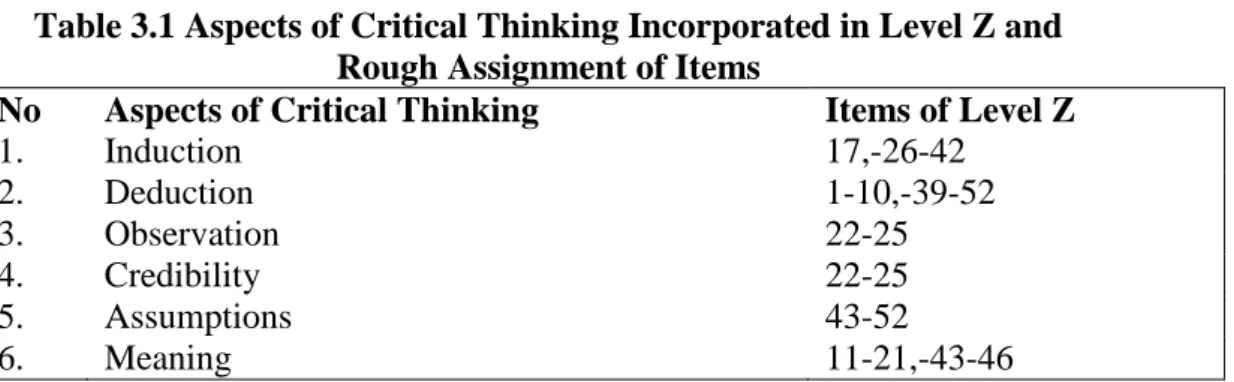
Tabel 3.1 Aspects of Critical Thinking Incorporated in Level Z and Rough Assignment of Items
46
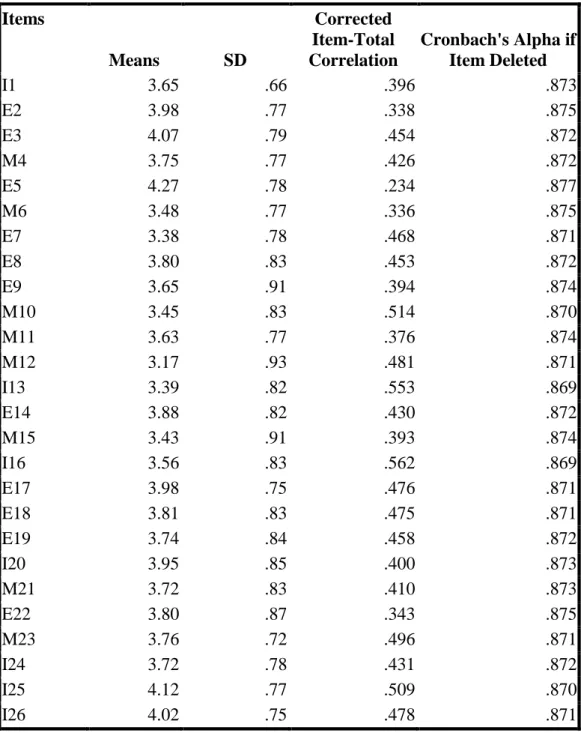
Tabel 3.2 Critical thinking dispositions (UF-EMI) test item analysis 51
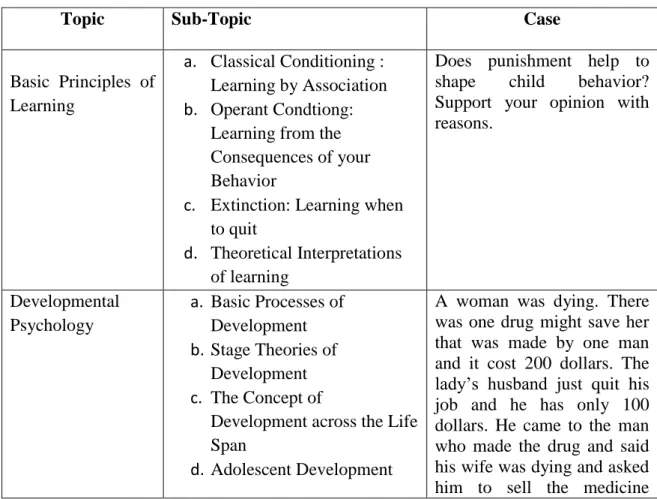
Tabel 3.3 Case Study Topics and Cases 52
Tabel 4.1 Mean of Cornell Critical Thinking Level Z Pretest and Posttest Scores for Experiment 1
63
Table 4.2 Analysis of Variance of Cornell CT Level Z for Experiment 1 64
Table 4.3 Analysis Simple Effect towards Cornell CT Level Z for Experiment 1
65
Table 4.4 Mean of UF EMI Pretest and Posttest Scores for Experiment 1 65
Table 4.5 Analysis of Variance of UF EMI on Experiment 1 66
Table 4.6 Multiple Comparisons of UF EMI between Groups for Experiment 1
67
vii
Table 4.7 Mean of Cornell Critical Thinking Level Z Pretest and Post-test Score on Experiment 2
74
Table 4.8 Analysis of Variance of Cornell Critical Thinking Level Z for Experiment 2
75
Table 4.9 Comparison between Groups on Cornell CT Level Z for Experiment 2
76
Table 4.10 Mean of UF EMI Pretest and Post-test Scores for Experiment 2 77
Table 4.11 Analysis Of Variance of UF EMI for Experiment 2 78
Table 4.12 Comparison between Groups for Experiment 2 78
Table 4.13 Mean of Student Activity Observation Scores 79
Table 4.14 Analysis Variance of Student Activity Sheet 80
Table 4.15 Category of high skill critical thinkers and low skill critical thinker in each group based on Cornell CT Level Z
83
Table 4.16 Anova of Difference Score of Cornell CT Level Z score 85
Table 4.17 Category of high disposition critical thinkers and low disposition critical thinker in each group based on UF EMI
86
Table 4.18 Anova of Difference Score of UF EMI score 88
viii
LIST OF FIGURES
Figure 2.1 Critical Thinking Dimensions by Facione 26
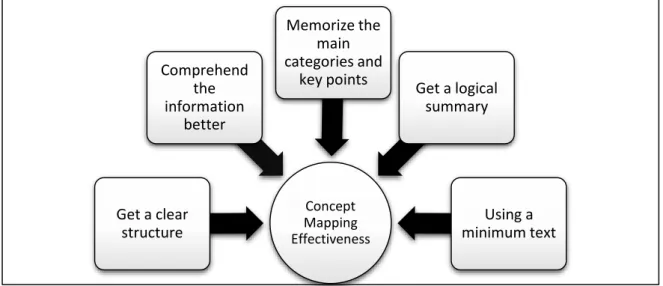
Figure 2.2 The advantage of Concept Maps 35
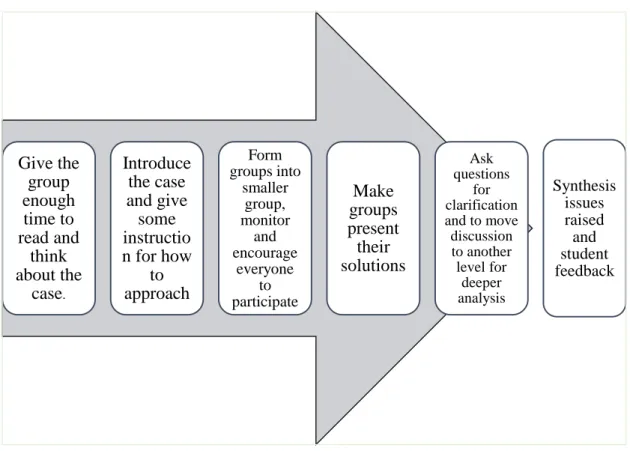
Figure 2.3 Case Study Activity Steps 36
Figure 2.4 Process of Preparatory Training of Case 38
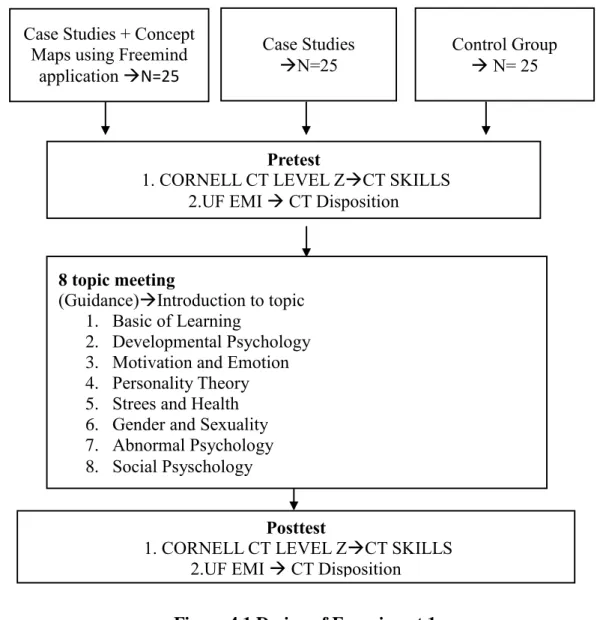
Figure 4.1 Design of Experiment 1 59
Figure 4.2 Example of Freemind Application 61
Figure 4.3 Outline of the Experimental Groups in a Meeting 62
Figure 4.4 Mean Score of Cornell Critical Thinking Score in Experiment 1 64
Figure 4.5 Mean Score of UF EMI on Experiment 1 66
Figure 4.6 Design of Experiment 2 72
Figure 4.7 Mean of Cornel Critical Thinking Level Z for Experiment 2 75
Figure 4.8 Mean of UF EMI for Experiment 2 77
Figure 4.9 Student Activity Score 80
Figure 4.10 The effect of CSCM and CS preparatory Training based on 84
ix
Critical Thinking Skills High-Low Category
Figure 4.11 Difference Score of Cornell CT Level Z score 86
Figure 4.12 Effect of CSCM and CS preparatory Training based on Critical Thinking Disposition High-Low Category
87
Figure 4.13 Difference Score of Cornell CT Level Z score 89
x Abstract
Promoting critical thinking abilities in students has been the focus of the educational field in Indonesia. Therefore, the education system needs to initiate methods that can facilitate critical thinking skills and dispositions. The present study attempts to add to the knowledge of how to develop critical thinking skills and dispositions through case studies and concept map activities in the introduction to psychology courses in an Indonesian college. Experiment 1 examined the effect of case studies and concept maps. Three groups participated in eight weekly classes of identical objectives. The groups differed in terms of the educational strategy: case studies combined with the concept maps (CSCM) group discussed about cases (case study) related to the class contents and they used FreeMind software to visualize the concept maps they made during the case studies.
The case studies (CS) group conducted a case study in each meeting but did not use concept maps.
The control group received a regular lecturing class without any active learning methods. All groups received a pre-test and post-test assessment of critical thinking skills by The Cornell Critical Thinking Level Z and also the critical thinking disposition by the University of Florida Engagement Cognitive Maturity and Innovativeness assessment (UF-EMI). The results showed that critical thinking skills improved significantly more in the CSCM group than in the CS and the Control groups. All groups showed significant improvement in critical thinking dispositions but with no significant differences among the groups.
Experiment 2 examined effects of preparatory training for a case study activity in addition to CSCM and CS treatments. The results showed that critical thinking skills improved significantly more in the CSCM group than in the CS with preparatory training, the CS without preparatory training, and the Control groups. Inconsistent with Experiment 1, two CS groups showed significant improvement of critical thinking skills compared to the Control group in Experiment 2. Further analysis showed that case studies without concept maps were effective only for the initial low critical thinkers. In contrast, case studies combined with concept maps was effective not only for low critical thinkers but also for high critical thinkers. Possible mechanisms involved in case studies with concept maps were discussed. When students were given a case for discussion, high critical thinkers might present some ideas related to the case. However, such ideas might be at a relatively ordinary level in the CS groups without concept maps. Such ordinary ideas might be effective to improve critical thinking skills in the low critical thinkers but not in the high critical thinkers. By contrast, if the case studies were combined with concept maps, high critical thinkers might be activated to provide clear reasoning and thus innovative ideas. To improve critical thinking skills in both the high critical thinkers as well as the low critical thinkers, clear reasoning and innovative ideas supported by case studies combined with concept maps is an effective approach.
The present study provides the first clear evidence of effectiveness of case studies and concept maps to improve critical thinking skills in Indonesian college students. However, further examination is needed on several points. First, effectiveness of case studies and concept maps on learning of class contents was not assessed in the present study. Second, the mechanism how concept maps improved critical thinking skills remains speculative. The hypothesis about the
xi
mechanism of case studies and concept maps is testable by recording and analyzing levels of case study discussions with or without concept maps to assess if indeed concept maps lead to deeper discussions in case studies. Further studies are needed to clarify these points.
1
CHAPTER 1 INTRODUCTION
1.1 Statement of the Problem
Recent years the progress and application of students’ critical thinking has been one of the focus in societies, job setting and educational studies (Boddy, Watson, & Aubusson, 2003;
Gellin, 2003; Larsson, 2007). Educational setting start to include critical thinking as one of the essential abilities that need improve through learning process. For example, critical thinking choose as one of the 10 learning goals for psychology majors by The American Psychological Association (2007).
Critical thinking also plays an important role in human’s different life aspects (Abed, Davoudi, & Hoseinzadeh, 2015) including social and interpersonal contexts that lead a person to make decision and problem-solving on a daily basis (Ku, 2009). On a daily basis, we are confronted by science-based claims and counter-claims which encourage the audience to think and shape their opinion based on what they hear or see, from relatively simple things like when choosing house materials, up to more complex things like talking about climate change. Some people are credulous, they quite easy to persuade without evaluating the information they find first. Research found most youth to be largely uncritical on inappropriate criteria when seeking information online (Metzger, Flanagin, Markov, Grossman & Bulger2015). For example, in a study of children’s information-seeking behaviors, Shenton and Dixon (2003) asked participants to describe instances where they sought information for school or personal use, despite sometimes expressing dissatisfaction with what they felt to be questionable information, no attempts were reported to check the credibility of any information retrieved from electronic sources from all participants in this research.
2
Researchers have analyzed the main factors that influence decision making, using data from 91 studies involving nearly 8,000 participants regarding information preferences in relation to attitudes, beliefs, and behaviors in situations that provided choices between congenial information, which supported participants' pre-existing attitudes, beliefs, or behaviors, and uncongenial information, which challenged these tendencies (Dolores, Hurt, Brechan & Merril, 2009). The examinations asked participants about their perspectives on a given subject and afterward enabled them to pick whether they needed to view or read data supporting their own particular or a contradicting perspective. The result was that individuals are about twice as liable to choose data that support their own perspective (67 percent) as to consider an opposing idea (33 percent). People with close-minded personalities are more unwilling to open themselves to differing perspectives. This research also found that people are more resistant to new concepts and points of view when their own ideas are associated with political, religious or ethical values. The conclusion of this study was that people have a tendency to ignore new information, if the new information does not match with what they believe or with prior knowledge, which might lead to faulty thinking. We need to be able to separate substance from what we believe and what is true information, to identify misrepresentations and assess levels of uncertainty and trustworthiness before we decided to believe or agree with an idea or information. Therefore cultivating critical thinking skills is needed, to avoid incorrect arguments or decisions by analyzing the situation and the presented data.
Indonesia consists of a pluralistic society with different tribes, religions, and language.
This diversity enriches Indonesian culture, however this diversity is also used by irresponsible parties to break down the unity to achieve certain goals. As example, in 2019 Indonesia will hold elections to elect representatives as well as the presidents. Following this event, it also reported that there is increasing number of rumors like false news and hate speech that spread
3
in media especially in social media. A report on CNN Indonesia presented data by the Ministry of Communications and Informatics mentioning there are as many as 800,000 sites in Indonesia that are potential generators of false news and hate speech (Pratama, 2016), this indicates that many untrue reports are spread by people who are irresponsible, where its impact on people who are not accustomed to analyzing the correctness of the news will be easily distracted and may feel compelled to do things that are harmful to others even can be threaten the integrity of the state
Information transmitted through social and electronic media is easy to share and read by many people, therefore it might have a large effect on the emotions, feelings, thoughts, and actions of a person or group. Psychologically, if fake news is believed by the recipient, it indirectly also affects the way we think, one of the consequences may be the onset of anxiety, hatred, and even fear for the reader. There are some reaction that people usually shown when they received particular news; first people are more likely to believe if the new information matches their opinions or attitudes, without searching the truth. For example, if a person who believes that the earth is flat gets an article that discusses various conspiracy theories about satellite images then instinctively the person will tend to believe these stories because it supports the flat earth theory that they believe. Naturally positive feelings will arise in a person if their opinions or beliefs are affirmed and tend not to care whether the information they receive is true and even it is easy for them to redistribute the information as mentioned in Dolores, Hurt, Brechan,& Merril (2009). This can be worsened if the receiver of information has inadequate knowledge in using the internet to seek more information or simply to check and review facts and has no way to evaluate the veracity and truthfulness of internet sites.
Second, because of the tendency that we are more likely to feel positively towards people who share the same or similar identity (in-group), then when there is news that is not necessarily true about injustice event caused by an outgroup, spread by people who have
4
attributes similar to us, this can cause feelings of hatred against the outgroup and may end up inciting conflict. The concept was driven by the observation that human social arrangements are universally characterized by differentiation into in-groups and out-groups where the feeling of us-them distinctions create boundaries of loyalty and cooperation among individuals (Brewer, 1997). Attitudes and values are shaped by this in-group vs out-group distinction in that individuals view all others from the perspective of the in-group. The tendency for feeling in-groups sometimes harmless, in this case people might prefer to socialize with people who share value like race or ethnicity and might categorizing towards outgroup that may lead to prejudice and discrimination.
Third, with people whom tendency to not care about the content of the information that they received, however they shared the information without further analysis. This reaction also have negative side effect, because if the information is false means more people might misguided. Last reaction is people who do some research for found supporting data to ascertain the truth of the news. However, this last reaction might not the favorite’s one, due this act are time consuming, demand ability to think deeply into an information, collecting data and then analyze it to determine the truth. Therefore, mostly people tendency to receive information without trying to find the truth, which lead to false belief and might cause suspicion on certain parties or others group.
Prior research and studies report that people who are more educated and taking courses that are related to stereotypes and prejudice express fewer stereotypes and prejudice in general (Rudman, Ashmore & Gary, 2001, Sidanius, Van Laar, Levin, & Sinclair, 2006). Research also shows that teaching critical thinking is a tool for removing prejudices and stereotypes of individuals through multicultural education which has been taught for several years (Martincova & Lukesova, 2014). By improving critical thinking when tasked with evaluating news then the students will apply critical roles as interpreter, analyst, and evaluator. The
5
interpreter role functions to get to know the media and data; the analyst applies concepts, such as source verification, fact-checking; the evaluator tries hard at producing his/her own content, sees the consequences of his/her choices and makes decisions about distribution so that they can avoid the traps of fake news. Critical thinking is also defined by The American Philosophical Association (1990) as “purposeful, self-regulatory judgment that uses cognitive tools such as interpretation, analysis, evaluation, inference, and explanation of the evidential, conceptual, methodological, logical criteria, or contextual considerations upon which judgment is based. By improving our citizen’s critical thinking skills through education, we also make a significant contribution to avoiding the occurrence of misperception and conflict.
The other major problem is that many university graduate’s competences doesn’t match the competence and qualification needed by the current job market (Moeliodihardjo, 2010).
The problems that studentsencounter in the classroom sometimes not similar what they face in their working life, where problems encountered are more varied, and influenced by many factors, are unstructured and have conflicting objectives (Yadav, Lundeberg & DeSchryver, 2010). Results from a survey of employers carried out by the World Bank in 2008, showed that two-thirds of employers complained that finding employees for professional and managerial positions that need higher skills and critical thinking was very difficult (Gropello, Kruse &
Tandon, 2011). A certain degree of difficulty in finding qualified workers with critical thinking might be a sign that the education sector is not providing students with the appropriate skills.
To overcome this problem requires major investments, higher education needs to provide the opportunity to students to become involved in learning activities that have meaningful and relevant learning outcomes. Student needs to reach the highest level in his/her thinking ability for competing in their work field in the future.
However, many types of research show that most educational systems did not really focus on reaching this goal. For example, the Turkish education system aims to improve
6
critical thinking skills, the reality showed the method of learning that has been applied for the most part was a ‘‘read and repeat’’ model conducted in the learning process (Sahin, 2014), where this type of learning process is reducing the potential for students to improve their thinking skills and to explore their true ability. These findings indicate that even there is growing attention of the need effective instruction for critical thinking but the reality has not been implemented optimally. In a similar, a study conducted by Bouton (2008) found that most educators only understand critical thinking skills based on their own personal experience rather than based on a scientific theory. In addition, educators also indicated that they had no formal training in developing a method of learning that can encourage critical thinking skills and dispositions. Therefore, educator’s knowledge and skill about critical thinking might not meet the objectives to be achieved in the classroom. The other problem is on how teacher transfer the complexity of critical thinking to student. Communicate effectively about critical thinking can be challenging effort for teacher.
The application of critical thinking in the education system has some serious issue to accomplish this purpose. Research shows that even in general higher education is not successfully teaching critical thinking at the third stage, third level, and postsecondary education (Stedman & Adams, 2012; Willingham, 2008). An investigative research by The California Commission on Teacher Credentialing found that regardless of the large number of educational workers who indicated that critical thinking is an important goal of education, however only a small percentage (9%) that teach critical thinking in learning activity (Paul, Elder, & Bartell, 1997). Ironically, as it turns out, the approach in teaching subject matter to our students sometimes only focuses on how we deliver information to the student and we tend to forget the main things in the learning process for the graduate level is to create talented youth to compete in the global market and to prepare them to participate professionally in real work life.
7
There are difference opinion between educational practitioners and academic, as example while educators frequently talk about critical thinking as an objective, researchers have largely avoided the term, preferring constructs that can be more precisely defined and measured. (Kuhn & Dean, 2004). Another issue about critical thinking is the unclear formula about which educational techniques are useful for improving it (Brunt, 2013, Heijltjes, van Gog, Leppink, & Paas, 2015) Some studies mentioned that learners’ critical thinking skills are quite difficult to develop naturally as an outcome of higher education (Davies, 2013; Elander, Harrington, Norton & Robinson, 2013). Due some reason, students do not seem to improve their critical thinking through their studies during university (Arum & Roksa, 2011). However, there is also some prove found beyond its complexity, critical thinking skills can be taught and learned in through learning activity (Abrami, Bernard, Borokhovski, Wade, Surkes, Tamim, &
Zhang, 2008). Through a supportive learning atmosphere were students simultaneously occupied with the atmosphere of problem solving teaching conditions and student adapting some strategies and solutions on how to maintain solutions to situations, therefore student develop critical as well the ability to interpret and analyze. Educational institutions must admit the essential need to develop thinking skills in students, moreover giving clear instruction about critical thinking help students to transfer those skills taught in the classroom to their lives and even after student graduate from school.
In Asia, despite the considerable differences between each countries, the governments have recognized the necessity of ushering in changes in teaching and learning practices in schools (UNESCO, 2015). In view of the need to improve the quality of education for all. In details, there is develop awareness of the global shift taking place in approaches to teaching and learning, moving from the conventional, teacher-centered transmission approach towards a learner-centered (UNESCO, 2015), which de-emphasizes practice in managing problematic situations. The predominant situation in the Indonesia education system. Indonesia is a nation
8
of islands with around 13,446 islands (Geospatial Information Agency of Indonesia, 2017), including the islands of Java, Sumatra, Kalimantan, Sulawesi, Lesser Sunda Islands, and Papua (or Irian Jaya). Indonesia has a population of 266 million (World Population review, 2018) encompassing major linguistic, religious, tribal, and cultural differences. As a developing country education plays an important role (Johan & Harlan, 2014) to empowering the human resources. However, considering there are more than 55 million students in all level of education (The Economist, 2014) spread across 33 provinces with different backgrounds, promoting a better quality of education is challenging.
Between different perspectives over what a quality education means and how it is accomplished, the larger part of schools in the nation keep on exhibiting a strikingly steady example of classroom activity that dominated by rows of desks, whole-class grouping systems and chalk and talk or traditional method learning. Traditional methods of learning use many facts and not enough conceptualization; an excessive amount of memorizing and not enough thinking on your own. This is also supported by some research (Daz-Iefebvre, 2004;
Hay, 2018; Kang & Howren, 2004) that show that lectures and memorization do not help develop long-term knowledge or the thinking ability to adapt knowledge to new situations.
Therefore, lectures and rote memorization do not promote critical thinking. Using Bloom’s (1956) cognitive taxonomy to determine critical thinking skills, the traditional lecture approach result students to engage in activities and teachers where there is less effort and plan to ensure that meaningful learning develop. Therefore, the three highest levels of Bloom Taxonomy operation which are analysis, synthesis, and evaluation that involve the ability to think critically are not accomplished. Building connection between critical thinking skills with content of the learning process, required teacher to focus on the process that employs students’ higher-order thinking skills (Duplass & Ziedler, 2002; Wong, 2007).
9
To help students become critical thinkers, then we need to encourage and develop it from an early age. Ignatavicius (2001) mentioned the following characteristics for critical thinkers: “outcome driven, open to new ideas, flexible, willing to change, innovative, creative, analytical, communicators, assertive, persistent, caring, energetic, risk takers, knowledgeable, resourceful, observant, intuitive, and ‘out of the box’ thinkers” which is it will be difficult to nurture with the teacher-centered based learning concept. Pursuit of this goal is not easy and usually needs a long time, especially if the students are familiar with learning patterns that put them as a recipient of information rather than as a searcher and information analyzer. Some methods reported have positive contribute on critical thinking, such as; musical skills have sophisticated multiple effects on individuals, music can play an important role in intelligence and thinking abilities (Topoğlu, 2014), blended socratic method of teaching (BSMT) is comprehensive model combining the Socratic method of teaching, information and communication technology (ICT), and business case helps improving the critical thinking skills of the business students (Boa, Wattanatorn & Tagong, 2018) paintings are relevant for improving the comprehension of concepts related to cognitive understanding of systems thinking, i.e. enriching the whole person, reinforcing critical and creative thinking skills.
(Molderez & Ceulemans, 2018)
Some research mentioned linking critical thinking skills to the content of the learning process, the instructional focus should be on the process of learning that employs students’
higher-order thinking skills (Duplass & Ziedler, 2002; Wong, 2007), which means that students should actively engaging in the learning task/activity. One of the most popular method that can encourage students to engage with the material, participate in the class, and collaborate with each other is active learning. Active learning is a learning method to accustom students independently by themselves. When students learn actively, it means that students dominate the learning activities. In addition, students actively use their brain, either to find the main idea,
10
from lectures, solving problems, or apply what they have learned to the problems that exist in real life.
The effort to improve Indonesian education quality has focussed on introduction of an active learning approach on teaching and learning process. According to Sopantini (2014) since 1998, which marks the changing of government from the New Order to the current reform period, the focus has shifted to a structural change in policy. However, Sopantini (2014) found that implementation of the policy of active learning has essentially failed due to a combination of technical, political and cultural factors and the interaction between these three factors.
Furthermore, Sopantini (2014) found most teachers in North Maluku, Indonesia showed a low capacity within the system to implement the active learning method in class and a lack of understanding regarding the theory and practice of active learning, furthermore there is a very limited number of capable facilitators that are able to evaluate teacher performance using active learning. Thus, due to the lack of knowledge about how to utilize the active learning method, many teachers still use the authoritarian method for teaching and delivering subjects and still heavily relies on memorizing texts.
Meanwhile, critical thinking skills can be improved in classroom activities when students are required to actively solve problems (Nelson & Crow, 2014; Youngblood & Beitz 2001). Bean (2011) discovers that active-learning practice as one of firm strategies that create students became powerful thinkers and better arguers. For example, when students are assigned to define or clarify an issue, students will assess which information is relevant and irrelevant, seek additional information as needed and formulate the right questions. Previous research found that various active learning methods effective on improving critical thinking skills and dispostions, such as flipped classroom (Dehghanzadeh & Jafaraghaee, 2018), direct infusion (Bensley & Spero, 2014) mobile learning (Cavus &Uzunboylu, 2009), project-based learning (Sasson, Yehuda & Malkinson, 2018) and scrabble board game (Kobzeva, 2015).
11
As one of the main purpose of education is to prepare student to compete and perform in working life, therefore education need to reform the teaching strategies that focus on helping student’s ability to be creative, innovative and think critically, not simply to memorize.
Students might just know basic information and not common on solving a problem, therefore they struggle in working life and daily life that demand them to make decision and be critical thinker. Hence, we need to implies the learning method that help student to bridge the relation between theoretical and practice, thus when faced with real conditions student can solve the problem with the experience and lesson that they received during study. Furthemore, by encouraging students to analyze, synthesize and evaluate when students are required to solve the problem, educators will also help students become good thinkers (McCown, Hammer, Hargreaves, Holzworth, & Freebairn, 1996).
One of the strategies that effective to bridge the gap between theory and practice is case studies. A case studies approach facilitates synthesis of content knowledge and the application to solve a narrative story, which also enable to student ability to identified goals to be reached (DeSanto-Madeya, 2007). The case studies method involve an educational strategy whose aim is to engage students by reflecting on the situations presented in the case under investigation, to analyze realistic data with regard to it and to become involved in making decisions (Prince
& Felder, 2006) that facilitate the development of the higher levels of thinking process.
The case studies is one of the popular teaching strategy in the western education system.
Some research has demonstrated the effectiveness of case studies in promoting active learning and helping students to understand complex and complicated issues (Kunselman and Johnson, 2004), in facilitating students to remember details and facts (Beyea, 2004) and in improving educational outcomes (Sanders-Smith, Bonahue, & Soutullo, 2016). Meanwhile, several study support the application of case studies as a one of the strategy to improve the development of critical thinking skills and critical thinking disposition. (Huang, Hsia, & Ling, 2012; Jonassen
12
& Serrano, 2002). Whilst in Indonesia, even though the use of case studies is a method that is commonly known, there is little evidence of its use, or empirical research demonstrating its use to promote critical thinking. There have been some studies from Indonesia that showed the effectiveness of case studies for improving learning outcomes (Utami and Indriyanti, 2014), increasing student enthusiasm and promoting a democratic atmosphere in the class (Anggraeni, 2012).
Another strategy is a concept map in which help students to visualize relationships among concepts by diagramming major concepts and associated data in a format that is logical to the learner and relevant to the subject matter. Concept maps may help bridge the gap between theory and application as Wheeler and Collins (2003) found that the use of concept maps to link knowledge and practice was an effective means of improving critical thinking skills. This study intend to improve the knowledge of how students develop critical thinking skills by assessing a case studies with concept maps and a case studies with a preparatory training model for improving students’ critical thinking abilities in the introduction to psychology courses. In learning from a case, the students determine the relevant facts, analyze and create conclusions about the problem and what action to take. Students encounter the problem before they create the structure to solve it. We assume that if we help a student in the process use concept maps, then the result might significantly improving critical thinking. Using concept maps helps to visually examine what students have learned, and through this process students might examine their previous knowledge (Lee, Chiang, Lioa, Chen & Liang, 2013) and combine that with new information, formulate it in a more critical and adjusted way to solve or describe a case. By create educational environment that provides opportunities for student to actively use their ability, engage in learning process, choose their preference activity then discover a meaningful idea will help to improve critical thinking.
13
Several study have shown support for the application of case studies combined with concept maps as a teaching strategy to promote the development of critical thinking skills and a critical thinking disposition (Huang et al., 2012; Jonassen & Serrano, 2002). In the research of Huang et al., (2012), a case studies was given as group assignment, nurses were required to work cooperative to solve a case that related to the subject matter. We intended to replicate the findings of Huang et al., (2012) regarding the educational setting for Indonesian college students. As mentioned before, there are some studies in Indonesia about the case studies, yet very few studies that combine case studies with concept maps to evaluate the effect on critical thinking.
In this study, we conduct two experiments at two different times, in which Experiment 2 is an advanced study to clarify the results of Experiment 1. For Experiment 1, the aim is to examine the effect of a case studies in combination with concept maps on critical thinking skills and critical thinking disposition. In Experiment 1, students were assigned one of the following three groups: a case studies with concept maps, a case studies alone and a traditional lecture without any active learning methods. According to Huang et al. (2012), it was expected that improvement of critical thinking skills and disposition would be greater in the case studies combined with conceptual mapping than in the case studies alone. In Huang et al., (2012) research, the case studies combined with concept maps and case studies alone were developed as experimental group without any control group, where students were required to work in group to solve a case that related to the subject matter. Meanwhile in our study for Experiment 1 as well for Experiment 2, we use control group to provide a comparison of baseline for determining the extent of change after the experiment is performed.
The purpose of Experiment 2 was to examine whether preparatory training for a case studies activity has an effect on improving critical thinking skills compare with the others three group that we use in Experiment 1. Studies have shown that case studies alone without a
14
concept map is an effective and beneficial learning strategy (e.g., Bayona & Castaneda, 2017;
Kreber, 2001). Grant (1997) outlines the advantages of using case studies as an interactive learning strategy, shifting the emphasis to more student-centered activities rather than teacher- centered. Popil (2011) argues that by applying preparatory training of a case studies activity, might help the student to increase their knowledge and experience in solving a case also and ability to link theory to practice therefore it will activate student higher thinking. In this case, our thinking was to give students some training using a case studies activity to investigate the effect of preparatory training on critical thinking. Theoretical and empirical studies have explored the advantage and disadvantages of instruction compared to other methods of learning such as case studies and the traditional method of learning (Ertmer, Newby, & McDougall, 1996; Yadav, Vinh, Shaver, Meckl & Firebaugh, 2014). Therefore for Experiment 2 the purpose is to clarify the effect of preparatory traing on improving critical thinking skill and disposition.
1.2 Purpose of the Study
The first purpose of the study was to empirically assess the effectiveness of case studies with concept maps for improving student to think critically and critical thinking dispositions.
Second, was to explore the effectiveness of preparatory training on improving skills and dispositions to think critically. The model (treatment) was used to teach the first year students in analyzing a case that related to Introduction to Psychology subject. The purpose is to help students to develop skills needed to think critically through solving the case, for example by using a case to solve a problem, student have a chance to collecting reliable data, interpreting information from different sources and contending the evidence.
15 1.3 Research Questions
Based on the statement of the problem, this study attempt to answer the following questions.
For Experiment 1:
1. Will a group of students presented with a case studies combined with concept maps who receive explicit training using the FreeMind application demonstrate better on the Cornell Critical Thinking Level Z compared with the case studies and Control Group?
2. Will a group of students presented with a case studies with concept maps who receive explicit training in using the FreeMind application model score better on the University of Florida Engagement, Maturity and Innovativeness (UF-EMI) test compared with the case studies and Control Group?
3. Will a group of case studies students who receive a case to solve present better on a test that requires them to analyze the Cornell Critical Thinking Level Z?
4. Will a case studies group on the University of Florida Engagement, Maturity and Innovativeness (UF-EMI) score higher compared to the Control Group?
For Experiment 2:
5. Will a group of students presented with a case studies with concept maps who receive training in using the FreeMind application model show better score on the Cornell Critical Thinking Level Z compared with others group?
6. Will a group of student who receives preparatory training of case studies perform better on the Cornell Critical Thinking Level Z compared with the case studies and Control Group?
7. Will a group of students who receives preparatory training of a case studies for critical thinking score differ in Engagement, Maturity and Innovativeness (UF-
16
EMI) compares than case studies and Control Group?
8. Will a group of students presented with a case studies in combination with concept maps perform better engagement and perform in learning activity compares to others group on Student Activity Observation Sheet?
Summary
This chapter provide an intuitive description of research problem and purpose of this study. The section described the reason on choosing the model a case studies with concept maps and preparatory training to improving critical thinking. Eight research questions were stated showing goals to test the viability of the model observationally utilizing instrument that assessed students’ ability on analysis of induction and deduction reasoning, observation and credibility, making assumptions and meaning also dispositions toward critical thinking.
Supplementary, this section explain the meanings of essential terms utilized in this examination, and distinguished the purpose for each Experiment.
17
CHAPTER 2 LITERATURE REVIEW
This chapter embraced several important areas of literature review, citations and explore reports reviewed in this archive put the investigation into a coordinated viewpoint. This part is separated into the accompanying segments: (1) critical thinking that explore about (a) definitions of critical thinking skills and disposition, the characteristics and other commonly issued that related; (b) critical thinking dimensions, (2) case studies describe (a) definition of case studies strategies; (b) case studies with concept maps; (c) case studies with preparatory training, (3) methods to apply teaching critical thinking to Indonesian college students. These filed of investigation shape the reason for the instructional treatment portrayed in Chapter two.
2.1 Critical Thinking
2.1.1 Definitions of Critical Thinking
We often heard news or issued that occurs in media or daily life, the next questions across are we should believe everything that we heard or read. Unfortunately, most people do that; consciously or not. We sometimes feel it would be easier to believe what said by others rather than having efforts to find appropriate information. This is one reason that causes us to fail to become critical thinkers. Most people have a tendency to follow public opinion, although sometimes that opinion is not necessarily correct or the application inappropriate. The inclination is due to some reasons such as fear will differ with others or lazy to collect accurate data about a particular topic.
The term critical thinking is widely used in the fields of education, psychology, and philosophy, and recently, there have been using also in medical field research. Critical thinking is conceptualized as an operative example of higher order thinking that defined as a skill of
18
taking responsibility and control of one’s own mind (Paul, 1996), these processes include skills such things as classifying, inferring, observing, evaluating, synthesizing, and hypothesizing.
Some basic complexities approaches among the diverse proffered records of critical thinking prevalent in educational theory and practice, which categorized on descriptive and normative.
Schunk (2008) define descriptive originations as a tendency to confine in terms of cognitive skills, and focus on the mental processes involved in thinking, while cognitive approach focus on the significance of mental procedures in learning process which occurs on supportive environment involving perceptions, thoughts, beliefs, attitudes, and values student in developing, acquisitions, forgetting and recovery information. A thought is difficult to be affected unless the support data is given consistently and rationally, through the critical thinking process, the individual will also evaluate whether the results of his thinking process has been able to solve existing problems. Therefore, critical thinking is often described as a metacognitive process which means the ability to use prior knowledge to plan a strategy that consisting of a number of sub-skills which if we used appropriately, increases the chances of producing a logical conclusion to an argument or solution to solve a problem (Dwyer, Hogan
& Stewart, 2014). Critical thinking also defined as reflective thinking which refers to critical thinkers must capable of reflecting the reasonable of their own and other’s thought. Focused thinking refers the thinking process is consciously directed and intently. The others elements focus on a decision about what to believe or do which indicates that critical thinking assesses statements (what we believe) and actions (what we do), then deciding what statements or actions more reliable.
From a psychological point of view, critical thinking tends to be linked with creating sharp decision making, create an opinion based on analysis of reasons, to overcome individualistic thinking, and to represent logical thinking flow to reach conclusions regarding what should be done, based on research evidence (Bassham, Irwin, Nardone & Wallace 2011).
19
Thinking alone is an activity of someone in search of a proper answer, filtering out various kinds of unimportant and distracting data or information, solving problems, to decide something (Colley, Bilics, & Lerch, 2012). Critical thinking as a process of identifying a range of possible courses of action, recognizing uncertainties about which course of action is best, and seeking relevant information to help make a decision (Wolcott, 2006). Previous researcher definition of critical thinking create main contributions to the development of critical thinking elements that consisted of a dispositional and skill dimension. Engaging problems and making decisions using critical thinking involves both skills and disposition immersed in increasingly complex and differentiated environments. Choosing between collected data and sources is required higher-order skill, especially to judge the credibility and validity of the sources.
Therefore, these critical thinking is not a common skill possessed by individuals.An individual with strong critical thinking skills would recognize that many possible courses of action exist for this problem (Wolcott, 2006)
There has been a comprehensive debate on what critical thinking really is (Johnson &
Hamby, 2015; Tsui, 2002). One area of discussion has concerned what to incorporate and prohibit in the definition of critical thinking, whether critical thinking just a set of skills or does it also include dispositional aspects as well? Some assumption said that the critical thinking skills are a natural talent possessed by some individuals. In the early 1985s, specialists working in the critical thinking field noticed that the capacity to think critically is different from the disposition to do so (Ennis, 1985). Experimental confirmation seems to affirm the thought that critical thinking abilities and dispositions are, in fact, isolate elements (Facione, 2000). Most psychological based scholars have liked to utilize "thinking aptitudes" (or higher request thinking abilities) as opposed to critical thinking as a generic term (Lewis and Smith, 1993;
Sternberg, 1987).
20
Mogensen (1997) suggests that critical thinking is the ability to think is reflective and evaluative directing the reasoned judgment. Mogensen added that critical thinking is a concept that covers the entire view in epistemology, transformative, dialectical and holistic. Perspective epistemology emphasis on how individuals actively test and ask the things that are around. The second perspective is a transformative emphasis on how individuals change various aspects of his life such as lifestyle, behavior and value the better. A dialectical view of the emphasis on how individuals view problems using a variety of viewpoints, listen to opinions of other people and treat other people fairly and responsibly. The fourth perspective is to think holistically, meaning that critical thinking involves both cognitive and affective aspects are interrelated.
Critical thinking can also be called with the thinking that has a direction because it focuses on the expected result. Critical thinking leads to a way of thinking individuals who require support to a trust. This definition of critical thinking is not simply accepting or rejecting a statement but includes a set of abilities and dispositions that help in deciding what to believe or do when employed.
Critical thinking skills are considered to be basic for the advancement of metacognitive comprehension that involve higher order thinking displayed by attitude toward a given learning task. Critical thinker will actively collecting data, monitoring comprehension, and evaluating progress before decided the truth of an information. Therefore, critical thinking is an individual effort to seeking the true information, and analyze all related data to find the answer to the problem. This whole process will lead to some action that the individual decided through a supportive teaching and learning process that requires critical thinking skills in selecting all the possibilities that exist and accompanied by supporting factual data. In this research, we emphasize critical thinking is reasonable reflective thinking that focused on deciding what to believe or do by evaluative directing the reasoned judgment includes a set of abilities and dispositions that help in deciding.
21 2.1.2 Critical Thinking Dimensions
Critical thinking is essential tool for investigation and solving problem, furthermore critical thinking is a great asset in one’s personal and civic life. Therefore, teaching critical thinking implies progressing in the direction to build a citizen that has ability on solving problem. The dimensions of critical thinking also developed by the American Philosophical Association Delphi identifies six cognitive abilities is a key concept of critical thinking (Facione, 1990), which involving both cognitive and affective domains. The dimensions of cognitive are interpretation, analysis, evaluation, inference, explanation, and self-regulation.
Meanwhile for the dispositions are discussed extensively in this report below. Along these lines the Delphi experts could achieve agreement on a comprehensively comprehensive meaning of basic reasoning that combined both cognitive skills and affective dispositions, however the experts remained profoundly divided on the issues that Paul has demanded in his examination regardless of whether or not critical thinking includes a normative dimension. The sixth aspect is further defined by the following explanation:
a. Interpretation, which refers to understand and express meaning or experience, situation, data, assessment, rules, beliefs, customs, procedures, and criteria. Through this interpretation, individuals are encouraged to be able to recognize a problem and reading the nonverbal movement of another individual to be able to understand the meaning given another individual. Interpretation contains with categorization, decoding, significance, and clarification of meaning.
b. Analysis implies ability to distinguish the reason and connection between proclamations, questions, ideas, depiction or different structures that represent intended to express certainty, judgment, reason, data, and feelings. The analysis consists of
22
several sub-specialties which are expertise to test ideas, detecting arguments, and analyzing the existing arguments.
c. Evaluation intends to quantify the credibility of proclamations or different portrayals which are estimated from individual experience, situation, judgment, belief or opinion, perception and to measure the strength of the relationship between. The evaluation consists of skills, which is the ability to measure the demands and arguments.
d. Conclusions. Conclusions are intended to identify and ensure that each element can draw conclusions reasoned, to establish estimates and hypotheses, to consider the relevant information and to show the consequences derived from the data, statements, principles, facts, judgments, beliefs, opinions, concepts, description, questions and other forms of representation. Conclusion consists of several sub-skills, which are questioning the fact, estimates the choices and describe alternative conclusions.
e. Explanation. The explanation refers to explain the results of an argument, to justify a reason in terms of facts, concepts, methods, criteria, and consideration of circumstances involved in determining the results; and to represent a form of reason in the form of a convincing argument ". Explanation consists of several skills such as explaining the results, determine the procedure and represents an argument.
f. Self-regulation, which is "the consciousness of individuals to monitor their own cognitive activities. At this stage the individual monitor cognitive activity itself by questioning, validating and correcting the form of a statement. On this aspect, there are two important things to do which are testing and corrections made by yourself.
Another studies by Ennis, Millman & Tomko, (2005) mentioned the critical thinking including areas of induction, deduction, evaluation, observation, credibility of statements, assumption identification, and meaning. The key element for developing critical thinking ability is repeatedly practice in making decisions and conclusion based on data, then continue
23
formulate feedback on those decisions. Even an expert might fail to appear critical thinking ability, on the other hand sometimes we can find children who impressively demonstrate critical thinking skills. Children are interested in many things, children spend a lot of time with developing critical questions, and somehow many of this questions are difficult to answer by an adult. However, with the increasing age, how the adult reacts towards their questions and some other factors, children slowly begin to diminish their critical thinking skills and of course it is affected the critical thinking ability. The other factors is the incompatibility of learning approaches with cognitive characteristics at a certain age. Using Piaget’s cognitive development theory adaptation Başkale & Bahar (2011) examine the child's characteristics and learning patterns in the preoperational stage to develop nutrition education for preschool children found knowledge scores increased and the group's food preferences positively changed. This study emphasizes the important of a child‐centered approach, self‐discovery, guidance to children and activity‐based teaching to build positive behavior on children.
Some thinking such as our race, religion, ethnic group, social class, political party, or philosophy of life are important to us (Ruggiero, 2009). As people grow up, they tend to be more sensitive related to their personal identity and thought. People will feel attacked their self- esteem when we express the opinion that seems to underestimate their ability or blame his thoughts and knowledge. “Mine is better” thinking is natural and often harmless. Since critical thinking related to problem-solving context, and involved with other people, the person needs to apply certain tactics and strategies for keeping the problem-solving process on task, communicating coherently with others, collecting observation support for a decision about what belief or action then judge the soundness of the information (Norris & Ennis, 1989). In line, a critical thinker must be able to make good inferences, then carrying out the critical thinking in orderly and deliver it with an effective way to others, therefore other people don't
24
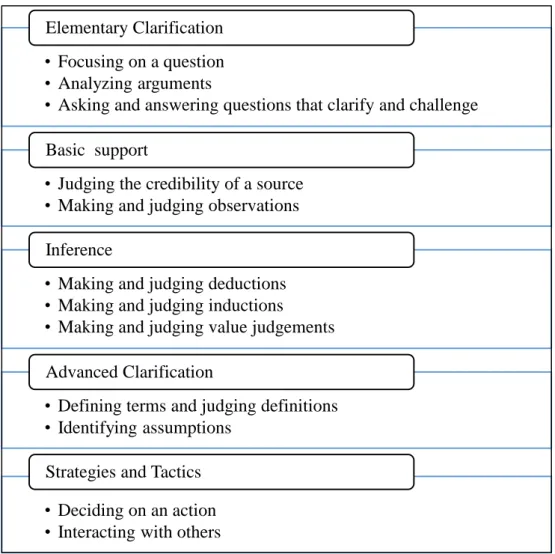
feel they are offended by judgmental opinion. The table below describes the critical thinking skills outline developed by Norris & Ennis (1989).
Table 2.1 Topics for Evaluating Critical Thinking Abilities by Norris & Ennis (1989)
The dimensions of critical thinking developed (Facione, Giancar & Facione,1995).
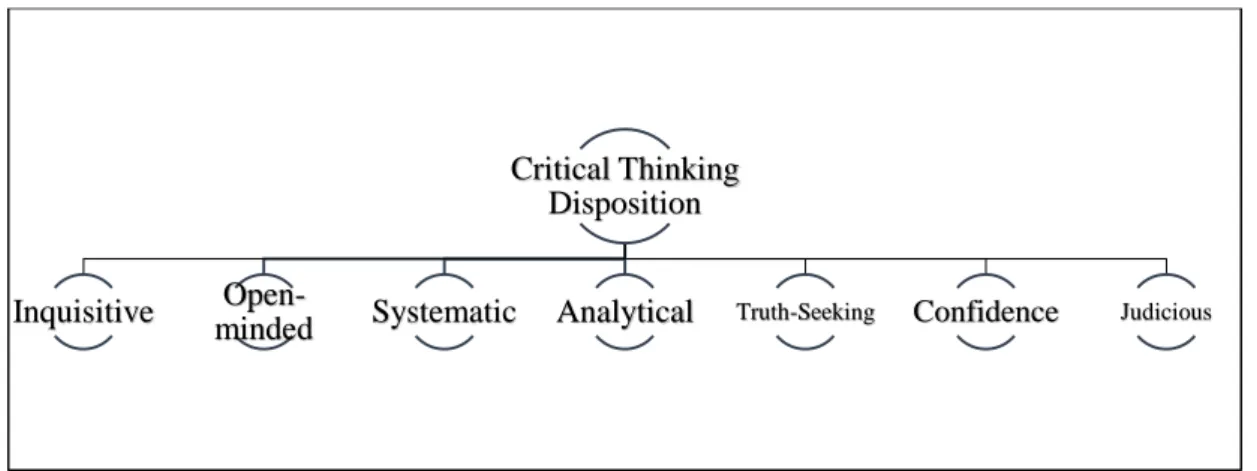
Facione suggests seven dimensions of critical thinking which are the curiosity, open-minded, systematic, analysis, truth-seeking, confidence in critical thinking and maturity. Seven dimensions are then compiled into The California Critical Thinking Disposition Inventory (CCTDI). The seventh dimension is further described as follows:
• Focusing on a question
• Analyzing arguments
• Asking and answering questions that clarify and challenge Elementary Clarification
• Judging the credibility of a source
• Making and judging observations Basic support
• Making and judging deductions
• Making and judging inductions
• Making and judging value judgements Inference
• Defining terms and judging definitions
• Identifying assumptions Advanced Clarification
• Deciding on an action
• Interacting with others Strategies and Tactics
25
a. Inquisitive, this dimension measures the intellectual abilities of students in searching for information and the desire to learn in spite of the knowledge that is needed even though the lesson has not been taught before.
b. Open-minded measures the extent to which individuals can tolerate different thoughts and sensitivity against the bias that may be carried by the individuals themselves.
c. Systematic refers to measures the tendency of individuals to organize, compose, focus and keep on digging for the information even at the high level of complexity of information.
d. Analytical, this dimension emphasis on how individuals use reasons and facts to solve problems, anticipate possible problems that may arise and consistent will need that at any time required another intervention in resolving a problem.
e. Truth-seeking, in this dimension, focuses on how individuals continue to try to seek knowledge required in accordance with the context, have the urge to keep asking and honest and objective in looking information even if the results do not support the opinion that these individuals possess.
f. Confidence in reasoning aims to measure of individual confidence when the process of conveying the reasons a problem. Confidence in critical thinking provides an opportunity for individuals to be able to trust the reasons given by the individual judgments and to lead to a rational problem-solving
g. Judicious in this dimension measures the tendency of individuals to assess the nature of the decision. Judicious in critical thinking can be characterized on how an individual approaches the problem, gather information and make decisions despite the difficult situation, believes that some situations may require more than one possible choice of settlement and in assessment must comply with the standard, context, and facts associated with problems.
26
Figure 2.1 Critical Thinking Dimensions by Facione (1995)
However, among the several dimensions associated with critical thinking skills above, it is interesting to include judicious as one important dimension to the critical thinking skills.
People who have good critical thinking skills, also need to have judicious in thinking.
Occasionally, there are things that difficult to convey directly to others, in this case, words without filtering might cause others false interpret what we mean, so we need to have to use words that are subtler and discreet, therefore people can understand the intent we truthfully. It is very necessary, being critical thinker doesn’t mean that we reserve the right to hurt the feelings of others through our opinion, but critical thinking demand ability to analyze a variety of circumstances with systematic, then choose the best option and deliver precisely that opinion on others. Norris & Ennis (1989) define critical thinking dispositions as the critical spirit which motivates critical thinkers to apply critical thinking abilities to their own thinking and to others and create standards of critical thought. Broadly speaking, having critical spirit lead a person with a certain type of character, which one of the most important element is open-mindedness.
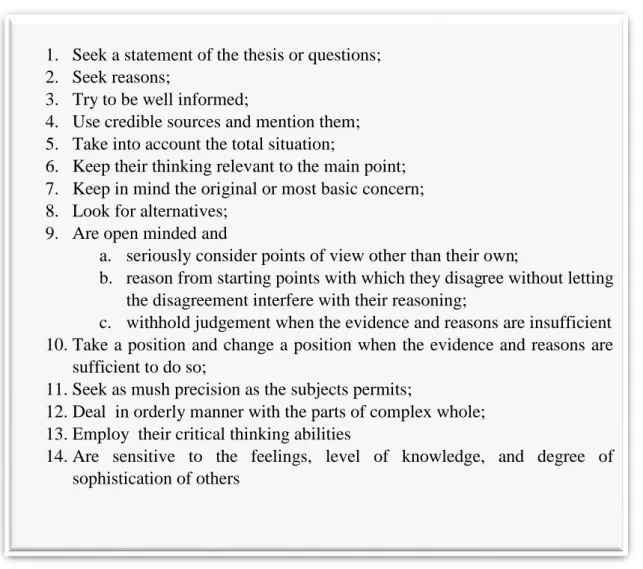
The table below gives a brief list of critical thinking dispositions covered by evaluating clarity- related abilities, basic support-related abilities, inference-related abilities, and strategies and tactics in critical thinking in an orderly and effective way.
Critical Thinking Disposition
Inquisitive Open-
minded Systematic Analytical Truth-Seeking Confidence Judicious
27
Table 2.2 Topics for Evaluating Critical Thinking Dispositions Critical Thinkers By Norris & Ennis (1989)
As mentioned before, we deal with many conditions that offer us to think critically about the situation. However, the question is what situation or problem that showed someone shown an ability to think critically? It needs to be clarified that every day we will face many problems in our daily life. However, the levels of the problems we face will be different, McPeck (1981) mentioned that since critical thinking is always “thinking about X” which is referring to thinking about something, it follows that critical thinking is intimately connected with other fields of knowledge. As people begin to think critically to get an answer or give an opinion, it begins to associate with the knowledge that he has, dig for more detailed information so that the case will be conveyed does contain a truth value. On the surface at least, perhaps
1. Seek a statement of the thesis or questions;
2. Seek reasons;
3. Try to be well informed;
4. Use credible sources and mention them;
5. Take into account the total situation;
6. Keep their thinking relevant to the main point;
7. Keep in mind the original or most basic concern;
8. Look for alternatives;
9. Are open minded and
a. seriously consider points of view other than their own;
b. reason from starting points with which they disagree without letting the disagreement interfere with their reasoning;
c. withhold judgement when the evidence and reasons are insufficient 10. Take a position and change a position when the evidence and reasons are
sufficient to do so;
11. Seek as mush precision as the subjects permits;
12. Deal in orderly manner with the parts of complex whole;
13. Employ their critical thinking abilities
14. Are sensitive to the feelings, level of knowledge, and degree of sophistication of others