1
――
The Two Gentlemen of Verona
への書き込みの転写とともに――住 本 規 子
はじめに
筆者は「読者から読者へ――書物のもうひとつの役割とグラスゴー大学所 蔵ファースト・フォリオの書き込み――」でグラスゴー・コピー(
West 11
) の書き込みを初期読者から伝達された貴重な情報と位置づけ、まずは、The
Tempest
の書き込みの転写を発表した。その後、全ページに書き込みが残っている残りの2作品を含むインクで書き込まれたほぼ全ての書き込みの転写 を果たしたところで、この初期読者の書き込みの特徴の分析を試みることに し、中間発表として第
54
回シェイクスピア学会にて発表を行った。1 研究発表応募を学会に提出した後で、他の学会で再会したエマ・スミス氏 より2016
年刊行予定の氏の新著Shakespeare
's First Folio: Four Centuries of
an Iconic Book
からグラスゴー・コピーをあつかった部分を原稿で読む機会1 小論の一部は第54回シェイクスピア学会(2015年10月10日 於北海道教育大学函館校)
の研究発表第4室第2発表(司会 英知明氏)の発表原稿に基づきます。英氏およびフロアの 方々からの有益なるフィードバックに感謝いたします。発表原稿はのちに山田昭廣氏がお読みくださ り、大変ご示唆に富んだ批評をいただくことができました。期日の関係で今回はすべてを反映させ ることはできず、多くは今後の課題となりましたが、一部は小論に反映することができました。ここに 感謝の意を表させていただく次第です。なお、小論に不備が残るとすれば、それは、すべて筆者 の責任であることは言うまでもありません。
【概要】
グラスゴー大学所蔵のファースト・フォリオには2カ所に所有者/読者の記名 が残っている。The Tempestのタイトルページに書き込まれた“Inchiquin”という 記名は古くから知られているが、最近発見されたThe Two Gentlemen of Veronaの4 幕2場の終わりに書き込まれた“Lorenzo / Cary:”という記名からフォークランド 子爵家のフォリオであった可能性が指摘されるようになってきた。拙論「読者から 読者へ」にひきつづき、書き込みの転写を共有するとともに、書き込み者の読みの 特徴の解析を試みる。
の提供を受けることになった。そこには、先行研究にあらたな展開を加える 重要な考察が示されていた。フォークランド子爵家の書き込みをした読者を、
Rasmussen & West
の推す初代子爵ヘンリー・ケアリ(Henry Cary c.1575- 1633
)ではなく第2代子爵ルーシアス・ケアリ(Lucius Cary 1610-43
)では ないかとほぼ特定したのである。スミスは、俳優リストの書き込みデータをAndrew Gurr
のThe Shakespeare Company
を使って各俳優の活動時期から書 き込みの年代を割り出すことで、父親世代では矛盾することを確認したのだ。ルーシアスは記名を残したロレンゾ(
Lorenzo 1613-41
)の兄にあたる。1629
年、父親のアイルランド総督としての任期終了でイングランドに戻っ てきたとすれば19
才と16
才であった兄弟にとってシェイクスピア・フォ リオは兄弟を最新のロンドン文化状況(を代表する演劇文化状況)と(再)接続するための格好の文化装置であったことだろうと、スミスは俳優リスト の書き込みを読み解くようだ。弟のロレンゾはその後オックスフォード大学 エクセター・コレジに学んだのちアイルランドのイングランド軍に身を投じ
1641
年のアイルランド反乱の鎮圧の最中に戦死している。(Maclean
)これ に対し兄のルーシアスは父親が在アイルランド中にダブリンのトリニティ・コレジを卒業。帰国後は母方の祖父から相続したグレイト・ティユー(
Great
Tew, Oxfordshire
)の館に居を構え、豊かな蔵書を蒐集構築かつ開放し、同館に集う文化人サークルの中心的存在として
1630
年代を穏やかに生きたの ち、ピューリタン革命では国王チャールズ一世方につき1643
年に戦死。内 乱に心を痛め精神を病んだ末、銃弾の飛び交うなかにわざわざ身をさらしに 出陣した自殺のような戦死であったという。(David Smith 440-44
)
The Great Tew Circle
と称されるグループの会合には、哲学者や神学者たちのほかフォリオ本を手に持った肖像画で有名な詩人のサー・ジョン・サッ クリング(
Sir John Suckling 1609-41
)や劇作家で「ひとつの時代の人では なくあらゆる時代の人」とシェイクスピアを賞賛する長い詩をフォリオに寄 せたベン・ジョンソン(Ben Jonson c.1572-1637
)も常連だったという(D.
Smith 441
)。そこではシェイクスピアが論じられることも多かったようだ。エマ・スミスはニコラス・ロウ(
Nicholas Rowe 1674-1718
)が18
世紀最初 のシェイクスピア編纂本につけた作家評伝のなかでルーシアスに言及してい ると指摘し、彼と彼のサークルのシェイクスピア賞賛を検証し、彼らが議論の土台にしたのは一部がグラスゴー・コピーとして今に残るファースト・フォ リオだったのではないかとしている。第二代フォークランド子爵の死後、グ レイト・ティユーの蔵書は売却されたという。たくさんの書き込みが行われ 議論の度にひもとかれ大いに使い込まれたフォークランド子爵家のコピー が、製本が崩壊しかかったまま、その中に含まれていたとしたら、
140
年ほ ど後の1780
年頃に第5代インチキン伯の蔵書に収まった頃には今とおなじ「寄せ集め」コピーの姿になっていたとしても不思議はない。(
Lee 29
) 現在の書き込み研究は、読者論や読書史の分野でいえば、D
・ピアスン(
David Pearson
)の以下の引用に代表される考え方をよりどころとして行われている。
People do not need to be famous, or important, for their marginalia to be of interest; the notes of obscure or anonymous former readers can provide equally valuable testimony of the ways in which books were being absorbed or reacted to in the past.
(Pearson 111
)読者がどのように本を受容したのかを記録する書き込みは、誰の書き込みで あろうと、どれもすでに平等といってよい価値を帯びている、というわけだ。
とはいえ、書き込み者が後世のシェイクスピア賞賛の先触れとして、シェイ クスピア読みを持続可能な文化にしていくのに少なからず影響を与えたルー シアス・ケアリという青年貴族である可能性が高まったグラスゴー・コピー の書き込みは、読者論や読書史研究にとどまらない、かけがえのない貴重な 文化資料として、慎重に研究され広く共有されなければなるまい。
スミスのルーシアス・ケアリ書き込み者説は、なによりも「俳優リストへ の書き込みからは、この書き込み者が舞台での上演を観た経験を持つ人物で あった可能性が、さらには、冒頭の三作品の末尾に書き込まれた・・・寸評 からは、この人物が文学作品としての戯曲に対し一定の批評意識を有してい た可能性が強く示唆される」(住本
35-36
)とした拙論を強力に後押しして くれるものであった。スミスの新説を取り込むかたちで発表の準備をしなお したことは言うまでもない。小論では、学会での司会者やフロアからのフィー ドバックに触発された考察を加えて、現段階で辿り着いた、より具体的な分析結果を報告したい。同時に、書き込みのあるオリジナルページがほぼ全部 残っているあと2作品のうち紙幅の関係で
The Two Gentlemen of Verona
の 書き込みを共有しておくこととする。作品評を残す読者
グラスゴー・コピーが「寄せ集めコピー」であることは前稿でも述べたが、
ここでは、詳細を追記しておく。書き込みが残されているページは特定のサ イズのページに限られ、欠損を補ったのであろう異なるサイズのものには同 様の書き込みは見られない。サイズは高さのみ記すと、筆者の計測によれば、
330
、328
、326
、325
、318
、317
(単位ミリ)の6種類確認された。このう ち本研究で対象とする書き込みは325
ミリのところにのみ現れる。前付けか ら初めの3
篇の喜劇で325
ミリ・サイズのページ、この範囲でも別サイズ が若干混じるが別サイズには書き込みが現れることはない。そのあとの喜劇 では、Much Ado about Nothing
の最終ページとその裏のLove
's Labour
's Lost
のタイトルページ、As You Like It
とA Midsummer Night
's Dream
の書き込み のあるページで、それ以外ではたとえ、325
ミリであっても同一人物の手に なると思われる書き込みは見られない。同じサイズであっても、もともと おなじコピーにあったページかどうかは今回の調査では確認できなかった。All
's Well That Ends Well, Twelfth Night, The Winter
's Tale
にも325
ミリ・サ イズのページは存在する。歴史劇では1,2,3 Henry VI, Richard III,
悲劇ではCoriolanus, Romeo and Juliet, Timon of Athens, Julius Caesar, Lear , Othello,
Antony and Cleopatra
にも存在するが、同様の書き込みが現れることはない。書き込みをした読者・所有者の代、つまり、散逸するまえの状態では、明星 コピーのように、すべてのページに書き込みがされていたのだろうか。
この点についての示唆となりうる情報は、フォリオの目次にあたるペー ジが与えてくれる。グラスゴー・コピーの「カタログ」(
Sig.
πA6
)には同 一読者によると考えて矛盾のない書き込みが見られる。具体的には、一部 の作品タイトルに一重線もしくは二重線が下線として書き込まれているの である。一重線で下線を引かれたタイトルは、喜劇では、The Tempest, The
Merry Wives of Windsor, Measure for Measure, A Midsummer Night
's Dream,
The Merchant of Venice, All is Well That Ends Well, Twelfth Night
の7
作品であ る。Much Ado about Nothing
とAs You Like It
、それにThe Winter
's Tale
には 二重線が引かれ、この読者の作品評価の度合いを物語っているように思われ る。彼は、最終ページに作品寸評を書き入れることにしていた可能性がある が、書き込みのある最終ページをもつ喜劇4本にそれらが残された。各作品 の読了ないしは観劇とカタログへの書き込みの後先は不明だが、残された寸 評の内容は下線の選択に連動しているように思われる。“prety[sic] well;
”と 書かれたThe Tempest
と“very good; light:
”とあるMerry Wives of Windsor
に一重線が引かれている一方、“starke naught;
”と手厳しい評がよせられたThe Two Gentlemen of Verona
には下線が引かれていない。書き込みのあるページとしては最終ページのみ現存する
Much Ado about Nothing
には、判 読が難しいものの、フランス語まじりの“bon fort bon: good
”2と読める寸評 が記されている。これは4本のなかでは最大級の賛辞であり、「カタログ」での二重線を裏付けているように見える。
現状のグラスゴー・コピーでは書き込みは全く残されてはいない歴史劇 と悲劇ではあるが、「カタログ」に残された下線が示唆するこの読者の評価 ないしは好みは以下のとおりである。歴史劇では
Henry IV, Part 1
が二重線 を、Henry IV, Part 2
とHenry VIII
が一重線をそれぞれ獲得している。悲劇 ではTitus Andronicus
をのぞく全ての作品が下線を獲得、そのうち、Julius
Caesar
とHamlet
に二重線が引かれている。歴史劇や悲劇の部分もオリジナルな状態で残っていてくれたらと考えるとため息をつくほかない。
ペンを片手に本を読むということ
J
・ベイトはグラスゴー・コピーの読者の読書スタイルが当時の教養ある 読者のそれと共通の特徴を示している、と以下のように指摘した。The Glasgow copy with those intriguing notes scribbled against the list
2 筆者の試みの読み。Rasmussen & Westでは‘[bon/Con]?Fort [. . .]? Good’と記載。BateやSmith (forthcoming)はこの書き込みには触れていない。山田昭廣氏は筆者の読み
をおおむね是とされた。
of names of principal actors at the beginning of the book also has some brief annotations to the comedies: . . . There are underlinings of admired passages and the marginal annotation
‘ap
'(perhaps meaning approbo,
‘I endorse this
')to highlight on beauties and on points of particular moral value that might merit copying into a commonplace book, is concordant with the way in which early modern readers responded to classical texts and serious histories.
(Bate 440-41,
下線筆者)共感したパッセージに下線を引いて残す(あるいは、さらに別のコモンプレイスブッ クに書き写す)という作業をしながら、つまりペンを持ちながら、テクストを読むという 読書スタイルは書き込みのあるページを見ると実に納得される、実際にそうであった のだろうと想像できる行動である。
Adam Hooks
もまた、The presence of marginalia . . . reveals that reading was an interactive process in which writing was not simply consumed, but also produced.
As crucial material evidence of the intellectual and practical responses of readers, marginalia have become central to Renaissance studies, showing how readers understood and used the texts they encountered.
(Hooks 636
)と述べているように、一般論としては初期近代読者の読書スタイルとしてひとつにくく ることが可能だ。しかし、具体的に共感を覚え下線を引いたパッセージをひとつひと つ検討していくと一般論ではないひとりひとりの読者の個性に肉薄することになるの ではないだろうか。小論では、もう1人の初期読者である明星大学所蔵のファースト・
フォリオ
MR774
(West 201
)の読者が下線(実際はすべて上線)3を引いたパッセージと比較することで、この可能性の追求を試みる。
グラスゴー・コピーに見る初期読者の書き込み――明星コピーと比較して グラスゴー・コピーで書き込みのある巻頭の
3
作品、The Tempest
、The Two
3 明星リーダーの下線(上線)は「読者反応の強さを表現している」(山田2013, 183)。Gentlemen of Verona
、The Merry Wives of Windsor
は、明星コピーの読者の場 合、書き込み密度の最も低い(最下位からそれぞれ7
、2
、1
位)作品たちだ(
Yamada xxviii
)。それでもグラスゴー・リーダーにくらべるとはるかにたくさんの下線と欄外の書き込みを残している。グラスゴー・リーダーは明 星リーダーより下線をひく箇所をより厳選している、とまずは言えよう。か なりの確立でグラスゴー・リーダーが下線をひいた箇所は明星リーダーもま た引いている。明星リーダーの場合は下線に長短2種あって、ショートライ ンであってもラインはラインと見なしてよいのかといった問題は残るが、そ の点を加味しながらここでは、明星リーダーが下線を引いていないところで グラスゴー・リーダーが下線を引いている箇所に注目してみることにした。
すると、以下
8
つの特徴が浮かび上がってきた。(1)「俳優リスト」と「カタログ」への書き込み
前附け部分で俳優リストと目次(カタログ)ページに反応を残しているこ とが上げられる。明星リーダーはこれらのページには彼にしては例外的にな んら手を加えていない。
俳優リストの書き込みからは書き込みの年代を推し量ることができる、と スミスは指摘する。詳細は公刊されたあかつきの同書に譲るとして、リス トにあがっている
26
名中“by eyewittnesse
”とメモ書きされているJohn Lowine
と“know
”とメモされたJoseph Taylor
およびRobert Benfield
の3
人以外は1629
年から30
年代にはすでに亡くなるか、劇団を去るかしてい るので、書き込みの年代も30
年代と推測される、というのだ。スミスは言 及していないが、年代もさることながら、二重線、一重線、下線なしと、区 別しているところにも注目しておきたい。これらの区別はやはり書き込み者 にとっての、なんらかの重要度を表しているのではないだろうか。往年の メンバーではShakespeare
4、Burbage
、Slye
に、現役ではTaylor
に二重線が 引かれ、一重線はLowine
とBenfield
という2名の現役と、往年のメンバー ではOstler
、Field
、Underwood
、Tooley
、Ecclestone
の5名に引かれてい 4 Shakespeareの名の下の書き込みを山田氏は“a least for making”が正しい読みである と指摘し、その意味は「a least part for making a play on stage」つまり「not one of ‘thePrincipall Actors’」なのではないかとの解釈を示されたが、先行研究にはない説得力ある
明快な解釈である。
る。下線なしは
15
名にのぼる。喜劇役者William Kemp
やRobert Armin
が 無視されているところに人気稼業のはかなさを、Hemings
とCondell
は当の ファースト・フォリオ出版の立役者なのに同じく無視されているところに、「本職」重視の書き込み者にはその重要度が見えていないことを確認してお こう。
アンドルー・ガーは
Playgoing in Shakespeare
's London
で1567
年から1642
年に至る観客情報を収集している。そこには、ケアリ家から母親のエ リザベスとともにルーシアスの情報が含まれている。特にルーシアスについ ては、以下の引用が資料としてあげられている。“
at the Blackfriars, prob. in 1630 or 1631
”; Asking for a copy [of a playbook] on the grounds that
‘if I valued it so high at the single hearing, when myne eares could not catch half the words, what must I do now, in the reading when I may pause upon it
'(Kurt Weber, Lucius Cary, 1940, p.63 quoted Gurr 226-27
)彼にとって“
words
”すなわち芝居のセリフ、聞いただけでは半分も聞き取 れないがその素晴らしさには感じ入っているセリフを、聞き漏らしてしまっ たセリフも含めすべてゆっくり鑑賞したい、これが大事だったのであろう。フォリオにまとめたのがだれであるかなどは関心の埒外だった。ガーが蒐集 した観劇記録とグラスゴー・コピーへの書き込みとは相まって当時の戯曲の 出版事情を物語る貴重な資料となっていることがわかる。
「カタログ」への書き込みについてはすでに触れたのでここでは省く。
(2)作品評価
4
作品に書き込まれた最終ページの作品寸評についてもすでに触れたのでここでは
Much Ado about Nothing
の寸評についてのみ補足的に触れておく。“
bon fort bon: good
”と読めるこの書き込みは太くて力強い筆はこびで書かれている。(図1参照)アラゴン大公とおれ、おまえ(
thou
)で呼び合う仲の
Benedick
の、アラゴン大公じきじきの発案になるキューピッド作戦にまんまとひっかけてくれたお礼とばかり、「弟君のお仕置きはあしたいい作戦
をご伝授しますから」とはしゃぐ台詞で幕となるこのお芝居に喝采する様子 がこの筆はこびに表れているように思う。
明星リーダーにはグラスゴー・リーダーのようなトータルな作品評は見ら れないが、“
good epilogue
”(S2 As You Like It
)などが例外的に書き込まれて いる。一方、グラスゴー・リーダーにもおなじようにピンポイントでの批評 眼を見せることもある。“a good iealous mans dilemma
”(D5r Wives
図2
) がそれだ。図1 Sp Coll BD8-b.1, sig.L1r ((By permission of University of Glasgow Library, Special Collections 撮影筆者)
図2 Sp Coll BD8-b.1, sig. D5r (By permission of University of Glasgow Library, Special Collections 撮影筆者)
図3 MR774, sig. D5r (明星大学図書館所蔵)
図
3
は明星コピーからの同じ部分の画像である。オハイオ州立大学教授アラ ン・ファーマー(Alan Farmer
)は、“Reading the First Folio Then and Now
” と題するワークショップで明星リーダーはMerry Wives of Windsor
を誤読し ているのではないか、と指摘した。“wives
”が“merry
”でしかも“honest
” であるなどということはあり得ない、というジェンダー・バイアスにとらわ れるあまりこのお芝居の女性たち発案の作戦プロットについていけていな い、というのだ。5ファーマーの指摘を参考にしつつ、もう少しこのセリフに 対してふたりの読者がどのような反応を示しているかを下線の弾き方で比べ てみよう。下線だけで比べるなら図
2
と図3
にあるように、明星リーダーもグラス ゴー・リーダーも同じ下3
行に下線(上線)を施していることがわかる。明 星リーダーが反応したはじめの2
行、Page
に関する言及、にはグラスゴー・リーダーは反応していない。明星リーダーは
Page
のうかつさの指摘、妻は 見張らなければいけない存在だというFord
のジェンダー観を共有したとい えるかもしれない。そこを無反応でやりすごしたグラスゴー・リーダーには、明星リーダーが示したほどの共感を覚えなかったと解釈されよう。それより、
“
good iealous mans dilemma
”という書き込みがあることで、Ford
の台詞を、さらにはそれが示唆するプロットの展開の方をおもしろがる反応がはっきり 伝わってくるように思われる。
(3)本文校訂
校訂というものを明星リーダーはほとんどしていない。
Hamlet
で一カ所 例外的に観察されるが、インクも筆跡も別人のものではないかと思われる(
Yamada 240
)。これに対しグラスゴー・リーダーは少なくともWives
で代名詞の変更ばかり3カ所実行している。一は、“
We three to hear it, & end it
between them
”(D2v TLN 133
)の“them
”を“us
”に変える校訂である。こ の修正は納めるべき対立関係が「かれら」としている原文を「われわれ」に 変更するものである。校訂(emendation
)はより積極的なテクストとの交渉 である。グラスゴー・リーダーはWives
ではことのほか積極的に読み込んで 5 Farmer, “‘Whoores subtile shifts’: Commonplacing Women in the Meisei Copy of the Shakespeare First Folio” (private circulation).いるのかもしれない。
1638
年には上演記録があるので、実際の舞台を観た ことがその原動力になっている可能性は考えられる(Kawachi 232
)。二は“
Heauen make you better then your thoughts
”(E2r TLN 1533
)の“you
”を“
me
”とする変更。これは、やがて18
世紀の編纂者Edward Capell
も採用し た読みである。三は “What, haue scap
'd Loue-letters in the / Holly-day-time of my beauty, and am I now a subiect for them?
”(D4r TLN 555
)で主語のI
を 補い、“haue I scap
'd. . .
”と読ませる修正である。三の変更は1630
年に出版 されたQ3
にあり、1632
年のF2
はじめ、現代まで受け継がれている。
Wives
には若干プロットのわかりにくさ、追いにくさが、明星リーダーにとってだけでなく、グラスゴー・リーダーにも感じられる瞬間があって、一 や二ではとっさにこのような代名詞の修正を書き込みたくなったのだ、とい う解釈もできるのではないだろうか。いずれにせよ、
1630
年代に書き込み を行っていた人物にこのような校訂志向が見られることは、歴史的に重要な ことである。(4)私的検閲?
図
4
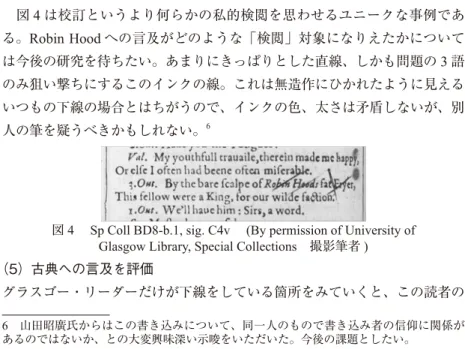
は校訂というより何らかの私的検閲を思わせるユニークな事例である。
Robin Hood
への言及がどのような「検閲」対象になりえたかについては今後の研究を待ちたい。あまりにきっぱりとした直線、しかも問題の
3
語 のみ狙い撃ちにするこのインクの線。これは無造作にひかれたように見える いつもの下線の場合とはちがうので、インクの色、太さは矛盾しないが、別 人の筆を疑うべきかもしれない。6(5)古典への言及を評価
グラスゴー・リーダーだけが下線をしている箇所をみていくと、この読者の 6 山田昭廣氏からはこの書き込みについて、同一人のもので書き込み者の信仰に関係が あるのではないか、との大変興味深い示唆をいただいた。今後の課題としたい。
図4 Sp Coll BD8-b.1, sig. C4v (By permission of University of Glasgow Library, Special Collections 撮影筆者)
場合、古典への言及がより評価されているように思われる。いくつもあるな かから、ここでは
3
か所を取り上げる。ディドーをめぐるやりとりに引かれ た下線、Gon. Not since widdow Dido
's time.
Ant. Widow? A pox o
’that: how came that Wid- dow in? Widdow Dido!
Seb. What if he had said Widdower Æneas too?
Good Lord, how you take it?
Adri. Widdow Dido said you? You make me study
(
A4r Temp TLN750-55
)ターゲットは古典への言及であろう。明星コピーで当該箇所にはなんらの反 応も書き込まれていない。ピストルらしい以下の大げさなセリフ、“
Or goe thou like Sir Acteon he, with / Ring-wood at thy heeles: O, odious is the name.
”(
D4v Wives TLN 660-61
) に下線を引き欄外に“ap:
”と書き入れている。明星リーダーはこの箇所には下線は引いていない。もう一カ所は両者とも に注目したことが認められる台詞での違いを取り上げておこう。
The Two Gentlemen of Verona 3
幕1
場のヴァレンタインの台詞。4
行からなる台詞の 前半に下線(上線)を引く明星リーダーに対し、グラスゴー・リーダーが引 くのは後半だ。Why then a Ladder quaintly made of Cords To cast vp, with a paire of anchoring hookes, Would serue to scale another Hero
's towre,
So bold Leander would aduenture it.
(C3 TGV TLN 1186-89
)Valentine
のこのセリフに目をとめているのは両者に共通しているのであるが、ハイライトする行が違っている。明星リーダーはプロットないしはストー リーラインをここでは追っているといえるかもしれない。
(6)ウィットと喜劇性の重視
明星リーダーが道化芝居やドタバタ芝居には熱心な反応を示すことはほと んどないのに対し、グラスゴー・リーダーはそういう箇所もばかばかしがら ずに積極的にマーキングをしている。たとえば、ラーンスの道化芝居中の
“
now should not the shooe speake a word for weeping:
”(C1 TGV TLN 616-17
) に下線を施し、“ap:
”と書き入れる。明星リーダーは欄外にひと言“foolerie
” と記すのみである。同じ芝居のヴァレンタインとスピードのテンポの良いや り取りへの反応にも違いが現れる。Val. How esteem
'st thou me? I account of her beauty.
Speed. You neuer saw her since she was deform
’d.
Val. How long hath she beene deform
‘d?
Speed. Euer since you lou
‘d her.
(B6 TGV TLN 455-58
)2
行目の恋に目がくらむと相手の真の姿が見えなくなるという教訓により近 いセリフは明星リーダーもショートラインではあるが、マーキングをしてい るし、欄外には、“Louers are blind
”と書きつけている。それにもかかわらず、このやりとりは素通りしている。グラスゴー・リーダーの方には、機知にと んだテンポのよいダイアローグそのものに、関心がありそうだ。
(7)情熱的恋愛
Shakespeare in Love
で す っ かりおなじみの “What light, is light, if Siluia be not feene
”(
C3v TGV TLN 1239
) で は じ まるパッセージで、ふたりの 読者のマーキングぶりを比べ てみよう。(図5&6
)下線の引 かれ具合に、グラスゴー・リー ダーのほうのこの台詞に対する 熱 さ が 顕 著 に 見 て 取 れ よ 図5 Mr 774, sig.C4v (明星大学図書館所蔵)
う。もっとも、明星コピーで は欄外の書き込みに“
Threats/
passionat loue
”とあり,
情熱的 恋を冷静に観察している読者 の存在が伝わってくる。7(8)モンスター・キャリバン
トリンキュローやステファノーらからモンスター呼ばわりされるキャリバン のせりふにも明星リーダーにはない下線が引かれている。“
ap:
”をともない“
For I am all the Subiects that you haue, / Which first was min owne King
”(A2v Temp TLN480-81
) や“Thou didst preuent me, I had peopel
'd else / This Isle with Calibans
”(A3 Temp TLN 490-91
)に下線を引くこの読者のマーキング は、キャリバンの人物造形を評価したとNicholas Rowe
が作家評伝で言及し たルーシアス・ケアリらしいマーキングだとのエマ・スミスの指摘はそのと おりであろう。このようなキャリバン自身の誇り高いせりふだけでなく、彼を“
Monster
”と呼び続けるトリンキュローやステファノーらのキャリバンとの道化芝居的なやり取りにも丹念に下線が引かれていくあたりは、コミッ クな道化芝居を評価するグラスゴー・リーダーの特徴の発現と言えるかもし
れない。
The Tempest
では妖精のエアリエルのせりふや、妖精を操るプロスペローの演劇そのものと重なっていくマジックを表現する
“
Our Reuels now are ended: These our actors,
/
(As I foretold you
)were all Spirits, and / Are melted into Ayre, into thin Ayre
”(B2 Temp TLN 1819-21
) といったせりふに 7 この書き込みの比較について、山田昭廣氏はグラスゴー・リーダーも明星リーダーも 完全におなじ読者反応である、上線のかわりに縦線でこの台詞すべてをカヴァーしている 明星リーダーの方が強いかもしれない、との解釈を示された(private correspondence)。明 星リーダーの縦線については、山田(2013)pp.165-66等を参照。図6 Sp Coll BD8-b.1, sig. C4v (By permission of University of Glasgow Library, Special Collections 撮影筆者)
すかさず下線が引かれる。このせりふの後に続く、地上のものの移ろいやす さという格言的表現はどちらの読者も共に下線で反応を示しているのだが。
さらには、
Gon. I
'th name of something holy, Sir, why stand you
In this strange stare?
Al. O, it is monstrous: monstrous:
Me thought the billowes spoke, and told me of it,
The windes did sing it to me: and the Thunder
(That deepe and dreadfull Organ-Pipe
)pronounc
'd
The name of Prosper:
(B1 Temp TLN 1630-36
)のような、ゴンザーローやアロンゾーら貴族たちの語る無人島の不思議の描 写にも多数の下線を引いて関心のありかを記録したグラスゴー・リーダーに は、明星リーダーに比べて、恐らくは実際の観劇体験が醸成したであろう演 劇的想像力がより強く感じられるように思う。
The Two Gentlemen of Verona
の書き込み 凡例転写記録の各項は、まず、書き込みの場所(
Signature, column a or b
など 場所の詳細、TLN
)、下線箇所の台詞話者を示し、そのあとで、下線をひか れたテクストを引用符(ダブル)で囲んで引用する。下線が複数話者の台詞 に跨り、かつひとかたまりのパッセージとして認識されていると判断される 場合には、引用に発話者指示speech prefix
を含める。韻文、散文を問わず、フォ リオの改行箇所を斜線で示す。すこしでも下線が及んでいると判断する単語 には下線を施した。下線以外の書き込みには引用符(シングル)をつけて記録する。‘
ap:
'(I approve
の意と考えられる) の場合はそれが指していると思われる下線の記録の最後に記録する。転写は読者の便宜のため幕場(
[1/1]
のように表示)ごとに区切って示すことにする。図
7
はLorenzo Cary
の記 名のあるC5v
の全体像である。The Two Gentlemen of Veronaの書き込みの転写
[1.1]
B4v a. 12-13. Valentine.
“But since thou lou
'st; loue still, and thriue therein,/
Euen as I would, when I to loue begin.
”‘ap:
’.
B4v a. 14-22.
“Pro. Wilt thou be gone? Sweet Valentine adew, /Thinke on thy Protheus, when thou
(hap
'ly
)seest/ Some rare note-worthy obiect in thy
図7
Sp Coll BD8-b.1, sig. C5v (By permission of University of Glasgow Library, Special Collections 撮影筆者)
trauaile./ Wish me partaker in thy happinesse,/ When thou do
'st meet good hap; and in thy danger, /
(If euer danger doe enuiron thee
)/Commend thy grieuance to my holy prayers,/ For I will be thy beades-man, Valentine. /Val.
And on a loue-booke pray for my successe?
”‘ap:
’.
B4v a. 33-39. Valentine.
“To be in loue; where scorne is bought with grones: / Coy looks, with hart-sore sighes: one fading moments mirth, / With twenty watchfull, weary, tedious nights; / If hap
'ly won, perhaps a haplesse gaine; / If lost, why then a grieuous labour won; / How euer: but a folly bought with wit, / Or else a wit, by folly vanquished.
”‘ap:
’.
B4v b. 55-56. Valentine.
“But wherefore waste I time to counsaile thee / That art a votary to fond desire?
”‘ap:
’.
B4v b. 61-62. Valentine.
“To Millaine let me heare from thee by Letters / Of thy successe in loue;
”‘ap:
’.
B4v b. 70-73. Proteus.
“Thou Iulia, thou hast metamorphis
'd me: / Made me neglect my Studies, loose my time; / Warre with good counsaile; set the world at nought; / Made Wit with musing, weake; hart sick with thought.
”‘ap:
’. B4v b. 97. Speed.
“Such another proofe will make me cry baâ.
”‘ap:
’. [1.2]
B5 b. 187. Luciana.
“Fire that
's closest kept, burnes most of all.
”B5 b. 201. Luciana.
“To plead for loue, deserues more fee, then hate.
”‘ap:
’. B5 b. 211-214. Julia.
“Fie, fie: how way-ward is this foolish loue; / That
(like
a testie Babe
)will scratch the Nurse, / And presently, all humbled kisse the Rod? / How churlishly, I chid Lucetta hence, / When willingly, I would haue had her here? / How angerly I taught my brow to frowne, / When inward ioy enforc
'd my heart to smile?
”‘ap:
’.
B5v a, b. [no annotations]
[1.3]
B6 a. 380-81. Proteus.
“Thus haue I shund the fire, for feare of burning, / And drench
'd me in the sea, where I am drown
'd.
”‘ap:
’.
B6 a. 386-89. Proteus.
“Oh, how this spring of loue resembleth / The vncertaine
glory of an Aprill day, / Which now shewes all the beauty of the Sun, / And by
and by a clowd takes all away.
”‘ap:
’. [2.1]
B6 b. 432-35. Speed.
“that these follies are within you, / and shine through you like the water in an Vrinall: that / not an eye that sees you, but is a Physician to comment / on your Malady.
”‘ap:
’.
B6 b. 456-58.
“Speed. You neuer saw her since she was deform
'd. / Val. How long hath she beene deform
'd? / Speed. Euer since you lou
'd her.
”B6 b. 463-66. Speed.
“Because Loue is blinde: O that you had mine / eyes, or your owne eyes had the lights they were wont / to haue, when you chidde at Sir Protheus, for going vn- / garter
'd.
”‘ap:
’.
B6v a. 487. Speed.
“Oh excellent motion; oh exceeding Puppet:
”‘ap:
’.
B6v a. 506-09. Silvia.
“A pretty period: well: I ghesse the sequell; / And yet I will not name it: and yet I care not. / And yet, take this againe: and yet I thanke you: / Meaning henceforth to trouble you no more.
”‘me[reading doubtful]: ap:
’.
B6v a. 526-27. Speed.
“Oh Iest vnseene: inscrutible: inuisible, / As a nose on a mans face, or a Wethercocke on a steeple:
”‘ap:
’.
B6v b. 549. Valentine.
“She gaue me none, except an angry word.
”‘ap:
’. B6v b. 557. Speed.
“Or fearing els some mess
ēger, yt might her mind discouer
”.
‘
ap:
’B6v b. 558. Speed.
“Her self hath taught her Loue himself, to write vnto her
(
louer,
”‘fo[reading doubtful].
’[2.2]
B6v b. 577-80. Proteus.
“And when that howre ore-slips me in the day, / Wherein I sigh not
(Iulia
)for thy sake, / The next ensuing howre, some foule mischance / Torment me for my Loues forgetfulnesse:
”‘ap:
’.
B6v b. 584-86. Proteus.
“Iulia, farewell: what, gon without a word? / I, so true loue should doe: it cannot speake, / For truth hath better deeds, then words to grace it.
”‘
ap:
’.
B6v b. 588-89. Proteus.
“Goe: I come, I come: / Alas, this parting strikes poore
Louers dumbe.
”‘ap:
’.
[2.3]
C1 a. 616-17. Launce.
“come I to my Father; Father, your blessing: now / should not the shooe speake a word for weeping:
”‘ap:
’.
[2.4]
C1 b. 683-84.
“Val. I know it wel sir, you alwaies end ere you begin. / Sil. A fine volly of words, gentlem
ē, & quickly shot off
”.
‘ap:
’.
C1 b. 687-91.
“Val. Your selfe
(sweet Lady
)for you gaue the fire, / Sir Thurio borrows his wit from your Ladiships lookes, / And spends what he borrowes kindly in your company. / Thu. Sir, if you spend word for word with me, I shall / make your wit bankrupt.
”‘me ap:
’.
C1 b. 692-93. Valentine.
“I know it well sir: you haue an Exchequer of
(words, / And I thinke, no other treasure to giue your followers:
”‘ap:
’.
C1v a. 725-27. Duke.
“Beshrew me sir, but if he make this good / He is as worthy for an Empresse loue, / As meet to be an Emperors Councellor:
”.
‘
ap:
’.
C1v a. 745. Valentine.
“Why Lady, Loue hath twenty paire of eyes
”.
C1v a. 747-49.
“Val. To see such Louers, Thurio, as your selfe, / Vpon a homely obiect, Loue can winke. / Sil. Haue done, haue done: here comes ye gentleman.
”‘ap:
’.
C1v a. 756. Silvia.
“Too low a Mistres for so high a seruant.
”‘
me:ap:
’. C1v a. 757-58. Proteus.
“Not so, sweet Lady, but too meane a seruant / To haue
a looke of such a worthy a Mistresse.
”‘wo:see:[reading doubtful]
’. C1v a. 764. Proteus.
“Ile die on him that saies so but your selfe.
”‘ap:
’.
C1v a. 766. Proteus.
“That you are worthlesse.
”[continued from the
‘ap:
’above]
C1v a. 777-88.
“Val. How does your Lady? & how thriues your loue? / Pro.
My tales of Loue were wont to weary you, / I know you ioy not in a Loue-
discourse. / Val. I Protheus, but that life is alter
'd now, / I haue done pennance
for contemning Loue, / Whose high emperious thoughts haue punish
'd me /
With bitter fasts, with penitentiall grones, / With nightly teares, and daily hart-
sore sighes, / For in reuenge of my contempt of loue, / Loue hath chas
‘d
sleepe from my enthralled eyes, / And made them watchers of mine owne hearts sorrow. / O gentle Protheus, Loue
's a mighty Lord,
”‘ap:
’.
C1v b. 789-94. Valentine.
“And hath so humbled me, as I confesse / There is no woe to his correction, / Nor to his Seruice, no such ioy on earth: / Now, no discourse, except it be of loue: / Now can I breake my fast, dine, sup, and sleepe, / Vpon the very naked name of Loue.
”[contituned from the
‘ap
’above.]
C1v b. 797. Valentine.
“Euen She; and is she not a heauenly Saint?
”C1v b. 811-18.
“Val. And I will help thee to prefer her to: / Shee shall be dignified with this high honour, / To beare my Ladies traine, lest the base earth / Should from her vesture chance to steale a kisse, / And of so great a fauor growing proud, / Disdaine to roote the Sommer-swelling flowre, / And make rough winter euerlastingly. / Pro. Why Valentine, what Bragadisme is this?
”‘
ap: to: [reading doubtful]
’.
C1v b. 824-26. Valentine.
“And I as rich in hauing such a Iewell / As twenty Seas, if all their sand were pearle, / The water, Nectar, and the Rocks pure gold.
”‘ap: to:
’C1v b. 847-50. Proteus.
“Euen as one heate, another heate expels, / Or as one naile, by strength driues out another. / So the remembrance of my former Loue / Is by a newer obiect quite forgotten,
”‘ap: me:
’.
C2 a. 855-57. Proteus.
“(That I did loue, for now my loue is thaw
'd, / Which like a waxen Image
'gainst a fire / Beares no impression of the thing it was.
)”‘
ap:p[pr?]o:[reading doubtful]
’.
‘ap:p[pr?]o:[reading doubtful]
’C2 a. 868-69. Proteus.
“If I can checke my erring loue, I will, / If not, to compasse her Ile vse my skill.
”‘ap: me:
’[2.5]
C2 a. 874-78. Launce.
“Forsweare not thy selfe, sweet youth, for I am / not welcome. I reckon this alwaies, that a man is neuer / vndon till hee be hang
‘d, nor neuer welcome to a place, / till some certaine shot be paid, and the Hostesse say wel-/ come.
”‘ap:
’.
C2 a. 903-05. Launce.
“Aske my dogge, if he say I, it will: if hee say / no, it
will: if hee shake his taile, and say nothing, it / will.
”‘ap:
’.
C2 a. 907-08. Launce.
“Thou shalt neuer get such a secret from me, but / by a parable.
”‘go:/And ap: [reading doubtful]
’.
[2.6]
C2 b. 938-39. Proteus.
“At first I did adore a twinkling Starre, / But now I worship a celestiall Sunne:
”‘ap: pfr: bon:[reading doudtful]
’.
C2b. 940-45. Proteus.
“Vn-heedfull vowes may heedfully be broken, / And he wants wit, that wants resolued will, / To learne his wit, t
'exchange the bad for better; / Fie, fie, vnreuerend tongue, to call her bad, / Whose soueraignty so oft thou hast preferd, / With twenty thousand soule-confirming oathes.
”‘ap:
me
’.
C2 b. 954-55. Proteus.
“And Siluia
(witnesse heauen that made her faire
)/ Shewes Iulia but a swarthy Ethiope.
”‘ap: ib:
’.
C2 b. 971-72. Proteus.
“Loue lend me wings, to make my purpose swift / As thou hast lent me wit, to plot this drift.
”[2.7]
C2v a. 976-77. Julia.
“Counsaile, Lucetta, gentle girle assist me, / And eu
'n in kinde loue, I doe coniure thee,
”‘ap: me:
’.
C2v a. 978-80. Julia.
“Who art the Table wherein all my thoughts / Are visibly Character
'd, and engrau
'd, / To lesson me, and tell me some good meane
”‘
ap:
’.
C2v a. 984-87. Julia.
“A true-deuoted Pilgrime is not weary / To measure Kingdomes with his feeble steps, / Much lesse shall she that hath Loues wings to flie,
”‘ap:
’.
C2v a. 991-95. Julia.
“Pitty the dearth that I haue pined in, / By longing for that food so long a time. / Didst thou but know the inly touch of Loue, /Thou wouldst as soone goe kindle fire with snow / As seeke to quench the fire of Loue with words.
”‘ap:
’.
C2v a. 1008-13. Julia.
“Then let me goe, and hinder not my course: / Ile be as
patient as a gentle streame, / And make a pastime of each weary step, / Till
the last step haue brought me to my Loue,/ And there Ile rest, as after much
turmoil / A blessed soule doth in Elizium.
”‘ap:
’.
C2v a. 1022-26.
“To be fantastique, may become a youth / Of greater time then I shall shew to be. / Luc. What fashion
(Madam
)shall I make your bree-/
(ches?
/ Iul. That fits as well, as tell me
(good my Lord
)/ What compasse will you weare your Farthingale?
”‘ap:
’.
C2v b. 1043-53. Julia.
“Iul. That is the least
(Lucetta
)of my feare: / A thousand oathes, an Ocean of his teares, / And instances of infinite of Loue, / Warrant me welcome to my Protheus. / Luc. All these are seruants to deceitfull men. / Iul. Base men, that vse them to so base effect; / But truer starres did gouerne Protheus birth, / His words are bonds, his oathes are oracles, / His loue sincere, his thoughts immaculate, / His teares, pure messengers, sent from his heart, / His heart, as far from fraud, as heauen from earth.
”‘ap:
’.
[3.1]
C2v b. 1084. Proteus.
“Know
(worthy Prince
)Sir Valentine my friend
”.
‘