16
Geospace Exploration Mission ERG
Takeshi Takashima
*1, Yoshizumi Miyoshi
2, Takayuki Ono
3, and ERG project team 1 Japan Aerospace Exploration Agency (JAXA) / ISAS, Japan
2 Solar-Terrestrial Environment Laboratory, Nagoya University, Japan 3 Graduate School of Science, Tohoku University, Japan
*Email:
[email protected]Keyword(s): Particle acceleration, Space weather, Radiation belts, Space mission Abstract
The ERG (Energization and Radiation in Geospace) is a Japanese geospace exploration mission for the solar maximum and early declining phase of this solar cycle, especially focusing on the relativistic electron acceleration as well as the dynamics of the space storms. The project consists of the satellite program, ground-based network observations, and integrated studies/simulations. The ERG satellite is the second mission candidate of the small satellite program of ISAS/JAXA and will be launched into the inner magnetosphere in FY2015. Comprehensive instruments for plasma/particle, fields and waves are installed in the ERG satellite to understand the electron acceleration process via the cross-energy coupling. This paper reports the overview and the current status of the ERG project.
1. Introduction
High-energy particles (ions and electrons) are trapped in the Earth’s magnetic field and formed the Van Allen radiation belts. MeV electrons in the radiation belts are the highest energy of particles in the geospace. The radiation belts are unique area where “direct observation of relativistic electron acceleration” is possible which is too difficult with distant planets or celestial bodies. Therefore, the direct observations inside the radiation belts will give an important clue to understand the particle acceleration process in the universe.
As acceleration mechanisms of relativistic electrons of the radiation belts, two different ideas have been proposed. One is the external source process via the adiabatic acceleration [1]. In this process, when electrons transport from the plasma sheet to the inner magnetosphere, the energy of electrons increases due to the conservation of their first adiabatic invariant. This process has been modeled as the stochastic radial diffusion process, and the radial diffusion is a fundamental transportation mode of energetic electrons. The MHD pulsations with a few minutes have been considered as the main driver for the radial transportation via the drift-resonance with electrons [2].
On the other hand, there exists other candidate, so-called the internal acceleration process. In this process, the first adiabatic invariant is violated due to the wave-particle interactions. It has been suggested that wave-particle interactions via cyclotron resonance work for the electron acceleration inside the radiation belts [3][4]. In this process, the free-energy for generating whistler mode waves is the temperature anisotropy of tens keV electrons, and subsequent non-linear evolution will produce chorus waves [5], which can acceleration MeV electrons.
Therefore, the whistler mode waves work as a mediating agent that can convert the energy from low energy electron population to higher energy one, and the concept of the cross-energy coupling would be a key idea to understand the electron acceleration process [6].
In order to examine which process (external supply process or internal acceleration process) occurs more efficiently for large flux enhancements of the outer belt, the phase space density observation is essential. When relativistic electrons of the outer belt increase, it is expected that, with the radial diffusion process, the phase space density increases monotonically with the distance from the Earth. On the other hand, with the internal acceleration process via the wave-particle interactions, the phase space density must have peak inside the outer belt. In order to measure the phase space density, it is necessary to observe the electron distribution function in a wide range of energy near the magnetic equator.
Besides these science interesting, a study of relativistic electrons in the radiation belts is important for the space weather. Space infrastructures such as GPS and meteorological satellites are indispensable to our lives in modern society. These satellites operate in the radiation belts. Some activities such as the International Space Station also take place at the bottom of the inner radiation belt. The high-energy particles can cause operational anomalies with satellites and exert a dangerous impact on the mankind’s long-term stay in space. In fact, the close relationship is suggested between the satellite anomaly and the large flux enhancement of relativistic electrons of the outer belt. For humankind to act safely and comfortably in the outer space, the study of the radiation belts in space weather research is especially important.
2. The ERG satellite
2.1 Overview of the ERG satellite
Space Environments and Missions A - 1
JAXA Special Publication JAXA-SP-12-008EThis document is provided by JAXA
17
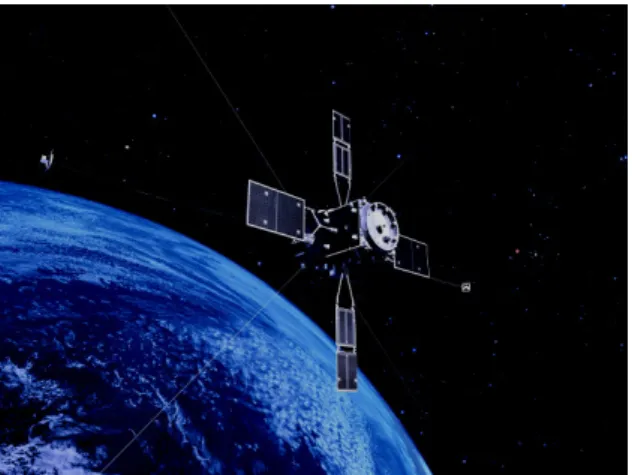
The comprehensive observations for plasma/particles, fields and waves near the magnetic equator are important for understanding the cross energy coupling for relativistic electron accelerations and dynamics of space storms. Figure 1 shows a image picture for the ERG satellite in the space. The ERG satellite is sun-aligned spin stabilized with 7.5rpm. The apogee altitude is 4 Re (L~5) and the perigee altitude is ~300 km. The planned inclination angle will be ~31deg.
The ERG satellite will be launched around the early declining phase of cycle 24 (~ FY2014-15). The nominal mission life is planned to be longer than 1 year.
2.1 Plasma and Particle experiments (PPE)
Plasma and Particle Experiment (PPE) consist of four electron sensors (LEP-e, MEP-e, HEP-e, and XEP-e) and
two ion sensors (LEP-i, and MEP-i). PPE electron sensors can measure electrons from 10 eV to 20 MeV, while ion sensors can measure ions from 12 eV/q to 180 keV/q with mass discrimination. The energy ranges of each detector are designed to overlap each other, which can provide seamless energy spectrum.
About electron observations, both HEP-e and XEP-e instruments mainly observe relativistic electrons of the radiation belts, and these instruments are essential to derive the phase space density profile. On the other hand, LEP-e and MEP-e instruments observe hot electrons that are free energy source for plasma waves. Since anisotropies of the distribution function should be a free energy of plasma waves, observations of the distribution function is important to clarify how plasma waves generate inside the radiation belts. Measurements of particles at the energy range of tens keV is very difficult in the radiation belts. Newly developed technologies to remove background contamination can be applied in ERG/PPE, and detail observations of tens keV electrons will be possible.
About ion observations, LEP-i and MEP-i instruments observe several ion species in the inner magnetosphere.
Although there are same contamination problems as electron observations, especially, at tens keV energies, the new technology is realize to observe ions up to 180 keV/q in the radiation belts. These ion observation data will be used for study of evolution of ring current ions, and ion observations with mass discrimination are essential to study the composition of ring current particles that come from both solar wind and the ionosphere.
2.2 Plasma Wave and Electric Field (PWE)
Plasma Wave and Electric Field (PWE) instrument observes electric fields at the frequency range from DC to 10 MHz as wells as the magnetic field at the frequency range from a few Hz to 20 kHz. The electric field is measured by two pairs of wire dipole antennas, and its length is about 30 m tip-to-tip. The high-frequency magnetic field is measured by the two orthogonal search coils.
There are various kinds of plasma waves in the inner magnetosphere. Whistler mode chorus waves and the ion Bernstein mode waves will be important for non-adiabatic acceleration to generate relativistic electrons.
Electromagnetic ion cyclotron (EMIC) waves that are generated from ring current ions will work for rapid pitch angle scattering of relativistic electrons. Whistler mode hiss waves inside plasma-pause work for the pitch angle scattering of electrons. The PWE instrument can observe the frequency spectrum and wave-form of these plasma waves. The MHD pulsations with ~5 min periods are a driver for adiabatic acceleration by radial diffusion, which can be observed by the PWE instrument as well as the MGF instrument. Thermal plasma density that is important information for wave-particle interactions is determined from cutoff-frequency of the upper-hybrid resonance waves. The onboard measurement of the thermal plasma density will be developed for the ERG satellite.
2.3 Measurement of Geomagnetic Field (MGF)
Measurement of Geomagnetic Field (MGF) instrument observes the ambient magnetic field as well as the MHD pulsations. The fluxgate sensor with the boom is used for measurements.
Observations of ambient magnetic field are a key to know ambient plasma environment around the ERG satellite. The plasma distribution function and pitch angle distribution is obtained using the ambient magnetic field. The local cyclotron frequency is also determined from the MGF measurement.
The MGF instrument observes MHD pulsations and EMIC waves as well as the PWE instrument. Since the ring current evolution produces distortions of the ambient magnetic field, and its distortion affects the particle distribution and trajectories in the inner magnetosphere, the accurate measurements of magnetic field deviation from the intrinsic magnetic field is important to evaluate the ring current effect. The ERG/MGF instrument can measure such deviations of magnetic fields during space storms.
Fig. 1. Image of the ERG satellite in the space Proceedings of 10th International Workshop on Radiation Effects on Semiconductor
Devices for Space Applications
This document is provided by JAXA
18
2.4 Software-Wave Particle Interaction Analyzer (S-WPIA)
In order to measure the wave-particle interactions, that is energy conversion process between plasma/particles and waves, the newly developed S-WPIA system will be installed in the ERG satellite.
The vector cross-product of the particle velocity and the electric field velocity should be equal to the time derivative of the kinetic energy of particles; the positive E⋅v means the acceleration of particles by waves, while the negative E⋅v means the growth of waves. Therefore, the relative phase between the electric field and the velocity of particles determines the direction of the energy flow.
Using the particle data from MEP-e/HEP-e and the wave form data from the PPE, the S-WPIA system can calculate the relative phase between the waves and the particles for each particle. This will be the first observation to identify directly the wave-particle interaction process in space, and we can observe the cross-energy coupling process via wave-particle interaction process.
3. International Collaborations
The next solar maximum would be great chance for comprehensive study of geospace and the Van Allen belts, because some missions of foreign countries have been planned. In fact, RBSP (US), ORBITALS (Canada), RESONANCE (Russia) are planned for geospace exploration during the next solar maximum. Simultaneous observations at different radial distance from the Earth and different local times are possible by the international fleet of satellites, which are highly desirable for the ERG project.
4. Summary
The high-energy particle acceleration is a common scientific subject, not limited to the Earth’s magnetosphere but applicable to particle acceleration in magnetospheres of other planets. The ERG satellite mission is particularly important for the future exploration of the Jovian magnetosphere.
Science subjects in the Van Allen belts are readily common in the Jovian magnetosphere, where ultra relativistic electrons are generated. In fact, the non-adiabatic acceleration process via wave-particle interactions has been proposed based on the recent studies in the terrestrial radiation belts. Moreover, the science instruments developed for the ERG satellites, which are designed to work under the intense radiation environment, will also be an important heritage for instrumentation of the future Jupiter mission.
References
[1] Schulz, M., and Lanzerotti, L.: Particle diffusion in the radiation belts, Springer-Verlag, Berlin and Heiderberg, 1974.
[2] Elkington, S. R., M. K. Hudson, and A. A. Chan, Acceleration of relativistic electrons via drift
‐resonant interaction with toroidal
‐mode Pc
‐5 ULF oscillations, Geophys. Res. Lett., 26(1999), 3273-3276
[3] Summers, D., R. Thorne, and F. Xiao, Relativistic theory of wave
‐particle resonant diffusion with application to electron acceleration in the magnetosphere, J. Geophys. Res., 103(1998), 20487-20500.
[4] Miyoshi, Y., A. Morioka, H. Misawa, T. Obara, T. Nagai, and Y. Kasahara, Rebuilding process of the outer radiation belt during the 3 November 1993 magnetic storm: NOAA and Exos-D observations , , 108 ( 2003 ) , 1004, doi:10.1029/2001JA007542.
[5] Katoh, Y. and Y. Omura (2007), Computer simulation of chorus wave generation in the Earth’s inner magnetosphere, Geophys. Res., Lett., 34, doi:10.1029/2006GL028594.
[6] Ebihara, Y., and Y. Miyoshi, Dynamic inner magnetosphere: A tutorial and recent advances, in Dynamic Magnetosphere, IAGA Special Sopron Book Series, in press.
JAXA Special Publication JAXA-SP-12-008E
This document is provided by JAXA