
Biosynthesis and in vitro enzymatic synthesis of the isoleucine conjugate of
12‑oxo‑phytodienoic acid from the isoleucine conjugate of α‑linolenic acid
journal or
publication title
Bioorganic & Medicinal Chemistry Letters
volume 28
number 6
page range 1020‑1023
year 2018‑04‑01
URL http://id.nii.ac.jp/1578/00002393/
doi: 10.1016/j.bmcl.2018.02.030
Creative Commons : 表示 ‑ 非営利 ‑ 改変禁止 http://creativecommons.org/licenses/by‑nc‑nd/3.0/deed.ja
Title 1
Biosynthesis and in vitro enzymatic synthesis of the isoleucine conjugate of 12-oxo- 2
phytodienoic acid from the isoleucine conjugate of -linolenic acid.
3 4
Authors 5
Akira Uchiyama
a, Takaomi Yaguchi
a, Hiroyuki Nakagawa
b, Kento Sasaki
a, Naoshige 6
Kuwata
a, Hideyuki Matsuura
a, and Kosaku Takahashi
a†7
8
Affiliations 9
a
Division of Fundamental Agroscience Research, Research Faculty of Agriculture, 10
Hokkaido University, Kita 9, Nishi 9, Kita-ku, Sapporo 060-8589, Japan 11
12
b
National Agriculture and Food Research Organization (NARO), Food Research Institute, 13
2-1-12 Kannon-dai, Tsukuba-shi, Ibaraki 305-8642, Japan 14
15
†To whom correspondence should be addressed.
16
Tel: +81-11-706-3349; Fax: +81-11-706-2505; E-mail: [email protected] 17
18
Abbreviations 19
AOC, allene oxide cyclase; AOS, allene oxide synthase; COI1, coronatine insensitive 1;
20
12,13-EOT, allene oxide; GC-MS, gas chromatography-mass spectrometry; 13-HPOT, 13- 21
hydroperoxy octadecatrienoic acid; JA, jasmonic acid; JA-Ile, jasmonoyl-L-isoleucine;
22
JAR1, jasmonic acid-resistant 1; JAZ, jasmonate-zim domain; LC-MS/MS, liquid 23
chromatography-tandem mass spectrometry; LA-Ile, isoleucine conjugate of -linolenic 24
acid; OPC-8:0, 3-oxo-2-( cis -2’-pentenyl)-cyclopentane-1-octanoic acid; OPDA-Ile, 25
isoleucine conjugate of OPDA; OPR, 12-oxo-phytodienoic acid reductase; SCF, skp-cullin- 26
F box.
27
28
Abstract 29
The isoleucine conjugate of 12-oxo-phytodienoic acid (OPDA-Ile), a new member of the 30
jasmonate family, was recently identified in Arabidopsis thaliana and might be a signaling molecule 31
in plants. However, the biosynthesis and function of OPDA-Ile remains elusive. This study reports an 32
in vitro enzymatic method for synthesizing OPDA-Ile, which is catalyzed by reactions of lipoxygenase 33
(LOX), allene oxide synthase (AOS), and allene oxide cyclase (AOC) using isoleucine conjugates of 34
-linolenic acid (LA-Ile) as the substrate. A. thaliana fed LA-Ile exhibited a marked increase in the
35
OPDA-Ile concentration. LA-Ile was also detected in A. thaliana. Furthermore, stable isotope labelled 36
LA-Ile was incorporated into OPDA-Ile. Thus, OPDA-Ile is biosynthesized via the cyclization of LA- 37
Ile in A. thaliana.
38 39
Keywords 40
Arabidopsis thaliana, jasmonates, LA-Ile, OPDA-Ile, 12-oxo-phytodienoic acid.
41 42
Plants have a wide variety of physiological responses that allow them to adapt to adverse 43
environmental conditions that negatively affect their growth and development. Jasmonic acid (JA, 1) 44
plays important roles in stress responses and development in plants. JA (1) functions as a signaling 45
molecule in numerous plant physiological processes related to development and defense responses.
146
Most enzymes that participate in JA (1) biosynthesis have been successfully characterized. JA (1) has 47
been shown to be a signaling molecule in both flowering plants and a model lycophyte, Selaginella 48
moellendorffii.
2JA (1) is a ubiquitous phytohormone detected in vascular plant species.
49
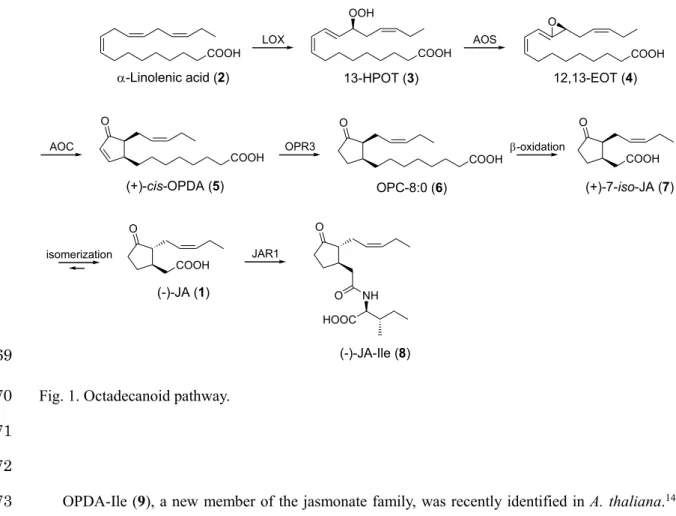
The JA (1) biosynthetic pathway begins with the lipase-mediated release of α-linolenic acid (2) 50
from the membrane lipids of chloroplasts (Fig. 1).
1In chloroplasts, lipoxygenase (LOX) oxidizes α- 51
linolenic acid (2) into 13(S)-hydroperoxy octadecatrienoic acid (13-HPOT,
3). 13-HPOT (3) is52
metabolized by allene oxide synthase (AOS) into an unstable allene oxide (12,13-EOT, 4), which is 53
cyclized by allene oxide cyclase (AOC) into cis-(+)-12-oxo-phytodienoic acid (OPDA, 5). The AOC 54
reaction provides two side chain configurations in the naturally occurring jasmonate structure.
55
Reduction of the 10,11-double bond in OPDA (5) by OPDA reductase 3 (OPR3) then yields 3-oxo-2-
56
(2-cis-pentenyl)cyclopentane-1-octanoic acid (OPC-8:0, 6). Three β-oxidation steps convert OPC-8:0 57
(6) into (+)-7-iso-JA (7), which is naturally isomerized to (−)-JA (1). JA (1) is converted to the 58
isoleucine conjugate of JA (JA-Ile, 8) by JAR1. JA-Ile (8) is considered a versatile signaling compound 59
in the JA signaling pathway.
1,3JA-Ile (8) binds to its receptor, coronatine insensitive 1 (COI1), and 60
then mediates the binding of the JAZ protein to the COI1-JA-Ile unit of the skp-cullin-F box (SCF) 61
complex, resulting in degradation by the 26S proteasome and the subsequent induction of COI1- 62
dependent JA responses.
4-6OPDA (5) is not only an intermediate in the JA biosynthetic pathway but 63
also exerts individual JA (1)-independent biological functions.
7-9OPDA (5) binds cyclophilin 20-3, 64
leading to enhanced redox capability in Arabidopsis thaliana.
10In contrast, OPDA (5), but not JA (1), 65
is present in the model bryophytes Marchantia polymorpha and Physcomitrella patens, with functions 66
in defense and development.
11-13However, the detailed mechanism of the OPDA signaling system 67
remains unknown.
68
COOH COOH
OOH
COOH O
COOH O
COOH O
COOH O
-Linolenic acid (2) 13-HPOT (3) 12,13-EOT (4)
(+)-cis-OPDA (5) OPC-8:0 (6) (+)-7-iso-JA (7)
LOX
COOH
O O
NH O HOOC (-)-JA (1)
(-)-JA-Ile (8)
AOS
AOC -oxidation
isomerization JAR1
OPR3
69
Fig. 1. Octadecanoid pathway.
70 71 72
OPDA-Ile (9), a new member of the jasmonate family, was recently identified in A. thaliana.
1473
Moreover, OPDA-Ile (9) induces the expression of the ZAT10 gene, which encodes a salt tolerance
74
zinc finger protein, and the GRX480 gene, which encodes a GLUTAREDOXIN.
15,16Based on these 75
findings, OPDA-Ile (9) may function as a signaling molecule in plants. The OPDA-Ile (9) biosynthetic 76
mechanism has not yet been determined, whereas the A. thaliana jar1 mutant, which lacks the jar1 77
gene encoding a protein that catalyzes the conjugation of JA (1) with Ile, produces OPDA-Ile (9).
1678
Thus, the OPDA-Ile (9) biosynthetic pathway, which is independent of JAR1, is proposed to be present 79
in A. thaliana.
80
The biological functions of OPDA-Ile (9) remain elusive. An efficient method for synthesizing 81
OPDA-Ile (9) should be developed to investigate the detailed biological activities of this compound.
82
OPDA-Ile (9) was previously produced via the chemical conjugation of Ile and OPDA (5) under 83
alkaline conditions.
16,17The stereochemistry of the two side chains of OPDA (5) is easily converted 84
from the cis-form to trans-form under alkaline conditions; therefore, the previously reported method 85
for synthesizing OPDA-Ile (9) is not necessarily optimal. For OPDA (5) biosynthesis, reactions with 86
LOX, AOS and AOC occur on the unsaturated alkyl chains of α-linolenic acid (2), 13-HPOT (3), and 87
12,13-EOT (4), respectively.
18-20Analysis of the crystal structures of AOS and AOC suggests that 88
unsaturated alkyl chains of 13-HPOT (3) and 12,13-EOT (4) are present in the active sites of the 89
corresponding enzymes.
18,1990
O
OPDA-Ile (9) NH
O HOOC
O NH HOOC LA-Ile (10)
Flax seed extract PpAOC2
91
Fig. 2. In vitro enzymatic synthesis of OPDA-Ile (9). LA-Ile (10) was incubated in the reaction mixture 92
[50 mM Tris-HCl (pH 8.0), flax seed extract, PpAOC2] at 25 °C for 1 hours.
93 94 95
We attempted the in vitro cyclization of LA-Ile (10) to produce OPDA-Ile (9) by performing 96
continuous reactions with LOX, AOS, and AOC according to the method for in vitro stereoselective 97
OPDA (5) synthesis (Fig. 2).
21The mixture used for the in vitro synthesis of OPDA-Ile (10) contained 98
flaxseed extract, recombinant PpAOC2 derived from the model moss Physcomitrella patens, and LA-
99
Ile (10) and was incubated at 25 °C for 1 hour. As a result, 11 mg of OPDA-Ile (9) was successfully 100
synthesized from 30 mg of LA-Ile (10) with a 35% yield (Supplemental data). Analysis of the AOS 101
crystal structure suggests that a lysine residue of AOS near the substrate interacts with the carboxyl 102
group of 13-HPOT (3), thereby playing an important role in its binding.
18While the carboxyl group in 103
linolenic acid (2) is replaced by an amide bond in LA-Ile (10), a lysine residue near the substrate of 104
AOS may interact with the oxygen of the amide bond in a possible LOX product of LA-Ile (10). The 105
alkyl chain of Ile moiety derived from LA-Ile (10) must not interfere with binding to LOX, AOS, or 106
AOC. Therefore, the cyclization of LA-Ile (10) into OPDA-Ile (9) is found to have occurred.
107
Additionally, the in vitro enzymatic synthesis of OPDA-Ile (9) was conducted under mild conditions 108
and efficiently yielded OPDA-Ile (9). Considering the mechanisms of the LOX, AOS, and AOC 109
reactions, the method reported in this study could be applied to the synthesis of other amino acid 110
conjugates of OPDA.
111
The biosynthetic mechanism of OPDA-Ile (9) was not revealed until recently. Two possibilities 112
exist for the OPDA-Ile (9) biosynthetic pathway. One possibility is that OPDA-Ile (9) is synthesized 113
by a protein that conjugates OPDA (5) and Ile. In the case of JA-Ile (8), a GH3 protein, JAR1 114
conjugates JA (1) and Ile.
1A protein from the GH3 protein family is predicted to catalyze the 115
conjugation of OPDA (5) and Ile. The other possibility is that OPDA-Ile (9) is biosynthesized by three 116
continuous reactions with LOX, AOS, and AOC with LA-Ile (10) as the substrate, similar to the in 117
vitro enzymatic synthesis of OPDA-Ile (9). In a previous study, the marginal conversion of OPDA into 118
OPDA-Ile was observed in WS.
15The in vitro enzymatic synthesis of OPDA-Ile (9) in this study 119
supports the hypothesis that OPDA-Ile (9) is biosynthesized from LA-Ile (10) via LOX-, AOS-, and 120
AOC-mediated reactions in plants. A. thaliana plants grown for 30 days under short-day conditions 121
were treated with 100
M LA-Ile (10) or OPDA (5), and the accumulation of OPDA-Ile (9) was122
analyzed by ultra-performance liquid chromatography-tandem mass spectrometry (UPLC-MS/MS).
123
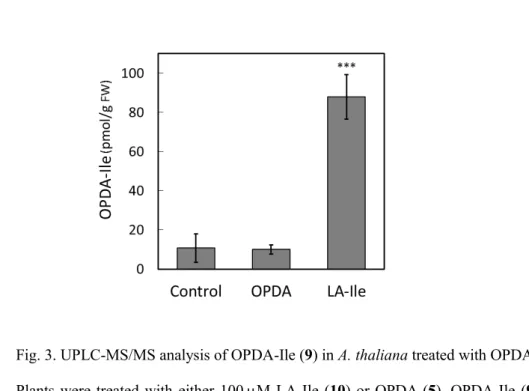
Based on the analytical data, the application of LA-Ile (10) significantly increased the OPDA-Ile (9) 124
concentration in A. thaliana. The amount of OPDA-Ile (9) in plants treated with LA-Ile (10) was 125
greater than that in untreated plants (Fig. 3). In contrast, the OPDA (5) treatment did not increase the 126
OPDA-Ile (9) concentration (Fig. 3). These results suggested that OPDA-Ile (9) was biosynthesized
127
from LA-Ile (10) but not OPDA (5).
128
129
Fig. 3. UPLC-MS/MS analysis of OPDA-Ile (9) in A. thaliana treated with OPDA (5) or LA-Ile (10).
130
Plants were treated with either 100 M LA-Ile (10) or OPDA (5). OPDA-Ile (9) was analyzed by 131
UPLC-MS/MS. The MRM mode was used to analyze a specific fragment peak at m/z 130.00 [M−H]
−132
derived from the peak at m/z 404.28 [M−H]
−. Each value is represented by the mean ± SD of five 133
independent biological replicates. Student’s t-test, ***p < 0.001.
134 135 136
As described above, OPDA-Ile (9) was postulated to be converted from LA-Ile (10); however, LA- 137
Ile (10) has not been reported as a natural product. A. thaliana was analyzed by liquid chromatography- 138
tandem mass spectrometry (LC-MS/MS) to determine the presence of LA-Ile (10). The analytical data 139
revealed a predominant peak derived from LA-Ile (10) in the chromatogram of an A. thaliana extract 140
(Fig. 4). The retention time of the peak was the same as the peak for the LA-Ile (10) standard. Thus, 141
LA-Ile (10 pmol/g FW, 10) is present in A. thaliana. To our knowledge, this report represents the first 142
evidence identifying LA-Ile (10) as a natural product.
143
144
145
Fig. 4. Analysis of LA-Ile (10) in A. thaliana. LA-Ile (10) was analyzed by LC-MS/MS. The MRM 146
mode was used to analyze a specific fragment peak at m/z 128.0 [M−H]
−derived from the peak at m/z 147
390.3 [M−H]
−. (A): standard; (B): plant extract.
148 149 150
To examine whether OPDA-Ile (9) was synthesized by an A. thaliana protein extract, a reaction 151
mixture comprising LA-Ile (10) and an A. thaliana protein extract was incubated for 1 hour, and then 152
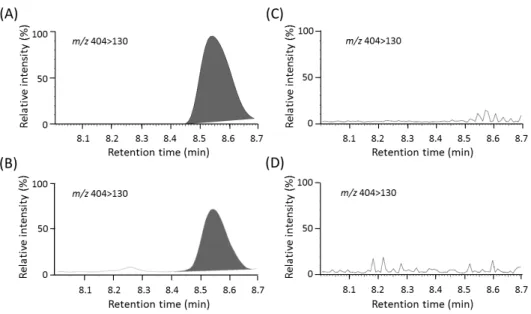
the reaction mixture was analyzed for the presence of OPDA-Ile (9) by UPLC-MS/MS. The peak 153
derived from OPDA-Ile (9) appeared clearly in the reaction mixture of LA-Ile (10) and the protein 154
extract (Fig. 5). In contrast, no clear peak derived from OPDA-Ile (10) was detected in the protein 155
extract lacking LA-Ile (10) or in the buffer used to generate the protein extract supplemented with LA- 156
Ile (10) (Fig. 5). Arabidopsis protein extract was shown to exhibit sequential LOX, AOS, and AOC 157
enzymatic activities to convert LA-Ile (10) into OPDA-Ile (9).
158
159
160
Fig. 5. In vitro synthesis of OPDA-Ile (9) by protein extracts from A. thaliana. LA-Ile (10) was 161
incubated with a protein extract prepared from A. thaliana at 25 C for 1 hour, and the mixture was 162
then analyzed for OPDA-Ile (9) by UPLC-MS/MS. The MRM mode was used to analyze a specific 163
fragment peak at m/z 130.00 [M−H]
−derived from the peak at m/z 404.28 [M−H]
−. (A): standard 164
OPDA-Ile (9); (B): LA-Ile (10) in protein extract; (C): protein extract without added LA-Ile (10); (D):
165
LA-Ile (10) in the buffer used for protein extraction.
166 167 168
Next, we investigated whether stable-isotope-labelled LA-Ile (9) was incorporated into OPDA-Ile 169
(9). LA-[
13C
6,
15N]Ile was fed to A. thaliana, and OPDA-[
13C
6,
15N]Ile in A. thaliana was then analyzed 170
by UPLC-MS/MS. The analytical data showed that the peak derived from OPDA-[
13C
6,
15N]Ile (m/z 171
411>137) clearly appeared, and the retention time of OPDA-[
13C
6,
15N]Ile was in accordance with that 172
of non-labelled OPDA-Ile (m/z 414>130) (Fig. 5). Accordingly, OPDA-Ile (9) is biosynthesized via 173
cyclization of the LA-Ile (10) substrate in A. thaliana.
174
175
176
Fig. 5. Incorporation of LA-[
13C
6,
15N]Ile into OPDA-[
13C
6,
15N]Ile into A. thaliana. Plants were treated 177
with or without 100 M LA-[
13C
6,
15N]Ile, and the resulting mixture was analyzed for OPDA- 178
[
13C
6,
15N]Ile by UPLC-MS/MS. The MRM mode was used to analyze a specific fragment peak of 179
OPDA-[
13C
6,
15N]Ile at m/z 137.00 [M−H]
−derived from the peak at m/z 411.28 [M−H]
−and a specific 180
fragment peak of OPDA-Ile at m/z 130.00 [M−H]
−derived from the peak at m/z 404.28 [M−H]
−. (A);
181
extract of plant treated with LA-[
13C
6,
15N]Ile: (B); extract of control plant.
182 183 184
Based on the data described above, OPDA-Ile (9) is biosynthesized in A. thaliana via LOX-, AOS-, 185
and AOC-mediated reactions, which participate in the octadecanoid pathway, using LA-Ile (10) as the 186
substrate. This result is supported by previous studies showing that the jar1 mutant still produces 187
OPDA-Ile (9), that the aos mutant does not produce OPDA-Ile and that marginal conversion of OPDA 188
into OPDA-Ile occurs in A. thaliana.
14,15Because the three proteins, LOX, AOS and AOC, are 189
localized in chloroplasts, OPDA-Ile (9) is predicted to be located in chloroplasts. Additionally, 190
arabidopsides, monogalactosyl glycerol lipids containing OPDA,
20are likely synthesized by a 191
combination of LOX-, AOS-, and AOC-mediated reactions using monogalactosyldiacylglycerol as the 192
substrate.
22The previously reported data also support the results obtained in this study. Thus, the
193
present study suggests that an -linolenic acid-related compound with a modified carboxylic acid can 194
become a substrate in the octadecanoid pathway. It is possible that a variety of OPDA-related 195
compounds are biosynthesized through the octadecanoid pathway in plants.
196
As described above, LA-Ile (10) is a synthetic precursor of OPDA-Ile (9). LA-Ile (10) synthesis is 197
also a crucial step in OPDA-Ile (9) biosynthesis; however, the conjugation mechanism of
-linolenic 198
acid (2) and Ile in A. thaliana remains unclear. As GH3 proteins conjugate amino acids and plant 199
hormones, such as indole-3-acetic acid and JA (1),
23a member of the GH3 protein family likely plays 200
an important role in OPDA-Ile (10) biosynthesis. The identification of an enzyme that catalyzes the 201
conjugation of
-linolenic acid (2) and Ile is required to elucidate the total biosynthetic pathway for 202
OPDA-Ile (9).
203 204
Acknowledgments 205
We are grateful to Dr. E. Fukushi and Mr. Y. Takata at Hokkaido University for collecting the MS 206
data for the synthetic compounds. This study was financially supported by Hokkaido University.
207 208
Supplementary data 209
The supplementary data associated with this article can be found in the online version.
210 211
References 212
1. C. Wasternack, M. Hause, Ann. Bot. 2013, 111, 1021–1058.
213 214
2. P. Pratiwi, G. Tanaka, T. Takahashi, X. Xie, K. Yoneyama, H. Matsuura, K. Takahashi, Plant Cell 215
Physiol., 2017, 58, 789–801.
216 217
3. P.E. Staswick, I. Tiryaki,. Plant Cell, 2014, 16, 2117–2127.
218 219
4. S. Fonseca, A. Chini, M. Hamberg, B. Adie, A. Porzel, R. Kramell, O. Miersch, C. Wasternack, R.
220
Solano, Nat. Chem. Biol., 2009, 5, 344–350.
221
222
5. J. Yan, C. Zhang, M. Gu, Z. Bai, W. Zhang, T. Qi, Z. Cheng, W. Peng, H. Luo, F. Nan, Z. Wang, D.
223
Xie, Plant Cell, 2009, 21, 2220–2236.
224 225
6. L.B. Sheard, X. Tan, H. Mao, J. Withers, G. Ben-Nissan, T.R. Hinds, T. Kobayashi, F.F. Hsu, M.
226
Sharon, J. Browse, S.Y. He, J. Rizo, G.A. Howe, N. Zheng, Nature, 2010, 468, 400–405.
227 228
7. N. Taki, Y. Sasaki-Sekimoto, T. Obayashi, A. Kikuta, K. Kobayashi, T. Ainai, K. Yagi, N. Sakurai, 229
H. Suzuki, T. Masuda, K. Takamiya, D. Shibata, Y. Kobayashi, H. Ohta, Plant Physiol., 2005, 139, 230
1268–1283.
231 232
8. C. Böttcher, S. Pollmann, FEBS J., 2009, 276, 4693–4704.
233 234
9. S. Goetz, A. Hellwege, I. Stenzel, C. Kutter, V. Hauptmann, S. Forner, B. McCaig, G. Hause, O.
235
Miersch, C. Wasternack, B. Hause, Plant Physiol., 2012, 158, 1715–1727.
236 237
10. S.W. Park, W. Li, A. Viehhauser, B. He, S. Kim, A.K. Nilsson, M.X. Andersson, J.D. Kittle, M.M.
238
Ambavaram, S. Luan, A.R. Esker, D. Tholl, D. Cimini, M. Ellerström, G. Coaker, T.K. Mitchell, A.
239
Pereira, K.J. Dietz, C.B. Lawrence, Proc. Natl. Acad. Sci. USA, 2013, 110, 9559–9564.
240 241
11. M. Stumpe, C. Göbel, B. Faltin, A.K. Beike, B. Hause, K. Himmelsbach, J. Bode, R. Kramell, C.
242
Wasternack, W. Frank, R. Reski, I. Feussner, New Phytol., 2010, 188, 740–749.
243 244
12. I. Ponce De León, E.A. Schmelz, C. Gaggero, A. Castro, A. Álvarez, M. Montesano, Mol. Plant 245
Pathol., 2012, 13, 960–974.
246 247
13. Y. Yamamoto, J. Ohshika, T. Takahashi, K. Ishizaki, T. Kohchi, H. Matusuura, K. Takahashi, 248
Phytochemistry, 2015, 116, 48–56.
249
250
14. Floková K, Feussner K, Herrfurth C, Miersch O, Mik V, Tarkowská D, Strnad M, Feussner I, 251
Wasternack C, Novák O. A previously undescribed jasmonate compound in flowering Arabidopsis 252
thaliana - The identification of cis-(+)-OPDA-Ile. Phytochemistry 2016;122:230–237.
253 254
15. Arnold MD, Gruber C, Floková K, Miersch O, Strnad M, Novák O, Wasternack C, Hause B. The 255
recently identified isoleucine conjugate of cis-12-oxo-phytodienoic acid is partially active in cis-12- 256
oxo-phytodienoic acid-specific gene expression of Arabidopsis thaliana. PLoS One 257
2016;11:e0162829.
258 259
16. Wasternack C, Hause B. OPDA-Ile - a new JA-Ile-independent signal? Plant Signal Behav 260
2016;11: e1253646.
261 262
17. R. Karamell, J. Schmidt, G. Schneder, G. Sembdner, K. Schreiber, Tetrahedron, 1998, 44, 5791–
263
5807.
264 265
18. E. Hofmann, P. Zerbe, F. Schaller, Plant Cell, 2006, 18, 3201–3217.
266 267
19. L. Li, Z. Chang, Z. Pan, Z.Q. Fu, X. Wang, Proc. Nat.l Acad. Sci. USA 2008, 105, 13883–13888.
268 269
20. S. Schaller, A. Stintzi, Phytochemistry, 2009, 70, 1532–1538.
270 271
21. A. Kajiwara, T. Abe, T. Hashimoto, H. Matsuura, K. Takahashi, Biosci. Biotechnol. Biochem., 2012, 272
76, 2325–2328.
273 274
22. A.K. Nilsson, P. Fahlberg, M. Ellerström, M.X. Andersson, FEBS lett., 2012, 586, 2483–2487.
275 276
23. C.S. Westfall, A.M. Muehler, J.M. Jez, J. Biol. Chem., 2013, 288, 19304-19311.
277
278
Supplemental data 279
1. General methods 280
The
1H- and
13C-NMR spectra were recorded on a Jeol EX-270 NMR spectrometer (Jeol, Tokyo, 281
Japan).
1H-NMR chemical shifts are referenced to the residual CDCl
3solvent peak at
7.24 ppm.
13C- 282
NMR chemical shifts are referenced to the residual CDCl
3solvent peak at
77.0 ppm. Field283
desorption-high resolution mass spectra (FD-HR-MS) were recorded on a JEOL JMS T100GCV mass 284
spectrometer (Jeol, Tokyo, Japan). Specific rotation values were measured on a JASCO DIP-310 285
polarimeter (Jasco Corporation, Tokyo, Japan).
286 287
2. LA-Ile (10) synthesis 288
-Linolenic acid (2, 0.88 mmol, 245 mg) was dissolved in tetrahydrofuran (11 ml) with

![Fig. 5. Incorporation of LA-[ 13 C 6 , 15 N]Ile into OPDA-[ 13 C 6 , 15 N]Ile into A. thaliana](https://thumb-ap.123doks.com/thumbv2/123deta/6762249.2217690/10.892.137.527.167.515/fig-incorporation-la-c-ile-opda-ile-thaliana.webp)
