
• 検索結果がありません。

Running title: Cell Growth Promoting Activity of Ascophyllan Effects of Sulfated Fucan, Ascophyllan, from the Brown Alga

N/A
N/A
Protected

Academic year: 2021

シェア "Running title: Cell Growth Promoting Activity of Ascophyllan Effects of Sulfated Fucan, Ascophyllan, from the Brown Alga"

Copied!
20
0
0

読み込み中.... (全文を見る)

全文

(1)

Running title: Cell Growth Promoting Activity of Ascophyllan

Effects of Sulfated Fucan, Ascophyllan, from the Brown Alga Ascophyllum nodosum on Various Cell Lines: A Comparative Study on Ascophyllan and Fucoidan

Zedong JIANG,

1

Takasi OKIMURA,

2

Takeshi YOKOSE,

1,3

Yasuhiro YAMASAKI,

4

Kenichi YAMAGUCHI,

1,4

and Tatsuya ODA

1, 4

1

Graduate School of Science and Technology, Nagasaki University, Nagasaki 852-8521, Japan

2

Research and Development Division, Hayashikane Sangyo Co., Ltd., Shimonoseki, Yamaguchi 750-8608, Japan

3

Nagasaki Prefectural Institute for Environment Research and Public Health, 11306-11, Ikeda 2-chome, Omura, Nagasaki, 856-0026, Japan

4

Division of Biochemistry, Faculty of Fisheries, Nagasaki University, Nagasaki 852-8521, Japan.

Key words: Ascophyllum nodosum; ascophyllan; fucoidan; sulfated fucan; cytotoxicity;

growth promotion; MDCK cells
To whom correspondence should be addressed. Division of Biochemistry, Faculty of Fisheries, Nagasaki University, Nagasaki 852-8521, Japan. Tel: +81-95-819-2831; Fax: +81-95-819-2831;

E-mail: [email protected]

(2)

Abbreviations: BSE, bovine spongiform encephalopathy; FBS, fetal bovine serum;

G-CSF, granulocyte colony-stimulating factor; -MEM, alpha-modified Eagle’s

minimum essential medium; TNF-, tumor necrosis factor-

(3)

Abstract: The effects of fucose-containing sulfated polysaccharides, ascophyllan and

fucoidan, isolated from the brown alga Ascophyllum nodosum, on the growth of various

cell lines (MDCK, Vero, PtK

1

, CHO, HeLa, and XC) were investigated. In a colony

formation assay, ascophyllan and fucoidan showed potent cytotoxic effects on Vero and

XC cells, while other cell lines were relatively resistant to these polysaccharides. Almost

no significant effects of these polysaccharides were observed in the cell lines tested using

the Alamar blue cytotoxicity assay over 48 h with varying initial cell densities

(2500–20,000 cells/well) in growth medium. Interestingly, a significant growth

promoting effect of ascophyllan on MDCK cells was observed, whereas treatment with

fucoidan showed growth suppressive effects on this cell line under the same experimental

conditions. These results suggest that ascophyllan is distinguishable from fucoidan in

terms of their bioactivities. This is the first report of the growth promoting effects of a

sulfated fucan on a mammalian cell line under normal growth conditions.

(4)

INTRODUCTION

Marine organisms are not only very important resources as food, feed, and energy, but they are also rich sources of structurally diverse bioactive compounds with valuable pharmaceutical and biomedical potentials. Marine algae are an especially major source of industrially important polysaccharides, including agar, carrageenan, and alginate. In addition to their importance in the food and cosmetic industries, polysaccharides derived from marine algae have been drawing much attention as important bioactive natural products. It has been shown that algal polysaccharides have a wide spectrum of activity in various biological systems depending on the compositions, entire structures, and the physicochemical properties. Some of them even show therapeutic effects on viral infection and tumor metastasis (1-4). A description of the use of seaweed products for medical purposes is found in traditional Chinese herbal medicine as early as the sixteenth century (5, 6).

A common structural feature of sulfated polysaccharides is that they contain sulfate half-esters in their sugar residues. Among the sulfated polysaccharides, the sulfated fucans found in marine brown algae, often called fucoidans, are well known to have potent anticoagulant and antithrombotic activities. Algal fucoidans are mainly found in Fucales and Laminariales, but are also present in Chordariales, Dictyotales,

Dictyosiphonales, Ectocarpales, and Scytosiphonales. In fact, this kind of sulfated polysaccharide has been discovered in all the brown algae (Phaeophyceae) investigated so far, but seems to be absent in green algae (Chlorophyceae), red algae (Rhodophyceae), and golden algae (Xanthophyceae), as well as in freshwater algae and terrestrial plants (7).

Previous studies have demonstrated that sulfated fucans have numerous other biological

properties such as anti-viral, anti-tumor, anti-inflammatory, and apoptosis-inducing

activities. All of these activities give polysaccharides a multitude of potential applications

in human health care. Besides that, biomaterials derived from plant origin generally have

(5)

an advantage in that there is an absence of potential risk of contamination from animal viruses and pathogens of bovine spongiform encephalopathy (BSE).

Although several fucoidan fractions have been prepared from various brown algal species so far, their precise structures are still debated. A reason for that stems from difficulties in their extraction and isolation in pure forms (8). Furthermore, their

compositions seem to change according to the algal species from which the compound is taken, the extraction process, and even the harvest seasons and local climatic conditions (7, 9). Such heterogeneity and polydispersity limit the study of their structures (8, 10).

The partial characterization of fucan fractions prepared from Fucus vesiculosus suggested the existence of different types of sulfated polysaccharides that were

distinguishable from fucoidans (11). In fact, ascophyllan (xylofucoglycuronan) has been isolated from the brown alga Ascophyllum nodosum as a sulfated fucan preparation distinguished from fucoidan, by the presence of a backbone of uronic acid with

fucose-containing branches (3-O- D -xylosyl-l-fucose-4-sulfate) (12, 13). A. nodosum is often used in the industrial-scale preparation of alginate; however, it seems that the effective use of residual fucan fractions have not been conducted yet. In our previous study, the presence of ascophyllan was confirmed as a separated fraction from the fucoidan fraction in extracts prepared from A. nodosum. The yields of alginate, fucoidan, and ascophyllan fractions obtained from 40 g of dry milled A. nodosum were 4.7, 0.5, and 0.76 g, respectively (14). We found that both ascophyllan and fucoidan isolated from A.

nodosum showed similar cytotoxic effects on U937 cells in a concentration-dependent

manner. Furthermore, we found that ascophyllan was capable of inducing the secretion of

tumor necrosis factor- (TNF-) and granulocyte colony-stimulating factor (G-CSF) in

the mouse macrophage cell line RAW264.7 (14). These results suggest that ascophyllan

isolated from A. nodosum is a polysaccharide with multiple bioactivities that is an

attractive candidate for using in food and pharmaceutical industries. Since fucoidan has

also been reported to induce TNF- secretion from monocytes (15), it seems that there

are some similarities between ascophyllan and fucoidan in their biological activities.

(6)

There may also be of some common structural features between the two polysaccharides;

they both have fucose and sulfate half-ester groups as main components. On the other hand, according to previous reports, the anticoagulant activities of ascophyllan and fucoidan seem to be different (16, 17). The characterization of sulfated fucan fractions extracted from A. nodosum suggested that fucoidan-like polysaccharides, but not

ascophyllan-like polysaccharides, are mainly responsible for the anticoagulant activity of the whole fucan preparation (16). Another study also suggested that fucoidan-like polysaccharides showed much higher anticoagulant activity than ascophyllan-like polysaccharides (17). To gain basic information on the biological activities of ascophyllan and fucoidan at the cellular level, we compared the cytotoxic effects of ascophyllan and fucoidan on various cell lines. Unexpectedly, we found that ascophyllan has growth-promoting activity on MDCK cells, while fucoidan was rather toxic to this cell line.

MATERIALS AND METHODS

Preparation of ascophyllan and fucoidan samples A. nodosum harvested off the coast of Norway was obtained from KAISEI Co. Shimonoseki, Japan. Ascophyllan and fucoidan were prepared from powdered A. nodosum using the methods reported

previously (14). In brief, the alginate fraction was removed from a hot water-extract by acid precipitation and subsequent digestion with alginate lyase. Ascophyllan and fucoidan fractions were obtained from the residual fucan fraction based on their differential solubilities in aqueous ethanol. Composition analyses confirmed that ascophyllan was a heteropolysaccharide (xylofucoglycuronan) consisting of fucose, xylose, uronic acid, and sulfate half-esters in approximately equimolecular proportions, which is consistent with previous reports (14). The composition of the preparation was obviously distinct from fucoidan preparations.

Cell culture Vero (African green monkey kidney), MDCK (Madin-Darby canine

(7)

kidney), and PtK

1

(potoroo rat kangaroo kidney), XC (rat sarcoma), CHO (Chinese hamster ovary), and HeLa (human epithelia carcinoma) cells were cultured in

-minimum essential medium (-MEM) supplemented with 10% fetal bovine serum (FBS), 10 g/ml each of adenosine, guanosine, cytidine, and thymidine, penicillin (100 IU/ml), and streptomycin (100 g/ml) in a humidified atmosphere with 5% CO

2

and 95%

air as described previously (18).

Measuring cytotoxicity of ascophyllan and fucoidan on mammalian cell lines The cytotoxicity of the polysaccharides was measured in terms of the inhibition of colony formation as described previously, with slight modifications (18). In brief, adherent cells (100 cells/well) were cultured in 96-well plates, with varying concentrations of

polysaccharides in the growth medium for 5 days. The number of colonies formed was counted after staining with 1% methylene blue in 50% methanol. Clusters of 30 or more cells were considered as colonies. The colony forming efficiency of the all cell lines used was between 90% and 95%. The cytotoxicity of the polysaccharides was also assessed using the Alamar blue assay, as described previously (19). In brief, adherent cells (2500–20,000 cells/well) were cultured in 96-well plates varying concentrations of polysaccharides in the growth medium for 48 h. Then, Alamar blue reagent was added to the cells at a final concentration of 10%. After incubation for 3 h at 37°C, the absorbance of untreated cells and those treated with ascophyllan or fucoidan was measured at 570 nm and 600 nm in a MPR-A4i2 microplate reader (Tosoh Co., Tokyo, Japan). To check the number of viable MDCK cells, the trypan blue dye exclusion test was used.

Statistical analyses Data were expressed as mean ± SD. Fisher’s protected least

significant difference (PLSD) for multiple comparisons, after one-way ANOVA, was

used to analyze data (SPSS version 16.0, SPSS, Chicago, IL). Differences were

considered significant at p<0.01.

(8)

RESULTS AND DISCUSSION

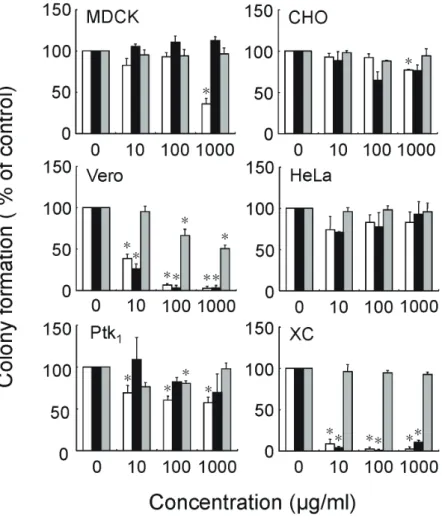
To examine the effects of ascophyllan and fucoidan on the proliferation of various cell lines, colony formation assays were carried out. As shown in Fig. 1, both ascophyllan and fucoidan demonstrated potent cytotoxic effects on Vero and XC cells in a similar

concentration-dependent manner, while other cell lines were relatively resistant to these polysaccharides. These results suggest that the cytotoxic potency of ascophyllan and fucoidan is dependent on the cell lines, with some cell lines appearing to be highly sensitive and others highly resistant towards these polysaccharides. The similarity between the two polysaccharides in terms of their cell line-dependent cytotoxicity may also suggest that there are common mechanisms of intoxication for the polysaccharides.

Both ascophyllan and fucoidan are characterized as sulfated polysaccharides extracted from a brown alga, and they are mainly composed of L-fucose and sulfate half-esters in common. Although the exact cytotoxic mechanisms of these sulfated polysaccharides are still unclear, it has been reported that fucoidan was able to induce apoptotic cell death in the human lymphoma HS-Sultan cell line through the activation of caspase-3 (20). Our recent study has demonstrated that ascophyllan also induces apoptosis in U937 cells, as judged by typical apoptotic nuclear morphological changes and DNA fragmentation (14).

Furthermore, other reports indicated that hyper-sulfation of fucoidan resulted in an increase in its anti-tumor and anti-angiogenic effects (21, 22). In contrast, it has been reported that desulfated fucoidan showed decreased biological activities compared to the natural fucoidan (23, 24). The ester sulfate has been proposed to exhibit certain biological roles for cellular recognition through specific binding to cell surface receptors (25).

Based on these findings, one can speculate that the ester sulfate residues of ascophyllan

and fucoidan may be active components responsible for a wide-variety of biological

activities, including cytotoxicity. On the other hand, alginate isolated from same

powdered A. nodosum, which consists of mannuronate and guluronate, showed no

significant toxic effects at least on the cell lines tested in this study (Fig. 1). Although

(9)

various biological activities of alginate and its oligomers have been found in in vivo and in vitro systems (26-30), no cytotoxic or direct cell killing activity of alginates has been reported so far. Porphyran, an alga-derived polysaccharide containing sulfate ester, is known to show inhibitory effects on the proliferation of tumor cells (31). In this case, the sulfate esters of the bioactive polysaccharides may play an important role in the signaling pathway leading to the arrest of the proliferation of sensitive cells. A lack of cytotoxic effects of alginate may be partly due to the absence of a sulfate ester group.

To further examine the differences in the cell line-dependent cytotoxicity of ascophyllan and fucoidan, we conducted Alamar blue assays in which sub-confluent monolayers of cells were incubated in the presence of varying concentrations of polysaccharides. As shown in Fig. 2, no significant cytotoxic effects of these

polysaccharides were observed even in Vero and XC cell. Although the exact reason for the discrepancy between the results obtained by two assays is uncertain now, this may be derived from several different experimental conditions. One possibility is that the quite different initial cell densities between the two assays may have led to different

sensitivities for the polysaccharides, even within the same cell line. In the colony formation assay, the initial cell numbers were 100 cells per well, which is a much lower cell density than that used in the Alamar blue assay. However, at least under the cell densities tested (2500–20,000 cells/well in a 96-well plate), no significant differences in ascophyllan or fucoidan were observed in the six cell lines using the Alamar blue assay.

Another possibility that seems more likely responsible for the different susceptibility of the cells to the polysaccharides is the different incubation periods of the two assays.

Colony formation assays take 5 days, while Alamar blue assays take 48 h. It is likely that ascophyllan and fucoidan may require long contact time with the target cells to cause profound cytotoxic effects. Obviously, further studies are necessary to clarify this point as well as the cytotoxic mechanisms by which these polysaccharides act.

During the course of investigating the cytotoxicity of ascophyllan, we realized that

ascophyllan promotes the proliferation of MDCK cells. In fact, the size of MDCK cell

(10)

colonies formed in the presence of ascophyllan evidently became larger than those of control colonies without ascophyllan (Fig. 3A). The Alamar blue assay confirmed that ascophyllan is capable of promoting the growth of MDCK cells in a

concentration-dependent manner (Fig. 3B). Furthermore, the growth curve of MDCK cells cultured in the presence of 1000 g/ml of ascophyllan was significantly higher than that of control cells cultured in the absence of ascophyllan (Fig. 3C). In both assays, the growth suppressive effects of fucoidan on MDCK cells were observed. These results clearly indicate that there is a difference in the bioactivities of ascophyllan and fucoidan in terms of their effects on the growth of MDCK cells. To our knowledge, this is the first report that ascophyllan or even algal-derived sulfated polysaccharides can promote the growth of certain cell lines under normal growth conditions. Regarding the effects of saccharides on the growth of certain mammalian cells, it has been reported that alginate oligosaccharides stimulate or enhance vascular endothelial growth factor-mediated growth of human endothelial cells and the growth of keratinocyte in the presence of epidermal growth factor (32, 33). Since no significant effects of alginate oligosaccharides were observed on the cells in the absence of the growth factors, it has been considered that alginate oligosaccharides may stimulate proliferative activity of growth factors by a synergistic mechanism. In addition to mammalian systems, it has been reported that enzymatically depolymerized alginate oligomers promoted the growth of bifidobacteria, whereas the original alginate polysaccharide had no effect (34). Alginate oligomers with an average molecular weight of 1800 Da, prepared with bacterial alginate lyase, increased shoot elongation after germination of komatsuna (Brassica rapa var. pervidis) seeds (35).

Iwasaki et al. have reported that an alginate oligosaccharide mixture had promoting

activities for the root growth of lettuce seedlings (36). Root growth-promoting activity of

alginate oligomer on carrot and rice plants was also reported (37). In addition to these

terrestrial plant cells, our recent study has demonstrated that the growth of a unicellular

marine microalga, Nannochloropsis oculata, was promoted by alginate oligosaccharides

(38). These findings suggest that alginate oligosaccharides might act on many different

(11)

plant cells as a growth-promoting agent. Furthermore, it has been suggested that uronic acid residues in certain bioactive oligosaccharides might play an important role in the initiation of certain signal-transduction pathways in plant cells (39). Farmer et al. have proposed that uronide-Ca

2+

complexes might be the active molecular species that initiate the signal transduction pathways leading to enhance growth and proliferation (40). Chaki et al. have suggested that sodium alginate oligosaccharides exerted antagonist activity towards calcium channels, especially voltage-operated calcium channels (41).

Ascophyllan is distinguishable from fucoidan in that it contains a much higher amount of uronic acids than fucoidan. Moreover, the level of uronic acid in ascophyllan is nearly equal to fucose. Taken together with these findings, it may be possible to speculate that uronic acid residues in ascophyllan may be somewhat involved in the growth-promoting activity on MDCK cells. Further studies are required to elucidate the mechanism of action of ascophyllan on this cell line, especially in terms of structure–activity relationships.

From the viewpoint of efficient utilization of unused resources remaining in the residue of A. nodosum after the isolation of alginate, it is worthwhile to develop ascophyllan and fucoidan as useful bioactive polysaccharides. For such applied research, the results obtained in this study may provide valuable basic information.

ACKNOWLEDGMENT

This work was supported in part by a Grant-in-Aid for Scientific Research from the

Ministry of Education, Culture, Sports, Science and Technology of Japan.

(12)

References

1) Srivastava, R. and Kulshreshtha, D. K.: Bioactive polysaccharides from plants.

Phytochemistry, 28, 2877–2883 (1989).

2) Baba, M., Schols, D., Pauwells, R., Nakashima, H. and De Clercq, E.: Sulfated polysaccharides as potent inhibitors of HIV-induced syncytium formation: A new strategy towards AIDS chemotherapy. J. AIDS, 3, 493–502 (1990).

3) Coombe, D. R., Parish, C. R., Ramshaw, I. A. and Snowden, J. M.: Analysis of the inhibition of tumour metastasis by sulfated polysaccharides. Int. J. Cancer, 39, 82–88 (1987).

4) Ellouali, M., Boisson-Vidal, C., Durand, P. and Jozefonvicz, J.: Antitumor activity of low molecular weight fucans extracted from brown seaweed Ascophyllum nodosum.

Anticancer Res., 13, 2011–2020 (1993).

5) Boisson-Vidal, C., Colliec, S., Fischer, A. M., Tapon-Bretaudiere, J., Sternberg, C., Durand, P. and Jozefonvicz, J.: Biological activities of fucans extracted from brown seaweeds. Drugs Fut., 16, 539–545 (1991).

6) McLellan, D. S. and Jurd, K. M.: Anticoagulants from marine algae. Blood Coagul.

Fibrinol., 3, 69–77 (1992).

7) Berteau, O. and Mulloy, B.: Sulfated fucans, fresh perspectives: Structures, functions, and biological properties of sulfated fucans and an overview of enzymes active toward this class of polysaccharide. Glycobiology, 13, 29R–40R (2003).

8) Mabeau, S. Kloareg, B. and Joseleau, J. -P.: Fractionation and analysis of fucans from brown algae. Phytochemistry, 29, 2441–2445 (1990).

9) Honya, M., Mori, M., Anzai, M., Araki, Y. and Nisizawa, K.: Monthly changes in the content of fucans, their constituent sugars and sulphate in cultured Laminaria japonica. Hydrobiologia, 398/399, 411–416 (1999).

10) Daniel, R., Berteau, O., Jozefonvicz, J. and Goasdone, N.: Degradation of algal

(Ascophyllum nodosum) fucoidan by an enzymatic activity contained in digestive

(13)

glands of the marine mollusc Pecten maximus. Carbohydr. Res., 322, 291–297 (1999).

11) Nishino, T., Nishioka, C., Ura, H. and Nagumo, T.: Isolation and partial characterization of a novel amino sugar-containing fucan sulfate from commercial Fucus vesiculosus fucoidan. Carbohydr. Res., 255, 213–224 (1994).

12) Larsen, B., Haug, A. and Painter, T.: Sulfated polysaccharides in brown algae. 3. The native state of dfucoidan in Ascophyllum nodosum and Fucus vesiculosus. Acta Chem.

Scand., 20, 219–230 (1970).

13) Kloareg, B., Demarty, M. and Mabeau, S.: Polyanionic characteristics of purified sulfated homofucans from brown algae. Int. J. Biol. Macromol., 8, 380–386 (1986).

14) Nakayasu, S., Soegima, R., Yamaguchi, K. and Oda, T.: Biological activities of fucose-containing polysaccharide ascophyllan isolated from the brown alga Ascophyllum nodosum. Biosci. Biotechnol. Biochem., 73, 961–964 (2009).

15) Heinzelmann, M., Polk Jr., H. C. and Miller, F. N.: Modulation of lipopolysaccharide-induced monocyte activation by heparin-binding protein and fucoidan. Infect. Immun., 66, 5842–5847 (1998).

16) Nardella, A., Chaubet, F., Boisson-Vidal, C., Blondin, C., Durand, P. and Jozefonvicz, J.: Anticoagulant low molecular weight fucans produced by radical process and ion exchange chromatography of high molecular weight fucans extracted from the brown seaweed Ascophyllum nodosum. Carbohydr. Res., 289, 201–208 (1996).

17) Nishino, T., Yokoyama, G., Dobashi, K., Fujihara, M. and Nagumo, T.: Isolation, purification, and characterization of fucose-containing sulfated polysaccharides from the brown seaweed Ecklonia kurome and their blood-anticoagulant activities.

Carbohydr. Res., 186, 119–129 (1989).

18) Oda, T., Tsuru, M., Hatakeyama, T., Nagatomo, H., Muramatsu, T. and Yamasaki,

N.: Temperature- and pH-dependent cytotoxic effect of the hemolytic lectin CEL-III

from the marine invertebrate Cucumaria echinata on various cell lines. J. Biochem. 121,

560–567 (1997).

(14)

19) Nakashima, T., Tamura, T., Kurachi, M., Yamaguchi, K. and Oda, T.:

Apoptosis-mediated cytotoxicity of prodigiosin-like red pigment produced by gamma-Proteobacterium and its multiple bioactivities. Biol. Pharm. Bull., 28, 2289–2295 (2005).

20) Aisa, Y., Miyakawa, Y., Nakazato, T., Shibata, H., Saito, K., Ikeda, Y. and Kizaki, M.: Fucoidan induces apoptosis of human HS-Sultan cells accompanied by activation of caspase-3 and down-regulation of ERK pathways. Am. J. Hematol., 78, 7–14 (2005).

21) Yamamoto, I., Takahashi, M., Suzuki, T., Seino, H. and Mori, H.: Antitumor effect of seaweeds. IV. Enhancement of antitumor activity by sulfation of a crude fucoidan fraction from Sargassum kjellmanianum. Jpn. J. Exp. Med., 54, 143–151 (1984).

22) Koyanagi, S., Tanigawa, N., Nakagawa, H., Soeda, S. and Shimeno, H.:

Oversulfation of fucoidan enhances its anti-angiogenic and antitumor activities.

Biochem. Pharmacol., 65, 173–179 (2003).

23) Haroun-Bouhedja, F., Ellouali, M., Sinquin, C. and Boisson-Vidal, C.: Relationship between sulfate groups and biological activities of fucans. Thrombosis Res., 100, 453–459 (2000).

24) Maruyama, H., Tanaka, M., Hashimoto, M., Inoue, M. and Sasahara, T.: The suppressive effect of Mekabu fucoidan on an attachment of Cryptosporidium parvum oocysts to the intestinal epithelial cells in neonatal mice. Life Sci., 80, 775–781 (2007).

25) Brennan, J., Takei, F., Wong, S. and Mager, D. L.: Carbohydrate recognition by a natural killer cell receptor, Ly-49C. J. Biol. Chem., 270, 9691–9694 (1995).

26) Tanaka, H., Kaneko, Y., Aoyagi, H., Yamamoto, Y. and Fukunaga, Y.: Efficient production of chitinase by immobilized Wasabia japonica cells in double-layered gel fibers. J. Ferment. Bioeng., 81, 220–225 (1996).

27) Tanaka, H., Yamashita, T., Aoyagi, H., Yamamoto, Y. and Fukunaga, Y.: Efficient production of chitinase by Wasabia japonica protoplasts immobilized in double-layered gel fibers. J. Ferment. Bioeng., 81, 394–399 (1996).

28) Aoyagi, H., Okada, M., Akimoto, C., Katsuyama, H. Yoshida, S. Kusakabe, I. and

(15)

Tanaka, H.: Promotion effect of alginate on chitinase production by Wasabia japonica.

Biotechnol. Tech., 10, 649–654 (1996).

29) Aoyagi, H., Sakamoto, Y., Asada, M. and Tanaka, H.: Indole alkaloids production by Catharanthus roseus protoplasts with artificial cell walls containing of guluronic acid rich alginate gel. J. Ferment. Bioeng., 85, 306–311 (1998).

30) Akimoto, C., Aoyagi, H. and Tanaka, H.: Endogenous elicitor-like effects of alginate on physiological activities of plant cells. Appl. Microbiol. Biotechnol., 52, 429–436 (1999).

31) Kwon, M. -J. and Nam, T. -J.: Porphyran induces apoptosis related signal pathway in AGS gastric cancer cell lines. Life Sci., 79, 1956–1962 (2006).

32) Kawada, A., Hiura, N., Shiraiwa, M., Tajima, S., Hiruma, M., Hara, K., Ishibashi, A. and Takahara, H.: Stimulation of human keratinocyte growth by alginate oligosaccharides, a possible co-factor for epidermal growth factor in cell culture. FEBS Lett., 408, 43–46 (1997).

33) Kawada, A., Hiura, N., Tajima, S. and Takahara, H.: Alginate oligosaccharides stimulate VEGF-mediated growth and migration of human endothelial cells. Arch.

Dermatol. Res., 291, 542–547 (1999).

34) Akiyama, H., Endo, T., Nakakita, R., Murata, K., Yonemoto, Y. and Okayama, K.:

Effect of depolymerized alginates on the growth of bifidobacteria. Biosci. Biotechnol.

Biochem., 56, 355–356 (1992).

35) Yonemoto, Y., Tanaka, H., Yamashita, T., Kitabatake, N., Ishida, Y., Kimura, A.

and Murata, K.: Promotion of germination and shoot elongation of some plants by alginate oligomers prepared with bacterial alginate lyase. J. Ferment. Bioeng., 75, 68–70 (1993).

36) Iwasaki, K. and Matsubara, Y.: Purification of alginate oligosaccharides with root growth-promoting activity toward lettuce. Biosci. Biotechnol. Biochem., 64, 1067–1070 (2000).

37) Xu, X., Iwamoto, Y., Kitamura, Y., Oda, T. and Muramatsu, T.: Root

(16)

growth-promoting activity of unsaturated oligomeric uronates from alginate on carrot and rice plants. Biosci. Biotechnol. Biochem., 67, 2022–2025 (2003).

38) Yokose, T., Nishikawa, T., Yamamoto, Y., Yamasaki, Y., Yamaguchi, K. and Oda, T.: Growth-promoting effect of alginate oligosaccharides on a unicellular marine microalga, Nannochloropsis oculata. Biosci. Biotechnol. Biochem., 73, 450–453 (2009).

39) Akimoto, C., Aoyagi, H. and Tanaka, H.: Endogenous elicitor-like effects of alginate on physiological activities of plant cells. Appl. Microbiol. Biotechnol., 52, 429–436 (1999).

40) Farmer, E.E., Moloshok, T.D., Saxton, M.J. and Ryan, C.A.: Oligosaccharide signaling in plants: Specificity of oligouronide-enhanced plasma membrane protein phosphorylation. J. Biol. Chem., 266, 3140–3145 (1991).

41) Chaki, T., Kajimoto, N., Ogawa, H., Baba, T. and Hiura, N.: Metabolism and

calcium antagonism of sodium alginate oligosaccharides. Biosci. Biotechnol. Biochem.,

71, 1819–1825 (2007).

(17)

Figure legends

Figure. 1. Cytotoxic Effects of Ascophyllan, Fucoidan, and Alginate Isolated from A.

nodosum on Various Cell Lines as Measured by Their Ability to Inhibit Colony Formation.

Adherent cells (MDCK, Vero, PtK

1

, CHO, HeLa, and XC) (100 cells/well) were

incubated in 96-well plates with the indicated concentrations of ascophyllan (black

columns), fucoidan (white columns), or alginate (grey columns) in -MEM containing

10% FBS at 37°C for 5 days. The number colonies formed was determined as described

in the text. The columns represent the average of triplicate measurements and the bars

indicate standard deviations. Data are means ± SD (n = 3).

p < 0.01.

(18)

Figure. 2. Cytotoxic Effects of Ascophyllan and Fucoidan Isolated from A. nodosum on Various Cell Lines as Measured by Alamar Blue Assay.

Adherent cells (MDCK, Vero, PtK

1

, CHO, HeLa, and XC) (2,500, 5,000, 10,000, or 20,000 cells/well) were incubated in 96-well plates with 1,000 µg/ml of ascophyllan (black columns) or fucoidan (white columns) in -MEM containing 10% FBS at 37°C for 48 h. Cell viability was examined using the Alamar blue assay as described in the text.

The values obtained without ascophyllan or fucoidan treatment were taken as control

(100%). The columns represent the average of triplicate measurements and the bars

indicate standard deviations. Data are means ± SD (n = 3).

p<0.01.

(19)

Figure. 3. Growth Promoting Effect of Ascophyllan Isolated from A. nudosum on MDCK Cells.

(A) Adherent MDCK cells (200 cells/well) were incubated in 48-well plates with the

indicated concentrations of ascophyllan in -MEM containing 10% FBS at 37°C for 5

days. The cells were then stained with 1% methylene blue in 50% methanol as described

in the text and the photographs were taken. (B) MDCK cells (200 cells/well) were

incubated in 96-well plates with the indicated concentration of ascophyllan (black circles)

(20)

or fucoidan (white triangles) in -MEM containing 10% FBS at 37°C for 5 days. The

viability of the treated cells was examined using the Alamar blue assay as described in the

text. Each point represents the average of triplicate measurements and the bars indicate

standard deviations. (C) Adherent MDCK cells (1,000 cells/well) were incubated in

24-well plates in the presence of 1,000 µg/ml of ascophyllan (black circles), fucoidan

(white triangles) or in the absence of polysaccharides (white circles) in -MEM

containing 10% FBS at 37°C for the indicated periods of time. The number of viable cells

treated with ascophyllan, fucoidan or control cells cultured in the absence of

polysaccharides was measured using the trypan blue dye exclusion text. Each point

represents the average of triplicate measurements and the bars indicate standard

deviations.

p < 0.01.

Figure legends

参照

関連したドキュメント

An easy-to-use procedure is presented for improving the ε-constraint method for computing the efficient frontier of the portfolio selection problem endowed with additional cardinality

If condition (2) holds then no line intersects all the segments AB, BC, DE, EA (if such line exists then it also intersects the segment CD by condition (2) which is impossible due

The inclusion of the cell shedding mechanism leads to modification of the boundary conditions employed in the model of Ward and King (199910) and it will be

Answering a question of de la Harpe and Bridson in the Kourovka Notebook, we build the explicit embeddings of the additive group of rational numbers Q in a finitely generated group

The main problem upon which most of the geometric topology is based is that of classifying and comparing the various supplementary structures that can be imposed on a

Our method of proof can also be used to recover the rational homotopy of L K(2) S 0 as well as the chromatic splitting conjecture at primes p > 3 [16]; we only need to use the

Classical definitions of locally complete intersection (l.c.i.) homomor- phisms of commutative rings are limited to maps that are essentially of finite type, or flat.. The

Yin, “Global existence and blow-up phenomena for an integrable two-component Camassa-Holm shallow water system,” Journal of Differential Equations, vol.. Yin, “Global weak