“Extensive” Approaches in Japanese
EFL Classrooms
HAGINOYA, Etsuko
Abstract
1. Introduction
Why do Japanese college EFL students lack confidence in using English even after studying the language for over six years in middle and high school? The following issues have been often pointed out and discussed by many researchers. First, too much emphasis is placed on knowledge of grammar in English education in Japan. Students get into the habit of analyzing the sentence grammatically whenever they read English. The grammar approach is an effective means of learning a foreign language, but at the same time it can prevent students from acquiring practical English skills. Also, translation plays a large role in English reading classes so much so that some students come to almost equate “comprehension” with “translation.”
In response to these arguments, the 1998 revisions to the curriculum guidelines set by the Ministry of Education, Culture, Sports, Science and Technology placed greater importance on learning the practical side of language, and shifted the emphasis in compulsory-level English education from grammar and translation to developing communication skills. Students who have studied under these revised guidelines seem more comfortable in speaking English. Regrettably, however, it is still true that the conversations they have in English are rarely content-based, but instead generally consist of mere “chatting.” One problem is that English education in Japan still leans too far toward the “intensive” side of learning. In other words, the total amount of reading and listening that students do in the target language is much too small.
As means of bolstering the “extensive” side of English education, Extensive Reading (ER) and Extensive Listening (EL) are receiving more attention than ever before. Furukawa (2006) notes that “elementary school students in English speaking countries read one million words on average per year”
and proposes that EFL students first set for themselves the quantitative goal of reading one million words a year, and then generally read as much as they can. Another study shows that a person needs to read at least 3,000 pages to acquire a working knowledge of a language. More than 90% of my students say, however, that during their six years in middle and high school they read no English language books other than school textbooks. Typical middle and high school English textbooks include about 42,000 words in total (Hasegawa, S & Nakajo, K, 2004). If we assume that 300 words constitute one page of a paperback, this amounts to less than 150 pages. Lack of reading quantity should be considered as one of the crucial reasons that Japanese college students so frequently say that they do not understand English.
2. Extensive Reading and Extensive Listening
The importance of reading “extensively” in acquiring good language skills has been widely recognized and practiced in first language (L1) education around the world. The history of Extensive Reading in second language (L2) acquisition can be traced back 90 years, when Harold Parmer (1921), an English linguist and phonetician who contributed to the development of the applied linguistics and played an important role in reforming Japan’s English education in early 20th century, introduced the term “Extensive Reading,” which he contrasted with “Intensive Reading,” and argued that “a reader’s attention should be on the meaning and not the language of the text.” A number of studies have since been conducted to examine the benefits of ER, many of which have found it to be effective in L2 learning (e.g. Susser & Rob, 1990, Lai, 1993, Renandya, 1999, Asraf & Ahamad, 2003, Iwatani, 2008). Many researchers and practitioners worldwide have followed this approach.
In Japan, however, ER in English education has only gained recognition in the past few decades. The Japan Extensive Reading Association was founded in 2002 with the purpose of spreading ER as a tool to aid in foreign language acquisition. Around the same time, books introducing ER methods and study guides such as Hyakumango Paperback he no Michi [Toward One Million Words and Beyond] by Sakai (2002), “Oyako de Hajimeru Eigo Hyakumango [Let’s Start One Million Words Extensive
Reading With Your Children]” by Furukawa & Itoh (2004), Eigo Tadoku Kanzen Book Guide” [The
Complete Guide for Extensive Reading in English] by Furukawa & Itoh. (2005) and other literature on ER were published. A Japanese translation of Extensive Reading in the Second Language Classroom by Day & Bamford (2004), which contains exhaustive information on practical knowledge and resources for ER, was published in 2006. This book contributed greatly to the spread of the practice of ER in Japan. In addition to these educators of English, Sam Itoh, the former editor-in-chief of the Japan Times, stressed the value of ER in his book Eigo ha Yasashiku Takusan [Let’s Read Easy English Books A Lot] (2003). He argues that it is beneficial for even professional editors of English language newspapers to read a large amount of English material, starting with books with a very limited vocabulary.
Today, ER is generally defined as reading a large amount of self-selected, fairly easy and enjoyable material at the reader’s own pace, as opposed to Intensive or Detailed Reading. Day and Bamford (1997) identified the following ten characteristics of ER, characteristics which are widely acknowledged today. 1. Students read as much as possible.
2. A variety of materials on a wide range of topics is available.
3. Students select what they want to read and have the freedom to stop reading material that fails to interest them.
4. The purposes of reading are usually related to pleasure, information and general understanding. 5. Reading is its own reward.
grammar.
7. Reading is individual and silent, at the student’s own pace, and, outside class, done when and where the student chooses.
8. Reading speed is usually faster rather than slower as students read books and other material they find easily understandable.
9. Teaches orient students to the goals of the program, explain the methodology, keep track of what each student read, and guide students in getting the most out of the program.
10. The teacher is a role model of a reader for the students.
Sakai (2002), the founder of the SSS (Start with Simple Stories) program in Japan, consolidated these characteristics and advocated the following three as the “Three Golden Rules of Extensive Reading.” 1. No dictionaries while reading
2. Skip over any difficult words that are unknown by the reader
3. Stop reading and get a new book if the book becomes boring or is too difficult
Extensive Listening can be defined more or less in the same way as Extensive Reading. Many of the recently published books designed for learners of English come with recorded narrations in the form of tapes, CDs or audio files that can be downloaded from web pages. The number of audio books in a variety of genres is increasing dramatically, and many are readily available online. These are valuable resources for students wishing to brush up on their listening and speaking skills as well. Not many studies on EL have been conducted yet, but Waring, R. (2010) compared ER and EL and listed their similarities and differences. He states the biggest difference is that fairly significant time constraints apply to EL. While readers can stop or go back to reread something whenever they want to in ER, this is not as easy to do for listeners in EL, and this makes it more difficult for the learners to follow the story or flow of what they are listening to. Also, for non-native speakers of English who did not learn the language “by ear,” it is harder to grasp meaning just by listening than it is by reading. In addition, recorded audio varies with the narrator, which to some extent affects comprehension on the part of the learner. It is apparent that these can make EL practice more difficult than ER, but considering the natural way people acquire language skills, i.e. first just by listening, it might be only natural to consider EL practice prior to ER as a means of L2 acquisition.
3. Materials for ER and EL
Graded readers were developed in the 1930s in order to make English literature more accessible to foreign learners of English. What are graded readers? David Hill, who has conducted in-depth surveys of graded readers, states that they are “extended texts, mostly fiction, written in language reduced in terms of structures and vocabulary” (1997). Day & Bamford (2004) suggest using the term “Language Learner Literature (LLL)” instead of “graded readers,” and note that they are reading materials that can communicate with their audience of learners at the appropriate linguistic level. The Oxford University Press, which first introduced graded readers to Japan in 1960s, publishes over 150 titles. Other ELT publishers such as Pearson Longman, Macmillan Heinemann, Cambridge University Press, and Thomson Learning followed, and today, graded readers are published in growing quantities from a number of major EFL textbook publishers. They come in many different genres̶from classics to science fiction, horror, play scripts, love stories, biographies and non-fiction̶to suit the reader’s interests, which makes it easier to set up desirable ER libraries at schools. When selecting books, however, it is necessary to note that the systems by which vocabulary levels are classified differ depending upon the publisher and the series. For example, a book for a learner with a 300-word vocabulary is labeled “Starter” in Macmillan Readers, “Level 1” in Penguin Readers, and “Level 2” in Oxford Hotshot Puzzles.
Many of the recently published graded readers likewise come with recorded narrations in the form of CDs or audio files that can be downloaded from websites. This is making the practice of EL a lot easier than it was just a few decades ago, when cassette tapes were virtually the only means of obtaining recorded sound and it was extremely difficult for individual learners to come by sufficient material for listening practice. Also, access to the Internet has increased remarkably, which enables students to find and select materials for both reading and listening online quite easily. A list of major LLL series available in Japan is shown in Table 1.
4. Study 1: Extensive Reading 4.1 Participants
This study was conducted on 73 non-English major Japanese college EFL students, with levels ranging from elementary to high intermediate, in compulsory courses.
4.2 Procedure
As I pointed out above, Japanese students tend to devote too much attention to grammatical analyses of the sentences they are reading. It seems that many cannot admit that they actually “understand” the context without verifying the sentence structure by reasoning through it grammatically. Also, many cannot convince themselves they understand the meaning of the sentence until they can successfully translate it into Japanese. Some even try to comprehend the meaning of a sentence only after translating it into Japanese. Since sentence structure in Japanese and English is distinctly different, this habit of analyzing and translating acts as an impediment to effective Extensive Reading practice. Therefore, the students needed to be trained to read and understand from the beginning of the sentence, taking in the ideas in order, and to not become distracted with analyzing the sentence structure or translating.
where the ideas are located in each sentence. Some students had difficulty in locating the main clause and the subordinate clauses. For those students, the subject and the verb in the main clause were also marked. Example 1:
In the Extensive Reading class, / the students read fairly easy materials / in large amounts.
If the students felt uncomfortable in reading long and complex sentences, the texts were aligned, as in the following example.
Example 2:
In the Extensive Reading class, the students read fairly easy materials in large amounts.
The students then tried to insert slashes and other marks by themselves until they became used to grasping the ideas in English and following the “story” smoothly.
After the basic reading training, students started to read at their own pace. At first, the whole class was guided by the teacher, reading the same passages, but after a short while the students chose their own reading materials individually and read as much as possible. Each student started by reading passages written at a 200-word vocabulary level, which usually contain less than 1,000 words. The target reading volume was set at 10,000 words by the end of the first month, and 100,000 words by the end of the school year.
4.3 Discussion
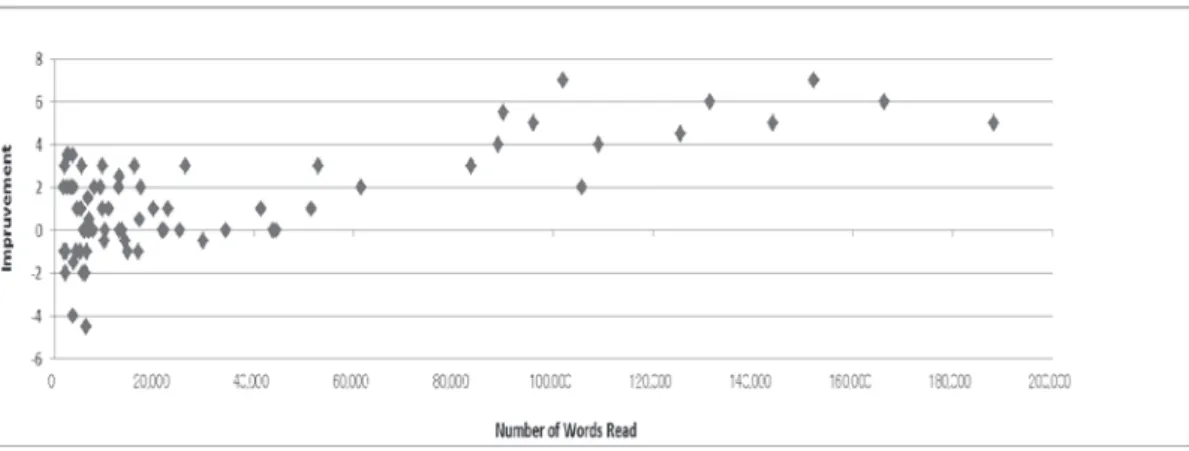
The students were given a short reading comprehension test of 40 non-multiple choice questions at the beginning of the school year before starting ER, and then the same test at the end of the year. Little improvement was found with those who read less than 50,000 words, but, in general, there was a positive correlation between reading volume and test score improvement. Figure 1 illustrates the correlation between the amount students read and test score improvements.
5. Study 2 : Extensive Listening 5.1 Participants
The same 73 students who participated in the ER program were asked to listen to as much as they could in addition to their reading.
5.2 Procedure
After they picked up their pace in reading, the same procedure as Extensive Reading was implemented with Extensive Listening practice, but without the basic training. They were already familiar with absorbing ideas in English at this stage. Besides, when listening, there is little time for grammatical analysis or translation. Students were advised to choose easy enough LLL materials based on self-evaluations of reading ability assessed from their ER experience. They started to listen to books of lower difficulty levels that they had skipped in the reading program, and gradually moved on to materials that were more difficult in terms of vocabulary. No specific target was set for EL, but students were encouraged to engage in listening as much as they could along with their reading.
5.3 Discussion
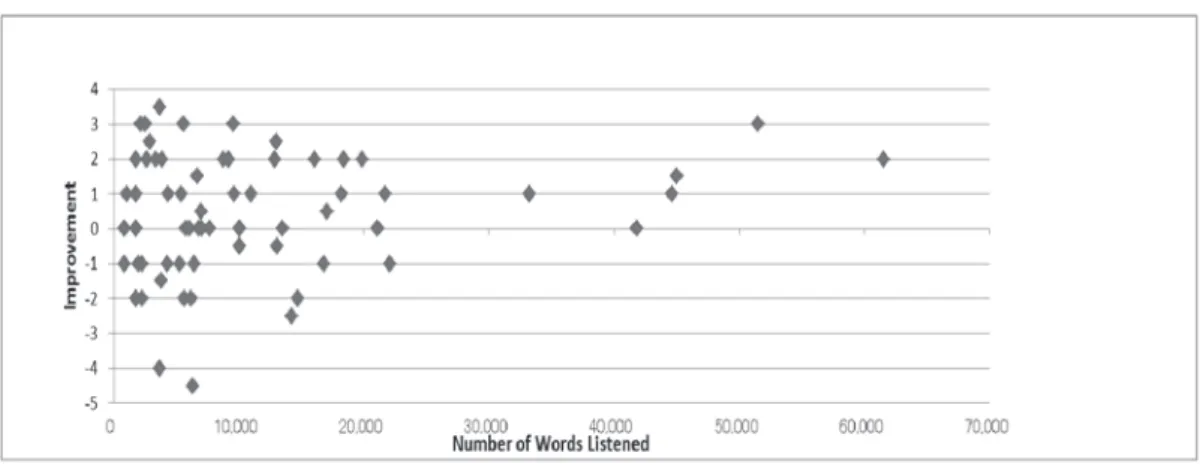
The students were given a short listening comprehension test of 40 non-multiple choice questions at the beginning of the school year before starting EL, and the identical test at the year’s end. Regrettably, the number of students who actively participated in Extensive Listening was very small. More than a few students ended up abandoning their listening practice at the early stages of EL, making it difficult to identify any statistically significant correlation between the amounts listened to and improvements in listening comprehension skills in this study. Figure 2 illustrates the amount students listened to and test score improvements.
6. Conclusion and Future Research
In this paper I examined the role of ER/EL and their potential benefits in foreign language acquisition. The results confirm that ER is effective, as many researchers have already claimed. However, a limitation was noted that has ramifications for the incorporation of ER into the curriculum: the benefits were confined to those students who actively participated in reading. The number of students who continually read and reached the target of 100,000 words a year was less than 15% of the total participants. These students say they started to feel comfortable reading English after completing several books and finding pleasure in the act of reading itself. This proves that the ER program was successful with those students. On the other hand, with regard to the other 85% of the students, reading was nothing more than a given task which they had to complete as an assignment, and naturally little improvement was seen in the reading comprehension test results. In addition, it should be noted that most of the students who failed to read extensively indicated that they did not like “reading” in the first place. Although Day & Bamford (1997) stated “many foreign language students, certainly those in Japan, can already read in their first language, and may even have the habit of regular reading,” this is not always the case. More than 80% of the participants in this study said they did not like to read even in their first language. “Reading for pleasure,” one of the fundamentals of ER, was not a habit that these students picked up.
In order to successfully implement ER in a curriculum, it is essential to consider ways to get reluctant readers motivated. They need to experience “reading for fun.” More students showed interest in reading after adding comic books to the LLL library. Also, using comparatively easy-to-read materials such as brochures and leaflets in the student’s interest areas, e.g. travel, music, sports, etc. increased students’ motivation to read. On the other hand, those students who successfully progressed through the ER program should be advised to advance to more difficult material and read authentic books. Since overwhelming amounts of information on a variety of topics written in common English is now readily available online and students’ access to the Internet both at school and at home has increased markedly, using the Internet and encouraging the students to read web pages which suit their respective linguistic levels should prove helpful as well.
With regard to EL, further empirical studies are needed. First, it is necessary to explore listening materials other than LLL, just as in the case of ER, especially for those students who are not enthusiastic about learning to begin with. There are a number of web pages designed for EFL students that allow them to listen to and learn English enjoyably. These could serve to supplement or complement other means of EL practice. With portable audio devices and smartphones, the potential is greater than ever. The following sites are popular with my students. Some of them have a podcasting program, which will serve as another effective learning method.
・ ESL Cyber Listening Lab http://www.esl-lab.com ・ ESL Podcast http://www.esl-pod.com
・ Starfall http://www.starfall.com
・ Spotlight Radio http://www.spotlightradio.net ・ Movie Trailers http://trailers.apple.com
Figure 3 displays the number of students who have Internet access, portable audio devices, and smartphones.
ER and EL should work as effective means of sufficient “input”, but developing this into “output” is another important issue in learning foreign languages. During this study, three types of “output” activities were attempted. First, the students kept book reports to keep track of their progress. After looking at various types of book report formats already developed by pioneering researchers in Extensive Reading, the form shown in Appendix 1 was chosen for use in this study. It was carefully designed so as not to discourage the students from reading. Secondly, each week in class, the students started off by giving short talks in turns about the book they had read. Their presentations included an outline of the story and the student’s comments on the book as well as his/her overall evaluation of the book. Also, in the class, students were divided into several groups and each group chose a topic for a research project relating to the topic of the book they had read. By surfing the Internet from web page to web page, skimming and scanning, they collected information for their presentations and discussions. Some web pages were too difficult for the students to follow, but they were inevitably able to find pages they could manage to read. This was challenging for most of them, but more than that, it was rewarding.
In addition to the above-mentioned three output activities, weblogs and Twitter can be used as powerful resources for Extensive Writing. The students are already familiar with weblogs; many of them even have their own weblogs accessible on their cell phone network and exchange thoughts and such using trackback features. Also, many are already accustomed to “tweeting.” In short, it is not at all difficult for them to set up English versions of their blogs on the Internet. After reading a book or article, they were free to write about it on their blogs or with Twitter instead of filling in their book report forms. The work of creating a blog, reading the instructions in English, and filling in the necessary information is an efficient way of studying the language in itself. By exchanging comments with each other, the students can practice more writing, and at the same time help other students choose the next book for them to read or listen to. By utilizing the Internet effectively, ER/EL programs can be enhanced and developed into more complete programs in which the four skills of English can be acquired comprehensively.
References
Asraf, R. M. & Ahmad, I. S. (2003). Promoting English language development and the reading habit among students in rural schools through the Guided Extensive Reading program. Reading in a
Foreign Language 15(2) Retrieved October 10, 2010 from http://nflrc.hawaii.edu/rfl/April2008/ iwahori/iwahori.html
Day, R. & Bamford, J. (1997). Extensive Reading: What Is It? Why Bother? The Language Teacher
Online 21.5. Retrieved July 8, 2009, from http://jalt-publications.org/tlt/files/97/may/etensie.html Day, R. & Bamford, J. (2004). Extensive Reading in the Second Language Classroom. Cambridge:
Cambridge University Press
Furukawa, A. & Itoh, A. (2004). Oyako de Hajimeru Eigo Hyakumango [Let’s Start One Million Words
Extensive Reading With Your Children]. Tokyo: Cosmopier Publishig
Furukawa, A. & Itoh, A. (2005). Eigo Tadoku Kanzen Bukku Gaido [The Complete Guide for Extensive
Reading in English]. Tokyo: Cosmopier Publishig
Furukawa, A. (2006). SSS Extensive Reading Method Proves to be an Effective Way to Learn English. Retrieved June 10, 2010 from http://www. seg. co.jp/SSS
Hill, D. R. (1997). Survey review: Graded readers. ELT Journal 51(1), 57 - 81
Itoh, S. (2003). Eigo ha Yasashiku Takusan [Let’s Read Easy English Books A Lot]. Tokyo: Kodansha Iwahori, Y. (2008). Developing reading fluency: A study of extensive reading in EFL. Reading in a
Foreign Language 20(1), Retrieved October 10, 2010 from http://nflrc.hawaii.edu/rfl/April2008/ iwahori/iwahori.html
Lai, F. (1993). The effect of a summer reading course on reading and writing skills. System, 21(1), 87-100
Palmer, H. (1921/1964). The Principles of Language Study. Oxford: Oxford University Press
Renandya, W.A. , Rajan, B.R.S., & Jacobs, G.M. (1999). Extensive reading with adult learners of
English as a second language. RELC Journal, 30, 39-61
Sakai, K. (2002). Kaidoku Hyakumango Paperback heno Michi [Towards One Million Words and
Beyond]. Tokyo: Chikuma Shobou
Susser, B & Robb, T (1990). EFL Extensive Reading Instruction: Research and Procedure. JALT Journal, 12(2)
Waring, R. (2010). Getting an Extensive Reading Program Going. Retrieved April 29, 2011 from http:// extensivereading.net/docs/get_er_going