• 検索結果がありません。

-1 FOR THE INTRAOPERATIVE DIAGNOSIS OF GLIOMAS

N/A
N/A
Protected

Academic year: 2021

シェア "-1 FOR THE INTRAOPERATIVE DIAGNOSIS OF GLIOMAS"

Copied!
10
0
0

読み込み中.... (全文を見る)

全文

(1)

RAPID IMMUNOHISTOCHEMISTRY OF IDH - 1 FOR  THE INTRAOPERATIVE DIAGNOSIS 

OF GLIOMAS

Yuko Hiroshima 1) , Hiroshi Nanjo 2) , Toshio Sasajima 3) , Hiroaki Shimizu 3) , Yoshihiro Minamiya 4) , Toshiaki Yoshioka 5) , Masaya Oda 3) , Yukitsugu Kudo - Asabe 1) , Masumi Tsuda 6) , Mishie Tanino 6) ,

Shinya Tanaka 6) , Yoichi Akagami 7) and Akiteru Goto 1) (received 18 January 2016, accepted 18 January 2016)

1) Department of Cellular and Organ Pathology, Graduate School of Medicine, Akita University, 1

-

1

-

1 Hondo, Akita 010

-

8543, Japan

2) Division of Clinical Pathology, Akita University Hospital, Akita 010

-

8543, Japan

3) Department of Neurosurgery, Graduate School of Medicine, Akita University, Akita 010

-

8543, Japan

4) Department of Thoracic Surgery, Graduate School of Medicine, Akita University, Akita 010

-

8543, Japan

5) Department of Occupational Therapy, School of Health Science, Akita University, Akita 010

-

8543, Japan

6) Department of Cancer Pathology, Graduate School of Medicine, Hokkaido University, Hokkaido 060

-

8638, Japan

7) Akita Industrial Technology Center, Akita, 010

-

1623, Japan

Abstract

Immunohistochemistry (IHC) plays a major role in the histopathological diagnosis of central ner- vous system (CNS) tumors. We developed a rapid immunohistochemistry (R - IHC) method using an alternating current electric field, which enables the completion of IHC in 20 min. We performed intraoperative R - IHC on 16 glioma patients (9 with grade I - III gliomas and 7 with glio- blastomas) using the anti - mutant isocitrate dehydrogenase 1 (IDH1) monoclonal antibody (IDH1 - R132H ; H09), and the results were validated on permanent formalin - fixed paraffin - embedded samples of the same patients by standard IHC. DNA sequencing of the IDH1 gene was also per- formed for the 16 patients. Of 6 gliomas, 5 were shown to be positive by both R - IHC and stan- dard IHC, and IDH1 mutation was confirmed by DNA sequencing. According to the results of R - IHC compared with both standard IHC results and DNA sequencing, the sensitivity of IDH1 R - IHC was 83% (5/6) ; specificity, 70% (7/10) ; positive predictive value, 63% (5/8) ; negative predictive value, 88% (7/8) ; and accuracy, 75% (12/16). Thus, R - IHC using the anti - mutant IDH1 monoclonal antibody has potential applications in the intraoperative identification of IDH1 mutations in gliomas.

Key words : IDH - 1, rapid immunohistochemistry, glioma, intraoperative diagnosis, DNA sequencing

Correspondence to : Akiteru Goto, M.D.

Department of Cellular and Organ Pathology, Akita Uni- versity Graduate School of Medicine, 1

-

1

-

1 Hondo, Akita 010

-

8543, Japan

Tel : 81

-

18

-

884

-

6062 Fax : 81

-

18

-

884

-

6441

E

-

mail : [email protected]

-

u.ac.jp

Introduction

For the histopathological diagnosis of central nervous

system (CNS) tumors, immunohistochemical staining

(IHC) is an essential technique owing to the wide variety

of morphological appearances even in the same entity of

(2)

such tumors 1) . However, the IHC procedure usually takes at least 2 - 3 h to complete all the steps. Thus, the incorporation of conventional IHC into the intraoperative pathological diagnosis of CNS tumors has not been feasi- ble thus far. In the last 3 decades, several methods for rapid immunohistochemistry (R - IHC) have been devel- oped, such as methods using microwaves 2,3) , high - quality reagents 4

-

8) , and ultrasound 9) . However, only a few pa- pers have reported the use of these techniques for CNS tumors 6,7) . Recently, we developed a R - IHC technique in which an alternating current (AC) electric field enables the antigen - antibody reaction 10) . The R - IHC procedure takes only 20 min, enabling its incorporation into the in- traoperative diagnosis of CNS tumors 11) . We have re- ported the application of intraoperative R - IHC for Ki - 67/

MIB - 1 staining to estimate the WHO grading of gliomas and CD20 staining to differentiate between CNS tumors of glial origin and CNS lymphomas 11) .

Isocitrate dehydrogenase (IDH1) mutations have origi- nally been identified by genome - wide exome sequencing of secondary glioblastomas, and the diagnostic role of IDH1/2 genes in the treatment of gliomas has been scru- tinized because among CNS tumors with favorable prog- nostic value, their mutations can be found in glio- mas 12) . IDH mutations uniformly occur in the function- ally critical residues arginine 132 (R132) of IDH1 and ar- ginine 172 (R172) of IDH2, and specific antibodies for these mutated proteins have been established 13,14) . Sev- eral types of IDH1 mutations have been reported, includ- ing R132H, with the most common types being R132C, R132S, R132L, and R132G 12) .

In this study, we performed intraoperative R - IHC us- ing the anti - mutant IDH1 (IDH1 - R132H ; H09) mono- clonal antibody to determine the mutational status of IDH1 in 16 glioma cases. The results were validated by conventional IHC of IDH1 on permanent formalin - fixed paraffin embedded (FFPE) samples from the same speci- men and confirmed by the DNA sequencing of IDH1.

R - IHC was also performed with GFAP, Olig2, and Ki - 67 antibodies to support the intraoperative diagnosis of glio- mas as necessary. The present results show the useful- ness and reliability of applying IDH1 R - IHC as an intra- operative test.

Materials and methods Patients

Sixteen patients surgically treated for astrocytic and oligodendroglial tumors and mixed gliomas at Akita Uni- versity Hospital, Akita, Japan, from 2011 to 2015 were in- cluded in this study. The final diagnoses were as follows : pilocytic astrocytoma, 1 case ; anaplastic astro- cytoma, 1 case ; anaplastic oligodendroglioma, 1 case ; anaplastic oligoastrocytoma, 6 cases ; and glioblastoma, 7 cases. The characteristics of the patients are listed in Table 1. The World Health Organization classification of CNS tumors was used for histopathological evalua- tion 1) . This study was approved by the institutional re- view board of the Akita University School of Medicine, and written informed consent was obtained from all the patients.

Tissue preparation for intraoperative R - IHC

Specimens for intraoperative diagnosis sized 3 - 5 mm

in diameter were placed into plastic cassettes (Tissue -

Tek Cryomold Standard ; Sakura Finetek Japan, Tokyo,

Japan), mounted with OCT compound medium (Sakura

Finetek Japan), and frozen in Histo - Tek Hyfluid (Sakura

Finetek Japan) at −75°C. Immunostaining with R - IHC

was applied on 3 - µm frozen sections, and H&E staining

was also performed on the serial sections. The frozen

sections on slide glasses were air dried for 30 s and fixed

by acetone at room temperature (RT) for 30 s. Endoge-

nous peroxidase was quenched by 3% H 2 O 2 for 1 min at

RT. Subsequently, the sections were incubated with pri-

mary antibody under a high - voltage (4.0 kV, offset 2.4

kV), low - frequency (5 Hz) AC electric field for 5

min. The sections were washed 3 times with PBS

(Muto Pure Chemicals, Tokyo, Japan) with 0.1% Tween20

(Tokyo Chemical Industry, Tokyo, Japan) and incubated

with Histofine Simple Stain MAX PO (Nichirei Biosci-

ences, Tokyo, Japan) for 5 min under the same electric

field conditions. The AC electric field was obtained with

R - IHC type A II (Akita Epson Corporation, Akita, Ja-

pan). Immunoproducts were visualized by diaminoben-

zidine (DAB) as a substrate at RT for 1 min, counter-

stained with hematoxylin, dehydrated, and mounted with

coverslips. Thus, the R - IHC procedure took 20 min, in-

(3)

cluding counterstaining and mounting. Detailed mecha- nisms of the R - IHC procedure are described else- where 10) .

Intraoperative R - IHC for specific mouse monoclonal antibodies against IDH1, GFAP, Olig2, and Ki - 67/MIB - 1 was also performed in each case (Table 2).

IHC for FFPE tissues

The specimens after intraoperative pathological diag- nosis were fixed in 10% buffered formalin and embedded in paraffin. Three - micrometer - thick sections of FFPE samples were incubated with Paraffin Stretcher (Sakura Finetek Japan, Tokyo, Japan) at 50°C overnight, and im- munohistochemical staining for IDH1 - R132H, GFAP, Olig2, and Ki - 67 was performed by the labeled streptavi- din biotin method using Ventana BenchMark XT immu- nostainer (Ventana Medical Systems, Tucson, AZ, USA).

Evaluation of immunohistochemical staining All the stained specimens were evaluated by 2 patholo- gists (Y.H. and H.N.) using a standard light microscope (Olympus BX50F4 ; Olympus Corporation, Tokyo, Ja- pan). Immunohistochemical results of IDH1 - R132H, GFAP, or Olig2 expression, positive or negative, with cut - off values of 5% positivity in tumor cells, were deter- mined. Faint staining was judged to be negative. The labeling index (LI) for Ki - 67/MIB - 1 was calculated by positively immunostained tumor cells in more than 100 tumor cells.

DNA extraction

FPPE specimens of CNS tumors were used for IDH1 mutation analysis. The target tumor lesion was identi- fied by an experienced pathologist (M.T.) under a stan- dard light microscope (Olympus BX50F4) and marked on a couple of 10 - µm - thick unstained sections using sterile toothpicks. Each area was excised with sterile dispos- able scalpels (Feather Safety Razor, Osaka, Japan), and DNA was isolated using WaxFree DNA extraction kits (Trimgen Corporation, Sparks, MD, USA) according to the manufacturer’s instructions. DNA concentration and purity were evaluated by the NanoDrop 2000c spec- trophotometer (Thermo Fisher Scientific, Waltham, MA, USA).

PCR amplification and sequencing of an IDH1 fragment

A 129 - bp fragment encoding a catalytic domain of IDH1 including codon 132 was amplified by PCR using the sense primer IDH1(f) 5´ - CGGTCTTCAGAGAAGC- CATT and the antisense primer IDH1(r) 5´ - GCAAAAT- CACATTATTGCCAAC 15,16) . The reaction volume for PCR included 500 ng of DNA extracted from each sam- ple, 0.4 µM of each primer, 0.2 mM dNTP mix, 1.5 mM MgSO 4 , and 1 U of KOD plus DNA polymerase. The amplification conditions were as follows : denaturation for 5 min at 94°C, followed by 35 cycles of denaturation at 94°C for 40 s, annealing at 56°C for 40 s, and extension at 72°C for 40 s. The final extension step at 72°C was ex- tended to 7 min. PCR products were electrophoresed on 1.5% agarose gels (Agarose LO3 ; Takara, Tokyo, Ja- pan) and photographed. For the control of the reliability of PCR, additional sense primer IDH1(f) 5´ - AC- CAAATGGCACCATACGA and antisense primer IDH1(r) 5’ - TTCATACCTTGCTTAATGGGTGT for generating a 254 - bp fragment were used in each DNA sample under the same PCR conditions. Cleaned PCR products using the QIAquick Spin Purification procedure (Qiagen, Craw- ley, West Sussex, UK) were subjected to standard direct sequencing using the IDH1(f) primer.

Results

R - IHC for intraoperative pathological diagnosis using GFAP, Olig2, and Ki - 67

R - IHC in this study was successfully performed as an

effective tool for histopathological diagnosis. Table 1

summarizes the results of GFAP, Olig2, and Ki - 67/MIB - 1

staining by R - IHC and standard IHC for each case. The

tumors were also histopathologically evaluated for necro-

sis and mitosis described in Table 1. The intraoperative

and final pathological diagnoses of the tumors are also

shown. All the 16 gliomas were found to be positive for

GFAP by both R - IHC and standard IHC. The results of

R - IHC for Olig2 were almost identical to those of stan-

dard IHC. The Ki - 67/MIB - 1 indices based on R - IHC

using frozen sections were significantly correlated with

those of paraffin - embedded sections. The indices cor-

(4)

related positively to each other well (r = 0.84).

R - IHC for IDH1 - R132H

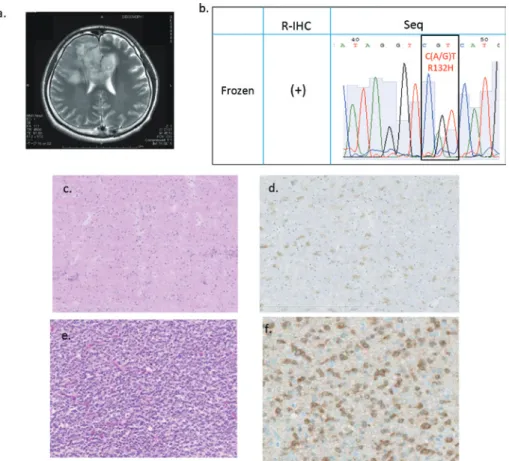
Figures 1, 2 and 3 show the representative results of R - IHC for the patients with and without IDH1 - R132H mutation. In Figure 1, the representative case was pa- tient 6, with a final diagnosis of anaplastic oligodendrogli- oma in both frontal lobes. Both standard IHC and R - IHC revealed positive staining for GFAP, and the Ki - 67/

MIB - 1 LI was 4.0% with R - IHC and 10.6% with standard IHC. Mutated IDH1 was mainly localized in the cyto- plasm, and occasional nuclear staining was observed.

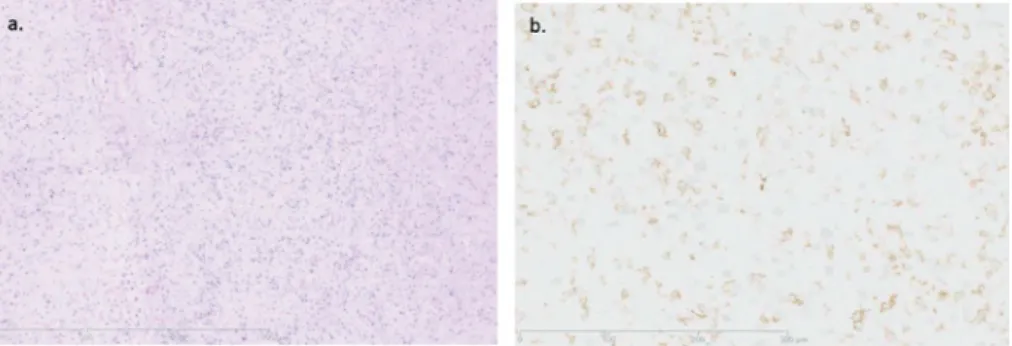
Another representative case, as figure 2, was patient 4 with recurrent tumor of anaplastic oligoastrocytoma, re- ceiving chemoradiation therapy before the current opera- tion. IDH1 R - IHC revealed positive staining intraoper- atively and could be detected as mutation positive at that time. Thus, out of 9 grade I - III tumors, 5 (55.6%) were positive both with R - IHC and standard IHC (cases 1, 2, 3, 4, 6) (Table 1). The tumor of patient 7 was character-

ized by necrotic areas, and partial positivity for IDH1 - R132H was observed only by R - IHC. This was consid- ered to be non - specific staining. In contrast, in 2 out of 7 glioblastomas (29%, patients 10 and 16), partial positiv- ity for IDH1 - R132H was observed only by R - IHC, which was considered non - specific staining. In case 16, vivid peri - cytoplasmic staining was observed with only IDH1 R - IHC, which made us misjudge it as mutation positive (Figure 3). Tumor cells were positive for GFAP and negative for Olig2 by both R - IHC and standard IHC, and the Ki - 67 values were 23.8% and 11.6%, respective- ly. The sensitivity of IDH1 R - IHC was 83%

(5/6) ; specificity, 70% (7/10) ; positive predictive value, 63% (5/8) ; negative predictive value, 88% (7/8) ; and accuracy, 75% (12/16).

IDH1 mutational analysis

IDH1 mutation was detected at codon 132 in 6 out of 9 grade I - III tumor cases (67%) (cases 1 - 6). All the mu- tations in codon 132 (from CGT to CAT) were heterozy- Table 1. Patients’ characteristics, pathological diagnoses,

R

-

IHC results (Frozen)

Case Age/Sex Frozen HE GFAP Olig2 Ki

-

67 IDH1

R

-

132H Mitosis Necrotic area Frozen HE+R

-

IHC 1 29/M II (Oligoastrocytoma with atypia) (+) (+) 15.0% (+) (−) (−) II or III (Oligoastrocytoma with atypia or

anaplastic oligoastrocytoma) 2 32/F II (Diffuse astrocytoma or oligoastrocytoma) (+) (−) 3.0% (+) (−) (−) II (Diffuse astrocytoma or oligoastrocytoma)

3 55/F II (Oligoastrocytoma) (+) (+) 10.0% (+) (−) (−) II (Oligoastrocytoma)

4 47/F II (Oligoastrocytoma) (+) (+) 12.4% (+) (−) (−) III (Oligoastrocytoma with partly grade III

component)

5 38/M III (Anaplastic oligoastrocytoma) (+) (+) 10.0% (−) (−) (−) III (Anaplastic oligoastrocytoma)

6 45/M II (Oligodendroglioma) (+) (+) 4.0% (+) (−) (−) II (Oligodendroglioma)

7 78/M III (Anaplastic oligoastrocytoma) (+) (−) 25.7% (+) (−) (+) III or IV (Anaplastic oligoastrocytoma or Glioblastoma)

8 12/M I (Pilocytic astrocytoma) (+) Not done 1.0% (−) (−) (−) I (Pilocytic astrocytoma)

9 72/F III or IV (Anaplastic astrocytoma or Glioblas-

toma) (+) (+) 40.0% (−) (+) (−) III or IV (Anaplastic astrocytoma or Glioblas-

toma)

10 76/M III (Malignant glioma) (+) (+) 23.3% (+) (−) (+) III or IV (Anaplastic astrocytoma or Glioblas-

toma)

11 60/F IV (Glioblastoma) (+) (−) 29.4% (−) (−) (+) IV (Glioblastoma)

12 76/M IV (Glioblastoma) (+) (−) 13.1% (−) (−) (+) IV (Glioblastoma)

13 77/M IV (Glioblastoma) (+) (−) 1.8% (−) (−) (+) IV (Glioblastoma)

14 57/M IV (Glioblastoma) (+) (+) 40.0% (−) (+) (+) IV (Glioblastoma)

15 68/F IV (Glioblastoma) (+) (+) 15.0% (−) (+) (+) IV (Glioblastoma)

16 78/F IV (Glioblastoma) (+) (−) 23.8% (+) (−) (+) IV (Glioblastoma)

M, male ; F, female ; (+), positive ; (-), negative ; NA, not applicable ; R

-

IHC, rappid immunohistochemistry ; IHC,

nase 1 ; GFAP, glial fibrillary acidic protein.

(5)

gous and resulted in amino acid substitution from argi- nine to histidine (IDH1 - R132H), the most common mutation in IDH1. Five out of 6 patients harboring IDH1 mutation were positive for an anti - IDH1 - R132H - specific monoclonal antibody by both R - IHC and standard IHC. One anaplastic oligoastrocytoma and 2 glioblasto- ma specimens with non - specific IDH1 - R132H staining in R - IHC (patients 7, 10, and 16) without IDH1 mutation contained necrotic lesions as mentioned above. In pa- tient 5, IDH1 staining by R - IHC was negative despite be- ing positive by standard IHC. In patient 2, the tumor was negative for Ki - 67 by standard IHC, but the highest Ki - 67 index in the surgical specimen was 12.7%, leading to a final diagnosis of anaplastic oligoastrocytoma.

Discussion

At present, the clinical course of CNS tumors can be predicted and the modality chosen according to the WHO histopathological grading 1) . Recently, glioblastoma with

IDH1 mutation was reported to have a better prognosis than anaplastic astrocytoma without the mutation 17) . An- other study revealed that patients with low - grade glio- mas without IDH mutation had shorter overall survival (median survival, 1.7 years) than did those with low - grade gliomas and glioblastoma with mutated IDH 18) . These reports indicate that, for such tumors, molecular testing is as useful as histopathological diagnosis. Fur- thermore, immunohistochemical IDH1 R - IHC staining may be even more important because enough surgical margins would be required if the tumor is found to be IDH1 - negative. Capper et al. reported that glioma oc- casionally has mutated IDH1 while gliosis does not 19) . In our study, patient 4 had recurrent tumor as mentioned above. In such a case, diagnosis based only on intraop- erative frozen H&E staining might be difficult because of the existence of gliosis or degenerative change due to the posttherapeutic change 20) . Positive staining for IDH1 R - IHC and a high Ki - 67/MIB - 1 LI would be a help- ful tool for deciding the tumor progression area intraop- immunohistochemical results, and IDH1 mutation status

Standard IHC results (FFPE)

GFAP Olig2 Ki

-

67

(after R

-

IHC) Mitosis IDH1

-

R132H IDH1

mutation Final diagnosis

(+) (+) 8.3% (−) (+) (+) III (Anaplastic oligoastrocytoma)

(+) (−) 0% (12.7% in surgical speciens) (−) (+) (+) III (Anaplastic oligoastrocytoma)

(+) (+) 13.4% (−) (+) (+) III (Anaplastic oligoastrocytoma)

(+) (+) 12.8% (−) (+) (+) III (Anaplastic oligoastrocytoma)

(+) (+) 10.8% (−) (+) (+) III (Anaplastic oligoastrocytoma)

(+) (+) 10.6% (−) (+) (+) III (Anaplastic oligodendroglioma)

(+) (−) 10.7% (−) (−) (−) III (Anaplastic oligoastrocytoma)

(+) (−) 7.4% (−) (−) (−) I (Pilocytic astrocytoma)

(+) (+) 45.7% (+) (−) (−) III (Anaplastic astrocytoma)

(+) (+) 19.8% (−) (−) (−) IV (Glioblastoma)

(+) (−) 21.3% (−) (−) (−) IV (Glioblastoma)

(+) (−) 9.4% (−) (−) (−) IV (Glioblastoma)

(+) (−) 2.4% (−) (−) (−) IV (Glioblastoma)

(+) (+) 49.8% (+) (−) (−) IV (Glioblastoma)

(+) (+) 24.8% (+) (−) (−) IV (Glioblastoma)

(+) (−) 11.6% (−) (−) (−) IV (Glioblastoma)

immunohistochemistry ; FFPE, formali

-

fixed paraffin

-

embedded ; IDH1, isocitrate dehydroge-

(6)

Fig. 1. Radiological and histological findings in patient 6.

a. MRI : magnetic resonance imaging revealing a heterogeneously enhanced tumor in both frontal lobes.

b. DNA sequencing data : mutation was observed in IDH1 codon 132 (from CGT to CAT).

c. H&E staining in frozen specimen : photomicrograph showing a mildly cellular tumor composed predominantly of atypical glial cells. Scale bar : 400 μm.

d. IDH1

-

R132H staining by R

-

IHC in a frozen specimen : R

-

IHC analysis showing positive staining for a mono- clonal antibody specific for IDH1 R

-

132H mutation. Scale bar : 500 μm.

e. H&E staining in a FFPE specimen : photomicrograph showing a highly cellular tumor composed predomi- nantly of atypical glial cells. Scale bar : 200 μm.

f. IDH1

-

R132H staining by standard IHC in a FFPE specimen : standard IHC analysis showing positive staining for IDH1 mutation. Scale bar : 100 μm.

Table 2. Primary antibodies for frozen and FFPE specimens employed in the study.

Specificity Clone Source Dilution

IDH1

-

R132H H09 COSMO Bio (Tokyo, Japan) 1 : 20

GFAP 6F

-

2 Dako (Tokyo, Japan) 1 : 100

Olig2 Olig2 IBL (Gumma, Japan) 1 : 100

Ki

-

67 MIB

-

1 Dako (Tokyo, Japan) 1 : 1 (prediluted antibody)

Abbreviations : IDH1=isocitrate dehydrogenase 1 ; GFAP = glial fibrillary acidic protein

(7)

eratively in such situations.

Of 6 mutation - positive tumors, 5 revealed appropriate staining results, but in case 5, only IDH1 R - IHC showed a false negative result. This can be ascribed to insuffi- cient activation of the antigen. In patients 7, 10, and 16, who showed false positive staining only by IDH1 R - IHC, the lesion contained necrotic areas as mentioned above, which might have led to non - specific staining. Thus, with current techniques, careful observation is required for detecting necrotic areas by H&E staining. More specific antibodies or more suitable staining conditions are required for lower non - specific staining, which would bestow the method with sufficient specificity for clinical use. As the number of available mutation - specific anti- bodies for IDH1 is limited, various staining conditions for IDH1 R - IHC have been tested before this study.

Several methods for R - IHC have been developed in the past decades. Our AC method is superior to them in terms of staining accuracy and rapidness 10,11) . The present condition also appears to be the best in terms of sensitivity, which would be of more importance in intra- operative diagnosis. Further studies are warranted to attain higher specificity of IDH1 R - IHC with stringent conditions. A combination of the results of IDH1 muta- tion, TERT mutation, and co - deletion of 1p/19q has been found to make a difference in the prognosis 21) . Inclusion of these assays may provide useful information to sur- geons by reporting the results of R - IHC IDH1 staining intraoperatively.

Our approach has the advantage of examining the same samples for IDH1 expression by IHC and IDH1 mutation by sequencing. One limitation, however, is that it has not been clarified if tumor heterogeneity exists for IDH1 mutation in gliomas. Such heterogeneity would make intraoperative R - IHC unsuitable for detecting IDH1 mu- tation in gliomas. However, in the present study, tumor heterogeneity was not found in any of the 6 cases with mutant IDH1, and both R - IHC and standard IHC showed homogenous staining for IDH1 in these cases. Second, it has not been clarified whether cancer stem cells in gli- omas have IDH1 mutation. Simultaneous evaluation of IDH1 and cancer stem cell markers such as CD133 by R - IHC could serve as indicators of the clinical course of gli- omas. Besides, R - IHC is potentially applicable for the intraoperative detection of gliomas harboring druggable genetic alterations, such as EGFR, PDGFR, or MET al- terations.

To conclude, our present results demonstrate the use- fulness and reliability of applying IDH1 R - IHC as an in- traoperative test. At present, the number of antibodies available for detecting genetic mutations is limited for R - IHC, but in the future, the development of more muta- tion - specific antibodies for IDH1 and other genes would lead to superior intraoperative genetic diagnosis of CNS tumors by R - IHC.

Fig. 2. Histological findings in patient 4.

a. H&E staining in frozen specimen : photomicrograph showing a mildly to moderately cellular tumor composed predominantly of atypical glial cells. Scale bar : 900 μm.

b. IDH1

-

R132H staining by R

-

IHC in a frozen specimen : R

-

IHC analysis showing positive staining for a mono-

clonal antibody specific for IDH1 R

-

132H mutation. Scale bar : 300 μm.

(8)

References

1) Louis, D.N., Ohgaki, H., Wiestler, O.D., Cavenee, W.K., Burger, P.C., Jouvet, A., Scheithauer, B.W. and Kleihues, P. (2007) The 2007 WHO classification of tumours of the central nervous system. Acta Neu- ropathol., 114, 97

-

109.

2) Ichihara, T., Nakao, A., Suzuki, Y., Sakamoto, J., No nami, T., Harada, A., Nagura, H. and Takagi, H.

(1989) Improvement of the rapid immunoperoxidase

staining method for intraoperative pathological diag- nosis of pancreatic cancer using microwave irradia- tion. J. Surg. Oncol., 42, 209

-

214.

3) Hatta, H., Tsuneyama, K., Kumada, T., Zheng, H., Cheng, C., Cui, Z., Takahashi, H., Nomoto, K., Murai, Y. and Takano, Y. (2006) Freshly prepared immune complexes with intermittent microwave irradiation result in rapid and high

-

quality immunostaining.

Pathol. Res. Pract., 202, 439

-

445.

4) Richter, T., Nährig, J., Komminoth, P., Kowolik, J. and Fig. 3. Radiological and histological findings in patient 16.

a. MRI : magnetic resonance imaging revealing a ring

-

enhanced tumor in the right parietal lobe.

b. DNA sequencing data : no mutation was observed in IDH1 codon 132.

c. H&E staining in a frozen specimen : photomicrograph showing an anaplastic and moderately to highly cellular tumor composed of pleomorphic astrocytic tumor cells. Scale bar : 500 μm.

d. IDH1

-

R132H staining by R

-

IHC in a frozen specimen : R

-

IHC analysis showing positive staining for a mono- clonal antibody specific for IDH1 R

-

132H mutation. Scale bar : 500 μm.

e. H&E staining in a FFPE specimen : photomicrograph showing an anaplastic and highly cellular tumor com- posed of pleomorphic astrocytic tumor cells. Scale bar : 1 mm.

f. IDH1

-

R132H staining by standard IHC in a FFPE specimen : standard IHC analysis showing negative staining

for IDH1 mutation. Scale bar : 1 mm.

(9)

Werner, M. (1999) Protocol for ultrarapid immu- nostaining of frozen sections. J. Clin. Pathol., 52, 461

-

463.

5) Kämmerer, U., Kapp, M., Gassel, A.M., Richter, T., Tank, C., Dietl, J. and Ruck, P. (2001) A new rapid immunohistochemical staining technique using the EnVision antibody complex. J. Histochem. Cyto- chem., 49, 623

-

630.

6) Haapasalo, J., Mennander, A., Helen, P., Haapasalo, H.

and Isola, J. (2005) Ultrarapid Ki

-

67 immunostain- ing in frozen section interpretation of gliomas. J.

Clin. Pathol., 58, 263

-

268.

7) Uzuka, T., Aoki, H., Natsumeda, M., Kakita, A., Taka- hashi, H. and Fujii, Y. (2011) Indication of intraop- erative immunohistochemistry for accurate patholo- gical diagnosis of brain tumors. Brain Tumor Pathol., 28, 239

-

246.

8) Mönig, S.P., Luebke, T., Soheili, A., Landsberg, S., Dienes, H.P., Hölscher, A.H. and Baldus, S.E. (2006) Rapid immunohistochemical detection of tumor cells in gastric carcinoma. Oncol. Rep., 16, 1143

-

1147.

9) Hatta, H., Tsuneyama, K., Kondo, T., Takano Y. (2010) Development of an ultrasound

-

emitting device for performing rapid immunostaining procedures. J.

Histochem. Cytochem., 58(5), 421

-

428.

10) Toda, H., Minamiya, Y., Kagaya, M., Nanjo, H., Aka- gami, Y., Saito, H., Ito, M., Konno, H., Motoyama, S.

and Ogawa, J. (2011) A novel immunohistochemical staining method allows ultrarapid detection of lymph node micrometastases while conserving antibody.

Acta. Histochem. Cytochem., 44, 133

-

139.

11) Tanino, M., Sasajima, T., Nanjo, H., Akesaka, S., Kagaya, M., Kimura, T., Ishida, Y., Oda, M., Taka- hashi, M., Sugawara, T., Yoshioka, T., Nishihara, H., Akagami, Y., Goto, A., Minamiya, Y., Tanaka, S., R

-

IHC Study Group. (2015) Rapid immunohisto- chemistry based on alternating current electric field for intraoperative diagnosis of brain tumors. Brain Tumor Pathol., 32, 12

-

19.

12) Yan, H., Parsons, D.W., Jin, G., McLendon, R., Rasheed, B.A., Yuan, W., Kos, I., Batinic

-

Haberle, I., Jones, S., Riggins, G.J., Friedman, H., Friedman, A., Reardon, D., Herndon, J., Kinzler, K.W., Velculescu, V.E., Vogelstein, B. and Bigner, D.D. (2009) IDH1 and IDH2 mutations in gliomas. N. Engl. J. Med., 360, 765

-

773.

13) Capper, D., Weissert, S., Balss, J., Habel, A., Meyer, J., Jäger, D., Ackermann, U., Tessmer, C., Korshunov, A., Zentgraf, H., Hartmann, C. and von Deimling, A.

(2010) Characterization of R132H mutation

-

spe- cific IDH1 antibody binding in brain tumors. Brain Pathol., 20, 245

-

254.

14) Kato, Y. (2015) Specific monoclonal antibodies against IDH1/2 mutations as diagnostic tools for glio- mas. Brain Tumor Pathol., 32, 3

-

11.

15) Watanabe, T., Nobusawa, S., Kleihues, P. and Ohgaki, H. (2009) IDH1 mutations are early events in the development of astrocytomas and oligodendroglio- mas. Am. J. Pathol., 174, 1149

-

1153.

16) Horbinski, C., Kofler, J., Kelly, L.M., Murdoch, G.H.

and Nikiforova, M.N. (2009) Diagnostic use of IDH1/2 mutation analysis in routine clinical testing of formalin

-

fixed, paraffin

-

embedded glioma tis- sues. J. Neuropathol. Exp. Neurol., 68, 1319

-

1325.

17) Hartmann, C., Hentschel, B., Wick, W., Capper, D., Felsberg, J., Simon, M., Westphal, M., Schackert, G., Meyermann, R., Pietsch, T., Reifenberger, G., Weller, M., Loeffler, M. and von Deimling, A. (2010) Patients with IDH1 wild type anaplastic astrocyto- mas exhibit worse prognosis than IDH1

-

mutated glioblastomas, and IDH1 mutation status accounts for the unfavorable prognostic effect of higher age : implications for classification of gliomas. Acta.

Neuropathol., 120, 707

-

718.

18) Cancer Genome Atlas Research Network. (2015) Comprehensive, integrative genomic analysis of dif- fuse lower

-

grade gliomas. N. Engl. J. Med., 372, 2481

-

2498.

19) Capper, D., Sahm, F., Hartmann, C., Meyermann, R., von Deimling, A. and Schittenhelm, J. (2010) Appli- cation of mutant IDH1 antibody to differentiate dif- fuse glioma from nonneoplastic central nervous system lesions and therapy

-

induced changes. Am.

J. Surg. Pathol., 34, 1199

-

1204.

20) Ishikawa, E., Yamamoto, T., Satomi, K., Matsuda, M., Akutsu, H., Shibuya, M., Nakai, K., Sakamoto, N., Takano, S. and Matsumura, A. (2014) Intraopera- tive pathological diagnosis in 205 glioma patients in the pre

-

BCNU wafer era : retrospective analysis with intraoperative implantation of BCNU wafers in mind. Brain Tumor Pathol., 31, 156

-

161.

21) Eckel

-

Passow, J.E., Lachance, D.H., Molinaro, A.M.,

(10)

et al. (2015) Glioma groups based on 1p/19q, IDH, and TERT promoter mutations in tumors. N. Engl.

J. Med., 372, 2499

-

2508.

Table 2.  Primary antibodies for frozen and FFPE specimens employed in the study.
Fig. 2.   Histological findings in patient 4.

参照

関連したドキュメント

上海三造機電有限公司 Burmeister & Wain Scandinavian Contractor A/S TGE Marine Gas Engineering GmbH 三井E&S(中国)有限公司.. Mitsui E&S

     ー コネクテッド・ドライブ・サービス      ー Apple CarPlay プレパレーション * 2 BMW サービス・インクルーシブ・プラス(

[1] Feireisl E., Petzeltov´ a H., Convergence to a ground state as a threshold phenomenon in nonlinear parabolic equations, Differential Integral Equations 10 (1997), 181–196..

By the algorithm in [1] for drawing framed link descriptions of branched covers of Seifert surfaces, a half circle should be drawn in each 1–handle, and then these eight half

Tuncay, Oscillation theorems for a class of second order nonlinear differential equations with damping, Taiwanese Journal of Mathematics, 13 (2009), 1909- 1928..

In [24] he used this, together with Hendriks’ theorem, so show that if the fundamental group of a PD 3 complex splits as a free product, there is a corresponding split of the complex

のようにすべきだと考えていますか。 やっと開通します。長野、太田地区方面  

We will give a different proof of a slightly weaker result, and then prove Theorem 7.3 below, which sharpens both results considerably; in both cases f denotes the canonical