Examining Japanese Teachers Use of L1 in English Classes :Frequency, Function and Reasons behind them
著者 Izumitani Tadashi, Sato Rintaro
雑誌名 奈良教育大学紀要. 人文・社会科学
巻 65
号 1
ページ 125‑139
発行年 2016‑11‑30
URL http://hdl.handle.net/10105/11041
Key Words: lesson analysis, L1 use, teacher belief
Examining Japanese Teachers’ Use of L1 in English Classes :
Frequency, Function and Reasons behind them
IZUMITANI Tadashi
(Kindai University Senior & Junior High School)
RINTARO Sato
(Department of English Language Education, Nara University of Education)
Abstract
Senior high school teachers are supposed to conduct English classes mainly in English, and, according to MEXT (2013), junior high school English classes will be also taught mainly in English.
Although it is crucial that teachers provide more L2 (target language) input for students to acquire a target language, L1 (learners’ mother tongue) should not be excluded in lessons. In this study, we examined Japanese English teachers’ use of L1 (Japanese), focusing on frequency, function and reasons behind them. In the study, each lesson of one senior high school teacher and two junior high school teachers was recorded and transcribed to examine the frequency and functions of their L1 use. The percentage of the teachers’ L1 (Japanese) use was calculated referring to Kimi and Shawn (2014), and the functions of L1 use were categorized based on Campa and Nasaaji (2009). After the lessons, stimulated recall interviews and questionnaire surveys were conducted to examine the reasons of their L1 use in their recorded lessons. The result showed that there was a significant difference in the ratio of L2 use in lessons among the teachers whose language proficiency levels were almost the same, and that the most frequently used functions of L1 use in the three lessons are activity instruction, followed by explanation and translation. Examining the reasons of their L1-use frequency and functions, we found that their L1 use seemed to be influenced by internal factors (e.g., teachers’ belief towards L1 and L2 use) rather than external factors (e.g., lesson contents, class size). In addition, the study concluded that learners’ grade or L2 proficiency level does not seem to influence teachers’ L2 use in the classroom.
Limitations are shown in the end.
1. Introduction
A new Course of Study (Japanese Educational Guideline) was introduced to senior high schools in Japan (MEXT, 2009). Its most striking statement, “classes, in principle, should be conducted in English (MEXT, 2009, p. 92),” caused heated discussions among teachers and researchers in the country. Moreover, MEXT (2013) revealed a plan of introducing this principle to junior high schools as well. These announcements of the new policy imply that in the near future, the main medium of instruction for English lessons will be English, not only in senior high schools, but also in junior high schools. In other words, teachers are expected to utilize their English
in facilitating classroom communication more frequently.
As supported by many previous studies, it is clear that L2 (target language) input is crucial for second language acquisition (e.g., Krashen, 1981). English teachers play a significant role as a resource of L2 input in the classroom by providing students with as much input as possible, especially in EFL environments where students do not have enough opportunity to be exposed to English in a daily basis. It might be ideal that English lessons should be conducted in English in all aspects.
However, we should not exclude learners’ L1 (learners’
first language) in the classroom. There is a role which L1 also plays in lessons (e.g., Levine, 2011).
Although there are numerous literatures about L1
use in EFL contexts, studies concerning teachers’ actual use of L1 and L2 in the classroom are limited in Japan.
This paper researches teachers’ actual L1 use in the Japanese classroom, focusing on its frequency, function, and reasons for use.
2. Previous study
There has been much heated debate about L1 and L2 use in the classroom (Hall & Cook, 2012). Some researchers have argued about exclusive L2 use in lessons (Krashen, 1981, 1982, 1985; Krashen & Terell, 1983; Mitchell, 1988). From the view of the study of second language acquisition, Krashen (1981, 1982, 1985) contends that input is crucial for learners to acquire a second language. In addition, he proposes that input provided for learners should be i+1, a little ahead of learners’ current levels. Taking his claim into consideration, it seems to be ideal to conduct lessons in English to expose learners to L2, and at the same time exposing learners to L1 seems to deprive them of opportunities to receive L2 input. The lack of L2- input opportunities is one of the issues in an English-as- Foreign-Language (EFL) environment where learners do not usually receive L2 input in a daily basis. Cook (2001) also claims that language lessons in EFL contexts should expose students to more L2 input, implying that teachers have to conduct lessons in English. Therefore, in terms of second language acquisition theory, to guarantee a large amount of L2 input in the classroom, teachers ought to provide as much L2 as possible in lessons.
However, contrary to the exclusive-L2 position, more recent researches show that L1 should be incorporated in lessons (Cook, 2001; Cummins, 2007; He, 2012;
Macaro, 2001, 2006, 2009; Sato, 2009, 2015; Seong, 2013;
Turnbull, 2001; Turnbull & Arnett, 2002). Cook (2001) claims that, although it is crucial to provide more L2 input in the classroom, L1 plays a role in the classroom. The research of He (2012) shows that the mother tongue is a valuable resource for L2 learners to scaffold themselves in understanding L2 by taking advantage of similarities and differences between the first language and the target language, and of learners’ conceptual understanding in L1. In the Japanese EFL environment, Sato (2009) argues that teachers can switch from L2 to L1 at the right moment in lessons and suggests that teachers can use L1 in a restricted manner for the following: to modify or simplify teachers’ L2 utterances, give crucial information
about homework or tests, explain abstract expressions, establish teacher-student rapport, and maintain students’
attention. In the similar EFL situation in Asia, Seong (2013) also proposes a balanced use of L1 in the L2 classroom in Korea: use of L1 when it is necessary (e.g., helping reduce learners’ anxiety), use of L1 in their task, use of L1 supplementary materials (e.g., grammars, difficult expression, and idioms), use of bilingual dictionaries under the guidance of the teachers in the L2 classroom, and use of L1 in planning and producing the L2 writing on certain topics. The proposal of Seong partly corresponds with one of Sato, meaning that learners’ L1 should be utilized in EFL contexts.
The discussions above about use of learners’ first language and target language will lead us to have a question: How much L1 or L2 should be used in the classroom? Atkinson (1987) argues that the percentage of L2 in the classroom should be about 95%. Macaro (2011) suggests that teachers should spend 80% of a lesson time in L2. Turnbull (2001) as well as Cook (2001) warns that teachers might rely too extensively on L1. Their arguments have in common that teachers have to provide more exposure of English for learners as a prerequisite. Sato (2009, 2015) also emphasizes the necessity of teachers’ increased use of L2 in the Japanese EFL environment. It is clear from these arguments that although there is no clear answer towards the ideal percentage of L1 and L2 use in the classroom, teachers have to communicate in English.
To examine more the ideal percentage of L1 and L2 use in the classroom, it seems to be worthwhile to survey what is actually happening in the classroom. Many researchers already conducted studies about when and how teachers and students use a target language and a mother tongue in the classroom (Duff & Polio, 1990; Kimi
& Shawn, 2014; Macaro, 2001; Polio & Duff, 1994; Rolin- Ianziti & Brownlie, 2002; Schweers, 1999). Regarding teachers’ L1 use in Japanese English classrooms, some studies examined how much L1 teachers used (Hobbs, Matsuo & Payne, 2010; Mills, 2014; Moore, 2013; Osada, 2011). The findings show that the frequency of L1 and L2 changes, depending on external and internal variables such as teachers or teaching contexts. Other previous studies examined the reasons of teachers’ actual L1 use in the classroom (De La Campa & Nassaji, 2009;
Edstorm, 2006; Kang, 2008; Kimi & Shawn, 2014; Reza
& Shahab, 2014; Wilkerson, 2008). Reza and Shahab (2014) identified the reasons of actual L1 use in the
classroom through stimulated recall interviews in which the participant teachers recalled the reasons of their L1 use in lessons. The result revealed that the teachers used L1 for students’ better comprehension, check students’
comprehension, task/activity at hand, comparison/
contrast between L1 and L2, students’ emotional well- being, students’ lack of comprehension, students’
proficiency level and efficiency.
For examining the internal factors of teachers’ L1 and L2 use in Japan, some researchers surveyed Japanese English teachers’ belief towards use of L1 (Carson, 2014a, 2014b; Shimizu, 2006). The findings show that most of teachers regard use of learners’ L1 as useful. On the other hand, others researched Japanese teachers’
belief towards conducting lessons in English, or teachers’
L2 use in the classroom (Miura, 2010; Tanabe, 2011;
Tsukamoto & Tsujioka, 2013; Yamada & Hristoskova, 2011). The findings of Tsukamoto and Tsujioka (2013) showed that, although many participants agreed with the idea of teaching English in English, some obstacles can still be encountered for doing so. Many teachers in the survey mentioned their English proficiency and their students’ English proficiency and comprehension level as the reasons of difficulty for conducting lessons in English.
The same findings were found in other researches (Tanabe, 2011; Yamada & Hristoskova, 2011). Miura (2010) surveyed the anxieties of pre-service teachers, who wanted to become an English teacher, about using English in lessons. The results showed that pre-service teachers felt worried about speaking English in the classroom such as accuracy and fluency, that is, English proficiency level. Even before becoming a teacher, pre- service teachers seem to be worried about their English proficiency levels.
Thus, various investigations concerning teachers’
L1 and L2 classroom use have already been conducted.
However, not much study has been done yet in Japanese junior and senior high schools. Therefore, this study in Japanese secondary schools 1) examined teachers’ L1- use frequency and 2) investigated their L1-use functions.
Accordingly, we formulated the following research questions:
RQ1. What is the frequency of L1 used by Japanese teachers, and what reasons do they give for using L1 in specific lesson situations?
RQ2. What are the functions of L1 used by Japanese teachers, and what are their reasons for using L1
to accomplish these functions?
3. Methodology
3. 1. Participant
Three Japanese teachers of English, A, B, and C, who are graduates of the same class of a national university of education in Japan, participated in the study (Table 1). All participants hold a degree in Bachelor of Arts in the English Education. A teaches at a senior high school (SHS), and B and C are junior high school (JHS) teachers.
They were all newly appointed teachers, and had already gained 10 months of teaching experience at the time of the study. None had experienced studying abroad in an English-speaking country.
Table 1
Demographic Information of the Participant Teachers Teacher School Degree Experience
(months)
English proficiency level (Eiken Tests)
A SHS BA 10 Pre-first
B JHS BA 10 Not taken
C JHS BA 10 Pre-first
For their English proficiency levels, A and C had already passed the pre-first grade of Eiken Tests, the most widely recognized English language assessment test in Japan. In Eiken Tests, the pre-first grade is equal to the English proficiency level of B2 in CEFR and 80 score in TOEFL iBT. People who passed the pre- first grade can ‘make explanations and express his/
her opinions about topics relevant to a range of social, professional, and educational situations’ according to STEP (2015). Teachers A and C can be regarded as proficient English speakers according to their results of Eiken Tests. Considering the performance garnered by B as an undergraduate student of the university, a professor of the university considered that B had the same level of English proficiency as A and C. Moreover, from the observation of the lesson videos of the three participants (in detail below), the same professor in charge of English Education of the university where the participants had attended regarded them to have equal levels of English proficiency. Finally, at the time of the study, all of them were preparing to take the first grade of Eiken Tests.
Thus, the participants can be regarded to have almost the same English proficiency level in this study.
A’s class (n=39) was composed of 16-17 years old second year SHS students. The overall academic level of students in the school was high, compared to students in other schools in the same prefecture. The students of A were regarded as Low-Intermediate English learners. The focus of the lesson observed was on reading by using an authorized textbook.
B’s class (n=19) was composed of 12-13 years old first year JHS students. Under the current educational system in Japan, students start to learn English as a subject from junior high school. In elementary schools, students attend a foreign language (English) class conducted once a week in the fifth and sixth grade. Most of students in B’s class learned some English in the same elementary school. However, in most Japanese junior high schools, students start to learn English from the basics of English (e.g., alphabet). In this study, the students of B would fall under Low-Beginner level English learners. The original class size was 40. Each class was subdivided into two English classes to teach in a small class. The lesson focused on grammar, negative sentence and interrogative sentence of past tense.
Table 2
Information of the observed lessons Number of
students (age)
Students’ English proficiency level
Lesson content (target) A 39 (16-17) Low-intermediate Reading B 19 (12-13) Low-beginner Grammar
(past tense)
C 37 (13-14) Beginner Grammar
(passive voice)
C’s class (n=37) was composed of 13-14 years old, second year JHS students. Considering that they had learned English for almost two years (except learning in elementary school), the proficiency level of C’s students would fall under Beginner. The observed lesson of C’s class focused on grammar. The target grammar was passive voice.
3. 2. Data Collection
There were three steps in the data collection procedure: lesson recording, stimulated recall interview, and questionnaire survey. To get the consent of the participants and to give them a broad explanation of this
study including the date of observation, electronic mailing was used.
One lesson per participant teacher was recorded in order to calculate the frequency of English and Japanese used by the teachers in their lessons. A video camera was placed at the back of the classroom. The participant teachers used a microphone in their jacket pocket to capture clear audio interactions with their students.
Stimulated recall interviews were conducted with each teacher after the observed lessons to make them recall the reasons or thought processes for their actions in the classroom (Gass & Mackey, 2000). This approach is effective for teachers to remember what they were thinking while teaching (Reza & Shahab, 2014). In each subsequent stimulated recall interview, the teachers were asked the reasons of their L1 and L2 use while watching their lesson recording. The interviews were videotaped as well as the lesson recordings. The data for both the recorded lessons and the interviews were transcribed after each observation.
A questionnaire survey was administered in order to ask teachers about their beliefs regarding L1 and L2 use of teachers in the classroom. The questionnaire survey was conducted on the same day as the recording and interview. The first part of the questionnaire, developed by Yamada and Hristoskova (2011), asks teachers about their attitude towards classroom L2 use (see Appendix A). The second asks teachers’ attitudes towards their own classroom use of L1 (see Appendix 2), which was based on Shimizu (2006), as well as the presumption that the teachers’ L1 use in class is related to teachers’
belief towards use of L2. For this study, the original questionnaire about L1 use on the second part was translated to Japanese, and the order of the questions was changed.
To maintain the reliability of the study, the following measures were taken. First, the teachers were not informed about the specific purposes of this study beforehand with regards to teachers’ L1 and L2 use in order to capture the actual lessons. Second, an interval between lesson recordings and the subsequent stimulated recall interviews was minimized as much as possible.
In the case of A and B, the interviews were conducted immediately after the lessons. However, the interview with C was held five days after the observation because of work schedule conflict. The language used in all the stimulated recall interviews and the questionnaire survey was the participant teachers’ L1, Japanese, so that they
could express what they thought exactly about their teaching in the classroom.
3. 3. Data Analysis
For the data analysis, we 1) divided teacher speech into individual utterances, 2) classified the utterances into the category of L1 or L2, and 3) categorized the L1 utterances into their respective functions.
We segmented the teachers’ speech from the recorded lessons into individual utterances. In the previous studies, word count (De La Campa & Nasaaji, 2009; Moore, 2013), turn count (Swain & Lapkin, 2000) or both (Storch & Aldosari, 2010) was adopted to analyze the units of L1 and L2. For the use of turn count, Storch and Aldosari (2010) concluded that turn count is an inexact measure due to the variability of turn length. On the other hand, for adopting word count, some problems arise in coding different languages. In the study of Moore (2013), which examined Japanese learners’ use of L1 (Japanese) and L2 (English) in the classroom, word count was adopted to compare the frequency of their L1 and L2 use. However, a difference in how to count
“word” between English and Japanese might influence the comparison of the total frequency of each language.
Although it seems valid to adopt word count for coding two different languages which are originated from Europe (such as German and English in the study of De La Campa and Nasaaji (2009), the standard of “utterance”
from Kimi and Shawn (2014), based on the completion of individual sentences, was adopted in this study to calculate the amount of English and Japanese which have different origins,. By using this standard, the two different languages can be dealt equally. In the segmentation, there were some utterances that consisted of one word, which we regarded as utterances as well.
Following the segmentation, each utterance was classified into primarily L1, primarily L2 or equal L1 and L2. Table 3 shows the explanation and examples of each category. In this table, some Japanese sentences or words are immediately followed by translations in English. The script used for translation was a modified version of the Hepburn system of Romanization. All the examples come from the present data.
Table 3
Explanations and Examples of L1-and-L2-Utterances Category
Category Example
Primarily L1 (completely or mostly in Japanese)
T: Ansho nai desu, kyo wa (You do not have a recitation test, today). Ansho tesuto atta kana te omou gurai, anmari itte nakatta to omou (You are wondering whether you have a recitation test, because I did not say so much).
Primarily L2 (completely or mostly in English)
T: So, last Friday, we practiced new words once. So, today, let’s review. Let’s repeat.
Repeat after me new words again. Are you ready? So, please repeat. Let’s go.
Equal L1 and L2 (almost the same amount of Japanese and English)
T: Hai, tsugi (OK, next), look at the board.
T: Hai, dewa, hoka (OK, then, others), any volunteer?
T: Today is February… Kyo, jugo nichi ka (Today, it is fifteenth).
After the classification of teachers’ utterances into L1 or L2, the percentage of L1 and L2 in the utterances of the three teachers was calculated. The teachers sometimes repeated the same sentences and words in the activities such as reading aloud and vocabulary check. In calculation, it is likely that the more repetition of English words or sentences teachers used, the higher the percentage of English use would be. In this study, however, each word or sentence repeated by the teachers in the lessons was calculated as one utterance.
Next, the utterances were categorized according to their respective functions of L1 use. Each utterance was categorized following the categories of De La Campa and Nasaaji (2009) which consists of 14 functions. However, while categorizing the utterances, four other L1 functions were identified. Therefore, the researcher added the four L1 functions into the category: explanation, filler, nod, and discipline. Table 4 shows the explanation of each category with an example based on the modified version of the L1-function category of De La Campa and Nasaaji (2009). Although some of the examples come from the data of the current study, the other examples which were not found in the study come from De La Campa and Nasaaji (2009). The participants’ utterances were categorized into the L1 functions, based on the revised version of categories.
Table 4
Modified version of L1-function category of De La Campa and Nasaaji (2009)
Category Example
1. translation: L1 utterances that translated a previous L2 utterance
T: On Saturday, I forget what I did.
Doyoubi wa nani shitaka wasuretan desu kedo (I forgot what I did on this Saturday, though).
2. Activity instruction: L1 utterances that provided activity instructions.
T: E, jya, namae mo kaite oite kudasai (Then, please write your name).
3. Elicitation of student contribution:
L1 utterances that elicited student contributions.
T: Mae no koto to, kako no koto to, fudan no koto kiku toki niwa, hitei suru toki niwa, nani dake chigau (What is a difference between what is previous, what is past and what is usual when using interrogative or negative form)?
4. Personal comment:
L1 utterances that expressed the instructor’s personal take on events.
T: Ashita wa ne, zenin manten toreru to iine (I hope that you all will get a perfect score tomorrow).
5. Comprehension check: L1 utterances that checked students’
comprehension
T: Kore, kono bun douiu imi dakke (this, what does this sentence mean)?
6. Administrative issues: L1 utterances related to
administrative issues (e.g., exam announcements).
T: Ansho kyo wa nai desu (Today, you don’t have a recitation test).
7. Repetition of student L1 utterance: L1 utterances spoken by a student and repeated by the instructor.
T: Did you swim?
S: No.
T: Why?
S: Samu katta kara (Because it was cold).
T: Samu katta kara (Because it was cold).
8. Reaction to student question: L1 utterances the instructor produced in response to a student question.
S: Kako bunshi no tesuto itsu kaette kimasu ka (When is a test of past participle returned)?
T: Jikai (Next time).
9. Instructor as bilingual: instances of code-switching a) Arbitrary
code-mixing: L1 utterances
containing instances of the instructor mixing L1 and L2 words randomly, including false starts.
Not found in this study
T: Okay, what is the, was ist der eigentliche englische Begriff [What is the actual term in English]?
b) L1 words from L1 culture: L1 words from L1 cultural context that the instructor
incorporated into L2 speech.
T: Did you eat yakisaba somen?
Yakisoba somen?
10. explanation:
explanation of L2 grammar, vocabulary or sound
T: Kako kei, kako no koto ni narun desu ne (Past tense, it becomes a past thing).
11. filler T: Hai, e.., dewa (OK, ah.., then).
12. nod T: Sou desu ne (That’s right).
13. discipline T: Oi, ii desu ka (Hey, OK?).
Note. L1 is Japanese and L2 is English in the current study.
In De La Campa and Nasaaiji (2009), L1 is English, and L2 is German. In the table, the words of L1 in each category are made italic: Japanese words from the current study and English words from De La Campa and Nasaaiji (2009) are made italic.
During the classification of the participant teachers’
utterances into L1 or L2 and the following categorization of the L1 utterances into functions, inter-rater reliability was checked among the researchers. When the researchers disagreed about the classification into L1 or L2, or the categorization of L1 functions, a final decision was made through discussion between the researchers.
Six points of disaccord among the researchers occurred that were resolved through discussion.
4. Results and Discussion
4. 1. Frequency of Teachers’ L1 utterances
Ta b l e 5 b e l o w s h o w s t h e f r e q u e n c y o f t h e participants’ L1 and L2 use. 98.8% of A’s utterances, 73.0% of B’s utterances, and 35.5% of C’s utterances were in English. Although the three participant teachers were regarded to have almost the same L2 proficiency level, their L2 frequency seemed to be quite different.
Table 5
Frequency of Participants’ L1 and L2 Use in the Classroom
A B C
Primarily L1 7
(1.2%)
193 (26.3%)
347 (62.9%)
Primarily L2 559
(98.8%)
535 (73.0%)
196 (35.5%) Equal L1
and L2
0 (0.0%)
5 (0.7%)
9 (1.6%)
Total 566
(100.0%)
733 (100.0%)
552 (100.0%)
To examine whether there is a significant difference in the ratio of L2 use among the three teachers, Chi- square analysis was used. In the analysis, the standardized residual of ±1.96 is selected as the significant difference level (p < .05). However, in the current study, the Bonferroni-adjusted alpha level was set at .017 to avoid Type I error (e.g., Field, 2009 ) by dividing .05 by three (repetitions because the analysis was conducted three times repeatedly. The results showed that there was a significant difference between A and B, χ2 (1) = 159.65, p < .001; A and C, χ2 (1) = 509.97, p < .001; and B and C, χ2 (1) = 180.35, p < .001. I then examined why there was such a big difference in L2-use frequency between the participant teachers.
In order to examine the reasons of such a big difference of L2 frequency among the teachers, the three teachers’ beliefs from the questionnaire data were analyzed. The results of the questionnaire showed that A, B, and C all agreed with the statements about the advantages of conducting lessons in English. The participants thought that English lessons should be conducted in English. Consequently, the belief of A was compared with of B and C. In the questionnaire, there is a section about the disadvantages of conducting lessons in English as well as the advantages mentioned above. B and C answered in the section that they felt anxieties and difficulties in conducting lessons in English. According to their responses, they were afraid that students would feel embarrassment or anxiety during lessons. In addition, B and C thought it difficult to moderate the level of their English input parallel to the students’ level of proficiency and to use entirely English in class. The previous studies also showed that teachers’ insufficient English proficiency level influenced teachers’ actual use of L2 in the classroom (Miura, 2010; Tsukamoto &
Tsujioka, 2013; Tanabe, 2011; Yamada & Hristoskova,
2011). In contrast, A did not consider embarrassment or anxiety for himself or his students, as indicated by his questionnaire response in the same section. The answer of A in the free comment section of the questionnaire is that “Preparations for conducting lessons are crucial.
Without thinking about what to say in lessons in advance, English does not become real for students (translated by the author).” In the subsequent interview with A after the lesson, A emphasized the importance of preparing a script in order to speak English in the classroom, which includes a preparation on what to say in English for every lesson such as what questions to ask, how to paraphrase or explain contents, or how to raise examples. By doing the preparation, A was able to moderate the levels of L2 input so that students in his class could understand the contents. A also said, however, that making scripts to speak English in lessons was the hardest aspect of every lesson preparation. Considering A’s comments, by preparing more for conducting lessons in English such as writing a script for lessons, it might be possible that B and C coped with their perceived difficulty in using English that matches the level of students and to accordingly and entirely use English in class.
Then, why was it that A did not seem to consider anxiety or embarrassment for students, compared with B and C? It can be presumed that students’ anxiety or embarrassment in lessons will come from their non- understanding of in-class contents. If so, we can infer that teachers’ perception of students’ anxiety or difficulty might stem from their students’ lack of comprehension on the look of their faces. In the post-lesson interviews, when asked why they switched from English to Japanese, B and C often answered that they used L1 to check or help students’ understanding at that time. In A’s case, he might have dealt with students’ anxiety or embarrassment by using English. As explained in the interview, A contemplated how to speak English before lessons such as how to paraphrase, what examples to provide, or what questions to ask. In addition, in the recorded lesson, A used some pictures to aid students’ comprehension of the contents while using English. These preparations would be helpful for students to understand the contents of lessons. Yamada (2011) claims that, in order to teach English in English, teachers need to understand what supports they should provide for students, and proposes the following linguistic supports:
(1) use of topics that students have enough
background knowledge about
(2) use of the language that students already know and the language slightly higher than their current level
(3) simplification of the language which is beyond their language level by way of paraphrasing (4) provision of background information to activate
students’ schema when using topics unfamiliar to students
(5) provision of planning time before speaking (6) use of glossary
(7) instruction of useful expressions for discussion, and speaking
(8) instruction in and encouragement of the use of communication strategies
In addition to preparing what he would say before the lesson and using pictures concerning the lesson, by applying some of the linguistic supports above, A seemed to confirm the comprehension of his students in lessons conducted in English.
Furthermore, by showing what and how to say in English, A seemed to encourage his students to use English. In his lessons, A provided the students with an opportunity to do output in English. Before pushing them to do output, A demonstrated the output activity. Seeing the teacher doing it, the students seemed to be motivated to speak English, and tried to talk with their friend in English. The previous studies show that by using her English and showing a model user of English, a teacher can motivate students to speak English (Koga & Sato, 2013; Sato & Koga, 2012). Considering these preparations and techniques, it is clear that A tried to help the students understand “English through English”. A did not consider students’ anxiety or embarrassment as obstacles to teach English in English because he could deal with students’
lack of understanding through the L2. Thus, it can be concluded that the main difference between A, and B and C in L2 frequency was due to the difference of their perceptions of difficulty or anxiety for themselves and their students regarding conducting lessons in English, as well as how they dealt with these perceptions.
Next, we examined the difference between B and C. Based on their answers on the questionnaire survey, the teachers thought that L1 should play a crucial role in various situations such as when explaining a complicated grammar rule, new vocabulary or an idea difficult to understand, as previous studies show (e.g., Sato, 2009).
Considering this response of the two teachers to the questionnaire, it may be supposed that they would incorporate more L1 into their lessons. However, B added in the free comment section of the questionnaire that, although L1 plays a role, in order to provide more L2 input, L1 use in lessons depends on situations (e.g., when students show lack of understanding, or when dealing with lesson contents quite hard for students to understand). B admitted usefulness of Japanese in teaching English, but she prioritized providing L2 input while minimizing the amount of Japanese used. In the interview, B was asked about switch from Japanese to English during one of the short talks with students. B explained that communicating longer than necessary in Japanese with students might change the atmosphere of lessons, and would lead them to the idea of using more L1 in class. From this response, B tried to maximize L2 in the lesson in order to keep the atmosphere of urging to use English. This point on B’s belief regarding L2 use would make it distinct from C’s.
Other variable that might influence teachers’
L1 and L2 frequency are the year levels and English proficiency levels of students. Many teachers might say that it can be easier to conduct lessons in English in SHS than in JHS because SHS students have acquired more knowledge in English than JHS students, or that it can be easier to conduct lessons in English in JHS than in SHS because what students in JHS learn is easier to understand or develop through in-class activities than in SHS (e.g., Narita, 2013). In this study, A’s lesson showed the highest frequency of L2, and C’s lesson showed the lowest. However, between B and C, B’s lesson showed a higher frequency than C’s. B’s students were first year JHS students, and C’s students were second year JHS students. Furthermore, A’s lessons showed a higher frequency of L2 than B’s lesson, although A’s students were second year SHS students and B’s students were first year JHS students. So, it is not true from this study that easiness or difficulty of conducting lessons in English depends on the year level of students. In addition, students’ English proficiency levels differ due to their different year levels. According to this study, it is also not true that students’ English proficiency influences ease or difficulty of conducting lessons in English. From these reasons, it may therefore be implied that neither students’
year level nor L2 proficiency level should be regarded as hindrances when conducting lessons in English.
4. 2. Functions of Teachers’ L1 Use
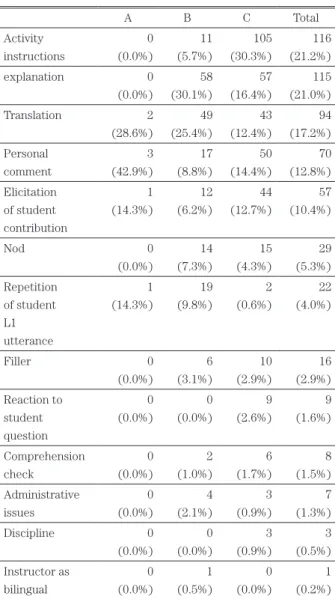
Table 6 shows the result of L1 functions categorized, following the revised category of De La Campa and Nassaji (2009). Activity instruction was used the most often among the three teachers, followed by explanation and translation. We examined why these L1 functions were used in their lessons and why there was a difference in L1 functions among the three teachers, focusing on the top three most frequently used functions.
Table 6
Frequency of the Participants’ L1 Functions (modified from De La Campa & Nassaji (2009)
A B C Total
Activity instructions
0 (0.0%)
11 (5.7%)
105 (30.3%)
116 (21.2%)
explanation 0
(0.0%)
58 (30.1%)
57 (16.4%)
115 (21.0%)
Translation 2
(28.6%)
49 (25.4%)
43 (12.4%)
94 (17.2%) Personal
comment
3 (42.9%)
17 (8.8%)
50 (14.4%)
70 (12.8%) Elicitation
of student contribution
1 (14.3%)
12 (6.2%)
44 (12.7%)
57 (10.4%)
Nod 0
(0.0%)
14 (7.3%)
15 (4.3%)
29 (5.3%) Repetition
of student L1 utterance
1 (14.3%)
19 (9.8%)
2 (0.6%)
22 (4.0%)
Filler 0
(0.0%)
6 (3.1%)
10 (2.9%)
16 (2.9%) Reaction to
student question
0 (0.0%)
0 (0.0%)
9 (2.6%)
9 (1.6%)
Comprehension check
0 (0.0%)
2 (1.0%)
6 (1.7%)
8 (1.5%) Administrative
issues
0 (0.0%)
4 (2.1%)
3 (0.9%)
7 (1.3%)
Discipline 0
(0.0%)
0 (0.0%)
3 (0.9%)
3 (0.5%) Instructor as
bilingual
0 (0.0%)
1 (0.5%)
0 (0.0%)
1 (0.2%)
Activity Instruction is an instruction or direction used in an activity such as raise your hand or make a pair. C used it the most among the three teachers, 105 times. B used L1 for activity instruction just 11 times, and A did not use it at all. It is presumed that the cause of this significant difference between B and C was due to their
class size. There were 19 students in the lesson of B, while there were 37 students in C’s lesson. In the interview, C said she felt it difficult to make activity instructions understood even in Japanese, much less in English. So, it can be understood that C felt less comfortable than B in giving activity instructions in English, and used Japanese to save time. On the other hand, although B used activity instructions mainly in L2, B sometimes used L1 for activity instructions before or after L2. In the interview, B said that she sometimes gave activity instructions in L1 after L2 to give clarification for the students.
However, not in every situation of the lesson, C used L1 for activity instruction. In the lesson, C sometimes spoke L2 for activity instruction. In the interview, we asked her about L2 use for activity instruction at some situations. C explained that some activity instructions were frequently used in lessons as classroom English (e.g. look at the blackboard or open your textbook).
In the survey of Tsukamoto and Tsujioka (2013), it was found that although many teachers conduct classroom instruction, greetings and warm-ups in English, they use less English in vocabulary or grammar explanation.
In comparison to the case of C, although classroom English was often used when conducting lessons, other expressions in Japanese might be difficult for C to speak in English.
The next function is explanation. B used explanation the most often among the three, followed by C. In the interview, B said that use of L1 for explanations helps students understand grammar and vocabulary without any problems. A difference in teaching content between the lessons may explain the differences in this function. A’s lesson focused on reading. A seldom provided explanations on grammar, vocabulary, or even the contents of the reading material in Japanese. On the other hand, the lesson focus of B and C was on grammar.
In the grammar section of the observed lessons, B and C both used more L1 to explain the points of the target grammar their students had to learn. The focus of their lessons might have influenced their amount of L1 and L2 use. Then, how about a difference between B and C? In the interview, when asked why they had taught grammar in Japanese, both B and C said that teaching grammar should be conducted in Japanese. In the questionnaire as well, they pointed out that Japanese should be used in grammar teaching. Although they both taught grammar in their lessons, their target grammar was different. B taught negative sentence and interrogative sentence of past
tense. On the other hand, C taught passive voice. We can presume that differences between target grammars might influence the degree to teach in English. Comparing to other grammars, passive voice may be more complicated for students to learn and for teachers to teach in English than negative sentence and interrogative sentence of past tense. However, only such complexity of grammar does not seem to have influenced teachers’ use of Japanese and English in their lessons. C used L1 for explanations as often as B, while B said in the interview that she tried to use as much English as possible to provide more English input, even in the grammar teaching section of the lesson.
The belief of B for L2 use also seems to make it distinct from the teaching of C.
Translation is an L1 utterance translating a previous L2 utterance. This function was used by the three teachers. A used it to provide Japanese translations after English words or idiomatic expressions when introducing vocabulary. This is one of a few L1 functions A used in his lesson. Although the amount of L1 use is quite less than B and C, A can be regarded not to have discarded the effectiveness or efficiency of L1 use. A admitted teachers’
L1 use in the classroom and said that there were many situations to use L1 in lessons in the questionnaire.
Especially for vocabulary teaching or learning, A seemed to think L1 effective. In the same questionnaire, A did not agree with the effectiveness of teaching English in English in vocabulary teaching while he totally agreed or almost agree with the other advantages of teaching English in English. This could explain A’s use of L1 in the introduction of vocabulary in the recorded lesson.
In the lesson, A provided his students with a match list of new vocabulary and its translation or meaning.
By matching the English vocabulary with Japanese, A provided the needed support for students’ understanding of the vocabulary. Kasahara (2015) claims that vocabulary list contrasting English and its translation plays a role in EFL contexts where natural exposure of English is limited in a daily life, and that intentional learning is important for the language acquisition in learning a language as a foreign language. By making the students engage on intentional learning, A might help them acquire new vocabulary.
B and C also used translation after showing English sentences and vocabulary. In the interview, B and C said that they provided Japanese translation so that the students could understand the contents fully. Though the frequency of translation conducted by B was close
to that of C, they seemed to use translation for different reasons. B used translation whenever students expressed signs of embarrassment or anxiety. In order to help or check students’ understanding, B seemed to provide the L1 translations. On the other hand, C used translation after every L2 sentence. Teachers’ belief towards when to provide translation might have influenced their L1 use in the classroom.
Beyond the three functions, we would like to give a significant importance on one L1 function that teacher A, whose L2-use frequency was close to 100% in the classroom, used: personal comment. Out of A’s L1-use functions, the percentage of personal comment was the highest. The samples are shown in the following:
T: Kaiteru jyan! (You have written it!) Nande sonna kincho surunkana? (Why are you feeling so nervous?) Fudan… mou! (Usually… Shoot!)
The three utterances mentioned above were relative to a part of the lesson. In the comprehension check of the reading material, asked some questions, students did not try to answer, or just responded with “I don’t know”.
This seemed to show that the students were afraid of making mistakes or giving out wrong answers. At that time, A spoke the sentences above to the students. In the interview, A said that he used Japanese in order to change the atmosphere of the lesson. In the questionnaire, A said in the free comment that “I think that L1 should be used when a teacher wants to draw students’ attention, when it is difficult to teach the contents in English, or to relax the atmosphere of the classroom (translated by the author).”
The previous studies also claim that L1 use is effective to decrease students’ anxiety in the classroom (Cook, 2001).
In this situation, A helped students reduce their anxiety by using Japanese to express what he thought at the moment to the students.
5. Conclusion and Limitations
This study analyzed the lessons of three English teachers, focusing on the frequency and functions of their L1 use, as well as their reasons for using L1. We found that even with almost the same L2 proficiency levels, teachers’ L1-use frequency and functions varied between the teachers. In this study, by examining the reasons of the result through an interview and questionnaire, we came to a conclusion that the participants’ L1 and L2 use
seemed to be influenced by internal factors (e.g. trying to provide more L2 for students) rather than external factors (e.g. students’ understanding of content) in the classroom. For making an input-rich classroom, the way to deal with the external factor will be necessary for the teachers. Another interesting finding in the research was that students’ year level and L2 proficiency level were not significant when conducting English lessons in English. Finally, in this research, the L1 functions which the teachers used provide us some proposals for using L1 effectively in the classroom. The teachers used L1 effectively for mitigating learners’ anxiety in the lesson, or checking or helping learners’ comprehension while providing more L2 input for the students. L1 use should not be disregarded in teaching a foreign language.
However, this study has the following limitations.
First, the number of participants was small, with just three teachers. For participants in this study, although the study regarded the participants’ English proficiency levels as almost the same, it is necessary to set up a criterion to evaluate participants’ English proficiency level. Second, the content of the participants’ lessons differed as A dealt with reading while B and C taught mainly grammar. If A’s lesson had focused on grammar, A might have used more L1 than or as much L1 as B and C, as compared to his reading lesson. Moreover, even in B’s and C’s grammar teachings, the content of the grammar was different. If B had taught a more complicated grammar, B might have used L1 more often to translate L2 sentences or help students’ comprehension. On the other hand, if grammar had been simple, C might have used more L2 in lessons.
Finally, we observed and recorded just one lesson from each of the participant teachers. Some internal and external factors might have influenced the participants’
teaching at the time of each lesson observation.
Therefore, it cannot generalize the overall tendency of participants’ L1-use with just one observation for each.
A longitudinal study would be necessary to collect more data about participants’ L1-use frequency, functions, and reasons behind its use in order to further explore factors influencing teachers’ decision making regarding L1 use.
References
Atkinson, D. (1987). The mother tongue in the classroom. ELT Journal, 41(4), 241-247.
Carson, E. (2014a). L1 in the EFL class: Student preferences and teacher beliefs. In R. Chartrand, G. Brooks, M. Porter, & M.
Grogan (Eds.), The 2013 PanSIG Proceedings (pp. 203- 213). Nagoya, Japan: JALT PanSIG.
Carson, E. (2014b). Teachers and students: At L1 odds in the EFL class. In N. Sonda & A. Krause (Eds.), JALT2013 Conference Proceedings (pp. 248-258). Tokyo, Japan:
JALT.
Cook, V. (2001). Using the first language in the classroom.
Canadian Modern Language Review, 57, 402-423.
Cummins, J. (2007). Rethinking monolingual instructional strategies in multilingual classrooms. Canadian Journal of Applied Linguistics, 10(2), 221-240.
De La Campa. J. C., & Nassaji, H. (2009). The Amount, Purpose, and Reasons for Using L1 in L2 Classrooms. Foreign Language Annals, 42(4), 742-759.
Duff, P., & Polio, C. (1990). How much foreign language is there in the foreign language classroom?, The Modern Language Journal, 74, 154-166.
Edstrom, A. (2006). L1 use in the L2 classroom: One teacher’s self-evaluation. Canadian Modern Language Review, 63(2), 275-292.
Field, A. (2009). Discovering Statistics Using SPSS (3rd ed.).
London, UK: Sage Publications.
Gass, S. M., & Mackey, A. (2000). Stimulated recall methodology in second language research. Mahwah, N.J: L. Erlbaum Associates.
Hall, G., & Cook, G. (2012). Own-language use in language teaching and learning. Language teaching, 45(3), 271-308.
He, A. E. (2012). Systematic use of mother tongue as learning/
teaching resources in target language instruction.
Multilingual Education, 2(1), 1-15.
Hobbs, V., Matsuo, A., & Payne, M. (2010). Code-switching in Japanese language classrooms: An exploratory investigation of native vs. non-native speaker teacher practice.
Linguistics and education, 21(1), 44-59.
Kang, D. M. (2008). The classroom language use of a Korean elementary school EFL teacher: Another look at TETE.
System, 36(2), 214-226.
Kasahara, T. (2015). Vocabulary Teaching in the Japanese EFL Environment. In Sato, R., Kasahara, T., & Koga, T.
(Eds.), The Introduction of effective English teaching methodology for Japanese learners: Theory and Practice of English Acquisition in the EFL environments (pp. 55- 89). Tokyo, Japan: Meiji Tosho.
Koga, T., & Sato, R. (2013). Effects of a Debate Task on Changes of Communication Variables. ARELE. 24. 295-306.
Krashen, S. D. (1981). Second Language Acquisition and Second Language Learning. Oxford, UK: Pergamon.
Krashen, S. (1982). Principles and practice in second language acquisition. Oxford, UK: Pergamon.
Krashen, S. D. (1985). The input hypothesis: Issues and implications. New York, USA: Longman.
Krashen, S., & Terrell, T. (1983). The natural approach:
Language acquisition in the classroom. New York, USA:
Pergamon.
Levine, G. (2011). Code choice in the language classrooms.
Bristol, UK: Multilingual Matters.
Macaro, E. (2001). Analysing Student Teachers’ Codeswitching in Foreign Language Classrooms: Theories and Decision Making. Modern Language Journal, 85(4), 531-548.
Macaro, E. (2006). Codeswitching in the L2 classroom: A communication and learning strategy. In E. Llurda (Ed.) Non-Native Language Teachers: Perceptions, Challenges,
and Contributions to the Profession (pp. 63-84). Boston, MA: Springer.
Macaro, E. (2009). Teacher use of codeswitching in the second language classroom: Exploring ‘optimal’ use. In M. Turnbull
& J. Dailey-O’Cain (Eds.), First language use in second and foreign language learning (pp. 35-49). Bristol:
Multilingual Matters.
Macaro, E. (2011). The teacher’s code switching and the learner’s strategic response: Towards a research agenda and implications for teacher education. Paper presented at the JACET 50th Commemorative International Conven¬tion, Fukuoka.
MacIntyre, P. D. (2007). Willingness to communicate in the second language: Understanding the decision to speak as a volitional process. Modern Language Journal, 91, 564- 576.
MEXT (Ministry of Education, Culture, Sports, Science and Technology). (2009). Course of Study for Senior High School Foreign Language (English). Tokyo, Japan: MEXT.
MEXT (Ministry of Education, Culture, Sports, Science and Technology). (2013). The English Education Reform Plan Corresponding to Globalization. Retrieved February 13, 2016, from http://www.mext.go.jp/english/topics/__icsFiles/
afieldfile/2014/01/23/1343591_1.pdf
Mills, Amy. (2014). Purposes and Implications of L1 Use in Japanese Elementary School English Classes. Language and information sciences, 12, 127-143.
Mitchell, R. (1988). Communicative language teaching in practice. London, UK: Centre for Information on language Teaching and Research.
Miura, K. (2010). Prospective Japanese English Teachers’
Perceptions of Using L2 in High School Instruction.
Tsurubunka University Bulletin, 72, 1-17.
Moore, P. J. (2013). An Emergent Perspective on the Use of the First Language in the English-as-a-Foreign-Language Classroom. The Modern Language Journal, 97(1), 239- 253.
Nakatsukasa, K., & Loewen, S. (2015). A teacher’s first language use in form-focused episodes in Spanish as a foreign language classroom. Language Teaching Research, 19(2), 133-149.
Narita, H. (2013). English education suitable for Japanese.
Tokyo, Japan: Shohakusha.
Osada, E. (2011). Teachers’ use of L1 in elementary school EFL classes. Scientific approaches to language, 10, 105-117.
Polio, C. G., & Duff, P. A. (1994). Teachers’ language use in university foreign language classrooms: A qualitative analysis of English and target language alternation. The Modern Language Journal, 78(3), 313-326.
Reza, G, S., & Shahab, M. (2014). Codeswitching in the Language Classroom: A Study of Four EFL Teachers’ cognition. RELC journal, 45, 151-164.
Rolin-Ianziti, J., & Brownlie, S. (2002). Teacher use of learners’
native language in the foreign language classroom. The Modern Language Journal, 58, 402-426.
Sato, R. (2009). Suggestions for creating a successful input-rich English class with a little code-switching. Journal of the Chubu English Language Education Society, 38, 371- 378.
Sato, R. (2015). The Case Against the Case Against Holding
English Classes in English. LANGUAGE TEACHER, 39, 15.
Sato, R. & Koga, T. (2012). Examining the Effects of All English Class on Learners’ Affective Aspects: Variations of Willingness to Communicate, Communication Anxiety and Perceived Communication Competence. Journal of the Chubu English Language Education Society, 41. 183- 190.
Schweers, C. (1999). Using L1 in the L2 classroom. English Teaching Forum, 3(2), 6–13.
Seong, M, P. (2013). The Use of Students’ First Language in the EFL Classroom in Korea. Humanising Language Teaching, 2. Retrieved February 13, 2016, from http://www.
hltmag.co.uk/apr13/sart08.htm
Shimizu, M. (2006). Monolingual or Bilingual Policy in the Classroom: Pedagogical implications of L1 use in the Japanese EFL classroom. Maebashi Kyoai Gakuen College Ronshu, 6, 75-89.
Storch, N., & Aldosari, A. (2010). Learners’ use of first language (Arabic) in pair work in an EFL class. Language Teaching Research, 14(4), 355-375.
Swain, M., & Lapkin, S. (2000). Task-based second language learning: The uses of the first language. Language Teaching Research, 4(3), 251-274.
Tanabe, N. (2011). High School Teachers’ Impressions About Their Use of English in Classes: A Questionnaire Survey After the Announcement of the New Course of Study. The journal of The Japan Association of College English Teachers (JACET) Chugoku-Shikoku Chapter, 8, 27-39.
STEP (The Eiken Foundation of Japan). (2015). About EIKEN Grade Pre-1. Retrieved February 13, 2016 from Eiken website: http://www.eiken.or.jp/eiken/en/grades/grade_p1/
Tsukamoto, M., & Tsujioka, N. (2013). Teaching English through English to senior high school students in Japan: Towards the implementation of the new course of study. Shitennoji University Bulletin, 55, 309-324.
Turnbull, M. (2001). There is a role for the L1 in second and foreign language teaching, but... The Canadian Modern Language Review, 57, 531-540.
Turnbull, M., & Arnett, K. (2002). 11. TEACHERS’USES OF THE TARGET AND FIRST LANGUAGES IN SECOND AND FOREIGN LANGUAGE CLASSROOMS. Annual review of applied linguistics, 22, 204-218.
Wilkerson, C. (2008). Instructors’ Use of English in the Modern Language Classroom. Foreign Language Annuals, 41(2), 310-320.
Yamada, H. (2011). Teaching/Learning English in English at Japanese Senior High Schools: Practical Tips for Teachers.
Jin-ai University Bulletin, 10, 87-98.
Yamada, H. & G. Hristoskova. (2011). Teaching/Learning English in English: Japanese SHS teachers & students perceptions.
Journal of Fukui Prefecture English Teachers’
Association, 69, 3-33.
Appendix
Appendix A Questionnaire about teachers’ belief towards teachers’ use of L2 (English) in the classroom (Yamada & Shimo, 2011)
1 .平成25年に公示された「グローバル化に対応した英 語教育改革実施計画」において,中学校でも「授業
は英語で行うことを基本とする」ということが計画 されています。この「授業は英語で行うことを基本 とする」についてどうお考えですか。
☐大いに賛同する ☐ほぼ賛同する ☐どちらとも 言えない ☐あまり賛同しない ☐全く賛同しない 2 .英語の授業を英語で行うに関して当てはまるところ
に丸(〇)を付けてください。
1 :全くその通り, 2 :ほぼその通り, 3 :どちら とも言えない, 4 :あまりそう言えない, 5 :全く 違う
a 英語を使う自然な環境をつくることが できる。
1 2 3 4 5
b 生徒が英語により多く触れることにな る。
1 2 3 4 5
c いつも英語を聞いていると英語を聞き 取りやすくなる。
1 2 3 4 5
d 授業が英語で行われると語彙力をつけ るのに役立つ。
1 2 3 4 5
e そのような授業では,生徒に英語を学 びたいという内的動機づけを与えること ができる。
1 2 3 4 5
f 言葉は実際のコミュニケーションで 使って習得できるものである。
1 2 3 4 5
g その他:
3 .英語の授業を英語で行うに関して当てはまるところ に丸(〇)を付けてください。
1 :全くその通り, 2 :ほぼその通り, 3 :どちら とも言えない, 4 :あまりそう言えない, 5 :全く 違う
a 全て英語で授業をすると,困惑する生 徒がいる。
1 2 3 4 5
b 英語力の低い生徒は日本語で説明する 必要がある。
1 2 3 4 5
c 生徒のレベルに合った英語を使うのは 難しい。
1 2 3 4 5
d 重要事項が理解できないことがある。 1 2 3 4 5 e 説明は日本語でした方がはるかに効率
的なことが多い。
1 2 3 4 5
f 日本人教師にとって,常に英語で話す ことは困難だ。
1 2 3 4 5 g その他:
4 .授業は,どのくらい英語で行っておられますか。
☐言語材料の提示(テキストの英文や例文提示)の み ☐言語材料の提示とclassroom English を使う 時 ☐言語材料の提示と生徒に英語でコミュニケー ション活動をさせる時 ☐ほとんど全て ☐その他
(下に記入してください)
5 .先生が話す英語を生徒に理解させるのに,どのよう
な工夫をされていますか。あてはまるもの全てに チェック☑を入れてください。
☐ゆっくり話す ☐繰り返す ☐簡単な英語を使う
☐ジェスチャーを使う ☐演技をする ☐写真・絵 や実物を見せる ☐日本語に訳す ☐その他(下に 記入してください)
6 .今後,「授業は英語で行うことを基本」としていく となると,次のどのようなことが必要と思われます か。それぞれについて,どう思われるかご回答くだ さい。
1 :とても必要, 2 :必要, 3 :どちらとも言えな い, 4 :あまり必要でない, 5 :全く必要でない a 英語の授業をとおして人間教育を行う
のだという理念
1 2 3 4 5
b 大学入試での英語の試験の改革 1 2 3 4 5 c 教育研究所などの主催による教員研修 1 2 3 4 5 d 個々の教員が必要に応じて自由に研修
できる制度
1 2 3 4 5
e それぞれの学校で教員が相互に研修し サポートできる体制
1 2 3 4 5
f 教員の英語力の向上 1 2 3 4 5 g その他:
7 .「授業は英語で行うことを基本」にすると,あなた は,次のどのようなことをしていこうと考えられま すか。それぞれについて,どう思われるかご回答く ださい。
1 :全くその通り, 2 :ほぼその通り, 3 :どちら とも言えない, 4 :あまり思わない, 5 :全く思わ ない
a 日本語を使用する方が教育効果の高い ことを大事にしつつ,英語を使った活動 を増やしていく。
1 2 3 4 5
b 試験問題を変える。 1 2 3 4 5 c 研修会に参加する。 1 2 3 4 5 d 教授法を自分で勉強する。 1 2 3 4 5 e 自分の学校の特性に沿った指導のあり
方を,同僚と一緒に考える。
1 2 3 4 5
f 英語力を向上させる 1 2 3 4 5 g その他:
8 .最後に,先生のバックグラウンドや勤務校について お教えください。
( 1 )大学でのご専攻(主専攻)は何でしたか。
BA in ☐英語教育 ☐言語学 ☐英文学 ☐教 育 ☐その他
MA in ☐英語教育 ☐言語学 ☐英文学 ☐教 育 ☐その他
( 2 )教職について何年になられますか。
☐5 年以内 ☐5 年から10年以内 ☐10年から20 年以内 ☐20年以上
( 3 )中学校または高等学校で英語を何年教えてお られますか。
☐5 年以内 ☐5 年から10年以内 ☐10年から20 年以内 ☐20年以上
( 4 )現在勤務されておられる学校にはどのような コースがありますか。
☐全日制:普通科のみ(理数科を含む) ☐全日 制:普通科と国際関係の学科
☐全日制:普通科と国際関係の学科と職業系の学 科 ☐全日制:普通科と職業系の学科(理数科を 含む)
☐全日制:職業系の学科のみ ☐定時制・通信 制:普通科,職業系の学科
9 .英語の授業における教師の英語使用に関して意見を 聞かせてください。
Appendix B Questionnaire about teachers’ belief towards teachers’ use of L1 (Japanese) in the classroom (modified from Shimizu (2006)
1 .英語の授業の際に,日本語を使用することがありま すか。
☐いつも。 ☐しばしば。 ☐時々。 ☐めったに ない。 ☐全くない。
2 .あなたは教師が日本語を英語の授業で使うべきだと 思いますか。
☐はい。 ☐いいえ。
3 .教師が日本語を使うのは必要ないと考えた方,それ
はなぜですか。
4 .あなたは英語の授業における教師の日本語の使用が 英語を学ぶのに役立つと思いますか?
☐すごくそう思う。 ☐少しそう思う。 ☐そう思 う。 ☐そうは思わない。 ☐全然そうは思わない。
5 .どのぐらいの頻度で授業の中で教師が日本語を使う べきだと思いますか。
☐全く使わないほうが良い。 ☐めったに使わない 方が良い。 ☐ときどき。 ☐頻繁に。
□ かなり頻繁に。
6 .いつ教師が日本語を使うのが適切だと思いますか。
複数回答可。
☐既に学習した教材の内容を復習するとき ☐新し い教材を導入するとき ☐複雑な文法を説明すると き ☐新しい語彙の説明をするとき ☐難しい概念 を説明するとき ☐表現やフレーズを練習すると き ☐指示を出すとき ☐アドバイスをするときや 効果的な勉強方法を教えるとき ☐生徒に冗談を言 うとき ☐英語力をテストするとき(例-テストで 英語から日本語に訳すときなど) ☐内容を理解し ているか確認するとき ☐生徒の居心地をより良く し,より自信を付けさせるとき ☐小グループで活 動をするとき ☐英語と日本語の関係を説明すると き ☐その他 (下に記入してください)
7 .英語の授業における教師の日本語使用に関して意見 を聞かせてください。
Received May 6, 2016; accepted June 23, 2016
【日本語要旨】
英語授業における日本人教師の日本語使用の調査
─頻度,機能,理由に着目して─
泉 谷 忠 至 近畿大学附属高等学校・中学校
佐 藤 臨太郎 奈良教育大学英語教育講座(英語教育学)
現行の『高等学校学習指導要領』(MEXT, 2009),そして『グローバル化に対応した英語教育改革実施計画』(MEXT, 2013)により,今後,高等学校のみならず中学校の英語授業においても,教師の積極的な英語使用が期待されている。
これまでも教室での外国語使用と母語使用に関しては議論されていたが,本論では実際に言語使用がどのように教師 によって行われているかを調査した。
第1章では,授業における教師の言語使用に関する先行研究を整理した。従来の第二言語習得研究では教師が学習 対象言語を使用するべきとされていた。しかし,近年の研究では,学習者の母語も使用されるべきと主張されている。
このような言語使用の研究においては,実際の教室での教師の言語使用頻度,使用機能,使用理由などに着目して調 査が行われている(e.g., Polio & Duff, 1994)。加えて,教師の言語使用に対しての信念の研究も行われている。しかし,
このような研究は日本の中学校・高等学校ではあまり行われておらず,本研究では,教師の日本語(母語)の使用量,
機能,そしてその理由に関する調査を行った。
第 2 章では,調査方法を示した。この調査には 3 人の英語教師(A(男性・高等学校 2 年担当)・B(女性・中学校 1 年担当)・C(女性・中学校 2 年担当)が参加した。 3 人とも教師 1 年目であり,彼らの英語運用能力は同等と考えた。
それぞれの教師の授業を記録し,授業後にその授業での日本語使用についてインタビューを行い,その後言語使用に 関するアンケートをその教師たちに実施した。データの分析は,先行研究を基に,録画した授業からそれぞれの教師 の英語・日本語使用率を算出し,使用された日本語の機能分類を行った。
第 3 章では,収集したデータを基に分析を行った。まず,記録した授業を基にそれぞれの教師の日本語使用率を参 集したところ, 3 人それぞれに大きな違いがみられた(日本語:A<B<C,英語:A>B>C)。その違いをアンケー トで集められた教師の日本語・英語使用に対しての信念を基に分析を行った。その結果, 3 人の教師は全員授業での 教師の英語使用に対して賛成しているが,BとCは英語使用率の最も高いAと比べ,授業での英語使用に対して不安 を感じていた(例:生徒の英語力に合わせた英語使用)。それに対して,Aは英語で授業を行うために準備をしっかり と行っていたことが分かった。BとCの間では,日本語を使用するべきと考える中で,Bは英語を積極的に使用しよ うとしており,英語使用率が異なる原因となったと考えた。次に,算出されたそれぞれの教師の英語使用率と担当学 年,学習者の英語運用能力から,教師が英語で授業を行うことに関して,学習者の学年と英語運用能力は関係が見ら れないことが分かった。最後に, 3 人の教師の日本語使用の機能に着目した。発見された日本語の機能の内,頻度の 高かった「活動の指示」,「説明」,「日本語訳」,「個人的意見」を分析した。分析の結果,それぞれの日本語使用機能 には教室の生徒人数や,授業の内容などが影響していることが発見された。
結論として,教師の言語使用には授業内容や生徒人数のような外部的要因よりむしろ,教師の信念のような内部的 要因が影響を与えていることが分かった。しかし,その一方で,教師の授業での英語使用は学習者の学年や運用能力 に関係なく行うことが可能であることも分かった。今後は日本人教師の英語使用・日本語使用の要因を明らかにする ために,さらなる研究が必要である。