IEICE TRANS. INF. & SYST., VOL.E97–D, NO.4 APRIL 2014
811
LETTER
Special Section on Data Engineering and Information ManagementAnalyzing Information Flow and Context for Facebook Fan Pages ∗
Kwanho KIM†, Josu´e OBREGON††,Nonmembers,andJae-Yoon JUNG††a),Member
SUMMARY As the recent growth of online social network services such as Facebook and Twitter, people are able to easily share information with each other by writing posts or commenting for another’s posts. In this paper, we firstly suggest a method of discovering information flows of posts on Facebook and their underlying contexts by incorporating process mining and text mining techniques. Based on comments collected from Facebook, the experiment results illustrate how the proposed method can be applied to analyze information flows and contexts of posts on social network services.
key words: information flow, context analysis, process mining, text mining, Facebook
1. Introduction
Recently, social network services such as Facebook and Twitter are increasingly growing as an online platform where individuals and organizations post and share infor- mation such as news, opinions and advertisements in a fast and easy manner. The original posts are notified to the sub- scribers of the sites, and the comments on the post let the in- formation be delivered to the friends of the subscriber again.
Since comments on a post reflect how information is ac- tually propagated from and to people, discovering hidden information flows and their underlying contexts from com- menting behaviors of people is a significant issue of infor- mation diffusion analysis on social networks. Sophisticated understanding about information propagation mechanisms that people actually possess can be achieved by information flows and contexts, which accelerates many social services such as viral marketing [1], social suggestion [2], and influ- ence analysis [3].
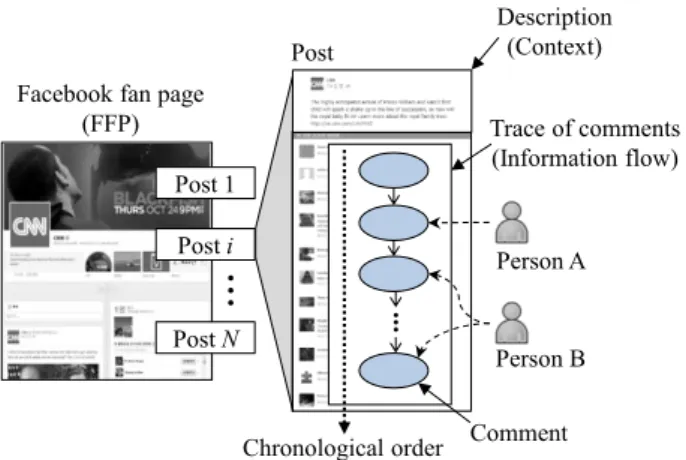
Specifically, this research focuses on Facebook fan pages(FFPs) which are to connect people with the same interest. A FFP includes many posts each of which is com- posed of a textual description and comments, as shown in Fig. 1. The description of a post represents its specificcon- textwhile its comments contain theinformation flowof the context based on people’s interactions in chronological or- der. Here, the sequence of ordered comments on a specific
Manuscript received July 4, 2013.
Manuscript revised October 29, 2013.
†The author is with Incheon National University, Incheon, 406–772, Republic of Korea.
††The authors are with Kyung Hee University, Yongin, Gyeonggi-do, 446–701, Republic of Korea.
∗This research was supported by the National Research Foundation of Korea (NRF) grant funded by the Korea government (MISP) and the Ministry of Education (Nos.
2013R1A2A2A03014718 and 2012R1A6A3A01038452).
a) E-mail: [email protected] (Corresponding author) DOI: 10.1587/transinf.E97.D.811
Fig. 1 Information flow and context of a post on a Facebook fan page.
post is called thetraceof comments on the post.
There are many studies on information flows based on social interactions such as calculation of influences [4], analysis on social network structures [5], [6], and discovery of information diffusion processes [7]. However, their major drawback is the lack of ability to suggest the corresponding context with an information flow. Moreover, the previous methods cannot capture the dynamic nature of information flows since they heavily rely on the static links between peo- ple, called friendship, rather than focusing on the dynamic information propagation established by people for a context.
In this paper, we present an integrated method of ana- lyzing the context from comments on a FFP, as well as dis- covering meaningful information flows from the FFP. While the previous method deals with only information flow dis- covery from re-posting behaviors of people [8], the inte- grated method proposed in this paper first suggests appli- cation of trace clustering to finding several meaningful in- formation flows and then reveals the underlying context of each flow based on frequent keywords. In summary, by us- ing the people’s comments on posts, the proposed method can discover information flows that imply the actual rela- tions among people, as well as their underlying contexts si- multaneously. Specifically, process mining and text min- ing techniques are incorporated to achieve the goal of our method.
The experiment results based on comments collected in a FFP demonstrate that our method is able to suggest a yet another viewpoint to understand information propa- gation among people through revealing hidden information flows and their contexts.
Copyright c2014 The Institute of Electronics, Information and Communication Engineers
812
IEICE TRANS. INF. & SYST., VOL.E97–D, NO.4 APRIL 2014
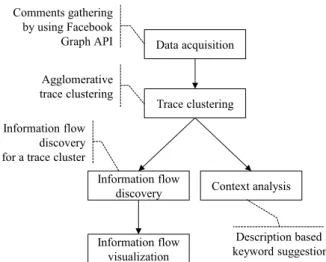
2. Analysis on Information Flows and Contexts The proposed method is composed of five steps as shown in Fig. 2. Based on the traces of a FFP obtained in the data ac- quisition step, similar traces are grouped into a trace cluster in the trace clustering step. Then, for each trace cluster, its information flow is discovered by detecting frequently ob- served sequences of people across the comments related to the information flow, and the discovered information flow is visualized in a graphical manner. In the meantime, the con- text for each information flow is investigated by means of keywords based on the post descriptions associated with the information flow.
2.1 Information Flow Discovery
Before discovering information flows, similar traces are needed to be clustered since the trace of a single post only reveals a particular case of information propagation rather than the radical flows repeatedly observed across posts. Ac- cordingly, we conduct clustering analysis of traces by em- ploying the agglomerative hierarchical clustering method which heuristically searches for clusters in a hierarchical tree [9]. A trace is represented as a vector of binary val- ues which means the appearance sequence of people in the trace, and the similarity between traces is measured by us- ing Jaccard coefficient. At the initial stage, each trace is set to be a trace cluster itself, and, two trace clusters are iter- atively combined into a single trace cluster if they are the most similar pair, until they do not have any trace cluster to be combined.
Subsequently, the information flow of a trace cluster, which successfully explains the interaction patterns among people across the posts in the trace cluster, is discovered.
Since the entire relations among people are very complex, information flows are desired to be abstracted by focusing on some important flows. Hence, we adopt the fuzzy min- ing that discovers meaningful sequences of activities by uti-
Fig. 2 Flow chart of the proposed method.
lizing an adaptive graph simplification especially for less structured flows [10]. The significance between people is in- vestigated based on how much two people are sequentially correlated with each other. According to the significances of people, some are grouped if they are less significant com- pared to others.
2.2 Context Analysis
To extract keywords according to information flows, the tex- tual descriptions of the posts associated with an informa- tion flow are aggregated into a single text document. Then, the importance of a word in a text document is examined in terms of term frequency (TF) and inverse document fre- quency (IDF) [11]. Particularly, as the importance metric of a word, we use a TF-IDF weighting scheme which is widely applied in many text mining applications such as informa- tion retrieval and text summarization.
In this research, a word is considered a keyword of an information flow, if the word frequently appears in the de- scriptions associated with the information flow and rarely appears in the descriptions associated with the other infor- mation flows. After calculating the importance values of all the words for each information flow, top ranked words are regarded as the keywords of the information flow.
3. Experiment Results
For the experiments, we used a FFP of CNN (https://www.
facebook.com/cnn) which publishes news articles, and more than 0.2 million people share opinions by making comments on the posts in the FFP. Posts published between May 17, 2013 and May 31, 2013 were gathered by utilizing the de- veloped software shown in Fig. 3. To reduce noises, we re- moved comments of the users who appeared less than eight times, and a total of 297 posts and 22,297 comments were finally involved in the experiments. To cluster traces and discover information flows, a process mining tool ProM was used [12].
Figure 4 shows the dendrogram of trace clustering for
Fig. 3 Screenshot of the software developed for gathering posts and comments on FFPs.
LETTER
813
Fig. 4 Dendrogram of traces extracted by trace clustering.
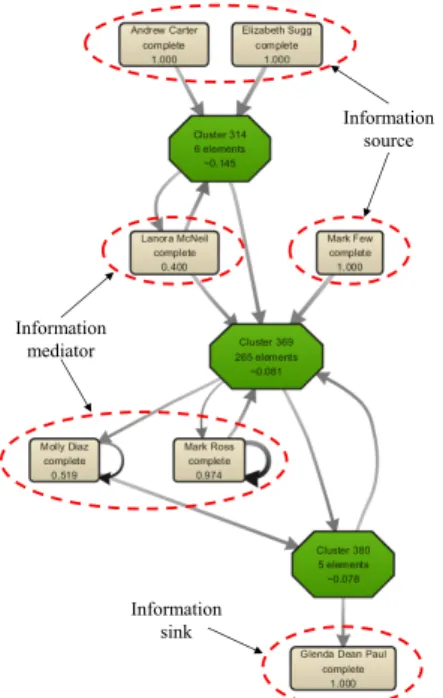
Fig. 5 Information flow of clusterCdiscovered from CNN’s FFP.
the gathered posts and comments. The graph visualizes sim- ilar posts in terms of information flows of their comments, and the lines on the graph represent the results of iterative clustering steps. A clustering threshold that determines the number of trace clusters was empirically chosen. After re- moving trace clusters with less than three traces, four trace clusters were remained. The clustersA,B,C and Dcon- tained 179, 10, 104, and 4 traces, respectively.
For each trace cluster, we discovered an information flow which representing how information was propagated among people in the FFP. Figure 5 depicts the information flow discovered from clusterC. A square box shows a per- son and his/her significance in the information flow, and an octagon box is a group of people whose significances were marginal. Three types of roles can be found in the view point of information flow such as: (i) information source
Table 1 Top 5 keywords of four clusters and their TF-IDF values.
Fig. 6 Visualization of the underlying context of clusterC.
which initiates information flows, (ii) information mediator which connects between people or groups, and (iii) infor- mation sink which mainly consumes information and hardly introduces subsequent reactions of the others.
At last, the keywords of each cluster, which represent its underlying context, were analyzed based on the aggre- gated descriptions of the posts associated with its informa- tion flow. We removed stop-words to eliminate noises. Top 5 keywords for four clusters are described in Table 1, in which their TF-IDF values are presented in the parentheses.
In addition, the discovered context can be visualized in the word cloud based on the TF-IDF values of the correspond- ing keywords.
For instance, the keywords of clusterCin the table in- dicate that its information flow shown in Fig. 5 was mainly about the victims of Boston bombing. It is expected that the information related with Boston bombing is propagated among people. First, in Fig. 5 it was found that people such as “Andrew carter” and “Elizabeth Sugg” mainly initiated information flows about Boston bombing. Second, people such as “Lanora McNeil” and “Molly Diaz” diffused the re- lated information to others by connecting between groups of people. Finally, a person, “Glenda Dean Paul”, was observed to frequently finalize the information flow about Boston bombing, indicating that people rarely reacted to her comments about the event.
4. Conclusion and Discussion
In this research, we developed a method that aims not only to discover information flows based on trace clusters by
814
IEICE TRANS. INF. & SYST., VOL.E97–D, NO.4 APRIL 2014
combining similar traces but also to analyze their under- lying contexts. The experiment results illustrated how the proposed method could be applied to the understanding of the information propagation of posts on FFPs. It is believed that the method allows Web analysts to figure out who are interested in the posts on the site and how the information of the post are propagated on the social networks based on the comments on FFPs.
The proposed method can also be widely adopted for most social network services just as illustrated for Face- book. It is because the method depends only on informa- tion related to comments such as user sequences and textual descriptions which are provided by the social network ser- vices.
For the future work, we plan to further extend the pro- posed method to accommodate additional information of so- cial networks such as friend relations and users’ profiles.
References
[1] P. Domingos, “Mining social networks for viral marketing,” IEEE Intell. Syst., vol.20, no.1, pp.80–82, Jan. 2005.
[2] Q. Li, J. Wang, Y.P. Chen, and Z. Lin, “User comments for news recommendation in forum-based social media,” Inf. Sci., vol.180, no.24, pp.4929–4939, Dec. 2010.
[3] M. Cha, H. Haddadi, F. Benevenuto, and K.P. Gummad, “Measuring user influence on twitter: The million follower fallacy,” Proc. 4th Int.
Conf. on Weblogs and Social Media, pp.10–17, Washington, DC,
May 2010.
[4] X. Jin, C. Wang, J. Luo, X. Yu, and J. Han, “LikeMiner: A system for mining the power of ‘Like’ in social media networks,” Proc. 17th Int. Conf. on Knowledge Discovery and Data Mining, pp.753–756, San Diego, CA, Aug. 2011.
[5] W.M.P. van der Aalst, T. Weijters, and L. Maruster, “Workflow min- ing: Discovering process models from event logs,” IEEE Trans.
Knowl. Data Eng., vol.16, no.9, pp.1128–1142, Sept. 2004.
[6] W.M.P. van der Aalst and M. Song, “Mining social networks: Un- covering interaction patterns in business processes,” Lect. Notes Comput. Sci., vol.3080, pp.244–260, June 2004.
[7] P. Sriprasertsuk and W. Kameyama, “Information distribution anal- ysis based on human’s behavior state model and the small-world network,” IEICE Trans. Inf. & Syst., vol.E92-D, no.4, pp.608–619, April 2009.
[8] K. Kim, J.-Y. Jung, and J. Park, “Discovery of information diffusion process in social networks,” IEICE Trans. Inf. & Syst., vol.E95-D, no.5, pp.1539–1542, May 2012.
[9] J.-Y. Jung, “PROCL: A process log clustering system,” J. Society for e-Business Studies, vol.13, no.2, pp.181–194, May 2008.
[10] C. G¨unther and W.M.P. van der Aalst, “Fuzzy mining – adaptive pro- cess simplification based on multi-perspective metrics,” Lect. Notes Comput. Sci., vol.4714, pp.328–343, Sept. 2007.
[11] N. Zhong, L. Yuefeng, and W. Sheng-Tang, “Effective pattern dis- covery for text mining,” IEEE Trans. Knowl. Data Eng., vol.24, no.1, pp.30–44, Jan. 2012.
[12] W.M.P. van der Aalst, T. Weijters, A.J. Weijters, B.F. van Dongen, A.K. Medeiros, M. Song, and H.M.W. Verbeek, “Business process mining: an industrial application,” Inf. Syst., vol.32, no.5, pp.713–
732, Sept. 2006.