Japan Advanced Institute of Science and Technology
JAIST Repository
https://dspace.jaist.ac.jp/
Title
Using text semantic similarity approach to check
the consistency of UML
Author(s)
Kotb, Yasser; Katayama, Takuya
Citation
Research report (School of Information Science,
Japan Advanced Institute of Science and
Technology), IS-RR-2006-013: 1-11
Issue Date
2006-09-07
Type
Technical Report
Text version
publisher
URL
http://hdl.handle.net/10119/8412
Rights
Description
リサーチレポート(北陸先端科学技術大学院大学情報
Using
Text Semantic
Similarity
Approach
to Check
the Consistency
of UML
Yasser Kotb* and Takuya Katayama**
Japan Advanced Institute of Science and Technology
School of Information Science
Asahidai 1-1, Nomi, 923-1292, Ishikawa, Japan
IS-RR-2006-013September 7, 2006
* C
orresponding author: [email protected]
jp.
** C
Using
Text
Semantic
Similarity
Approach
to
Check
the
Consistency
of UML1
Yasser
Kotb2
and Takuya
Katayama3
Japan Advanced Institute of Science and Technology School of Information Science
Asahidai 1-1, No7ni, 923-1292, Ishikawa, Japan
Abstract
It is an important and stimulating issue to discover the inconsistency and incompleteness of the large software system through the UML diagrams. However, the use of temporal logic and model checking techniques to address the problem of UML consistency for developing software systems has received much attention. It is still not applicable and hard mission to specify the different consistency issues of UML. In this paper, we address this problem. We investigate the use of a recent natural language processing technique called Text Semantic Similarity, or Textual Entailment, to improve the consistency and the completeness among various UML diagram.
Keywords: UML Language Engineering, Text Semantic Similarity, Consistency, Verification.
1
Introduction
The Unified Modeling Language UML [16] is becoming the de-facto notation for
software engineering projects. Software systems are described using multiple views.
These views are partially overlapping, e.g. class diagrams for the static structure
and state charts for the behavior of the system. This separation of concerns on
the one hand reduces the complexity of the overall specification, but on the other
hand the increasing number of notations very often leads to a wide range of
incon-sistencies and incompleteness. For example, syntactical inconincon-sistencies violate the
well-formedness of the models; behavior inconsistencies violate the compatibility
between different diagrams or create inconsistencies during refinement of the
dia-grams. It is a common hypothesis that incompleteness and inconsistency allowed
by UML are a source of high risk problems in the software development process. It
1 This research is supported by JSPS (Japan Society for the Promotion of Science) and the Grant -in-Aid for JSPS Fellows.
2 Email: kotb@jaist .ac.jp 3 Email: katayama@ j ai st . ac . j p
is well known that errors introduced early in the development process are usually
the most expensive to correct [10]
. Therefore, work on how to check the consistency
of software systems which model by UML diagrams is necessary and useful.
The problem of consistency within and between different UML modeling artifacts
arises independency of the used methodology. Our aim in this paper is describing
a novel approach for checking the consistencies and incompleteness across UML
diagrams. The system model consists of a class diagram, a family of sequence
diagrams, a family of state machines and system constraints will be checked through
a new natural language processing approach. This approach is called Text Semantic
Similarity (TSS) [4] or more recently Textual Entailment (TE) [5] [1]. The TSS
task is defined as recognizing, given two text fragments, whether the meaning of
one text can be inferred from the other. This application independent task is
suggested as capturing major inferences about the variability of semantic expression
which are commonly needed across multiple applications. For instance, there is
an obvious similarity between the text segments "I own a car" and "I have an
automobile" . TSS has been used for relevance feedback and text classification [14],'
word sense disambiguation [9], and more recently for extractive summarization [15],
and methods for automatic evaluation of machine translation or text summarization
[13].
In this paper, we propose the use of the novel natural language processing
ap-proach, TSS, for checking large software systems, which is designed using the various
UML diagrams. In this regard we investigate the typical approach to find the
simi-larities between two text segments. As using a simple lexical matching method, and
produce a similarity score based on the number of lexical units that occur in both
input segments. Improvements to this simple method have considered stemming,
stop-word removal, part-of-speech tagging, longest subsequence matching, as well
as various weighting and normalization factors [15].
The main features of the approach presented here allow one to automatically
detect differences and inconsistencies between various UML diagrams. For instance,
use case diagrams, class diagrams, sequence diagrams etc. This represents the
various views of the same system model. The key idea here is to measure the degree
of similarity of the various vocabularies, which represent the same actors, classes
and message names in different semantically equivalent texts. In this regard, we
propose a complete framework to check the consistency of UML diagrams using the
text semantic similarity techniques.
This paper is a part of an ongoing effort to design a complete system for checking
the consistency and completeness of UML system model diagrams [8] through XMI
representation.
The rest of the paper is organized in the following way. Section 2 gives a brief
introduction to the consistency problem and the text semantic similarity approach
and their measurement techniques. In Section 3, we illustrate our motivation
exam-ple that will play role to clarify our ideas in next sections. Section 4 proposes our
framework that is checking the consistency and completeness among various UML
diagrams. We call it the UML Text Similarity Framework. Section 5 addresses the
different related research topics to our research. Lastly, Section 6, we draw attention
for some conclusions and some idea about future works.
2
Background
Review
In this section, we discuss the notion of consistency problem as well as brief review to text semantic similarity approach.
2.1 The Notion of Consistency Problems
The consistency problems can be addressed into two major viewpoints [6]. The first
one is the situation where the consistency occurs and the other one is depending on
the consistency conditions.
For the first viewpoint, the problem of consistency arises in two different cases.
First, when the system is modeled from different modeling viewpoints. This type
of consistency problem is called horizontal consistency. Second, when a model is
evolved into another model, or by replacing one or more of its sub models, then it
is desirable that the replaced sub model is a refinement of the previous sub model,
in order to keep the overall model consistent. This type of consistency problem is
called vertical consistency.
For the second viewpoint, a different categorization is obtained by looking at
the conditions for the consistency problem. We can distinguish between two classes;
syntactic consistency and semantics consistency. In general, consistency is the
property that different sub models of a model can be integrated into a single model
with a well-defined semantics and can thus be considered as a semantic property. In
order to ensure consistency, a number of inconsistent models can already be detected
by regarding their syntax which means the semantics property of consistency is
checked syntactically. Syntactic (semantics) consistency ensures that a model is
consistent with respect to the syntax (semantics) and is ensured by formulating
consistency conditions on the syntax (semantics) of models.
2.2 Text Semantic Similarity Approach
Text semantic similarity or recently the textual entailment defines the task that requires to recognize, given two text fragments, whether the meaning of one text
can be inferred (entailed) from another text. More concretely, textual entailment
is defined as a directional relationship between pairs of text expressions, denoted
by T - the entailing "Text", and H - the entailed "Hypothesis". We say that T
entails H if the meaning of H can be inferred from the meaning of T, as would
typically be interpreted by. people. This somewhat informal definition is based
on (and assumes) common human understanding of language as well as common
background knowledge. It is similar in spirit to evaluation of applied tasks such as
Question Answering (QA) and Information Extraction (IE), in which humans need
to judge whether the target answer or relation can indeed be inferred from a given
candidate text.
In fact, one of the fundamental
characteristic
of natural language is the
variabil-ity of text semantic expression, where the same meaning can be expressed by, or
inferred from, different texts. This natural language characteristic
may be
consid-ered as the language ambiguity twin problem.
Both can be combined to form the
many-to-many
mapping between language expressions and meanings during the
lan-guage processing approaches.
Many natural language processing applications,
such
as QA, IE, multi-document
summarization,
and machine
translation
evaluation,
need a model for this variability characteristic
in order to recognize that a
particu-lar target meaning can be inferred from different text variants. Although there are
many different applications
that are need similar models for text semantic
variabil-ity. This problem has been addressed many times in a different application-oriented
manners and method views that are evaluated by their impact on final application
performance.
For example, one of the earliest applications
of text similarity is
per-haps the vectorial model in information retrieval (IR), where the document most
relevant to an input query is determined by ranking documents in a collection in
reversed order of their similarity to the given query [15]
.
Overall, these various approaches become difficult to compare such various
prac-tical methods that were developed within different applications under the same
framework conditions. Furthermore, researchers within one application area might
not be aware of relevant methods that were developed in the context of another
application. This leads to big challenge to build a clear framework that has clear
generic task definitions and evaluations. Recently, there are two consecutive
at-tempts to investigate such challenge: the first Recognizing Textual Entailment
Challenge (15 June 2004 - 10 April 2005) [5] and the second Recognizing Textual
Entailment Challenge (1 October 2005 - 10 April 2006) [1]. Both try to promote an
abstract generic task that captures major semantic inference needs across
applica-tions. However, as in other evaluation tasks, these challenges give a new definition
of textual entailment from operational view and corresponds to the judgment
cri-teria given to the annotators who decide whether this relationship holds between a
given pair of texts or not.
Recently there have been a few suggestions in the literature to regard entailment
recognition for texts as an applied, empirically evaluated, task [5]
. For example,
a QA system has to identify texts that entail a hypothesized answer. In certain
Information Retrieval (IR) queries the combination of semantic concepts and
rela-tions denoted by the query should be entailed from relevant retrieved documents.
In IE entailment
holds between different text variants that express the same target
relation.
In multi-document
summarization
a redundant
sentence, to be omitted
from the summary, should be entailed from other sentences in the summary.
In
machine translation
evaluation a correct translation
should be semantically
equiva-lent to the gold standard translation,
and thus both translations
should entail each
other. Therefore, it is expected that the textual entailment recognition is a suitable
generic task for evaluating and comparing applied semantic inference models.
2.2.1 Measuring Text Semantic Similarity
Given two input text segments, we want to automatically derive a score that
indi-cates their similarity at semantic level, thus going beyond the simple lexical
match-ing methods traditionally used for this task [4] [3]. We should take into account the
relations between words, as well as the role played by the various entities involved
in the interactions described by each of the two texts, we take a first rough cut at
this problem and attempt to model the semantic similarity of texts as a function
of the semantic similarity of the component words. Corley and Mihalcea [3] do
this by combining metrics of word-to-word
similarity and language models into a
formula that is a potentially
good indicator of the semantic similarity
of the two
input texts. For a given pair of text segments Ti and Ti, they start by creating sets
of open-class words, with a separate set created for nouns, verbs, adjectives,
and
adverbs.
In addition,
they also create a set for cardinals, since numbers can also
play an important
role in the understanding
of a text. Next, they try to determine
pairs of similar words across the sets corresponding
to the same open-class in the
two text segments.
There is a relatively large number of word-to-word similarity metrics that were
previously proposed in the literature, ranging from distance-oriented
measures
com-puted on semantic networks, to metrics based on models of distributional
similarity
learned from large text collections [3]
. In fact most of these metrics are defined
between concepts, rather than words, but they can be easily turned into a
word-to-word similarity metric by selecting for any given pair of word-to-words those two meanings
that lead to the highest concept-to-concept similarity.
The lexical cohesion can be considered as semantic similarity between words.
Similarity is computed by spreading activation or association on a semantic network
constructed systematically from an English dictionary [17]. It is given by a set of
associative relation shared by the people in a linguistic community. In this case, the
similarity between words is a mapping a: L x L —~
[O, 1] , where L is a set of words
(or lexicon). The value of a (w, w') increases with strength of semantic relation
between w and w'.
3
Motivating
Example
We illustrate the application of the text semantic similarity to check the consistency
of UML diagrams with an example. This example shows a part of the structure
viewpoint of educational system. In this example, we will restrict ourselves to
structure modeling view for the proposed educational system framework. However,
our approach can be extended directly in same manner to others dynamic modeling
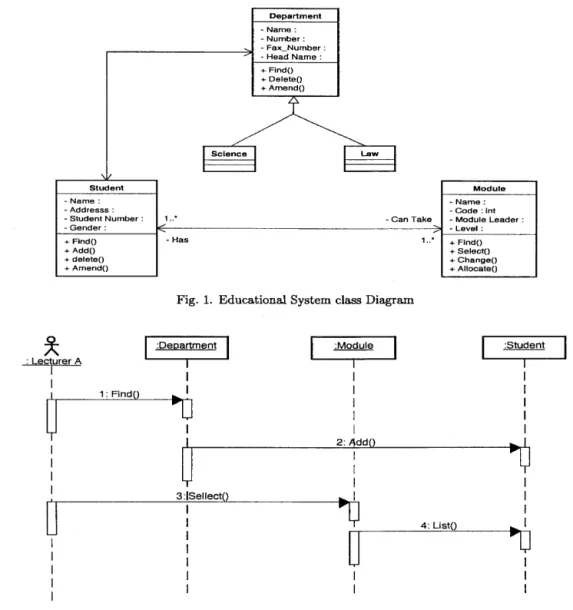
views. Figure 1 shows a case diagram for educational system. In this class diagram:
Department, Student and Module are representing the main classes in the system.
While the Science and Law are derived classes from the general class Department.
Figure 2 shows a sequence model for the educational system composed of classes that
are extracted from the above class diagrams. The flow of events of this educational
system is represented by messages of sequence diagrams.
FIEM Department -Name: - Number - Fax_Number - Head Name : + Find() + Delete() + Amend() Science Law Student -Name: - Addresss : - Student Number : - Gender : + Find() + Add() + delete() + Amend() 1 • - Can Take - Has
Fig. 1. Educational System class Diagram
1..* Module - Name : - Code : int - Module Leader : - Level : + Find() + Select() + Change() + Allocate() : Lecturer A :Department :Module 1: Find() 2: Add :Student 3:ISellect() 4: List(
Fig. 2. Educational System Sequence Diagram (A)
As the complexity of software increases due to development of network
tech-niques and the process of multimedia data, it has been essential to decompose the
overall design of software framework. Moreover, most of the time, it is impossible
to predict how software will have to evolve in some time. It might require more
features, or some of its features have to be changed. Therefore, it is important to be
able to decompose the softwares features as desired. By decomposing the software
to be developed into different schemes according to the different functional domains
will help us handle the overall software requirements complexity. This
decomposi-tion of the software is known by separadecomposi-tion of concerns, it is a software engineering
concept used to reduce the complexity of software. It refers to the ability to
iden-tify, encapsulate and manipulate only those parts of software that are relevant to
a particular concept, goal or purpose [12]
. Therefore, leading software companies
each have a different system modeling groups. Each group is responsible to design
the different aspect views of the real project.
I.e. a group of designers are
respon-Professor A :Division :Course 1: Find 2: Add() :Student YII Sellect()II 4: ListQ I _I I II I II Fig. 3. Educational System Sequence Diagram (B)
sible for designing the use case description for the desired system software, while
another group is responsible for model the class diagrams and so on. This leads
to an inconsistency problem among these different groups, especially if each group
used different vocabularies to represent there model view. For example, Figure 3
shows different sequence diagrams corresponding to our educational system
exam-ple. Comparing Figure 2 and Figure 3, we can notice that both figures are almost
same except that the actor name Lecturer in Figure 2 represented by the new actor
name Professor in Figure 3. Again, the classes Department and Module in Figure 2
are represented by new classes named Division and Course in Figure 3 respectively.
At first glance it may seem that this is an easy task to discover such
inconsis-tency manually. This is not true because really large software systems usually have
huge vocabularies that lead to same meaning. There is one way to deal with this
issue; the manger of the software system can build a main dictionary that contains
all these vocabularies and their specified means. And each group now has to
ref-erence to this dictionary. Although, this approach seems easy and sufficient, it is
impractical and difficult because it is manual manner that carries a lot of effort
from all groups. This, of course, would increase the dependent comportment in the
each design group. Moreover, establishing shared vocabularies and set of concepts
among disparate teams is not applied in practice. In practice, the implementation
of a system, whether from scratch or as an update to an existing solution, may be
disconnected from the models. An interesting example of this is the growing number
of organizations that outsource implementation and maintenance of their systems
while maintaining control of the overall enterprise architecture [2]. This motivates
us to find an automatic way two solve such inconsistency problems in real software
system.
In the next section, we will present our novel approach to check such UML
di-agrams inconsistency problems by using this resent approach of natural language
processing TST. As mentioned in previous section, TST approach is able to
recog-nize if a given two text fragments, whether the meaning of one text can be inferred
Yti
USta,,~`.a^*~5
I Ia am
0 0 `iSIY —.s,..}.
-T
V ~ XMI Use Case XMI Class --- J XM1 Sequence Consistency ReportMore correctness needs
OKI
NO
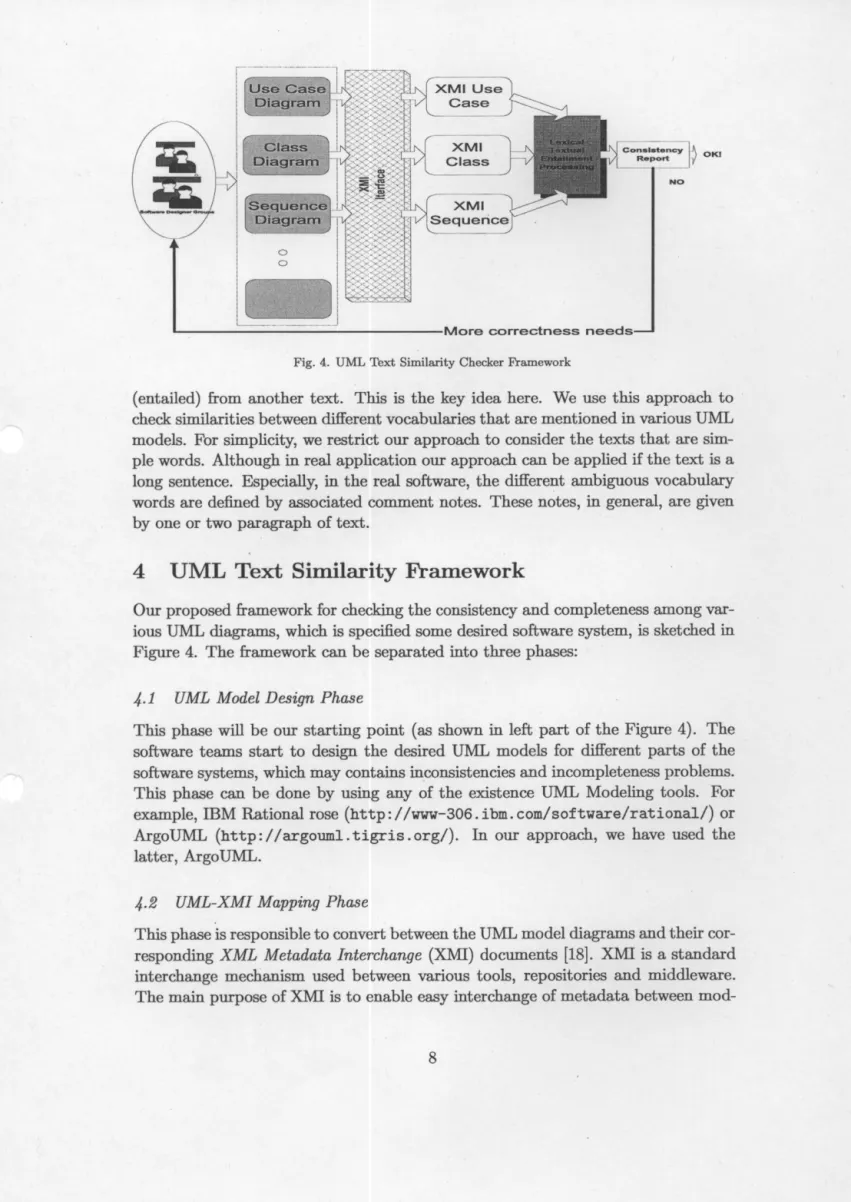
Fig. 4. UML Text Similarity Checker Framework
(entailed) from another text. This is the key idea here. We use this approach to
check similarities between different vocabularies that are mentioned in various UML
models. For simplicity, we restrict our approach to consider the texts that are
sim-ple words. Although in real application our approach can be applied if the text is a
long sentence. Especially, in the real software, the different ambiguous vocabulary
words are defined by associated comment notes. These notes, in general, are given
by one or two paragraph of text.
4
UML
Text
Similarity
Framework
Our proposed framework for checking the consistency and completeness among
var-ious UML diagrams, which is specified some desired software system, is sketched in
Figure 4. The framework can be separated into three phases:
4.1 UML Model Design Phase
This phase will be our starting point (as shown in left part of the Figure 4). The
software teams start to design the desired UML models for different parts of the
software systems, which may contains inconsistencies and incompleteness problems.
This phase can be done by using any of the existence UML Modeling tools. For
example, IBM Rational rose (http : //www-306
. ibm com/software/rational/)
or
ArgoUML (http : //argouml . tigris . org/). In our approach, we have used the
latter, ArgoUML.
4.2
UML-XMI Mapping Phase
This phase is responsible to convert between the UML model diagrams and their
cor-responding XML Metadata Interchange (XMI) documents [18]. XMI is a standard
interchange mechanism used between various tools, repositories and middleware.
The main purpose of XMI is to enable easy interchange of metadata between
eling tools (based on the OMG UML) and between tools and metadata repositories
(OMG MOF based) in distributed heterogeneous environments. XMI integrates
three key industry standards: XML (eXtensible Markup Language), a W3C
stan-dard; UML (Unified Modeling Language), an OMG modeling stanstan-dard; and MOF
(Meta Object Facility) and OMG modeling and metadata repository standard. In
our approach, we extract these XMI documents using the XMI export tool that is
available inside ArgoUML system.
4.3
Text Similarity Checker Phase
This phase is the kernel part in our approach.
It employs the text similarity manner
in order to check the inconsistencies
amongst the different UML diagrams through
their corresponding
XML documents.
This is done as follows: first, we convert the
given UML model diagrams to its equivalent XMI documents using the UML-XMI
interface part mentioned
above. Then, we extract the different vocabularies
from
each XMI document into different classes corresponding
to each diagram.
At this
point, we check the text similarity between each pair of pervious constructed classes.
The system will report the similarity between diagram/classes vocabularies. This
report itself represents the different textual inconsistency and incompleteness in our
models. By correcting these problems manually if any we able to repeat the last
steps again until we obtain a consistent UML models.
Here, we are restricted ourselves to check the similarity of vocabularies not a
long text, however, the same manner will be done well if some of the vocabularies
of diagrams are expressed as a long text not words.
Returning to our running example, if the system gets the educational system
class diagram that is given in Figure 1 and the educational system sequence diagram
(B) that is given in Figure 3, the system will report the following inconsistencies:
(i) Professor is entailed from Lecturer.
(ii) Division is entailed from Department.
(iii) Course is entailed from Module.
5
Related
Work
There are some works that combine the natural language processing techniques
and software development methodology. None of them has been used this new
approach mentioned here. For example, Konrad and Cheng [7] identify a round trip
engineering process that supports the specification of a UML model using CASE
tools, the analysis of specified natural language properties, and the subsequent
model refinement to eliminate errors uncovered during the analysis. This process
has been implemented in SPIDER, a tool suite that enables developers to specify
and analyze a UML model with respect to behavioral properties specified in terms
of natural language. This is a configurable process that analysis the UML against
specified properties.
Vladimir Mend [11] describes how readily available tools for natural language
processing can be employed to transform a textual use case into a pro-case in an
automated way. There are two premises of this work: (P1) A step of a textual
use case describes either communication between an actor and System under design
(SuD), or an internal action. (P2). Each action is described by a simple English
sentence following a uniform pattern like the SVDPI pattern. This work is mainly
concern with the analysis of only one UML diagram, textual UML description
di-agram, while our work is concerning the consistency amongst the different UML
diagrams.
6
Conclusions
and
Future
Works
This article presented the application
of the text similarity method in a new
ap-plication domain, the area of software development.
Nowadays, software system is
almost modeled using the UML language that becomes the de-facto notation
for
software engineering
projects.
However, it is not easy to develop software using
UML language from different views without getting inconsistencies
or
incomplete-ness problems.
To address this problem, we present a framework for checking the
consistency among the different UML diagrams.
This is done by checking the text
semantic similarity among the different vocabularies that are extracted from these
various diagrams. The extraction
of these vocabularies is done through XMI
docu-ments, which are exported automatically
from each UML diagram.
Our research to build a strong consistency checker model for software systems
through the XMI methodologies
is ongoing.
In this paper, we simply address the
simple vocabularies,
like single words. In future work, we intend to use long
vo-cabulary terms that are given by long text or that are described inside the UML
comment notes.
References
[1] Bar-HaimR., Dagan, I., Dolan, B., Ferro, L., Giampiccolo, D., Magnini, B. and Szpektor, I. 2006. The S
econd PASCAL Recognising Textual Entailment Challenge. In Proceedings of the Second PASCAL Challenges Workshop on Recognising Textual Entailment.
[2] Brown, A. An introduction to Model Driven Architecture. Feb 2004, http://www-128.ibm.com/
developerworks/rational/library/3100.html
[3] Corley, C. and Mihalcea, R. Measures of Text Semantic Similarity. In Proceedings of the ACL 2005 workshop on Empirical Modeling of Semantic Equivalence, Ann Arbor, MI, June 2005, pp. 13-18. [4] Corley, C., Csomai, A. and Mihalcea, R. Text Semantic Similarity, with Applications. In Proceedings of
International Conference Recent Advances in Natural Language Processing (RANLP 2005), Borovets,
Bulgaria, September 2005.
[5] Dagan, I. Glickman, 0. and Magnini, B. 2006. The PASCAL Recognising Textual Entailment Challenge. L
ecture Notes in Computer Science, Volume 3944, Jan 2006, Pages 177 - 190.
[6] Engels, G., Kster, J. M. and Groenewegen, L. Consistent Interaction of Software Components. T
ransactions of the SDPS: Journal of Integrated Design and Process Science, Vol. 6 No. 4. Dec. 2002. pp. 2-22.
[7] Konrad, S. and Cheng, B. H. C. Automated Analysis of Natural Language Properties for UML Models. M
oDELS Satellite Events, 2005, LNCS 3844, pp. 48-57.
[8] Kotb, Y. and Katayama, T. Consistency Checking of UML Model Diagrams Using the XML Semantics
Approach. 14th International World Wide Web Conference 2005 (WWW 2005), Chiba, Japan, 2005. ACM, pp. 982-983.
[9] Lesk, M. E. Automatic sense disambiguation using machine readable dictionaries: How to tell a pine cone from an ice cream cone. In Proceedings of the SIGDOC Conference 1986, Toronto, June 1986. pp.
24-26.
[10] Lutz, R. R., Targeting Safety-related Errors During software requirements analysis. ACM SIG-SOFT93 S
ymposium on the Foundation of Software Engineering, 1993, pp. 99-106.
[11] Mend, V. Deriving Behavior Specifications from Textual Use Cases. In Proceedings of Workshop on Intelligent Technologies for Software Engineering (WITSE04, Sep 21, 2004, part of ASE 2004), pp.
331-341, Sep 2004.
[12] Ossher, H., Tarr, P., Using Multidimensional Separation of Concerns to (Re) Shape evolving Software. Communication of the ACM, October 2001/Vol. 44, No. 10, pp 43-50.
[13] Papineni, K., Roukos, S., Ward, T. and Zhu, W. Bleu: a method for automatic evaluation of machine translation. In Proceedings of the 40th Annual Meeting of the Association for Computational Linguistics
(ACL 2002), Philadelphia, PA, July 2002. pp.311-318.
[14] Rocchio, J. Relevance feedback in information retrieval. Prentice Hall, Ing. Englewood Cliffs, New J
ersey, 1971.
[15] Salton, G., Singhal, A., Mitra, M. and Buckley, C. Automatic text structuring and summarization.
Information Processing and Management, 2(33), 1997. pp. 193-207.
[16] UML Resource Page (UML), Object Management Group (OMG), http://www.omg.org/um1.
[17] Waltz, D. L. and Pollack, J. B. Massively parallel parsing: A strong interactive model of natural language i
nterpretation. Cognitive Science, 9:51-74, 1985. [18] XMLMetadataInterchange
http://www.omg.org/technology/documents/formal/xmi.htm (XMI),
OMG,