Advances in Mass Rearing of Chrysoperla carnea
(Stephen) (Neuroptera: Chrysopidae)
著者
ASHFAQ Muhammad, NASREEN Abida, CHEEMA Ghulam
Mustafa
journal or
publication title
南太平洋研究=South Pacific Study
volume
24
number
2
page range
47-53
Advances in Mass Rearing of Chrysoperla carnea
(Stephen) (Neuroptera:
Chrysopidae)
Muhammad ASHFAQ1, Abida NASREEN2 and Ghulam Mustafa CHEEMA22 Department of Entomology, University of Agriculture, Faisalabad, Pakistan 2 Department of Entomology
, University College of Agriculture, Bahauddin Zakariya, University, Multan, Pakistan
Abstract
Rearing techniques for Chrysoperla carnea Stephen (Chrysopidae: Neuroptera) have been improved to have its mass rearing in laboratory and to make releases in fields in a very simple and economical way. In this technique hard gelatin capsules (500 mg) were used for larval rearing. Out of 100 test capsules, 140 pupae were recovered by this technique. Of all 62 % of the test capsules contained single, two % capsules found without pupae. Adult emergence was found to be 99 % and none of the adult was deformed. Sixty seven mg of frozen eggs of Sitotroga cereallela per larva were offered in a single feed per capsule to complete its larval growth. A rectangular (35 x 20 x 35 cm) adult rearing chamber made of transparent plastic sheet with removable top was designed, to allow proper illumination and ventilation inside the chamber. Handling of the adult green lace wing i.e., Chrysoperla carnea (sanitation, cleaning, feeding and harvesting of eggs) in the newly designed rearing chamber proved very easy and it eliminated the use of vacuum sucker, anesthesia and chemicals like Sodium hypochlorite, Potassium hypochlorite etc. The eggs of C. carnea were harvested efficiently without initiation of diapause because of the microenvironment developed inside the cage with high relative humidity.
Key words: Chrysoperla carnea mass rearing, larvae rearing in gelatin capsule, newly designed adult rearing chamber
Introduction
Many insect parasitoids (Trichogramma spp. Braconid sp. and Ichneumonid spp.) and predators (Coccinelid spp., Chrysoperla spp.) have proved to be a very good tool in insect pest management of various crops. Amongst all, the Chrysoperla carnea has proved to be the most important general insect predator as it feeds voraciously on a number of horticultural and agricultural cropping systems including vegetables, fruits, nuts, fiber and forage crops, and forests (TAUBER et al. 2000). The adults of C. carnea are soft bodied and light green in colour having golden eyes. It is one of the most common entomophagous insect species available on the globe (OLKOWSKI et al. 1992, HUNTER 1994). Many researchers like DOUTT and HAGEN (1949), RIDGWAY and JONES (1969), TULISALO et al. (1977), LENTERN and WOETS (1988), BREEN et al. (1992), EHLER and KINSEY (1995) have described its potentials to control agricultural insect pests e.g.
the larva of C. carnea has a wide range of acceptable prey (HYDRON and WHITECOMB, 1979). It predates upon whiteflies, Aphids, eggs and small larvae of Lepidoptera voraciously. Its importance as a predator was recognized in early 1920s, since that time scientists tried to develop new techniques and equipment for its mass production. The current effort is a vital step, towards advancement, in the rearing techniques of C. carnea on larger scale at farmers field.
Materials and Methods Larval Rearing:
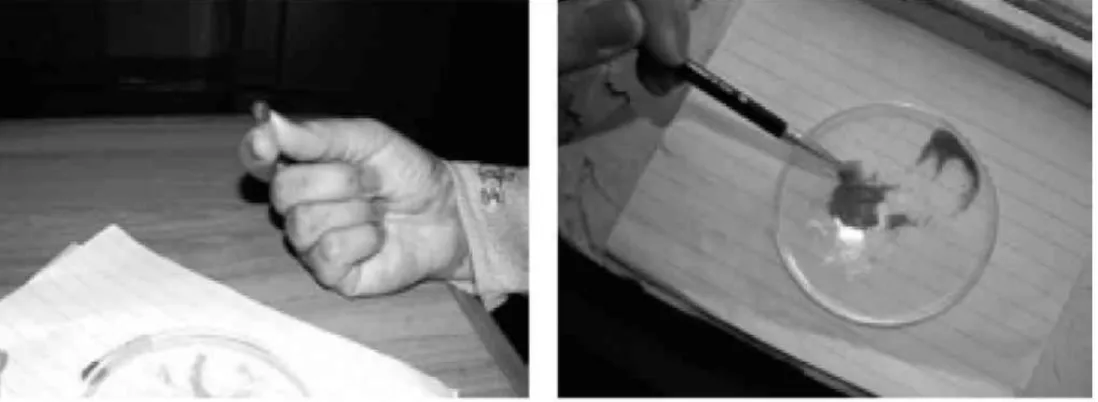
In the present methodology, capsules made of hard gelatin of medium size (500 mg) (Fig. 1), were used for rearing of C. carnea larvae. In this case frozen eggs of AGM, Sitotroga cereallela weighing 5g and grey eggs of C. carnea weighing 50mg were blended together in a Petri dish (Fig. 2). The mixture containing frozen eggs of AGM and the eggs of predator was filled in the capsules at 60mg per capsule (Fig. 3). The filled capsules were packed in a polythene bag of suitable size to reduce the effects of moisture on the capsule and kept in conditioned room at a temperature 227±2°C and relative humidity being 60±5 %. After 10 days the capsules were opened, 98 % capsules were having one or more pupae inside (Fig. 4). The capsules were opened and the parts of capsules having cocoons were placed in Petri dishes covered with lids for adult emergence (Fig. 5). The emergence of adults was completed within 5 to 7 days. The moths emerged from pupae in the Petri dish, were shifted into a newly designed/improved rearing chamber/cage by placing the Petri dish inside through side window (Fig. 6). The moths soon flew into the chamber/cage. The Petri dish was taken out of the cage, for next day's moth emergence.
Fig. 1 (Left). A medium size capsule made of hard gelatin used as rearing unit for C. carnea larva
Fig. 2 (Right). Blending frozen eggs of Sitotroga cereallela and grey eggs of C. carnea Adult Rearing:
The improved rearing cage (Fig. 7) is designed with the objective to demolish the use of anesthesia and vacuum sucker and the labour were involved in adult handling for sanitation, food and water supply, as well as, daily harvesting of eggs, whereas,
maintenance of proper light, humidity and ventilation inside the rearing cage has also become possible in the newly designed rearing chamber/cage.
Fig. 3 (Left). Filling of the blended mixture of eggs of C. carnea and food in capsules. Fig. 4 (Right). Pupae of C. carnea in the capsules.
Fig. 5 (Left). Emergence of adult moths from pupae in capsules.
Fig. 6 (Right). Releasing adult moths emerged from pupae in rearing cage.
A: Removable top to adhere paper for egg collection
B: Ventilator
C: Plastic Rod having pits to offer food to adults D: Windows for adult handling
E: Petri dish containing water soaked cotton
Fig. 7. Diagram of improved transparent rearing cage for adult C. carnea.
The rectangular cage with dimensions of 35 x 20 x 35 cm made of transparent plastic plate (4mm thickness) has been made in such a way as the front wall of the cage
has two circular windows (diameter 13cm) covered with lids that may be opened or closed as and when required. The windows have been designed for sanitation, provision of water and release of newly emerged moths. A rod measuring 37 cm long made of 4 mm thick plastic plate containing small circular pits (diameter 0.5cm) as food bowls, running length wise inside at the middle of cage. Adult food (mixture of yeast, water and honey 1:1:1) is offered in the food bowls. Small circular holes of 2mm diameter are drilled into the sidewalls of the cage to ensure proper ventilation. The top plate of the cage is replaceable to affix granulated black paper (egg laying substrate) on the ceiling of the cage. The eggs of C. carnea were removed from the substrate by razor (GAUTUM, 1994) for further use in the laboratory. The eggs on the paper can also be used for field releases by cutting strips of suitable size having any additional activity/effort.
Results and Discussion Larval Rearing:
Chrysoperla carnea is a highly predaceous and cannibalistic insect at larval stage. It is very difficult to hold and feed its high-density culture because of multidimensional reasons. FINNY (1948, 1950) used wooden trays (3.75 x 40 x 100cm) covered with white muslin cloth for its larval rearing. In this method, additional food was also offered in wooden trays after every three days, interval. As a result of that, he succeeded in having 54% pupal formation. During 1970s a number of advances were made in the larval rearing of C. carnea. RIDGWAY et al. (1970) used hexels, covered with organdy on one side and with glass plate having food on it on the other. Larvae were anesthetized with carbon dioxide at two-day interval, when glass feeding plates were changed. MORRISON et al (1975) used ornamental masonite as a larvae rearing unit, three pieces of masonite were separated by two pieces of organdy, formed the cells. This technique eliminated the need of anesthesia. By this technique 76 % cells produced pupae, from which 82 % adults emerged. Later on MORRISON (1977) replaced masonite with verticals covered with organdy on both sides. Measured amount of food (eggs of Angmois Grain Moth) and C. carnea eggs were added before covering the second side. Additional food was supplied at three to four day intervals by coating a glass plate with honey and AGM eggs and placing it on the top of the unit egg side down. This unit produced 93 % pupae and adult emergence was 95 %. Later on GAUTUM (1994) used plastic trays containing hexagonal cells and individual vials for larval rearing. Food was added in each cell after three to four days by sprinkling from the top. GAUTUM (1994) also used tubes to rear 5 - 10 C. carnea larvae with 1.5 - 2.5 cm3 volume of C. cephalonica eggs as prey and got 64-76 % pupae and this method was at par with those of other methods.
Rearing of larvae in capsules is the most convenient and successful method as compared to that of verticals (MORRISON, 1977) and separate vials (GAUTUM, 1994). C. carnea larvae completed the larval stages & pupate in the capsules with single food supply, as against three to four additional food supplies during the larval stage by other methods (MORRISON, 1977; GAUTUM, 1994). It is because of the fact that the capsules are made of hard gelatin, containing 9 to 10 % moisture (HOWARD, 1985) and that does not allow the frozen food (AGM eggs) to let loose its moisture contents. Therefore, the food is preserved for a longer period. The preservation of food by this technique has
altogether eliminated the number of additional feeds required in various earlier techniques. During this technique the quantity of food used per larva to complete its growth is reduced to one fourth viz. from 160mg (GAUTUM, 1994) to 40mg only. There were formed 140 pupae in 100 capsules by this technique. Sixty two % of the capsules contained one pupa, 30 % two pupae and 6 % had three pupae inside. There were found only two % capsules without pupae. Adults emerged from these pupae were 99 % and none of these was deformed.
Adult Rearing:
Many scientists (FINNY 1984, HAGEN 1950, HAGEN and TASSEN 1970) reported the successful rearing of Chrysoperla carnea. They emphasized on the development of diet for its mass rearing. FINNY (1948) reared it in wooden cage on honeydews of Pseudococcus citric. Later on the wooden cages were provided with black organdy top as substrate for egg laying and hydrolysate of yeast was used as adult food (FINNEY 1950). An anesthesia of carbon dioxide was recommended to shift the moths from one cage to another for sanitation purpose (HAGEN, 1950) GAUTUM (1994) used round transparent jars with black organdy at the top opening for egg collection and used vacuum sucker for shifting the moths from one jar to another.
The newly designed adult rearing unit/chamber has eliminated the use of vacuum device (RIDGWAY et al., 1970 and GAUTUM, 1994) and carbon dioxide (anesthesia) (HAGEN, 1950) for handling the adults C. carnea. Sanitation in the newly designed cage is done efficiently through the windows provided in the front wall. Eggs on paper can be harvested safely by razor (GAUTUM, 1994) without the use of Sodium hypochlorite (NORDLUND, 1995a) used to remove the eggs laid on black organdy. Egg laying capacity of C. carnea reduced very much when the relative humidity in the environment is below 35% (TAUBER and TAUBER, 1983) and at this level of relative humidity it undergoes diapause. In the improved adult rearing unit chamber/cage the
relative humidity of the microenvironment inside the cage can also be maintained at optimum level by placing a Petri dish containing water soaked cotton (Fig. 8). The placement of water soaked cotton in the soaked cage not only prevented the diapause but also maximum egg laying protenails were observed by the C. carnea in this micro environment. Keeping all the results presented above in view, it can be safely said that because of adoption of this very simple and very economical technology for rearing of C. carnea will make possible for its mass release as a biological control agent for pest insect of economic importance at farmers field. The farmers with small land holding can also use this technology easily, after having a short term training, as no special technicality like use of chemicals for egg removal, special way of food provision the larvae and adults etc is involved in this technique.
Although these studies are a milestone in the advancement of mass rearing technology of C. carnea yet further experimentation is needed to explore some vital aspects as precision in food supply, effects of ecological conditions, storage, transportation and field releases.
References
BREEN, R. G., R. L. MEAGHER, Jr., D. A. NORDLUND, and YIN-TUNG WANG. 1992. Biological control of Bemisia tabaci (Homopter: Aleyrodidae) in a green house
using Chrysopa rufilabris (Neuroptera: Chrysopidae). Biol. Control 2:9-14.
DOUTT, R. L., and K. S. HAGEN. 1949. Periodic colonization of Chrysopa californica as a possible control of mealy bugs. J. Econ. Entomol. 42: 560.
EHLER, L. E., and M. G. KINSEY. 1995. Ecology and management of Mindarus kinseyi on white-fir seedlings at a California nursery. Hilgardia 62: 560.
FINNY, G. L. 1948. Culturing Chrysopa californica and obtaining eggs for field distribution. J. Econ. Entomol. 41: 719-21.
FINNY, G. L. 1950. Mass culturing Chrysopa californica to obtain eggs for field distribution. J. Econ. Entomol. 43: 97-100.
GAUTUM, R. D., 1994. Techniques of mass rearing of predators, pp. 114-116. In: biological pest suppression. West will publishing house, New Delhi.
HAGEN, K. S. 1950. Fecundity of Chrysopa californica as affected by synthetic food. Ibid. 43: 101-4.
HAGEN, K. S. and R. L. TASSEN. 1970. The influence of food wheast and related Saccharomyles fragilis yeast products on the fecundity of Chrysopa carnea. Can.
Entomol. 102: 806-11.
HOWARD, C. A. 1985. Peroral Solids, Capsules, Tablets and Controlled Release Dosage Forms, pp. 126-127. In Lea and Fisher (eds.), Introduction to pharmaceutical
dosage forms. 4th edition, Philadelphia.
HUNTER, C. D. 1994. Suppliers of beneficial organisms in North America. California
Environmental Protection Agency, Department of Pesticide Regulation,
Sacramento, CA.
HYDRON, S. B., and W. H. WHITCOMB. 1979. Effect of larval diet on Chrysopa rufilabris. Fla. Entomol. 62: 293-298.
MORRISON, R. K., 1977. A simplified larval rearing unit for the common green lacewing.
MORRISON, R. K., V. S. HOUSE and R. L. RIDGWAY. 1975. Improved rearing unit for larvae of green lacewing. J. Econ. Entomol. 68: 821-822.
NORDLUND, D. A., and J. A. CORREA. 1995. Description of green lacewing adult feeding and oviposition units and a sodium hypochlorite based egg harvesting
system. Southwest. Entomol. 20: 293-301.
OLKOWSKI, W., E. DIETRICK, and H. OLKOWISKI. 1992. The biological control industry in the United States, part II. IPM practitioner 14: 12-14.
RIDGWAY, R. L., R. K. MORRISON and M. BADGLEY. 1970. Mass rearing of green lacewing. J. Econ. Entomol. 63(6): 834-836.
RIDGWAY, R. L., and S. L. JONES. 1969. Inundative releases of Chrysopa carnea for control of Heliothis on cotton. J. Econ. Entomol. 62: 177-180.
TAUBER, M. J., and C. A. TAUBER, K. M. DAANE, and K. S. HAGEN. 2000. Commercialization of Predators: Recent Lessons from Green Lacewings.
(Neuroptera: Chrysopidae: Chrysoperla). American Entomologist. 46: 26-38. TAUBER, M. J., and C. A. TAUBER. 1983. Life History traits of Chrysopa carnea and
Chrysopa rufilabris (Neuroptera: Chryspidae) Influence of Humidity. Ann.
Entomol. Soc. Am. 76: 282-285.
TULISALO, U., T. TUOVINEN, and S. KURPPA. 1977. Biological control of aphids with Chrysopa carnea on parsley and green pepper in the greenhouse. Ann. Entomol.
Fenn. 43: 97-100.
VAN LENTEREN, J., and J. WOETS. 1988. Biological and integrated control in green house. Annu. Rev. Entomol. 33: 239-269.