The
Valuation
of
Callable Russian
Options for
Double
Exponential
Jump
Diffusion
Processes
南山大学・数理情報研究科, 数理情報研究センター 鈴木淳生1(Atsuo Suzuki)
Graduate School of Mathematical Sciences and Information Engineering
Nanzan University
南山大学・数理情報学部 澤木勝茂 (Katsushige Sawaki)
Faculty of Mathematical Sciences and Information Engineering
Nanzan University
Keywords: callable Russian Option, double exponential distribution,optimal stopping,
opti-mal boundaries
1. Introduction
Russian option was introduced by Shepp and Shiryaev [6], [7] and is
one
ofperpetual American lookback options. In Russian option the buyer has the right to exercise it at any time. Onthe other hand, in callable Russian option not only the buyer but also the seller has the right
to cancel it at any time. This option is formulated as coupled optimal stopping problem. See
Cvitanic and Karatzas [1] Kifer [2].
Kyprianou [5] derived the closed-form solution in the
case
where the dividend rate iszero.
Suzuki and Sawaki [8] gave the pricing formula with positive dividend. Kou andWang [4]gave
theclosed form
forthe value
function ofperpetualAmerican
put options withoutdividend
andso
on.
Suzuki and Sawaki [9] derived the pricing formula of non-callable Russian option fordouble exponentialjump diffusion processes.
In this paper,
we
deal with callable Russian options. A callable Russian option isa
contactthat the seller and the buyer have the rights to cancel and to exercise at anytime, respectively.
Wepresent thepricing formula of callable Russianoptionsfor double exponential jump diffusion
processes. The pricing of such
an
optioncan
be formulatedas
a coupled optimal stoppingproblemwhich is analyzed
as
Dynkin game. We derive the value function ofa
callable Russianoption and its optimal boundaries. Also
some
numerical resultsare
presented to demonstrateanalytical sensitives of the value function with respect to parameters.
This paper is organized
as
follows. In section 2we
introducea
pricing model of callable Russian options by lneans of a coupled optimal stopping problem given by Kifer [2]. Section3 presents the value function of callable Russian options for double exponential jump diffusion
processes. Section 4 presents numerical examples to verify analytical results. We end the paper
with
some
concluding remarks and future work.2. Pricing model
In this section
we
consider the pricing model for the callable Russian option. Let $B(t)$ be the process of the riskless asset price at time $t$ defined by $B(t)=B(())e^{rt}$, where $r$ is positiveinterest rate. Let $W(t)$ be astandard Brownian motion and $N(t)$ be aPoisson process with the
intensity $\lambda$
.
Let$J_{i}$ denote i.i.$d$
.
positive random variables. $Y_{l}\equiv\log J_{i}$ has a double exponentialdistribution and its the density function is given by
$f(y)=p\eta_{1}e^{-\eta_{1}y}1_{tv\geq 0\}}+q\eta_{2}e^{\eta_{2}y}1_{\{y<0\}}$,
where $\eta_{1}>1,$ $\eta_{2}>0$ and $0\leq p,$$q\leq 1$ such that$p+q=1$
.
Under a risk-neutral probability, theprocess of the risky asset price $S(t)$ at time $t$ satisfies the stochastic differential equation
$\frac{dS(t)}{S(t-)}=\mu dt+\kappa dW(t)+d(\sum_{i=1}^{N(t)}(J_{i}-1))$, (2.1)
where $\mu$ and $\kappa>0$ are constants. Define another probability
measure
$\tilde{P}$
as
$\frac{d\tilde{P}}{dP}|_{F\ell}=\exp\{-bW(t)-\frac{1}{2}b^{2}t\},$ $b= \frac{\mu-r+d+\lambda\zeta}{\kappa}$,
where $d$ is the positive continuous dividend rate of the risky asset, $\mathcal{F}_{t}=\sigma(W^{r}(s), N(s),$$\{J_{i}\}$)
and
$\zeta=E[J_{i}]-1=\frac{p\eta_{1}}{\eta_{1}-1}+\frac{q\eta_{2}}{\eta_{2}+1}-1$
.
By Girsanov’s theorem, $\tilde{W}(t)=W(t)-bt$ is
a
Brownian motion with respect to $\tilde{P}$.We
can
rewrite (2.1)as
$\frac{dS(t)}{S(t-)}=(r-d-\lambda\zeta)dt+\kappa d\tilde{W}(t)+d(\sum_{i=1}^{N(t)}(J_{i}-1))$. (2.2)
Solving (2.2) gives $S(t)=S(O)$exp$X(t)$, where
$X(t)=(r-d- \frac{1}{2}\kappa^{2}-\lambda\zeta)t+\kappa\tilde{W}(t)+\sum_{i=1}^{N(t)}Y_{i}$
.
Let $V(v)$ be
a
function of class $C^{2}$.
Then the infinitesimal generator $\mathcal{L}$ of the process $S(t)$ isgiven by
$\mathcal{L}V(v)=\frac{1}{2}\kappa^{2}v^{2}V’’(v)+(r-d-\lambda\zeta)vV’(v)+\lambda.\int_{-\infty}^{\infty}(V(ve^{y})-V(v))f(y)dy$
for all $v>0$
.
Next we introduce the four real numbers $\beta_{1},$$\beta_{2},$$\beta_{3},$$\beta_{4}$
.
Kou and Wang (2003) showed thatthe equation $G(\theta)=\alpha$ for all $\alpha>0$ has the solutions $\beta_{1},$ $\beta_{2},$$-\beta_{3},$ $-\beta_{4}$, where
$G( \theta)=\theta(r-d-\frac{1}{2}\kappa^{2}-\lambda\zeta)+\frac{1}{2}\theta^{2}\kappa^{2}+\lambda(\frac{p\eta_{1}}{\eta_{1}-\theta}+\frac{q\eta_{2}}{\eta_{2}+\theta}-1)$
And the four solutions satisfy
$0<\beta_{1}<\eta_{1}<\beta_{2}<\infty$, $0<\beta_{3}<\eta_{2}<\beta_{4}<\infty$.
Define the process
$\Psi(t)\equiv\max(vs,\sup_{0\leq u\leq t}S(u))/S(t)$, $S(0)=s,$$v\geq 1$
.
Then the value function of non-callable Russian options is given by
$V_{R}(v)= \sup_{\tau}\tilde{E}[e^{-r\tau}\Psi(\tau)|\Psi(0)=v]$,
where the supremum is taken for all stopping times $\tau$
.
Theorem 2.1.
(Suzuki and Sawaki $[9J$) The valuefunction
$V(v)$of
Russian option is given by$V_{R}(v)=\{\begin{array}{ll}A(v_{1})v^{\beta_{1}}+B(v_{1})v^{\beta_{2}}+C(v_{1})v^{-\beta_{3}}+D(v_{1})v^{-\beta_{4}}, 1\leq v\leq v_{1}v, v\geq v_{1}.\end{array}$
The
coefficients
are
determined by$A(v_{1})$ $=$ $\frac{(\eta_{1}-\beta_{1})v_{1}^{-\beta_{1}}}{(\beta_{1}+\beta_{3})(\beta_{2}-\beta_{1})}\{\frac{(\mathcal{B}_{2}-1)(\beta_{3}+1)}{\eta_{1}-1}v_{1}-\frac{(\beta_{2}+\beta_{4})(\beta_{4}-\beta_{3})}{\eta_{1}+\beta_{4}}Dv_{1}^{-\beta_{4}}\}$
$B(v_{1})$ $=$ $\frac{(\beta_{2}-\eta_{1})v_{1}^{-\beta_{2}}}{(\beta_{2}-\beta_{1})(\beta_{2}+\beta_{3})}\{\frac{(\beta_{1}-1)(\beta_{3}+1)}{\eta_{1}-1}v_{1}-\frac{(\beta_{1}+\beta_{4})(\beta_{4}-\beta_{3})}{\eta_{1}+\beta_{4}}Dv_{1}^{-\beta_{4}}\}$
$C_{\text{ノ}}(v_{1})$ $=$ $\frac{(\eta_{1}+\beta_{3})v_{1}^{\beta_{3}}}{(\beta_{1}+\beta_{3})(\beta_{2}+\beta_{3})}\{\frac{(\beta_{1}-1)(\beta_{2}-1)}{\eta_{1}-1}v_{1}-\frac{(\beta_{1}+\beta_{4})(\beta_{2}+\beta_{4})}{\eta_{1}+\beta_{4}}Dv_{1}^{-\beta_{4}}\}$
and
$\frac{A(v_{1})}{\eta_{2}+\beta_{1}}+\frac{B(v_{1})}{\eta_{2}+\beta_{2}}+\frac{C(v_{1})}{\eta_{2}-\beta_{3}}+\frac{D(v_{1})}{\eta_{2}-\beta_{4}}$ $=$ $0$
.
Moreover, the optimal $bounda\eta v_{1}$ is the solution in $(1, \infty)$ to the equation
$A(v)\beta_{1}+B(v)\beta_{2}-C(v)\beta_{3}-D(v)\beta_{4}=0$
and the optimal stopping time is given by
$\hat{\tau}=\inf\{t>0|\Psi(t)\geq v_{1}\}$.
3.
Callable Russian
optionsWe
assume
that $p=1$ and $q=0$.
Itmeans
that the jump is down only. Thenwe
can
express$G(\theta)$
as
$G( \theta)=\theta(r-d-\frac{1}{2}\kappa^{2}-\lambda\zeta)+\frac{1}{2}\theta^{2}\kappa^{2}+\lambda(\frac{\eta_{1}}{\eta_{1}-\theta}-1)$
and the equation $G(\theta)=r$ has three solutions $\beta_{1},$$\beta_{2},$$-\beta_{4}$, which satisfy
$1\leq\beta_{1}<\eta_{1}<\beta_{2}<\infty$, $0<\beta_{4}<\infty$
.
Let $\sigma$denote
a
cancel time fortheseller and$\tau$
an
exercise timeforthe buyer. If the seller cancelsthe contract, the buyer receives $\Psi(\sigma)\neq\delta$ from the seller. We can think of $\delta>0$
as
the penaltycost for the cancel. On the other hand, if the buyer exercises it, (s)he receives $\Psi(\tau)$ from the
seller. Therefore, the payoff function ls given by
Let $\mathcal{T}_{0,\infty}$ denote the set of all stopping times with values in the interval $[0, \infty]$
.
Then the valuefunction $V^{*}(v)$ of the callable Russian option is defined by
$V^{*}(v)=$ inf $supJ(\sigma, \tau, v)$, (3.1)
$\sigma\in \mathcal{T}_{0,\infty\tau\in \mathcal{T}_{0,\infty}}$
where
$J(\sigma, \tau, v)=\tilde{E}[e^{-\alpha(\sigma\wedge\tau)}\{(\Psi(\sigma)+\delta)1_{\{\sigma<\tau\}}+\Psi(\tau)1_{\{\tau\leq\sigma\}}\}|\Psi(0)=v]$
.
And the function $V^{*}(v)$ satisfies the inequalities
$v\leq V^{*}(v)\leq v+\delta$,
which provides the lower and the upper bounds for the value function of the callable Russian
option.
We
define
two sets $A$ and $B$as
$A$ $=$ $\{v\in R^{+}|V(v)=v+\delta\}$
$B$ $=$ $\{v\in R^{+}|V(v)=v\}$
.
$A$ and $B$
are
called the seller’s cancel region and the buyer’s exercise region, respectively. Thenthe two optimal stopping times are given by
$\sigma_{A}$ $=$ $\inf\{t>0|\Psi(t)\in A\}$,
$\tau_{B}$ $=$ $\inf\{t>0|\Psi(t)\in B\}$
.
Then for any$v,\hat{\sigma}\equiv\sigma_{A}$ and $\hat{\tau}\equiv\tau_{B}$ attain the infimum and supremumin (3.1), $i.e.$, we have
$V^{*}(v)=J(\hat{\sigma},\hat{\tau}, v)$
.
The pair $(\hat{\sigma},\hat{\tau})$ is the saddle point of $J(\sigma, \tau, v)$
.
Remark 3.1. The
seller
minimizes the payofffunction and$\Psi(t)\geq\Psi(O)=v\geq 1$.
$fi$}$vm$ this, $it$follows
that the seller’s optimal cancel $r_{\mathfrak{B}^{ion}}$ is{1}.
Lemma
3.1.
Suppose that$r-d- \frac{1}{2}\kappa^{2}-\lambda\zeta>0$.
Then thefunction
$V(v)$ is Lipschitz continuousand its Radon-Nikodym dertvative
satisfies
$0\leq V’(v)\leq 1$, $a.e$
.
$v$.
(3.2)Proof.
Since $\hat{\sigma},\hat{\tau}$ and $\Psi(t)$ dependson
the initial value$v$,
we
write themas
$\hat{\sigma}^{v},\hat{\tau}^{v}$ and $\Psi(t, v)$.
Replacing the optimal stopping times $\hat{r}^{v}$ by another stopping time $\hat{\tau}^{u}$, we get the inequalities
$V(v)\leq J(\hat{\sigma}^{u},\hat{\tau}^{v}, v)$
,
$V(u)\geq J(\hat{\sigma}^{u},\hat{\tau}^{v}, u)$.
Note that $z_{1}^{+}-z_{2}^{+}\leq(z_{1}-z_{2})^{+}$ for any $z_{1},$$z_{2}\in R$
.
For any $v\geq u$,we
have$0$ $\leq$ $V(v)-V(u)$
$=$ $J(\hat{\sigma}^{u},\hat{\tau}^{v},v)-J(\hat{\sigma}^{u},\hat{\tau}^{v}, u)$
$=$ $\tilde{E}[e^{-\alpha}’\wedge\hat{\tau}^{\prime J})(\Psi(\hat{\sigma}^{u}\wedge\hat{\tau}^{v},v)-\Psi(\hat{\sigma}^{14}\wedge\hat{\tau}^{v},u))]$ $=$ $\tilde{E}$
[$e^{-\alpha(\hat{\sigma}^{u}\wedge\hat{\tau}^{v})}H^{-1}$($\hat{\sigma}^{u}$ A$\hat{\tau}^{v}$)
$\{(v$ –$supH_{u})^{+}-(u$-$supH_{u})^{+}\}$]
$\leq$ $(v-u)\tilde{E}[e^{-\alpha(\dot{\sigma}^{u}\wedge f)}H^{-1}(\hat{\sigma}^{u}\wedge\hat{\tau}^{v})]$
$\leq$ $v-u$,
where $H(t)=\exp X(t)$
.
Therefore,we
obtain$0 \leq\frac{V(v)-V(u)}{c1-\prime u}\leq 1$
.
If the penalty $\delta$ is too large, the seller never
cancels. How large $\delta$ is it?
Lemma 3.2. Set$\delta^{*}=V_{R}(1)-1$.
If
thepenalty$\delta>\delta^{*}$, the sellernever cancels. In otherwords,the callable Russian option is reduced to Russian option.
Proof.
Consider thefunction $U(v)=V_{R}.(v)-v-\delta$.
Since it holds $U’(v)\leq 0$ by Lemma 3.1 and$U(1)=\delta^{*}-\delta<0$,
we
have $V_{R}(v)<v+\delta$.
Hence, it follows that $V^{*}(v)<v+\delta$ because it holdsthat $V(v)\leq V_{R}(v)$
.
口We introduce the function for $v_{0}=e^{x_{0}}>1$
$V(v)=\{\begin{array}{ll}A_{v^{\beta_{1}}}+Bv^{\beta_{2}}+Cv^{-\beta_{4}}, 1\leq v\leq v_{0}v, v\geq v_{0}.\end{array}$ (3.3)
We set $v=e^{x}$ and $V(v)=V(e^{x})\equiv t^{V}(x)\wedge$
.
In what follows,we
determine thecoefficients
$A,$$B,$$C$and $e^{xo}$
.
In order to determine the coefficients,we
prepare the conditions. By value matchingcondition,
we
have$Ae^{\beta_{1}x0}+Be^{\beta_{2}xo}+Ce^{-\beta_{4}x0}=e^{x0}$
and by smooth pasting condition,
we
have$A\beta_{1}e^{\beta_{1}x_{0}}\neq B\beta_{2}e^{\beta_{2}x_{0}}-C\beta_{4}e^{-\beta_{4}x_{0}}=e^{x0}$
.
We
can
get the last condition by using the infinitesimal generator $\hat{\mathcal{L}}$ofthe process $X(t)$ given by
$\hat{\mathcal{L}}\hat{V}(x)=\frac{1}{2}\kappa^{2}\hat{V}’’(x)+(r-d-\frac{1}{2}\kappa^{2}-\lambda\zeta)\hat{V}’(x)+\lambda\int_{-\infty}^{\infty}(\hat{V}(x+y)-\hat{V}(x))f(y)dy$
for all $v>0$
.
For $x<x_{0}$, we obtain$/-\infty\infty\hat{V}(x+y)f(y)dy$
$=$ $\int_{0}^{x0-x}(Ae^{\beta_{1}(x\neq y)}+Be^{\beta_{2}(x+y)}+Ce^{-\beta_{4}(x+y)})\eta_{1}e^{-\eta_{1}y}dy+\int_{x_{0}-x}^{\infty}e^{x+y}\eta_{1}e^{-\eta_{1}y}dy$
$=$ $\eta_{1}(\frac{A}{\eta_{1}-\beta_{1}}e^{\beta_{1}x}+\frac{B}{\eta_{1}-\beta_{2}}e^{\beta_{2}x}+\frac{C}{\eta_{1}+\beta_{4}}e^{-\beta_{4}x})$
$- \eta_{1}e^{-\eta_{1}(x_{0}-x)}(\frac{A}{\eta_{1}-\beta_{1}}e^{\beta_{1}x_{0}}+\frac{B}{\eta_{1}-\beta_{2}}e^{\beta_{2}x_{0}}+\frac{C}{\eta_{1}+\beta_{4}}e^{-\beta_{4}x_{0}}-\frac{e^{x0}}{\eta_{1}-1})$
.
IFlrom this,
we
obtain$(\hat{L}-r)\hat{V}(x)$ $=$ $Ae^{\beta_{1}x}( \frac{1}{2}\beta_{1}^{2}+\beta_{1}(r-d-\frac{1}{2}\kappa^{2}-\lambda\zeta))+Be^{\beta_{2}x}(\frac{1}{2}\beta_{2}^{2}+\beta_{2}(r-d-\frac{1}{2}\kappa^{2}-\lambda\zeta))$ $+Ce^{-\beta_{4}x}( \frac{1}{2}(-\beta_{4})^{2}-\beta_{4}(r-d-\frac{1}{2}\kappa^{2}-\lambda\zeta))$ $+ \lambda.\int_{-\infty}^{\infty}\nu^{r}(x+y)f(y)dy-(\lambda+r)\hat{V}(x)$ ’ $=$ $Ae^{\beta_{1}x}g(\beta_{1})+Be^{\beta_{2}x}g(\beta_{2})+Ce^{-\beta_{4}x}g(-\beta_{4})$ $- \lambda p\eta_{1}e^{-\eta_{1}(x0-x)}(\frac{A}{\eta_{1}-\beta_{1}}e^{\beta_{1}x_{0}}+\frac{B}{\eta_{1}-\beta_{2}}e^{\beta_{2}xo}+\frac{C}{\eta_{1}+\beta_{4}}e^{-\beta_{4}xo}-\frac{e^{x_{0}}}{\eta_{1}-1})$,
where
$g(x)=G(-x)-r$
.
By Lemma 2.1 in Kou and Wang [3], wehave$g(\beta_{1})=g(\beta_{2})=9(\beta_{4})=$$0$. Since $(\hat{\mathcal{L}}-r)\hat{V}(x)=0$ holds, we get the condition
$\frac{A}{\eta_{1}-\beta_{1}}e^{\beta_{1}x0}+\frac{B}{\eta_{1}-\beta_{2}}e^{\beta_{2}x_{0}}+\frac{C}{\eta_{1}+\beta_{4}}e^{-\beta_{4}x_{0}}-\frac{e^{xo}}{\eta_{1}-1}=0$
.
(3.4)Lemma 3.3. Solving thefollowing equations
$Ae^{\beta_{1}x0}+Be^{\beta_{2}x_{0}}+Ce^{-\beta_{4}x0}$ $=$ $e^{x_{0}}$
$A\beta_{1}e^{\beta_{1}x_{0}}+B\beta_{2}e^{\beta_{2}x_{0}}-C\beta_{4}e^{-\beta_{4}x0}$ $=$ $e^{x_{0}}$
$\frac{A}{\eta_{1}-\beta_{1}}e^{\beta_{1}x_{0}}+\frac{B}{\eta_{1}-\beta_{2}}e^{\beta_{2}x_{0}}+\frac{C}{\eta_{1}+\beta_{4}}e^{-\beta_{4}xo}$ $=$ $\frac{e^{x_{0}}}{\eta_{1}-1}$
gives the solutions
$A$ $=$ $\frac{(\eta_{1}-\beta_{1})(\beta_{2}-1)(\beta_{4}+1)}{(\eta_{1}-1)(\beta_{1}+\beta_{4})(\beta_{2}-\beta_{1})}e^{(1-\beta_{1})x_{0}}$
$B$ $=$ $\frac{(\beta_{2}-\eta_{1})(\beta_{1}-1)(\beta_{4}+1)}{(\eta_{1}-1)(\beta_{2}+\beta_{4})(\beta_{2}-\beta_{1})}e^{(1-\beta_{2})x_{0}}$
$C$ $=$ $\frac{(\eta_{1}+\beta_{4})(\beta_{2}-1)(\beta_{1}-1)}{(\eta_{1}-1)(\beta_{1}+\beta_{4})(\beta_{2}+\beta_{4})}e^{(1+\beta_{4})x_{0}}$
.
Since thecoefficients $A,$$B,$$C$depend
on
$x_{0}$,we
denote themas
$A(x_{0}),$ $B(x_{0})$ and$C(x_{0})$.
Thenumber $v0=e^{x_{0}}$ given by (3.3) satisfies the equation
$A(x_{0})e^{\beta_{1}x0}+B(x_{0})e^{\beta_{2}x_{0}}\cdot+C(x_{0})e^{-\beta_{4}x_{0}}=\delta+1$
.
In the remainder of this section,
we
discuss thecase
where$p,$$q>0$.
We seta
function $V(v)$$V(v)=\{\begin{array}{ll}Av^{\beta_{1}}+Bv^{\beta_{2}}+Cv^{-\beta_{\delta}}+Dv^{-\beta_{4}}, 1\leq v\leq v_{0}v, v\geq v_{0}.\end{array}$
By value matching condition
and
smooth pasting condition,we
have
$Ae^{\beta_{1}x0}+Be^{\beta_{2}x0}+Ce^{-\beta sx_{0}}+De^{-\beta_{4}x0}$ $=$ $e^{x0}$
$A\beta_{1}e^{\beta_{1}x_{0}}+B\beta_{2}e^{\beta_{2}x_{0}}-C\beta_{3}e^{-\beta\prime sx_{0}}-D\beta_{4}e^{-\beta_{4}x0}$ $=$ $e^{x0}$,
respectively. For $x_{1}<x<x_{0}$, wehave
$1_{-\infty}^{\infty}\hat{V}(x+y)f(y)dy$ $=$ $\int_{x_{1}-x}^{0}(Ae^{\beta_{1}(x+y)}+Be^{\beta_{2}(x+y)}+Ce^{-\beta s(x+y)}+De^{-\beta_{4}(x+y)})q\eta_{2}e^{\eta_{2}y}dy$ $+.1_{0}^{x0-x}(Ae^{\beta_{1}(x+y)}+Be^{\beta_{2}(x+y)}+c_{e^{}}^{-\beta_{3}(x+y)}+De^{-\beta_{4}(x+y)})p\eta_{1}e^{-\eta_{1}y}dy$ $+ \int_{x0-x}^{\infty}e^{x+y}p\eta_{1}e^{-\eta_{1}y}dy$ $=$ $q \eta_{2}(\frac{A}{\eta_{2}+\beta_{1}}e^{\beta_{1}x}+\frac{B}{\eta_{2}\dashv-\beta_{2}}e^{\beta_{2}x}+\frac{C}{\eta_{2}-\beta_{3}}e^{-d_{3}x}+\frac{D}{\eta_{2}-\beta_{4}}e^{-\beta_{4}x})$ $-q \eta_{2}e^{r\rho(x_{1}-x)}(\frac{A}{\eta_{2}+\beta_{1}}e^{\beta_{1}x_{1}}+\frac{B}{7|2+\beta_{2}}e^{r_{i_{2}x_{1}}}+\frac{C}{\eta_{2}-l?_{3}}e^{--\beta_{3}x_{1}}+\frac{D}{\eta_{2}-\beta_{4}}e^{-\beta_{4}x_{1}})$
$+p \eta_{1}(\frac{A}{\eta_{1}-\beta_{1}}e^{\beta_{1}x\beta_{2}x-\beta_{d}x\beta_{4}x)}+\frac{B}{\eta_{1}-\beta_{2}}e+\frac{C}{\eta_{1}+\beta_{3}}e+\frac{D}{\eta_{1}+\beta_{4}}e^{-}$ $-p \eta_{1}e^{-\eta_{1}(x_{0}-x)}(\frac{A}{\eta_{1}-\beta_{1}}e^{\beta_{1}x0}+\frac{B}{\eta_{1}-\beta_{2}}e^{\beta_{2}x_{0}}+\frac{C}{\eta_{1}+\beta_{3}}e^{-\beta sxo}+\frac{D}{\eta_{1}+\beta_{4}}e^{-\beta_{4}x_{0}})$ $+p\eta_{1}e^{-\eta_{1}(x_{0}-x)_{\frac{e^{x_{0}}}{\eta_{1}-1}}}$. Therefore,
we
obtain $(\hat{L}-r)\hat{V}(x)$ $=$ $Ae^{\beta_{1}x}( \frac{1}{2}\beta_{1}^{2}+(r-d-\frac{1}{2}\kappa^{2}-\lambda\zeta)\beta_{1})$ $+Be^{\beta_{2}x}( \frac{1}{2}\beta_{2}^{2}+(r-d-\frac{1}{2}\kappa^{2}-\lambda\zeta)\beta_{2})$ $+Ce^{-\beta_{3}x}( \frac{1}{2}(-\beta_{3})^{2}+(r-d-\frac{1}{2}\kappa^{2}-\lambda\zeta)(-\beta_{3}))$ $+De^{-\beta_{4}x}( \frac{1}{2}(-\beta_{4})^{2}+(r-d-\frac{1}{2}\kappa^{2}-\lambda\zeta)(-\beta_{4}))$ $+ \lambda\int_{-\infty}^{\infty}\hat{V}(x+y)f(y)dy-(\lambda+r)\hat{V}(x)$ $=$ $Ae^{\beta_{1}x}g(\beta_{1})+Be^{\beta_{2}x}g(\beta_{2})+Ce^{-\beta_{3}x}g(-\beta_{3})+De^{-\beta_{4}x}g(-\beta_{4})$ $- \lambda p\eta_{1}e^{-\eta_{1}(x0-x)}(\frac{Ae^{\beta_{1}x_{0}}}{\eta_{1}-\beta_{1}}+\frac{Be^{\beta_{2}x_{0}}}{\eta_{1}-\beta_{2}}+\frac{Ce^{-\beta_{3}x_{0}}}{\eta_{1}+\beta_{3}}+\frac{De^{-\beta_{4}x0}\prime}{\eta_{1}+\beta_{4}}-\frac{e^{x_{0}}}{\eta_{1}-1})$ $- \lambda q\eta_{2}e^{\eta_{2}(x_{1}-x)}(\frac{Ae^{\beta_{1}x_{1}}}{\eta_{2}+\beta_{1}}+\frac{Be^{\beta_{2}x_{1}}}{\eta_{2}+\beta_{2}}+\frac{Ce^{-\beta_{3}x_{1}}}{\eta_{2}-\beta_{3}}+\frac{De^{-\beta_{4}x_{1}}}{\eta_{2}-\beta_{4}}I\cdot$Since
$(\hat{\mathcal{L}}-r)\hat{V}(x)=0$ for$x_{1}<x<x_{0}$ ,
we can
get$\frac{A}{\eta_{1}-\beta_{1}}e^{\beta_{1}x_{0}}+\frac{B}{\eta_{1}-\beta_{2}}e^{\beta_{2}x0}+\frac{C}{\eta_{1}+\beta_{3}}e^{-\beta_{3}x0}+\frac{D}{\eta_{1}+\beta_{4}}e^{-\beta_{4}x_{0}}-\frac{e^{x_{0}}}{\eta_{1}-1}$ $=$ $0$
$\frac{A}{\eta_{2}+\beta_{1}}e^{\beta_{1}x_{1}}+\frac{B}{\eta_{2}+\beta_{2}}e^{\beta_{2}x_{1}}+\frac{C}{\eta_{2}-\beta_{3}}e^{-\beta_{3}x_{1}}+\frac{D}{\eta_{2}-\beta_{4}}e^{-\beta_{4}x_{1}}$ $=$ $0$.
Lemma 3.4. Solving the equations yields
$Ae^{\beta_{1}x_{0}}+Be^{\beta_{2}x_{0}}+Ce^{-\beta_{3}x0}+De^{-\beta_{4}x_{0}}$ $=$ $e^{x_{0}}$
$A\beta_{1}e^{\beta_{1}x0}+B\beta_{2}e^{\beta_{2}x0}-C\beta_{3}e^{-\beta_{3}x0}-D\beta_{4}e^{-\beta_{4}x0}$ $=$ $e^{x_{0}}$
$\frac{A}{\eta_{1}-\beta_{1}}e^{\beta_{1}xo}+\frac{B}{7\prime 1-\beta_{2}}e^{\beta_{2}x_{0}}+\frac{C}{\eta_{1}+\beta_{3}}e^{-\beta_{3}x_{0}}+\frac{D}{\eta_{1}+\beta_{4}}e^{-\beta_{4}x0}$ $=$ $\frac{e^{x0}}{\eta_{1}-1}$
the solutions
$A$ $=$ $\frac{(\eta_{1}-\beta_{1})e^{-\beta_{1}x_{0}}}{(\beta_{1}+\beta_{3})(\beta_{2}-\beta_{1})}\{\frac{(\beta_{2}-1)(\beta_{3}+1)}{\eta_{1}-1}e^{x_{0}}-\frac{(\beta_{2}+\beta_{4})(\beta_{4}-\beta_{3})}{\eta_{1}+\beta_{4}}De^{-\beta_{4}x_{0}}\}$
$B$ $=$ $\frac{(\beta_{2}-\eta_{1})e^{-\beta_{2}x_{0}}}{(\beta_{2}-\beta_{1})(\beta_{2}+\beta_{3})}\{\frac{(\beta_{1}-1)(\beta_{3}+1)}{\eta_{1}-1}e^{x0}-\frac{(\beta_{1}+\beta_{4})(\beta_{4}-\beta_{3})}{\eta_{1}+\beta_{4}}De^{-\beta_{4}x_{0}}\}$
$C$ $=$ $\frac{(\eta_{1}+\beta_{3})e^{\theta_{3}x_{0}}}{(\beta_{1}+\beta_{3})(\beta_{2}+\beta_{3})}\{\frac{(\beta_{1}-1)_{(}’\beta_{2}-1)}{\eta_{1}-1}e^{x0}-\frac{(\beta_{1}+\beta_{4})(\beta_{2}+\beta_{4})}{\eta_{1}+\beta_{4}}De^{-\beta_{4}xo}\}$
.
And the solutions
of
the equations$\frac{A}{\eta_{2}+\beta_{1}}e^{\beta_{1}x_{1}}+\frac{B}{\eta_{2}+\beta_{2}}e^{\beta_{2}x_{1}}+\frac{C}{7|2-\beta_{3}}e^{-\beta_{3}x_{1}}+\frac{D}{\eta_{2}-\beta_{4}}e^{-\beta_{4}x_{1}}$ $=$ $0$
are given by
$A$ $=$ $- \frac{\eta_{2}+\beta_{1}}{\beta_{2}-\beta_{1}}\{\frac{\beta_{2}+\beta_{3}}{\eta_{2}-\beta_{3}}C+\frac{\beta_{2}+\beta_{4}}{\eta_{2}-\beta_{4}}D+\delta+1\}$
$B$ $=$ $\frac{\eta_{2}+\beta_{2}}{\beta_{2}-\beta_{1}}\{\frac{\beta_{1}+\beta_{3}}{\eta_{2}-\beta_{3}}C+\frac{\beta_{1}+\beta_{4}}{\eta_{2}-\beta_{4}}D+\delta+1\}$
.
By the above lemma,
we can
determinethe coefficients $A,$$B,$$C,$ $D$ and $v0$.
4. Main Theorem
In this section
we
give the main theorem. In order to prove it,we
needs the following lemmas.Lemma 4.1. Assume that a
function
$V(v)$ has the following$p$roperties.1. $(\mathcal{L}-r)V(v)\leq 0$
,
for
$v>v_{0}$.
2.
It holds $(\mathcal{L}-r)V(v)=0$ and $V(x)$satisfies
$v<V(v)<v+\delta$for
$1<v<v_{0}$.
3. At $v=\cdot v_{0}$
we
have $V’(v_{0}-)=V’(v_{0}+)$.
Then, $V$ is the value
function
of
callable Russian options with dividend, i.e., $V^{*}=V$ holds. Theoptimal exercise region is the interval $[v_{0}, \infty$) and the optimal
can
cel region is{1}.
In what follows
we
will explore the properties of the function $V(v)$ in Lemma 4,1.Lemma 4.2. For$v>v_{0}$ the
function
$V(v)$satisfies
$(\mathcal{L}-r)V(v)\leq 0$
.
Proof.
Since $\hat{V}(x)=e^{x}$ for $x>x_{0}$,we
have$\int_{0}^{\infty}\hat{V}(x+y)f(y)dy=\int_{0}^{\infty}\eta_{1}e^{x+(1-\eta_{1})y}dy=\frac{\eta_{1}e^{x}}{\eta_{1}-1}$
.
Hence, we obtain
$(\hat{\mathcal{L}}-r)\hat{V}(x)$ $=$ $\frac{1}{2}\kappa^{2}e^{x}+(r-d-\frac{1}{2}\kappa^{2}-\lambda\zeta)e^{x}+\frac{\lambda\eta_{1}}{\eta_{1}-1}e^{x}-(\lambda+r)e^{x}$
$=$ $-de^{x}<0$.
That is, it holds $(\mathcal{L}-r)V(v)\leq 0$
.
口Lemma 4.3. For $1<v<v_{0}$ the
function
$V(v)$satisfies
$(\mathcal{L}-r)V(v)=0$ and$v<V(v)<v+\delta$
.
Proof.
The former assertion is known. We will show the latterone.
The second derivativeof $V(v)$ is nonnegative because $\beta_{1},$$\beta_{2}>1$ and $A,$$B,$$C>0$
.
It follows that $V$ isa
convex
function. Since $V(v)$ is
a convex
function, $V’(v)$ is increasing. From this,we
can see
that$V’(v)<1$ for $1<v<v_{0}$
.
By the boundary conditions $V(1)=\delta+1$ and $V(v_{0})=v_{0}$,we
have$v<V(v)<\tau)+\delta$
.
$\square$Lemma 4.4. Set
$h(v)=\delta+1-A(v)v^{\beta_{1}}-B(v)v^{\beta_{2}}-C(.v)v^{-\theta_{4}}$
.
(4.1)Proof.
By (4.1), a direct computation yields$h(1)$ $=$ $\delta+1$
$(\eta_{1}-\beta_{1})(\beta_{2}-1)(\beta_{4}+1)$ $(\beta_{2}-\eta_{1})(\beta_{1}-1)(\beta_{4}+1)$ $(\eta_{1}+\beta_{4})(\beta_{2}-1)(\beta_{1}-1)$
$\overline{(\eta_{1}-1)(\beta_{1}+\beta_{4})(\beta_{2}-\beta_{1})}\overline{(\eta_{1}-1)(\beta_{2}+\beta_{4})(\beta_{2}-\beta_{1})}\overline{(\eta_{1}-1)(\beta_{1}+\beta_{4})(\beta_{2}+\beta_{4})}--$
$=$ $\delta>0$
.
Furthermore, Since $h(\infty)=-\infty,$$h”(v)<0$and $h’(1)=0$, the equation $h(v)=0$ has the unique
solution in $(1, \infty)$
.
$\square$Theorem 4.1. Let $V^{*}(v)$ denote the value
function of
the callable Russian option.If
$\delta\geq\delta^{*}$,the value
function
is equal to non-callable Russian option, i.e. $V^{*}(v)=V_{R}(v)$.
If
$\delta<\delta_{*}$,
then$V^{*}(v)$ is given by
$V(v)=\{\begin{array}{l}A(v_{0})v^{\beta_{1}}+B(v_{0})v^{\beta_{2}}+C(v_{0})v^{-\beta_{4}}1\leq v\leq v_{0}vv\geq v_{0}\end{array}$
and the optimal stopping times are given by
$\hat{\sigma}$
$=$ $\inf\{t>0|\Psi(t)=1\}$,
$\hat{\tau}$
$=$ $\inf\{t>0|\Psi(t)\geq vo\}$
.
The optimal boundary $v_{0}$
for
the buyer is the unique solution to the equation$A(v)v^{\beta_{1}}+B(v)v^{\beta_{2}}+C(x_{0})v^{-\beta_{4}}=\delta+1$
.
Moreover, the
function
$V(v)$ is also represented by$V(v)= \tilde{E}[\int_{0}^{\infty}e^{-\alpha t}(r-\mathcal{L})V(\Psi(t))dt]$
.
5. Numerical example
In this section
we
presentsome
numerical examples which show that theoretical resultsare
varied and that
some
effects of the parameterson
the price of callable Russian option. We set$r=0.1,$ $d=0.09,$ $\kappa=0.3$
.
$p=1,$ $q=0,$ $\eta_{1}=50,$ $\lambda=3$.
Using these parameter, $\delta^{*}$ is0.248.
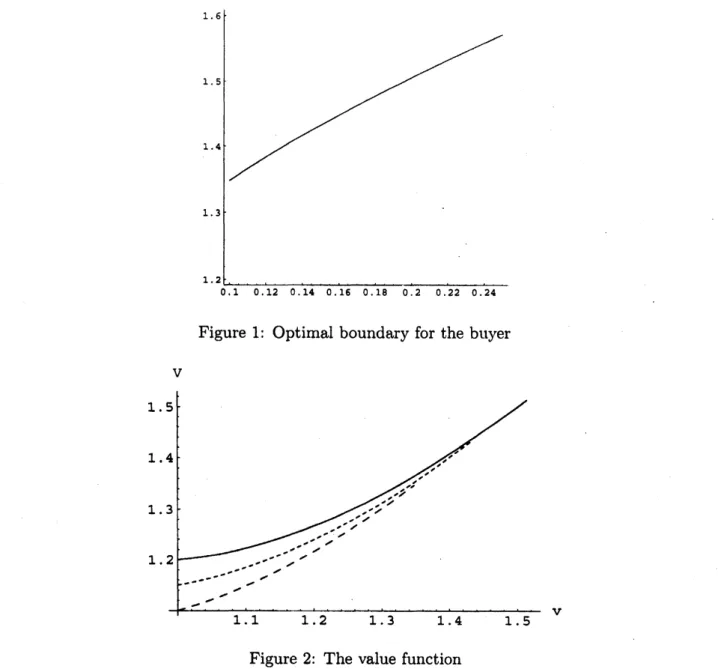
Figure 1 shows that the optimalexercise boundary
as
the penalty $\delta$ increases from0.1
up to$\delta^{*}$
.
From the figure,we
can
see
that the optimal boundary $v_{0}$ is increasing in the penalty $\delta$.
Figure 2
demonstrates
the value functionofthe callable Russianoption with jumps. Dashedlines represent $\delta=0.1,0.15$ from thebottom. Real line represents $\delta=0.2$
.
From this figure, wecan
recognize that $V(v)$ isconvex
and increasing in $v$.
References
[1] Cvitanic, J. andKaratzas, I., Backward stochastic differentialequations with reflection and
Dynkingames, The Annals
of
Probability, 24, 2024-2056, (1996).[2] Kifer, Y., Gameoptions, Finance and Stochastics, 4, 443-463, (2000).
[3] Kou,
S.G.
and H. Wang, Firstpassage
times for a jump diffusion process, Advances inApplied Probability, 35, 504-531, (2003).
[4] Kou,
S.G.
and H. Wang, Option Pricing Undera
Double Exponential Jump DiffusionFigure 1: Optimal boundary for the buyer
V
Figure 2: The value function
[5] Kyprianou, A.E.,
Some
calculations for Israeli options, Financeand
Stochastics, 8, 73-86, (2004).[6] Shepp, L.A. and Shiryaev, A.N., TheRussianoption: reducedregret, The
Annals
of
AppliedProbability, 3, 631-640, (1993).
[7] Shepp, L.A. and Shiryaev, A.N., A
new
look at pricing of the ‘Russian option‘, Theoryof
Prvbability and its Applications, 39, 103-119, (1994).
[8] Suzuki, A. and K. Sawaki, The Pricing of Callable Russian Options and Their Optimal
Boundaries, preprint.
[9] Suzuki, A. and K. Sawaki, The Valuation of Russian Options for