COMPUTATIONS
OF SPACES OF SIEGEL MODULAR CUSP FORMSCRIS
POOR, [email protected]ABSTRACT. We survey the known dimensions of $s_{n}^{k}$, the space of Siegel modular forms of
weight it and degree $n$. We mention afew new results for degrees 4, 5and 6. We obtain
our results by combining aVanishing Theorem and arestriction technique. For afixed $n$, $k$
the Vanishing Theorem gives an explicit set ofFourier coefficients which determine $s_{n}^{k}$. The
restriction of Siegel modular forms to elliptic modular forms reveals linear relations among
these explicit Fouriercoefficients. Sometimes weproduce enough linear relations to determine
$\dim S_{n}^{k}$. We discuss conjectures to the effect that$\dim S_{n}^{k}$ may always be computed by these
means.
\S 1.
Outline.I. Vanishing Theorem giving upper bounds for $\dim S_{n}^{k}$
.
$\mathrm{I}\mathrm{I}$
.
Restriction to modularcurves
and examples computing $\dim S_{n}^{k}$.
III. Conjectures: will the method in part II always work.All of the work in this talk is joint work with David Yuen.
\S 2.
Notation.$e(z)=e^{2\pi}:z$ for $z\in \mathbb{C}$
$P_{n}(\mathbb{R})=\{\mathrm{Y}\in M_{n\mathrm{x}n}^{\mathrm{s}\mathrm{y}\mathrm{m}}(\mathrm{R}) :\mathrm{Y}>0\}$, the positive definite real matrices.
$P_{n}^{\mathrm{s}\mathrm{e}\mathrm{m}\dot{|}}(\mathbb{R})=\{\mathrm{Y}\in M_{n\mathrm{x}n}^{\mathrm{s}\mathrm{y}\mathrm{m}}(\mathbb{R}) :\mathrm{Y}\geq 0\}$, the positive semi-definite real matrices.
$\mathcal{X}_{n}=\{T\in \mathrm{V}\mathrm{n}(\mathrm{Q}) : \forall x\in \mathrm{Z}^{n}, x’ Tx \in \mathrm{Z}\}$, the positive semi-integral matrices.
$t^{-}t_{n}=\{\Omega\in M_{n\mathrm{x}n}^{\mathrm{s}\mathrm{y}\mathrm{m}}(\mathbb{C}) : \Im\Omega>0\}$, the Siegel upper half space of degree $n$
.
$\Gamma_{n}=\mathrm{S}\mathrm{p}_{n}(\mathbb{Z})$, the modular group.
$\mathcal{F}_{n}=\mathrm{a}\mathrm{n}\mathrm{y}$ fundamental domain for $\Gamma_{n}$ acting
on
$H_{n}$.
$S_{n}^{k}=\mathrm{S}\mathrm{i}\mathrm{e}\mathrm{g}\mathrm{e}\mathrm{l}$ modular cusp forms of weight $k$ and degree $n$
.
For simplicity of exposition,
assume
levelone
andeven
weights throughout this talc.All the results extend to $S_{n}^{k}(\Gamma, \chi)$ for $\Gamma$ of finite index,
$\chi$ acharacter and $k$ $\in\frac{1}{2}\mathrm{Z}^{+}$
.
\S 3.
I. Vanishing Theorem.“It is abasic and important problem to know how many Fourier coefficients
determine amodular form.” H. Katsurada [5]
ThefollowingTheorem of Siegel [3] gives finiteset of Fourier
coefficients
that determine the form $f\in S_{n}^{k}$.
Loosely, $f$ must bezero
if its vanishingorder is too high.Typeset by $\mathrm{A}_{\mathrm{A}4}\subsetneq \mathfrak{M}$
数理解析研究所講究録 1281 巻 2002 年 146-153
CRIS POOR
Theorem (Siegel). Let $f\in S_{n}^{k}$ have Fourier expansion $f( \Omega)=\sum_{T\in \mathcal{X}_{\mathfrak{n}}}a(T)e(\mathrm{t}\mathrm{r}(T\Omega))$
.
If
$a(T)=0$for
all $T$ such that $\mathrm{t}\mathrm{r}(T)\leq\kappa_{n}\frac{k}{4\pi}$ then we have $f=0$.
Here
we
define$\kappa_{n}=\sup_{\Omega\in F_{n}}\mathrm{t}\mathrm{r}((\Im\Omega)^{-1})$
.
The best known upper bound for $\kappa_{n}$ is $\kappa_{n}\leq n\frac{2}{\sqrt{3}}\mu_{n}^{n}$ where $\mu_{n}$ is Hermite’s constant.
The partial order
on
$\mathcal{X}_{n}$ given by $A\geq B$ when $A-B$ is semidefinite is natural whereasall linear orders
are
artificial. Howcan
the vanishing orderof$f$ be measured inan
intrinsicway without relying on height functions like the $\mathrm{t}\mathrm{r}\mathrm{a}\mathrm{c}\mathrm{e}$?We can measure vanishing order
by taking the semihull of the support of the Fourier series of $f$. This set turns out to be
akernel, which
we
will define. This concept can then be used to formulate an intrinsicvanishing theorem.
Definition. Let $f\in S_{n}^{k}$ have Fourier expansion $f( \Omega)=\sum_{T\in \mathcal{X}_{n}}a(T)e(\mathrm{t}\mathrm{r}(T\Omega))$
.
Define:
$\mathrm{s}\mathrm{u}\mathrm{p}\mathrm{p}(f)=\{T\in \mathcal{X}_{n} : a(T)\neq 0\}\subseteq P_{n}(\mathbb{R})$
$\nu(f)=\mathrm{C}\mathrm{l}\mathrm{o}\mathrm{s}\mathrm{u}\mathrm{r}\mathrm{e}\{\mathrm{C}\mathrm{o}\mathrm{n}\mathrm{v}\mathrm{e}\mathrm{x}\mathrm{H}\mathrm{u}\mathrm{l}\mathrm{l}(\mathbb{R}\geq 1\mathrm{s}\mathrm{u}\mathrm{p}\mathrm{p}(f))\}\subseteq P_{n}^{\mathrm{s}\mathrm{e}\mathrm{m}\mathrm{i}}(\mathbb{R})$
$=\mathrm{S}\mathrm{e}\mathrm{m}\mathrm{i}\mathrm{h}\mathrm{u}\mathrm{l}\mathrm{l}(\mathrm{s}\mathrm{u}\mathrm{p}\mathrm{p}(/))$
Definition. $A$ kernel is a closed convex set $K\subseteq \mathcal{P}_{n}^{\mathrm{s}\mathrm{e}\mathrm{m}\mathrm{i}}(\mathbb{R})$ satisfying: (1) $\mathbb{R}\geq 1K=K$,
(2) $\mathrm{O}\not\in K$,
(3) $\mathbb{R}_{>0}K\supseteq \mathcal{P}_{n}(\mathbb{R})$.
Proposition. Let $f$,$g\in S_{n}$. We have $\mathrm{v}(\mathrm{f}\mathrm{g})=\mathrm{v}(\mathrm{f})+\nu(g)$.
Proof.
Unpublished.The operator $\nu$ thus behaves like avaluation. The $\nu(f)$ for $f\in S_{n}$
are
all kernelsand
so
the intrinsic vanishing of aSiegel modular cusp form may be measured by kernels.Complete proofs of the Kernel Lemma and the Semihull Theorem may be found in [7].
Kernel Lemma.
If f
$\in S_{n}$ then $\nu(f)$ is a kernel.Proof, (sketch) The Koecher Principle tells us that $\nu(f)\subseteq P_{n}^{\mathrm{s}\mathrm{e}\mathrm{m}\mathrm{i}}(\mathbb{R})$
.
The proof of the Kernel Lemmauses
thesame
techniquesas
the proofof the Koecher Principle. The usefuladded information is item (3). $\square$
The kernel $\nu(f)$ is related to the critical points ofthe invariant function $\det(\mathrm{Y})\tau k|f(\Omega)|$
.
Semihull Theorem. Let
f
$\in S_{n}^{k^{\wedge}}$.
Write $\Omega=X+i\mathrm{Y}\in’\kappa_{n}$.
If
$\det(\mathrm{Y})^{\mathrm{p}}k|f(\Omega)|$ attains $a$mctsimum at $\Omega_{0}=X_{0}+i\mathrm{Y}_{0}$ then $\frac{k}{4\pi}\mathrm{Y}_{0}^{-1}\in\nu(f)$.
Proof
(sketch) For all $P\in P_{n}^{\mathrm{s}\mathrm{e}\mathrm{m}\mathrm{i}}(\mathbb{Z})$, $q\in \mathbb{Z}^{+}$ such that $\inf(\mathrm{t}\mathrm{r}(P\nu(f)))\geq q$ apply themaximum modulus principle
on
$\{\zeta : \Im\zeta\geq-\epsilon\}$, $\epsilon>0$ to$\zeta\mapsto\frac{f(\Omega_{0}+\zeta P)}{e(q\zeta)}$
.
$\square$COMPUTATIONS OF SIEGEL MODULAR FORMS
For every cusp form $f$
we
know that $\det(\mathrm{Y})\tau k|f(\Omega)|$ attains amaximum in $\mathcal{F}_{n}$.
Thismakes
an
intrinsic Vanishing Theorem possible.Vanishing Theorem (Intrinsic Version). Let $f\in S_{n}^{k}$
.
If
$\frac{k}{4\pi}(\Im \mathcal{F}_{n})^{-1}\cap\nu(f)=\emptyset$ thenwe
have $f=0$
.
It must be confessed, however, that
use
of this Intrinsic Version in specificexam-ples requires
more
information about $\mathcal{F}_{n}$ than is presently available. $\mathcal{F}_{1}$ is well known.Gottschling [2] has given adescription of $\mathcal{F}_{2}$ but it is surprisingly complicated: $\mathcal{F}_{2}$ is
bounded by 28 real algebraic hypersurfaces. Although present computations still rely
on
linear orders, the Intrinsic Version allows
us
great freedom in the choice of alinear order.Siegel used the $\mathrm{t}\mathrm{r}\mathrm{a}\mathrm{c}\mathrm{e}$, $\mathrm{t}\mathrm{r}(T)$. Witt used the reduced determinant, $\det(T)^{1/n}$
.
Eichler used Hermite’s function, $m(T)$.
Weuse
the dyadic $\mathrm{t}\mathrm{r}\mathrm{a}\mathrm{c}\mathrm{e}$, $w(T)$:For $T\in \mathcal{X}_{n}$ define: $w(T)= \inf_{Y\in P_{n}(\mathrm{R})}\frac{\mathrm{t}\mathrm{r}(\mathrm{Y}T)}{m(\mathrm{Y})}$
.
The following Theorem, along with techniques for calculatingthe dyadic $\mathrm{t}\mathrm{r}\mathrm{a}\mathrm{c}\mathrm{e}$,
can
also be found in [7].Theorem. Let $f\in S_{n}^{k}$ have the Fourier expansion $f( \Omega)=\sum_{T\in \mathcal{X}_{\mathfrak{n}}}a(T)e(\mathrm{t}\mathrm{r}(T\Omega))$
.
If
$a(T)=0$for
all $T$ such that $w(T) \leq\frac{2}{\sqrt{3}}n\frac{k}{4\pi}$ thenwe
have $f=0$.
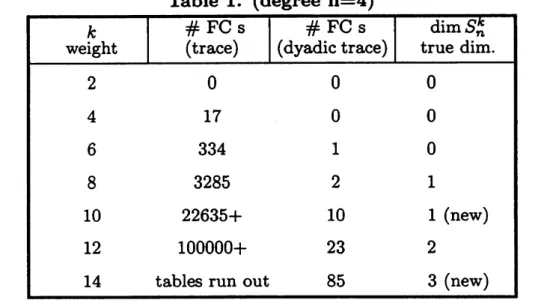
Table 1illustrates for degree 4how favorably the dyadic $\mathrm{t}\mathrm{r}\mathrm{a}\mathrm{c}\mathrm{e}$ version compares with Siegel’s $\mathrm{t}\mathrm{r}\mathrm{a}\mathrm{c}\mathrm{e}$version. Table 1contains all
even
$k>0$for which$\dim S_{4}^{k}$ is presently known.Example. Let $J_{8}\in S_{4}^{8}$ be Schottky’s form. Igusa [4] proved the identity:
$(2^{} \cdot 3^{2}\cdot 5\cdot 7)J_{8}=\theta_{E_{8}\oplus E_{8}}-\theta_{D_{16}^{+}}$
.
According to Table 1,
we can
prove this identity by the relatively easy task of verifyingit for 2Fourier coefficients. In summary, the Vanishing Theorem gives
a
$D$ such that$\dim S_{n}^{k}\leq D$
.
Wecan
decrease $D$ bystudying therestrictions of Siegel modular cusp formsto modular
curves.
This is the topic of part $II$.
CRIS POOR
\S 4.
II. Restriction to Modular Curves. Let $s\in P_{n}(\mathbb{Z})$. Let $\ell\in \mathbb{Z}^{+}$ such that $\ell s^{-1}\in P_{n}(\mathbb{Z})$. Define:$\phi_{s}$ : $H_{1}arrow H_{n}$, $\phi_{s}^{*}$ : $S_{n}^{k}$ $arrow S_{1}^{nk}(\Gamma_{0}(\ell))$
.
$\tau\mapsto s\tau$ $(\Omega\mapsto f(\Omega))\mapsto(\tau\mapsto f(s\tau))$
Casually, if $f(\Omega)$ is aSiegel modular form then $f(s\tau)$ is an elliptic modular form. This
is the “Eichler trick.” It is usually
seen
in the context of theta series where $\phi_{s}^{*}$ sends thethetanullwerte of degree $n$ to the theta series for $s$ of degree 1.
The Fourier coefficients of $\phi_{s}^{*}f$ at each cusp
can
be worked out in terms of the Fourier coefficients of $f$.
Let $q=e(\tau)$ for $\tau\in H_{1}$.
$( \phi_{s}^{*}f)(\tau)=f(s\tau)=\sum_{T\in \mathcal{X}_{n}}a(T)e(\mathrm{t}\mathrm{r}(Ts\tau))=\sum_{T\in \mathcal{X}_{n}}a(T)q^{\mathrm{t}\mathrm{r}(Ts)}=\sum_{j=1}^{\infty}(\sum_{T:\mathrm{t}\mathrm{r}(Ts)=j}a(T))q^{j}$
.
It is essential to make
use
of similar expansions at the other cusps of$\Gamma_{0}(\ell)\backslash H_{1}$,see
[8] fordetails.
Since $\phi_{s}^{*}f$ is modular for $\Gamma_{0}(\ell)$, the Fourier coefficients of$\phi_{s}^{*}f$for all cusps satisfy linear relations. These induce linear relations
on
the Fouriercoefficients of$f$ and this is thewholepoint of the method.
Example. $n=4;\ell=2;s=D_{4}=(\begin{array}{llll}2 1 1 11 2 0 01 0 2 01 0 0 2\end{array})$
.
Also let $H=(\begin{array}{llll}2 1 1 11 2 0 01 0 2 01 0 0 4\end{array})$.
We compute the following expansion:
$(\phi_{D_{4}}^{*}f)(\tau)=a(D_{4})q^{4}+(16a(D_{4})+48a(A_{4}))q^{5}$
$+(144a(D_{4})+288a(A_{4})+216a(A_{3}\oplus A_{1})+48a(A_{2}\oplus A_{2})+12a(H))q^{6}+\ldots$
(4.1)
The function $\phi_{D_{4}}^{*}f\in S_{1}^{4k}(\Gamma_{0}(2))$ is invariant under the Fricke involution because $D_{4}^{-1}$ is
equivalent to $\frac{1}{2}D_{4}$, ahelpful lemma. We need information about the ring $M_{1}(\Gamma\circ(2))$
.
Inorder to fix notation, define $E_{k,d}^{\pm}(\tau)=(E_{k}(\tau)\pm d^{k}\tau E_{k}(d\tau))/(1\pm d^{k}\tau)$ where the $E_{k}(\tau)=$
$1- \frac{2k}{B_{k}}\sum_{n=1}^{\infty}\sigma_{k-1}(n)q^{n}$
are
the Eisenstein series and the $B_{k}$are
given by $t/(e^{t}-1)=$$\sum_{k=0}^{\infty}B_{k}t^{k}/k!$. We have $E_{k,d}^{\pm}\in M_{1}^{k}.(\Gamma_{0}(d))$ except in the
case
of$E_{2,d}^{+}$. The ring $M_{1}(\Gamma_{0}(2))$is generated by $E_{2,2}^{-}\in M_{1}^{2}$(FO(2)) and $E_{4,2}^{-}\in M_{1}^{4}(\Gamma_{0}(2))$ and the ring of cusp forms is
principally generated by $C_{8,2}^{+}\in S_{1}^{8}(\Gamma_{0}(2))$
.
The $\pm \mathrm{s}\mathrm{u}\mathrm{p}\mathrm{e}\mathrm{r}\mathrm{s}\mathrm{c}\mathrm{r}\mathrm{i}\mathrm{p}\mathrm{t}$ indicates an eigenvalue of149
COMPUTATIONS OF SIEGEL MODULAR FORMS
$\pm 1$ under the Pricke involution. The Fourier expansions of these generators
are
given by$E_{2,2}^{-}( \tau)=1+24\sum_{n=1}^{\infty}(\sigma_{1}(n)-2\sigma_{1}(n/2))q^{n}=1+24q+24q^{2}+96q^{3}+24q^{4}+144q^{5}+\ldots$
$E_{4,2}^{-}( \tau)=1-80\sum_{n=1}^{\infty}(\sigma_{3}(n)-4\sigma_{3}(n/2))q^{n}=1-80q-400q^{2}-2240q^{3}-2960q^{4}-\ldots$
$C_{8,2}^{+}(z)= \frac{1}{256}(E_{2,2}^{-}(\tau)^{4}-E_{4,2}^{-}(\tau)^{2})=q-8q^{2}+12q^{3}+64q^{4}-210q^{5}-96q^{6}$ -...
The order of$\phi_{D_{4}}^{*}f$ at the cusp $[I]$ is at least 4and the order at the cusp $[J]$ is the
same
because $\phi_{D_{4}}^{*}f$ is
an
eigenfunction of the Pricke involution. Thuswe
have $(C_{8,2}^{+})^{4}|\phi_{D_{4}}^{*}f$ in$M_{1}(\Gamma_{0}(2))$ and we have
$\phi_{D_{4}}^{*}f=(C_{8,2}^{+})^{4}$ (Form of weight $4k-32$).
Let
us use
this fact, along with column 3ofTable 1, to explain the entries in column 4ofTable 1.
$k=2$,$k=4$
.
Prom column 3ofTable 1wesee
that the Vanishing Theorem alone provesthat $S_{4}^{2}=\{0\}$ and that $S_{4}^{4}=\{0\}$
.
$k=6$
.
$S_{4}^{6}$ is controlled byone
Fourier coefficient, $a(D_{4})$.
Wesee
that$\phi_{D_{4}}^{*}f=0$ and
so
every coefficient in equation 4.1 gives ahomogeneous linear relation; in particular
we
musthave $a(D_{4})=0$ and hence we have $S_{4}^{6}=\{0\}$
.
$k=8$
.
$S_{4}^{8}$ is controlled by two Fourier coefficients, $a(D_{4})$ and $a(A_{4})$.
For $k=8$ there isa
parameter $c\in \mathbb{C}$ such that
$\phi_{D_{4}}^{*}f=c(C_{8,2}^{+})^{4}=c(q^{4}-32q^{5}+432q^{6}-2944q^{7}+7192q^{8}+39744q^{9}-\ldots)$
.
Elimination of the parameter $c$ provides alinear relation for any $f\in S_{4}^{8}$:
$a(D_{4})=c$,
$16a(D_{4})+48a(A_{4})=-32c$,
.$\cdot$
. $a(D_{4})+a(A_{4})=0$
.
The relation $a(D_{4})+a(A_{4})=0$ implies that $\dim S_{4}^{8}\leq 1$
.
$k=10$
.
$S_{4}^{10}$ is controlled by 10 Fourier coefficients. For $k=10$ thereare
parameters$\alpha$,$\beta\in \mathbb{C}$ such that $\phi_{D_{4}}^{*}f=(C_{8,2}^{+})^{4}(\alpha(E_{2,2}^{-})^{4}+\beta C_{8,2}^{+})$. The element $(E_{2,2}^{-})^{2}E_{4,2}^{-}$ cannot
occur
in this representation because it has$\mathrm{e}\mathrm{i}\mathrm{g}\mathrm{e}\mathrm{n}\mathrm{v}\mathrm{a}\mathrm{l}\mathrm{u}\mathrm{e}-1$under the Pricke operator.Elim-ination of the parameters $\alpha$ and $\beta$ provides two linear relations. Recall the form $H$, the
homomorphism $\phi_{H}^{*}$ : $S_{4}^{10}arrow S_{1}^{40}(\Gamma_{0}(6))$ gives 8relations
on
thesesame
ten Fourier coeffi-cients. The span of the two sets ofrelations is 9dimensionalso
thatwe
have $\mathrm{d}\cdot \mathrm{m}S_{4}^{10}\leq 1$.CRIS POOR
for $k>2n$ the generic
zone.
The middle zone, $n/2<k\leq 2n$, may be termed the sporadiczone.
All the $\dim S_{3}^{k}$were
given by Tsuyumine,see
[9].Poor-Yuen used divisor methods in [6] to compute $\dim S_{4}^{k}$ for A $=6,8,12$.
Duke-Imamoglu [1] used explicit formulae and $L$-functions to compute $\dim S_{n}^{4}$ for $4\leq n\leq 7$ and $\dim S_{n}^{6}$ for $4\leq n\leq 11$ and $\dim S_{n}^{8}$ for $n=4,8$
.
Nebe-Venkov computed $\dim S_{5}^{12}$.
Themethod ofthis paper adds $\dim S_{4}^{k}$ for $k=10,14$ and $\dim S_{5}^{k}$ for $k=8,10$ and $\dim S_{6}^{k}$ for
$k=8$
.
\S 5.
III. Conjectures.The previous sections have shown how to give progressively improved
upper
bounds for$\dim S_{n}^{k}$
.
In order to show equality,one
constructs the correct number oflinearly indepenCOMPUTATIONS OF SIEGEL MODULAR FORMS
dent forms in $S_{n}^{k}$
.
So far this has not been aproblem, at least whenever the upper boundturned out to be the correct dimension.
One
wonders howgoodthis method for producingupper bounds actually is and whether it might stabilize above the actual dimension. We believe that the method described in this talk will always work. We wish to characterize the Fourier series of Siegel modular cusp forms from among all formal series. The
conjec-tures that follow
are an
attempt to do this. We write aformal seriesas
$\sum_{T\in \mathcal{X}_{n}}a(T)q_{n}^{T}$,the $q_{n}$ indicates that the exponent is
an
$n\cross n$ matrix. We define what itmeans
to saythat aformal series is of “Koecher Type.”
Definition. Let $n$,$It\in \mathbb{Z}^{+}$
.
Aformal
series $\sum_{T\in \mathcal{X}_{\mathfrak{n}}}a(T)q_{n}^{T}$ isof
Koecher $\Phi e$ $(n, k)$when
we
have $a(\mathrm{v}’ \mathrm{T}\mathrm{v})=\det(v)^{k}a(T)$for
all $v\in \mathrm{G}\mathrm{L}_{n}(\mathbb{Z})$.
More generally, let
a
set$\mathcal{T}\subseteq \mathcal{X}_{n}$ be given. Aformal
se
ries $\sum_{T\in \mathcal{T}}a(T)q_{n}^{T}$ isof
KoecherType $(\mathrm{T})$ $k)$ when it can be extended to a
formal
series $\sum_{T\in \mathcal{X}_{n}}a(T)q_{n}^{T}$of
Koecher $\infty pe$$(n, k)$.
Conjecture (Theory Version). Given$n$, $It\in \mathbb{Z}^{+}$
.
Fourierseries in$S_{n}^{k}$are
characterized among all$fo$ rmal seriesof
Koecher $\mathbb{R}pe$ $(n, k)$ by the linearrelations on the $a(T)$, $T\in \mathcal{X}_{n}$,induced by the $\phi_{s}^{*}$ homomorphisms at all cusps
for
all$s\in P_{n}(\mathbb{Z})$.
Asecond conjecture is formulated with computer applications in mind. By general
nonsense, these conjectures
are
equivalent.Conjecture (Computer Version).
Given
$n$, $k\in \mathbb{Z}^{+}$.
Given a
finite
set $\mathcal{T}\subseteq \mathcal{X}_{n}$.
There exists afinite
set $\mathrm{S}$ $\subseteq P_{n}(\mathbb{Z})$ such that $\mathcal{T}$-partialsums
of
Fourier series in $S_{n}^{k}$are
characterized among all
formal
series $\sum_{T\in \mathcal{T}}a(T)q_{n}^{T}$of
Koecher $\infty pe(n, k)$ by the linearrelations
on
the $a(T)$, $T\in \mathcal{T}$, induced by the $\phi_{s}^{*}$ homomorphisms at all cuspsfor
$s\in S$.Abetter assertion would be that $\mathrm{S}$ is effectively computable ffom $n$, $k$ and $\mathcal{T}$ but
we
suspect this is
more
difficult. You probably shouldn’t believe either conjecture until yousee the following Theorem. The proofof this Theorem is unpublished.
Theorem. Given $n$, $k\in \mathbb{Z}^{+}$
.
Fourier series in $S_{n}^{k}$are
characterized among allconver-gent series $\sum_{T\in \mathcal{X}_{\mathfrak{n}}}a(T)q_{n}^{T}$ by the linear relations
on
the $a(T)$, $T\in \mathrm{X}\mathrm{n}$,
induced by the $\phi_{s}^{*}$homomorphisms at all cusps
for
all $s\in P_{n}(\mathbb{Z})$.
Acounterexample to the conjecture would be astrange creature indeed: aformal series
whose coefficients have super-exponential growth such that every time the substitution
$q_{n}^{T}:=q^{\mathrm{t}\mathrm{r}(sT)}$ is made for $s\in P_{n}(\mathbb{Z})$
we
obtainan
elliptic modular form of level $\Gamma_{0}(\ell)$ forthe minimal $\ell$ such that $\ell s^{-1}$ is integral.
At this point
we
view the Conjectureas
aregularity theorem. Recall the originalregularity theorem: aweakly harmonic distribution is already $C^{\infty}$ and hence harmonic.
We wish to frame
our
Conjecture inan
analogous manner. Call aformal series modularif it is the Fourier series of aSiegel modular form. Call any formal series ofKoecher Type
that gives an elliptic modular form of level $\Gamma_{0}(\ell)$ every time the substitution $q_{n}^{T}:=q^{\mathrm{t}\mathrm{r}(sT)}$
is made weakly modular. In the above spirit
we
may rephrase the Conjectureas:
aweaklymodular formal series is already convergent and hence modular.
CRIS POOR
REFERENCES
1. W. Duke and O. Imamoglu, Siegel Modular Forms
of
Small Weight, Math. Ann. 308(1997), 525-534.
2. E. Gottschling, Explizite Bestimmung der
Randfl\"achen
des Fundamentalbereiches derModulgruppe zweiten Grades, Math. Ann. 138 (1959),
103-124.
3. J. I. Igusa, Theta Functions, Grundlehren der mathematische Wissenschaften 194,
Springer Verlag,
1972.
4. J. I. Igusa, Schottky’s invariant and quadratic
for
ms, Christoffel Symp., Birkhauser Verlag,1981.
5. H. Katsurada, On the Coincidence
of
Hecke-Eigenforms, Abhand. Math. Sem. Univ.Hamburg 70 (2000), 77-83.
6. C. Poor and D. Yuen, Dimensions
of
Spacesof
Siegel Modular Formsof
Low Weightin Degree Four, Bull. Austral. Math. Soc. 54 (1996), 309-315.
7. C. Poor and D. Yuen, Linear dependence among Siegel Modular Forms, Math. Ann.
318 (2000), 205-234.
8. C. Poor and D. Yuen, Restriction
of
Siegel Modular Forms to Modular Curves, Bull.Austral. Math. Soc. 65 (2002), 239-252.
9. S. Tsuyumine, On Siegel modular
foms of
degree three, Amer. J. Math. 108 (1986),755-862,
1001-1003.
DEpARTMENT 0F MATHEMATICS, FORDHAM UNIVERSITY, Bronx, NY 10458
Email: [email protected]