
Construction
of
the
$\Phi_{4}^{4}$quantum field
theory
on
noncommutative
Moyal
space
Harald
GROSSE1
and
Raimar
WULKENHAAR2
1 Fakult\"at
f\"ur
Physik, Universit\"at WienBoltzmanngasse 5,
A-1090
Wien, Austria2 Mathematisches Institut der
Westf\"alischen
Wilhelms-Universit\"atEinsteinstrafle
62,D-48149
M\"unster, GermanyAbstract
We review
our
recent construction of the $\phi^{4}$-model on four-dimensionalMoyal space.
A
milestone is the exact solutionof
the quartic matrix model $\mathcal{Z}[E, J]=\int d\Phi\exp(trace(J\Phi-E\Phi^{2}-\frac{\lambda}{4}\Phi^{4}))$ in terms of thesolu-tion ofa non-linear equationfor the 2-point function and the eigenvalues
of$E$. The$\beta$-function vanishes identically. For the Moyal model, the
the-oryof Carlemantypesingular integral equations reduces the construction to
a
fixed point problem. Its numerical solution reveals a second-orderphase transition at $\lambda_{c}\approx-0.396$ and aphasetransition ofinfinite order at
$\lambda=0$. The resulting Schwinger functions in position space
are
symmet-ric and invariant under the full Euclidean group. They
are
only sensitive to diagonal matrix correlation functions, and clustering is violated. TheSchwinger 2-point function is reflection positive iff the diagonal matrix 2-point function is a Stieltjes function. Numerically this
seems
to be thecase
for coupling constants $\lambda\in[\lambda_{c}, 0].$1
Introduction
Perturbatively renormalised quantum field theory is an
enormous
phenomeno-logical success, a
success
which lacks a mathematical understanding. Theper-turbation series is at best an asymptotic expansion which cannot converge at physical coupling constants. Some physical effects such
as
confinementare
out of reach for perturbation theory. In two and partly three dimensions,meth-ods of constructive physics [GJ87, Riv91], often combined with the Euclidean
approach [Sch59, OS73, OS75], were used to rigorously establish quantum field
theory models.
In four dimensions there
was
littlesuccess so
far. It is generally believed that due toasymptoticfreedom,non-Abelian gauge
theory (i.e. Yang-Millstheory)has
the
chance
ofa
rigorousconstruction.
But this isa
hard problem [JW00]. Whatmakes it
so
difficult is the fact that any simpler model such as quantum electro-dynamicsor
the $\lambda\phi^{4}$-model cannot be constructed in four dimensions (Landaughost problem $[LAK54a, LAK54b, LAK54c]$
or
triviality [Aiz81, Fr\"o82One
of the maindifficulties
is the non-linearityof
themodels
underconsider-ation.
Fixed
point methods providea
standard
approach to non-linear problems, but theyare
rarely used in quantum field theory. In this contribution we reviewa
sequence of papers $[GW12b, GW13b, GW14]$ in whichwe
successfully usedsymmetry and fixed point methods to exactly solve a toy model for
a
quantumfield theory in four dimensions.
1. Following $[GW12b]$,
we
show insec.
2 that the quartic matrix model $\mathcal{Z}=$$\int \mathcal{D}[\Phi]\exp(tr(J\Phi-E\Phi^{2}-\frac{\lambda}{4}\Phi^{4}))$ is exactly solvable in terms of the solution
ofanon-linear equation. This
can
be tracedback toa
Ward identity forthe$U(\infty)$ group action. As by-product
we
find that any renormalisable quarticmatrix model has vanishing $\beta$-function. All these steps
are
completelyelementary.
2.
Self-dual
$\phi_{4}^{4}$-theoryon
Moyal space $[GW05b, GW05c]$ is of that type. Forextreme noncommutativity $\thetaarrow\infty$, and after careful discussion of
ther-modynamic and continuum limit, the non-linear equation is reduced to
a fixed-point problem $[GW12b]$ which has a unique non-perturbative and
non-trivial solution for $\lambda<0$ [GW14].
Sec.
3 reviews this work. The keystep is the observation that
a
certain difference function satisfiesa
linearsingular integralequationofCarlemantype [Car22, $Ri57$]. We also present
some
numerical results, contained in work in progress [GW14], which showevidence for phase transitions.
3. Following $[GW13b]$,
we
identify insec.
4a
limit to Schwinger functions fora
scalar fieldon
$\mathbb{R}^{4}$. Surprisingly for
a
highly noncommutative model, these Schwingerfunctions
show full Euclidean symmetry. Otherwise they have unusual properties suchas
absent momentum transfer in interactionprocesses. This
seems
to suggest triviality, but the numerical investigation [GW14] of the 2-point function shows scattering remnants from anon-commutative geometrical substructure. Most surprisingly, the Schwinger
2-point function seems to be reflection positive in one of its phases.
2
Exact
solution of the
quartic matrix
model
For
us a
‘matrix’ isa
compact (Hilbert-Schmidt) operator on Hilbert space $H=$$L^{2}(I, \mu)$. Such operators $\Phi\in \mathcal{L}^{2}(H)$
can
be represented by integral kerneloper-ators $( \Phi v)_{a}=\int_{I}d\mu_{b}\Phi_{ab}v_{b}$
.
Then all natural matrix operations suchas
product,adjoint and trace have counterparts $( \Phi\Phi’)_{ab}=\int_{I}d\mu_{c}\Phi_{ac}\Phi_{cb}’,$ $(\Phi^{*})_{ab}=\overline{\Phi_{ba}}$ and $tr(\Phi\Phi’)=\int_{I}d\mu_{a}(\Phi\Phi’)_{aa}$ in $\mathcal{L}^{2}(H)$.
To define a Euclidean quantum
field
theory for a matrix $\Phi\in \mathcal{L}^{2}(H)$ we giveourselves an action functional
$S[\Phi]=Vtr(E\Phi^{2}+P[\Phi])$ . (1)
Here, $P[\Phi]$ is a polynomial in $\Phi$ with scalar coefficients, and this alone would
be
a
familiar action in the theory of matrix models [DGZ95]. To be closer tofield theory on $a$ (compact) manifold $\mathcal{M}$
we
add the analogue of the kinetic term $\int_{\mathcal{M}}dx(-\triangle\phi)\phi$, that is,we
require the external matrix $E$ to be an unbounded selfadjoint positive operatoron
$H$ with compact resolvent. The volume $V$ willplay
a
crucial r\^ole. The construction involves several regularisation and limitingprocedures. One such regularisation consists in a finite size $\mathcal{N}$ for the matrices,
and $V$ will be a certain function of$\mathcal{N}$which together with$\mathcal{N}$ is sent to
$\infty.$
Adding
a source
term to the action,we
define the partition junctionas
$\mathcal{Z}[J]=\int \mathcal{D}[\Phi]\exp(-S[\Phi]+Vtr(\Phi J))$ , (2) where $\mathcal{D}[\Phi]$ is the extension of the Lebesgue
measure
from finite-rank operatorsto $\mathcal{L}^{2}(H)$ and $J$
a
test function matrix. For absent $P[\Phi]\mapsto 0$ in (1), $\frac{\mathcal{D}[\Phi]}{\mathcal{Z}[0]}$ wouldbe the $Gaui3ian$ measure of covariance determined by $E$. What we want, and
whatweachieve, $istoc$onstruct $\frac{\mathcal{D}[\Phi]}{z\}^{0]}}forP[\Phi]=\frac{\lambda}{4,S}\Phi^{4}inthel$imit V
$arrow\infty.$
Sucha
limit cannot b$ee$xpected f$or\mathcal{Z}.$ nstead,$wepastotheg$
enerating functional$\log \mathcal{Z}[J]$ of connected correlation functions,
$\langle\varphi_{a_{1}b_{1}}\ldots\varphi_{ab_{N}}N\rangle_{c}=\frac{\partial^{N}1og.\mathcal{Z}[J]}{\partial J_{b_{1}a_{1}}..\partial J_{b_{N}a_{N}}}|_{J=0}$ (3)
2.1 Ward identity and topological expansion
Unitaryoperators $U$belongingto
an
appropriate unitisation of thecompactoper-ators on$H$ give rise to a transformation $\Phi\mapsto\tilde{\Phi}=U\Phi U^{*}$. Since $UU^{*}=U^{*}U=id$
and because the space of selfadjoint compact operators is invariant under the ad-joint action, we have
$\int \mathcal{D}[\Phi]\exp(-S[\Phi]+Vtr(\Phi J))=\int \mathcal{D}[\tilde{\Phi}]\exp(-S[\tilde{\Phi}]+Vtr(\tilde{\Phi}J))$ . Unitary invariance $\mathcal{D}[\tilde{\Phi}]=\mathcal{D}[\Phi]$ ofthe Lebesgue
measure
implies$0= \int \mathcal{D}[\Phi\{\exp(-S[\Phi]+Vtr(\Phi J))-\exp(-S[\tilde{\Phi}]+Vtr(\tilde{\Phi}J))\}$
Note that the integrand $\{$. . . $\}$ itself does not vanish because $tr(E\Phi^{2})$ and $tr(\Phi J)$
are
not unitarily invariant. Linearisation of $U$ about the identity operator leadsto the Ward identity
We
can
always place ourselves inan
orthonormal basis of $H$ where $E$ is diagonal(but $J$ is not). Since $E$ is of compact resolvent, $E$ has eigenvalues $E_{a}>0$ of finite multiplicity $\mu_{a}$. We thus label the matrices by
an
enumeration of the(necessarily discrete) eigenvalues of $E$ and
an
enumerationof
thebasis
vectorsof
thefinite-dimensional
eigenspaces. Writing $\Phi$ in$\{$. . . $\}$
of
(4)as
functional
derivative $\Phi_{ab}=\frac{\partial}{V\partial J_{ba}}$,
we
have proved (first obtained in [DGMR07]):Proposition 1 The partition
function
$Z[J]$of
the matrix modeldefined
by theexternal matrix $E$
satisfies
the $|I|\cross|I|$ Ward identities$0= \sum_{n\in I}(\frac{(E_{a}-E_{p})}{V}\frac{\partial^{2}\mathcal{Z}}{\partialJ_{an}\partial J_{np}}+J_{pn}\frac{\partial \mathcal{Z}}{\partial J_{an}}-J_{na}\frac{\partial \mathcal{Z}}{\partial J_{np}})$ (5)
Without loss of generality
we can
assume
that the map $I\ni m\mapsto E_{m}\in \mathbb{R}_{+}$ isinjective. Namely, correlation functionswill only depend
on
the set ofeigenvalues$(E_{m})$
of
$E$. Partitioning the index set $I$ into equivalence classes $[m]$ which havethe
same
$E_{m}$, the indexsum
over
a
function
that only dependson
$E_{m}$ becomes $\sum_{m\in I}f(m)=\sum_{[m]\in[I]}\mu_{[m]}f([m])$. Therefore, at the price of addinga
measure
$\mu_{[m]}=\dim ker(E-E_{m}id)$,
we can
assume
that $m\mapsto E_{m}$ is injective.In
a
perturbative expansion, Feynman graphs in matrix modelsare
ribbongraphs. Viewed
as
simplicial complexes, they encode the topology $(B, g)$ ofa
genus-g
Riemann surface with $B$ boundary components (or punctures, markedpoints, holes, faces).
Some
simple examples for $P[\Phi]=\Phi^{4}$are:
$A$
$d_{d}$
Since$E$ is diagonal, the matrixindex isconserved alongeach strandoftheribbon
graph. We have to distinguish between internal faces (with constant matrix
index) and broken faces which constitute the boundary components. Such
a
boundary face is characterised by $N_{k}\geq 1$ external double lines to which we
attach the
source
matrix $J$. Conservation ofthe matrix index along each strandimplies that the right index of $J_{ab}$ coincides with the left index of another $J_{bc},$
or of the
same
$J_{bb}$. Accordingly, the $k^{th}$ boundary component carriesa
cycle$J_{p_{1}\ldots p_{N_{k}}}^{N_{k}}$ $:= \prod_{j=1}^{N_{k}}J_{p_{j}p_{j+1}}$ of $N_{k}$ external sources, with $N_{k}+1\equiv 1.$
Being interested in
a
non-perturbative solution,we
will not expand the par-titionfunction
into ribbon graphs. Butwe
keep the topological information andexpand $\log \mathcal{Z}[J]$ according to the cycle structure:
$\log\frac{\mathcal{Z}[J]}{\mathcal{Z}[0]}=\sum_{B=1}^{\infty}\sum_{1\leq N_{1}\leq\cdots\leq N_{B}}^{\infty}\sum_{p_{1)}^{\beta}\ldots,p_{N_{\beta}}^{\beta}\in I}\frac{V^{2.-B}}{S_{N_{1}..N_{B}}}G_{|p_{1}^{1}\ldots p_{N_{1}}^{1}|\ldots|p_{1}^{B}\ldots p_{N_{B}}^{B}|}\prod_{\beta=1}^{B}(\frac{J^{N_{\beta}}p_{1}^{\beta}\ldots p_{N_{\beta}}^{\beta}}{N_{\beta}})$
(6)
The symmetry factor $S_{N_{1}\ldots N_{B}}$ is obtained
as
follows: If $\nu_{i}$ of the $B$ numbers $N_{\beta}$in
a
given tuple $(N_{1}, \ldots, N_{B})$are
equal to $i$, then $S_{N_{1}\ldots N_{B}}= \prod_{i=1}^{N_{B}}\nu_{i}!.$Next
we
turn the Ward identity (5) for injective $m\mapsto E_{m}$ into a formula for the second derivative $\sum_{n\in I\partial J_{an}\partial J_{np}}^{\partial^{2}Z[J]}$ of the partition function. The $J$-cyclestructure in $\log \mathcal{Z}$ creates
$\bullet$ singular contributions $\sim\delta_{ap},$
$\bullet$ regular contributions present for all
$a,p$:
Theorem 2
$\sum\frac{\partial^{2}\mathcal{Z}[J]}{\partial J_{an}\partial J_{np}}=\delta_{ap}\{V^{2}\sum\frac{J_{P_{1}}\cdots J_{P_{K}}}{S_{(K)}}(\sum\frac{G_{|an|P_{1}|\ldots|P_{K}|}}{V^{|K|+1}}+\frac{G_{|a|a|P_{1}|\ldots|P_{K}|}}{V^{|K|+2}}$
$n\in I$ (K) $n\in I$
$+ \sum \sum \frac{G_{|q_{1}aq_{1}\ldots q_{r}|P_{1}|\ldots|P_{K}|^{J_{q_{1}\ldots q_{r}}^{r}}}}{V^{|K|+1}})$
$r\geq 1q_{1},\ldots\rangle q_{r}\in I$
$+V^{4} \sum\frac{J_{P_{1}}\cdots J_{P_{K}}J_{Q_{1}}\cdots J_{Q_{K’}}}{S_{(K)}S_{(K’)}}\frac{G_{|a|P_{1}|\ldots|P_{K}|}}{V|K|+1}\frac{G_{|a|Q_{1}|\ldots|Q_{K’}|}}{V|K|+1}\}\mathcal{Z}[J]$
$(K),(K’)$
$+ \frac{V}{E_{p}-E_{a}}\sum(J_{pn}\frac{\partial \mathcal{Z}[I]}{\partial J_{an}}-J_{na}\frac{\partial \mathcal{Z}[I]}{\partial I_{np}})$ (7)
$n\in I$
Proof.
We identify the following foursources
ofa
singular contribution $\sim\delta_{ap}$:1. $\sum_{n}\frac{\partial^{2}}{\partial J_{an}\partial J_{np}}\sum_{q_{1},q_{2_{\rangle}}}..,$
$G \ldots|q_{1}q_{2}|\ldots(\frac{J_{q_{1}q_{2}}J_{q_{2}q_{1}}^{\downarrow}\downarrow}{2})\prod J$
2. $\sum_{n}\frac{\partial^{2}}{\partial J_{an}\partial J_{np}}\sum_{q_{1},q_{2},\rangle}..G\ldots|q_{1}|\ldots|q_{2}|\ldots(\frac{J_{q_{1}q_{1}}^{\downarrow}}{1})(\frac{J_{q_{2}q_{2}}^{\downarrow}}{1})\prod J$
$\downarrow$
3.
$\sum_{n}\frac{\partial}{\partial J_{an}}\frac{\partial}{\partial J_{np}}\ldots\sum_{q_{0,)}q_{r+1}}G.\cdot,\cdot|q0q_{1}\ldots q_{r}q_{r+1}|\ldots(\frac{J_{q0q_{1}}J_{q_{1}q_{2}}\cdots J_{q_{r}q_{r+1}}J_{q_{r+1}q0}}{r+2})\prod J$4. $\sum_{n}\frac{\partial^{2}}{\partial J_{an}\partial\sqrt{}np}[\sum_{q_{1}},$
$G \ldots|q_{1}|\ldots(\frac{J_{q_{1}q_{1}}^{\downarrow}}{1})\prod J][\sum_{q_{2}}G\ldots|q_{2}|\ldots(\frac{J_{q_{2}q_{2}}^{\downarrow}}{1})\prod J]$
All
other typesof
derivatives,collected
into $( \sum_{n\in I\partial J_{an}\partial J_{np}}^{\partial^{2}Z[J]})_{reg}$, persistfor
$a\neq p.$For $p\neq a$
we
clearly have$( \sum_{n\in I}\frac{\partial^{2}\mathcal{Z}[J]}{\partial J_{an}\partial J_{np}})_{reg}=\sum_{n\in I}\frac{\partial^{2}\mathcal{Z}[J]}{\partial J_{an}\partial J_{np}}|_{a\neq p}=\frac{V}{E_{p}-E_{a}}(J_{pn}\frac{\partial \mathcal{Z}}{\partial J_{an}}-J_{na}\frac{\partial \mathcal{Z}}{\partial J_{np}})$ , (8)
where the last equality isthe Ward identity (5), divided by $\frac{E_{p}-E_{a}}{V}\neq 0$. By
a
con-tinuity argument, the rightmost term in (8) must agree with $( \sum_{n\in I\partial J_{an}\partial J_{np}}^{\partial^{2}Z[J]})_{reg}$
also in the limit $parrow a$, and this finishes the proof. $\square$
2.2
Schwinger-Dyson equationsWe
can
write the actionas
$S= \frac{V}{2}\sum_{a,b}(E_{a}+E_{b})\Phi_{ab}\Phi_{ba}+VS_{int}[\Phi]$, where $E_{a}$are
the eigenvalues of$E$. Functional integration yields, up toan
irrelevant constant,$\mathcal{Z}[J]=e^{-VS_{int[\frac{\partial}{V\^{o} J}]}}e^{\frac{V}{2}\langle J,J\rangle_{E}}, \langle J, J\rangle_{E}:=\sum_{m,n\in I}\frac{\sqrt{}J}{E_{m}+E_{n}}$ (9)
Instead of
a
perturbative expansion of $e^{-VS_{int}[\frac{\^{o}}{V\partial J}]}$,
we
apply such $J$-derivativesto (9) that they give rise to
a
correlation function $G$on
the lhs.On
the rhs of(9), these external derivatives combine with internal derivatives from $S_{int}[ \frac{\partial}{V\partial J}]$
to certain identities for $G$ These Schwinger-Dyson equations are often of little
use
because they expressan
$N$-point function in terms of$(N+2)$-point functions. In thefield-theoretical
matrix models under consideration, the Ward identity(7) lets this tower of Schwinger-Dyson equation collapse. To
see
thiswe
consider the2-point function$G_{|ab|}$ for$a\neq b$. Accordingto (6), $G_{|ab|}$ isobtainedby deriving(9) with respect to $J_{ba}$ and $J_{ab}$:
$G_{|ab|}= \frac{1}{V\mathcal{Z}[0]}\frac{\partial^{2}\mathcal{Z}[I]}{\partial I_{ba}\partial I_{ab}}|_{J=0}$
$notc$ontribute f
$ora\neq b)($
disconnected p$artofZ$ does$= \frac{1}{V\mathcal{Z}[0]}\{\frac{\partial}{\partial I_{ba}}e^{-VS_{int}[\frac{\partial}{V\partial J}]}\frac{\partial}{\partial J_{ab}}e^{\frac{V}{2}\langle J,J\rangle_{E}}\}_{J=0}$
$= \frac{1}{(E_{a}+E_{b})\mathcal{Z}[0]}\{\frac{\partial}{\partial J_{ba}}e^{-VS_{i\mathfrak{n}t}[\frac{\partial}{V\partial J}]}I_{ba}e^{\frac{V}{2}\langle J,J\rangle_{E}}\}_{J=0}$
$= \frac{1}{E_{a}+E_{b}}+\frac{1}{(E_{a}+E_{b})\mathcal{Z}[0]}\{(\Phi_{ab}\frac{\partial(-VS_{int})}{\partial\Phi_{ab}})[\frac{\partial}{V\partial I}]\}\mathcal{Z}[J]|_{J=0}$ (10)
which w
$eknowfrom.Incaseoftheq$
uartic matrix m$ode1P[\Phi]=Nowo$
bserve thave $\frac{\partial(-VS_{int})}{\partial\Phi_{ab}}=-\lambda V\sum_{n,p\in I}\Phi_{bp}\Phi_{pn}\Phi_{na}$, hence
$( \Phi_{ab}\frac{\partial(-VS_{int})}{\partial\Phi_{ab}})[\frac{\partial}{V\partial J}]=-\frac{\lambda}{V^{3}}\sum_{p,n\in I}\frac{\partial^{2}}{\partialJ_{pb}\partial J_{ba}}\frac{\partial^{2}}{\partial J_{an}\partial J_{np}},$
and the Schwinger-Dyson equation (10) for $G_{|ab|}$ becomes with (7)
$G_{|ab|}= \frac{1}{E_{a}+E_{b}}-\frac{\lambda}{V^{3}(E_{a}+E_{b})\mathcal{Z}[0]}\sum_{p\in I}\frac{\partial^{2}}{\partial J_{pb}\partial J_{ba}}\sum_{n\in I}\frac{\partial^{2}\mathcal{Z}}{\partial J_{an}\partial J_{np}}|_{J=0}$
$= \frac{1}{E_{a}+E_{b}}-\frac{\lambda}{V(E_{a}+E_{b})\mathcal{Z}[0]}\frac{\partial^{2}}{\partial J_{ab}\partial J_{ba}}\{$
$( \sum_{n\in I}\frac{G_{|an|}}{V}+\sum_{n,q,r\in I}\frac{G_{|an|qr|}}{V^{2}}\frac{J_{qr}J_{rq}}{2}+\sum_{n,q,r\in I}\frac{G_{|an|q|r|}}{V^{3}}\frac{J_{qq}}{1}\frac{J_{rr}}{1}$
$+ \frac{G_{|a|a|}}{V^{2}}+\sum_{q,r\in I}\frac{G_{|a|a|qr|}}{V^{3}}\frac{J_{qr}J_{rq}}{2}+\sum_{q,r\in I}\frac{G_{|a|a|q|r|}}{V^{4}}\frac{J_{qq}}{1}\frac{J_{rr}}{1}$
$+ \sum_{q,r\in I}\frac{G_{|qaqr|}}{V}J_{qr}J_{rq}+V^{2}\frac{G_{|a|q|}}{V^{2}}\frac{J_{qq}}{1}\frac{G_{|a|r|}}{V^{2}}\frac{J_{rr}}{1})\mathcal{Z}[J]\}J=0$
$- \frac{\lambda}{V^{2}(E_{a}+E_{b})\mathcal{Z}[0]}\sum_{p\in I}\frac{(\frac{\partial^{2}\mathcal{Z}\lceil J]}{\partial J_{ab}\partial J_{ba}}+\frac{\partial^{2}\mathcal{Z}[J]}{\partial J_{aa}\partial J_{bb}}-\frac{\partial^{2}\mathcal{Z}[J]}{\partial J_{pb}\partial J_{bp}})}{E_{p}-E_{a}}J=0$
(11)
Taking $\frac{\partial^{2}Z[J]}{\partial J_{pb}\partial J_{bp}}=(VG_{|pb|}+\delta_{pb}G_{|p|b|})\mathcal{Z}[0]+\mathcal{O}(J)$ and $\frac{\partial J}{\partial J_{ab}}=0$ for $a\neq b$ into
account,
we
have proved:Proposition 3 The 2-point
function
of
a quartic matrix model with action $S=$$V tr(E\Phi^{2}+\frac{\lambda}{4}\Phi^{4})$
satisfies for
injective $m\mapsto E_{m}$ the Schwinger-Dyson equation$G_{|ab|}= \frac{1}{E_{a}+E_{b}}-\frac{\lambda}{E_{a}+E_{b}}\frac{1}{V}\sum_{p\in I}(G_{|ab|}G_{|ap|}-\frac{G_{|pb|}-G_{|ab|}}{E_{p}-E_{a}})$ $\}$ (12a)
$- \frac{\lambda}{V^{2}(E_{a}+E_{b})}(G_{|a|a|}G_{|ab|}+\frac{1}{V}\sum_{n\in I}G_{|an|ab|}$
(12b)
$+G_{|aaab|}+G_{|baba|}- \frac{G_{|b|b|}-G_{|a|b|}}{E_{b}-E_{a}})$
$- \frac{\lambda}{V^{4}(E_{a}+E_{b})}G_{|a|a|ab|} \}$ (12c)
It
can
be checked that in a genus expansion $G$ $= \sum_{g=0}^{\infty}V^{-2g}G^{(g)}$ (which isprobably not convergent but Borel summable), precisely the line (12a) preserves
Moreover, in a scaling limit $Varrow\infty$ with $\frac{1}{V}\sum_{p\in I}$ finite, the exact
Schwinger-Dyson equationfor $G_{|ab|}$ coincides with its restriction (12a) to planar sector$g=0,$
a
closed non-linear equation for $G_{|ab|}^{(0)}$ alone:$G_{|ab|}^{(0)}= \frac{1}{E_{a}+E_{b}}-\frac{\lambda}{E_{a}+E_{b}}\frac{1}{V}\sum_{p\in I}(G_{|ab|}^{(0)}G_{|ap|}^{(0)}-\frac{G_{|pb|}^{(0)}-G_{|ab|}^{(0)}}{E_{p}-E_{a}})$ (13)
Wehave derived in 2007/08this self-consistency equation for the Moyal model by
the graphical method proposed by [DGMR07]. In this form, (13) is meaningless
because $\sum_{p\in I}$ diverges. In
2009 we
solved the renormalisation problem, namelythe renormalisation of infinitely many Feynman graphs at
once
[GW09]. This renormalisation increases the non-linearity. In [GW09]we
have solved (13)per-turbatively to $\mathcal{O}(\lambda^{3})$. After several years of setbacks with the non-perturbative
solution,
a
breakthroughcame
in2012:
The equation (13)can
be turned intoan
equation which is linear in the difference $G_{|ab|}^{(0)}-G_{|a0|}^{(0)}$ to the boundary andnon-linear only in $G_{|a0|}^{(0)}!$
A similar calculation gives the Schwinger-Dyson equation for higher $N$-point functions:
$G_{|ab_{1}\ldots b_{N-1}|}$
$=- \frac{\lambda}{E_{a}+E_{b_{1}}}(\frac{1}{V}\sum_{p\in I}(G_{|ap|}G_{|ab_{1}\ldots b_{N-1}|}-\frac{G_{|pb_{1}\ldots b_{N-1}|}-G_{|ab_{1}\ldots b_{N-1}|}}{E_{p}-E_{a}})$
$-G_{|b_{1}\ldots b_{2l}|} \frac{G_{|b_{2l+1}\ldots b_{N-1}a|}-G_{|b_{2l+1}\ldots b_{N-1}b_{2l}|}}{E_{b_{2l}}-E_{a}})\frac{N-2}{\sum 2}l=1$
(14a)
$- \frac{\lambda}{V^{2}(E_{a}+E_{b_{1}})}(G_{|a|a|}G_{|ab_{1}\ldots b_{N-1}|}+\sum_{k=1}^{N-1}G_{|b_{1}\ldots b_{k}ab_{k}\ldots b_{N-1}a|}$
$+G_{|aaab_{1}\ldots b_{N-1}|}+ \frac{1}{V}\sum_{n\in I}G_{|an|ab_{1}\ldots b_{N-1}|}$ (14b)
$- \sum_{k=1}^{N-1}\frac{G_{|b_{1}\ldots b_{k}|b_{k+1}\ldots b_{N-1}b_{k}|}-G_{|b_{1}\ldots b_{k}|b_{k+1}\ldots b_{N-1}a|}}{E_{b_{k}}-E_{a}})$
$- \frac{\lambda}{V^{4}(E_{a}+E_{b_{1}})}G_{|a|a|ab_{1}\ldots b_{N-1}|}$ $\}$ (14c) Again, the first lines (14a) preserve the genus, whereas $g\mapsto g+1$ in (14b) and $g\mapsto g+2$ in (14c). The planar sector $G_{|ab_{1}\ldots b_{N-1}|}^{(0)}$, exact for $Varrow\infty$ with $\frac{1}{V}\sum_{p\in I}$
finite, is a linear inhomogeneous equation with inductively known parameters. It turns out that a real theory with $\Phi=\Phi^{*}$ admits
a
short-cut which directlygives the higher $N$-point functions without any index summation. Since the
equations for $G$
are
real and $\overline{J_{ab}}=J_{ba}$, the reality $\mathcal{Z}=\overline{\mathcal{Z}}$under orientation reversal
$G_{|p_{0}^{1}p_{1}^{1}\ldots p_{N_{1}-1}^{1}|\ldots|p_{0}^{B}p_{1}^{B}\ldots p_{N_{B}-1}^{B}|}=G_{|p_{0}^{1}p_{N_{1}-1}^{1}\ldots p_{1}^{1}|\ldots|p_{0}^{B}p_{N_{B}-1}^{B}\ldots p_{1}^{B}|}$ (15) Whereas empty for $G_{|ab|}$, in $(E_{a}+E_{b_{1}})G_{ab_{1}b_{2}\ldots b_{N-1}}-(E_{a}+E_{b_{N-1}})G_{ab_{N-1}\ldots b_{2}b_{1}}$ the
identities (15) lead to many cancellations which result in a universal algebraic recursion formula:
Proposition 4
$G_{|b_{0}b_{1}\ldots b_{N-1}|}=(- \lambda)^{\frac{N-2}{\sum_{l=1}^{2}}}\frac{G_{|b_{0}b_{1}\ldots b_{2l-1}|G_{|b_{2l}b_{2l+1}\ldots b_{N-1}|}-G_{|b_{2l}b_{1}\ldots b_{2l-1}|}G_{|b_{0}b_{2l+1}\ldots b_{N-1}|}}}{(E_{b_{0}}-E_{b_{2\mathfrak{l}}})(E_{b_{1}}-E_{b_{N-1}})}$
$+ \frac{(-\lambda)}{V^{2}}\sum_{k=1}^{N-1}\frac{G_{|b_{0}b_{1}\ldots b_{k-1}|b_{k}b_{k+1}\ldots b_{N-1}|}-G_{|b_{k}b_{1}\ldots b_{k-1}|b_{0}b_{k+1}\ldots b_{N-1}|}}{(E_{b_{0}}-E_{b_{k}})(E_{b_{1}}-E_{b_{N-1}})}$ (16)
The last line of (16) increases the genus and is absent in $G^{(0)}$
$|b_{0}b_{1}\ldots b_{N-1}|$. Instead of
giving the general proof, let
us
look at thecase
$N=4$. Then (14), multiplied by$E_{a}-E_{b_{1}}$, reads $(E_{a}-E_{b})G_{|abcd|}$ $=(- \lambda)(\frac{1}{V}\sum_{p\in I}(G_{|ap|}G_{|abcd|}-\frac{G_{|pbcd|}-G_{|abcd|}}{E_{p}-E_{a}})-G_{|bc|}\frac{G_{|da|}-G_{|dc|}}{E_{c}-E_{a}})$ $- \frac{\lambda}{V^{2}}(G_{|a|a|}G_{|abcd|}+G_{|babcda|}+G_{|bcacda|}+G_{|bcdada|}+G_{|aaabcd|}+\frac{1}{V}\sum_{p\in I}G_{|ap|abcd|}$ $- \frac{G_{|b|cdb|}-G_{|b|cda|}}{E_{b}-E_{a}}-\frac{G_{|bc|dc|}-G_{|bc|da|}}{E_{c}-E_{a}}-\frac{G_{|bcd|d|}-G_{|bcd|a|}}{E_{d}-E_{a}})$ $- \frac{\lambda}{V^{4}}G_{|a|a|abcd|}$ (17)
Write down the
same
equation but with $brightarrow d$, and take the difference betweenthese equations. Then most terms cancel because by (15)
we
have theequal-ities $G_{|abcd|}=G_{|adcb|},$ $G_{|pbcd|}=G_{|pdcb|)}G_{|babcda|}=G_{|dcbaba|},$ $G_{|bcacda|}=G_{|dcacba|},$ $G_{|bcdada|}=G_{|dadcba|},$ $G_{|aaabcd|}=G_{|aaadcb|},$ $G_{|ap|abcd|}=G_{|ap|adcb|},$ $G_{|b|cdb|}=G_{|dcb|b|},$ $G_{|bc|dc|}=G_{|dc|bc|},$ $G_{|bcd|d|}=G_{|d|cbd|}$ and $G_{|a|a|abcd|}=G_{|a|a|adcb|}$. Altogether, the
difference (17)$-(17)_{brightarrow d}$ reads after cancellation
$(E_{d}-E_{b})G_{|abcd|}=(- \lambda)\frac{G_{|ab|}G_{|cd|}-G_{|ad|}G_{|cb|}}{E_{c}-E_{a}}$
$- \frac{\lambda}{V^{2}}(\frac{G_{|b|cda|}-G_{|a|cdb|}}{E_{b}-E_{a}}+\frac{G_{|bc|da|}-G_{|ba|dc|}}{E_{c}-E_{a}}+\frac{G_{|a|bcd|}-G_{|d|bca|}}{E_{d}-E_{a}})$ ,
For completeness, we list in the appendix the Schwinger-Dyson equation for
$B=2$ boundary components.
Wemake the following keyobservation: An affine transformation$E\mapsto ZE+C$
together with
an
adjusted rescaling $\lambda\mapsto Z^{2}\lambda$leaves
the
algebraic equations (16)as
wellas
(65)and
(66) invariant:Theorem 5 Given a real quartic matrix model with $S=V tr(E\Phi^{2}+\frac{\lambda}{4}\Phi^{4})$ and $m\mapsto E_{m}$ injective, which determines the set$G_{|p_{1}^{1}\ldots p_{N_{1}}^{1}|\ldots|p_{1}^{B}\ldots p_{N_{B}}^{B}|}$
of
$(N_{1}+\ldots+N_{B})-$point
functions.
Assume that the basicfunctions
with all$N_{i}\leq 2$ are turnedfinite
by $E_{a} \mapsto Z(E_{a}+\frac{\mu^{2}}{2}-\Delta\mu^{2}2aoe)$ and $\lambda\mapsto Z^{2}\lambda$. Then all
functions
withone
$N_{i}\geq 3$1.
are
finite
withoutfurther
needof
a
renormalisationof
$\lambda,$ $i.e$. all $renor^{arrow}mal-$isable quartic matrix models have vanishing$\beta$-function,
2. are given by universal algebraic recursion
formulae
in termsof
renor,nalisedbasic
functions
with $N_{i}\leq 2.$ $\square$Thetheorem tells
us
that vanishing of the$\beta$-function
for theself-dual
$\Phi_{4}^{4}$-model
on
Moyal space (proved in [DGMR07] to all ordersin perturbation theory) is generic to all quartic matrix models, and the result
even
holds non-perturbatively!The universal recursion formula (16) computes the planar $N$-point function
$G_{|b_{0}\ldots b_{N-1}|}$ at $B=1$
as
a sum of fractions with products of 2-point functions inthe numerator and products of differences of eigenvalues of $E$ in the
denomin-ator. This structure admits
an
interesting graphical interpretation. We draw the indices $b_{0}$, . . .$b_{N-1}$ in cyclic orderon
the circle $S^{1}$ and representa
factor $G_{b_{i}b_{j}}$as
a
chord connecting $b_{i}$ with $b_{j}$ and a factor $\frac{1}{E_{b_{i}}-E_{b_{\grave{J}}}}$as
an arrow fromThe chords form the non-crossing chord diagrams counted by the Catalan
num-ber $C_{\frac{N}{2}}= \frac{N!}{(\frac{N}{2}+1)!\frac{N}{2}!}$. The
arrows
form two disjoint trees,one
connecting theeven
vertices
ans one
connecting the odd vertices. By rational fraction expansion it is possible to achieve that each tree intersects the chord only in the vertices.The assignment of trees to a given chord diagram is, in general, not unique. $A$
canonical choice is not known to
us.
2.3
Digression: Quantum gravity in two dimensionsTwo-dimensional quantum gravity (see [DGZ95, ADJ97] for reviews)
can
be in-terpretedas
theenumeration of random triangulationsof surfaces. Its asymptoticbehaviour is captured by the matrix model partition function
$\mathcal{Z}=\int \mathcal{D}[\Phi]\exp(-\mathcal{N}\sum_{n}t_{n}tr(\Phi^{n}))$ , (19)
where the integral is
over
$(\mathcal{N}\cross \mathcal{N})$-Hermitean matrices $\Phi$ and the$t_{n}$
are
scalarcoefficients. In the limit $\mathcal{N}arrow\infty$, this series in $(t_{n})$ is evaluated in terms of
the $\tau$-function for the Korteweg-de Vries $(KdV)$ hierarchy. There is another
approach to topological gravity in which the partition function is
a
series in$(t_{n})$ with coefficients given by intersection numbers of complex curves. Witten
conjectured [Wit91] that the partition functions ofthe two approaches coincide.
Thisconjecturewas proved byKontsevich [Kon82] who achieved the computation
of the intersection numbers in terms of weighted
sums
over
ribbon graphs (fatFeynman graphs), which he proved tobegeneratedfrom the Airy function matrix
model (Kontsevich model)
$\mathcal{Z}[E]=\frac{\int \mathcal{D}[\Phi]\exp(-\frac{1}{2}tr(E\Phi^{2})+\frac{i}{6}tr(\Phi^{3}))}{\int \mathcal{D}[\Phi]\exp(-\frac{1}{2}tr(E\Phi^{2}))}$ , (20)
where $E=E^{*}>0$ is related to the series $(t_{n})$ by $t_{n}=(2n-1)!!tr(E^{-(2n-1)})$. The
limit $\mathcal{N}arrow\infty$ of
$\mathcal{Z}[E]$ gives the $KdV$ evolution equation, thus proving Witten’s
conjecture.
We have proved that also the quartic matrix model
is in the $large-\mathcal{N}$ limit exactly solvable in terms of the solution of
a
non-linearequation (13). Any triangulation
can
be subdivided intoa
quadrangulation(and vice versa). From Witten’s uniqueness argument [Wit91], $2D$ quantum gravityshould have equivalent descriptions
as
cubic (20) and quartic (21) matrix model. Understanding the precise relation between (20) and (21) would be of high interest:1. In contrast to (21), the cubic action (20) lacks manifest positivity due to
its purely imaginary coupling constant.
2. A quartic actionadmits
a
Hubbard-Stratonovich transform whichisthe key ingredient ofa
new
approach to constructive quantumfield theory $[Riv07b]$ that avoids the cluster expansion.3.
Conversely, the integrabilityof
(20) might provide valuable information about the solution of the self-consistency equation (13).Coloured tensor models (see [GP12, Riv13] for recent reviews) extend these
methods to quantum gravity in $D\geq 3$. They became
a
very active domain ofresearch after understanding [GurlO] of the analogue of the $large-\mathcal{N}$ behaviour of
matrix models $[tHo74]$. They have Schwinger-Dyson equations (see
e.g.
[Bon12])and action of the $U(\infty)$ group. It might be promising to extend
our
techniquesto coloured tensor models.
3
$\Phi_{4}^{4}$-theory
on
Moyal space
as a
fixed point problem
3.1
PreliminariesTaking the renormalisation group [WK74] serious,
we
would expect thatGen-eral Relativity, because not renormalisable, is marginal and hence scaled away. Presence of gravity tells
us
that the scaling must stop atsome
length scale, and from the weakness of the gravitational coupling constantone
deduces the value of that scale: the Planck length $10^{-35}m$. There, the geometry of nature isex-pected to differ from the familiar structure of
a
differentiable manifold.One
ofmany candidates for Planck scale physics is noncommutative geometry [Con94],
a
vast reformulation of geometry and topology in the language of operatoral-gebras. The focus is shifted from manifolds to generalisations of the algebra of functions. This concept proved very successful in understanding the geometry of
the
Standard Model
of particle physicsas
Riemannian
geometry ofa
space whichis the product of
a
manifold witha
discrete space [Con96, CC96].A
large class of examples of noncommutative geometriescomes
fromdeform-ations ofthe algebra offunctions
on
manifolds. Schwartz functionson
Euclideanspace $\mathbb{R}^{4}$
this group action induces a noncommutative associative product on the space of Schwartz functions, the Moyal product:
$(f \star g)(x)=\int_{\mathbb{R}^{4}\cross \mathbb{R}^{4}}\frac{dydk}{(2\pi)^{4}}f(x+\frac{1}{2}\Theta k)g(x+y)e^{i\langle k,y\rangle},$ $\Theta=-\Theta^{t}\in M_{4}(\mathbb{R})$ . (22)
Whether
or
not the Moyal space $(\mathbb{R}^{4}, \star)$ is relevant for Planck scale physicsis pure speculation (although a refinement can be justified by uncertainty rela-tions for position operators [DFR95]). In any
case
the Moyal space isa
nice toy modelon
which it is easy to formulate and to study (quantum) field theories. To formulate a Euclidean quantum field theory on Moyal space it is, at first sight, enough to replace in the action of a usual field theory the pointwise product of functions by the $\star$-product. The simplest example is the $\phi_{4}^{4}$-model with action$S[ \phi]=\int_{\mathbb{R}^{4}}dx(\frac{1}{2}\phi\star(-\triangle+\mu^{2})\phi+\frac{\lambda}{4}\phi\star\phi\star\phi\star\phi)(x)$ . (23)
The resulting Feynman rules [Fi196] lead to situations where a multiple insertion
of non-planar subgraphs gives rise to divergences of arbitrarily high degree (ul-traviolet/infrared mixing [MVS00]). See [CR00] for a thorough investigation of
this problem. Relativistic quantum field theories
on
noncommutative Minkowski spaceare
muchmore
difficult [BDFP02]. Here the $UV/IR$-mixing problemoccurs
in different types of graphs [BahlO].
The Moyal algebra $(\mathcal{S}(\mathbb{R}^{4}), \star)$ has matrix basis [GV88, VG88, GGISV03]
$\phi(x)=\sum_{\underline{m},\underline{n}\in \mathbb{N}^{2}}\Phi_{\underline{m}\underline{n}}f_{\underline{m}\underline{n}}(x) , f_{\underline{m}\underline{n}}(x)=f_{m_{1}n_{1}}(x^{0}, x^{1})f_{m2n_{2}}(x^{3},x^{4})$ ,
$f_{mn}(y^{0}, y^{1})=2(-1)^{m} \sqrt{\frac{m!}{n!}}(\sqrt{\frac{2}{\theta}}y)^{n-m}L_{m}^{n-m}(\frac{2|y|^{2}}{\theta})e^{-\frac{|y|^{2}}{\theta}}$
(24) where $L_{m}^{n}$
are
Laguerre polynomials and $y\equiv y^{0}+iy^{1}$. Without loss ofgeneralitywe
assume
the only non-vanishing components of $\Theta$ to be $\theta$$:=\Theta_{12}=-\Theta_{21}=$ $\Theta_{34}=-\Theta_{43}$. The functions $f_{\underline{m}\underline{n}}$ satisfy
$(f_{\underline{k}\underline{l}} \star f_{\underline{mn}})(x)=\delta_{\underline{ml}}f_{\underline{k}\underline{n}}(x) , \int_{\mathbb{R}^{4}}dxf_{\underline{mn}}(x)=(2\pi\theta)^{2}\delta_{\underline{mn}}.$
Therefore, the $\phi_{4}^{\star 4}$-interaction in (23) becomes
a
matrix product (we write $\phi$ fora
function and $\Phi$for
a
matrix):$S[ \phi]=(2\pi\theta)^{2}\sum(\frac{1}{2}\Phi_{\underline{k}\underline{l}}(\triangle_{\underline{kl};\underline{mn}}+\mu^{2}\delta_{\underline{k}\underline{n}}\delta_{\underline{l}\underline{m}})\Phi_{\underline{m}\underline{n}}+\frac{\lambda}{4}\Phi_{\underline{kl}}\Phi_{\underline{l}\underline{m}}\Phi_{\underline{m}\underline{n}}\Phi_{\underline{n}\underline{k}})\underline{k},\underline{l},\underline{m},\underline{n}\in \mathbb{N}^{2}$ (25)
The matrix kernel $\triangle_{\underline{k}\underline{l};\underline{m}\underline{n}}$ of the Laplacian $(-\triangle)$, viewed as map from $\mathbb{N}^{4}$
to $\mathbb{N}^{4},$
In $[GW05b]$
we
studied the renormalisation group flow of the $\phi_{4}^{\star 4}$-model inmatrix representation (making
use
ofa
power-counting theorem $[GW05a]$ for matrix models with kernel $\triangle_{\underline{k}\underline{l};\underline{m}\underline{n}}$). We noticed that the marginal parts of thelocal term and of the
nearest
neighbour term in $\Delta_{\underline{kl};\underline{mn}}$ havedifferent
flows. Toabsorb these
different
flowsa
$4^{th}$ relevant/marginal operator inthe action func-tional is necessary. This operator corresponds to
a
harmonic oscillatorpotential:$S[ \phi]=64\pi^{2}\int d^{4}x(\frac{Z}{2}\phi\star(-\triangle+\Omega^{2}(2\Theta^{-1}x)^{2}+\mu_{bare}^{2})\phi+\frac{\lambda Z^{2}}{4}\phi\star\phi\star\phi\star\phi)(x)$ . (26)
Weproved in $[GW05b]$ that the corresponding Euclidean quantum fieldtheory is
renormalisable to all orders in perturbation theory. This result
was
reestablishedby various methods,
see
$[Riv07a]$ fora
review.Presence ofthe harmonic oscillator term $\Omega\neq 0$ breaks translation invariance.
Conversely, this term achieves covariance under Langmann-Szabo duality
trans-formation [LS02] which consists in exchanging $xrightarrow p$ and $\phi(x)rightarrow\hat{\phi}(p)$ followed
by Fourier transform back to the original variables. Remarkably, this
trans-formation leaves $\int dx\phi\star\phi\star\phi\star\phi$ invariant, and it exchanges $\int dx\phi(-\Delta)\phi$ with
$\int dx\phi|2\Theta^{-1}x|^{2}\phi$. Presence ofthe oscillator term gives rise to
an
interestingspec-tral noncommutative geometry $[GW13a]$ (seealso $[GW12a]$) which is conceptually simpler than the isospectraldeformation [GGISV03] of$\mathbb{R}^{4}$
. Most importantly, the oscillator term
cures
the Landau ghost problem $[LAK54a, LAK54b, LAK54c]$ ofusual$\phi_{4}^{4}$-theory: We have discovered in [GW04] that the one-loop renormalisation
group flows of $\Omega$
and $\lambda$ influence each other in such a way that the running
coup-ling constant $\lambda(\Lambda)$ remains finite at any scale A. Even more, at the self-duality
point $\Omega=1$ the $\beta$-function ofthe $\lambda\Phi_{4}^{4}$-coupling vanishes to all orders in
perturb-ation theory [DGMR07]. This
result
was
obtained
byan
ingenious combination of Ward identities and Schwinger-Dyson equations (see [DR07] foran
explicit three-loop calculation). In $[GW12b]$we
have generalisedthe method of Disertori-Gurau-Magnen-Rivasseau [DGMR07] to the whole class ofquartic matrix models(reviewed in
sec.
2). Vanishing of the $\beta$-function is often connected withinteg-rability, andtogether with the absent Landau ghost problem
a
non-perturbativelyconstructed $\phi_{4}^{4}$-model
on
Moyal spacecame
into reach. The first milestonewas
the derivation of the self-consistency equation (13) and the understanding of its
renormalisation in [GW09]. It took
us
several years to fully understand this equation, and it is only recently that we finished thesolution/construction of theMoyal space $\phi_{4}^{4}$-model $[GW12b]$. In the sequel
we
review this construction.3.2
Renormalisation and integral representationAt the self-duality point $\Omega=1$, the matrix kernel $\triangle_{\underline{kl};\underline{mn}}^{\Omega=1}$ of the Schr\"odinger
matrix basis (24) into $a$ (field-theoretical matrix) quartic model with action
$S[ \Phi]=V(\sum_{\underline{m},\underline{n}\in \mathbb{N}_{\mathcal{N}}^{2}}E_{\underline{m}}\Phi_{\underline{m}\underline{n}}\Phi_{\underline{n}\underline{m}}+\frac{Z^{2}\lambda}{4_{\underline{m}}},\sum_{\underline{n},\underline{k},\underline{l}\in \mathbb{N}_{N}^{2}}\Phi_{\underline{mn}}\Phi_{\underline{n}\underline{k}}\Phi_{\underline{kl}}\Phi_{\underline{lm}})$ , (27)
$E_{\underline{m}}=Z( \frac{|\underline{m}|}{\sqrt{V}}+\frac{\mu_{bare}^{2}}{2}), |\underline{m}|:=m_{1}+m_{2}\leq \mathcal{N}, V=(\frac{\theta}{4})^{2}$
Our general results
on
quartic matrix models imply that the planar 2-pointfunc-tion $G_{|\underline{a}\underline{b}|}^{(0)}$ satisfies the self-consistency
equation (13),
$G_{|\underline{a}\underline{b}|}^{(0)}= \frac{1}{E_{\underline{a}}+E_{\underline{b}}}-\frac{Z^{2}\lambda}{E_{\underline{a}}+E_{\underline{b}}}\frac{1}{V}\sum_{\underline{p}\in N_{N}^{2}}(G_{|\underline{ab}|}^{(0)}G_{|\underline{a}\underline{p}|}^{(0)}-\frac{G_{|\underline{p}\underline{b}|}^{(0)}-G_{|\underline{ab}|}^{(0)}}{E_{\underline{p}}-E_{\underline{a}}})$ (28)
We have introduced a cut-off $\mathbb{N}_{\mathcal{N}}^{2}$ in the matrix size; the
index sum
diverges for$\mathbb{N}_{\mathcal{N}}^{2}\mapsto \mathbb{N}^{2}$. As usual, therenormalisation strategy consists in adjusting
$Z,$$\mu_{bare}$ in
sucha waythat the limit $\mathbb{N}_{\mathcal{N}}^{2}\mapsto \mathbb{N}^{2}$ exists. This will beachieved bynormalisation
conditions for the 1PI function $\Gamma_{\underline{a}\underline{b}}$ defined by $G_{|\underline{a}\underline{b}|}^{(0)}=:(H_{\underline{ab}}-\Gamma_{\underline{a}\underline{b}})^{-1}$, where $H_{\underline{a}\underline{b}}:=E_{\underline{a}}+E_{\underline{b}}$. We express (28) in terms of $\Gamma_{\underline{a}\underline{b}},$
$\Gamma_{\underline{a}\underline{b}}=-\frac{\lambda Z^{2}}{V}\sum_{\underline{p}\in \mathbb{N}_{N}^{2}}(\frac{1}{H_{a-\underline{p}}-\Gamma_{\underline{a}\underline{p}}}+\frac{1}{H_{\underline{p}\underline{b}}-\Gamma_{\underline{p}\underline{b}}}-\frac{1}{(H_{\underline{p}\underline{b}}-\Gamma_{\underline{p}\underline{b}})}\frac{z\Gamma}{\sqrt{V}}(|\underline{p}|-|\underline{a}|)\underline{p}\underline{b}^{-\Gamma_{\frac{a}{}\frac{b}{}}})$ , (29)
and write $\Gamma_{\underline{a}\underline{b}}$
as
first-order Taylor formula with remainder$\Gamma_{\underline{ab}}^{ren},$
$\Gamma_{\underline{a}\underline{b}}=Z\mu_{bare}^{2}-\mu^{2}+\frac{(Z-1)}{\sqrt{V}}(|\underline{a}|+|\underline{b}|)+\Gamma_{\underline{a}\underline{b}}^{ren}$ $\Gamma_{\underline{0}\underline{0}}^{ren}=0,$ $(\partial\Gamma^{ren})_{\underline{00}}=$ O.
Equation (29) for $\Gamma_{\underline{a}\underline{b}}[\Gamma_{ab}^{ren}, \mu_{bare}^{2}, Z]$ together with
$\Gamma_{\underline{0}\underline{0}}^{ren}=0$ and $(\partial\Gamma^{ren})_{\underline{0}\underline{0}}$
consti-tute three equations to $\overline{\overline{d}}$
etermine the three functions $\Gamma_{\underline{ab}}^{ren},$$\mu_{bare}^{2},$$Z$
.
Eliminating$\mu_{bare}^{2},$ $Z$ thus gives rise to a closed equation
for
renormalisedfunction
$\Gamma_{\underline{ab}}^{ren}$ alone.For this elimination it is important to note that the equations for $\Gamma_{\underline{ab}}^{ren},$$\mu_{bare}^{2},$ $Z$
depend on $\underline{a},$
$\underline{b}$ only via the
norms
$|\underline{a}|,$ $|\underline{b}|$ which parametrise the spectrum of $E.$
Therefore, $\Gamma_{\underline{a}\underline{b}}$ is actually
a
function only of $|\underline{a}|,$ $|\underline{b}|$, and consequently the indexsum
reduces to $\sum_{\underline{p}\in \mathbb{N}_{N}^{2}}f(|\underline{p}|)=\sum_{|p|=0}^{\mathcal{N}}(|\underline{p}|+1)f(|\underline{p}|)$.We study
a
particular scaling limit in which matrix size $\mathcal{N}$ and volume $V$are
simultaneously sent to $\infty$ such that the ratio$\frac{\mathcal{N}}{\sqrt{V\mu^{4}}}=\Lambda^{2}(1+\mathcal{Y})$ is kept fixed.
Note that
$V=$ $( \frac{\theta}{4})^{2}arrow\infty$ isa
limit
of
extreme noncommutativity!The
new
parameter $(1+\mathcal{Y})$ corresponds to a finite wavefunctionrenormalisation, identified
later to decoupleour equations. The parameter $\Lambda^{2}$
represents an ultraviolet
cut-off which is sent to $\Lambdaarrow\infty$ in the very end (continuum limit). In the scaling
indices”’ $p\in[0, \Lambda^{2}]$. In the
same
way. $\Gamma_{\underline{ab}}^{ren}$converges
toa
function
$\mu^{2}\Gamma_{ab}$ with$a,$$b\in[0, \Lambda^{2}]$, and the discrete
sum
converges toa
Riemann integral$\frac{1}{V}\sum_{|\underline{p}|=0}^{\mathcal{N}}(|\underline{p}|+1)f(\frac{|\underline{p}|}{\sqrt{V}})arrow\mu^{4}(1+\mathcal{Y})^{2}\int_{0}^{\Lambda^{2}}pdpf(\mu^{2}(1+\mathcal{Y})p)$
This limit makes the restriction to the planar sector (13)
of
(12) exact.After elimination of $\mu_{bare}^{2}$, but before elimination of $Z$,
our
equation for $\Gamma_{ab}$becomes $(Z-1)(1+\mathcal{Y})(a+b)+\Gamma_{ab}$ $=- \lambda(1+\mathcal{Y})^{2}\int_{0}^{\Lambda^{2}}pdp(\frac{Z^{2}}{(a+p)(1+\mathcal{Y})+1-\Gamma_{ap}}-\frac{Z^{2}}{p(1+\mathcal{Y})+1-\Gamma_{0p}})$ $- \lambda(1+\mathcal{Y})^{2}\int_{0}^{\Lambda^{2}}pdp(\frac{Z}{(b+p)(1+\mathcal{Y})+1-\Gamma_{pb}}-\frac{Z}{p(1+\mathcal{Y})+1-\Gamma_{p0}}$ $Z \Gamma_{pb}-\Gamma_{ab}$ $-\overline{(b+p)(1+\mathcal{Y})+1-\Gamma_{pb}}(1+\mathcal{Y})(p-a)$ $+ \frac{Z}{p(1+\mathcal{Y})+1-\Gamma_{p0}}\frac{\Gamma_{p0}}{p(1+\mathcal{Y})})$ (30)
Applying $\frac{d}{db}|_{a=b=0}$
we
get $Z$in terms of$\Gamma_{ab}$ (and its derivative). Inserted backone
gets a highly non-linear integro-differential equation. Fortunately
we can
reduce the non-linearity by subtracting from (30) thesame
equation taken at $b=$ O.This subtraction eliminates the second line of (30) containing $Z^{2}$. In terms of
$G_{ab}:=((a+b)(1+\mathcal{Y})+1-\Gamma_{ab})^{-1}$, this difference equation reads
$\frac{Z^{-1}}{(1+\mathcal{Y})}(\frac{1}{G_{ab}}-\frac{1}{G_{a0}})=b-\lambda\int_{0}^{\Lambda^{2}}pdp\frac{\overline{c}_{ab^{--}}^{L^{b}}c_{a}cc_{z_{\frac{0}{0}}}}{p-a}$
(31) Differentiation $\frac{d}{db}|_{a=b=0}$ of (31) yields $Z$ in terms of $G_{ab}$ and its derivative. The
resulting derivative $G’$
can
be avoided by adjusting $\mathcal{Y}:=-\lambda\lim_{barrow 0}\int_{0}^{\Lambda^{2}}dp\frac{G_{pb}-G_{p0}}{b}$This choice leads to $\frac{Z^{-1}}{(1+\mathcal{Y})}=1-\lambda\int_{0}^{\Lambda^{2}}dpG_{p0}$, which is a perturbatively
di-vergent integral for $\Lambdaarrow\infty$. Inserting $Z^{-1}$ and $\mathcal{Y}$ back into (31)
we
end up ina
linear integral equation for the difference function $D_{ab}:= \frac{a}{b}(G_{ab}-G_{a0})$ to the boundary:The non-linearity restricts to the boundary function $G_{a0}$ where the second index
is put to zero. Assuming $a\mapsto G_{ab}$
H\"older-continuous,
we can pass to Cauchyprincipal values. In terms of the
finite
Hilberttransform
$\mathcal{H}_{a}^{\Lambda}[f(\bullet)]:=\frac{1}{\pi}\lim_{\epsilonarrow 0}(\int_{0^{+}}^{a-\epsilon}\int_{a+\epsilon}^{\Lambda^{2}})\frac{f(q)dq}{q-a}$ , (33)
the integral equation (32) becomes
$( \frac{b}{a}+\frac{1+\lambda\pi a\mathcal{H}_{a}^{\Lambda}[G_{0}]}{aG_{a0}})D_{ab}-\lambda\pi \mathcal{H}_{a}^{\Lambda}[D_{b}]=-G_{a0}$ . (34)
3.3
TheCarleman
solutionEquation (34) is awell-known singular integral equation ofCarleman type [Car22, $Tki57]$:
Theorem 6 $([Ri57],$ transformed from $[-1, 1] to [0, \Lambda^{2}])$ The singular
lin-ear
integral equation$h(a)y(a)-\lambda\pi \mathcal{H}_{a}^{\Lambda}[y]=f(a)$ , $a\in]O,$$\Lambda^{2}$
[, is
for
$h(a)$ continuous on ]$0,$$\Lambda^{2}$[, H\"older-continuous near $0,$$\Lambda^{2}$
, and $f\in If$
for
some
$p>1$ (determined by $\theta(O)$ and $\theta(\Lambda^{2})$) solved by$y(a)= \frac{\sin(\theta(a))e^{-\mathcal{H}_{a}^{\Lambda}[\pi-\theta]}}{\lambda\pi a}(af(a)e^{\mathcal{H}_{a}^{\Lambda}[\pi-\theta]}\cos(\theta(a))$
$+\mathcal{H}_{a}^{\Lambda}[e^{\mathcal{H}^{\Lambda}[\pi-\theta]} \bullet f \sin(\theta(\bullet))]+C)$ (35a)
$=* \frac{\sin(\theta(a))e^{\mathcal{H}_{a}^{\Lambda}[\theta]}}{\lambda\pi}(f(a)e^{-\mathcal{H}_{a}^{\Lambda}[\theta]}\cos(\theta(a))$
$+ \mathcal{H}_{a}^{\Lambda}[e^{-\mathcal{H}^{\Lambda}[\theta]}f(\bullet)\sin(\theta(\bullet))]+\frac{C’}{\Lambda^{2}-a})$ , (35b)
where $\theta(a)=arc,\tan[0\pi](\frac{\lambda\pi}{h(a)})$, $\sin(\theta(a))=\frac{|\lambda\pi|}{\sqrt{(h(a))^{2}+(\lambda\pi)^{2}}}\geq 0$ and $C,$$C’$ are
arbit-rary constants.
The possibility of $C,$$C’\neq 0$ is due to the fact that the finite Hilbert transform
has
a
kernel, in contrast to the infinite Hilbert transform with integrationover
$\mathbb{R}$
. The two formulae (35a) and (35b)
are
formally equivalent, but the solutions belong to different function classes and normalisation conditions may (and will)make
a
choice.In principle, (35) provides the solution $G_{ab}$ of (34), where the angle function
plays
a
key r\^ole. This solutioninvolves
multiple Hilberttransforms
whichare
difficult to control. A better strategy starts from the observation that the angle (36) satisfies, for $b=0$, again
a
Carleman type singular integral equation$\lambda\pi\cot\theta_{0}(a)G_{a0}-\lambda\pi \mathcal{H}^{\Lambda}[G_{0}]=\frac{1}{a}$
with solution
$G_{a0}= \frac{e^{-\mathcal{H}_{a}^{\Lambda}[\pi-\theta_{0}]}\sin(\theta_{0}(a))}{\lambda\pi a}(e^{\mathcal{H}_{a}^{\Lambda}[\pi-\theta_{0}]}\cos(\theta_{0}(a))$
$+\mathcal{H}_{a}^{\Lambda}[e^{\mathcal{H}^{\Lambda}[\pi-\theta_{0}]}\sin(\theta_{0} +C)$ (37a)
$=* \frac{e^{\mathcal{H}_{a}^{\Lambda}[\theta_{0}]}\sin(\theta_{0}(a))}{\lambda\pi}(\frac{e^{-\mathcal{H}_{a}^{\Lambda}[\theta_{0}]}\cos(\theta_{0}(a))}{a}$
$+ \mathcal{H}_{a}^{\Lambda}[^{\underline{e^{-\mathcal{H}^{\Lambda}[\theta_{0}]}\sin(\theta_{0}(\bullet))}}\bullet]+\frac{C’}{\Lambda^{2}-a})$
(37b) Tricomi’s identities [Tri57,
\S 4.4(28
$+$18)], whichcan
be arrangedas
$e^{\pm \mathcal{H}_{a}^{\Lambda}[\theta_{b}]}\cos(\theta_{b}(a))\mp \mathcal{H}_{a}^{\Lambda}[e^{\pm \mathcal{H}^{\Lambda}[\theta_{b}]}\sin(\theta_{b}(\bullet))]=1,$
and rational fraction expansion $\mathcal{H}_{a}^{\Lambda}$$[ \underline{j(}.\cdot)]=\frac{1}{a}(\mathcal{H}_{a}^{\Lambda}[f$ $-\mathcal{H}_{0}^{\Lambda}[f(\bullet)]$
)
simplify(37) to
$G_{a0}= \frac{e^{-\mathcal{H}_{a}^{\Lambda}[\pi-\theta_{0}]}\sin(\theta_{0}(a))}{\lambda\pi a}(C-1)$
(38a)
$=* \frac{e^{\mathcal{H}_{a}^{\Lambda}[\theta_{0}]}\sin(\theta_{0}(a))}{\lambda\pi a}(e^{-\mathcal{H}_{0}^{\Lambda}[\theta_{0}]}\cos(\theta_{0}(0))+\frac{C’a}{\Lambda^{2}-a})$
(38b) Both lines
are
formally equivalent, but we have to guarantee the normalisation$\lim_{aarrow 0}G_{a0}=1$.
From
(36)one
concludes $\lim_{parrow 0}\theta_{0}(p)=\{\begin{array}{llll}0 for \lambda \geq 0\pi for \lambda <0\end{array}\}.$Consequently, $e^{-\mathcal{H}_{0}^{\Lambda}[\theta_{0}]}= \exp(-\int_{0^{-}p}^{\Lambda_{d_{R}}^{2}}\theta_{0}(p))arrow 0\lambda<0$, which
means
that (38b)reduces for $\lambda<0$ to (38a), with $C’\mapsto C-1$. Similarly, $\lim_{aarrow 0}e^{-\mathcal{H}_{a}^{\Lambda}[\pi-\theta_{0}]}\lambda>0=0,$
so
that (38a) is only consistent with $\lambda<$ O. The normalisation $\lim_{aarrow 0}G_{a0}=1$ leads$ith\lim_{aarrow 0}\frac{\sin\theta_{0}(a)}{T^{1_{hese}^{\lambda|\pi a}}}=ltol-C=e^{-\mathcal{H}_{0}^{\Lambda}[\pi-\theta_{0}]}in(38a),wasitisfor\lambda>0.$wresults
c
$anbes$ummariseda
$sfo1lows$:hereas (38b) stays
Lemma 7 The angle
function
$\tau_{b}(a)$ $:= arc,\tan[0\pi](\frac{|\lambda|\pi a}{b+\frac{1+\lambda\pi a\mathcal{H}_{a}^{\Lambda}[G_{0}]}{G_{a0}}})$ isfor
$b=0$ reverted to$G_{a0}= \frac{\sin(\tau_{0}(a))}{|\lambda|\pi a}e^{sign(\lambda)(\mathcal{H}_{0}^{\Lambda}[\tau_{0}(\cdot)]-\mathcal{H}_{a}^{\Lambda}[\tau_{0(\bullet)])}}\{\begin{array}{ll}1 for\lambda<0,(1+\frac{Ca}{\Lambda^{2}-a}) for \lambda>0,\end{array}$ (39)
Recall that $G_{a0}$ forms the inhomogeneity in the Carleman equation (34). We
insert (39) into the Carleman solution (35) for (34) and obtain with the addition
theorem $|\lambda|\pi a\sin(\tau_{d}(a)-\tau_{b}(a))=(b-d)\sin\tau_{b}(a)\sin\tau_{d}(a)$ after essentially the
same
stepsas
in the proof of (39):Theorem 8 ([GW14]) The
full
matrix 2-pointfunction
$G_{ab}$of
self-dual
$\phi_{4^{-}}^{4}$theory
on
Moyal space is in the limit $\thetaarrow\infty$ given in termsof
the boundary2-point
function
$G_{a0}$ by the equation$G_{ab}= \frac{s\dot{m}a))}{a}e^{sign(\lambda)(\mathcal{H}_{0}^{\Lambda}[\tau_{0}(\cdot)]-\mathcal{H}_{a}^{\Lambda}[\tau_{b}(\cdot)])}\{\begin{array}{ll}1 for\lambda<0,(1+\frac{Ca+bF(b)}{\Lambda^{2}-a}) for \lambda>0,\end{array}$ (40)
where $C$ is a undetermined constant and $bF(b)$ an undetermined
function of
$b$vanishing at $b=0.$
Some remarks:
$\bullet$ We have provedthis theorem in
2012
for $\lambda>0$under the assumption $C’=0$in (35b), but knew that
non-trivial solutions
of the homogeneousCarleman
equation parametrised by $C’\neq 0$
are
possible. Thatno
such term arises for$\lambda<0$ (if angles are redefined $\theta\mapsto\tau$) is a recent result [GW14].
$\bullet$ An important observation is $G_{ab}\geq 0$, at least for $\lambda<0$. This is atruly
non-perturbativeresults because individual Feynman graphs show
no
positivity at all!$\bullet$ As in [GW09], the equationfor $G_{ab}$
can
be solved perturbatively. Matchingat $\lambda=0$ requires $C,$$F$ to be flat functions of $\lambda$
. Because of $\mathcal{H}_{a}^{\Lambda}[G_{0}]\vec{arrow}$
$-\infty$, the naive $\arctan$ series is dangerous for $\lambda>$ O. Unless there are
cancellations, we expect
zero
radius of convergence!$\bullet$ From (40)
we
deduce the finite wavefunction renormalisation$\mathcal{Y}:=-1-\frac{dG_{ab}}{db}|_{a=b=0}=\int_{0}^{\Lambda^{2}}\frac{dp}{(\lambda\pi p)^{2}+(\frac{1+\lambda\pi p\mathcal{H}_{p}^{\Lambda}[G.0]}{G_{p0}})^{2}}-\{\begin{array}{l}0 for \lambda<0,F(O) for \lambda>0.\end{array}$
(41)
$\bullet$ The partition function $\mathcal{Z}$
is undefined for $\lambda<0$. But the Schwinger-Dyson
equations for $G_{ab}$ and for higher functions, and with them $\log \mathcal{Z}$, extend to $\lambda<$ O. These extensions
are
unique but probably not analytic in aneighbourhood of $\lambda=0.$
It remains to identify the boundary function $G_{a0}$. The Carleman equation
(34) for $G_{ab}$
was
obtained from thedifference
(30)$-(30)_{b=0}$. Consequently, (30)gives the second relation between $G_{ab}$ and $G_{a0}$ from which both
are
determined.Combining them we obtain a single consistency equationfor $G_{a0}$, which in terms
of $\mathcal{T}_{a}:=|\lambda|\pi a\cot\tau_{0}(a)$ reads $\mathcal{T}_{a}=1+a+\lambda\pi a\mathcal{H}_{a}^{\Lambda}[1]$
$+ \int_{0}^{\Lambda^{2}}dp(\frac{p\exp(\mathcal{H}_{a}^{\Lambda}[ar[c\tan\frac{|\lambda|\pi}{p+\mathcal{T}}])}{\sqrt{(\lambda\pi a)^{2}+(p+\mathcal{T}_{a})^{2}}}-\frac{p\exp(\mathcal{H}_{0}^{\Lambda}[ar[c,\tan\frac{|\lambda|\pi}{p+\mathcal{T}}])}{1+p})$
(42)
This equation is, unfortunately, of little
use.
The integralsare
individually di-vergent for $\Lambdaarrow\infty$so
thatwe
have to relyon
cancellations
on
which we have
no
control.We
compensate this lack bya
symmetry argument.Given
the boundary function $G_{a0}$, the Carleman theory computes the full 2-point function $G_{ab}$ via(40). In particular,
we
get $G_{0b}$as
function of $G_{a0}$. But the 2-point function issymmetric, $G_{ab}=G_{ba}$, and the special
case
$b=0$ leads to the followingself-consistency equation:
Proposition 9 The limit $\thetaarrow\infty$
of
$\phi_{4}^{4}$-theoryon
Moyal space is determined bythe solution
of
thefixed
point equation $G=TG,$$G_{b0}= \frac{\{\begin{array}{ll}f1or \lambda<01+bF(b)for \lambda>0\end{array}\}}{1+b}\exp(-\lambda\int o^{b}dt\int_{0}^{\Lambda}\frac{2dp}{(\lambda\pi p)^{2}+(t+\frac{1+\lambda\pi p\mathcal{H}_{p}^{\Lambda}[G.0]}{G_{p0}})^{2}})$
(43)
At this point
we can
eventually send $\Lambdaarrow\infty$. Any solution of (43) isautomat-ically smooth and $($for $\lambda>0$ but $F=0)$ monotonously decreasing. Any solution
of the true equation (30) (without the difference to $b=0$) also solves the master
equation (43), but not necessarily conversely. In
case
of a
unique solution of(43), it is enough to check one candidate.Existence of
a
solution of (43) is established $($for $\lambda>0$ but $F(b)=0)$ by theSchauder fixed point theorem. We consider the following subset of continuously
differentiable functions on $\mathbb{R}_{+}$ vanishing at $\infty$:
$\mathcal{K}_{\lambda}:=\{$$f\in C_{0}^{1}(\mathbb{R}_{+}):f(0)=1,$ $0<f(b) \leq\frac{1}{1+b},$
$0 \leq-f’(b)\leq(\frac{1}{1+b}+C_{\lambda})f(b)\},$
where $C_{\lambda}$ is defined via $2\lambda P_{\lambda}^{2}(1+C_{\lambda})e^{C_{\lambda}P_{\lambda}}=1$ at $P_{\lambda}= \frac{\exp(-=_{\lambda\pi}^{1})}{\sqrt{1+4\lambda}}$
.
Then$[GW12b]$: 1. $\mathcal{K}_{\lambda}$ convex,
2. $\overline{T\mathcal{K}_{\lambda}}\subset \mathcal{K}_{\lambda},$
3. $(Tf)”(b)\leq$ $( \frac{23}{4}+\frac{2}{\pi}+\frac{7+8\pi}{2}\frac{1}{(\lambda\pi^{2}P_{\lambda})^{2}})(Tf)(b)$ for any $f\in \mathcal{K}_{\lambda},$
4. $T:\mathcal{K}_{\lambda}arrow \mathcal{K}_{\lambda}$ is continuous.
The properties
1.-3.
imply that $T\mathcal{K}_{\lambda}$ is relatively compact in $\mathcal{K}_{\lambda}$ bya
variant ofthe Arzel\’a-Ascoli theorem. Together with 4. the Schauder fixed point theorem
then guarantees that (43) has
a
solution $G_{a0}\in \mathcal{K}_{\lambda}.$This solution provides $G_{ab}$ via (40) and all higher correlation functions via
equations for the basic $(N_{1}+\ldots+N_{B})$-point functions such
as
(63) and (64). The recursion formula (16) becomes after transition to continuous matrix indices$G_{b_{0}\ldots b_{N-1}}= \frac{(-\lambda)}{(1+\mathcal{Y})^{2}}\frac{G_{b_{0}b_{1}\ldots b_{2/-1}}G_{b_{2l}b_{2l+1}\ldots b_{N-1}}-G_{b_{2l}b_{1}\ldots b_{2l-1}}G_{b_{0}b_{2/+1}\ldots b_{N-1}}}{(b_{0}-b_{2l})(b_{1}-b_{N-1})}\frac{N-2}{\sum 2}l=1$
(44) It involves the finite wavefunction renormalisation $1+ \mathcal{Y}=-\frac{dG}{d}b\ovalbox{\tt\small REJECT}|_{a=b=0}$ given by
(41). Ofparticular interest is the effective coupling constant $\lambda_{eff}=-G_{0000}$
.
Thislimit of coinciding indices is not
so
easy; thereforewe
directly solve the integral equation for $G_{a000}$ before using the reality condition. We find $[GW12b]$$\lambda_{eff}=\lambda\{1+\frac{\lambda}{(1+\mathcal{Y})}\int_{0}^{\infty}dp\frac{(\frac{1-G_{p0}}{(1+\mathcal{Y})p}-G_{p0})G_{p0}}{(\lambda\pi pG_{p0})^{2}+(1+\lambda\pi p\mathcal{H}_{p}^{\infty}[G_{0}])^{2}}\}$
(45)
The equation for the basic function $G_{ab|cd}$ arising from (64) is solved in two
steps. A first summation
over
$b\in I$ in (64) yields after passage to the integral representationa
Carleman equation$X_{a|cd} \{1+\lambda\int_{0}dq\infty(G_{aq}-G_{0q})-\lambda\int_{0}^{\infty}dq\frac{G_{aq}\sin\tau_{q}(a)\cos(\tau_{q}(a)-\tau_{0}(a))}{s\dot{m}\tau_{0}(a)}\}$
$+7r_{a}[ \frac{X_{|cd}}{\pi}\bullet\int_{0^{qdq}}^{\infty}\sin^{2}\tau_{q}(\bullet)G_{aq}]$
$= \lambda\int_{0}^{\infty}qdq(F_{aq|cdcq}+F_{aq|dcdq})+\frac{\lambda}{(1+\mathcal{Y})^{2}}(G_{acdc}+G_{adcd})$ ,
where $F_{ab_{1}|c_{1}c_{2}c_{3}c_{4}}:= \frac{G_{abcccc}G_{bc}-G_{bccc}G_{abcc}}{G_{b_{1}c_{1}}G_{b_{1}c_{3}}}$. Inserted back into (64) gives
(after passage to the integral representation)
a
familiar Carleman equation for$G_{ab|cd}$ with solution
$G_{ab|cd}=F_{ab|cdcb}+F_{ab|dcdb}$
$- \frac{\sin\tau_{b}(a)}{\lambda\pi a}\cos\tau_{b}(a)G_{ab}X_{a|cd}-G_{ab}\wp_{a}[\frac{\sin^{2}\tau_{b}(\bullet)}{\lambda\pi\bullet}X_{|cd}]$ (46)
The $(2+2)$-point function $G_{ab|cd}$ turns out to be the most interesting part of the
4-point function in position space (see
sec.
4).3.4
Perturbation theoryThe master equation (43) can, for $F(b)\equiv 0$, be iteratively solved. To lowest
order
one
has $G_{a0}= \frac{1}{1+a}+\mathcal{O}(\lambda)$, from which the next order becomesIf we put in $G_{a0}= \frac{1}{(1+a)^{1+\lambda}}+\mathcal{O}(\lambda^{2})$ the index $a\mapsto\not\simeq_{2}\mu$,
see
(58), we get$\int_{\mathbb{R}}\frac{dp}{(2\pi\mu)^{4}}e^{ip(x-y)}G_{*^{2}0}=\frac{2^{-\lambda}}{4\pi^{2}\Gamma(1+\lambda)}\frac{K_{1-\lambda}(\mu\Vert x-y\Vert)}{(\mu\Vert x-y\Vert)^{1-\lambda}}$
$x \vec{arrow}\frac{2^{-2\lambda}\Gamma(1-\lambda)}{4\pi^{2}\Gamma(1+\lambda)}\frac{1}{(\mu\Vert x-y\Vert)^{2-2\lambda}}-y0$
We thus conclude that the anomalous dimension is $\eta=-2\lambda$, i.e. negative for the
stable sign $\lambda>0$ of the coupling constant. We shall
see
in the next section thatthis result excludes
a
Wightman theory for $\lambda>$ O. It is worthwhile to mentionthat this
wrong
sign isa
consequence of renormalisation. The divergent bare2-point function would lead to the opposite sign. Removing the divergence at
$a=0$ overcompensates for $a>0$ and gives $\eta=-2\lambda$
.
Intwo dimensions, $\eta$ wouldbe non-negative for $\lambda>0.$
From (47) we get:
$\bullet$ Hilbert transform: $\lambda\pi W_{a}[G_{0}]=-\lambda\frac{\log(a)}{l+a}+\mathcal{O}(\lambda^{2})$,
$\bullet$ angle function: $\tau_{b}(a)=\frac{|\lambda|\pi a}{1+a+b}(1-\lambda\frac{(1+a)\log(1+a)-a\log a}{(1+a+b)})+\mathcal{O}(\lambda^{3})$, $\bullet$ wavefunction renormalisation: $1+\mathcal{Y}=-\underline{d}G_{A}da|_{a=0}=1+\lambda+\mathcal{O}(\lambda^{2})$.
Inserted into (40)
one
finds$G_{ab}= \frac{1}{1+a+b}-\lambda\frac{(1+a)\log(1+a)+(1+b)\log(1+b)}{(1+a+b)^{2}}+\mathcal{O}(\lambda^{2})$ . (48) This result coincides with renormalised 1-loop ribbon graph computation.
From the action functional (27)
one
obtains in the infinite volume limit tocon-tinuous matrix indices the following Feynman rules:
$\bullet$
.
$\frac{a}{\overline{b}:},$
$= \frac{1}{1+(a+b)(1+\mathcal{Y})}$
$\bullet$ $=-Z^{2}\lambda$ (index conserved at every corner)
$\bullet$
$J_{A) ’ 0_{p}’}$
$=(1+ \mathcal{Y})^{2}\int_{0}^{\Lambda^{2}}pdp$ for every closed face
To lowest order
we
have $G_{ab}= \frac{1}{1+(a+b)(1+\mathcal{Y})-\Gamma_{ab}^{ren}}$, where $\Gamma_{ab}^{rn}$ is the(49a)
$(Z-1)a$
$\Gamma_{ab}^{ren}=(-\lambda)\int_{0}^{\Lambda^{2}}pdp(\frac{1}{1+a+p}-\frac{1}{1+p}+\frac{a}{(1+p)^{2}})+(a\mapsto b)+\mathcal{O}(\lambda^{2})$ , (49b)
in agreement with (48). This shows that the fixed point solution for $G_{a0}$ and the
Carleman solution for $G_{ab}$ provide the resummation of infinitely many
renormal-ised Feynman graphs!
From (44) and $\mathcal{Y}=\lambda+\mathcal{O}(\lambda^{2})$ we obtain for the 4-point function
$G_{abcd}= \frac{(-\lambda)}{(1+\mathcal{Y})^{2}}\frac{G_{ab}G_{cd}-G_{ad}G_{cd}}{(a-c)(b-d)}=:G_{ab}G_{bc}G_{cd}G_{da}(-\Gamma_{abcd})$ , $\Gamma_{abcd}=\lambda(1-\lambda\frac{a-(1+a)\log(1+a)-c+(1+c)\log(1+c)}{a-c}$
$- \lambda\frac{b-(1+b)\log(1+b)-d+(1+d)\log(1+d)}{b-d})+\mathcal{O}(\lambda^{3})$ , (50)
which agrees with
$-d(0_{b}^{b^{t}}c\backslash d^{\mathcal{C}}p)’+\mathcal{O}(\lambda^{3})$
$j a_{\star}.$
$-(- \lambda)^{2}\int_{0}^{\Lambda^{2}}\frac{pdp}{(1+p+a)(1+p+c)}-(-\lambda)^{2}\int_{0}^{\Lambda^{2}}\frac{pdp}{(1+p+b)(1+p+d)}$ (51)
The singularities of $Z^{2}$ and of the 4-point graphs cancel exactly! 3.5 Computer simulations [GW14]
A
numerical investigation of43), for $F(b)\equiv 0$,can
reveal interesting propertiesof the $\phi_{4}^{4}$-theory
on
Moyal space.Our
strategy is to approximate $G_{a0}$as
piecewiselinear
function
on
$[0, \Lambda^{2}]$ sampled according toa
geometric progression. We view(43)
as
iteration $G_{a0}^{n+1}=(TG^{n})_{a0}$ for someinitial function $G^{0}$. In this waywe findnumerically that $T$ satisfies, for any $\lambda\in \mathbb{R}$, the assumptions of the Banach fixed
point theorem for Lipschitz functions
on
$[0, \Lambda^{2}]$, i.e. $T$ is contractive and $(G^{n})$$(G^{n})$ converges for any sign of $\lambda$ (without discontinuity at $\lambda=0$), the necessary
consistency condition $G_{ab}=G_{ba}$ for (40) turns out to be maximally violated for
$\lambda>0$ (assuming $C=0=F(b)$) and satisfied (within numerical
error
bounds)for $\lambda\leq 0$. The observed relative asymmetry $\sup_{a,b}|\begin{array}{l}RG-GG_{ab}+Gba\end{array}|$
of
nearly100% for
$\lambda>0$ signals that
the
parameters $C,$$F(b)$ in (40) whichreflect the
non-trivialsolution ofthe homogeneous Carleman equation
are
definitely non-zero. Taking$C,$$F(b)\neq 0$ for $\lambda>0$ into account is not feasible at the moment
so
thatour
numerical resultsare
reliable only for $\lambda\leq 0$. For $\lambda=10^{7}$ and only2000
samplepoints in $[0, \Lambda^{2}]$, the relative asymmetry for $\lambda\leq 0$ is of the order of 5%.
The most striking outcome of
our
computer simulationsconcerns
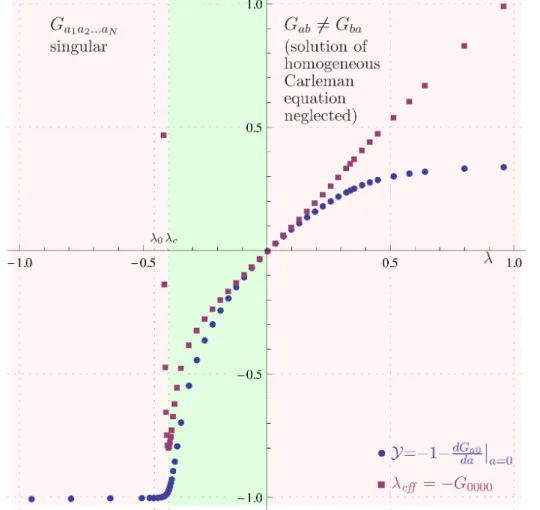
the finite wavefunction renormalisation $(1+\mathcal{Y})$ given by (41). Figure 1 shows both $\mathcal{Y}$ andthe effective coupling constant $\lambda_{eff}$ given by (45)
as
functions of$\lambda$
. We find clear
Figure 1: $\mathcal{Y},$ $\lambda_{eff}$ based
on
$G_{a0}$ for $\Lambda^{2}=10^{7}$ with2000
sample points.evidence for
a
second-order phase transition: $\mathcal{Y}’$ is discontinuous at $\lambda_{c}=-0.396,$and
we
have in reasonable approximationa
critical behaviourfor
some
$A,$ $\alpha>0$. To beprecise, we find $1+\mathcal{Y}=0$ only at $\lambda_{0}=-0.455$, but thisseems
to be due to the discretisation. Of course, there cannot be a discontinuityin $\mathcal{Y}’$ for finite $\Lambda$
, but Figure 1 is strong support for
a
critical behaviour (52) inthe limit $\Lambda^{2}arrow\infty$.
It is
worthwhile
to mention that nothing particular happensat the expected pole $\lambda_{b}=-\frac{1}{72}=0.014$ of Borel resummation!
Since
$1+\mathcal{Y}=0$(withinnumerical
error
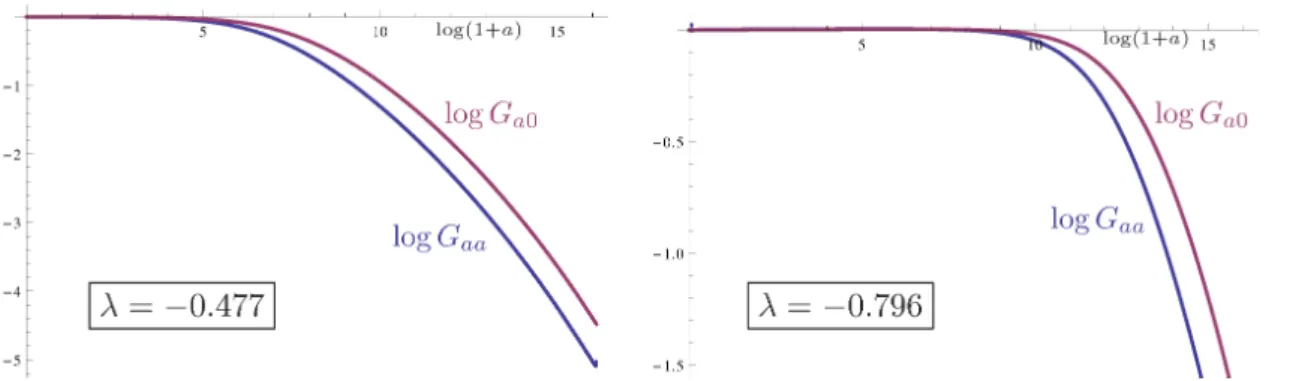
bounds) inthe phase $\lambda<\lambda_{c}$, wesee
from (44) that higher $N$-point functions will not exist for $\lambda<\lambda_{c}$. Most surprisingly,as
we discuss atthe end of section 4.2, a key property of the Schwinger 2-point function $S_{c}(x, y)$
in position space is precisely realised in $[\lambda_{c}, 0]$, not outside. To be
more
precise, Figure 2 suggests $G_{ab}=0$ for $0\leq a,$$b\leq\Lambda_{0}^{2}$, where $\Lambda_{0}^{2}$ increases with $\lambda_{c}-\lambda>0.$Figure 2: Plots of $\log G_{a0}$ and $\log G_{aa}$
over
$\log(1+a)$ for $\lambda<\lambda_{c}.$This could leave the possibility of meaningful higher functions (44) for matrix indices $0\leq a_{i}\leq\Lambda_{0}^{2}$, but not for larger indices. Such a picture could have the
interpretation of a maximal momentum cut-offof the Euclidean particles.
4
Schwinger
functions
and reflection positivity
In the previous section
we
have constructed the connected matrix correlationfunctions $G_{|\underline{q}_{1}^{1}\ldots\underline{q}_{N_{1}}^{1}|\ldots|\underline{q}_{1}^{B}\ldots\underline{q}_{N_{B}}^{B}|}$ of the $(\thetaarrow\infty)$-limit of
$\phi_{4}^{4}$-theory
on
Moyal space.These
functions
arise from the topological expansion (6) ofthe free energy$\log\frac{\mathcal{Z}[J]}{\mathcal{Z}[0]}=\sum_{B=11\leq N_{1}}^{\infty}\sum_{\leq\cdots\leq N}^{\infty}\frac{(V\mu^{4})^{2-B}}{BS_{N_{1}\ldots N_{B}}}\sum_{\underline{q}_{i}^{\beta}\in \mathbb{N}^{2}}G_{|\underline{q}_{1}^{1}\ldots\underline{q}_{N_{1}}^{1}|\ldots|\underline{q}_{1}^{B}\ldots\underline{q}_{N_{B}}^{B}|}\prod_{\beta=1}^{B}\frac{1}{N_{\beta}}(\frac{J_{\underline{q}_{1}^{\beta}\underline{q}_{2}^{\beta}}}{\mu^{3}}\cdots\frac{J_{\underline{q}_{N_{\beta}}^{\beta}\underline{q}_{1}^{\beta}}}{\mu^{3}})$.
(53)
Since
$\lim_{V\mu^{4}arrow\infty}G_{|\underline{q}_{1}^{1}\ldots\underline{q}_{N_{1}}^{1}|\ldots|\underline{q}_{1}^{B}\ldots\underline{q}_{N_{B}}^{B}|}$ is finite, the limit $\lim_{Varrow\infty}\frac{1}{V\mu^{4}}\log_{\mathcal{Z}[0]}^{ZJ}\perp$ of thenaturally expected free energy density
![Figure 3: Widder’s criteria $L_{k,a}$ [G..] $:= \frac{(-a)^{k-1}}{k!(k-2)!}\frac{d^{2k-1}}{da^{2k-1}}(a^{k}G_{aa})\geq 0$ for $\lambda\approx\lambda_{c}.$](https://thumb-ap.123doks.com/thumbv2/123deta/5959278.1056262/31.892.100.743.569.975/figure-widder-criteria-frac-frac-lambda-approx-lambda.webp)
![Figure 4: $\tilde{\rho}_{k}(m^{2})=\int_{0}^{m^{2}}dtL_{k,t}[G_{0}]$ as approximation for the mass density of](https://thumb-ap.123doks.com/thumbv2/123deta/5959278.1056262/32.892.138.772.281.741/figure-tilde-rho-int-dtl-approximation-mass-density.webp)
