On the Phase
Transition
Phenomenon
of Graph
Laplacian Eigenfunctions
on
Trees
Naoki
Saito
and Emest
Woei
Department of Mathematics
University of Califomia
Davis,
CA
95616
USA
Email: saitoGmath.
ucdavis.
edu;woei Gmath.
ucdavis.
eduAbstract
Wediscussourcurrentunderstandingonthephase transition phenomenonof the
graph Laplacian eigenfunctions constructedon acertaintypeoftrees,whichwe pre-viously observed through our numerical experiments. The eigenvalue distribution for suchatreeisasmoothbell-shaped curvestartingfrom the eigenvalue $0$upto4.
Then, atthe eigenvalue 4,there is a suddenjump. Interestingly, the eigenfunctions
corresponding tothe eigenvalues below 4are semi-global oscillations (likeFourier
modes)overtheentiretree or oneof the branches; on the otherhand, those
corre-spondingtotheeigenvaluesabove 4
are
muchmorelocalizedandconcentmted(likewavelets) aroundjunctions/branching vertices. For a special class of trees called
starliketrees,wecannow explainsuchphasetransitionphenomenon precisely. For
amorecomplicatedclassof treesrepresentingneuronaldendrites, wehavea
conjec-turebasedonthe numerical evidencethatthenumberoftheeigenvalues largerthan 4is bounded from abovebythe number of vellices whose degrees is strictlylarger
than2. We have alsoidentifiedaspecial classof trees thataretheonlyclass oftrees
thatcanhave the exacteigenvalue4.
1
Introduction
More and
more
dataare
collectedina
distributed and irregularmanner
due to the adventof
sensor
technology. Such dataare
notso
organizedas
familiar digital signals andimagessampled
on
regularlattices. Examples include datameasuredon sensor
networks, socialnetworks, webpages, biological networks, and
so on.
Such unorganized datacan
becon-veniently represented
as
a
graph where each vertex representsa
sensor
or
measured databy
a
sensor
and each edge representsa
relationship (e.g.,a
physicalor
wirelessconnec-tivity
or a
certainmeasure
ofaffinity, etc.) between twoverticesconnectedby that edge.Moreover, constmcting
a
graph froma
usual signalor
image and analyzing itcan
alsoleadto
a
very
powerful tool (e.g.,the nonlocalmean
denoisingalgorithm ofBuades, Coll,and Morel [1]$)$
.
Hence, it isvery
important to transfer harmonic and wavelet analysistechniques, which
were
originally developedon
the usual Euclideanspaces
andproven
to graphs and networks. Examples of such effort includes spectral graph wavelet
trans-form of Hammond, Vandergheynst, and Gribonval [8] and the tensor-product Haar-like
basis for digital databases proposed by Coifman, Gavish, and Nadler [3, 5], to
name
justa
few. As sines, cosines, and complex exponentials playa
fundamental role in harmonicanalysis
on
the Euclideanspaces,
thegraph Laplacian eigenfunctions play sucha
roleon
graphs (note that the sines, cosines, and complex exponentials
are
the Laplacianeigen-functions for
an
interval with the Dirichlet, Neumann, andperiodic boundaryconditions,respectively). Hence, it isof crucial importance tounderstand the behavior of the graph
Laplacianeigenfunctions of
a
given graph. Inthis shortnote,we
willdescribeour
efforttounderstand the
surprising
behavior of the graph Laplacianeigenfunctions
on
treesthatwe
discovered previously[9]:some
ofthemare
globaloscillationslikeFourier modes and theothers
are
localizedwiggles likewavelets dependingon
thecorresponding eigenvalues.In
our
previousreport [9],we
proposeda
methodtocharacterize dendritesofneurons,more
specifically retinalganglioncells(RGCs)ofa
mouse,and cluster them intodifferentcell typesusingtheirmorphological features, which
are
derived from the eigenvalues ofthe graph Laplacians when such dendrites
are
representedas
graphs (in fact literallyas
“trees”). For the details
on
the dataacquisition andthe conversionof dendrites tographs,see
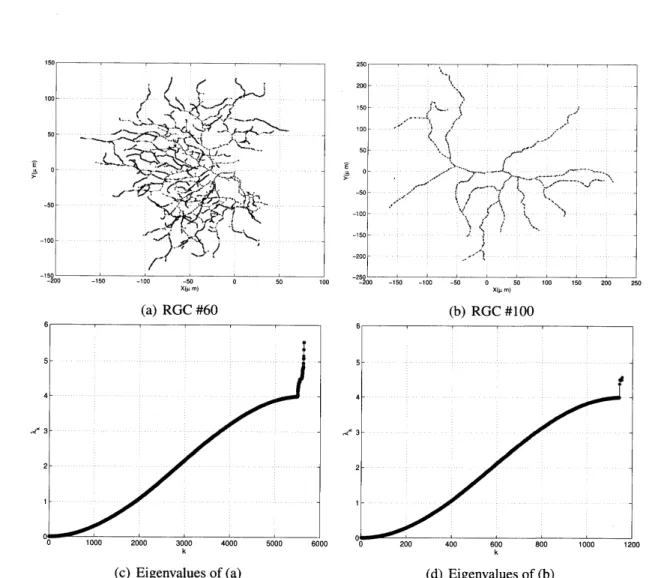
[9] and references therein. While analyzing the eigenvalues and eigenfunctions ofthose graph Laplacians,
we
observeda
very
peculiarphase tmnsition phenomenonas
shown in Figure 1. In otherwords, the eigenvalue distribution for each dendritic tree is
a
smooth bell-shapedcurve
starting from the eigenvalue $0$up
to 4. Then, at theeigen-value 4, there is
a
suddenjump
as
shownin
Figure1
$(c, d)$.
Interestingly, the eigenfunc-tions corresponding tothe eigenvalues below 4are
semi-globaloscillations (likeFouriercosines/sines)
over
theentire dendritesor one
of the dendrite arbors(or branches);on
theotherhand, those correspondingtothe eigenvalues above 4
are
muchmore
localized
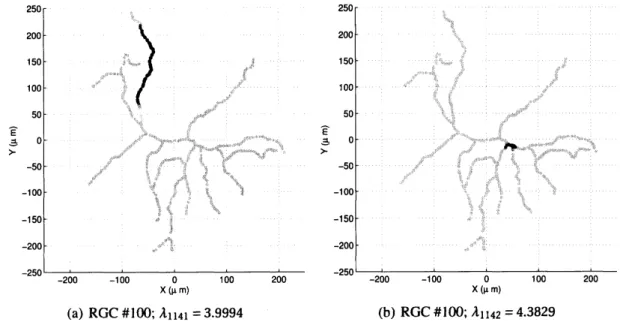
andconcentmted(like wavelets) aroundjunctions/branching vertices,
as
shownin Figure2.We want to
answer
the followingquestions:Ql Why does such
a
phasetransition
phenomenonoccur?Q2 What isthesignificance of the eigenvalue 4?
Q3 Is there
any
treethatpossesses
theexacteigenvalue 4?At this
point
of time,we
havea
completeanswer
to Q3, which will be describedin
Section 5. As forQl andQ2,
we
havea
completeanswer
fora
specificandsimple class oftreescalled starliketreesasdescribed in Section3,and apartial
answer
formore
generaltrees such
as
those representingneuronal dendrites, whichwe
will discuss in Sections 4and6.
2
Definitions and Notation
Let $G$ be
a
graph representing dendrites ofan
RGC, and let $V(G)=\{\nu_{1}, \nu_{2},\ldots, \nu_{n}\}$ bea
setofvertices in $G$where each $\nu_{k}\in \mathbb{R}^{3}$represents
a
sampled point(in the $3D$ coordinatesystem) along dendritic arbors of this RGC. Let $E(G)=\{e_{1},e_{2},\ldots,e_{m}\}$ be
a
set of edgeswhere $e_{k}$connectstwo
vertices
$\nu_{i},$$\nu_{j}$ forsome
$1\leq i,j\leq n$,andwe
write$e_{k}=(v_{i}, \nu_{j})$.
Let$-200$ $-150$ - $t$00 $X(\mu m)-50$ $0$ (a) RGC#60 50 $t00$ $0$ 1000 2000 3000 4000 5000 6000 $0$ 200 400 600 800 1000 1200 $k$ $k$
(c) Eigenvalues of(a) (d) Eigenvalues of(b)
Figure 1: Typical dendrites of Retinal Ganglion Cells (RGC) of
a
mouse
and the graphLaplacian eigenvalue distributions. (a) $2D$ projection ofdendrites of RGC of
a
mouse;(b) that of another RGC revealing different morphology; (c) the eigenvalue distribution
ofRGC shown in (a); (d) that of RGC shown in (b). Regardless of their morphological
X$(\mu m)$
(a) RGC #100;$\lambda_{1141}=3.9994$
$X(\mu m)$
(b) RGC #100;$\lambda_{1142}=4.3829$
Figure
2:
Thegraph Laplacian eigenfunctions of RGC#100.
(a)Theone
correspondingto the eigenvalue $\lambda_{1141}=3.9994$, immediately below the value4; (b) theone
correspondingtothe eigenvalue$\lambda_{1142}=4.3829$, immediately abovethevalue 4.
can
be convertedtoa
tree rather thana
general graph since it is connected and containsno
cycles;see
[9] forthedetails. We alsonote thatwe
only deal with unweighted graphsin this
paper.
In other words,we
essentially examine the connectivities, topology, andcomplexity ofthe dendritic trees, which
may
not reflect the physical lengths andwidthsof the dendritic arbors;
we
are
currently investigatingweightedgraphs where the weightsare
related to the physical distances between vertices, and hope thatwe
can
reportour
findingsat
a
later date. Let $L(G);=D(G)-A(G)$ be the (combinatorial)Laplacian matrixwhere$D(G);=$diag$(d_{\nu_{1}},\ldots,d_{\nu_{n}})$iscalled the degreematrix of$G$, i.e.,the diagonalmatrix
ofvertex degrees, and $A(G)=(a_{ij})$ is the adjacency matrix of $G$, i.e., $a_{ij}=1$ if $\nu_{i}$ and $\nu_{j}$
are
adjacent; otherwise it is$0$
.
Furthermore, let $0=\lambda_{0}(G)\leq\lambda_{1}(G)\leq\cdots\leq\lambda_{n-1}(G)$bethe sorted eigenvalues of$L(G)$
.
Let $m_{G}(\lambda)$ be themultiplicity of the eigenvalue $\lambda$.
Moregenerally, if$I\subset \mathbb{R}$ is
an
interval of the realline, thenwe
define $m_{G}(I);=\#\{\lambda_{k}(G)\in I\}$.
At this
point
we
would like to givea
simple yetimportant
example ofa
tree andits
graph Laplacian:
a
path graph consisting of $n$vertices
shown in Figure3.
The graphLaplacian of such
a
pathgraphcan
beeasily obtained andis instructive.$L(G)$ $=$ $D(G)-A(G)$
$\{\begin{array}{llllll}l -l -l 2 -l -l 2 -l \ddots \ddots \ddots -l 2 -l -l l\end{array}\}$ $=$ $\ovalbox{\tt\small REJECT}^{1}$
2
2
...
2
$1\ovalbox{\tt\small REJECT}-\ovalbox{\tt\small REJECT}^{0}1$
$011$
$01$
. $11$
.
$01^{\cdot}$ $01\ovalbox{\tt\small REJECT}$
.
The
eigenvectorsl
of this matrixare
nothing but the $DCT$TypeIIbasis vectors used fortheJPEG image compression standard;
see e.g.,
[10]. In fact,we
have$\lambda_{k}=2-2\cos(\pi k/n)=4\sin^{2}(\pi k/2n),$ $k=0,1,\ldots,$$n-1$;
$( \rho_{k}=(\cos(\pi k(j+\frac{1}{2})/n))_{0\leq j<n}^{T},$ $k=0,1,\ldots,$$n-1$.
Note that for
any
finite $n\in \mathbb{N},$ $\lambda_{\max}=\lambda_{n-1}<4\neq$, andno
localization/concentrationoccurs
in the eigenvector $\phi_{n-1}$, which is simply
a
global oscillation with the highest possible(i.e.,the Nyquist)frequency, i.e., $\phi_{n-1}=((-1)^{j}\sin(\pi(j+\frac{1}{2})/n))_{0\leq j<n}^{T}$
.
3
Analysis of
Starlike Trees
As
one can
imagine, analyzing this phase transition phenomenon for complicatedden-dritic treestums outtoberather difficult. Hence,
we
startour
analysison a
simpler classoftreescalled starliketrees. A starliketree is
a
treethat has exactlyone
vertex of degreegreater than 2. Examples
are
shown in Figure 4. Weuse
the following notation. Let(a) $S(2,2,1,1,1,1)$ (b) $S(n_{1},1,1,1,1,1,1,1)$ a.k.a.comet
Figure4: Typical examples of
a
starlike tree.$S(n_{1}, n_{2},\ldots, n_{k})$ be
a
starliketreethat has $k(\geq 3)$paths (i.e., branches)emanatingfrom thecentral vertex $\nu_{1}$
.
Let the $i$thbranch have $n_{i}$ verticesexcluding $\nu_{1}$.
Let $n_{1}\geq n_{2}\geq\cdots\geq n_{k}$.
Hence,the total number ofvertices is $n=1+ \sum_{i=1}^{k}n_{i}$
.
Soon after
we
proved in2010
the largest eigenvalue fora
comet (a special class ofstarlike trees
as
shown in Figure 4 $(b))$ is always larger than 4,we
noticed the followingmore
general results forany
starlike treeobtainedby Das in2007
[4]:$\lambda_{\max}=\lambda_{n-1}<k+1+\frac{1}{k-1}$; (1)
$2+2 \cos(\frac{2\pi}{2n_{k}+1})\leq\lambda_{n-2}\leq 2+2\cos(\frac{2\pi}{2n_{1}+1})$
.
(2)On the otherhand, Grone and
Merris
[6] proved the followinglowerbound fora
generalgraph $G$withatleast
one
edge:$\lambda_{\max}\geq\max_{1\leq j\leq n}d(\nu_{j})+1$
.
(3)Hence
we
have the followingCorollary
3.1.
A starlike tree has exactlyone
gmph Laplacian eigenvalue greaterthanorequalto 4. The equality holds$\iota f$and only
if
the starliketree is$K_{1},3=S(1,1,1)$, which isalso knownas$a$claw.
Pmof.
Thefirst statementiseasy
to show. The lowerbound in(3) is larger thanor
equalto4for
any
starliketreesince$\max_{1\leq j\leq nj}d(\iota/)=d(\nu_{1})\geq 3$.
On the otherhand,the secondlargest eigenvalue $\lambda_{n-2}$ clearly cannot exceed 4 due to (2). The second statement about
the
necessary
and sufficient conditionon
the equality requiresthe argument in Section5, in particular,Corollary5.2.
Fromthis,we
can
easilysee
that the only starliketreehaving theexacteigenvalue4is$K_{1}$,3.$\square$
As for the concentration/localization ofthe eigenfunction $\phi_{n-1}$ correspondingto the
largest eigenvalue $\lambda_{n-1}$,
very
recentlywe
haveprovedthe followingTheorem
3.2.
Let $\phi_{n-1}=$ $(\phi_{1,n-1}, \cdots ,\psi_{n,n-1})^{T}$, where $\phi_{j,n-1}$ is the valueof
theeigen-function
corresponding to the largesteigenvalue $\lambda_{n-1}$at thevertex $\nu_{j},$ $j=1,\ldots,$$n$.
Then,the absolute value
of
this eigenfunction at the centml vertex $\nu_{1}$ cannot be exceededbythoseatthe othervertices, i.e.,
$|\phi_{1,n-1}|>|\phi_{j,n-1}|$, $j=2,\ldots,$$n$
.
Thedetails oftheproof will
appear
elsewhere. We note that Dasprovedthis theoremfor
a
homogeneous starlike tree, $S(m, m,\cdots , m)$ in [4], andour
theorem isfora
generalstarliketree.
Remark
3.3.
Let $\phi=(\phi_{1},\phi_{2},\ldots,\phi_{n})^{T}$bean
eigenvector ofa
starlike tree $S(n_{1},\ldots, n_{k})$corresponding to the eigenvalue $\lambda$
.
Let$\nu_{2},\ldots,$ $\nu_{n_{1}+1}$ be the $n_{1}$ vertices along
a
branchemanating from the central vertex $\nu_{1}$ with $\nu_{n_{1}+1}$ being the leaf vertex. Then, along this
branch,theeigenvectorcomponents satisfy the followingequations:
$\lambda\phi_{n_{1+1}}$ $=$ $\phi_{n_{1}+1}-\phi_{n_{1}}$ (4)
From Eq. (5),
we
have the followingrecursion relation:$\psi_{j+1}+(\lambda-2)\phi_{j}+\phi_{j-1}=0$, $j=2,\ldots,$$n_{1}$
.
(6)This recursion
can
be explicitly solvedusingthe rootsof thecharacteristic equation$r^{2}+(\lambda-2)r+1=0$, (7)
andthegeneral solution
can
bewritten
as
$\phi_{j}=Ar_{1}^{i-2}+Br_{2}^{i-2}$, $j=2,\ldots,$$n_{1}+1$, (8)
where $r_{1},$$r_{2}$
are
the roots of (7), and $A,B$are
appropriate constants derived from theboundary condition (4). Now, let
us
consider these roots of (7) in details. Thedeter-minantof(7)is
$\prime D(\lambda);=(\lambda-2)^{2}-4=\lambda(\lambda-4)$
.
(9)Since
we
know that $\lambda\geq 0$, this determinant changes itssign dependingon
$\lambda<4$or
$\lambda>4$.(Note that $\lambda=4$
occurs
only for the claw $K_{1,3}$on
whichwe
explicitly know everything;hence
we
will notdiscuss thiscase
further in this remark.) If$\lambda<4$, then $\prime D(\lambda)<0$ anditis
easy
toshowthat therootsare
complex valued with magnitude 1. This implies that (6)becomes
$\phi_{j}=A’\cos(\omega(j-2))+B’\sin(\omega(j-2))$, $j=2,\ldots,$$n_{1}+1$, (10)
where$\omega$ satisfies$\tan\omega=\sqrt{\lambda(4-\lambda)}/(2-\lambda)$, and$A’,B’$
are
appropriateconstants. In otherwords, if$\lambda<4$, the eigenfunction along this branchis of oscillatorynature. On the other
hand, if $\lambda>4$, then $D(\lambda)>0$ and it is easy to show that both $r_{1}$ and $r_{2}$
are
real valuedthat the dominating partis theterm $Br_{2}^{i-2}$ in (8). The siuation is the
same
for the otherbranches. This observation has lead
us
to the proof of Theorem 3.2, whichwe
defertoour
forthcomingpaper.
Insummary,
fora
starlike tree, thephase transitionphenomenonwith the eigenvalue4 is hence essentially explained andwellunderstood.
4
Our Conjecture
Unfortunately, actual dendritic trees
are
not exactly starlike. However,our
numericalcomputations anddata analysis indicate that:
$0 \leq\frac{\#\{j\in(1,n)|d(\nu)>2\}-m_{G}([4,\infty))}{n}\leq 0.047$ (11)
foreach RGC
we
examined. Hence,we can
define starlikeliness $S\ell(T)$ ofa
giventree $T$as
$S \ell(T):=1-\frac{\#\{j\in(1,n)|d(\iota_{j\neq}/)>2\}-m_{T}([4,\infty))}{n}$ (12)
We note that $SP(T)\equiv 1$ for
a
certain class of RGCs whose dendritesare
widely andsparsely spread (see [9] forthe characterization). This
means
that dendrites inthat classare
all close toa
starlike treeor a
concatenation of several starlike trees. We showsome
examples of
dendritic
trees with $Sl(T)\equiv 1$ andthose with $Sl(T)_{\neq}<1$ in Figures 5, 6, and7.
Cell$\#$$99$ Cell$\#$$100$ $-50$ $0$ 50 Cell$\# 101$ $-100$ $-50$ $0$ 50 100 150 Cell$\# 196$ $-200$ -loo 0100 200 Cell$\# 210$ $-50$ $0$ 50 $-100$ $0$ 100 Cell$\# 102$ $-150$ $-100$ $-50$ $0$ 50 Cell$\# 201$ $-200$ $0$ 200 $400$ Cell$\# 174$ $-200$ $0$ 200
$-40$ $-20$ $0$ 20 40 Cell$\# 166$ $-40$ $-20$ $0$ 20 40 60 Cell$\# 238$ $-40$ $-20$ $0$ 20 40 Cell$\# 215$ $-60$ $-40$ $-20$ $0$ 20 40 $-40$ $-20$ $0$ 20 Cell$\# 80$ $-50$ $0$ 50 Cell$\# 169$ $-60$ $-40$ $-20$ $0$ 20 Cell$\# 55$ $-100$ $-50$ $0$ 50 100
X$(\mu m)$
(a) RGC #100;$S\ell(T)\equiv 1$
$X(\mu m)$
(b) RGC #155;$Sl(T)=0.953\lessgtr 1$
Figure7: Zoomed-upversionsof
some
dendritic trees.Conjecture
4.1.
Forany
tree $T$offinite
volume,we
have$0\leq m_{T}([4,\infty))\leq\#\{j\in(1, n)|d(\nu_{l^{)}\neq}>2\}$
and each eigenfunction correspondingto$\lambda\geq 4$hasits largestcomponent(in theabsolute
value)
on
the vertices whose degreeare
largerthan2.5
A Class of Trees Having the Eigenvalue
4
As raised in Introduction,
we are
interested in answering Q3: Is thereany
treethatpos-sesses
theexact eigenvalue 4? Toanswer
this question,we
have recently found that thefollowing resultsofGuo [7] (written in
our own
notation):Theorem
5.1
(Guo 2006). Let $T$ bea
tree with $n$ vertices. Then,$\lambda_{j}(T)\leq\lceil\frac{n}{n-j}\rceil$, $j=0,\ldots,$$n-1$,
and theequalityholds
iff
$a$) $j\neq 0;b)n-j$ divides $n$; andc) $T$ is spanned by $n-j$ vertexdisjointcopies
of
$K_{1.\frac{j}{n-i}}$.This impliesthefollowing
Corollary
5.2.
Atreethat hasan
eigenvalue exactlyequalto 4necessarilyconsistsof
$m$copies
of
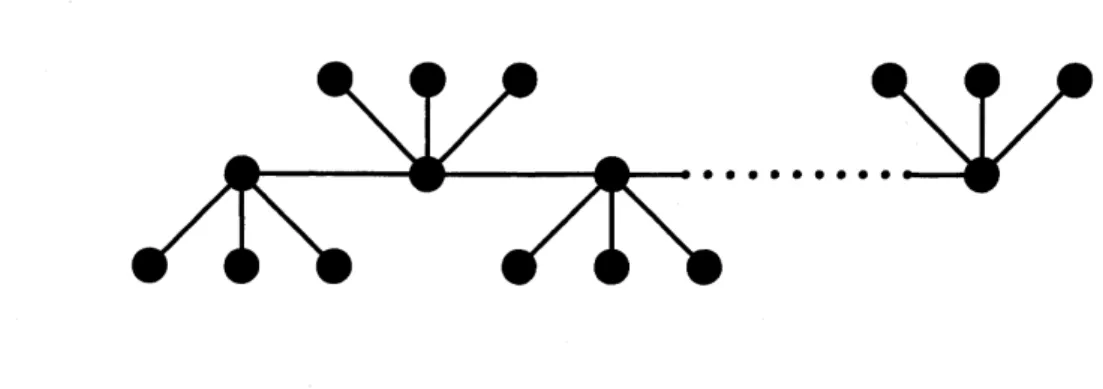
$K_{1},3\equiv S(1,1,1)$ connectedvia theircentmlverticesas
shown in Figure8 where$m\in \mathbb{N}$
.
Pmof.
Set $n=4m$ in Guo’s theorem. Then, there isan
eigenvalue exactly equal to 4 at$j=3m$ , i.e., $\lambda_{3m}=4$, and this tree necessarily consists of $m$ copies of $K_{1}$
,3 connected
via their central vertices, which is guaranteed because of the
necessary
and sufficientFigure 8: Atreeconsistingof multiplecopiesof$K_{1,3}$ connectedviatheir central vertices.
Thistree has theexacteigenvalue4with multiplicity 1.
Figure
9
showstheeigenvalue distributionofa
treeconsisting of$m=5$copies
of$K_{1}$,3.Regardless of $m$, the number of
copies
of$K_{1,3}$, the eigenfunction corresponding to theeigenvalue 4 has onlytwovalues:
one
constantvalue atthe central vertices, and the otherconstantvalueof theopposite signatthe leaves whereas that correspondingtothe largest
eigenvalue is againconcentrated around the central vertex,
as
shownin Figure 10.6 Discussion
In this
paper, we
obtained precise understanding ofthe phase transition phenomenon ofthe graph Laplacian eigenvalues and eigenfunctions for starlike trees. For
a more
com-plicated class oftrees representingdendrites ofRGCs,
we
obtaineda
conjecturebasedon
the numerical evidence that the number of the eigenvalues larger than 4 is bounded from
above bythe number ofvertices whosedegrees is strictlylarger than 2. We also identified
a
special class of trees consisting ofcopies of the claw $K_{1}$,3, which is the only class oftreesthat
can
have theexacteigenvalue 4.Ournextstep toward understanding the phasetransitionphenomenon for real dendritic
trees is to analyze
a
slightlymore
complicated class of trees, i.e., trees generated byconcatenating several starlike trees. Since
we now
know the eigenvalue/eigenfunctionbehavior of starliketreesprecisely,
we
expectthatwe
can
also shedlighton
that class oftrees. Weplantoproceed such analysis bystarting withtwo concatenated starliketrees.
Another quite interesting question is the following. Can
a
simple (i.e.,no
multipleedges and
no
self-loops) and connected graph–not necessarilya
tree–have the exacteigenvalue 4? The
answer
isclear “Yes.” For example,a
regular finite lattice graph in$\mathbb{R}^{d}$,
$d>1$ has repeated eigenvalue 4. Moreprecisely, each eigenvalue and the corresponding
eigenfunction of
a
graphrepresentingthe regularfinite lattice ofsize $n\cross n\cross\cdots\cross n=n^{d}$can
bewrittenas
$\lambda_{j_{1\cdots\prime}j_{d}}$ $=$
$\phi_{j_{1},\ldots,j_{d}}(x_{1},\ldots,x_{d})$ $=$
4$\sum_{i=1}^{d}\sin^{2}(\frac{j_{i}\pi}{2n}1$ (13)
Figure9: The eigenvaluedistributionof
a
treeconsisting of 5 copiesof$K_{1.3}$.
Wenote that(a) $\psi_{15}$
(b) $\psi_{19}$
Figure 10: (a)The eigenfunction $\phi_{15}$ correspondingto $\lambda_{15}=4$of the tree 5$K_{1,3}$ inthe$3D$
perspective view. (b) Theeigenfunction $\phi_{19}$ corresponding to the maximumeigenvalue
where $j_{i},x_{i}\in Z/nZ$for each $i$,
as
shown by Burden and Hedstrom [2]. Hence,determin-ing $m_{G}(4)$, i.e., the multiplicity of the eigenvalue 4 of this lattice graph, isequivalent to
finding theinteger solution $(j_{1},\ldots,j_{d})\in(Z/nZ)^{d}$ tothe followingequation:
$\sum_{i=1}^{d}\sin^{2}(\frac{j_{i}\pi}{2n})=1$
.
(15)For$d=2$, it is
easy
toshow that $m_{G}(4)=n-1$ by direct examination of(15) with $d=2$.
For $d=3,$ $m_{G}(4)$ behaves in
a
muchmore
complicatedmanner, which is deeply relatedto number theory. We expect that
more
complicated situationsoccur
for $d>3$.
Weare
currently investigatingthis interesting problem
on
regular finite lattices with YujiNakat-sukasa ofUC Davis, and
we
plan toreportour
findings ata
laterdate. Onthe otherhand,it is clearfrom (14)that the eigenfunctions correspondingto the eigenvalues greater than
or
equalto 4on
such lattice graphs cannotbe localizedor
concentratedon
thosevertices
whosedegree is larger than 2 unlike thetree
case.
References
[1] A. BUADES, B. COLL, AND J. M. MOREL,Image denoisingmethods.A
new
non-local principle, SIAMReview, 52 (2010),
pp. 113-147.
[2] R. L. BURDEN AND G. W. HEDSTROM, The distribution
of
the eigenvaluesof
thediscrete Laplacian, BIT, 12(1972),
pp.
475-A88.[3] R. R. COIFMAN AND M. GAVISH, Harmonic analysis
of
digital data bases, inWavelets andMultiscale Analysis: Theory and Applications,J. Cohenand A. Zayed,
eds., Applied and Numerical HarmonicAnalysis, Boston, MA, 2011, Birkhauser.
[4] K.C.DAS,Some spectml pmperties
of
the Laplacian matrixof
starliketrees,ItalianJ. PureAppl. Math.,
21
(2007),pp.
197-210.
[5] M. GAVISH, B. NADLER, AND R. R. COIFMAN, Multiscale wavelets
on
trees,graphs and high dimensional data: theory and applications to semi
super-vised leaming, in Proc. 27th Intem. Conf. Machine Leaming, J. F\"urnkranz and
T.Joachims, eds., Haifa, Israel, 2010,Omnipress,
pp. 367-374.
[6] R. GRONE AND R. MERRIS, The Laplacian spectrum
of
a
graphII, SIAMJ.Dis-creteMath.,7 (1994),pp. 221-229.
[7] J.-M. GUO, The kth Laplacian eigenvalue
of
a
tree, J. Graph Theor., 54 (2006),pp.
51-57.[8] D. K. HAMMOND, P. VANDERGHEYNST, AND R. GRIBONVAL, Wavelets on
graphs via spectml gmph theory, Applied and Computational Harmonic Analysis,
(2011). To
appear;
available onlineas an
in-press itematwww.sciencedirect.com.[9] N. SAITO AND E. WOEI,Analysis