Russian
Options with Finite
Time
Horizon:
A Laplace Transform
Approach*
北海道大学・経済学研究科 木村俊一 (Toshikazu Kimura)
Graduate School of Economics and Business Administration
Hokkaido University
1
Introduction
Russian options
are
path-dependent contingent claims that give the holder the right to receivethe realized supremumvalue of the underlying asset prior to his exercise time. The holder
can
exercise the option atany tinle, $i.e.$, the option is of American-style. Shepp and Shiryaev $[12, 13]$
introduced the Russian option, $ab^{\neg}suming$ no maturity date for the exercise; see Duffie and
Harrison [3] for afinancialjustification of their result8. Shepp and Shiryaev showed that there
exists
an
optimal threshold level of theasset price below which it isadvantageous toexercise theoption, provided that the asset pays dividends. This type of Russian options
can
be regardedas
aspecialcase
ofAmerican
lookbackoptions. More specifically, it is the perpetual fixed-strikelookback call option wlth null strike price(Pedersen [10]). In
common
with lookback options,Russian options are not genuine option contracts, because they pay the holder the supremum
Isset price, always finishing in-the-money. This
means
that high premiumsare
charged forRussian optiollS in compensation $fo\iota\cdot$ “reduced
$1^{\cdot}Cgl\cdot et’[12]$
.
This paper deals with Russian options $wit1_{1}fir\iota iteti_{7}nehor^{v}izon,$ $i.c.$, there is afinite $expi_{1}\cdot y$
or maturity date for the exercise. Thc holder lnay $exelcis^{1}e$ the option at any time but durillg
the option’slifetinle. Recently,
some
$\iota\cdot esearchelS$ have $contrib_{l1}ted$ theoretical results to thevaluation of finite-lived Russian options. $Ekst_{1}\cdot\ddot{o}m[5]$ showed $t1_{1}e$ existence and continuity of
an optimal stopping or early $exe7cise$ boundaly for the Russian option. Also, Ekstr\"om proved
that the option value is given by the solution ofacertain boundary value problem, from which
he analyzed asymptotic behavior of the optimal stopping boundary
near
expiration. This freeboundary $p_{1}\cdot oblem$
was
$furt1_{1}er$ studied by Duistermaat et al. [4] who suggested anumericalalgorithm for valuing the Russian option;see Kyprianou and Pistorius [9] for related thmretical
wolk. Peskir [11] provedthat the $opti_{1}\cdot na1$stoppingboundary
can
becharacterized by the solutionof anonlinear integral equation arising $fi\cdot om$ the early $exel\cdot cise$ prelnium representation.
Except for Duisterm’aat et al. [4], there is no quantitative researdl of the finite-lived Russian
option, whichis$\iota$)$rinci_{I)}ally$due to thelackof efficienttools$fo1^{\cdot}$solving the$hee$boundary probleIn.
Duistermaat et al. [4] have used the Imethod of randomization of Carr [2] $w\mathfrak{l}_{1}o$ proposed that the
value ofan American vanilla option can be approximated by arandomization of the maturity
date using
an
$n$-stage$E_{1}\cdot 1angian$distribution. As$narrow\infty$, it ispossibletoshowconvergenceto thevalue of theAnlericanoption. Thisidea has its origin in the classictheory of integraltransforms,
and it goes by the
name
of the Post-Widder inversion formula [15];see
Abate and Whitt [1,Section
8]for
all algorithm basedon
theFourier$se_{\wedge}\cdot ies$.
Duistermaat
et al. developed alecursive$alg_{o1^{\backslash }}ithm$ for computing the n-th approximations ofthe val
$ne$ and the early exercise boundary
of the finlte-lived Russian option. The complexity of$thci\iota\cdot algo\iota\cdot ith_{l}ncome_{\backslash };$ flom the $\exp_{1}\cdot ession$
of the $n$-stage Erlangial) $dist_{1}\cdot ibution$, and it is $dil\cdot ectlyCOl$)$CC\Gamma lucd$ with the implementation and
speed of the algorithm. The $p_{\mathfrak{U}1}\cdot po_{\backslash }\backslash e$ of $this^{\neg}$ paper is to $p_{1}\cdot ovide$ another quantitative method
for colnputing both $t1_{1}e$ option value and the early exelcise boundary.
’This paper is an abbreviated version of Kimura [8]. All proofs, remarks and .gome computational results
areomitted due tothe page restriction. This research was supported $i_{11}$ part by theGrant-in-Aid for Scientific
2
Basic
Framework
2.1
Optimalstopping
problemThe setup is the standard Black-Scholes-Merton framework where the price of the underlying
asset evolves accordingto ageometric Brownian motion: Let $(S_{t})_{t\geq 0}$ be the price process ofthe
underlying
as
set, which is defined by$S_{t}=s$exp$\{r-\delta_{f}^{1}\sigma^{2})t+\sigma W_{t}\}$ , $t\geq 0$, (2.1)
where$S_{0}=s>0,$$r>0$istherisk-free rateof interest,$\delta\geq 0$ is the continuous dividend rate,$\sigma>$
$0$ is the volatility coefficient of the asset price, and $W\equiv(W_{t})_{t\geq 0}$ is a one-dimensional
standard
Brownian motion process
on
a filtered probabilityspace $(\Omega, \mathcal{F}, (\mathcal{F}_{t})_{t\geq 0}, \mathbb{P})$.
The filtration $F\equiv$$(\mathcal{F}_{t})_{t\geq 0}$ is
a
naturalone
generated by $W$ and the probabilitymeasure
$\mathbb{P}$ is chosenso
that thestock has
mean
rate of return $r$.
For the price process $(S_{t})_{t\geq 0}$ and a constant $m\geq s$, define thesupremum process
as
$M_{t}=m \vee\sup_{0\leq u\leq t}S_{u}$, $t\geq 0$, (2.2)
where $a \vee b=\max\{a, b\}$
.
Given
a
finite time horizon $T>0$, the arbitrage-free value of the Russian option at time$t\in[0,T]$ is given by
$V(s,m, t)=e ss\sup_{0\leq\theta\iota\leq T-t}E_{s,m}[e^{-r\theta}{}^{t}M_{\theta_{t}}]$, (2.3)
where $\theta_{t}$ is a stopping time of the filtration $F$ and the conditional expectation $E_{s,m}[\cdot]\equiv$
$E[\cdot|\mathcal{F}_{0}]=E[\cdot|S_{0}=s, M_{0}=m]$ is calculated under therisk-neutral probability
measure
P. Therandomvariable$\theta t\in[0, T-t]$ iscalled
an
optimal stoppingtime if$V(s, m, t)=E_{s,m}[e^{-r\theta_{t}}M_{\theta_{t}}\cdot]$.
It is clear from $(2.1)-(2.3)$ that $V(s, m, t)\geq rn,$ $V$ is nondecreasing in $s$ and $m$, and $V$ is
non-increasing in $t$. Ekstr\"om [5] proved that the value function
$V\equiv V(s, m, t)$ is continuous, $i.e.,$ $V$
is uniformly continuous in $s,$ $m$ and $t$ separately. Solving the optimal stopping problem (2.3) is
equivalent
to
finding the points $(S_{t}, \Lambda l_{t}, t)$ for which early exercise before maturity is optimal.Let
$\mathcal{D}=\{(s, m, t)\in \mathbb{R}+\cross[s, +\infty)x[0, T]\}$
be the whole domain, and $\mathcal{E}$ and $C$ denote
the exercise region and continuation region,
respec-tively. In terms of the value function$V(s, m, t)$, the continuation region$C$ is defined by
$C=\{(s, m,t);V(s, m, t)>m\}$,
which is an open set since $V$ is continuous. The exercise region $\mathcal{E}$ is the complement of
$C$ in $\mathcal{D}$
and the optimal stopping time $\theta_{t}^{*}$ satisfies
$\theta_{t}^{*}=\inf\{u\in[0,T-t];(S_{u}, M_{u}, t+u)\in \mathcal{E}\}$
.
Since $V$ is nondecreasing in $s,$ $(s, m, t)\in C$ implies $(x, m, t)\in C$ for all $x$ satisfying $s\leq x\leq m$
.
Hence, there exists
a
function $\underline{S}(m, t)$ with $0\leq\underline{S}(m, t)\leq m$ such that$\underline{S}(m,t)=\inf\{s\in[0, m];(s, m, t)\in C\}$, (2.4)
and $(\underline{S}(m, t))_{t\in[0,T]}$ is called the early exercise boundary. The boundary function $\underline{S}(m, t)$ is
nondecreasing in $t$since $V$is nondecreasingin$t$, and it is continuous in $t$ if$\delta>0$;
see
Theorem 2in Ekstr\"om [5]. In terms of the function $\underline{S}(m, t)$, the continuation region $C$
can
be representedas
2.2
Free boundary
problemIt has been known that the optimal stopping problem (2.3) of finding the option value $V$
can
be deduced to
a
parabolic free boundary problem (see Theorem 1 in Ekstr\"om [5]): The value $V$of the Russian option with finite time horizon is given byasolution of the PDE
$\frac{\partial V}{\partial t}+\frac{1}{2}\sigma^{2}s^{2}\frac{\partial^{2}V}{\partial s^{2}}+(r-\delta)s\frac{\partial V}{\partial s}-rV=0$
, $\underline{S}(m.t)<s\leq m$, (2.5)
together withthe boundary conditions
$|m \downarrow s\lim\lim_{s\downarrow\underline{S}}\frac{\partial V}{\frac{\partial V\partial s}{\partial m}}=0\lim V(s,m, t)=ms\downarrow\underline{S}=0’,$
(2.6)
and the terminal condition
$V(s,m, T)=m$
.
(2.7)The boundary conditions in (2.6)
are
respectively called the value matching, smooth pasting andNeumann conditions in order.
Fkom (2.3),
we
see
that thevalue $V$ dependson
timeonly through the time $T-t$ remainingto maturity. For notational
convenience. we
introduce the time-reversed quantities$\tilde{V}(s, m,\tau)=V(s, m, T-\tau)=V(s, m, t)$,
and
$\tilde{\underline{S}}(m,\tau)=\underline{S}(m,T-\tau)=\underline{S}(m, t)$,
with the change of variables $\tau$ $:=T-t$
.
It follows from the definition (2.3) of the value function$V$ that
$\tilde{V}$
($ks$, km,$\tau$) $=k\tilde{V}(s, m,\tau)$, (2.8)
for arbitrary $k\in \mathbb{R}+\cdot$ In particular, if
we
set $k=m^{-1}$,
then$\overline{V}(s, m, \tau)=m\tilde{V}(\frac{s}{m}, 1,\tau)$
,
which permits a reduction in the dimensionality of the problem by a similarity variable. That
is,
we
may finda
solution of the form$\tilde{V}(s, m, \tau)=mW(\xi,\tau)$, (2.9)
with the change of variables $\xi:=s/m$
.
Using the relations
$\frac{\partial V}{\partial s}=\frac{\partial W}{\partial\xi}$, $\frac{\partial^{2}V}{\partial s^{2}}=\frac{1}{m}\frac{\partial^{2}W}{\partial\xi^{2}}$
$\frac{\partial V}{\partial m}=W-\xi\frac{\partial W}{\partial\xi}$, $\frac{\partial V}{\partial t}=-m\frac{\partial W}{\partial\tau}$,
we
can
rewrite the PDE (2.5)as
$- \frac{\partial W}{\partial\tau}+\frac{1}{2}\sigma^{2}\xi^{2}\frac{\partial^{2}W}{\partial\xi^{2}}+(r-\delta)\xi\frac{\partial W}{\partial\xi}-rW=()$ ,
where $\underline{\xi}(\tau)(\in[0,1])$ is defined by
$\xi(\tau)=\frac{1}{m}\tilde{\underline{S}}(m, \tau)$,
being nonincreasing in $\tau$. The boundaryconditions for $W$ are given by
$| \xi\downarrow\underline{\xi}(\tau)^{\frac{\partial W}{\partial\xi}=0}\lim_{\xi\uparrow 1}^{\lim^{\lim}}(W-\frac{\partial W}{\partial\xi’})=0\xi\downarrow\underline{\xi}(\tau)W(\xi,\tau)=1$
,
(2.11)
and the initial condition is
$W(\xi, 0)=1$
.
(2.12)3
Valuation with
Laplace-Carlson
Transforms
For $\lambda>0$, define the Laplace-Carlson transform (LCT) of the time-reversed quantity $W(\xi, \tau)$
as
$W^{*}( \xi, \lambda)=\mathcal{L}C[W(\xi, \tau)](\lambda)\equiv\int_{0}^{\infty}\lambda e^{-\lambda\tau}W(\xi, \tau)d\tau$
.
Similarly, we denote the LCT of $\xi(\tau)$ by attaching the asterisk, $i.e.,$ $\underline{\xi}^{*}(\lambda)=\mathcal{L}C[\xi(\tau)](\lambda)$
.
Nodoubt,
there
isno
essential difference between theLCT
andthe
Laplace transform (LT) definedby
$\overline{W}(\xi, \lambda)=\mathcal{L}[W(\xi, \tau)](\lambda)\equiv\int_{0}^{\infty}e^{-\lambda\tau}W(\xi, \tau)d\tau$
.
Obviously,
we
have $W$“$(\xi, \lambda)=\lambda\overline{W}(\xi, \lambda)$ for $\lambda>0$.
The principalreason
whywe
prefer LCTsto LTs is that LCTs generate relatively simpler formulas than LTs for option pricing problems
because constant values
are
invariant after taking transformation. In the context of optionpricing, LCTs have been adopted in the randomization of Carr [2] as an initial approximation.
Let $\tilde{V}^{*}\equiv\tilde{V}$“$(s, m, \lambda)=\mathcal{L}C[\tilde{V}(s, m, \tau)](\lambda)$
be the LCT of the time-reversed value $\tilde{V}$
.
Hlrom
thePDE (2.10) with the conditions (2.11) and (2.12),
we
obtaina
closed-formsolutionas
follows:Theorem 1 The LCT of the time-reversed value $\tilde{V}(s, m, \tau)$ of the Russian option with finite
time horizon $T<\infty$ is given by
$\tilde{V}^{*}(s, m, \lambda)=\{\begin{array}{ll}\frac{mr}{\alpha_{2}-\alpha_{1}\lambda+r}\{\alpha_{2}(\frac{s}{m\underline{\xi}^{*}})^{\alpha_{1}}-\alpha_{1}(\frac{s}{m\underline{\xi}^{*}})^{\alpha_{2}}\}+\frac{\lambda m}{\lambda+r}, m\underline{\xi}^{*}<s\leq mm, 0<s\leq m\underline{\xi}^{*},\end{array}$
(3.1)
where the parameters $\alpha_{1}>1$ and $\alpha_{2}<0$
are
two real roots of the quadratic equation$5^{\sigma^{2}\alpha^{2}+(r-\delta-\frac{1}{2}\sigma^{2})\alpha-(\lambda+r\cdot)=0}1$ (32)
and the LCT $\xi^{*}\equiv\xi^{*}(\lambda)\leq 1$ is aunique positive solution of the functional equation
Proposition 2 The LCTs of$t1_{1}e$ time-reversed Greeks
$\Delta^{*}=\mathcal{L}C[\frac{\partial\tilde{V}}{\partial s}]$ , $\Gamma^{*}=\mathcal{L}C[\frac{\partial^{2}\tilde{V}}{\partial s^{2}}]$ and $\Theta^{*}=\mathcal{L}C[\frac{\partial\tilde{V}}{\partial\tau}]$
for $s\in(m\xi^{*}, m$] are respectively given by
$\Delta^{*}=\frac{\alpha_{1}\alpha_{2}r}{\alpha_{2}-\alpha_{1}\lambda+r}\frac{m}{s}\{(\frac{s}{m\underline{\xi}^{*}})^{\alpha_{1}}-(\frac{s}{m\underline{\xi}^{*}})^{\alpha_{2}}\}$ ,
$\Gamma^{*}=\frac{\alpha_{1}\alpha_{2}r}{\alpha_{2}-\alpha_{1}\lambda+r}\frac{m}{s^{2}}\{(\alpha_{1}-1)(\frac{s}{m\underline{\xi}^{*}})^{\alpha_{1}}-(\alpha_{2}-1)(\frac{s}{m\underline{\zeta}^{*}})^{\alpha_{2}}\}$,
$\Theta^{*}=\frac{\lambda rm}{\lambda+r}[\frac{1}{\alpha_{2}-\alpha_{1}}\{\alpha_{2}(\frac{s}{m\underline{\xi}^{*}})^{\alpha_{1}}-\alpha_{1}(\frac{s}{m\underline{\xi}^{*}})^{\alpha_{2}}\}-1]$
.
Proposition 3 For the early exerciseboundary$(\underline{S}(m, t))_{t\in[0,T]}$ oftheRussianoption withfinite
time horizon $T<\infty$,
we
have$\lim_{tarrow T}\underline{S}(m, t)=m$
.
(3.4)Applying Abelian theorem
on
the terminal value of LTs to the LCT $\tilde{V}^{*}(s, m, \lambda)$,we
canobtain the well-known result for the perpetual case;
see
Duffie and Harrison [3] and Shepp andShiryaev [12]. There exist several different proofS for valuing the perpetual Russian option [3,
7, 9, 10, 12, 13]. To make this paper self-contained, however, we provide the result and a brief
proof from the view point of the Laplace transform approach.
Proposition 4 Let $V_{\infty}(s, m)$ be the value of the perpetual Russian option. For$\delta>0$
, we
have$V_{\infty}(s, m)=\{\begin{array}{ll}\frac{m}{\alpha_{2}^{o}-\alpha_{1}^{o}}\{\alpha_{2}^{o}(\frac{s}{m\underline{\xi}_{\infty}})^{\alpha_{1}^{O}}-\alpha_{1}^{o}(\frac{s}{m\underline{\xi}_{\infty}}I^{\alpha_{2}^{O}}\}, m\underline{\xi}_{\infty}<s\leq mm, 0<s\leq m\underline{\xi}_{\infty\text{。}},\end{array}$ (3.5)
where $\alpha_{i}^{o}=\lim_{\lambdaarrow 0}\alpha_{i}(\lambda)(i=1,2)$
are
two real roots of the quadratic equation$\frac{1}{2}\sigma^{2}\alpha^{2}+(r-\delta-\frac{1}{2}\sigma^{2})\alpha-r=0$, (3.6)
and
$\underline{\xi}_{\infty}=(\frac{\alpha_{2}^{o}(1-\alpha_{1}^{O})}{\alpha_{1}^{o}(1-\alpha_{2}^{o})})^{\frac{1}{\alpha_{1}-\alpha_{2}}}$
.
(3.7)
It is worthwhile noting here that the expressions for $V_{\infty}(s, m)$ in (3.5) and $\xi$ in (3.7) of
the perpetual Russian option
are
symmetric with respect to the roots $\alpha_{1}^{o}$ and $\alpha_{2^{-}}^{o}.F$ rthermore,motivated by
some
observations in numerical experiments, we obtainan
interesting symmetricPropertyof theoptimalthresholdlevel$\underline{\xi}_{\infty}$. Syobolic computationwith amathematical software
yields
Proposition 5 Denote $\underline{\xi}_{\infty}\equiv\underline{\xi}_{\infty}(r, \delta)$ for $r,$$\delta>0$
.
Then. $\underline{\xi}_{\infty}(r, \delta)$ is the symmetric function of$r$ and $\delta,$ $i.e.$,
4
Computational Results
As shown in the previous section, Laplace transforms are useful to do asymptotic analysis via
Abelian theorems. However, the primary value of the transforms is in time-dependent analysis
of theoriginalfunctions via analytical
or
numerical transform inversion. Inparticular, numericalinversion is most important when a transform cannot be analytically inverted by manipulating
tabled formulas, which is the normal case in option pricing problems. Numerical inversion
is also important when
a
Laplace transform is implicitly defined, $e_{9}.$,as
the solution of acertain functional equation. Actually, this is the
case
of our problem: To invert the LCTs$\tilde{V}^{*}(s, m, \lambda)$ and $\underline{\xi}^{*}(\lambda)$, we first have to solve the functional equation (3.3) for $\xi^{*}(\lambda)$
.
Amongmany numerical methods for Laplace transform inversion, the Gaver-Stehfest method $[6, 14]$
is especially convenlent for such implicitly defined Laplace transforms, since it works with the
transformevaluated only at real arguments.
Consider the LCT $G^{*}(\lambda)=\mathcal{L}C[G(\tau)](\lambda)$ for
a
given function $G(\tau)\in L^{1}(\mathbb{R}_{+})$.
Gaver [6]developed
an
inversion algorithm basedon
the asymptotic result$G( \tau)=\lim_{narrow\infty}G_{n}(\tau)$, $\tau\geq 0$
where $G_{n}(\tau)\equiv G_{n}^{(n)}(\tau)(n\geq 1)$ is defined by using
a
sequence $\{G_{n}^{(m)}(\tau);n, m\geq 1\}$ generatedby the recursion
$\{\begin{array}{ll}G_{0}^{(m)}(\tau)=G^{*}(m\frac{\log 2}{\tau}), n=0G_{n}^{(m)}(\tau)=(1+\frac{m}{n})G_{n-1}^{(m)}(\tau)-\frac{m}{n}G_{n-1}^{(m+1)}(\tau), n\geq 1.\end{array}$ (41)
To accelerate the convergence of $(G_{n}(\tau))_{n\geq 1}$ to $G(\tau)$, Stehfest [14] proposed
an
extrapolationformula
$\overline{G}_{n}(\tau)=\sum_{k=1}^{n}\frac{(-1)^{(n-k)}k^{n}}{k!(r\iota-k)!}G_{k}(\tau)$, (4.2)
which has been known under
an
alias of the n-point Richardson extrapolation scheme in thecontext ofoption pricing. The procedure for generating the n-th approximation $\overline{G}_{n}(\tau)$ is called
the Gaver-Stehfest method;
see
Abate and Whitt [1] for details. To compute the root $\xi^{*}(\lambda)\in$$[0,1]$ ofthefunctional equation (3.3) for
a
given $\lambda>0$,we
simplyuse
theNewton method. Thisis due to the existence and uniqueness of the root in the interval $[0,1]$
.
From
a
financial point of view, the no-dividendcase
$\delta=0$ is the most interesting one forthe Russian option with finite time horizon, because we have to require the condition $\delta>0$
when
we
deal with the perpetual Russian option. Tables 1 and 2 show the normalized optionvalue $\tilde{V}(s, m, \tau)/m$ for
some cases
with and without dividends, respectively. The initial valueof the Newton method is fixed to 1 and the 4-point extrapolation is adopted in
our
inversionalgorithm. We
see
from these tables that the premiums of Russian options with short maturityare
notso
expensive especially for $s_{l,\prime}’m<1$, which implies that the (normalized) guaranteeddiscounted value $e^{-r\tau}$ is dominant in the option value for those
cases.
Forcases
with $\delta=0$and long maturity, the premiums
are
extremely high such that the commercial value of Russianoptions is doubtful. From theseobservations, wemay say that theRussianoption isintrinsically
valuable when the maturity $T$ is relatively short.
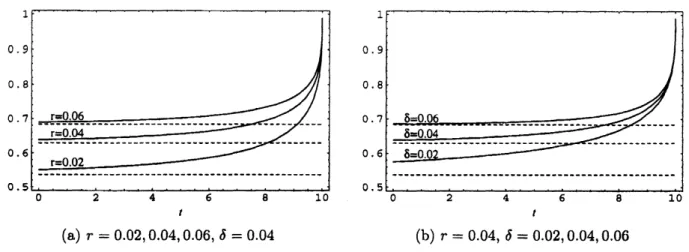
Figures 1(a) and l(b) illustrate
some curves
of thenormalized earlyexercise $boundm\cdot y\xi(t)=$$\underline{S}(m, T-t)/m$ of theRussian option with finite horizon$T=10$
as
functions of$t\in[0,10]$, wheredashed lines represent the optimal threshold levels $\underline{\xi}_{\infty}$ for the
$a_{\wedge}\backslash \backslash sociated$ perpetual
cases.
TheTable 1: Option values $\tilde{V}(s, m, \tau)/m$ with dividends $(r=0.05, \delta=0.03)$ $\ovalbox{\tt\small REJECT} 0.2101.13081.22441260012910\sigma s/.m\tau=1\tau=5\tau.=10\tau.=\infty$
0.9
1.0403 1.1150 11453 11723 0.8 1.0008 1.0378 1.05711.0781
0.3 1.01.2188
1.4228 1.5273 1.6904 0.9 1.1125 12890 13816 15273 0.81.0426
1.1741 1.2517 1.3775 0.4 1.01.3130
1.6535 1.8572 2.3065 0.9 1.1940 14950 16771 20803 $\ovalbox{\tt\small REJECT} 0.81.1014$1.35141.50491.8644Table 2: Option values $\tilde{V}(s, m, \tau)/m$ with no dividends $(r=0.05, \delta=0)$
$\frac{\ovalbox{\tt\small REJECT}\sigma s/.m\tau.=1\tau=5\tau=10\tau=100}{0.210114751.30661.41442.0519}$
0.9 10518 11835 1,2780
18478
0.8 1.0061 1.0800 1.1545 1.64680.3
1.0
12372
1.5256 1.73913.2714
0.9 1.1274 13793 1.5696 29456 0.8 1.0508 1.2472 1.4101 2.62290.4
1.013329
17766
2.1287
5.0986
0.9
12110
16045
1,919945903
0.811138
14446
1.7202
40855
In these figures, we
can see
that eachcurve
ofthe boundaries reaches the value 1 at maturity,which is consistentwithProposition 3. Thealgorithmworks well
even
near
expiration, depictingrapidly increasing
curves
as
$tarrow T$.
Note that Figures l(a) and l(b) providea
numerical checkfor the symmetry relation proved in Proposition 5. All of the figuresindicate ageneral property
that the lower the threshold level $\underline{\xi}_{\infty}$, the slower convergence of$\underline{\xi}(\tau)$
as
$\tauarrow\infty$.5
Conclusion
In thispaper,
we
analyzedtheRussianoption withfinite timehorizonviatheLaplace transformapproachto obtain the LCTs of the option value, the early exercise boundaryand
some
hedgingparameters. all of which can be expressed in terms of the unique real root of a functional
equation.
Our
numerical analysis showed that the accuracyof thisroot playsan
important roleinnumerica.‘ inversionof Laplace transforms with the Gaver-Stehfest methodthat requires
more
than 20-digits precision. Although the Gaver-Stehfest method generates sufficiently accurate
solutions for almost all
cases as
shown in Section 4, the solutions sometimes behave unstably forthe situations where $V(s, m, t)\approx m$, typically occurred when $tarrow T$ or $sarrow\underline{S}(m, t)$
.
Removingthis instability especially around the smooth-pasting point is
an
important problem to be solved$t$ $t$
(a) $r=0.02,0.04,0.06,$ $\delta=0.04$ (b) $r=0.04,$ $\delta=0.02,0.04,0.06$
Figure 1: Early exercise boundaries $\underline{S}(m, T-t)/m(T=10, \sigma=0.2)$
The Laplace transform approach is
so
general that it could be applied to otherAmerican-stylepath-dependentoptions whose payofffunctions
are
sufficientlysmooth with respect to statevariables, $e.g.$, lookback, barrier, exchange and
so on.
Also, the approach could be extended tothe
cases
that the underlying asset price has jumps and that it is discretely monitored. Theseextensions still remain
as
future work.References
[1] Abate, J. andW. Whitt, “The Fourier-series method for invertingtransforms ofprobability
distri-butions,” Queueing Systems, 10 (1992) 5-88.
[2] Carr, P., “Randomizationand the American put,“ $Re\uparrow yieu$’
of
Financial Studies, 11 (1998) 597-626.[3] Duffie, J.D. and J.M. Harrison, ‘Arbitrage pricing ofRussian options and perpetual lookback
op-tions,” Annals
of
Applied Probability, 3 (1993) $641-()51$.
[4] Duistermaat, J.J., A.E. Kyprianou and K. van Schaik, “Finite expiry Russian options,” Working
Paper, Utrecht University, 2003.
[5] Ekstr\"om, E., “Russianoptionswithafinite time horizon,” Joumal
of
Applied Probability,41 (2004)313-326.
[6] Gaver, D.P., “Observing stochastic processes and approximate transform inversion,” Operations
Research, 14 (1966) 444-459.
[7] Graversen, S.E. and G. Pe\v{s}kir, “On the Russian option: The expected waiting time,” Theory
of
Probability and theirApplications, 42 (1998) 416-425.
[8] Kimura, T., “Valuing Russian options withfinite time horizon viaLaplace transforms,” Discussion
PaperSeries$A$, No. 2006-171, Graduate School ofEconomicsand BusinessAdministration,Hokkaido
University, 2006.
[9] Kyprianou, A.E. and M.R. Pistorius, “Perpetual options and Canadization through fluctuation
theory,” Annals
of
Applied Probability, 13 (2003) 1077-1098.[10] Pedersen, J.L., “Discounted optimal stopping problems for the maximumprocess,” Journal
of
AP-plied Probability, 37 (2000) 972-983.
[11] Peskir, G., “The Russianoption: Finite horizon,” Finance andStochastics, 9 (2005) 251-267.
[12] Shepp,L. andA.N. Shiryaev, “TheRussianoptions:Reducedregret” Annals
of
AppliedProbability,3 (1993) 631-640.
[13] Shepp, L. and A.N. Shiryaev, “A newlook at the ‘Russianoption’,” Theory
of
Probability and theirApplications, 39 (1994) 103-119.
[14] Stehfest, H., “Algorithm 368: Numerical inversion of Laplace transfOrms,” Communications
of
the$ACM,$ $13$ (1970) 47-49.