27
Zhiyuan Xu and Yisong Zhang
AbstractThis cross-sectional study aims to examine how EFL learners process English formulaic expressions in a home context by looking at what strategies the subjects use, and how L1 culture and conceptual knowledge influences the use of those strategies. Participants included 72 third-grade English learners in a Chinese university, and 15 American native-speaker controls. Data were elicited through DCT and were evaluated based on 4 categories: Native-like English, Towards Native-like English, Chinese English and Irrelevant English. Correspondingly, two evaluating groups attended the study: native speakers of English and Chinese teachers of English. Results showed that over 60% of DCT replies were not native-like English, indicating that Chinese learners possess relatively low levels of English conceptual fluency. A further analysis of the last three categories (i.e., Towards Native-like English, Chinese English and Irrelevant English) demonstrated that learners primarily used simplification, verbosity, literal salience and L1 cultural transfer strategies in processing formulaic expressions. This study indicated the weak connection of English linguistic proficiency and sociolinguistic competence in an EFL environment, as well as the reliance on L1 conventionalized conceptualization in processing English formulaic expressions. Implications for teaching formulaic expressions in Chinese EFL classrooms are also discussed.
Key terms: formulaic expressions, strategies, EFL learners
1. Introduction
Formulaic expressions, such as, ‘Thank you’, ‘No problem’, ‘Get out of here’, are, according to Wray (2002, p.9)‘words or other elements linked together, which are, or appear to be, prefabricated: that is, stored and retrieved whole from memory at the time of use, rather than being subject to generation or analysis by the language grammar’. These prefabricated words have ‘a formula-specific pragmatic property’ (Kecskes, 2000b, p.613) encoded in them, ‘reflective of native-like selection and native-like fluency’ (Pawley & Syder, 1983, p. 191). Kecskes (2007, p.192) describes the importance of these formulae by stating that ‘people belonging to a particular speech community have preferred ways of saying things (Wray, 2002) and preferred ways of organizing thoughts’. Depending on the degree of variability, different terms of formulaic expressions are used, such as conventional expressions, pragmatic routines, prefabricated expressions, multi-word units, ready-made chunks, lexical phrases, etc. We adopt the term ‘formulaic expressions’ in this study to emphasize the social-cultural aspect of these expressions. Formulaic expressions are a resource available to a speech community to realize social intercourse and communication. Psycholinguistics shows that formulaic expressions are stored and retrieved as a ‘chunk’ in the mental lexicon. Conklin and Schmitt (2008) argued that formulaic expressions are often linked to a single meaning/pragmatic function in social communication. Lack of ability to produce native-like formulaic expressions may lead to communicative failure in social intercourse. This study aims to investigate how EFL learners process English formulaic expressions in a home context by looking at what strategies the subjects use, and how L1 socio-cultural knowledge influences the use of the strategies.
2 Literature review
2.1 Processing of formulaic expressions by language learners
Formulaic expressions are used to examine aspects of sociolinguistic competence in the field of pragmatics, applied linguistics, and second language acquisition. Natural and automatic interpretation and production of formulaic expressions are characteristics of native English speakers, who process formulaic expressions without consciously decomposing their components.
However, this is not the case for language learners who do not have enough exposure or practice in the target language environment. The acquisition of these expressions requires ‘the knowledge of the socio-cultural background of the target
language, whose meaning can be explained only as functions of habitual usage. The pragmatic functions are usually not encoded in these linguistic units’ (Kecskes, 2000b, p. 607). As a consequence, language learners may exhibit non-native-likeness in producing formulaic expressions. This is indicative of their low level of sociolinguistic competence. Take Chinese EFL learners for example. In China, English language teaching is largely form-based and exam-oriented. English learning is more linguistic knowledge focused. Under this approach, students often gain linguistic signs but not the concepts encoded in the signs. Consequently, lack of native-like sociolinguistic competence becomes a characteristic of the learners. For example, learners may achieve high scores in exams, but may not properly express English in social situations. They may produce grammatical utterances, but are unable to produce appropriate ones. They ‘may violate social norms of the target language because they lack pragmatic competence (appropriateness of meaning) to support grammatical competence (appropriateness of form)’ (Lee, 2013, p.1). Such insufficient pragmatic awareness is most evident among the learners when communicating with native speakers. In EFL environments, the development of learners’ linguistic proficiency is oriented mainly towards language skills with little target-like socio-cultural knowledge.
Bardovi-Harlig and Dörnyei (1998) argued that L2 learners are not able to acquire a sufficient level of sociolinguistic competence of the target language because the target language L2 leaners encounter in the classroom lacks a native-like pragmatic function. It is hard for EFL learners with instructed classroom learning to make a qualitative change to gain native-like or close to native-like sociolinguistic competence. They are not likely to achieve high-level sociolinguistic competence even though they are proficient in terms of their linguistic knowledge. That is, even though learners have a good command of L2 words and grammar, they are still not likely to achieve high-level competence in using the language in social intercourse. Ringbom (2013) believes that in foreign language learning contexts, pragmatic competence generally tends to lag behind linguistic competence. Bardovi-Harlig and Dörnyei (1998) further argue that even the advanced language learners often show a marked imbalance between their grammatical and their pragmatic knowledge or, more specifically, between the microlevel of lexico-grammatical knowledge and the macrolevel of communicative competence in sociocultural contexts. Thus, there is generally a weak connection between English linguistic proficiency and sociolinguistic competence in English learning contexts.
2.2 Strategies in processing formulaic expressions
Most studies of formulaic expressions so far have investigated relationships between L2 proficiency and processing of formulaic expressions (Cook & Liddicoat, 2002;Garcia, 2004;Taguchi, 2011, 2007, 2005; Holtgraves, 2007; Bardovi-Harlig & Bastos, 2011). These studies indicated a general advantage of ESL learners’ competence in processing formulaic expressions. However, few researches have so far studied how L2 learners process formulaic expressions, i.e. what strategies learners employ to process formulaic expressions, and how linguistic proficiency influences strategic use. Kecskes (2001) investigated how L2 speakers processed situation-bound utterances. Participants included 88 non-native students in the USA. Analysis of individual learners’ strategies indicated that learners mainly used such strategies in processing Situation-Bound Utterance as overuse, oversimplification, verbosity and ignoring the utterances. Probably due to the diverse home backgrounds of the learners, Kecskes did not go into further analysis of the reasons why learners used those strategies and how their home conceptual knowledge influenced the strategies.
On the other hand, some Chinese researchers investigated lexical processing of chunks or phraseology by Chinese EFL learners (Liuetal, 2012; Hu, 2011;Wang & Ma, 2009; Wei, 2007; Xu & Xu, 2007; Wang & Zhang, 2006). In these studies, vocabulary and grammar received more emphasis, rather than the socio-cultural features of the chunks. Corpus was the main method used to examine how Chinese learners produce oral and written English lexical chunks. Researchers calculated the frequency of certain lexical or grammatical chunks and worked out rules governing the frequency. As a consequence, learners’ pragmatic competence in natural oral production remains an area yet to be investigated, and how learners’ L1 conventionalized conceptualization influences this oral production also remains unknown. Xu and Xu (2007) examined the structural and functional similarities and differences in discourse management chunks between Chinese non-English major college students’
29
and British native speakers’ speech production. Results suggest that Chinese learners tend to use literally translated chunks from Chinese and overuse the “I think” type of chunks. Although the authors investigated the strategies used in processing the chunks, the strategies are largely linguistically rather than pragmatically focused.
3. Research questions
Empirical studies on EFL learners’ processing of formulaic expressions are under-represented in the literature. This study attempted to fill the gap in this regard. The study intended to examine what strategies Chinese EFL learners use to process English formulaic expressions, and how Chinese conventionalized conceptualization may influence the use of the strategies.
4. Method 4.1 Instrument
A DCT (Discourse Completion Test) was used in this study. As there are few standard testing materials oriented on EFL learners’ formulaic expression processing, this study based the DCT material on Deniz’s research (2012) (with her permission). Deniz conducted a comprehensive study on the development of English conceptual fluency and social identity by investigating how Turkish international students living in the US processed formulaic expressions. 20 discourse completion tests were employed in her research, which included dialogues, such as making requests, greeting, making apologies, responding to compliments, introducing, making phone calls, etc. We made changes to the DCTs and adapted them to the Chinese context. 10 dialogues were employed in the study and the other 10 were used as sample testing materials in the rater training session. Example:
Situation: You promised to return a textbook to your classmate within a day or two, after photocopying a chapter. You kept it
for almost 2 weeks.
Classmate: I’m really upset about the book because I needed it to prepare for last week’s class. You: _______________________________________________________________.
4.2 Subjects
Two groups of subjects participated in the study. One group was the Chinese learners of English; the other group was the native speakers of English, who were the controls in the study.
The Chinese learners of English consisted of 72 third-grade students from the School of International Studies at Zhejiang University, China. All subjects are Chinese native speakers who studied English as their major at the time this study was conducted in June, 2013. Their mean age is 21.6 years and 91.7% are female. The average number of years of English learning is 13.6. All the students have passed TEM-4. The TEM-4 is an official test organized by the Chinese government annually to examine the general English proficiency of English majors. The test includes listening, speaking, reading and writing skills. Second-year English major students in mainland China take the TEM-4. The test has a full score of 100. All the subjects in this study attended the test in April, 2012. The mean score was 81.10 with SD=10.04. It indicates that in general, the subjects in the study had a high command of the English language.
15 native English speakers participated in our study as controls in September, 2013. They were drawn from the State University of New York, at Albany, USA. Their replies to the DCTs were compared to those of the English learners in our analysis.
4.3 Evaluation
We used 4 categories to evaluate the DCT replies made by Chinese learners of English. They were Native-like English; Towards Native-like English; Chinese English and Irrelevant English. Native-like English replies are appropriate and grammatical in English language. Towards native-like English replies are those that can be understood by native speakers, but with errors in grammar and wordings. Chinese English replies are appropriate in Chinese culture, but may not be understood
by native English speakers. Irrelevant English replies are neither understood by native speakers nor by the Chinese, or have nothing to do with the target questions.
One major difference between Towards Native-like English and Chinese English replies is that Towards Native-like English replies are generally based on English conceptual knowledge, while subjects who provide Chinese English responses tend to rely more on a Chinese conceptual system.
Accordingly, two evaluating groups participated in the study. The first group comprised of two native English speakers. They made judgments on the first two categories. The second group consisted of two Chinese teachers of English. After the native speakers’ evaluation was completed, the Chinese evaluators decided whether the remaining DCT replies were Chinese English or irrelevant English.
All the raters underwent training prior to the formal evaluation. The two native raters practiced evaluating on 10 sample DCTs according to native-like and towards native-like English categories. The training lasted 95 minutes. The other two Chinese raters practiced evaluating the rest of the DCT materials in accordance with Chinese English and Irrelevant replies. The training lasted 88 minutes. The inter-rater reliabilities in the training session were 0.82 of the native raters, and 0.85 of the Chinese raters. The formal evaluation session lasted 71 minutes for the native speakers and 67 minutes for the Chinese. The inter-rater reliabilities of the two native raters and of the two Chinese raters were 0.96 and 0.91 respectively.
After all the papers were evaluated based on the four categories, we gave 4 points for Native-like English, 3 for Towards Native-like English, 2 for Chinese English and 1 point for Irrelevant English. Then the data were processed using SPSS 18.0.
5. Results and discussion
Our data showed that among the 72 participants whose native languages were Chinese, 36.0% DCT replies were Native-like English, 31.1% were Towards Native-like English, 20.1% were Chinese English and 12.8% were Irrelevant English.
Fig. 1. Distribution of 4 DCT categories (by percentage)
Our study suggested that Chinese learners of English had a relatively low level when processing formulaic expressions, as over 60% of the DCT replies are not Native-like. The subjects in the study were third-grade English majors in a Chinese key university, and all of them passed TEM-4, indicating the subjects have a high command of English proficiency. The finding of the study confirmed the weak connection between linguistic proficiency and sociolinguistic competence in EFL contexts.
Due to lack of target social-cultural knowledge, EFL learners tend to rely on their L1 conceptual system when comprehending and producing formulaic expressions in L2. A further analysis of the strategies used in Towards Native-like English, Chinese English and Irrelevant English of the DCT suggests that this study partly supports Kecskes’ (2001) findings. In addition to the strategies of oversimplification and verbosity found in his study, subjects in our study also used literal salience and L1 transfer strategies, but the strategy of overuse and ignoring the expressions suggested by Kecskes were not found in the current study.
31 5.1 Oversimplification
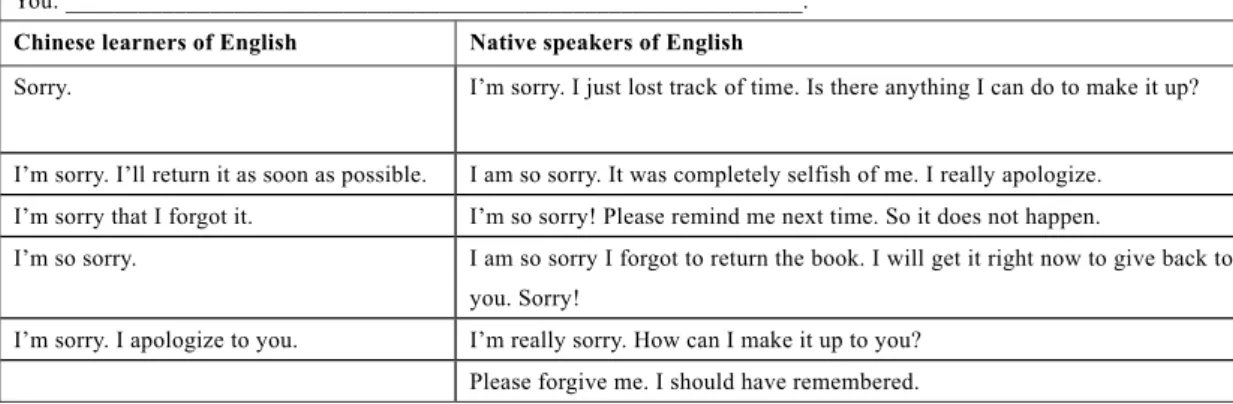
When giving replies to a compliment, showing an appreciation, or making an apology, Chinese learners of English tend to give a brief ‘Thank you’ or ‘I’m sorry’ reply. On the other hand, native speakers tend to be elaborate as shown in Table 1 and 2.
Table 1 Making apologies
Situation 1: You promised to return a textbook to your classmate within a day or two, after photocopying a chapter. You kept
it for almost 2 weeks.
Classmate: I’m really upset about the book because I needed it to prepare for last week’s class. You: _____________________________________________________________.
Chinese learners of English Native speakers of English
Sorry. I’m sorry. I just lost track of time. Is there anything I can do to make it up? I’m sorry. I’ll return it as soon as possible. I am so sorry. It was completely selfish of me. I really apologize. I’m sorry that I forgot it. I’m so sorry! Please remind me next time. So it does not happen.
I’m so sorry. I am so sorry I forgot to return the book. I will get it right now to give back to you. Sorry!
I’m sorry. I apologize to you. I’m really sorry. How can I make it up to you? Please forgive me. I should have remembered.
Table 2 Response to compliments
Situation 2: You just gave a presentation in class.
Instructor: Your presentation was great.
You: ________________________________________________________________.
Chinese learners of English Native speakers of English
Thank you. Thank you. I worked really hard.
Thank you. I’m glad to hear that. Thank you so much, that really means a lot. Thanks. Thank you. I’m glad to hear it.
Thank you. I tried to make it interesting. Thanks. Glad you enjoyed it.
Thank you-I hope it was, dear.
Without adequate exposure to English socio-cultural experiences and activities, Chinese EFL learners probably do not know what else they may say in these situations except a simple reply of ‘Thank you’ or ‘I’m sorry’. It may also indicate that they would rather play it safe by saying less. The tendency of using simplistic expression confirms what Taguchi (2011, p. 285) has found that, earners have a limited range of pragmalinguisitic resources, often symbolized by the use of a few forms over a range of function or the use of formulaic language. Native speakers of English, on the other hand, are more elaborate in their use of discourse turns. As demonstrated in Table 1 and 2, native English speakers use more semantic and syntactic modifiers compared to non-native English speakers.
5.2 Verbosity
Interestingly, Chinese students tend to be verbose, particularly when answering ‘how/ why’ type of questions. To them, this type of question is easier to reply to as long as they have something to express. That is to say, students probably feel safe (or confident) when they have enough to say in English. On the contrary, native speakers tend to offer a concise reply. The
differences are displayed in Table 3.
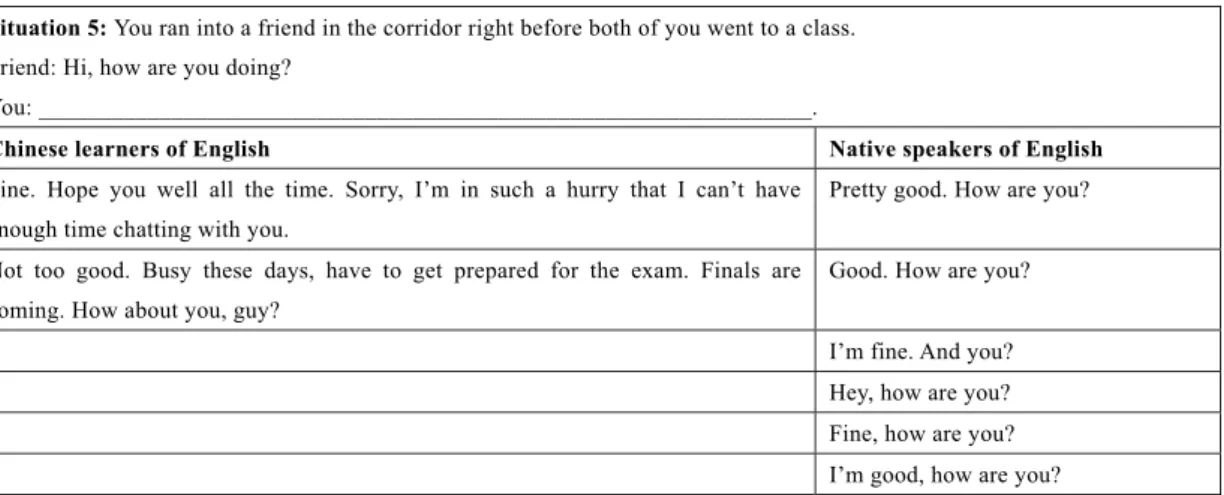
According to Kecskes (2000a), the expression ‘How are you doing?’ in American culture generally serves as a greeting. Replies like ‘Fine, thank you’ (or its equivalents) are expected. However, in some other cultures, this expression means what it literally says: ‘tell me how you are doing’. Failing to recognize the difference makes non-native English speakers tend to use their L1 conceptual script. Our finding supported his view, in Table 3, the Chinese subjects interpret ‘How are your doing’ in its literal meaning by taking it as a question. Not realizing the question is a way of greetings, the students provided excessive information, thus violating the Gricean quantity maxim which says ‘Make your contribution as informative as required. Don’t make your contribution more informative than required’ (Grice, 1975, p. 43). All native speakers interpreted the conversations in the non-literal way by providing brief replies. When doing so, the native speakers tend to take a ‘you’ perspective. By responding with ‘How are you?’, they seek to keep a smooth social intercourse to achieve the phatic function of language use.
Table 3 Responses to greetings
Situation 5: You ran into a friend in the corridor right before both of you went to a class.
Friend: Hi, how are you doing?
You: ________________________________________________________________.
Chinese learners of English Native speakers of English
Fine. Hope you well all the time. Sorry, I’m in such a hurry that I can’t have enough time chatting with you.
Pretty good. How are you? Not too good. Busy these days, have to get prepared for the exam. Finals are
coming. How about you, guy?
Good. How are you? I’m fine. And you? Hey, how are you? Fine, how are you? I’m good, how are you?
We assume that the Chinese verbosity may be accounted for by the Chinese philosophy of Collectivism, an ideology that finds its roots in Confucianism. Collectivism is highly valued in Chinese culture. It regards friendship, harmony and cooperation as important social norms. Directed by these norms, the Chinese seek to establish social connections with other people, especially with people who they do not know well. In the scenarios described above, Chinese EFL learners tried to build a closer relationship through being verbose.
5. 3 Salience of literal meaning
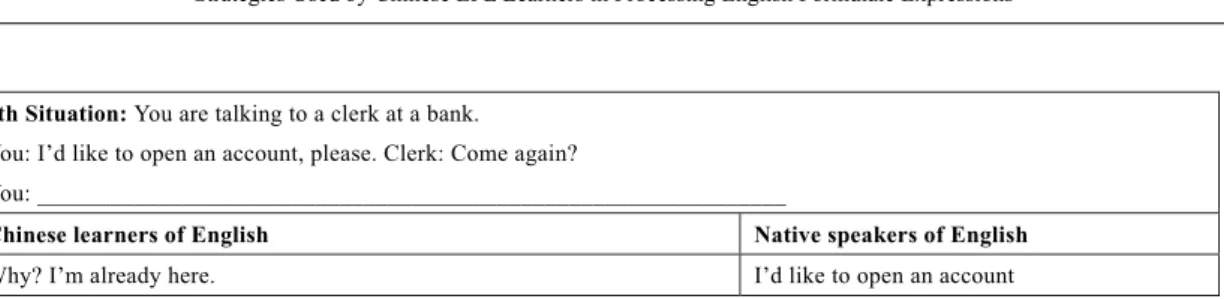
The ‘Graded Salience Hypothesis’ proposed by Giora (1997) posits the priority of salient meanings, which are the most conventional, frequent, familiar and prototypical. Salient meanings are often processed initially regardless of literality or metaphorical meaning. For example, nowadays, the metaphorical meaning of ‘get out of here’ - ‘ you’re kidding’, becomes the most salient meaning for native speakers as a result of the change of collective salience over time. People would not use its literal meaning unless in a particular context. For native speakers, the metaphorical interpretation may be processed initially. However, what is salient is quite different for foreign language learners compared to what is salient for native speakers. Foreign language learners encounter the literal meanings prior to the metaphorical meanings when starting to learn the language. Due to lack of target native-like socio-cultural experiences, they are unable to acquire the conceptual load attached to the words. So the literal meanings of the words are usually salient in their minds. Our findings support the literal salience hypothesis in foreign language learning based on the results shown in Table 4:
33 9th Situation: You are talking to a clerk at a bank.
You: I’d like to open an account, please. Clerk: Come again?
You: ______________________________________________________________
Chinese learners of English Native speakers of English
Why? I’m already here. I’d like to open an account
All of the Chinese learners of English except one interpreted ‘come again?’ in its literal sense by providing ‘Why?’ sort of replies. The only student who interpreted it in its metaphorical sense told us that he did not understand the meaning at all, but guessed it may mean ‘Repeat again’ or ‘I beg your pardon’ from the question mark the phrase ended with. On the other hand, 13 native speakers of English interpreted it in a metaphorical way, while 2 interpreted it in its literal sense.
Similarly, Chinese learners also interpret ‘Tell me about it’ literally as shown in Table 5.
Table 5 Response to ‘Tell me about it.’
8th Situation: You’re talking to your friend Bob about another friend, Ray.
Friend: I think Ray was really rude to you yesterday. Bob: Tell me about it.
You: ________________________________________________________________.
Chinese learners of English Native speakers of English
He was talking behind your back. Yah…I really didn’t like how he spoke to you. He said something bad about your personality. Are you OK?
I don’t want to talk about people behind their back. Yeah. He was a jerk! He said that you didn’t behave yourself. I can’t believe he said that. I don’t want to gossip. Yeah, he was.
I just have that kind of feeling. Yeah, he was really rude for no reason. He turned on the radio when you were studying. Ray must be stressed or something. He said you were foolish.
He lies to you.
For native speakers, what is salient in the expression ‘tell me about it’ is its metaphorical meaning: ‘I know’, ‘I notice’ or ‘It’s true’. But this is not the case with EFL learners. All of the Chinese students in our study interpreted the expression in its literal sense by telling the story about how rude Ray was to Bob. Without enough exposure to the target socio-cultural environment, what the EFL students learn are mostly the linguistic signs without the pragmatic function encoded in the units.
5.4 Transfer of L1 culture
Firstly, Chinese people tend to be modest when being complimented as shown in Table 6
Table 6 Response to compliments
3rd Situation: You had friends over and they have just finished having dinner at your house that was prepared by you.
Friend: That was really delicious!
You: ________________________________________________________________. Chinese learners of English Native speakers of English Thank you. I think there is still room to improve. Thank you. I’m glad you liked it. Thank you. Nothing edible, just poor food. Thanks. I spent all day cooking.
Oh, thanks, it could be better next time. Thank you. I’m glad you enjoyed it.
I try to also make it healthy, thank you for the compliment. I’m so happy you liked the dinner. Did you get enough to eat? An element of typical Chinese modesty is indicated in the replies from Chinese learners of English. Americans would feel proud of being complimented and believe they deserve the praise. Yu (2011) investigated the sociolingusitic behavior of Chinese learners of American English by focusing on how they offer ‘compliments’ in L2. Results showed that the linguistic strategies used by native Chinese speakers to realize compliments were different from those used by the native speakers. For instance, Chinese speakers exhibited a lower tendency to offer compliments than the native speakers.
Secondly, Chinese people would feel it is impolite when they have something good to have while others do not, so they tend to express their regret for others as displayed in Table 7.
Table 7 Response to questions
7th Situation: A friend of yours asks about a party that you went to.
Friend: How was the party last night?
You: ________________________________________________________________.
Chinese learners of English Native speakers of English
Great! You’d better go with me last time. It was pretty good. What did you do last night? Fantastic. It’s a pity you couldn’t come with me. Wonderful-I needed to relax with dear friends. I enjoyed it very much! So wonderful. Sorry you weren’t there. Great. What did you do?
Great. Hope you were there. Great, I had a blast. What did you do last night? Good. It was fun.
It was good. What did you do?
Native English speakers view ‘How was the party last night?’ as a social ritual. They would ask ‘What did you do?’ in return to show consideration for the other party. By asking the question, they seek to establish personal relationships in human intercourse for phatic purpose. That’s not the type of question most Chinese people are used to asking in this situation. In our study, only 3 of 72 students provided ‘What did you do’ replies, accounting for 4.2%, while 10 out of the 15 Americans provided the sort of “What did you do” reply, equivalent to 66.7%. Umar’s research (2004) found that Arab English learners, even at a high level of proficiency, may turn to their L1 cultural framework when formulating their pragmatic strategies. The current study supports Umar’s research in that Chinese learners of English also rely on their native conceptual base in selecting their pragmatic strategies when processing English formulaic expressions.
6. Implications for teaching
As an important component of natural discourse, formulaic expressions have been targeted in foreign language teaching and need to be addressed in teaching pedagogy as they seem to ‘hold the key to native-like idiomaticity’ (Wray, 2000, p. 479) . According to Ellis (2005), formulaic expressions make learners able to practice sociolinguistic function of the language and maximize their communicative ability. By learning formulaic expressions, learners may ‘raise their awareness of the conventions involved in the target socio-cultural norms’ (Yu, 2011, p. 1144). Learners will thus be enabled to develop pragmatic competence, promote production fluency and reduce their reliance on their L1 conceptual base.
Formulaic expressions also help promote language processing. ‘As lexical chunks segmented from input and stored as a single entity in long-term memory, formulaic expressions are fundamental to language production by allowing language production to occur while bypassing controlled processing and the constraints of short-term memory capacity’ (Wood, 2002, p.
35
1). The lexical chunks help reduce the learning burden, as ‘calling on memorized formulas is believed to be less cognitively demanding than constructing new utterances from scratch, and so it is thought that formulas may help speakers cope with the demands of real-time language production and comprehension while maintaining fluency’ (Durrant, 2008, p. 43). Teaching formulaic expressions provides learners with a quick route into native-like speech production, as learners achieve fast and efficient language processing with ‘a natural tendency to economy of effort’ (Sinclair, 1987, p. 320).
The research described in this article informs Chinese EFL teachers and other foreign language teachers of where to direct their efforts in improving the idiomaticity and fluency of English production.
Firstly, Chinese learners’ lower level of the use of English formulaic expressions relative to the native speakers indicates what teachers may do to expose learners to native-like formulaicity. Teachers may offer explicit instructions on target language formulaic expressions, focus more on the use of the expressions, and build more practice activities on formulaic expressions into relevant EFL textbooks at all proficiency levels.
Textbooks are a very important source of language learning input in the Chinese EFL context. Original textbooks are a source of formulaic expressions. However, some English textbooks are commercialized in China nowadays. The textbooks are tailored by textbook writers to adapt to the needs of the market. Such textbooks fail to provide authentic materials with native formulaic expressions to language learners. On the other hand, in accordance with what Koprowski (2005) has found, the few formulaic expressions in the textbooks are mostly connected with specific grammar structures. This raises concerns about the nature of authenticity in language input in the classroom.
Besides original textbooks, recordings or videos may serve as effective teaching tools in providing authentic input. The introduction of multimedia technology into Chinese EFL classrooms enables teachers to use videos of native speakers performing the same speech acts. Learners may mimic the materials and practice them. This approach ‘is to be favored over the inert correct dialogues traditionally presented in textbooks. Potentially, such data offer learners a chance to hear the turns of phrases used by native speakers to achieve a range of conversation management and interactional functions’ (Wray, 2000, p. 479).
Teachers may also organize classroom activities targeted at the use of formulaic expressions in daily interactions. Situational conversations, role plays, debates and topic discussions are among those which can be used to offer a close-to-authentic context for language learning. All these will make learners improve their language sense. Learners may come to realize how to appropriately use formulaic expressions and where to avoid simplicity and verbosity when performing speech acts.
7. Conclusion
This cross-sectional study investigated what strategies Chinese EFL learners used to process English formulaic expressions. We found that learners have a relatively low level in processing formulaic expressions, although they have a high English linguistic proficiency. This finding indicates the weak connection of English linguistic proficiency and sociolinguistic competence in an EFL environment. One characteristic of language learning in a home context is that learners are not adequately exposed to the ‘conventionalized conceptualization’ (Taylor, 1993, p. 212) of the target language, so they usually tend to rely on the conceptual base of their mother tongue when producing formulaic expressions. An analysis of the strategies learners used to process formulaic expressions indicated this reliance on L1 cultural cognition and conceptual system. Future research may investigate whether EFL learners with different English proficiency may use different strategies in processing formulaic expressions.
References
Bardovi-Harlig K and Bastos M (2011). Proficiency, length of stay, intensity of interaction and the acquisition of conventional expression in L2 pragmatics. Intercultural Pragmatics, 3, 347–384.
Bardovi-Harlig, K., & Dörnyei, Z. (1998). Do language learners recognize pragmatic violations? Pragmatic versus grammatical awareness in instructed L2 learning. TESOL Quarterly, 2, 233–262.
Barron, A. 2003. Acquisition in interlanguage pragmatics: Learning how to do things with words in a study abroad context. Benjamins, Amsterdam, Philadelphia.
Conklin, K., & Norbert, S. (2008). Formulaic sequences: are they processed more quickly than nonformulaic language by native and nonnative speakers? Applied Linguistics, 1, 72–89.
Cook, M. & Liddicoat, A. (2002). The development of comprehension in interlanguage pragmatics: The case of request strategies in English. Australian Review of Applied Linguistics, 25, 19–39.
Coulmas, F. (1981). Introduction. In F. Coulmas (Ed.), Conversational routine: Explorations in standardized communication
situations and prepatterned speech (pp.1–19). The Hague, Netherlands: Mouton..
Deniz, O. (2012). The development of conceptual socialization of international students: A language socialization perspective
on conceptual fluency and social identity. Cambridge Scholars Publishing.
Durrant, P. (2008). High frequency collocations and second language learning, University of Nottingham.
Ejzenberg, R. (2000). The juggling act of oral fluency: A psycho-sociolinguistic metaphor. In H. Riggenbach (Ed.),
Perspectives on Fluency. Ann Arbor: University of Michigan Press.
Ellis, R. (2005). Analyzing learner language. Oxford: Oxford University Press.
Farashaiyan, A., & Hua, T. K. (2012). On the relationship between pragmatic knowledge and language proficiency among Iranian male and female undergraduate EFL learners. The Southeast Asian Journal of English Language Studies, 1, 33–46. Garcia, P. (2004). Developmental differences in speech act recognition: A pragmatic awareness study. Language Awareness,
13, 96–115.
Giora, R. (1997). Understanding figurative and literal language: the graded salience hypothesis. Cognitive Linguistics, 7, 183-206.
Grice, P. (1975). Logic and Conversation. In P. Cole. & J.Morgan (Eds.), Syntax and semantics 3: Speech Acts (pp. 41-58). New York: Academic Press..
Holtgraves, T. (2007). Second language learners and speech act comprehension. Language Learning, 57, 594–610.
Hu, Y.(2011). Studies on the formulaic sequences in speech production: retrospect and prospect. Foreign Language Learning
Theory and Practice, 2, 55-63.
Kecskes, I.( 2000a.) Conceptual fluency and the use of situation-bound utterances. Links & Letters, 7, 145–161. Kecskes, I. (2000b). A cognitive-pragmatic approach to situation-bound utterances. Journal of Pragmatics, 32, 605–625. Kecskes, I. (2007). Formulaic language in English Lingua Franca. In I.Kecskes & L.Horn, (Eds.), Explorations in pragmatics:
Linguistic, cognitive and intercultural aspect (pp.191–218). Berlin & New York: deGruyter.
Koprowski, M. (2005). Investigating the usefulness of lexical phrases in contemporary coursebooks. ELT Journal, 4, 322-332. Lee, W. Correlations between Taiwanese university EFL learners’ frequency of use of language learning strategies and their
pragmatic awareness and grammatical awareness. Retrieved on Octorber 28, 2013, from
http://www.edu-papers.com/correlations-between-taiwanese-university-efl-learners-frequency-of-use-of-language-learning-s trategies-and-their-pragmatic-awareness-and-grammatical-awareness..
Liu, S., Zhu,B., & Qiu, G. (2012). Corpus-based study on formulaic language noun chunks based on the timed argumentations in SWECCL. Journal of Hebei North University (Social Science Edition), 1, 94-97.
Pawley, A., & Syder, F. H. (1983). Two puzzles for linguistic theory: Nativelike selection and nativelike fluency. In J. Richards, & R. Schmidt (Eds.), Language and communication (pp. 191–226). London: Longman,.
37
(pp. 396-399). Routledge: Taylor & Francis Group.
Schauer, G. A. (2006). Pragmatic awareness in ESL and EFL contexts: contrast and development. Language Learning, 56, 269–318.
Shimizu, T. (2009). Influence of learning environment on L2 pragmatic realization: A comparison between JSL and JFL learners’ compliment responses. In N. Taguchi (Ed.), Pragmatic competence (pp. 167–198). New York: Mouton de Gruyter. Sinclair, J. M. (1987). Collocation: a progress report. In R. Steele, R. & T. Threadgo (Eds.), Language topics: Essays in honour
of Michael Halliday (pp. 319-331). Amsterdam: John Benjamins,.
Taguchi, N. (2011). Do proficiency and study-abroad experience affect speech act production? Analysis of appropriateness, accuracy, and fluency. IRAL, 49, 265–293.
Taguchi, N. (2007). Development of speed and accuracy in pragmatic comprehension in English as a foreign language. TESOL
Quarterly, 41, 3–338.
Taguchi, N. (2005). Comprehending implied meaning in English as a second language. Modern Language Journal, 89, 543–562.
Taylor, J. R. (1993). Some pedagogical implications of cognitive linguistics. In R. Geiger, R. & B. Rudzka-Ostyn (Eds.),
Conceptualizations and mental processing in language (pp.200-223). Berlin/New York: Mouton de Gruyter.
Umar, A. M. A. (2004). Request Strategies as Used by Advanced Arab Learners of English as a Foreign Language. Journal of
Educational & Social Sciences & Humanities, 1, 1–40.
Wang, L. (2010). Study on Chinese Advanced EFL Learners: Formulaic Language and Linguistic Creativity, National defense industry press.
Wang. L., & Ma, H. (2009). A corpus-based study on stance constructions of Chinese EFL public speakers. Foreign Language
Teaching and Research, 5, 365-370.
Wang, L., & Zhang, Y. 2006. A corpus-based study on chunks in English argumentative writing of Chinese EFL learners. Computer-assisted, Foreign Language Education, 8, 36-41.
Wei, N. (2007). Phraseological characteristics of Chinese learners’ spoken English: evidence of lexical chunks from COLSEC.
Modern Foreign Languages, 3:281-291.
Wood, D. (2002). Formulaic language in acquisition and production: Implications for Teaching. TESL Canada Journal, 20, 1, 1-15.
Wray, A. (2000). Formulaic sequences in second language teaching: principle and practice. Applied Linguistics, 4, 463-489. Wray, A. (2002). Formulaic language and the lexicon. UK: Cambridge University Press.
Xu, J., & Xu, R. (2007). Discourse management chunks in Chinese colleges learners’ English speech: A spoken corpus-based study. Foreign Language Teaching and Research, 6, 437-443.
Yu, M. (2011). Learning how to read situations and know what is the right thing to say or do in an L2: A study of socio-cultural competence and language transfer. Journal of Pragmatics, 43, 1127–1147.
Appendix Testing material
Directions: In order to do the following task, first, you need to read the situation and utterances provided. Second, assume that
you are in the provided situation. How would you respond? Third, write your response in the blank area. Do not spend a lot of time on thinking of a response, since in a naturally occurring conversation we tend to produce utterances promptly. Try to respond as naturally as possible.
1st Situation: You promised to return a textbook to your classmate within a day or two, after photocopying a chapter. You kept
it for almost 2 weeks.
Classmate: I’m really upset about the book because I needed it to prepare for last week’s class.
You: _____________________________________________________________.
2nd Situation: You just gave a presentation in class.
Instructor: Your presentation was great.
You:______________________________________________________________
3th Situation: You had friends over and they have just finished having dinner at your house that was prepared by you.
Friend: That was really delicious!
You: _____________________________________________________________
4th Situation: Your boss introduces you to the newly hired secretary.
Your boss: Let me introduce you to our new secretary, Sally.
You: _____________________________________________________________
5th Situation: You ran into a friend in the corridor right before both of you went to a class.
Friend: Hi, how are you doing?
You: ____________________________________________________________
6th Situation: You just entered the library to drop off a book and there you ran into a friend.
Friend: Hey, …What’s up?
You: _____________________________________________________________
7th Situation: A friend of yours asks about a party that you went to.
Friend: How was the party last night?
You: ____________________________________________________________
8th Situation: You are talking to your friend Bob about another friend, Ray.
You: I think Ray was really rude to you yesterday. Bob: Tell me about it.
You: ____________________________________________________________
9th Situation: You are talking to a clerk at a bank.
You: I’d like to open an account, please. Clerk: Come again.
You: _____________________________________________________________
10th Situation: You are talking about Rhea’s winning a million dollars with Bill.
You: Did you hear? Rhea won a million dollars the other day! Bill: You’re pulling my leg!