第 54 卷 第 5 期
2019 年 10 月
JOURNAL OF SOUTHWEST JIAOTONG UNIVERSITY
Vol. 54 No. 5 Oct. 2019
ISSN -0258-2724 DOI:10.35741/issn.0258-2724.54.5.6 Research article
P
ERFORMANCE OF
S
ELF
-C
OMPACTING
G
EOPOLYMER
C
ONCRETE
C
ONTAINING
N
ANO
S
ILICA AND
G
ROUND
W
ASTE
C
ERAMIC
T
ILES AS A
F
INE
A
GGREGATE
包含纳米二氧化硅和地面废陶瓷砖作为细骨料的自填土聚合物的性能
Mohammed Noori Hussein Alhashimi, Fadhil Abbas Jasim, Ghassan Nasir Ahmed, Wisam Abdullah NajimIraq University College,
Basrah, Iraq, [email protected]
Abstract
The waste produced from the remnants of construction projects, such as construction of houses, roads, bridges, and multi-story buildings, clearly constitutes a major environmental danger and has become a concern in many countries. In Iraq, the great economic growth taking place and the development of modern means of construction has led to the spread of large quantities of waste that must be disposed of. Numerous studies have focused on the disposal of these wastes, with the most important process being recycling. The possibility of using pulverized waste ceramic tiles (PWCT) as a sand replacement to produce high-strength, self-compacting geopolymer concrete (HSSCGPC) was investigated in the present study. HSSCGPC specimens were prepared using ground granulated blast furnace slag (GGBFS) and nano silica (NS) as an alternative to cement. The performance of the produced HSSCGPC was evaluated by subjecting it to several laboratory tests, including workability, compressive strength, splitting tensile strength, flexure, and durability tests, to determine its conformance to the EFNARC standard. The results demonstrated the possibility of using both NS and GGBFS together as a full substitute for cement, with PWCT as a full substitute fornatural sand, although the use of PWCT decreased the workability and strength of the final product. PWCT was established as a prospective candidate for replacement of up to 50% of the sand in cement in terms of environmental friendliness, cost effectiveness, and conservation of natural resources. HSSCGPC had high durability when compared with normal types of concrete.
Keywords: Geopolymer Concrete, Waste Materials, Nano Silica, Ground Granulated Blast Furnace Slag.
摘要 房屋,道路,桥梁和多层建筑等建筑项目的残余物产生的废物显然构成了重大的环境危险,并已成为许多 国家关注的问题。在伊拉克,巨大的经济增长和现代建筑手段的发展导致了必须处置的大量废物的扩散。许多研 究都集中在这些废物的处理上,最重要的过程是回收。在本研究中,研究了使用粉碎的废陶瓷砖(压力测试)代 替砂子来生产高强度,自密实的地质聚合物混凝土(高速电脑)的可能性。使用碎粒高炉矿渣(GGBFS)和纳米 二氧化硅(NS)代替水泥制备高速电脑标本。通过对所生产的高速电脑进行多项实验室测试(包括可加工性,抗 压强度,劈裂抗张强度,挠曲和耐用性测试)来评估其性能,以确定其是否符合欧洲金融研究中心标准。结果表 明,尽管使用压力测试会降低最终产品的可加工性和强度,但可以同时使用NS和GGBFS完全替代水泥,而压力测 试可以完全替代天然砂。从环境友好性,成本效益和自然资源保护等方面考虑,压力测试有望替代水泥中多达50 %的沙子。与普通混凝土相比,高速电脑具有较高的耐久性。
关键词: 地聚合物,废料,纳米二氧化硅,粒状高炉矿渣。
I.
I
NTRODUCTIONRecently, many scientific researchers have shown that concrete made from some types of recycled industrial waste is useful in modern construction and construction methods. This material provides high quality construction and excellent specifications, as well as making a great contribution from the environmental point of view [1]. Recycling is one of the best ways to dispose of harmful waste in the environment, and the use of alternative recycled materials to produce concrete also conserves the natural resources normally consumed to create concrete [2].
The great economic, commercial, and industrial growth witnessed by the world in recent years has greatly increased the use of natural resources, especially for construction purposes [3]. The increased urban growth around the world has led to significant environmental hazards; for example, the use of river sand or sand extracted from mountain quarries has produced changes in the nature of the earth's surface [4]. Cement production also causes significant environmental damage, including water pollution, damage to agricultural land, and air pollution. A more recent concern is the recognition that the process of cement production is accompanied by the release of very large amounts of carbon dioxide (C02), a greenhouse gas that is a
major cause of global warming. This production of huge amounts of carbon dioxide has led to experiments aimed at using waste materials as an alternative to cement to reduce the emission of carbon dioxide and to preserve the environment, while at the same time reducing the high costs of producing cement. This has resulted in the emergence of a new term: polymer.
A new type of concrete developed at the beginning of the 1950s was called geopolymer concrete and consisted of materials that differed entirely from ordinary concrete materials, especially cement; these materials included fly ash, bottom ash, blast furnace slag, ground granulated blast furnace slag (GGBS), rice husk ash, silica fume, metakaolin, volcanic tuffs, mine tailings, zeolites, silver trim, and silicates, as well as alkali-activated solutions such as sodium silicate, sodium hydroxide, potassium silicate, and potassium hydroxide. The term “geopolymer” describes a family of mineral binders with associated chemical
compositions that are comparable to zeolites but with an amorphous microstructure. Geopolymer concrete is a distinctive material comprising aluminosilicate materials, such as aluminosilicate gels, glasses, and zeolites. The polycondensation of the silica/alumina precursors within the polymers is the necessary mechanism that helps to achieve the structural strength of the resulting concrete [5], [6], [7], [8].
The introduction of geopolymer concrete that used waste industrial products is perhaps one of the first examples of green building, which is now a central concept in present-day construction. With clear and appropriate planning, the design and construction stages can be quickly initiated, with the designer choosing either a conventional or a new approach in construction design. Nevertheless, sustainable design is encouraged to minimize environmental impacts, and civil engineers and researchers are recognizing their responsibility to add sustainable elements into the construction field [9], with green building as one of the alternatives. The choice of mechanical and electrical equipment is important in green building concepts, but the designation of the structural components of the building should also shift to more economical and environmental methods; therefore, new and innovative design ideas will be expected in the civil engineering practice code [10]. Geopolymer concrete is a good example of an innovative and eco-friendly construction material and an alternative to ordinary Portland cement.
The use of geopolymers reduces the demand for ordinary Portland cement, which accounts for the high CO2 emission during concrete production [11].
Geopolymer cement concrete uses waste materials, like fly ash and silica, which are waste products generated from thermal power plants, and GGBS, a waste material generated by steel plants [12]. These waste materials are processed by acceptable technology and used for concrete in the form of geopolymer concrete. The utilization of this type of concrete helps to cut back on the stockpile of waste materials and reduces carbon emissions by reducing the cement demand.
The increasing use of self-compacting, high-strength concrete is now very evident worldwide due to expanding construction and development [13]. The concrete used in modern construction must have a target strength that enables the support
of large loads and has suitable durability to withstand weathering. Therefore, studies on the properties of concrete and the proportions of materials required for its production are very important, as are studies on the fresh and hardened properties of the final concrete product. The aim of the present research was to investigate the production and engineering properties of a self-compacting, high-strength geopolymer concrete that incorporates a proportion of ground waste ceramic tiles as a fine aggregate.
II.
O
BJECTIVES OF THES
TUDYi. Producing high strength self-compacting geopolymer concrete from available local materials as well as using grounded waste ceramic tiles as fine aggregate
ii. Using both ground-granulated blast-furnace slag (GGBS) and nano silica (NS) in combination and in isolation to produce high-strength self-compacting geopolymer concrete
iii. Studying new properties of high strength self-compacting geopolymer concrete.
iv. Studying the hard properties of high-strength self-compacting geopolymer concrete.
III. L
ITERATURER
EVIEWThe production of geopolymer concrete, which does not require the use of cement in its composition, helps reduce the amount of carbon dioxide emitted. Geopolymer is an industrial product rich in silica and ammonia mixed with some active alkali solutions such as sodium hydroxide, sodium silicate, potassium hydroxide, potassium silicate, among others. It is known that this self-compacted concrete has the ability to flow and fill framework, as a result of its weight, without the need for external compaction or the use of vibrators [13].
The primary interesting characteristics of geopolymer concrete, according to Prof. B. V. Rangan and Hardijito [14], are
i. It does not need high heat temperature for its production; it is easily produced at room temperature.
ii. It has few or even no pores and no bleeding, which makes the penetration of chemicals very difficult.
iii. It has a higher compressive, tensile, flexural strength and durability than ordinary concrete.
iv. It is also not permeable.
v. It has very high resistance to sulphate attack as compared to ordinary concrete when put it into
sulphate solution for more than two weeks.
According to the above points (S. P. Ahirrao and S. V. Deodhar), it was also found that this type of concrete shows very high resistance to solutions of sulfuric acid and chloride and oxidizing materials. It contains fly ash, glass powder and other pozzolanic materials, which increase the density and the bonding between its components. As a result, it has a very high strength as compared to ordinary concrete [15], [16].
IV.
M
ATERIALSU
SED A. Fine Aggregate1) Natural Sand
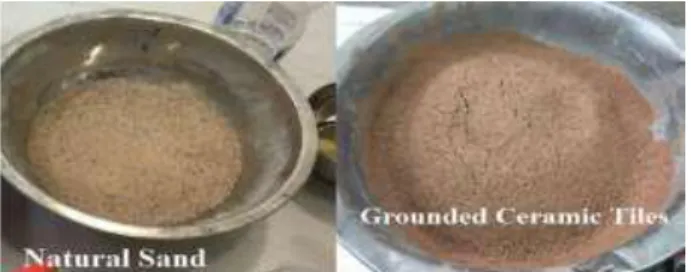
Constant weights of natural sand extracted from Snam Mountain in the south of Basra city with finesse modulus 2.6, and with 2.36 mm maximum grain size as shown in Figure 1.
Figure 1. Natural sand and grounded ceramic tiles.
2) Grounded Ceramic Tiles (GCT)
In this study, the broken pieces of ceramics were collected from the residues of the construction projects of the residential buildings in the center of Basrah city, and we cleaned and ground them in the lab to get 2.36 mm maximum grain size as shown in Figure 1.
3) Nano Silica (NS)
Figure 2 presents a powder of nano silica (SiO2) with max size less than 50 nm and density of 100g/m3, which was used in this study.
4) Ground-Granulated Blast-Furnace Slag (GGBS)
A powder GGBS pozzolanic used in this study is shown in Figure 2.
Figure 2. NS and GGBS.
5) Superplasticizer (SP)
In our study, we used high range performance concrete Superplasticizer admixture type SP42 produced by the DCP company is shown in Figure 3.
Figure 3. Superplasticizer.
6) Water
Clean, drinkable water was used in this study.
7) Additional solutions (AS)
For the purpose of the production of geopolymer concrete, cement is not used permanently and is replaced with waste materials having pozzolanic properties. Therefore, it is necessary to use catalysts that have the ability to catalyze the polymerization reaction. In this study, a mixed solution of alkaline NaOH with 12 molarity and Na2SiO3 was used. B. Properties of the Materials
Table 1 shows the chemical and physical properties of natural sand and ceramic powder. The ceramic pieces were collected from the remains of the construction of residential building sites located in the center of Al-Basrah city. These pieces were
then cleaned, washed, and left to dry. After that, we carried out the ceramic grinding process in the laboratory to obtain the desired size, and then carried out the analysis process. Tables 2 and 3 summarize the properties of the GGBS and NS. Figure 4 shows NS under x-ray and electronic microscope.
Table 1.
Chemical and physical properties of natural sand and GST Chemical compounds Natural sand percentage GST SiO2 95.3 44.07 Al2O3 1.91 11.09 Fe2O3 0.64 32.84 CaO 0.2 3.07 MgO 1.16 K2O 0.91 0.11 Na2O 0.15 - TiO 0.32 - L.O.I 0.47 - Physical
properties Natural sand GST Max Size 2.36 mm 2.36 mm Specific Gravity 2.34 2.86 Relative Density 1.3 tm-3 1.65 tm-3 Fineness Modules 2.8 3 PH 7.15 8.24 Water absorption 2.8% 7.1% C. Mixture Proportion
In this study, a lot of trial mixes have been made in order to achieve the requirements that we seek. Table 4 shows only the trial mixes through which we were able to produce HSSCGPC.
D. Specimen Casting
For each HSSCGPC specimen in the form of cubes with sides 50 mm, cylinders of dimension (100 mm × 200 mm), and prisms of dimension (100 mm × 100 mm × 500 mm) were prepared. Experimental specimens in the form of cubes, prisms, and cylinders were tested to determine the compressive strength, the tensile strength and the flexural strength, respectively. All the samples were mold after 1 day of casting and subsequently kept at room temperature until the testing age was attained.
Table 2.
Physical properties and chemical composition of GGBFS Component
CaO SiO2 Al2O3 Fe2O3 MgO SO3 K2O Na2O L.O.I
Specific gravity Blaine fineness (m /kg) GGBFS (%) 34.19 40.4 10.60 1.28 7.63 0.68 2.4 0.17 2.742.30 575 Table 3.
Typical physical and chemical properties of NS
Properties NS
Chemical:
SiO2 content, % > 99.7
Mineral form Amorphous
Free moisture, 110°C, % < 1.0 Loss on ignition, 1000°C, % < 0.8 Na2Oeq content, % < 0.05 SO3 content, % < 0.03 Cl content, % < 0.07 pH 6.0 Physical:
Appearance of powder Fluffy white
Specific gravity 2.2
Bulk density, vibrated, lb/ft3 23-25 Specific surface area (BET), m2/g 20-50 Primary particle size range, nm 325 mesh 60-300
(45 µm) retained, % < 0.05
Pozzolanic strength index, 7d, % 142
Table 4. Mix proportions
Materials (Kg/m3)
NS
Trial 1 Trial 2 Trial 3 Trial 4 Trial 5 Trial 6 Trial 7 Trial 8
0 433 234 155 85 0 0 85 GGBS 504 185 234 310 255 475 475 550 Sand 950 950 950 950 856 950 475 0 GST 0 0 0 0 0 0 475 950 SP 20 20 20 20 18 15 15 18 AS 116 2 152 155 85 160 160 85 Water 190 190 190 190 181 190 190 190
V.
E
XPERIMENTALT
ESTS A. Fresh Properties TestsIn this study, three tests were conducted to measure filling and passing ability for the fresh HSSCGPC. These tests included slump flow, T50 cm slump flow and L-box as shown in Figure 5.
Figure 5. Slump flow test. B. Hard Properties Tests
In this study, three tests were conducted to measure the hard properties and durability for
HSSCGPC. These tests measured compressive strength and flexural strength.
VI.
R
ESULTS ANDD
ISCUSSIONS A. Results of Fresh Properties TestsTable 5 provides the fresh properties of the prepared HSSCGPC specimens obtained using slump flow test and L-box test. The quantitative and qualitative analysis indicated that all the concrete mixes achieved the desired fresh properties which conformed to the EFNARC limits of self-compacting geopolymer concrete [17].
Table 5.
Fresh properties tests results
Tests Trial 1 Trial 2 Trial 3 Trial 4 Trial 5 Trial 6 Trial 8 Trial 8
Slump flow (mm) 676 677 682 679 684 688 679 673
T50 cm slump flow (s) 4.6 4.4 3.9 4.4 3.7 3.6 4.5 5.1 L-box ratio (H2/H1) 0.96 0.96 0.98 0.97 0.98 0.99 0.96 0.94 B. Results of Hard Properties Tests
1) Compressive Strength and Durability
Table 6 summarizes the values of the compressive strength for all trial mixes. Results revealed that the compressive strength of the waste ceramic concrete was lower than the sand concrete during all of curing durations. A decrease in the ratio of compressive strength compared to the sand concrete after 28 days was discerned, and the ceramic tiles concrete has a lower compressive strength than the sand concrete. Also, the results indicated that trial 2 has the highest compressive strength while trial 8 has the lowest compressive strength. It is also worth mentioning that all compressive strengths have been obtained at a high strength.
Table 6.
Compressive strength Mix
Compressive strength (mpa) 7 days 28 days 56 days Trial 1 44.76 65.48 67.22 Trial 2 76.14 77.97 78.1 Trial 3 52.4 61.56 65.5 Trial 4 40.6 45.92 52.4 Trial 5 42.4 50.8 62.24 Trial 6 45.2 50.84 76.04 Trial 7 42.7 47.87 50.2 Trial 8 40.1 44.06 47.98
2) Splitting Tensile Strength
Figure 6 indicates that the increase by grounded
ceramic as fine aggregate will reduce tensile resistance to the HSSCGPC. As noted in Figure 6, the results indicate that trial 2 has the highest splitting tensile strength while trial 8 has the lowest splitting tensile strength and that the use of natural sand to produce HSSCGPC will yield a higher splitting tensile strength than the use of grounded ceramic tiles.
Figure 6. Splitting tensile strength.
3) Flexural Strength
The flexural strength of a material is its capability to oppose the bending force applied on the concrete or other slabs placed on the ground. The flexural strength determination is a prerequisite for the design of concrete mixtures to examine the compliance with established standards of an engineering structure [18], [19]. In the present work, flexural strength was measured at room temperature in compliance with the specifications of ASTM D790. Figure 7 depicts the flexural strength of the
prepared trial mixes after 28 days of curing. The values of flexural strength obtained for the natural sand incorporated in HSSCGPC mixes were evidently higher than the values for the ground waste ceramic tiles. The discrepancy may be attributed to the reduction in the sand ratio, which led to weakening of the bond between the fine aggregates and the binder [20].
Figure 7. Flexural strength in 28 days.
4) Durability Tests
a) Resistance to Sea Water, Acid Attack, Dioxide Penetration, and Chloride Penetration
In addition to the previous tests, we also isolated several samples from each of the trial mixtures that we produced in order to place these models in seawater and expose them to conditions with harsh substances like acid and chloride (see Figure 8). We conducted several tests to measure the durability of the samples under these conditions. The most important of these tests is the compressive strength test, results of which are shown in Figure 9.
Figure 8. HSSCGPC exposed to harsh condition.
Figure 9 shows that the HSSCGPC has a good ability to resist severe conditions. HSSCGPC that uses natural sand shows greater resistance than HSSCGPC using ground waste ceramic tiles.
Figure 9. HSSCGPC durability.
VII.
C
ONCLUSIONS1. This study reports on the feasibility of using available local materials and ground waste ceramic tiles to replace sand or as a fine aggregate to enhance HSSCGPC for economic and environmentally friendly applications.
2. It is possible to produce HSSCGPC by using GGBS and NS as an alternative to cement.
3. It is possible to produce HSSCGPC using only GGBS as a complete substitute for cement, but it is not possible to produce HSSCGPC by using only NS.
4. Newly created HSSCGPC showed a satisfactory performance and high compressive strength. It was concluded that using GGBS and NS in the GP binder phase can be synergistically combined with conventional sand and ground waste ceramic tiles to produce enhanced HSSCGPC.
5. Replacing natural sand with ground waste ceramic tiles resulted in a decrease in performance with respect to both flow ability and mechanical properties.
6. Using ground waste ceramic tiles as a fine aggregate caused a reduction in the strength of HSSCGPC.
7. GGBS and NS achieve high-performing HSSCGPC due to high specific surface area and the high content of silica, alumina, and iron.
8. There is a direct relationship between the amount of NS and the strength of HSSCGPC. If the amount of NS increases, the compressive and flexural strength will increase too. This is because the nano particles of NS will prevent any voids and make the mix denser. In addition, its pozzolanic activity will increase the C-S-H gel.
9. When NS is used, the compressive strength of HSSCGPC increases soon after being formed because the smaller size of NS particles enables it to be hydrated very quickly.
10. As prepared, HSSCGPC showed excellent resistance to acid attack, dioxide penetration, and chloride penetration for up to 56 days of exposure in the sea-water environment. In addition, the ground
waste ceramic tiles incorporated into HSSCGPC resulted in a greater weight loss than the weight loss undergone by natural-sand HSSCGPC samples under acid exposure over the entire period. In other words, waste ceramic tiles exhibit excellent durability when exposed to harsh conditions, but not as great as the durability exhibited when natural sand is used.