著者
Mlodkowski Pawel
journal or
publication title
Comparative culture, the journal of Miyazaki
International College
volume
24
page range
45-58
year
2019
45
Monetary Integration Challenges in Asia-Pacific
Region
Pawel Mlodkowski
Miyazaki International College
Abstract
Monetary integration in Asia has been a hot topic for years. Proponents justify regional cooperation by proving a range of benefits. The importance of their arguments stems from the fact that exchange rate instability plagues Asian countries. The competitiveness of Asian economies, which are export-oriented, relies on exchange rates. In the past, macroeconomic stability was achieved through the use of hard pegs. However, the costs of fixed rates called for alternative solutions. Instead, for national regimes in the Asia-Pacific region it may be feasible to introduce a common basket peg, or even a common currency, to cope with exchange rate-related problems. Successful management of regional policy may lead to an Asian Monetary Union and would not be easy. Not only must economies converge, but a great deal of political will and solidarity would be required. This paper discusses alternative solutions and offers a correlation analysis of business cycles showing the current situation in Asia.
Keywords: ASEAN, exchange rate, monetary integration, monetary policy
coordination, trade.
Introduction
Asia has emerged as a global power during the last 25 years. Over this period, the region has been characterized by high levels of foreign direct investment that fueled incredible economic expansion. Factors contributing to growth have been numerous, but low labor costs and fewer regulations (including a lack of environmental protection laws) have been recognized as beneficial and therefore attractive for relocating global production to Asian countries. Socio-economic success materialized through the improvement of living standards
46
over a relatively short period of time. This, in turn, provided grounds for discussion of possible regional solutions with regard to economic and monetary integration. After successful implementation of the ASEAN initiative, economists and governments in the region have analyzed scenarios of monetary integration. The success of the Economic and Monetary Union (EMU) in Europe has driven the popularity of monetary integration in Asia until recent years. There is a vast amount of research concerned with various designs of the monetary system in Asia.
Problem
Monetary integration, regardless of the region of the world it covers, has been a hot topic and has been gaining in popularity. This is in spite of the fact of fast expansion of currencies issued online, which has been beyond national government control.
The literature most often lists Japan, South Korea, Taiwan, Hong Kong, Indonesia, Malaysia, Singapore, China, Thailand and the Philippines as members for Asian monetary integration (Yuen, 2002; Williamson, 2005; Eichengreen & Bayoumi, 1996). A list of potential member states of the currency union in Asia tends to differ from study to study. For instance, Eichengreen and Bayoumi (1996) also include Australia and New Zealand in their analysis of correlations. Different sets of countries are considered for the purpose of answering questions on the optimal composition of a new monetary union. Optimality is defined here with utility function maximizing potential benefits for monetary union members. The above list is concise and represents the focus group for this research.
Demand for monetary integration within this group stems from a desperate need to achieve exchange rate stability. Such an attitude results from the fact that all of these countries belong to highly open small economies. As a consequence, economic performance depends heavily on the external value of their respective national currencies. The Asian currency crisis of 1997 was a problem resulting mostly from rigidity of exchange rate regimes (Hefeker & Nabor, 2002). This rigidity is also a result of the disproportionate share (in currency baskets) assigned to the dollar (Rajan, 2002). The currency crisis of 1997 raised the question of finding a valid solution to the myriad of exchange rate problems suffered by Asian countries. The goal of this paper is to present various arguments for monetary integration in the region and possible solutions to the problem of effective monetary cooperation.
47
There have already been many studies that have discussed various methods of achieving exchange rate stability. They have included exchange rate regimes based on fixed and flexible rates, currency basket-based regimes, and the idea of a common currency for selected countries in Asia.
Current Asian exchange rate regimes range from hard peg to free float systems. The former approach is still in use, despite the Asian currency crisis having resulted from rigidity of fixed exchange rates (Hefeker & Nabor, 2002). This is justified by the fact that the main benefit of hard peg is that of “reducing uncertainty in trade and investment” (Hefeker & Habor, 2002, p. 3). Stability in the external value of domestic currency reduces the risk in international business. The variability of exchange rates greatly affects the competitiveness of products exported. Instable international capital flows and current account reversals put the financial stability of a nation in question. Prevalent during the currency crisis in 1997 were many competitive devaluations (Hefeker & Nabor, 2002, p. 4). As argued by Mc Kinnon (1998), Rose (1998), and Hefeker and Nabor (2002), such countermeasures added to macroeconomic instability in Asia. One may claim that a hard peg regime effectively solves most of the above-mentioned problems. The popularity of fixed exchange rates in Asia is attributed to a long history of successful economic performance under such regimes. Limiting exchange rate fluctuations created instability. Governments in the region, however, and global institutions are still on a quest to achieve macroeconomic stability for the sake of each society’s wellbeing.
Objective
The objective of this paper is to provide a review of opinions on monetary integration in Asia and an evaluation of possible forms of international cooperation in the area of exchange rate regime in the region. In terms of specific contribution to a discussion of available scenarios an objective is to offer a simple argument based on a correlation of business cycles among potential members of an Asian Monetary Union.
Methodology
Monetary integration is an international economic policy issue. Any study in this area must draw heavily from literature and contemporary political discussion. However, in addition
48
to a systematic and diligent literature review, this paper offers a very simple empirical investigation of business cycle correlation among potential members of an Asian Monetary Union. Real GDP growth rates (annual observations) are the basis for calculating correlation coefficients between pairs of countries. For the purpose of presenting significant changes to the underlying situation and eligibility of Asian countries to create an optimum currency area (according to classical OCA theory), correlation coefficients are presented separately for three distinctive sub-periods over the last 113 years. Time series employed in the empirical exercise come from GAPMINDER database.
Result and Discussion
The external value of domestic currency does not need to be fixed. There is an option to employ the most self-sustaining solution in the form of a free float. However, to have a flexible exchange rate, a set of conditions must be met. One should note, however, that free float is not a solution for small economies. The most successful countries with freely floating exchange rates are those with the largest share in the global economy. Only in a stable and well-developed economic system do free market forces grant stability to the external value of a domestic currency. Deep foreign exchange markets with millions of transactions and high turnover seem resistant to speculative capital flows and any other forms of market mechanism deficiencies.
According to Cowen et al. (2006, p. 46) exchange rate management marked by flexibility is likely to foster regional integration. Therefore, Asian countries would still be able to pursue national agendas without losing autonomy in exchange rate policy. Debate on monetary integration in Asia centers on an analysis of hard peg versus flexible exchange rate regimes. Fixed rates with the same peg (probably pegged to the US dollar) can be a phase in the transition to a common currency. On the other hand, remaining in a system that fuels exchange rate volatility is likely to negatively influence international transactions (trade and investment) due to inherent uncertainty (Cowen et al., 2006, p. 45).
The fundamental problem in designing and introducing monetary integration in Asia is the scale of collective action required. Since the emergence of a “common currency” as an idea for ASEAN countries, there have been many alterations in expressed willingness to proceed
49
with monetary cooperation. There was initially high solidarity followed by strong resistance, as there were local economic problems and a global financial crisis that called for drastic countermeasures at the national level.
These days it may be difficult to find many Asian countries that are still willing to engage in close forms of monetary cooperation. Currently, each country pursues and retains its own monetary and exchange rate policies, thus maintaining full autonomy in this regard. However, there are still researchers who analyze monetary cooperation and integration scenarios for Asian countries. There is one point found in the literature, as early as 2002 with Hefeker and Nabor ( p.1), that has received substantial attention. It is about a system based on a basket peg. Williamson (2005) offers the idea of either each country having its own basket peg, or the creation of a single basket for pegging all Asian currencies. A different approach is advocated by Rajan (2002). He proposes implementation of the Japanese government’s plan to introduce a tri-currency basket peg for East Asia. It would be composed of the most important international currencies for trade and investment, which are the dollar, the euro, and the Japanese yen. It should be noted that currency pegs, in general, lead to more positively correlated business cycles (Frankel & Rose, 1998). This may be perceived as a substantial benefit to all countries involved in such forms of exchange rate cooperation. At the same time, achieving high symmetry in business cycles would facilitate further attempts to reach full monetary integration.
Fixed exchange rates are characterized in the literature as having a few disadvantages in special circumstances. Listing just the most prominent ones here, one should point out a loss of autonomy for national governments with respect to the external value of the local currency and the requirement for setting an anchor currency, both of which may prove challenging. Another problem, should some adjustments become necessary, results from further changes to the exchange rate. Changes or a withdrawal from the fixed exchange rate regime could generate a currency crisis and result in loss of credibility of the national government or its specialized agency responsible for managing exchange rate policy (Hefeker & Nabor, 2002, p. 5).
In spite of the introduction of a common basket peg for Asian countries being the most realistic, there are many objections. These doubts stem from different compositions of export and import-related flows along with diverse foreign direct and portfolio investment
50
transfers in all potential members of such an exchange rate arrangement. Within such a common basket, shares in the Japanese yen, the dollar, and the euro are difficult to calibrate in such a way that suits all Asian countries involved. In particular, the Japanese yen is commonly used for invoicing intra-regional trade. Also, the denomination of sovereign debt issued by Asian countries has shifted from the dollar to the yen. However, the US dollar still retains significant influence when it comes to exchange rates in the region (Eichengreen & Bayoumi, 1996, p. 5). A collective basket may be a feasible solution in the mid-term, however. Hong Kong and Singapore, as very small and highly open economies with strong trade links with their neighbors, may find it more appealing to peg the external value of their respective national currencies to other East Asian currencies (Eichengreen & Bayoumi, 1996, p. 10). Eichengren and Bayoumi (1996, p. 11) noted that the country pairs consisting of Singapore and Malaysia, Singapore and Thailand, Singapore and Hong Kong, Singapore and Taiwan, and Hong Kong and Taiwan, would most benefit from a common external peg. Another group that includes Indonesia, South Korea, and the Philippines exhibits a weaker case for benefits stemming from a common hard peg. While the concept of a collective hard peg for Asian countries has been studied for many years, there is still no credible plan for achieving such a form of regional cooperation.
A common basket peg for all the Asian countries within this analysis has a convincing rationale. It seems that after many years of fascination with economic integration, the world economy has entered a period of opposite tendencies in many regions. Not only Brexit, but also the main themes of the US presidential campaign in 2016, prove that societies are willing to support separatist initiatives. Voters support leaders who promise to protect national economies by imposing barriers to trade, controls over investment, and restrictions to the flow of people.
According to empirical investigations available in the literature, should each Asian country peg its currency to one of the G-3 currencies, greater exchange rate stability would be achieved (Cowen et al., 2006, p. 46). As a side effect, such regimes would guarantee that any changes in “the third country exchange rates would [not] disturb the trading relationships among the East Asian countries themselves” (Williamson, 2005, p. 1).
51
An alternative solution, based on a basket of currencies to which external value of national currency is pegged, is tailoring individual baskets for each Asian country. Such a country-specific basket would be composed of international currencies as well as the currencies of neighboring countries in the immediate region. It can be argued that tailoring currency baskets on the basis of currency composition of international trade and investment would be better adapted to the features of each specific country. This would probably reduce intraregional exchange rate variability, in turn promoting trade and investment (Cowen et al., 2006, p. 46). When it comes to technical issues related to a country-tailored currency basket, one should bear in mind that for each country involved, even a small one, the country would need to operate its own forward market for foreign exchange. This has always been problematic for smaller countries (Williamson, 2005, p. 2). Williamson (2005) claims that this problem would be effectively solved through the introduction of a formerly presented exchange rate regime based on the common basket for all Asian countries. Still, developing the most appropriate weights to compose such a basket would be somewhat challenging (Cowen et al., 2006, p. 48).
The two forms of fixed exchange rate regimes using a currency basket (the common basket and the tailored one) represent two similar solutions aimed at limiting exchange rate variability at the cost of national economic policy independence. This issue may be even more problematic as international capital mobility might also be affected, as derived from the “impossible trinity” rule (Cowen et al., 2006, p. 45). The exchange rate regime options for Asian countries discussed above would reduce independence in monetary policies as long as capital flows remain unrestricted. In this case, they are subject to government control. “...[R]egional integration may in the end be held back if countries are forced to trade off domestic stability for deeper trade linkages” (Cowen et al., 2006, p. 48).
Adapting an exchange rate regime that employs a collective currency basket and a hard peg requires a great deal of solidarity and political will. There is a need for a very good understanding of all benefits and trade-offs that are involved in such a new arrangement. Prospective forms of exchange rate and monetary cooperation in Asia still require a systematic analysis at the national level and at the regional level. Proper and competent information campaigns are required to gain common acceptance for new forms of international cooperation.
52
A reason for achieving good public understanding of this new regime is to avoid populists gaining the attention of the public. Even the most developed countries, like the UK, have witnessed populists, propelled by misunderstandings and ignorance, playing against coordinated international initiatives. Therefore, all countries that wish to embark on a quest for stability and prosperity by means of monetary and exchange rate cooperation must approach the marketing of these ideas to the general public with due diligence and care.
Shaping an appropriate mentality in societies and generating readiness for sacrifice, especially at the beginning of monetary integration, are necessary for successful implementation of any initiatives of this magnitude. It can be argued that East Asian countries still lack political solidarity in 2017. However, the same problem was recognized as early as 1996 (Eichengreen & Bayoumi, 1996, p. 21). This is simply an impediment that needs to be addressed by conscious and responsible public marketing.
How far are we from an Asian Monetary Union?
The various factors and conditions mentioned above lead to the fundamental question of the feasibility of a monetary union among Asian countries. There has been a consensus that an Asian Monetary Union (AMU) could be potentially beneficial. However, it is an initiative that requires lengthy and gradual reforms at national levels. This kind of economic integration of diverse national economic systems calls for a great deal of political will and requires a longer time line for its successful completion (Cowen, et. al., 2006; Hekefer & Nabor, 2002; Yuen, 2000).
Economic policy implications resulting from monetary integration in Asian countries would differ due to a variety of factors. Smaller currency areas to be formed in Asia are also advised (Yuen, 2000, p. 16) as a viable option. It may be easier to have several groups of fewer countries that coordinate their monetary policies first, and then these small ‘currency unions’ could more easily achieve external harmonization with other currency areas in the region. Yuen (2000, p.3) claims that factors facilitating such a scenario are “the symmetry of underlying [economic] shocks, geographic proximity and socio-cultural compatibility”. By using such criteria, it has become possible to recognize three potential groupings of Asian countries for the presented alternative two-stage monetary integration scenario. These separate clusters
53
would comprise : Singapore and Malaysia, Japan and Korea, and Taiwan and Hong Kong (Yuen, 2000, p. 12).
There are still many impediments to the Asian Monetary Union becoming a reality. As argued by Takeuchi (2006, p. 1) there are still significant disparities among Asian economies. Differences in industrial structure and the efficiency of factor markets (labor and capital markets) drive the costs of adopting a common currency in the region. Associated reasoning and arguments of the role of such differences stem directly from the original Optimal Currency Areas (OCA) theory. These differences are responsible for a higher probability of asymmetric shocks and resulting mismatch between economic situations in each member state and the common monetary policy. However, these arguments against monetary integration in Asia may simply be an overreaction to the advice formulated by the OCA theory. As already observed before the introduction of the euro by Eichengreen and Bayoumi (1996, p. 15-16) the labor markets of East Asia are more flexible than those of Western Europe. Monetary integration in Europe generated benefits for member countries. The member countries have had conditions far from optimal for those advised by the OCA theory. It is more reasonable and justified to implement monetary integration in Asian countries that are closer to satisfying the OCA criteria. Asian countries are much more economically homogeneous than those of Europe. The probability of asymmetric shocks is therefore much lower. The low probability of Asian countries exhibiting unique asymmetric shocks creates a situation conducive to national governments in the region. There would be no other choice but to pursue similar (if not identical) policies across the region. In such a case, there is no reason for conflict of interest among potential member states. Joint and coordinated fiscal adjustments, along with a common monetary policy, seem highly feasible. Such a situation would allow Asian countries to form a successful monetary union (Yuen, 2000).
The main impediment for monetary integration in Asia is still a lack of political will, political solidarity, and consensus regarding regional institutional infrastructure (Rajan, 2002). Other impediments result from China’s asymmetric shocks, due to many factors, but mainly because of different production structures and a unique economic model pursued by the Chinese government. This is why there has been a low correlation between the Chinese business cycle and the cycle of other Asian economies (Yuen, 2000, p. 12). Impediments to monetary integration in Asia are also of a political nature. European monetary integration was
54
marked with increased political integration along with the creation of a supranational body (Eichengreen & Bayoumi, 1996, p. 18). The European Central Bank was able to override national governments who reached consensus on relinquishing independence of monetary policy. In 2017, after 21 years since Eichengreen and Bayoumi (1996, p. 19) formulated their comments on Asian monetary integration, countries in the region still lack understanding and the initiatives necessary to bring about greater solidarity and political cooperation. There must be much more trust and cooperation for an Asian Monetary Union to emerge.
Another empirical test for the viability of monetary integration in Asia?
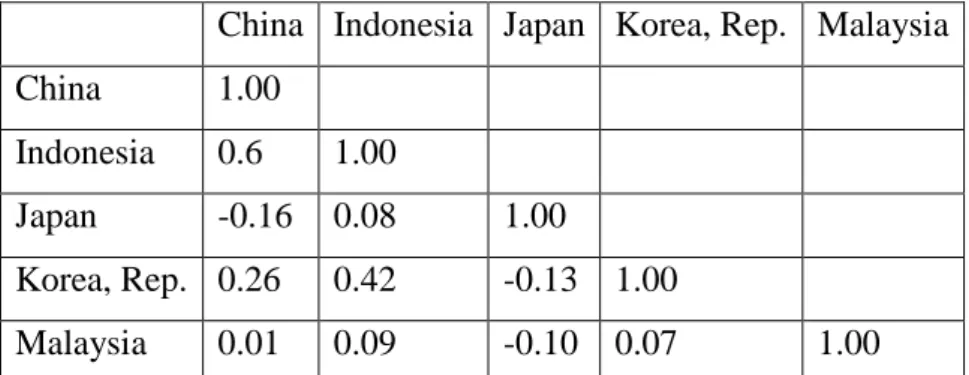
The classical OCA theory advanced several optimality conditions for a group of countries to engage in monetary integration. Generalizing OCA criteria leads to the conclusion that high positive correlation of business cycles is a pre-condition for a shock-less substitution of domestic monetary policies with a common one. Therefore, in order to get a better image of the suitability of Asian countries engaging in such integration, one could take a closer look at correlations of their business cycles over the last few years. A simple empirical investigation on the feasibility of an Asian Monetary Union delivers correlation coefficients of real GDP growth rates for China, Indonesia, Japan, Korea, and Malaysia. Using long time series for real GDP from the GAPMINDER database, correlation coefficients were calculated for three different periods: 1900-1989, 1999-2004, and 1990-2013.
Table 1 Correlation of real GDP growth rates among Asian countries over the period from
1900 to 1990
China Indonesia Japan Korea, Rep. Malaysia
China 1.00
Indonesia 0.6 1.00
Japan -0.16 0.08 1.00
Korea, Rep. 0.26 0.42 -0.13 1.00
Malaysia 0.01 0.09 -0.10 0.07 1.00
55
Table 1 presents correlation coefficients for the longest period considered (1900-1989). It indicates that over the period of 90 years in Asia, business cycles in all countries included in the empirical exercise were neither positively nor negatively correlated. Coefficients that are not significantly different from zero suggest total independence in the way these economies grew over time. However, as empirical investigation advanced with the periods covered, a very new situation was revealed for all considered Asian countries.
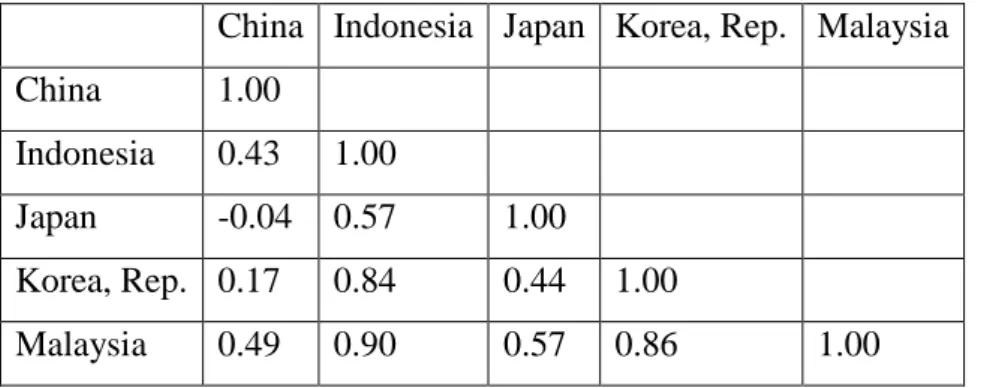
When correlation analysis is restricted to a shorter period - from 1999 to 2004, results (Table 2) seem to indicate a much more pronounced similarity in business cycles, with China and Japan still walking their growth paths independently.
Table 2 Correlation of real GDP growth rates among Asian countries over the period from
1999 to 2004
China Indonesia Japan Korea, Rep. Malaysia
China 1.00
Indonesia 0.43 1.00
Japan -0.04 0.57 1.00
Korea, Rep. 0.17 0.84 0.44 1.00
Malaysia 0.49 0.90 0.57 0.86 1.00
Source: Author, based on GAPMINDER database (www.gapminder.org)
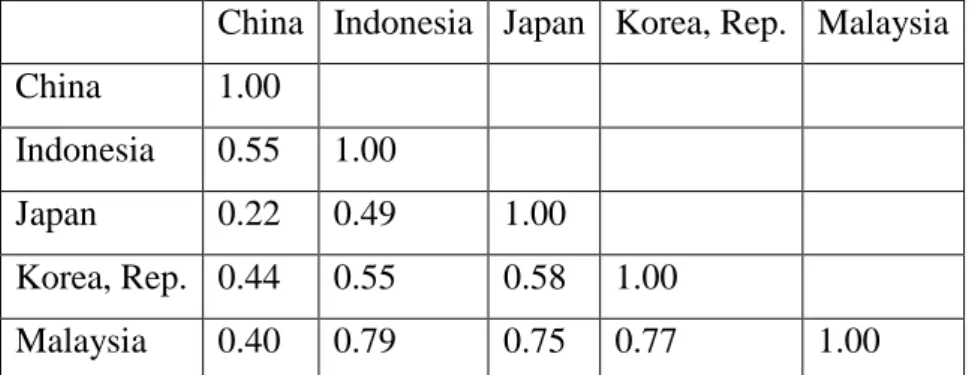
Then, including the most recent period of economic growth up until 2013 (Table 3), shows a new situation. All of the considered national economies achieved a much stronger positive correlation of their respective business cycles over the last 27 years. What may be responsible for such a significant change is a common and similar response to the most recent global financial crisis. However, as surprising as it is to see Japan and China with positive correlations in their business cycles, such a result is a strong supporting argument for potential monetary integration in Asia. Previous negative correlations were a strong argument for opponents of an Asian Monetary Union. These negative correlations provided ammunition to dismiss any ideas of a common monetary policy for the two prominent economies.
56
Table 3 Correlation of real GDP growth rates among Asian countries over the period from
1990 to 2013
China Indonesia Japan Korea, Rep. Malaysia
China 1.00
Indonesia 0.55 1.00
Japan 0.22 0.49 1.00
Korea, Rep. 0.44 0.55 0.58 1.00
Malaysia 0.40 0.79 0.75 0.77 1.00
Source: Author, based on GAPMINDER database (www.gapminder.org)
Indonesia and Malaysia are highly positively correlated, as well as Korea and Malaysia, and Korea and Indonesia. All correlation coefficients seem to drift in the same direction. All of them are statistically significant. Common monetary policy, as is conducted in a monetary union, can be effective and beneficial for all member states as long as it suits them all at the same time. Therefore, it is important to achieve high synchronization of business cycles prior to commencing with monetary integration. Otherwise, monetary policy will generate asymmetric shocks and will be responsible for increased macroeconomic instability. Presented pairs of countries show high and growing similarity in terms of their business cycles. One could even think about the feasibility of small cluster unions, as proposed by Yuen (2000).
Conclusions and Recommendations
There have been cycles in the popularity of monetary integration in Asia for many years. Every time there has been turmoil due to regional crisis or global recession, national governments have abandoned previously worked-out plans for closer regional cooperation. As has been discussed above, any economic integration initiatives, not only in the area of money and monetary policy, require a large dose of political will, international solidarity, and well-devised public marketing campaigns to proceed. These observations flow directly from the European experience and role model created by the EMU in Europe.
An Asian Monetary Union (AMU) is a long-term commitment requiring cooperation among countries that share difficult and painful histories. However, in this regard, potential members of an AMU are not very different from those of European countries. The difficult
57
history of European nations was addressed through appropriate education and diligent arguments supporting integration initiatives. In this way, it became possible to overcome historically developed animosities.
Another conclusion is that designing and implementing a monetary union in Asia would require full time engagement of all stakeholders. Formation of a monetary union in Asia may not be feasible today due reasons presented earlier. However, empirical tests suggest that after a century (1900-2000) of independent economic growth, Asian countries witness real convergence of business cycles. This, in turn, creates a very different situation for a discussion on the feasibility of regional monetary integration. Impediments that previously existed seem to diminish, or even transform into supporting factors.
Economic stability of Asian countries would increase greatly due to monetary integration and an exchange rate regime based on a common basket with a hard peg and later on the creation of a new common currency. Policy formation in small steps and the testing of alternatives seem to be the most probable scenario. Careful and well-informed political decisions have a potential to save Asian countries from potential threats to their stability on their path toward a full monetary union.
Due to the very nature of Asian economies, exchange rate stability remains the central issue for the whole region. Current exchange rate regimes allow national governments to retain some autonomy in their respective monetary policies, but in a highly globalized world, this would become less and less possible. A monetary union is an alternative for achieving external stability, but would cost national governments the loss of ability to shape monetary policy. However, potential benefits may outweigh such costs. The example of the EMU should be used as a reference. European governments seem to do well in a situation where union-wide authority (the European Central Bank) manages the common currency and conducts monetary policy that in fact suits all of member states. In addition to expanding knowledge and understanding the gist of monetary integration among citizens and politicians, governments should invest some of their resources in developing long-term economic integration plans. These schedules should, in turn, include the design of institutional and political infrastructures to facilitate further economic and monetary integration for the sake of Asian nations.
58
Bibliography
Cowen, D., Salgado, R., Shah, H., Teo, L., Zanello A. (2006). Financial Integration in Asia:
Recent Developments and Next Steps [online]. IMF. Retrieved from:
http://www.imf.org/external/pubs/ft/wp/2006/wp06196.pdf [Accessed 10, June 2017]
Eichengreen, B., Bayoumi, T. (1996). Is Asia an Optimum Currency Area? Can It Become
One? Regional, Global and Historical Perspectives on Asian Monetary Relations
[online]. Berkeley, Center for International and Developmental Economics Research. Retrieved from: http://repositories.cdlib.org/cgi/viewcontent.cgi?article=1033 &context=iber/cider [Accessed 10, June 2017]
Hefeker, C., Nabor, A. (2002). Yen or Yuan? China’s role in the Future of Asian Monetary
Integration [online]. Hamburg, Hamburg Institute of International Economics.
Retrieved from: http://www.hwwa.de/Publikationen/Discussion_Paper/2002/206.pdf [Accessed 10, June 2017]
Rajan, R. (2002). Counterbalance: The Euro in Asia [online], Harvard Pacific Asia Review, Retrieved from: http://www.hcs.harvard.edu/~hapr/winter00_millenium/Euro.html [Accessed 10, June 2017]
Takeuchi, F. (2006), Measuring the Costs of an Asian Currency Unit [online]. Tokyo, Japan
Center for Economic Research. Retrieved from:
http://www.jcer.or.jp/eng/pdf/kenho1e.pdf [Accessed 10, June 2017]
Williamson, J. (2005). A currency basket for East Asia: Not just China [online], Institute for International Economics, Retrieved from: http://eldis.org/static/DOC19890.htm [Accessed 10, June 2017]
Yuen, H. (2000). Is Asia an Optimum Currency Area? “Shocking Aspects of
output fluctuations in East Asia [online]. Singapore, National University of
Singapore. Retrieved from: http://nt2.fas.nus.edu.sg/ecs/pub/wp/previous/Hazel.pdf [Accessed 10, June 2017]