西 南 交 通 大 学 学 报
第 55 卷 第 6 期
2020 年 12 月
JOURNAL OF SOUTHWEST JIAOTONG UNIVERSITY
Vol. 55 No. 6
Dec. 2020
ISSN: 0258-2724 DOI:10.35741/issn.0258-2724.55.6.1
Research articleElectrical and Electronic Engineering
3D
M
ULTIPLE
I
NPUT
M
ULTIPLE
O
UTPUT
L
ARGE
-S
CALE
A
NTENNA
S
YSTEMS
3D 多输入多输出大型天线系统
Saif Saad Hameed a, Fouad H. Awad a, Adnan Yousif Dawod b, Ayoob Abdulmunem Abdulhameed c
a College of Computer Science & Information Technology, University of Anbar
Ramadi, Al Anbar, Iraq, [email protected], [email protected]
b
University of Kirkuk Kirkuk, Iraq, [email protected]
c College of Businesses Informatics, University of Information Technology and Communications
Al-Nidhal St., Baghdad, Iraq, [email protected]
Received: April 2, 2020 ▪ Review: July 15, 2020 ▪ Accepted: December 1, 2020
This article is an open-access article distributed under the terms and conditions of the Creative Commons Attribution License (http://creativecommons.org/licenses/by/4.0)
Abstract
The channel could be evaluated by utilizing several estimation algorithms. The various patterns of pilot arrangements for the channel appreciation are a huge problem in channel appreciation techniques since all the processes depends on it; this paper discusses improvements in channel selection. The Least Square and Least Square Mean methods are common, simple ways to begin to estimate a channel; however, they are less efficient than more complex approaches. Due to the boost in demand with high data rates in communications, developers continue to invent new methods and mechanisms to adjust the capacity and the accuracy of the communication network. One of the primary troubles in wireless communication is the communication channel, which is affected by nonlinear and random noise sources, which decrease the quality of the service on the network; in this case, the channel must be equalized to increase performance with minimal error. In this paper, a Massive Multiple Input Multiple Output was designed and simulated in order to estimate the channel and the performance of the network through using Least Square and Least Square Mean.
Keywords: Massive Multiple Input Multiple Output, 5G, 3D Multiple Input Multiple Output, Large-Scale Antenna System
摘要 可以通过利用几种估计算法来评估信道。由于所有过程都依赖于频道欣赏技术,因此各种形
式的频道欣赏试验性安排是一个巨大的问题。本文讨论了渠道选择方面的改进。最小二乘法和最 小二乘均值方法是开始估算信道的常用,简单方法;但是,它们比更复杂的方法效率低。由于对 通信中高数据速率的需求激增,开发人员继续发明新的方法和机制来调整通信网络的容量和准确
性。无线通信中的主要问题之一是通信信道,它受到非线性和随机噪声源的影响,从而降低了网 络上的服务质量。在这种情况下,必须对通道进行均衡,以提高性能并减少错误。本文设计并模 拟了一个大规模多输入多输出,以通过使用最小二乘和最小二乘均值来估计网络的信道和性能。
关键词: 大规模多输入多输出,5G,3D 多输入多输出,大型天线系统
I. I
NTRODUCTIONMultiple-antenna (Multiple Input Multiple Output (MIMO)) technology has become a major element in wireless communications and has been joined into wireless broadband standards, such as LTE and Wi-Fi [3], [10]. Essentially, the more antennas that the TX/RX is prepared with, the more potential signal pathways and the more performance improves in terms of data averages and link reliability [1], [2], [4].
The cost is the accretion intricacy of the hardware (number of RF amplifier frontends) and the joint intricacy and energy-consuming level of the signal processor at the ends [5].
Massive MIMO (as well-familiar as large-scale antenna systems, huge MIMO, hyper MIMO, full-dimension mimo and ARGOS) deviates from the existing practice and uses a large number of antennas (e.g., in matrix or array format) that operate in coherence and adapt accordingly. The added antennas help concentrate the delivery and receipt of the signal energy in the smallest possible spaces [6], [11]. The massive MIMO is the perfect system based on throughput, energy efficiency and system capacity, especially when combined with the simultaneous scheduling of a high number of user stations [7]. The massive MIMO was first used for time division duplex (TDD) operations; however, it could then be utilized for Frequency Division Duplex (FDD) operations as well [8].
Moreover, a massive MIMO comprises of cheap and weak power-consuming components in its structure, with miniature latency, a layer to facilitate media access control (MAC) [9]. A system’s throughput relies on a promulgation environment supplying asymptotically perpendicular channels, and experiments have, so far, not detected any restrictions concerning this.
The challenge of making many low-cost and low-power structures effectively work together to achieve high consumption and the necessity for efficient acquisition schemes can be tackled by reducing the overall internal power consumption to achieve an aggregate energy efficiency decrease, and finding new schemes to provide enhanced performance.
The massive MIMO standard terminal has a supply of a large number of antennas
disseminated around the prime base station to alleviate the effects of fuss, fading, and multi-subscriber confusion [12], [13].
That main facilitator lies in the multi-dimensional arbitrary vectors associated with massive MIMO channels. Further potential benefits of large-scale antenna systems include [14]:
1. Economizing the eradiation of radio frequency (RF) energy for each piece of information conveyed.
2. Facilitating the formation of waveforms that are more agreeable with hardware.
3. Sensitivity to minute degradation stemming from non-linearities and shortcomings in the hardware.
Obstacles pile up around major performance analysis and establishment of massive MIMOs in realistic scenarios. In order to gain a greater understanding of this subject, assistance is required in the following areas:
A. Channel Appreciation for Massive MIMO
Minimizing complications due to [outdated] decoding methods used by massive MIMOs.
Vitality-efficient signal handling for massive MIMOs.
Reducing the effects of hardware weakness at massive MIMOs.
Distribution schemes through massive MIMOs.
Modification of large-scale MIMO systems.
Optimizing network processes at massive MIMOs.
Tests and measurements at massive MIMOs.
Efficient returns techniques in to FDD.
II. P
ROBLEMD
EFINITIONThe increasing demand for a high data rate in communications links regarding quality of service (QoS) parameters keeps developers inventing new methods and techniques to increase the capacity and reliability of communications networks. One of the primary obstacles presented by wireless communication is
3
that its channels are affected by non-linear, random sources of noise. This decreases the quality of the service on the network, meaning that the channel must be equalized to optimize performance and minimize errors.
III. T
HEO
BJECTIVES A. General ObjectiveTo design and simulate a MIMO/ Single Input Single Output (SISO) orthogonal frequency-division multiplexing (OFDM) to assess the performance of the channels as they network. This will be done via two methods: Least Square (LS) and minimum mean square error (MMSE). B. Specific Objectives
Study and analyze the OFDM system.
Study and analyze the MIMO and SISO techniques, and their performance using a mathematical model.
Simulate the system using MATLAB.
IV. C
OMPUTERM
ODELFigure 1. Computer model
V. R
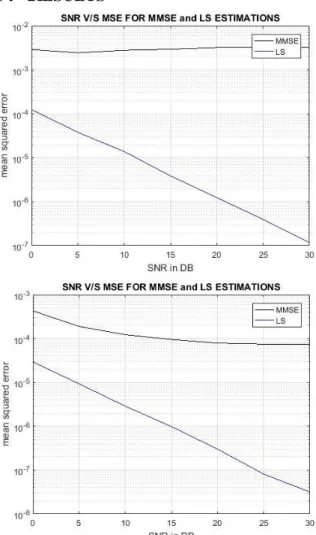
ESULTSFigure 2. Results
VI. C
ONCLUSIONIn this case, the main trouble with wireless communication is the effect of non-linear and random noise sources that lower network service quality; in such cases, channels should be balanced to optimize performance and minimize error. The design and simulation of MIMO/SISO OFDM systems was carried out to assess the performance of their channels, employing two main methods: LS and MMSE.
Channel assessment is one of the difficult aspects of OFDM designing; the patrimonial signal has many effects that cause ionization, refraction, and deviation. Furthermore, movement may change channel response to change quickly. At the receiver, those channel effects must be nullified to recover the original signal. When compared to LS, MMSE was implemented more easily, as its performance metrics are bit-error rate, symbol error average, and mean field.
R
EFERENCES[1]
KHRWAT,
A.S.
(2002)
Channel
Prediction for Limited Feedback Precoded
MIMO-OFDM Systems. IEEE Transactions
on Broadcasting, 48 (3).
[2] VAN DE BEEK, J.-J., EDFORS, O.,
SANDELL, M., WILSON, S.K., and
BORJESSON, P.O. (1995) On channel
estimation
in
OFDM
systems.
In:
Proceedings of the IEEE 45th Vehicular
Technology Conference, Chicago, Illinois,
July 1995. Piscataway, New Jersey: Institute
of Electrical and Electronics Engineers, pp.
815-819.
[3]
PROAKIS,
J.G.
(1989)
Digital
Communications. New York: McGraw-Hill.
[4] HSIEH, M.-H., and WEI, C.-H. (1998)
Channel estimation for OFDM systems based
on comb-type pilot arrangement in frequency
selective fading channels. IEEE Transactions
on Consumer Electronics, 44 (1), pp.
217-225.
[5]
OKADA,
M.,
HARA,
S.,
and
MORINAGA, N. (1993) Bit Error Rate
Performances of Orthogonal Multicarrier
Modulation Radio Transmission Systems.
IEICE Transactions on Communications,
E76-B (2), pp. 113-119.
[6] EDFORS, O., SANDELL, M., VAN DE
BEEK,
J.-J.,
WILSON,
S.K.,
and
BRJESSON, P.O. (1998) OFDM channel
estimation by singular value decomposition.
IEEE Transactions on Communications, 46
(7), pp. 931-939.
[7] COLERI, S., ERGEN, M., PURI, A., and
BAHAI, A. (2002) Channel estimation
techniques based on pilot arrangement in
OFDM systems. IEEE Transactions on
Broadcasting, 48 (3), pp. 223-229.
[8] WEINSTEIN, S. and EBERT, P. (1971)
Data Transmission by Frequency-Division
Multiplexing Using the Discrete Fourier
Transform.
IEEE
Transactions
on
Communications, COM-19 (5), pp. 628-628.
[9] GHAURI, S.A. (2013) Implementation of
OFDM and Channel Estimation Using LS
and MMSE Estimators. International Journal
of Computer and Electronics Research, 2 (1).
[10] REIMERS, U. (1998) Digital video
broadcasting.
IEEE
Communications
Magazine, 36 (6), pp. 104-110.
[11] ZHAO, Y. and HUANG, A. (1997) A
novel channel estimation method for OFDM
mobile communication systems based on
pilot
signals
and
transform-domain
processing. In: Proceedings of the IEEE 47th
Vehicular
Technology
Conference.
Technology in Motion, Phoenix, Arizona,
May 1997. Piscataway, New Jersey: Institute
of Electrical and Electronics Engineers, pp.
2089-2093.
[12]
JIN, S., TAN, W., MATTHAIOU, M.,
WANG, J., and WONG, K.-K. (2015)
Statistical eigenmode transmission for the
MU-MIMO downlink in rician fading. IEEE
Transactions on Wireless Communications,
14 (12), pp. 6650-6663.
[13] NADEEM, Q.-U.-A., KAMMOUN, A.,
DEBBAH, M., and ALOUINI, M.-S. (2015)
A generalized spatial correlation model for
3D MIMO channels based on the fourier
coefficients of power spectrums. IEEE
Transactions
on
Signal
Processing.
Available
from
https://arxiv.org/pdf/1504.05455.pdf
.
[14] NAM, Y.-H., NG, B.L., SAYANA, K.,
LI, Y., ZHANG, J., KIM, Y., and LEE, J.
(2013) Full-dimension MIMO (FD-MIMO)
for next generation cellular technology. IEEE
Communications Magazine, 51 (6), pp.
172-179.
参考文:
[1] KHRWAT,A.S。(2002)有限反馈
预编码多输入多输出-正交频分复用系统
的信道预测。电气工程师学会广播事务,
48(3)。
[2] 范 德 贝 克 ( J.-J 。 ) , EDFORS
( O 。 ) , M 。 SANDELL , S.K 。
WILSON 和 P.O. BORJESSON。(1995)
关于正交频分复用系统中的信道估计。
在:1995 年 7 月在伊利诺伊州芝加哥举行
的电气工程师学会第 45 届汽车技术会议
论文集中。新泽西州皮斯卡塔维:电气与
电子工程师协会,第 815-819 页。
[3] PROAKIS,J.G。(1989)数字通讯。
纽约:麦格劳-希尔。
[4] HSIEH , M.-H 。 和 WEI , C.-H 。
(1998)基于频率选择性衰落信道中梳形
5