INTRODUCTION
Obesity has been increasing worldwide due to changes in lifestyle such as eating habits and a lack of exercise. In the United States, awareness of the economic burden and health consequences as-sociated with the growing obesity epidemic is rising (1). It is known that visceral fat- type obesity induces type - 2 diabetes mellitus, hyperlipidaemia, and hypertension and increases the risk of car-diovascular disease (2, 3). Many researchers have investigated anti - obesity agents as potential therapeutics for decreasing or pre-venting obesity.
Citrus Sudachi is the special local product in Tokushima Pre-fecture, and over 98% of Sudachi consumed in Japan is produced in Tokushima Prefecture. About 8,000 tons of citrus sudachi fruit is produced every year. Half of the fruit is sold on market and half is processed for obtaining juice. In the course of producing juice, about 200 tons of juice residual materials are generated every year. It is known that citrus peel contains various type of functional polyphenols. Therefore, it would be of value to evaluate the func-tion of sudachi peel extract (SPE) for the purpose of effective utili-zation of citrus sudachi peel.
Sudachitin is a polymethxypolyphenol found in citrus sudachi. We have evaluated the function of sudachitin. When mice were fed a high - fat diet and treated with 5 mg/kg sudachitin, gain of body weigh was reduced compared to that in mice fed a high - fat diet only. Fat weight including visceral and subcutaneous fat and serum levels of tryglyceride and cholesterol were also reduced in the sudachitin - treated group. We also examined the mechanism and found that sudachitin increases Sirt1, PGC1 -α and UCP-1 gene expression, resulting in enhancement of energy expenditure (4).
In this study, we examined the function of SPE in mice model. We have already identify anti - obesity effect of sudachitin. How-ever, it is difficult to apply directly to a human study because sudachitin is a single compound as pharmacological medicine and is also expensive. A food supplement containing SPE is sold on the market for human use. Identification of SPE function would be promote human clinical study using a food supplement containing SPE.
MATERIALS AND METHODS
Mice and dietsMale C57BL/6J mice (Japan SLC, Shizuoka, Japan) were main-tained under specific pathogen - free conditions with a 12 - h light : dark cycle at 25!2!!and 55!10% relative humidity. Sudachi peel extract was provided by Ikeda Yakusou Ltd (Tokushima, Japan). Mice without SPE treatment (control group) were given a high - fat diet, a purified ingredient diet with 45 kcal/g fat primarily from lard (no. D12451 ; Research Diets, New Brunswick, NJ, USA). Mice in the SPE group were fed a high - fat diet containing 1% SPE. All experimental procedures were approved by the Animal Research Committee of the University of Tokushima.
Determination of body fat percentage
The percentage of body fat at 12 weeks after starting SPE treat-ment was measured by X - ray computed tomography (CT ; LaTheta ; Aloka, Tokyo, Japan) from the first lumbar vertebra to the pubic bone under isoflurane anesthesia. Data were analyzed using LaTheta software.
Insulin and glucose tolerance test
For insulin tolerance test, mice were intraperitoneally adminis-tered 0.75 U insulin per kg of body weight. For glucose tolerance test, mice were orally administered 1.5 g glucose per kg of body weight. Blood samples were collected from the tip of the tail vein
ORIGINAL
Extracts of citrus Sudachi peel attenuate body weight gain in
C57BL/6 mice fed a high-fat diet
Hitomi Kobayashi1, Mami Mitani1, Yuka Minatogawa1, Satoko Hayashi1, Mariko Nakamoto1, Emi Shuto1,
Yoshitaka Nii2, and Tohru Sakai1* 1
Department of Public Health and Applied Nutrition, Institute of Biomedical Sciences, Tokushima University Graduate School, Tokushima, Japan,2Food and Biotechnology Division, Tokushima Prefectural Industrial Technology Center, Tokushima, Japan
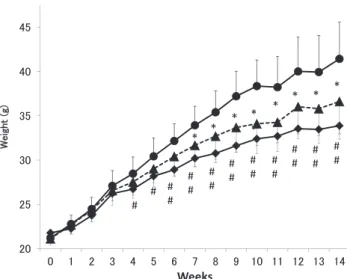
Abstract : Citrus Sudachi is the special local product of Tokushima Prefecture, and over 98%% of Sudachi consumed in Japan every year is produced in Tokushima Prefecture. In this study, we evaluated the function of sudachi peel extract (SPE) using an animal model of obesity. C57BL/6 mice were fed a high -fat diet containing 1%% SPE powder. Treatment with SPE significantly decreased body weight compared to that of mice fed a high -fat diet. A significant difference in body weight was observed between the control and SPE groups from 7 weeks after the start of the experiment, the significant difference continued until the end of the 14-week experiment. Re-duction of blood glucose levels following insulin administration in SPE -treated mice was grater than that in control mice. Determination of mRNA expression in adipose tissue showed that the expression level of TNF -α in the SPE group was significantly decreased compared to that on the control group. These results suggest that SPE potentially has the ability to attenuate body weight gain. J. Med. Invest. 64 : 20-23, February, 2017
Keywords : Citrus sudachi, high-fat diet, inflammation, weight
Received for publication June 30, 2016 ; accepted August 1, 2016. Address correspondence and reprint requests to Tohru Sakai, Depart-ment of Public Health and Applied Nutrition, Institute of Biomedical Sci-ences, Tokushima University Graduate School, 3 - 18 - 15 Kuramoto - cho, Tokushima, 770 - 8563, Japan and Fax : +81 - 88 - 633 - 9427.
The Journal of Medical Investigation Vol. 64 2017
20
at 0, 30, 60, 90 and 120 min after glucose administration. Blood glu-cose levels were measured by the FAD- gluglu-cose dehydrogenase method with a GLUCOCARD GT - 1820 device (ARKLAY, Kyoto, Japan).
Quantitative reverse transcribed (RT)-PCR analysis
Total RNA was isolated from epididymal fat using an RNeasy Lipid Tissue Mini kit (Qiagen Science, MD, USA). First- strand cDNA was reverse - transcribed at 42"!for 60 min and at 95"!for 5 min from 2μg of the extracted total RNA with reverse transcriptase (Invitrogen, CA, USA) and a random primer. Real - time PCR was performed by using specific primers and SYBR green dye (Takara Bio, Shiga, Japan) in a StepOne PlusTMreal - time PCR system
(Applied Biosciences, USA) according to the manufacturer’s in-structions. The primers used were 5 ’-ATGGCCTCCCTCTCATC-AGTT - 3’ (sense) and 5’- ACAGGCTTGTCACTCGAATTTTG-3’ (antisense) for TNF -α, 5’-CCCAATGAGTAGGCTGGAGA-3’ (sense) and 5’-TCTGGACCCATTCCTTCTTG-3’ (antisense) for monocyte chemotactic protein (MCP) - 1, 5 ’-GTGGACCTTCCAG-GATGAGG - 3’ (sense) and 5’-CGGAGCCTGTAGTGCAGTTG-3’ (antisense) for interleukin (IL) - 1β, 5’-ACAACCACGGCCTTCCC-TACTT - 3’ (sense) and 5’-CACGATTTCCCAGAGAACATGTG-3’ (antisense) for IL- 6, 5’-GAGCAGATACAGCAATGCCAG-3’ (sense) and 5’-GACACTGGGGCACTTTTGTT-3’ (antisense) for EGF-like module - containing mucin - EGF-like hormone receptor - EGF-like (emr) - 1, and 5’-CTTCATTGTGGGAGCAGACA-3’ (sense) and 5’-TCTC-CAGAGCTGGGTTGTTC - 3’ (antisense) for 36B4.
Statistics
Data are shown as means and standard deviation. Data were ana-lyzed using one - way analysis of variance followed by the Scheffe post hoc test for multiple comparisons. Data are expressed as means!SD. Differences were considered significant at P!0.05.
RESULTS
Mice fed a high - fat diet showed significantly greater body weight than that of mice fed normal chow. Treatment with SPE signifi-cantly decreased body weight compared to that of mice fed only a
high - fat diet from 7 weeks to the end of the experiment (Fig. 1). Both subcutaneous fat weight and visceral fat weight were deter-mined. SPE treatment tended to reduce both fat weights, but the difference was not significant. Data for body fat percentage were similar to the results for fat weight (data not shown). Next, we in-vestigated blood glucose levels after intraperitoneal insulin and oral glucose administration. Mice treated with SPE showed signifi-cantly lower blood glucose levels at 90 and 120 min after insulin administration (Fig. 2 A). We also evaluated reduction of glucose levels as AUC and found that the AUC value in the SPE group was significantly higher than that in the control group (Fig. 2 B). A sig-nificant difference was not found between the control and SPE groups in blood glucose levels after oral glucose administration (data not shown).
Figure 1. SPE attenuates body weight gain in C57BL/6 mice fed a high - fat diet. Mice were fed a high - fat diet and treated with (triangle) (n = 10) or without SPE (circle) (n = 9). Other mice were fed normal chow (diamond) (n = 5). Data are shown as means!SD.*p!0.05,**p!0.01 for HFD vs SPE. #p!0.05, ##p!0.01 for NC vs HFD.
Figure 2. Treatment with SPE improves responses to insulin. Mice were administered insulin, and blood glucose was determined at 30, 60, 90 and 120 min after the treatment. Circle, high - fat diet (n = 9) ; triangle, high - fat diet plus SPE (n = 10) ; diamond, normal chow (n = 5). (A). Glucose level was also assessed as the AUC value (mg/dl·min). Black bar, normal chow (ND) ; white bar, high - fat diet (HFD) ; hatched bar, high - fat diet plus SPE (S1). (B). Values are means!SD.*p!0.05,**p!0.01.
We evaluated inflammatory status in adipose tissue by quanti-tative RT - RCR analysis. Expression levels of emr - 1 and TNF -α mRNA in mice fed a high - fat diet were significantly higher than those in mice fed normal chow. The expression level of TNF -α was significantly lower and that of emr - 1 was tended to be lower in the SPE group than in the high- fat diet group (Fig. 3). Expression levels of other inflammatory cytokines were also measured, but no significant difference was found between the control and SPE groups (data not shown).
DISCUSSION
We previously found that the citrus flavonoid sudachitin that is present in sudachi peel increases mitochondrial function, resulting in enhancement of energy expenditure. This function is effective for preventing obesity in an animal model. Indeed, treatment with sudachitin at 5 mg/kg body weight improved the serum lipid pro-file and reduced body weight in mice fed a high - fat diet (4). In this study, we examined effect of SPE on body weight in mice fed a high - fat and found that SPE attenuate body weight gain. To our knowledge, this is the first finding that SPE prevents obesity.
SPE contains a large number of constituents. Our analysis showed that SPE contains many polyphenols including hesperidin, nariru-tin, naringenin and sudachitin etc. (Table 1). These components have been shown to have unique physiological actions. Hesperidin is a flavone abundantly found in citrus fruit peel. Glucosyl hes-peridin has been shown to reduce serum TG in several animal models (5, 6) and in subjects with hypertirglyceridemia (7, 8). Glucosyl hesperidin plus caffeine is effective for controlling obesity mediated by the inhibition of hepatic lipogenesis (9). An anti - obestic effect of these combinations has been shown in healthy, moderately obese subjects (10). Naringenin is a predominant flavone in grape-fruit. Naringenin has been shown to have antioxidant, anti - inflam-matory and anti - proliferative activities (11). Furthermore, narin-genin improves obesity - related diseases in mice (12, 13). The results of these studies and our study using sudachitin suggest that citrus fruit peel contains useful components for an anti - obesitic effect. Shinet al. examined the effect of the extract of Prunus mume fruit on obesity - related diseases. They found that the extract of
Prunus mume fruit attenuates the high-fat diet-induced increase in body weight and fat accumulation and improves the impaired fasting glucose levels. An extract of thePrunus mume fruit contains chlogenic acid, caffeic acid, rutin, luteolin - 7 - glucoside, naringin, apigenin - 7 - glucoside and hesperidin (14).
Mice were given a diet containing 1% SPE in this experiment. We chose this dose because feeding of 1% SPE diet can given 5 mg sudatitin per kg body weight. In our previous study, treatment with sudachitin at 5 mg/kg body weight significantly suppressed gain of body weight in mice fed a high - fat diet. In this study using SPE, mice were given 5 mg sudachitin/kg body weight plus other flavonoids including hesperidine, narirutin and naringenin. How-ever, the beneficial effect of sudatichin on obesity is superior to that of SPE. For example, it has been shown that sudatichin treat-ment alone decreases fat accumulation, serum triglyceride and NEFA levels (4). In contrast, treatment with SPE tended to decrease fat accumulation in mice a fed high - fat diet, but the reduction was not significant. We determined mRNA expression levels in adipose tissue and skeletal muscle, which are affected by sudachitin treat-ment, but we did not find any beneficial change (data not shown). It is possible that multiple flavonoids counteract their physiological actions, resulting in the appearance of phenotype observed in this study.
SPE significantly attenuated body weight gain in mice fed a high - fat diet but did not significantly reduce subcutaneous fat weight and visceral fat weight. However, treatment with SPE tended
Figure 3. SPE suppressed inflammatory response in adipose tissue from mice fed a high - fat diet. RNA was purified from adipose tissue of mice in the control and SPE groups. Expression levels of emr - 1 (A) and TNF -α (B) mRNA were quantified by using a real-time PCR system as described in the materials and methods section. Black bar, normal chow (ND) (n = 5) ; white bar, high - fat diet (HFD) (n = 9) ; hatched bar, high - fat diet plus SPE (S1) (n = 10). Values are means!SD.*p!0.05,**p!0.01.
Table 1 Contents of flavnoides in SPE (g/100 g SPE powder) Hesperidine 3.7 Narirutin 2.3 Naringenin 1.7 Neohesperidine 1.5 Sudachitin 1.2 Rutin !0.5 mg Tangeretin !0.5 mg Nobiletin !0.5 mg
to reduce both subcutaneous fat weight and visceral fat weight (data not shown). Reduction of weight gain might be an additive reduction of both subcutaneous fat weight and visceral fat weight. We did not determine the mechanism for reduction of body weight gain by SPE treatment. As stated previously, SPE contains many flavonoids and some of these flavonoids have been shown to have anti - obesity action. We were not able to determine what ingredient is effective. However, we found that SPE has a beneficial effect in mice fed a high - fat diet. Our finding raises the possibility that sudachi peel is applicable for a food supplement. The devel-opment of a method for effective utilization of sudachi peel would be economically valuable for Tokushima Prefecture.
CONFLICT OF INTEREST
The authors declare they have no conflict of interest.
ACKNOWLEDGEMENTS
This work was supported by the Local Innovative Cluster Initia-tive Grant from the Ministory of Education, Culture, Sport, Science and Technology of Japan and Kieikai Research Foundation.
REFERENCES
1. Finkelstein EA, Khavjou OA, Thompson H, Trogdon JG, Pan L, Sherry B, Dietz W : Obesity and severe obesity forecasts through 2030. Am J Prev Med 42 : 563 - 570, 2012
2. Hunt KJ, Resendez RG, Williams K, Haffner SM, Stern MP, Study SAH : National Cholesterol Education Program versus World Health Organization metabolic syndrome in relation to all - cause and cardiovascular mortality in the San Antonio Heart Study. Circulation 110 : 1251 - 1257, 2004
3. Lakka HM, Laaksonen DE, Lakka TA, Niskanen LK, Kumpusalo E, Tuomilehto J, Salonen JT : The metabolic syndrome and total and cardiovascular disease mortality in middle -aged men. JAMA 288 : 2709 - 2716, 2002
4. Tsutsumi R, Yoshida T, Nii Y, Okahisa N, Iwata S, Tsukayama M, Hashimoto R, Taniguchi Y, Sakaue H, Hosaka T, Shuto E, Sakai T : 2014. Sudachitin, a polymethoxylated flavone, im-proves glucose and lipid metabolism by increasing mitochon-drial biogenesis in skeletal muscle. Nutr Metab (Lond) 11 : 32, 2014
5. Akiyama S, Katsumata S, Suzuki K, Nakaya Y, Ishimi Y, Uehara M : Hypoglycemic and hypolipidemic effects of hesperidin
and cyclodextrin - clathrated hesperetin in Goto - Kakizaki rats with type 2 diabetes. Biosci Biotechnol Biochem 73 : 2779 -2782, 2009
6. Chiba H, Uehara M, Wu J, Wang X, Masuyama R, Suzuki K, Kanazawa K, Ishimi Y : Hesperidin, a citrus flavonoid, inhibits bone loss and decreases serum and hepatic lipids in ovariec-tomized mice. J Nutr 133 : 1892 - 1897, 2003
7. Miwa Y, Mitsuzumi H, Sunayama T, Yamada M, Okada K, Kubota M, Chaen H, Mishima Y, Kibata M : Glucosyl hes-peridin lowers serum triglyceride level in hypertriglyceridemic subjects through the improvement of very low - density lipo-protein metabolic abnormality. J Nutr Sci Vitaminol (Tokyo) 51 : 460 - 470, 2005
8. Miwa Y, Yamada M, Sunayama T, Mitsuzumi H, Tsuzaki Y, Chaen H, Mishima Y, Kibata M : Effects of glucosyl hesperidin on serum lipids in hyperlipidemic subjects : preferential re-duction in elevated serum triglyceride level. J Nutr Sci Vitaminol (Tokyo) 50 : 211 - 218, 2004
9. Ohara T, Muroyama K, Yamamoto Y, Murosaki S : A combination of glucosyl hesperidin and caffeine exhibits an anti -obesity effect by inhibition of hepatic lipogenesis in mice. Phytother Res 29 : 310 - 316, 2015
10. Ohara T, Muroyama K, Yamamoto Y, Murosaki S : Oral intake of a combination of glucosyl hesperidin and caffeine elicits an anti - obesity effect in healthy, moderately obese subjects : a randomized double - blind placebo - controlled trial. Nutr J 15 : 6, 2016
11. Yoshida H, Watanabe H, Ishida A, Watanabe W, Narumi K, Atsumi T, Sugita C, Kurokawa M : Naringenin suppresses macrophage infiltration into adipose tissue in an early phase of high - fat diet- induced obesity. Biochem Biophys Res Com-mun 454 : 95 - 101, 2014
12. Assini JM, Mulvihill EE, Sutherland BG, Telford DE, Sawyez DG, Felder SL, Chhoker S, Edwards JY, Gros R, Huff MW : Naringenin prevents cholesterol - induced systemic inflamma-tion, metabolic dysregulainflamma-tion, and atherosclerosis in Ldlr−/−
mice. J Lipid Res 54 : 711 - 724, 2013
13. Mulvihill EE, Assini JM, Sutherland BG, DiMattia AS, Khami M, Koppes JB, Sawyez CG, Whitman SC, Huff MW : Narin-genin decreases progression of atherosclerosis by improving dyslipidemia in high fat fed low density lipoprotein receptor -null mice. Arterioscler Thromb Vasc Biol 30 : 742 - 748, 2010 14. Shin EJ, Hur HJ, Sung MJ, Park JH, Yang HJ, Kim MS, Kwon
DY, Hwang JT : Ethanol extract of the Prunus mume fruits stimulates glucose uptake by regulating PPAR -γ in C2C12 myotubes and ameliorates glucose intolerance and fat accumulation in mice fed a high fat diet. Food Chem 141 : 4115 -4121, 2013