Keywords : Corpus linguistics, smart, intelligent, lexical priming
1 Introduction
This paper will focus on the uses ofsmart and intelligent . The initial reason for choosing these two adjectives centred on my intuitive understanding of how smart is used and what I regarded as inaccurate use by my Japanese students. After consulting British and American dictionaries I discovered that my intuition was not accurate. Once I began to investigate these two words in the Bank of English (BoE) I further discovered that these two synonyms are less similar and more complex than what I had previously assumed.
This paper will first provide a brief overview of the literature of corpus linguistics with particular attention to intuition, collocation, semantic prosody, and lexical priming. This is followed by an analysis ofsmart and intelligent across the subcorpora that make up the BoE corpus. Then this paper will split into two separate discussions, one onsmart and the other on its synonym in-telligent . Each discussion will focus on different aspects of corpus linguistics. Finally, I will briefly introduce a possible analytical tool for rare collocations. Due to the breadth of this topic and the limitations of this paper I will only be able to touch on a few of the many issues within corpus linguistics in general and withsmart and intelligent in particular.
of
smart
and
intelligent
Michael IWANESALOVAARA
PartⅠ
2 Literature Review
2.1 Intuition and corpus linguistics
The advent of computers has radically changed the nature of corpus linguis-tics by transforming a painstakingly slow cataloguing and indexing process that took lifetimes to complete into a near instantaneous production of corpus data only dreamed of a generation ago (Kennedy 1998: 57). Before the com-puter the most relied upon tool, and at that time perhaps the most reliable, was human intuition. This reliance on intuition may partly explain Chomsky stating in 1965:
The structural descriptions assigned to sentences by the grammar, the distinctions that it makes between well−formed and deviant, and so on, must, for descriptive adequacy, correspond to the linguistic intuition of the native speaker (whether or not he may be immedi-ately aware of this) in a substantial and significant class of crucial cases. (Chomsky 1965: 24 cited in Hunston and Laviosa 2001: 1081) ; emphasis added)
With the development of powerful computers and the establishment of mega−corpora, Rampton (1990) challenges the Chomskian notion that being a native speaker automatically endows that speaker with the expertise to in-tuitively describe language. Expertise is something granted by an institution and can more readily be assessed and challenged by others (Rampton 1990: 99). For the language learner, expertise more clearly defines the parameters of the body of knowledge to be acquired while the intuition of the native speaker makes it difficult for the learner to assess the competence of the teacher and the reliability of what is being taught (ibid .).
EFL learners can be in a situation where they have to mediate between the native speaker descriptions of language on one hand and the expert
scriptions found in grammar books −− a process that can undermine the credi-bility of the teacher. Hunston (2002: 2021) lists several areas where intuition is particularly unreliable .
!judgements about collocations: adverb−adjective collocates are more difficult to intuit than verb−noun collocates.
!judgements about frequency: it is difficult to intuitively sense which wordsmart or intelligent is more frequent.
!semantic prosody and pragmatic meaning : in other words, it is not easy to see the macro patterns revealed by a corpus from a micro and intui-tive perspecintui-tive.
!details of phraseology: the difficulty in explaining why a phrase may seem a bit off or unnatural.
Of course this is not to say that intuition is not useful or necessary when doing corpus−based research. Hunston goes on to list where intuition is re-quired (Hunston 2002: 2223)
!Where a corpus provides information on frequency, intuition is required to determine whether something is possible .
!Conclusions derived from evidence are corpus specific and are not nec-essarily facts about language or register.
!Intuition is required to interpret the evidence offered by a corpus. !Corpus data are out of the spatial context from which they are derived. In sum, intuition and a corpus are two of the many tools required in lan-guage study (Hunston 2002: 23). Recognising patterns involves intuition and judgement as well as simple observation (Hunston and Laviosa 2001: 37) or, as Hoey (2005: 30) puts it, intuition that is primed .
2.2 Collocation
Firth (1957) is generally credited for introducing collocation as a technical −75−
term and defined it statements of the habitual or customary places of [a] word (1968: 181 cited in Xiao and McEnery 2006: 105). While Sinclair defines collocation simply as the occurrence of two or more words within a short space of each other in a text (1991: 170;cf Sinclair 2003: 173) others empha-sise frequency or co−occurrence (Hunston 2002: 68; Hoey 2005: 3; Xiao and McEnery 2006: 105).
The notion of co−selection (Sinclair 2003: 174) identifies words that stand complete and do not require other words to complete the meaning, of which there are two types: selective and focusing. Theselective type of co−selection is the familiar relationship between an adjective and the noun it modifies where the noun designates the set and the adjective the subset (Sinclair 2003: 178) (i.e sky: blue sky, cloudy sky, etc.). In other words, the adjective and noun phrase has a single meaning while thefocusing type of co−selection focuses on an aspect of the noun which may appear to be redundant (i.e. physical ac-tivity, physical injury) (2003: 36, 175).
Sinclair (1991: 115) identified two types of collocations: upward and down-ward. Collocates with a higher frequency than the NODE are upward colloca-tions and tend to bring out phraseological features, features of characteristic usage (Danielsson 2003: 118). Collocates with a lower frequency are downward collocations which tend to bring out semantic features and is more informa-tive than upward collocations (Danielsson 2003: 118).
The idiom principle as defined by Sinclair is the apparently simultaneous choice of two words (1991: 110) or more where one decision leads to more than one word (1991: 111). Sinclair added that normal texts operate mostly on theidiom principle relying on the open −choice principle whenever there is a good reason (1991: 114). Unexpected choices are evidence of a switch from the idiom principle to the open −choice principle (ibid .). An example of the idiom principle is beautiful woman while the title of Leonard Cohen s novel
Beautiful Losers (1966) exemplifies the open −choice principle .
Applying Sinclair s open−choice and idiom principles to normal texts which contain mostly expected choices does not clearly define what is nor-mal or expected . Also what is expected may not be found in the data par-ticularly when gender is introduced. In other words, what is said about women may not be said about men and vice−versa. At some point what is expected, like intuition, fails to provide adequate guidance (see section 3.4.2 Gender).
2.3 Semantic Prosody
Semantic prosody goes beyond the intuitive and impressionistic level and the individual collocation by identifying pattern[s] of collocations revealed in a corpus (Cotterill 2003: 291). Using a corpus to identify semantic prosody is invaluable since it permits large−scale searches for patterns of word behav-iour to identify racism, sexism and asymmetry (Cotterill 2003: 292). Hunston (2002: 120) discusses semantic prosody as a subtle means of constructing oth-erness (c.f. Caldas−Coulthard and Moon 1999 sexism; Krishnamurthy 1996 racism) or introducing a contagion (Danet 1980 cited by Cotterill 2001: 294) in order to perpetuate a stereotype or manipulate an audience as in the O.J. Simpson murder trial (Cotterill 2001).
When it comes to gender distinctions Hunston (2003: 121) postulates that findings suggest that women and men are construed differently in popular media thus affirming [the] inequality between the genders in society. She refers to contrasting lists of adjectives applied to women and men compiled by Caldas−Coulthard and Moon (1999) and identifies a problem in interpreting the results; does one assume sexism exists in the data and search for it or does the data reveal sexism (Hunston 2002: 121)? The caution she offers is to be clear on the steps taken between what is observed and the interpretation placed on those observations (2002: 123). It remains a challenge to identify
the subtlety of semantic prosody within a body of decontextualised concor-dance lines while keeping one s bias − ideological or personal − in check.
2.4 Lexical Priming
Collocation gives semantic prosody content or semantic prosody gives collo-cation its form. Whitsitt argues that the act of observing semantic prosody is in fact an emptying of meaning from the item under observation (2005: 293). However, according to the prosodists meaning is unidirectional from collo-cation to empty word form; Whitsitt argues for the plausibility of meaning going in both directions (Whitsitt 2005: 295 also see n.16). This is a position I also accept.
2.4.1 Definition of Lexical Priming
Collocation challenges the traditional theory that lexical item as an isolated element organised by syntax, realised by phonology, and latterly cross−refer-enced by text (Hoey 2003) and consequently the Chomskian view that gram-mar is generated first as well as Pinker s emphasis on the primacy of mean-ing or semantics (Hoey 2005: 1). By focusmean-ing on collocation and naturalness Hoey (2005: 2) inverts the traditional hierarchy and argues that lexis is the foundation from which grammars and meaning are outputted (2005: 9). The interlocking and pervasive character of collocations is fundamental to sen-tence construction (Hoey 2003) and a key to creating a natural text (c.f. Hoey s (2005: 57) discussion of a Bill Bryson excerpt). Because collocations are per-vasive they are also subversive with each lexical item primed for collocational use (Hoey 2003) and accounts for the [recurring] co−occurrence of words (2005: 7).
It is at this point that Hoey seems to have stepped away from semantic prosody in favour of connecting prosody with the knowledge a person has in
recognising that two words such asmurder and commit collocate (Whitsitt 2005: 297).
In the example ofbeautiful woman , Hoey might argue, there is no seman-tic explanation as to whybeautiful co−occurs with woman ten times more frequently than withman2)
. As Whitsitt (2005: 298) argues, there may be se-mantic reasons why words collocate however they ignore the role experience plays in priming the words to collocate the way they do. For example the connection between woman and beautiful has been repeated endlessly in art, literature, music, advertising and popular culture, etc. and therefore has beenprimed in our minds to naturally collocate in a way that Beautiful Los-ers (Cohen 1966) does not − or at least did not before Cohen wrote his novel. While semantic prosody involves the imbuing of meaning from one word form to another (Louw 1993: 157;c.f. Whitsitt 2005: 288) semantic asso-ciation is the assoasso-ciation of words (not forms) or word sequences in the mind of the language user (Hoey 2005: 24). This seems to imply that the language user has greater linguistic autonomy in terms of meaning than in the gram-mar and semantic based theories of language. To borrow from Louw, mean-ing is imbued to a collocation from the mind of the language user rather than from between word forms. However the autonomy of the language user de-pends on how primed the user is. For example creative writers and speak-ers can be regarded as being more autonomous than the general populous.
2.5 Summary
Finding the evidence of the movement of meaning within a corpus is relatively straightforward; determining how or why meaning moves is much more dif-ficult. One of the problems identified by Whitsitt (2005: 295) has to do with the language used to talk about language, specifically the metaphors used, which in themselves can hinder and limit research through imprecision.
ever, patterns do emerge and determinations are made and knowledge is ex-panded. Hoey s development of lexical priming stems from his earlier work on semantic prosody.
PartⅡ
3 Discussion:smart and intelligent
I have chosen to analysesmart and intelligent for four reasons. First, I had intuitively regarded these words as basically synonymous. Even though I had been aware thatsmart could be used to describe the appearance of a person or thing, I had assumed this usage to be dated and falling out of circulation thus creating a tautology based on my usage and extrapolating that to Eng-lish usage generally. Second, in my experience most Japanese speakers of English seem to usesmart to refer to appearance more frequently than na-tive speakers of English. Third, typically I would point out to my students that smart is a synonym of intelligent . So I wanted to confirm what I had been teaching. Finally, after reading the presentation notes prepared by Caldas− Coulthard and Moon (1999) I became curious about the use ofintelligent and gender. In particular how meaning can change in two−adjective descriptions of women and men.
3.1 Dictionaries (see Appendix 1)
While the American Longman Dictionary of Contemporary English Online shows that my understanding of smart is biased toward American usage3) , the OALD 7th
Ed. clearly contradicts my assumptions regardingsmart . Also, thoughsmart and intelligent are synonyms, smart has a much wider range of meaning and usage, which I will now discuss.
Corpus smart intelligent
British 7,837 (80%) 5,448 (78.6%)
American 1,946 (20%) 1,481 (21.4%)
9,783 6,929
Table 1 Frequency ofsmart and intelligent
3.2 Bank of English (BoE)
For this research I accessed the Bank of English (BoE) using telnet . Since part of my research involves examining British and American usage I decided not to include the Australian oznews and Canadian strathy corpora. Also the initial results revealed that the large volume of concordance lines required a culling of the corpus.
3.2.1 Culling the corpus
Investigation of the frequency values of each corpus revealed that among the British corpora the brmags corpus provided about 28% (2,118) of the concor-dance lines forintelligent (7,566) due to a large volume of personal ads seek-ing companionship. However, these repetitive and formulaic ads (c.f. Stubbs 2001) do not conform to what Sinclair would have called normal text nor are the lexical choices expected outside this specialised genre so I decided to exclude brmags from my analysis. The frequency ofsmart and intelligent in each corpus are in Table 1.
Finally, one problem similar to that related to the personal ads problem is the repeated lines from within and throughout the media corpora which I have not resolved. On one hand, the spread of a particular line ensures more people read it, but only one source (writer, editorial team, ad agency, etc.) wrote it. This contrasts with other written materials which are published once
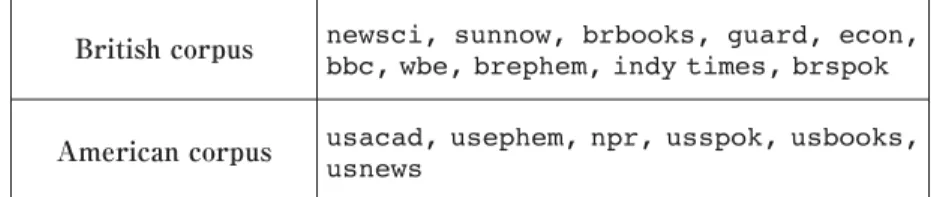
British corpus newsci, sunnow, brbooks, guard, econ,bbc, wbe, brephem, indy times, brspok
American corpus usacad, usephem, npr, usspok, usbooks,usnews
Table 2 British and American subcorpora
and tend not to produce very many repeated concordance lines. I have tried to remove all repeated concordance lines, but I am not sure the resulting fre-quency figures signify anything more than general trends of usage.
The sub−corpora used throughout this paper are as follows:
3.2.2 Characteristics ofsmart in the corpora
A trend found in the newsci corpus shows smart moving away from the dictionary−identified British usage of describing fashion, intelligence, and tech-nology to almost exclusively referring to techtech-nology (see Appendix 2). The rough equivalent in the American corpus (usacad) displays a wider usage to include people, behaviour, and non−technology−based things (see Appendix 3). While both are academic corpora, I suspect this difference has little to do with them being either British or American. Instead they reflect the range of data collected from national and international sources. The science based newsci corpus is naturally more specialised than the wider ranging usacad corpus.
Unlike the brmags corpus, the newsci corpus is included in the larger British corpus because technology is a significant subcategory across all cor-pora and more importantly it is relevant to many of my Japanese business and engineering students who study ESP.
One unexpected discovery (see Appendix 4) is wide fluctuation in the number and range of evaluative collocates there are in the British corpora
from under 15 (brephem 6, newsci 8, wbe 10, econ 12, bbc 15) to over 25 (brspok 26, times 27, brbooks 32). The American corpus is does not fluc-tuate as widely. The notable exception is the usspok subcorpora which is a significantly smaller corpus overall and only 20 concordance lines forsmart . A further difference can be found between the bbc and the npr subcor-pora. The bbc subcorpus has a narrower evaluative range than the npr sub-corpus. This seems to reflect the differences in usage where, as I will show, the British usesmart more negatively with people whereas in American us-agesmart replaces intelligent and is used more positively.
3.3 Analysis ofsmart
I have restricted my analysis to only nouns in the R 1 position and have placed them into the following categories: animates; behaviour; inanimates: technol-ogy, business, etc.; inanimates: style.
Overall the British corpus (see Appendix 2) could be divided into two sub −categories: people; colloquialisms. The people category includes smart peo-ple , smart women , smart guy . The colloquial category includes smart arse , smart ass , smart alec . These colloquialisms and their derivatives are com-mon throughout the individual corpora though none were found in the bbc, wbe, and econ subcorpora. This perhaps reflects the more conservative nature of these media. Other colloquial expressions in the individual subcorpora were smart cookie and smart cookies . A third category not in the British corpus but evident in the individual subcorpora is position i.e. lawyer, businessman, users, etc.
The table below provides a statistical sketch ofsmart in the British cor-pora.
Category British R 1 noun collocates of!smart (1,617 lines) animates
14.3% (232 lines) people, set, alec, arse, ass, guy, alecs, aleck behaviour
14.3% (231 lines) moves, move, talk thing, form, turn, way inanimates: technology,
business, etc. 55.2% (892 lines)
cards, card, money, bombs, car, drugs, weapons, cars, socket, bomb, idea, tags
inanimates: style 16.2% (262 lines)
materials, suit, clothes, restaurant, suits, city, res-taurants, London, hotels, hotel
Table 3 British corpus: smart+R 1
Category American R1 noun collocates of!smart”(377 lines)
animates 39% (147 lines)
people, ass, guy, aleck, set, ones, women, man, girl, person, woman, consumer, shopper, rats
behaviour
17.2% (65 lines) thing, move, way, choice, alecky, investing, values, inanimates: technology,
business, etc. 42.2% (159 lines)
bombs, valley, bomb, money, weapons, marketing, cars, investment, highways, station, financial, pills inanimates: style
1.6% (6 lines) looking Table 4 American corpus: smart+R 1
The table below provides a statistical sketch ofsmart in the American cor-pora.
3.3.1 British and American Nouns: Similarities and Differences
A comparison of the R 1 nouns found in the t−score pictures of the British −84−
and American corpora shows usage patterns that match the dictionary defi-nitions outline above (see Appendix 2). There are similarities in the frequency ratio in referring tosmart behaviour even though the specific collocates show some differences. Both corpora show frequent use ofsmart to refer to tech-nology and business with military and money dominating the frequency list. Significant differences are found in reference to the animates (i.e people and other living things). The British corpus reveals a tendency to use nouns that generally have a negative evaluation (smart alec , smart arse , smart ass , smart alecs , smart alec ) and while the American corpus shares some of the same negatively evaluated nouns it also has a wider range of positively evalu-ated nouns (smart people , smart guy , smart set , smart ones , smart women , smart man , smart girl , smart person , smart woman , smart con-sumer , smart shopper ).
The main difference is the use ofsmart to refer to style. While British references tosmart style cover a wide range of things (i.e. clothes , buildings , shops , cities ), the American corpus has only a single reference to appearance (smart looking ).
I did not expect the absence ofsmart referring to someone s physical appearance. Among the Japanese learners of English we often hear smart used to describe a person s body shape or size. For example I have had many conversations that go something like this:
Learner : She issmart .
Interlocutor : You mean she is clever?...intelligent ? Learner : No, she lookssmart ... slim.
Although the above conversation is a simulation, it does contain a fairly common ambiguity in Japanese learners speech when using smart , which is noted by a clarifying question by the interlocutor.
1. She is smart.
6. Kitajima is a smart swimmer. 9. She is a smart student. 13. You are looking very smart.
Agree (39) Disagree (1) Agree (37) Disagree (3) Agree (38) Disagree (2) Agree (33) Disagree (7) Table 5 Japanese learner Agree/Disagree
3.3.2 Learnersmart survey
After talking with Japanese friends, colleagues and students to confirm that their use ofsmart does include references to body shape and size. I conducted a paper survey among my students (see Appendix 5).
The subjects of this survey were English majors at a Japanese women s university I taught at. Their English language abilities ranged from high be-ginner (over TOEIC 300) to intermediate (under TOEIC 500) with most being in the high beginner to low intermediate range (TOEIC 350450).
With above mentioned ambiguity in mind I preselected four target sen-tences. The first 2 sentences were intended to reveal that ambiguity among Japanese learners while the latter 2 sentences were intended to confirm their understanding of the other main meanings ofsmart . They were embedded in a list of 15 sentences on the assumption that students at all levels would most likely recognise these 4 sentences as valid and meaningful4)
. The results (Table 5;cf Appendix 4) indicate that this assumption was reasonable.
The students where then asked to choose which definition they think smart refers to. The results (Table 6) confirmed the ambiguity in understand-ing sentences 1 and 6 and the relative clarity of sentences 9 and 13.
intelligent body
shape/size style
1.She is smart. 20 10 9
6.Kitajima is a smart swimmer. 13 17 9
9.She is a smart student. 33 4 2
13.You are looking very smart. 9 12 18
Table 6 Learner usage ofsmart
body shape/size : always23.7% most of the time34.2% sometimes18.4% rarely18.4% never5.3%
style: always32.4% most of the time21.6% sometimes24.3% rarely18.4% never2.7%
intelligent: always
10.8%
most of the time 27.0% sometimes 24.3% rarely 35.1% never 2.7%
Table 7 Howsmart is used by Japanese learners of English
The third part of the survey (Table 7) was to get picture of howsmart is used by these students. According to the survey my students usedsmart to refer to body shape or size 57.9% of the time; style 54%; intelligent 37.8%.
This survey is only intended to show the presence of a usage trend. Fur-ther investigations are required to investigate usage patterns in particular the prominence ofsmart in learner English compared with its use in Japanese as a borrowed word.
3.3.3 Summary
This analysis of R 1 nouns is very brief and is meant only to outline the differ-−87−
ences between British and American usage ofsmart as well as identify a Japa-nese usage.
From the corpus evidence there seems to be a greater tendency in Brit-ish EnglBrit-ish to usesmart negatively when referring to people while American usage is generally more positive.
The unexpected result of Japanese English learners having their own usage ofsmart merits further investigation. What seems to be happening is that smart , as a borrowed word in the Japanese language, is being filtered back into their spoken English with additional meaning tacked on.
3.4 Analysis ofIntelligent
I was intrigued by the presentation by Caldas−Coulthard and Moon (1999) which did a gender analysis of adjectives in British newspapers. What drew my attention was that intelligent was used to describe only women. This raised several questions. Was it understood that men were intelligent and therefore it was not necessary to mention it? If that was the case, how did the reporters consider women? I do not intend to directly answer those ques-tions in this paper, but they have spurred me to examine what adjectives are used to describe women and men.
First, a survey of which nounsintelligent collocate with in the British and American corpora (see Appendix 6 a, 6 b). The nouns have been divided into four categories in both corpora: animates: human; animates: non−human; behaviour; and, inanimates. Only nouns in the R 1 position were analysed. The results of the two corpora can be seen in these two tables below.
Category R 1 noun (43 collocates) animates: human
52.7% (664 lines)
man, people, woman, person, women, men, agents, player, girl, face, agent, consumer, child, reader, eyes, footballer, boy, lad, adults
animates: nonhuman
12.1% (152 lines) life, beings, animals, creatures behaviour
12.3% (155 lines)
behaviour, debate, use, questions, conversation, way, interest, decisions
inanimates 23% (289 lines)
finance, machines, agents, pads, agent, football, ro-bots, environments, software, transport, thing, pro-duction
Table 8 British corpus − intelligent +R 1 nouns
Note:agent and agents refer to both people and things.
Category R 1 noun (35 collocates)
animates: human 51.1% (179 lines)
people, man, woman, men, person, women, guy, con-sumer, girl, eyes, students, he
animates: nonhuman 26.9% (94 lines)
life, beings, alien, species, creatures, animals, sub-jects, animal
behaviour 13.4% (47 lines)
choice, questions, decisions, behaviour, use, conver-sation, thought, way, guessing
inanimates
8.6% (30 lines) machines, pitch, design, film, energy Table 9 American corpus − intelligent +R 1 nouns
3.4.1 British and American Nouns: Similarities and Differences
When referring to other people both corpora show evidence that British and −89−
American speakers useintelligent about half the time. A significant difference is that in the British subcorporaintelligent is often used with sport (agents, agent, player, footballer) while the American subcorpora collocate around work or avocation (businessman, chef, historian, poet). However the top six collocates are the same (albeit in different order).
The range of collocates for non−human animates is doubled in the Ameri-can corpus (8 collocates) as is the frequency of use (26.3%). Even when the 8 collocates are used to search the British corpus there is only a slight increase of 12 additional lines.
While the behaviour category shares many similarities in terms of fre-quency and collocates, the differences are quite interesting. While one would assume that the concept of an intelligent debate is a widely held discourse goal there is no mention of it in the American corpus. In fact with respect to debate , the only evaluative collocates in the American corpus point to confrontation (heated , intense , bitter, considerable , lively , fierce , vigorous , acrimonious , open , divisive , spirited , ongoing ). While the British corpus does include confrontational debates (heated , fierce , lively , etc.) it also contains positively evaluated collocates that indicate depth (serious , real , intellectual ). The other collocate found only in the British corpus isintelligent inter-est . At first this collocation struck my non−British ears as being redundant. However, sinceinterest also collocates with high , little , keen , nominal, and academic (to list only a few), intelligent interest makes sense. One explana-tion why it seems somehow incorrect is that I have yet to be primed (Hoey 2005) to use it.
Overall, the British corpus indicates a wider, more common application than the American corpus. This seems to complement the generally positive and wide use ofsmart in American English.
Total # of concordance lines occurrence of intelligent at L 2 occurrence of intelligent at L 1 JJ+and+JJ+woman|women 626 16 (2.6%) 17 (2.7%) JJ+and+JJ+man|men 1,081 24 (2.2%) 17 (1.6%) JJ+JJ+woman|women 4,531 30 (0.7%) 27 (0.6%) JJ+JJ+man|men 8,903 30 (0.3%) 23 (0.3%)
Table 10 Survey of two−adjectives and of intelligent with woman/women and man/men
3.4.2 Gender: adjectives +intelligent
Due to the relatively low overall number of concordance lines involved with this particular discussion both the British and American corpora as defined above will now be combined.
To placeintelligent in relation to other adjectives in positions L 1 and L 2 I did a general survey using the search strings JJ+and+JJ+woman|women and JJ+and+JJ+man|men (Appendix 7 a) as well as JJ+JJ+woman|women and JJ+JJ+man|men (Appendix 7 b). Though there were some surprises (i. e. the high frequency of adjectives describing male sexual orientation) intelli-gent (with the conjunction and ) ranked in the top 5 for both genders. How-ever, without the conjunctionand there is a significant drop in rank (Appen-dices 8 a, 8 b) and ratio while the number of occurrences rose (Table 10).
There is much to be said about the data. I will, however, focus on only one of the interesting patterns.
3.4.2.1 Unexpected expected choice ?
Sinclair s idiom principle centres on expected choice (1991: 114), however looking at the adjective collocates for intelligent (woman, women, man, men) I have noticed what is not there as much as what is there.
For example, there are numerous concordance lines wherepowerful col-locates with woman (67), women (82), man (289) and men (192). However there is only one concordance line wherepowerful collocates with intelligent men .
minister since the war. Intelligent and powerful men accepted There is no evidence ofpowerful collocating with intelligent woman /women . Similarly, there are numerous concordance lines wheresuccessful collocates with woman (38), women (84), man (46) and men (45). However there are only two concordance lines where successful collocates with intelligent woman /women .
proletariat, and where intelligent, successful women feel that 36−year−old successful and intelligent woman. But then Maria There is no evidence ofsuccessful collating with intelligent man /men .
This lack of fidelity between adjectives and nouns as the number of ad-jectives increase seems to suggest that English speakers may be conditioned orlexically primed to associate power and intellect with men and not women as well as success and intelligence with women and not men. Admittedly the sample is very limited, however, there seems to be little difference between what is expected and intuition (Whitsitt 2005: 295). Had there been numerous concordance lines with powerful, intelligent women or intelligent, success-ful men I would not have noticed because I would have intuitively expected them to be there. Their absence is unexpected.
This is where Hoey s lexical priming (2005) may be helpful in identifying the social aspect of lexical choice. Although Hoey (2003: 1) prefers to use the term loaded and Whitsitt the metaphor of a gun (2005: 298) to illustrate lexi-cal priming, I prefer the term condition (as in toprepare) and the metaphor of priming a surface (i.e. wall or canvas) for a coat of paint. Regardless of
minology and metaphor, priming in both cases implies preparation. We are primed to expect that the nouns that followsuccessful and powerful include both genders but whenintelligent is added we are differently primed.
Possible explanations as to why successful (and) intelligent man/men and intelligent (and) powerful woman/women do not appear may be because of socially constructed lexical gender biases: intelligent men are assumed or expected to be successful or visa−versa; intelligent women are not assumed or expected to be powerful or visa−versa. These lexical biases may be a hold-over of a time before sexism was widely regarded as a social problem. These questions require more in−depth analysis than what this paper can provide.
3.4.2.2 Rare Collocation Set
Another problem with this data set is the paucity of data (Appendices 8 a, 8 b). Most of the collocates in my data set do not meet the minimum frequency of 3 concordance lines (Xiao and McEnery 2006: 105). This raises the question regarding corpus linguistics research: if a collocation does not meet this fre-quency standard, does it exist? Many researchers (as above) generally set 3 concordance lines as a minimum, however, this limit ignores possible insights provided by singletons.
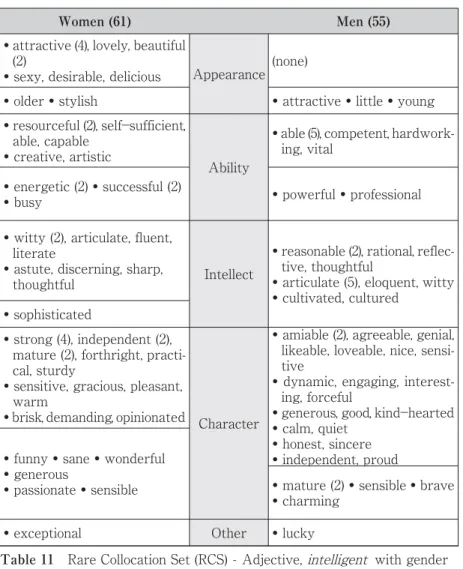
A possible solution is to categorise the adjectives into similar groupings and create what I call a rare collocation set (RCS). From each of the 16 searches I removed all non−singleton co−occurrences. I identified five catego-ries: Appearance, Ability, Intellect, Character, and Other (Table 11). The sin-gleton concordance lines (Appendices 8 a, 8 b) were analysed and the adjectives were grouped within each category. The groupings were not focussed on syno-nyms. With lexical priming in mind I tried to group the adjectives according to their similarities in meaning when combined withintelligent and the gen-der based nouns5)
. This may have ended up as what Hoey refers to as woolly −93−
confusion (2005: 3), but I was curious in finding a way to organise these sin-gletons.
There are several interesting patterns in this RCS, however I comment only on one. In the Character category the largest groupforintelligent woman/women emphasises a seriousness that dominates the description of women with intel-ligence. Over on the male side the adjectives describing men emphasise the warmer side of the male character. Although, none of the rare collocates seem out of place, what is striking is the lack of balance. This may be because of lexical priming and therefore a window on how language is used and not used. Or it may reflect a faulty methodology in how the concordance lines were collected, culled and organised. I will leave this deeper analysis for another time.
3.5 Summary ofsmart and intelligent
While dictionaries provide a snap shot of meaning, a mega−corpus like the BoE provides more precise information. For example, who uses smart and how it is used differently in different contexts (colloquial or technological) and locations (the UK or the USA). Similarly the brief examination of intelligent shows that gender may have an effect on prosody or association (Hoey 2005).
4 Teaching implications
While teaching EFL is not a major theme of this paper I would like to make a few comments. Immediate implications for teaching EFL affect my reliance on intuition to explain how language is used. To state the obvious, I am not in Canada and learner language needs in Japan and elsewhere extend beyond regional explanations. Intuition is of course needed, but so is consideration of the learners own language usage needs.
Women (61) Men (55) • attractive (4), lovely, beautiful
(2)
• sexy, desirable, delicious Appearance (none)
• older • stylish • attractive • little • young • resourceful (2), selfsufficient,
able, capable • creative, artistic
Ability
• able (5), competent, hardwork-ing, vital
• energetic (2) • successful (2)
• busy • powerful • professional
• witty (2), articulate, fluent, literate
• astute, discerning, sharp,
thoughtful Intellect
• reasonable (2), rational, reflec-tive, thoughtful
• articulate (5), eloquent, witty • cultivated, cultured
• sophisticated
• strong (4), independent (2), mature (2), forthright, practi-cal, sturdy
• sensitive, gracious, pleasant, warm
• brisk, demanding, opinionated Character
• amiable (2), agreeable, genial, likeable, loveable, nice, sensi-tive
• dynamic, engaging, interest-ing, forceful
• generous, good, kindhearted • calm, quiet
• honest, sincere • independent, proud • funny • sane • wonderful
• generous
• passionate • sensible • mature (2) • sensible • brave • charming
• exceptional Other • lucky
Table 11 Rare Collocation Set (RCS) − Adjective, intelligent with gender
Note 1: ungrouped words are below the dotted line.
Note 2: The numbers in parentheses represent the number of singleton citations across all search results
Note 3: Although adjectives such asattractive and beautiful for women and sensitive for men were culled from the data set, they remained if they were singletons in an individual search.
Longer term implications involve rethinking how I introduce and explain language. Hoey s lexical priming, for instance, places the emphasis on the as-sociations made by language users/learners giving them greater autonomy. This would seem to imply providing a learning environment and teaching methodology that is meaningful for the learner in the sense that they can make their own associations or primings. I will be exploring this area in my dissertation.
5 Conclusion
Before starting this paper I thought I had a well−developed intuitive sense of how words are used and by whom. Given the amount written on intuition it is safe to say my attitude was not atypical of how many language teachers think. However, studying common words likesmart and intelligent surprised me how complex these words are. While intuition in language teaching should not be dismissed, it needs to be informed by expertise in order to better equip both the language teacher and learner. And, as this brief corpus study has shown, there is no lack of teaching material from regional usage to genre us-age, from the colloquial to the technical, from complimentary collocates to gender differences.
This last point, how meaning can change (i.e.intelligent women implies a different meaning thanintelligent and sensible women ), I find very fasci-nating and will continue to examine collocation and meaning as well as con-tinue to evaluate semantic prosody and lexical priming .
Finally, this paper serves only as an introduction. Even for a brief dis-cussion any one of the points raised merits a separate paper. I have highlighted some of the issues in corpus research, the similarities and differences ofsmart andintelligent as well as touch on gender differences and introduced a pos-sible method for analysing singletons. I hope to use this paper to launch into
further detail the issues raised and briefly described.
Primary References
Caldas−Coulthard and Moon (1999) Curvy, hunky, kinky: using corpora as tools in critical analysis Paper read at the Critical Discourse Analysis Meeting, University of Birmingham, April 1999. (Unpublished)
Cohen, L. (1966)Beautiful Losers . Toronto: McClelland & Stewart.
Cotterill, J. (2003) Domestic Discord, Rocky Relationships: Semantic Prosodies in Representations of Marital Violence in the O.J. Simpson Trial Discourse & Society 12/3:291−312. London: Sage Publications.
Danielsson, P. (2003) Automatic extraction of meaningful units from corpora: A corpus−driven approach using the word stroke International Journal of Corpus Linguistics 8/1:109−127. Amsterdam:John Benjamins. Hoey, M. (2003) Lexical priming and the properties of text (www) http://www.
monabaker.com/
tsresources/LexicalPrimingandthePropertiesofText.htm (July 16, 2007) Hoey, M. (2005)Lexical priming . Abingdon: Routledge
Hornby, A. S.et al (2005) Oxford Advanced Learners Dictionary , 7th Edition . Oxford: OUP
Hunston, S. and S. Laviosa (2001)Corpus Linguistics . Birmingham: Centre for English Language Studies, The University of Birmingham.
Hunston, S (2002)Corpora in Applied Linguistics . Cambridge: CUP.
Kennedy, G. (1998) An Introduction to Corpus Linguistics . Essex: Pearson Education Limited.
LongmanDictionary of Contemporary English Online . (www) http://pewebdic 2.cw.idm.fr/ (May 14, 2007)
Rampton, M. (1990) Displacing the native speaker : expertise, affiliation, and inheritance ELT Journal 44/2:97−101. OUP.
Sinclair, J. (1991)Corpus, Concordance, Collocation . Oxford: Oxford University Press.
Sinclair, J. (2003)Reading Concordances . London Pearson Education. Stubbs, M. (2001)Words and Phrases .Web: access for chap 1. (www)
http://www.uni−trier.de/uni/fb 2/anglistik/Projekte/stubbs/book 2001. htm (July 15, 2007).
Whitsitt, S. (2005) A critique of the concept of semantic prosody.International Journal of Corpus Linguistics 10:3 p.283305.
Xiao, R. and McEnery, T. (2006) Collocation, Semantic Prosody, and Near Syn-onymy: A Cross−Linguistic Perspective. Applied Linguistics 27/1: 103 129. OUP.
Secondary References
Chomsky, N. (1962) Paper given at the University of Texas 1958, 3 rd Texas Conference on Problems of Linguistic Analysis in English, Austin, Univer-sity of Texas, p. 159. In Leech (1991:8).
Danet, B. (1980) Baby or Fetus ? Language and the Construction of Reality in a Manslaughter Trial , Semiotica 32:187219.
Firth, J. R. (1957)Papers in Linguistics . London: OUP.
Firth, J. R. (1968) A synopisis of linguistic theory 19301955 in F.R. Palmer (ed.)Selected Papers of J.R. Firth 19521959 . pp. 132. Bloomington: In-diana University Press.
Krishnmurthy (1996) Ethnis, Racial and Tribal: The Language of Racism? . In C. R. Caldas−Coulthard and M. Coulthard (eds) Texts and Practices: Readings in Critical Discourse Analysis , pp. 12949. London: Routledge. Louw (1993) Irony in the text or insincerity of the writer? The diagnostic po-tential of semantic prosodies, in M. Bakeret al (eds) Text and Technol-ogy , pp. 15776. Amsterdam: John Benjamins.
1 )Hunston and Laviosa, Corpus Linguistics provides two different dates: 2000 on the publishing information page; and July 2001 in the footer of every page thereafter. I have chosen 2001 as the likely publishing date throughout this paper.
2 )Bank of English: beautiful woman 601 matching lines; beautiful man 63 match-ing lines.
3 )I am aware the dictionaries use NAmE, however, however having grown up in Canada my own English usage is a mix of British and American English. Therefore I will refer specifically refer to American English throughout this paper. Also I am aware that younger Canadians are much more America oriented than I and may use what is referred to as North American English.
4 )The second of these sentences refers to Kitajima who is a famous Japanese Olym-pic champion swimmer.
5 )I need to stress that the groupings are not definitive and that someone else would mostly likely come up with different groupings and rationales for doing so.
Appendix 1: D ictionary definitions of smart and in tellig en t −100−
Appendix 2 a: British corpora smart R 1 nouns −101−
Notes: moves *: al m os t al l of the concor d ance lin es wer e fr om a w eekl y ar ti cl e w it h S ma rt Mo ve s as pa rt of th e tit le . sc ri pt*: thi s is an exampl e w her e sma rt script co uld b e eit he r empha sising int ellige n ce , st y le or bo th . newsci is al mos t excl us iv el y technol ogy and bus in es s or iented. sunnow is pr edomi n antl y spor ts or iented (footbal l & h or se ra ci ng) . −102−
Appendix 3: A merican corpora smart R 1 nouns Note: *ra ts d em on st ra te s the limit at io ns of th is cha rt s since the y are al so re gar d ed as in st ru ments of sci enti fi c res ear ch. *language is another word that coul d b e classified elsewhere i.e. b ehav io ur. usephem s mar t ar ts appear s to b e a commer ci al expr es si on that may refer to st yl e. usbooks sma rt cra cks as in w ise cra cks usnews s mar t compani es and sm ar t m ar keti ng do not refer to high technology bu t to int ellige n t co m pa nie s an d m ar ke ti ng.. −103−
Appendix 4 Evaluative L 1 collates for smart −104−
Note: A lt hough se manti c pr os ody is b as ic al ly a d eter mi nati on of whether a collocation is positive or ne gative, I thought that these two options were too lim iting and sought to intro duce a n eutral evaluation .I al so tr ie d to cons ider the effect gr ammati cal w or ds had on evaluation. Howeve r, th is w as le ad ing m e aw ay fro m the que st io n I w as trying to answer so I abandoned for now this particular inquiry. I will pick up on it another time. I h ave included this d ata to support so me of the p oints m ade in section 3.2. −105−
Appendix 5: Learner Survey Results
Survey about the word smart Remember there are no wrong answers. [Do page 1 first.]
1. Read the following sentences and circle whether you agree or disagree.
Appendix 5: Learner Survey Results (continued)
[Do this page second.]
2. Check if you thinksmart in these sentences means intelligent, body shape/ size, or style.
Remember there are no wrong answers.
3. When you use the word smart which meaning do you use?
Remember there are no wrong answers
body shape/size: always (9) most of the time (13) sometimes (7) rarely (7) never (2) style: always (12) most of the time (8) sometimes (9) rarely (7) never (1)
intelligent: always (4) most of the time (10) sometimes (9) rarely (13) never (1)
Thank you for your time!
Appendix 6 a: British corpora in tellig en t R 1 nouns −108−
Appendix 6 b: American corpora in tellig en t R 1 nouns Note: 1. Both judgement and judgment ar e p re se nt in th e A me rica n co rpo ra . 2. Words that h ave m ultiple m eanings are in it alics i.e . ra ce s 3. Al l v ar ia nts of tr uncated wor d s in the t − sco re p ict u re se pa ra te d b y a /. i.e .co mmunica t is p re se nt ed as co mmunica tions /c ommu-nicators −110−
Appendix 7 a: Two−adjective (with the conjunction and ) survey with woman/women and man/men
Appendix 7 b: Two−adjective survey with woman/women and man/men
Appendix 8 a: Search scripts and con cordance lines for adjective (JJ), in tellig en t , w oman/women JJ+intelligent+woman when she chose , was an acute , i ntelligent woman . < p > But you d idn’t know time . < p > While Judith , a brisk , i ntelligent woman with a mbitions of her own , was a hard case , a demanding intelligent woman with a l ot of mouth on especially such a feisty, funny, intelligent woman. But Alex i s g oing to need as a title for the independent, intelligent woman o f 2 5 − 35 and beyond . The afflicted. I’m a perfectly sane, intelligent woman and that’s what scar e s t h e described her as ‘ a sharp , i ntelligent w oman ” . Not m uch c hance , then , up a bit.” <p> She was a strong, intelligent w oman in her late fifties . S ome and Miss Manners , ” a stylish , i ntelligent woman who b rought up her the Jamie household. A thoughtful, intelligent woman, she appears to be one o f nothing about this warm , i ntelligent woman that would make y ou each other. Audi is a wonderful, intelligent woman. Her husband called her JJ+intelligent+women Woman’s Hour . She talks of busy i ntelligent women who need to be kept that plenty of funny , literate , intelligent women might choose t o focus say these things; i t i s mature, intelligent w omen −− like funny , quirky A nne metropolitan , feminist , witty , i ntelligent women . For Viva ! 9 63 AM JJ+and+intelligent+woman talking , i mmensely energetic and intelligent woman , i s a lready fired up with fall of Lily Bart , a lovely and intelligent woman w ith every p rospect of −113−
but she was a sophisticated and i ntelligent woman who h e believed had early promise as a strong and intelligent woman , t urns out to be from a 3 6−year −old successful and intelligent woman. B ut then Maria Bentley She was a self −sufficient and i ntelligent woman, w ho prided h erself on her JJ+and+intelligent+women disappoint all those delicious and i ntelligent w omen who’ve called you. ” And of public schools . Strong and intelligent women , who i n a better s ystem intelligent+and+JJ+woman < p > For example , another obviously int elligent and articulate woman wrote to me health status examination <p> A n i ntelligent and e nergetic woman , Tiffany batterings ! M y mother was a highly intelligent and exception a l woman who doted confession, from this strikingly intelligent a nd fluent woman, that s he is a a more rounded picture of an intelligent a nd generous woman who , if she 16 November 1992 < p > When an intelligent and m ature woman , who is a ‘ o f cancer , was a tireless , highly intelligent and passionate woman who made a dumped −on victim , but an ordinary , intelligent and pleasant woman . The obvious comes across as an exceptionally intelligent and resourceful woman whose and thin . < p > AN UNASSUMING though intelligent and witty wom a n , long content to intelligent+and+JJ+woman of staying single . For years three intelligent and discernin g women shared his Thornton . Both are strong −minded , intell igent and forthright women , who argued divorcée) I know well, both very intelligent and p ractical women , c hanged −114−
vlcds is the number of extremely intelligent and sensible women I k now who intelligent+JJ+woman fit from a description from an intelligent , astute woman who was there . ” in creation. What this slender , intelligent , creative woman thought of this I think she is a very pleasant , i ntelligent , g racious woman with most of was struggling to explain why an intelligent , independent woman stays w ith a within the family , especially an intelligent , sensitive woman lamenting los t somewhat difficult one . Beautiful , intelligent , sexy woman , very articula t e . W e Cave describes as a ‘ very brave, i ntelligent, s turdy woman who j ust gets on intelligent+JJ+women with me. I know so many attractive intelligent able women i n t heir thirties and that they watch pornography , and intelligent , artistic women boast of being work presents strong , independent , intelligent , capable women characters trying romantic needs ? And why do so many i ntelligent , desirable women still humiliate presenting images of confident and intelligent older women , the ma gazines are suggesting that these independent , intelligent , opinionated women represented a light of these relationships with intelligent, resourceful women, and h er do you know? I’m talking about i ntelligent, sensitive women; ones you l ike is of a group of successful , i ntelligent , strong women getting together to the proletariat, and where i ntelligent, successful women feel that late −115−
Appendix 8 b: Search scripts and con cordance lines for adjective (JJ), in tellig en t , man/men JJ +in tellig en t+man because he is such an amiable , i ntelligent man , but as much as Henman He was by every account a brave , intelligent man w hose c areer h ad been m ostly Babangida . H e was a forceful , intelligent man , t rying to put Nigeria’s gruff blustering a kind −hearted, intelligent m an who deeply r espected his me to do that.” <p> A likeable, i ntelligent man , Stefanki does not appear to models is no way for a mature , intelligent man to behave . T hen he’ll unable to believe that the quiet , i ntelligent man from a g ood family has an MP last week as ‘ the stupidest intelligent man in the northern hemisp here ” . meet a more attentive , thoughtful , intelligent man . C harming i s t he word the reduced by a stroke from a vital , intelligent man to a bedridden misery . JJ +in tellig en t+men divide between these sincere, intelligent men could scarcely be wider. Yet towards these hardworking , i ntelligent men and women w ho make our power JJ + an d +in tellig en t+man why Neville , an extremely able and intelligent man , has f ormed this most parole , h e was an articulate and i ntelligent man whose a utobiographical Soul it was to have this attractive a nd intelligent man care f or me . < p > But s hortly because he seems a calm and i ntelligent man . B ut running China’s age , a courteous , cultivated and i ntelligent man , a n e xtremely hard −working −116−
a decision from an honest and intelligent man who knows no robotics and him to be a very interesting and intelligent man . The conversation flowed that Mr Milosevic was a proud and intelligent man . H e was doing his job , JJ + an d +in tellig en t+men staff must be composed of able and i ntelligent men possessing the courage to parole , h e was an articulate and i ntelligent man whose a utobiographical Soul so often by apparently earnest a nd intelligent men − some of them , s trange as one of the most knowledgeable and intelligent m en in the field . Sometimes you gods want to turn such nice and i ntelligent men as Crosland and Mr to strong, brave, rational, and intelligent men.” According t o in tellig en t+an d + JJ + man of lay officials in government . An intelligent and able man , a political as they were hysterical . A n i ntelligent a nd amiable man , w ho was for our host at times . He’s an intelligent and charming man . ” < p > I’m sure away are they , sir ? ” Huckfield , a n intelligent and earnest man , persisted . < p > plural marriage. Green, a h ighly intelligent a nd eloquent man , continues to business . Dobbo , undoubtedly an intelligent a nd engaging man , is unlikely t o must have been the most charming , intelligent and g enerous man . H e did no oppressors . H e was a civilised , intelligent and good m an . H e sought peace s behalf . She said : ‘ He was a n intelligent and loveable man who always Johnson , however , was a t ough , i ntelligent a nd lucky man . Exactly how to the title character −− a d eeply intelligent and reflective man c ompelled by −117−
Lords . H e said : The father is an intelligent and sensible m an . H e understands a book about his life in rugby. An intelligent and witty man , h e c ould t alk in tellig en t+an d + JJ + men of fatigue. He has the company o f intelligent a nd agreeable men of greater of fuss by some good −looking , i ntelligent a nd articulate men . I t s ounds than you ! ” < p > It is the custom of intelligent and competent men t o m arry women prime minister since the war . intelligent and powerful men accepted picture of generous motives by ‘ i ntelligent and reasonable men ” , saying ‘ the in tellig en t+J J+ man city . H e lived by the day . A n i ntelligent , a ble m an −he was i n the gutter . Roger Seelig was when he − an intelligent , a rticulate man c laimed h e c ould but behind the guise lies a h ighly intelligent, cultured man , w ho is just a s this duty Kesselring − an intelligent , g enial man known as ‘ s miling was crazy . S o did Chernin − a v ery i ntelligent little man , mackenzie was A good man wrote this book , a n intelligent , mature m an . H e taught me a Line , Fisher struck Nichols as an intelligent , reasonable man . He said that , in tellig en t+J J+ men hidden cameras were used by two intelligent, a rticulate men − one black a nd the Himbo is focused on you . intelligent , dynamic men don’t have time to The New Criterion was created for intelligent , independent men a n d women , like while ‘ m any broad − minded , i ntelligent professional men a nd laymen ” remain friends for ever . S ome intelligent young men , like R obin D ouglas − −118−
Abstract
This article discusses intuition, collocations, semantic prosody, and lexical priming before examining how smart and intelligent are used in the Bank of English corpus. Comparisons are made between British and American us-ages and their R 1 noun collocates as well as a brief look at how smart is used in Japan. There is further discussion on gender differences affect how intelligent is used in the L 1, L 2 or L 3 position when reference is made to woman, women, man or men. The final discussion is a suggestion on how rare collocations could be used.
A Bank of English Corpus Study
of
smart
and
intelligent
Michael IWANESALOVAARA