Effectiveness of a Programmed Lecture
on Self-Understanding of Emotion
and Autonomy in Novice Nurses
Kazuyo Kusaka,
Yumi Chiba
and Chifumi Sato
Purpose: The purpose of this research was to verify the effectiveness of a lecture,which programmed for the ability promotion of interpersonal relationship and autonomy in novice nurses, in order to prevent early resignation and to establish high-quality nursing. M ethods: This intervention program consisted of a lecture and a self-check exercise,and it took for 2 hours. To evaluate their emotional changes after the educational intervention program,the participants were asked to answer self-reporting questionnaires including Emotional intelligence Quotient Scale(EQS)and Nursing Autonomy Scale(NAS). Results: Out of 3 areas of self-effect , human-relations and situation-reactions ,a significantly higher increase was observed in situation-reaction . Furthermore, out of 5 factors in NAS, each score of 4 factors except Autonomic decision-making ability and the total score significantly increased after the interven-tion. There was a significant correlation between the increases in scores of Self-effect of EQS and those in Practice ability of NAS after the intervention. Consideration : The lecture and self-check exercise were effective on self-understanding and autonomy in novice nurses.(Kitakanto Med J 2010; 60:353∼361)
Key Words: emotional intelligence quotient, autonomy, nurses, a programmed lecture interper-sonal relationship
Introduction
In the business scene of the United States and Japan, the theory of emotional intelligence quotient (intelligence quotient of mind ; EQ) and emotional literacy (ability of emotional information use; EL) aiming at the improvement of interpersonal relation-ships and adaptability by paying attentions to prob-lems on the perception and expression of emotion has attracted peoples attention. In other words,this is an attempt for peoples improvement in interpersonal relationship ability and making the best use of all their strong point at work,and it was focusing on EQ theory and finding characteristics and weak points in interper-sonal relationships of themselves. Nuclear families have recently increased in Japan and interpersonal relationships have been decreased at home. The wide
distribution of e-mails further facilitated decreasing interpersonal relationship abilities and communica-tion skills among young people.
In nursing practice, young nurses who feel stress and choose early resignation in a few years from employment have been increasing. In 2005,the resig-nation rate of nurses was as high as 12.3%. Stress caused by the lack in interpersonal relationships is thought to be one of the factors of resignation. Therefore,it is predicted that the ability of establishing interpersonal relationships and autonomic practices becomes an important issue for the prevention of early resignation and for establishing high-quality nursing. A previous research in nurses with 3-year experience showed that they did not acquire adequate interper-sonal skills. Other research suggested that emotional intelligence could not be developed quickly enough 1 School of Health Sciences, Gunma University Faculty of Medicine, 3-39-22 Showa-machi, Maebashi, Gunma 371-8511, Japan 2 Department of Nursing, Faculty of Health Care Sciences, Chiba Prefectural University, 2-10-1 Wakaba, Mihama-ku, Chiba-city, Chiba 261-0014,Japan 3 Department of Analytical Health Science,Graduate School of Allied Health Sciences,Tokyo Medical and Dental University, 1-5-45 Yushima, Bunkyo-ku, Tokyo 113-8519, Japan
Received : August 24, 2010
Address: KAZUYO KUSAKA School of Health Sciences, Gunma University Faculty of Medicine,3-39-22 Showa-machi,Maeba-shi, Gunma 371-8511, Japan
through interpersonal skills training, and therefore it was essential that nurse educators create assessment strategies that would identify emotional intelligence at recruitment.
In the United States, the majority of companies has confirmed significant outcome in achievement enhancing by introducing EQ education, and some companies in Japan have also started introducing it. The importance of the improvement of EL is pointed out in the field of education for medical and healthcare occupations. However, literature search has shown that there is no paper concerning this issue until now in Japan especially and we tried to conduct educa-tional intervention for novice nurses in order to develop their ability more.
The purpose of this research was to verify the effectiveness of a programmed lecture aiming at ability promotion of interpersonal relationships and auton-omy in novice nurses.
M ethods
1. Terminology1) Emotional intelligence quotient (EQ)
EQ is Ability to use the affect for the purpose that should be done to its maximum .
EQ are abilities to perceive the emotional status, approach the affect that becomes help of the idea, invent the affect, and understand an affection of dynamic knowledge. EQ is an ability to adjust the affect prudently to grow up on an affect side and an intellectual side (Salovey& Mayer).
2) Autonomy
Treat you with autonomy by yourself. 3) Reflections on a Sense of Incongruity
Reflections on a sense of incongruity meant the method learning from troubles . In other words, those are the way of facing negative-emotion for the person , admitting the emotion, and examining and expressing it directly (throwing back) by misunder-standing of emotion and trouble with the person.
4) Negative Emotions
Negative emotions represented anger, irritation, regret, grudge, distrust, doubtfulness, feeling betrayed, helpless, nothingness, effort in vain, haste, self-reproach, humiliation, deplorableness, insufficiency, loneliness, sadness, anxiety, fear, bewilderment, dis-traught, confuse, surprise and depression.
2. Subjects
Subjects were 38 nurses with one-year experience in a city hospital. Among them, 2 participants took maternity leave after lecture resulting in a final number of 36. The research purpose and the contests were explained to the director of nursing service department
in the hospital and agreement was obtained by air mail. Afterwards, the participants were recruited from the nursing department and directly collected the Questionnaire from the participated nurses before and after the educational lecture of intervention.
3. Instruments/Outcome measurement 1) EQ Scale (EQS)
This scale was made by Kikuo Yamauchi. This scale has two objective concepts such as the selves and others,and contains the standard of 65 items in total.
This scale was made in consideration of the side of affection dynamic, acknowledged action of the affect intelligence.
Three areas of Self-correspondence , For per-sonal and For situation were defined as concepts of Japanese original affected intelligence.
As for the self-correspondence,ability necessary to control the self is evaluated.
The love and others minding to others, and the ability of empathic understanding are evaluated for personality.
The ability for the changed society to have the prospect and to correspond is evaluated for the situa-tion.
As for these three areas,three subordinate position factors (for instance, Self-insight , Sympathy and Situation insight etc.) are set respectively. In a word, there is a correspondence factor of nine totals.
As for nine correspondence factors, 2 or 3 respec-tively subordinate position factors are set. There is a subordinate position factor of 21 in total.
As for the subordinate position factor of 21,three items are set respectively. It is composed of 65 items in total including two excluded items. The answer score of the EQS was evaluated from 1: not changed at all to 4: changed very much. The higher score indi-cates the higher level of EQS. Changed very much is 4 points, Changed a little bit is 3 points, Hardly changed is 2 points and not changed at all is 1 points.
2) Nursing Autonomy Scale (NAS)
This scale was based on Pankratz Nursing Questi-onnaire. This scale was used for the evaluation of nurses perception, decision-making and practice of autonomy and contains total 47 items of 5 factors checked by self-report. Perception ability (accurate situation-perceiving), Practice ability (specific action for leading to exact nursing practice),Actual decision-making ability(judging appropriate nursing based on a specific clue) for evaluating the ability of decision making and practice of nurses works in clinical set-tings,Abstract decision making ability(judging based
on a nursing model or hypothesis) and Autonomic ability(judging autonomically without depending on others). The contents were mainly composed of 3 areas; perception, decision-making, and practice. Each item had a five-point Likert-type (1-5) scale. The scores of the questionnaire ranged from 47 to 235 and the higher score indicate a more positive answer. When items included negative meanings, the highest score was calculated as 1, and the lowest score was calculated as 5.
4. Intervention Procedures
1) Composition of the Intervention
The intervention was composed of a structured lecture and exercise by self-check. The lecture was conducted in the theme of The self-understanding of nurses and the care of patients; nursing as an interper-sonal relationship performed for 2 hours (including 20 minutes video program)by a professional researcher in psychiatric nursing.
2) Theoretical bases of the Lecture
The lecture was structured and conducted based on the theory of Peplau. In brief, about half a cen-tury has passed since the viewpoint of interpersonal relationship and communication was introduced into nursing in addition to a process-record method. She doubted the pattern that attributes every patients behaviors to their objective symptoms and issued-behaviors, and she emphasized the significance of describing communications between patients and nurses with their own words. She advocated the importance of aiming at nurses achievement together
with patients through the analysis of characteristics of interpersonal relations reflected in the interaction written with their own words and the analysis of developmental issues.
Keywords constituting the lecture were EQ , reflections on a sense of incongruity , nurse-patient relationship and congruence , and the relations among them were grouped as shown in Fig. 1
3) Core Structure and Contents of the Lecture The core structure and contents of the lecture were related to reconsideration of nursing situation= process-record as follows. In clinical settings,nurses perform cares through interpersonal relationships with patients. In other words, since it is important for nurses to establish expected relationships with patients when providing better care, the lecture was structured with the title as shown above so that interpersonal skills and autonomy of nurses could be improved.
In precise, the lecture was structured as the pur-pose of program , explanation about interpersonal relationships , integration of emotion and thought and improving the method of getting to know your-self and improving the ability of emotional informa-tion use .
4) Introduction of Process-record
In the lecture, process-record was provided, for which recording scenes they experienced, and the explanation about how to use it was given,so that they could acquire 1) self-understanding in the process occurred inside themselves,2)perception deepened in the process occurred inside interpersonal partners, 3) improvement of problem judging and quality of care.
Moreover, reflections on a sense of incongruity; how to learn from troubles was introduced and a sheet to record the scenes they experienced was provided and instructions were given so that they can realize their own emotions
Furthermore, the necessity of process-record and the notice of describing were explained. First, understanding process-record is the skill for deepen-ing self and patient understanddeepen-ing was obtained. Next,a record sheet for process-record was provided and explanation about how to write in detail and analyze was given. Furthermore,the necessity of self-understanding was explained as easier as to understand and how to make use the sheet to advantage was instructed.
5) Administration of the Lecture
The lecture was conducted stating that it was desirable to be able to 1) perceive occurred emotion, understand the meaning of emotion, and express emo-tion suitable for situaemo-tion by combining emoemo-tion and thought. Video was used to deepen visual under-standing. The main point for solving issue in clinical setting is the congruence (assertion) of what they thought . In addition,explanation was provided that congruence, rooted in integration of what they thought and what they felt ,should be necessary for leadership,and also explanation that there were 4 types of continuing education in order to make use of self-understanding to advantage in support-relationship was provided : 1) Self-study; basic education and technical knowledge/skill,2)Supervision ; leading by model person, 3) Consultation ; advice from higher technical skilled person, 4) Case examining meeting ; sharing experience by support from group,and congru-ence also necessary for satisfying continuing education Moreover, as specific means of deepening self-understanding,the lecture about self-objectification of incongruity was conducted.
A record sheet for reflections on a sense of incon-gruity was provided explaining how to use it, and instruction was given so that they would practice it.
5. Assessment Procedures
To evaluate their emotional changes after the intervention, the nurses were asked to answer a self-reported questionnaire about their characteristics,EQS and NAS one-week before and one-month after the intervention. Furthermore, 2 months later, we con-ducted a questionnaire survey in a free description style. The contents of this research item were about the impression of the lecture with 4-Likert-type evaluation, changes in self-understanding and inter-personal skills after the lecture ,and the questionnaire was provided for persons who reported changes,asking
them to write down free-description about how they changed.
This study was done from July to September in 2006.
6. Statistical Analyses
EQS and NAS implemented twice at a week before and a month after the lecture were analyzed by Wilcoxon s signed-ranked test,and Spearman s correla-tion coefficients were tested between EQS and NAS. Concerning free-descriptions, the data were analyzed qualitatively. The domination level was assumed to be less than 5%.
7. Ethical Consideration
The basic plan of this research was submitted to the nursing part of each hospital and the agreement of cooperation was obtained. Oral explanation about the research was conducted for each subject, and privacy and anonymity were promised at publicity. The agreement for cooperation with the research was again obtained from each subject and arbitrary answer was assumed.
Results
1. Characteristics of the SubjectsThere were totally 36 respondents; 31 females (86.1%)and 5 males(13.9%),and the average age was 23.4±2.8 years old ; 23.0±0.1 (range 21.6-24.3) in females and 25.4±1.2 (range 23.3-30.0) in males.
2. Comparison before and after the intervention 1) EQS
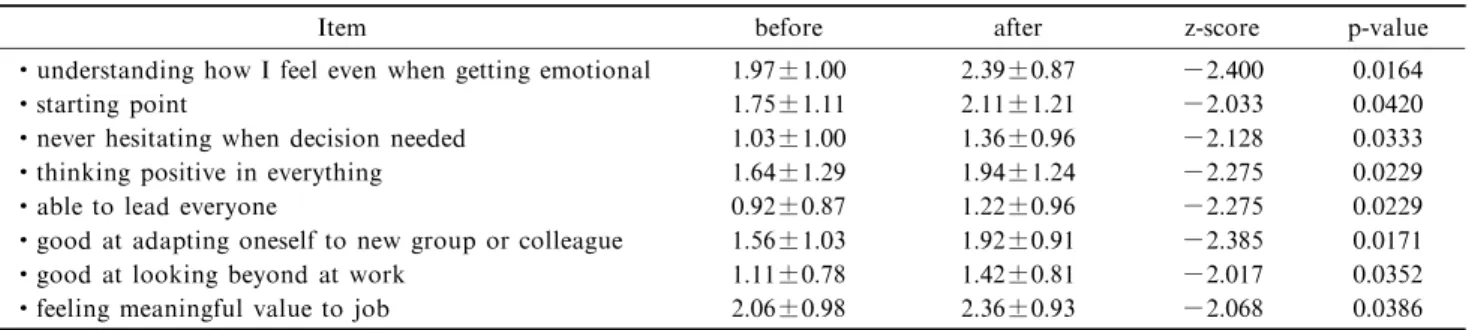
Among the total of 65 items,scores were increased significantly in 8 items after the intervention ; under-standing how I feel even when getting emotional from 1.97 to 2.39, believing everything will go well when starting something from 1.75 to 2.11, never hesitating when decision needed from 1.03 to 1.36, thinking positive in everything from 1.64 to 1.94, able to lead everyone from 0.92 to 1.22, good at adapting oneself to new group or colleague from 1.56 to 1.92, good at looking beyond at work from 1.11 to 1.42 and feel-ing meanfeel-ingful value to job from 2.06 to 2.36(respec-tively p<0.05) (Table 1).
Among 21 sub-factors, scores were significantly increased in 2 sub-factors; self-effect and decision-making from 4.97 to 5.47 and from 4.03 to 4.58, respectively(p<0.05). Among 9 corresponding items, situation-insight showed significantly higher scores. Furthermore, among 3 areas of self-effect , human-relations and situation-reactions ,scores were signif-icantly increased in situation-reaction (Table 2).
2) NAS
Among 5 factors in NAS,scores were significantly increased in four factors and the total after the lecture (Table 3); perception ability from 42.1 to 45.1 (p< 0.01), practice ability from 36.2 to 39.4 (p<0.05),
actual decision making ability from 19.7 to 21.7(p< 0.05), abstract decision making ability from 17.8 to 19.4 (p<0.05) and total from 129.3 to 138.8 (p< 0.01) (Table 3).
3. Relation of Score Changes between EQS and NAS
There was a significant correlation between the increases in scores of EQ1: self-reactions of EQS and F2: practice ability of NAS (p=.387,p<0.05) (Table 4).
4. Impression of the Lecture
There were 32 respondents (88.9%) in the free questionnaire on the impression of the lecture. It consisted of positive contents by 29 respondents as follows: 1) realized the importance of
self-Table 1 Comparison before and after intervention in EQS (n=36) Item before after z-score p-value ・understanding how I feel even when getting emotional 1.97±1.00 2.39±0.87 −2.400 0.0164 ・starting point 1.75±1.11 2.11±1.21 −2.033 0.0420 ・never hesitating when decision needed 1.03±1.00 1.36±0.96 −2.128 0.0333 ・thinking positive in everything 1.64±1.29 1.94±1.24 −2.275 0.0229 ・able to lead everyone 0.92±0.87 1.22±0.96 −2.275 0.0229 ・good at adapting oneself to new group or colleague 1.56±1.03 1.92±0.91 −2.385 0.0171 ・good at looking beyond at work 1.11±0.78 1.42±0.81 −2.017 0.0352 ・feeling meaningful value to job 2.06±0.98 2.36±0.93 −2.068 0.0386 express significant items in total 65 items
Table 2 Comparison before and after intervention in EQS (n=36) Factors before after z-score p-value Sub-factor
・self-effect 4.97±2.06 5.47±1.92 −2.061 0.0393 ・decision-making 4.03±2.14 4.58±2.33 −2.258 0.0239 Correlated-factor
・situation insight 11.98±4.09 12.69±3.85 −2.067 0.0389 3 areas of self, interpersonal, situation-effect
・self-reaction (EQ 1) 40.97±10.71 42.78±10.69 −1.445 0.1484 ・interpersonal-reaction (EQ 2) 46.64±12.13 48.78±9.78 −1.179 0.2383 ・situation-reaction (EQ 3) 33.17±13.62 35.72±13.74 −2.080 0.0375 0 It expresses significant items in 21 sub-factors, 9 items in correlated-factor and 3 areas as EQ 1 to 3
Table 3 Comparison before and after intervention in NAS (n= 30) EQS EQ 1 (96) EQ 2 (97) EQ 3 (98)
NAS ρ p-value ρ p-value ρ p-value
F1: Perception ability −0.015 0.938 -0.018 0.926 −0.148 0.434 F2: Practice ability 0.387 0.035 0.021 0.911 0.013 0.948 F3: Actual decision-making ability 0.110 0.563 −0.206 0.274 −0.096 0.613 F4: Abstract decision-making ability 0.344 0.068 0.119 0.540 0.133 0.491 F5: Autonomic decision-making ability −0.177 0.358 0.014 0.942 0.048 0.805 Total 0.156 0.410 −0.089 0.640 −0.113 0.553 Wilcoxon signed-ranked test Spearman s correlation coefficient
Table 4 Correlations between changed score of EQS and NAS (n=30) Factors before after z-score p-value F1: Perception ability 42.10±5.04 45.07±5.95 −2.686 0.007 F2: Practice ability 36.20±7.05 39.43±6.83 −3.023 0.003 F3: Actual decision-making ability 19.73±3.89 21.73±4.30 −2.536 0.011 F4: Abstract decision-making ability 17.80±4.15 19.42±4.21 −2.028 0.043 F5: Autonomic decision-making ability 13.28±3.08 13.21±2.65 −0.092 0.926 Total 129.27±3.00 138.83±18.82 −2.974 0.003
understanding by the lecture, and helpful for understanding, 2 ) enabled objective self-understanding,3)able to understand process record , and own goal became clear. Three answered nothing special and not remembered . In changing self-understanding and interpersonal skill after lecture , the number of answer was 0 for changed very much , 10 (30.6%) for changed a little bit , 20 (55.6%) for hardly changed and 2 (5.6%) for not changed at all , and the average score was 2.25±0.10.
To persons who felt changes, a question of in
what point and how do you think you changed ,was asked in a free questionnaire form. Eight persons replied that 1) self-understanding came to be dee-pened, 2) objective self and patient-understanding enabled,3)communication realized with persons who used to feel difficulty in getting well with (Table 5-1, 5-2, 5-3).
Table 5-1 Impression of the lecture
Category Subcategory
realized the importance of self-understanding and helpful for self-understanding How to do to understand myself objectively was learnt.
Awareness of self-understanding The self-understanding is difficult. I cannot be understood if it doesn t self-understanding. I want to deepen the self-understanding.
It became a chance to think about my character tendency. Deepening of self-understanding It came to understand EQ and my tendency of character.
I have understood recognition to my work. It came to consider my emotion.
It was able to know the situation of me who was not able to notice till then. It has understood how to be related with the person.
It has been understood to be able to do a good caring by the self-understanding. Clarification of problem The difference between my idea and patients idea was able to be understood.
I learnt the importance of conveying my feelings to other people. I learnt the method by which my problem was able to be clarified. How to take the process record was studied.
Others positive contents It was an interesting content.
The concrete example of each item was comprehensible. Nothing special
Others
Not remembered Table 5-2 Change before and after lecture
Stage Content People ① It changed very much. 0 ② It changed a little. 10 Four stage evaluation
③ It doesn t change so much. 20 ④ It doesn t change at all. 2 Table 5-3 Contents of changes after the lecture
Category Sub-category
When the sense of incongruity was felt, it came to turn around.
It came to often look back on my emotion when related with the patient.
Turning around It came to think the understanding of the patient and sympathy always. I came to think how it thought. The part that I did not notice was noticed, and it came to look back on relations with the person. It thought about patients speaking and action,and it came to think about the influence that my speaking and action gave the patient.
It knew the tendency to my character, and it came to be shown objectively. Aggressiveness It came to be able to speak with a person a little not good.
Discussion
1. Lecture1) Process-record and Reflections on a Sense of Incongruity
There were many positive comments in the free questionnaire such as 1) realized the importance of understanding by the lecture, and helpful for understanding, 2) enabled objective self-understanding,3)able to understand process record and own goal became clear. We explained the neces-sity of process record and summary in description,and tried to make them understand that process-record means the skill for deepening self and patients under-standing. Then, we provided a record-sheet for process-record explaining how to describe concretely and analyze,and instructed so that nurses could use the sheet by explaining why they need self-understanding to them. The instruction may have enabled them to be conscious of themselves, make their function of understanding work and, finally, deepen their self-understanding.
We provided a record sheet for self-objectification of incongruity explaining how to use it, and gave instructions so that they could make use of it. If one leaves these negative emotions thrown out, stress would accumulate without knowing. Therefore, reflections on a sense of incongruity are one of the best methods of stress coping. Moreover, we explained plainly when they feel incongruity as an actual incongruity by presenting the case so that they can image clearly. That may be the reason why signifi-cantly higher increases were observed in the scores of
understanding how I feel even when getting emo-tional on EQS scale.
2) Congruence as a Starting Point of the Nurse-Patient Relationship
We explained the aim of nursing (patient safety, comfort, development, independence) that nurses should achieve through the relationship in care sup-port conducted by them. Additionally,we explained about the importance of an accord between congru-ence,what they think and feel,and self-understanding and expressing, and explained congruence would be the starting point of relationship. They realized that nothing would matter if they expressed their feeling directly,which may have brought significant increases in the scores of self-effect and decision-making in EQS.
The main point for solving the issues in clinical settings is the congruence (assertion) of what they thought . These explanations enabled the subjects to realize the importance of congruence in interpersonal relationships with a team and orient themselves to
deepen their own self-insight with seizing situations, which may have resulted in significant increases in the scores of self-insight in EQS.
2. Emotional Intelligence Quotient
In this research, the scores were significantly in-creased in 8 items after the intervention. Of these, 3 items including 1. understanding how I feel even when getting emotional , 46.good at looking beyond at work , 48. feeling meaningful value to job were categorized into self-effect of the areas. Therefore, there appear to be significantly higher increases in the scores of 5 items as follows; 16.believing everything will go well when starting something , 37. never hesitating when decision needed , 38. thinking posi-tive in everything , 40. able to lead everyone , 43. good at adapting oneself to new group or colleague , which were categorized into self-effect. Moreover,out of 21 sub-factors,significant increases were observed in 2 sub-factors of self-effect/decision-making.
Self-effect is the ability of expressing their cur-rent emotion correctly. Therefore, EQS is suggested to have a significant effect of deepening self-understanding of subjects themselves, considering the replies shown in the questionnaire,such as it was very nice of me to know particular character of my own by trying EQS .
In the previous work in UK,many curricula now make reference in some way to the notion of an emo-tionally intelligent practitioner, and one for whom theory,practice and research are inextricably bound up with tacit and experiential knowledge.
3. Autonomy of Nurses
The scores significantly increased in able to practice nursing considering patients rehabilitation (practice ability) and able to provide nursing rich in originality all the time (practice ability) suggesting that they could become providing a situation-reaction and practice ability was improved. Furthermore, the score increased significantly in able to choose a nursing method depending on emotional changes(such as fear, anger and haste) in patients (actual decision-making ability). This seems to be due to the fact that
self-objectification of incongruity is the skill that made people realize their own negative emotion (such as fear,anger and haste)for others and transmits these emotions properly and the lecture about this skill was provided. The score significantly increased in able to choose speak it out to the others,which belongs to the area of self-reaction . Decision-making is the abil-ity to express the conclusion from situation-judgment from by action, which belongs to the area of the ability of situation-reaction . Concerning correlated
9 corresponding factors, 1 factor of situation-reaction showed a significant increase in point.
Situation-insight indicated the ability of understand-ing the meanunderstand-ings of changunderstand-ing situation exactly and coping with them properly without having negative prejudice for changing. Among 3 areas,the score was significantly higher in the area of self-reaction . Area of self-reaction is to evaluate the ability of tolerating situation changing surrounding themselves, or themselves and the others,the ability of leadership, and the ability of control such as choosing each ability and skill in the area of self-reaction and interper-sonal reaction appropriately according to the situation.
As a result of the lecture, these abilities of self-reaction improved. In precedent researches on EQS, especially in a research using a practiced-grouped approach for graduate-nurses,among 3 areas,the score was significantly higher in self-reaction, which was different from the result showing a significantly higher increase in situation-reaction in this research. However,there were significant higher increases in the scores in self-effect in self-reaction , self-insight in situation-reaction , whish were similar to those observed in this research. In other words, the possi-bility of the improvement of effect and self-insight ability was suggested. Moreover,in a prece-dent research on the factors affecting the quality of care by nurses, they reported that these qualities depended on EQ more than the concentration of the group,and improving EQ would be important for the improve-ment of care by nurses. Nursing methods estimating problems occur in future (abstract decision-making ability) . This may have resulted from the improve-ment in the ability of situation-reaction by the lecture. From these results, the effectiveness of the lecture purposed for self-understanding and patient care of nurses appeared to be obvious.
The factors related to nurses previous autonomy or process of decision-making were nursing method, field of nursing, previous experiences and knowledge, self image, self-esteem and job satisfaction. In future, it is necessary to increase subjects, clear the difference depending on experience-year and improve the contents of the lecture.
4. Subjects Evaluation of the Lecture
Among 32 replies of the free-form questionnaire about the lecture,10 subjects felt changes in their own self-understanding and interpersonal relationships. The replies were as follows; 1) self-understanding deepened, 2) objective self and patient-understanding enabled,3)communication realized with who used to feel difficulty in getting well with, and the subjects themselves realized the effects. These effects were
considered to be due to the lecture,considering a reply such as it was easy to understand and pick up con-crete cases every item .
However, though 22 subjects replied that the lec-ture urged their self-understanding and made their self-understanding deepened, they still did not realize their changes. Additionally,since there were a few in nothing changed at all , 20 subjects could improve the knowledge for their interpersonal relationship skill advance. Henceforth,it will be necessary to add more practical methods and more useful contents not only for understanding but also for practice. The necessity of role-play setting practical scenes and carrying out practical education is suggested.
5. Limitation of the Study
In this study, because the lecture was given only one time,the effect was limited to the improvement of knowledge, and the improvement of the practice abil-ity was not fully assessed, although an important content was covered as for the lecture and this research investigated the effect of the lecture aiming at the improvement in interpersonal relationship ability. A device is necessary that includes the content of the lecture that can be made the best use for practice in the future. Moreover, since the number of the subjects was small in this study,a larger intervention with more participants is necessary.
Conclusions
The structured lecture in this research was effective for self-understanding and autonomy in nurses. Since the number of the subjects was limited, its validity should be further evaluated in a larger number of participants.
References
1. Okamoto,N.Miyamoto,M. Current status and problem of Emotional Literacy in registered nurse. Proceedings of the 26th Japan Nursing Science Society Science Meeting 2006; 169.
2. C. CADMAN, J. BREWER. Emotional intelligence: a vital prerequisite for recruitment In nursing. Journal of Nursing Management 2001; 9 : 321-324.
3. Takayama, N. The person is moved! EQ management; Gijyutsu Hyoron 2006.
4. Kusaka, K.Koizumi,H.Chiba,Y.et al. Examination of nursing technology checklist for nursing practice ability. The Japanese Journal of Nursing Education 2006; 47(10): 884-891.
5. Miyamoto, M. A sense of Incongruity and Booster Iden-tity. Japan Nursing Society Publication Association. Tokyo : 2000.
6. Yamauchi, K. Torii1, T. Utugi, S. Ootake, K. EQS manyuaru. Business education publication : 2001. 7. Pankratz,L.et al. Nursing autonomy and patients right;
Health and Social Behavior 1974; 15: 211-216.
8. Kikuchi A, et al. The study related to autonomy of nursing professionals. Journal of Nursing Research 1997; 30(4): 23-35.
9. Peplau, H. Nursing theory of interpersonal relationship (Translated by Inada Y). Tokyo : Igaku-Shoin., 1973. 10. Miyamoto, M. Reconstruction of Nursing Situation.
Tokyo : Japan Nursing Society Publication Association, 1999.
11. Dawn Freshwater and Theodore Stickley. The heart of the art: emotional intelligence in nurse education, Nursing Inquiry 2004; 11(2): 91-98.
12. Koyano, Y. Application of a program for the develop-ment of emotional literacy to newly graduated nursing
masters and its assessment by EQS. Proceedings of the 26th Japan Nursing Science Society Science Meeting 2006; 219. 13. Imura, K. Ogasawara, K. Nagayama, H. Thuji, H. Katayama,Y. Relation of quality of group cohesion based on nursing masters emotional intelligence and caring. Journal of Japan Nursing Research Society 2003; 26(3): 386.
14. Alexander CS,Weisman CS,Chase GA. Determinants of staff nurses perceptions of autonomy within different clini-cal contexts, Journal of Nursing Research 1982; 31(1): 48-52.
15. Shigiki Y. Professional autonomy of nurses, ―meaning and research―. International Nursing Review 1995; 18(1): 23-28.