
JAIST Repository: 目標志向型多基準意思決定分析及びその日本伝統工芸品感性評価への応用
162
0
0
全文
(2) Multi-Attribute Target-Oriented Decision Analysis and Its Application to Kansei Evaluation of Japanese Traditional Crafts. by Hongbin Yan. submitted to Japan Advanced Institute of Science and Technology in partial fulfillment of the requirements for the degree of Doctor of Philosophy. Supervisor: Professor Dr. Yoshiteru Nakamori. School of Knowledge Science Japan Advanced Institute of Science and Technology. September 2009.
(3) Abstract Multi-attribute decision analysis (MADA) problems involve the task of ranking a finite number of decision alternatives, each of which is explicitly described in terms of different characteristics (also, often called attributes, decision criteria, or objectives), which have to be taken into account simultaneously. Among various MADA methods, multi-attribute utility theory (MAUT) is one widely used method to solve MADA problems. However, substantial empirical evidence and recent research have shown that it is usually difficult to build mathematically rigorous utility functions based on attributes and the conventional attribute utility function often does not provide a good description of individual behavioral/psychological preferences. As a substitute for utility theory, in 1979 Kahneman and Tversky proposed the Sshaped value function in the Prospect Theory to better represent decision makers’(DMs) behavioral/psychological preferences, and in 1999 Heath et al. suggested that the inflection point in the S-shaped value function can be interpreted as a target. To develop this concept further, target-oriented decision analysis involves interpreting an increasing, bounded function, properly scaled, as a cumulative distribution function (cdf) and relating it to the probability of meeting or exceeding a target value, i.e. it argues that target serves as reference point and alters outcomes in a manner consistent with the value function of Prospect Theory. As an emerging area considering the behavioral aspects of decision analysis, target-oriented decision analysis lies in the philosophical root of Simon’s bounded rationality as well as represents the S-shaped value function of Prospect Theory. In fact, decision analysis with targets/goals has a long history in the literature. Distance-based approach is one widely used method in decision analysis problems. However, different distances should have different impacts on DMs’ preferences, which is missed in the distance-based approach. In this sense, revisiting the targets/goals in decision analysis problems is essential to many decision problems. This research builds upon past research work and makes an intensive/in-depth study on target-oriented decision analysis from the following three aspects: 1. Target-oriented decision analysis with different types of target preferences and hybrid uncertain targets: We propose two methods to target-oriented decision model with different target preferences and extend those two methods to target-oriented decision analysis with fuzzy targets (a) Target-oriented decision analysis with different types of target preferences Original target-oriented decision model presumes that the DM has a monotonically increasing target preference, e.g., the attribute/criterion wealth. However, there are three types of target preferences: “the more the better” (corresponding to benefit target preference), “the less the better” (corresponding to cost target preference), and range targets (too much or too little is not acceptable). The key ideas of our methods are to use the cdf and level set of the probability distribution function (pdf) in the target-oriented decision model. Compared i.
(4) with previous work, our methods can model different types of target preferences and induce four shaped value functions: S-shaped, inverse S-shaped, convex, and concave. (b) Target-oriented decision analysis with fuzzy targets In addition, target-oriented decision model assumes that target has a random pdf. It is well known that all facets of uncertainty cannot be captured by a single probability distribution. Fuzzy uncertainty is considered by DMs to linguistically specify their uncertain targets. In our research, we extend those two methods to decision analysis with fuzzy targets. Compared with the pioneering work on fuzzy decision analysis by Bellman and Zadeh, our research outperforms in terms of three aspects. 2. Multi-attribute target-oriented decision analysis: We develop a non-additive multiattribute target-oriented decision model based on fuzzy measure and fuzzy integral, and develop a prioritized aggregation operator to model the prioritization between targets/attributes. (a) Non-additive multi-attribute target-oriented decision analysis In many situations, multiple attributes are of interest. Several researches have extended the target-oriented decision model into multi-attribute case. In their model, multi-additive value function is used to aggregate partial target achievements while assuming the mutual independence between different targets. However, it is recognized that in many decision problems attributes are interdependent. On the other hand, even if, in an objective sense the targets are mutually independent (probabilistically mutually independent), they are not necessary considered to be independent from the DM’s subjective viewpoint. Thus traditional approaches are not adequate for such complex situations. The key idea of our work to model the interdependence between different targets is to use the fuzzy measure and fuzzy integral. In our research, several similarities between multi-attribute target-oriented decision model and nonadditive fuzzy integral have been discovered. Hence, the λ-fuzzy measure is used as a technique to induce the possible combinations of indices of meeting targets and fuzzy integral is used to model the non-additive multi-attribute model. Compared with previous research, our method can model the interdependence from DM’s subjective viewpoint as well as be of simple use in real applications. (b) Prioritized multi-attribute target-oriented decision analysis Furthermore, the importance information associated with different targets plays a fundamental role in the comparison between alternatives by overseeing tradeoffs between respective satisfactions of different targets. A concept closely related to the importance information is the priority, which does not allow the tradeoffs between different targets. In some cases, the DM may have a prioritization between different targets. In our research, a prioritized OWA aggregation operator has been proposed to model the prioritization between different targets based on the Ordered Weighted Averaging (OWA) operator and Hamacher t-norms.. ii.
(5) 3. Application to Kansei evaluation problems: We extend the proposed decision models into Kansei evaluation context and propose a Kansei evaluation model based on prioritized multi-attribute fuzzy target-oriented decision analysis. A case study for Kansei evaluation of Japanese traditional crafts is also conducted to illustrate the proposed Kansei evaluation model. Differed from existing work on Kansei evaluation, our proposed Kansei evaluation model can (a) solve the inconsistent preference order relations on Kansei attributes, (b) integrate the psychological preferences in satisfaction degree of Kansei attributes, (c) and consider the prioritization between different Kansei attributes. By using our model, consumers can choose their preferred products according to their Kansei preferences. The consumer-oriented Kansei evaluations for traditional crafts in Japan provides possible solutions for both consumer-oriented product design and recommendation strategy for traditional crafts in Japan. Thus we believe that the proposed Kansei evaluation model would be of great help for marketing or recommendation purposes. In conclusion, our efforts in studying the target-oriented decision model are to solve decision analysis with hybrid uncertain targets and different target preferences, non-additive and prioritized multi-attribute target-oriented decision analysis, and then apply the decision models in Kansei evaluation problems. Key word: S-shaped function; Bounded rationality; Target-Oriented decision model; Different target preferences; Possibilistic/Probabilistic uncertainty; Fuzzy measure and fuzzy integral; Prioritized aggregation; Kansei evaluation; Japanese traditional crafts.. iii.
(6) Acknowledgments First of all, I would like to express my deepest respect and profound gratitude to my supervisor, Professor Yoshiteru Nakamori from Japan Advanced Institute of Science and Technology (JAIST), for his constant encouragement and kind guidance during this work. He introduced me to JAIST, offered me a very good research environment. He has given me much invaluable knowledge not only how to formulate a research idea or to write a good paper, but also the vision, and much useful experience in academic life. Everything I studied under his supervision will go along with me all of my life. I would also express my sincere gratitude to my co-adviser, Assistant Professor VanNam Huynh from Japan Advanced Institute of Science and Technology, for his vision, collected friendly and thoughtful guidance, helpful discussions and suggestions. I also would like to express my thanks to Associate Professor Tetsuya Murai from Hokkaido University for his suggestions and continuous encouragements during the co-research with him. I would also like to express my appreciation to Professor Taketoshi Yoshida, Professor Takashi Hashimoto, Professor Tu-Bao Ho from JAIST for being the members of my defense committee. Their critical and valuable comments enables me to find the weakness and improve my research a lot. I would like to thank the Lecture Mary Ann Mooradian for her help in proof-reading and correcting errors in my papers. I learned a lot from her corrections. I have received a lot of help from my colleagues and friends in Nakamori-Lab during the past three years. Let me say special thanks to Dr. Zbigniew Kr´ol for his kind suggestions for my research. I would also like to express my appreciation to my colleagues. Many thanks to Mr. Akio Hiramatsu, Ms. Mitsumi Miyashita, Ms. Kayano Chihara, Mr. Yukihiro Yamashita, and Ms. Aya Imoto for their kind help and suggestions during my doctoral research in JAIST. I wish to convey sincere thanks to JAIST staffs for their kind and convenient procedures and services during my doctoral research. Last but not the least, I would like to express my gratitude to my parents for their endless love and enduring support. Special thanks to my lovely wife, Wenge Jia, for her constant loving support, patience, and understanding. At any moment of my life, they encourage me, support me, and never let me alone. They are the root of my love and continuous creativity.. iv.
(7) Contents Abstract. i. Acknowledgments. iv. 1 Introduction 1.1 Development of Target-Oriented Decision Model . . . . . . . . 1.1.1 Expected utility and prospect theory . . . . . . . . . . 1.1.2 Optimizing and satisficing . . . . . . . . . . . . . . . . 1.1.3 Target-oriented decision analysis: A behavioral decision 1.2 Problem Statement . . . . . . . . . . . . . . . . . . . . . . . . 1.3 Main Contributions . . . . . . . . . . . . . . . . . . . . . . . . 1.4 Overview of the Thesis . . . . . . . . . . . . . . . . . . . . . .. 1 1 1 2 3 5 7 10. . . . . . . . . . . . . model . . . . . . . . . . . .. . . . . . . .. . . . . . . .. . . . . . . .. 2 Background and Literature Review of Multi-Attribute Decision Analysis 2.1 Relationships Between MCDA, MADA, and MODA . . . . . . . . . . . . . 2.2 Structure of Multi-Criteria Decision Analysis . . . . . . . . . . . . . . . . . 2.3 Multi-Attribute Decision Analysis Methods Based on Decision Makers’ Preference Expressions . . . . . . . . . . . . . . . . . . . . . . . . . . . . . 2.3.1 Preferences on consequence data . . . . . . . . . . . . . . . . . . . . 2.3.2 Preferences on attributes . . . . . . . . . . . . . . . . . . . . . . . . 2.3.3 Preferences on aggregation modes . . . . . . . . . . . . . . . . . . . 2.4 Inclusion of Decision Makers’ Behavioral Preferences into Multi-Attribute Decision Analysis . . . . . . . . . . . . . . . . . . . . . . . . . . . . . . . . 2.4.1 The TODIM method . . . . . . . . . . . . . . . . . . . . . . . . . . 2.4.2 The SMAA-P method . . . . . . . . . . . . . . . . . . . . . . . . . 2.5 Conclusions . . . . . . . . . . . . . . . . . . . . . . . . . . . . . . . . . . . 3 Random Target-Oriented Decision Analysis with Different Target Preferences 3.1 Introduction . . . . . . . . . . . . . . . . . . . . . . . . . . . . . . . . . . . 3.2 Cumulative Distributive Function based Method for Different Types of Target Preferences . . . . . . . . . . . . . . . . . . . . . . . . . . . . . . . 3.3 Target-Oriented Decision Analysis Based on the Level Set of Probability Density Function . . . . . . . . . . . . . . . . . . . . . . . . . . . . . . . . 3.4 Illustrative Examples . . . . . . . . . . . . . . . . . . . . . . . . . . . . . . 3.4.1 Normally distributed targets . . . . . . . . . . . . . . . . . . . . . . 3.4.2 Uniformly distributed target . . . . . . . . . . . . . . . . . . . . . . v. 12 13 13 15 16 19 19 20 21 23 23 25 26 27 31 33 33 37.
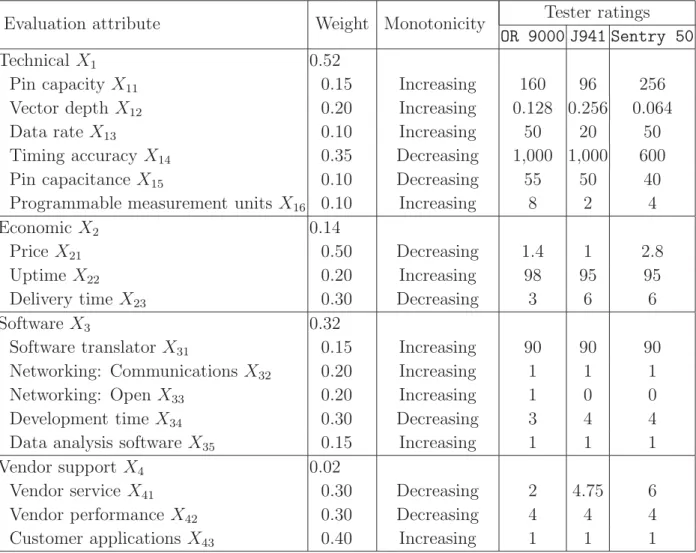
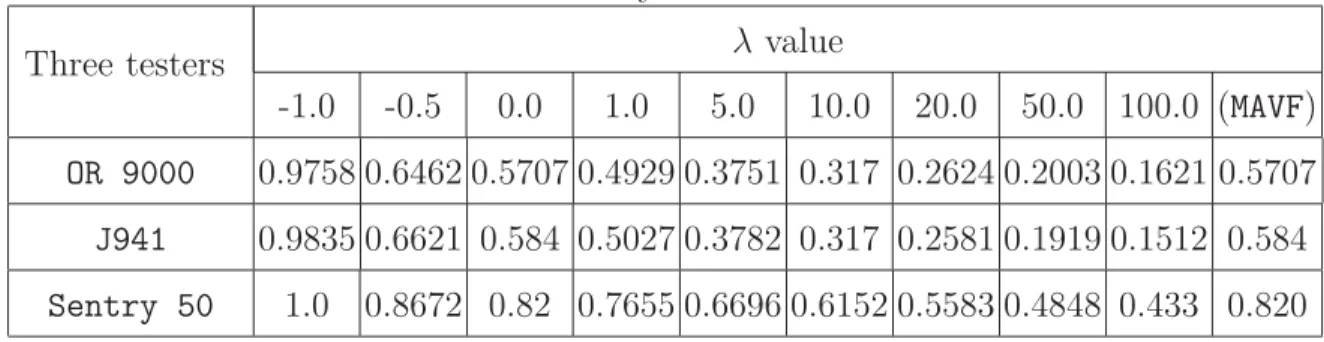
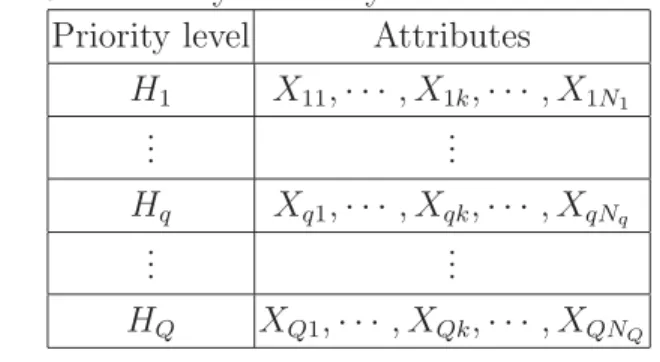
(8) 3.5. 3.6 3.7. Comparison and Relationship with Related Research . . . 3.5.1 Comparison with Bordley and Kirkwood’s approach 3.5.2 Relationship with Prospect Theory . . . . . . . . . Discussions . . . . . . . . . . . . . . . . . . . . . . . . . . Summary . . . . . . . . . . . . . . . . . . . . . . . . . . .. 4 Fuzzy Target-Oriented Decision Analysis with Different ences 4.1 Introduction . . . . . . . . . . . . . . . . . . . . . . . . . . 4.2 Possibility Distributions and Fuzzy Subsets . . . . . . . . . 4.3 Transformations from Possibility to Probability . . . . . . 4.4 Fuzzy Target-Oriented Decision Analysis . . . . . . . . . . 4.4.1 Cumulative Distribution Function Based Method . 4.4.2 Level Set Based Approach . . . . . . . . . . . . . . 4.5 Illustrative Examples . . . . . . . . . . . . . . . . . . . . . 4.5.1 Fuzzy min . . . . . . . . . . . . . . . . . . . . . . . 4.5.2 Fuzzy max . . . . . . . . . . . . . . . . . . . . . . . 4.5.3 Fuzzy equal . . . . . . . . . . . . . . . . . . . . . . 4.5.4 Fuzzy interval . . . . . . . . . . . . . . . . . . . . . 4.6 Comparison with Bellman-Zadeh’s Paradigm . . . . . . . . 4.7 Conclusions . . . . . . . . . . . . . . . . . . . . . . . . . .. . . . . .. . . . . .. . . . . .. . . . . .. . . . . .. . . . . .. . . . . .. . . . . .. 37 38 38 39 39. Target Prefer. . . . . . . . . . . . .. . . . . . . . . . . . . .. . . . . . . . . . . . . .. . . . . . . . . . . . . .. . . . . . . . . . . . . .. . . . . . . . . . . . . .. . . . . . . . . . . . . .. . . . . . . . . . . . . .. 5 Non-Additive Multi-Attribute Target-Oriented Decision Analysis 5.1 Introduction . . . . . . . . . . . . . . . . . . . . . . . . . . . . . . . . . . 5.2 Formulation of Multi-Attribute Target-Oriented Function . . . . . . . . . 5.3 Fuzzy Measure and Fuzzy Integral . . . . . . . . . . . . . . . . . . . . . . 5.3.1 General fuzzy measure . . . . . . . . . . . . . . . . . . . . . . . . 5.3.2 λ-fuzzy measure . . . . . . . . . . . . . . . . . . . . . . . . . . . . 5.3.3 Choquet fuzzy integral . . . . . . . . . . . . . . . . . . . . . . . . 5.4 Multi-Attribute Target-Oriented Decision Analysis Based on λ-Fuzzy Measure and Choquet Fuzzy Integral . . . . . . . . . . . . . . . . . . . . . . 5.5 Illustrative Example-New Products Development Problem . . . . . . . . 5.5.1 Problem descriptions . . . . . . . . . . . . . . . . . . . . . . . . . 5.5.2 Previous research . . . . . . . . . . . . . . . . . . . . . . . . . . . 5.5.3 Non-additive fuzzy target-oriented decision analysis . . . . . . . . 5.6 Summary . . . . . . . . . . . . . . . . . . . . . . . . . . . . . . . . . . . 6 Prioritized Multi-Attribute Target-Oriented Decision Analysis 6.1 Introduction . . . . . . . . . . . . . . . . . . . . . . . . . . . . . . 6.2 Theoretical Background . . . . . . . . . . . . . . . . . . . . . . . 6.2.1 Aggregation in multi-attribute decision analysis . . . . . . 6.2.2 Triangular norms . . . . . . . . . . . . . . . . . . . . . . . 6.3 Prioritized Multi-Attribute Target-Oriented Decision Analysis . . 6.3.1 A prioritized OWA aggregation operator . . . . . . . . . . 6.3.2 Properties of proposed prioritized OWA operator . . . . . 6.3.3 Illustrative examples . . . . . . . . . . . . . . . . . . . . . 6.3.4 Discussion: Choosing a suitable t-norm . . . . . . . . . . . 6.3.5 Comparison with previous research . . . . . . . . . . . . . vi. . . . . .. . . . . . . . . . .. . . . . . . . . . .. . . . . . . . . . .. . . . . . . . . . .. . . . . . . . . . . . . .. 40 41 42 43 45 45 46 49 49 50 51 52 53 54. . . . . . .. 55 56 57 59 59 60 61. . . . . . .. 61 63 63 64 66 69. . . . . . . . . . .. 70 71 73 73 75 76 76 78 79 81 83.
(9) 6.4. 6.5. Including Benchmark into Prioritized OWA Aggregation 6.4.1 Crisp requirements . . . . . . . . . . . . . . . . . 6.4.2 Uncertain requirements . . . . . . . . . . . . . . . 6.4.3 A comparative analysis . . . . . . . . . . . . . . . Conclusions . . . . . . . . . . . . . . . . . . . . . . . . .. . . . . .. . . . . .. . . . . .. . . . . .. . . . . .. . . . . .. . . . . .. . . . . .. . . . . .. . . . . .. 85 86 87 88 93. 7 Kansei Evaluation Based on Prioritized Multi-Attribute Fuzzy TargetOriented Decision Analysis 95 7.1 Introduction . . . . . . . . . . . . . . . . . . . . . . . . . . . . . . . . . . . 96 7.2 Literature Review of Kansei Evaluation and Motivations . . . . . . . . . . 97 7.2.1 Definition of Kansei evaluation . . . . . . . . . . . . . . . . . . . . 97 7.2.2 Approaches to Kansei evaluation . . . . . . . . . . . . . . . . . . . 98 7.2.3 Motivations . . . . . . . . . . . . . . . . . . . . . . . . . . . . . . . 99 7.3 A Kansei Evaluation Model Based on Prioritized Multi-Attribute TargetOriented Decision Analysis . . . . . . . . . . . . . . . . . . . . . . . . . . . 99 7.3.1 Identification and measurement of Kansei attributes . . . . . . . . . 100 7.3.2 Generation of Kansei profiles . . . . . . . . . . . . . . . . . . . . . 103 7.3.3 Specification of consumers’ preferences . . . . . . . . . . . . . . . . 104 7.3.4 Calculation of satisfaction degree based on fuzzy target-oriented decision model . . . . . . . . . . . . . . . . . . . . . . . . . . . . . 106 7.3.5 Prioritized aggregation of target achievements . . . . . . . . . . . . 108 7.4 Discussions . . . . . . . . . . . . . . . . . . . . . . . . . . . . . . . . . . . 109 7.5 Conclusions . . . . . . . . . . . . . . . . . . . . . . . . . . . . . . . . . . . 110 8 Case Study: Kansei Evaluation of Japanese Traditional Crafts 8.1 Introduction . . . . . . . . . . . . . . . . . . . . . . . . . . . . . . . . 8.2 Background of Traditional Crafts in Japan . . . . . . . . . . . . . . . 8.3 A Preparative Study . . . . . . . . . . . . . . . . . . . . . . . . . . . 8.3.1 Identification of products to be evaluated: Kanazawa gold leaf 8.3.2 Identification of the subjects . . . . . . . . . . . . . . . . . . . 8.3.3 Identification and measurement of Kansei attributes . . . . . . 8.3.4 Gathering Kansei assessments . . . . . . . . . . . . . . . . . . 8.4 Consumer-Oriented Kansei Evaluation of Kanazawa Gold Leaf . . . . 8.4.1 Generation of Kansei profiles . . . . . . . . . . . . . . . . . . 8.4.2 Specification of consumers’ preferences . . . . . . . . . . . . . 8.4.3 Calculation of target achievements . . . . . . . . . . . . . . . 8.4.4 Prioritized aggregation of target achievements . . . . . . . . . 8.5 Analysis of Obtained Results and Discussions . . . . . . . . . . . . . 8.5.1 On probability of each Kansei attribute meeting target . . . . 8.5.2 On prioritized aggregation . . . . . . . . . . . . . . . . . . . . 8.5.3 Discussions . . . . . . . . . . . . . . . . . . . . . . . . . . . . 8.6 Conclusions . . . . . . . . . . . . . . . . . . . . . . . . . . . . . . . .. . . . . . . . . . . . . . . . . .. . . . . . . . . . . . . . . . . .. 9 Contributions and Future Work 9.1 Main Contributions of the Thesis . . . . . . . . . . . . . . . . . . . . . . 9.2 Suggestions for Future Research . . . . . . . . . . . . . . . . . . . . . . . 9.2.1 Bipolar scale aggregation in multi-attribute target-oriented decision model . . . . . . . . . . . . . . . . . . . . . . . . . . . . . . . . . vii. 111 . 112 . 113 . 114 . 115 . 117 . 117 . 119 . 120 . 120 . 120 . 122 . 124 . 125 . 125 . 126 . 129 . 129 130 . 130 . 132 . 132.
(10) 9.2.2 9.2.3. Continuous multi-attribute decision making based on target-oriented decision model . . . . . . . . . . . . . . . . . . . . . . . . . . . . . 133 Applications in recommender systems . . . . . . . . . . . . . . . . . 135. References. 137. Publications. 149. viii.
(11) List of Figures 1.1 1.2. History formulation and development of target-oriented decision model . . 5 Content of this thesis . . . . . . . . . . . . . . . . . . . . . . . . . . . . . . 11. 2.1. Set relations between various aggregation operators, adapted from Detyniecki [36] . . . . . . . . . . . . . . . . . . . . . . . . . . . . . . . . . . . 20. 3.1. 3.4. Induced value functions with a normally distributed target by means of cdf and level set based methods, with respect to benefit target preference . . . Induced value functions with a normally distributed target by means of cdf and level set based methods, with respect to cost target preference . . . . . Induced value functions with a normally distributed target by means of cdf and level set based methods, with respect to equal/range target preference Uniformly distributed target with benefit and cost target preference . . . .. 36 37. 4.1 4.2 4.3 4.4 4.5. Different fuzzy targets used in decision making problems Target achievements under fuzzy min target . . . . . . . Target achievements under fuzzy max target . . . . . . . Target achievements under fuzzy equal target . . . . . . . Target achievements under fuzzy interval target . . . . .. 49 50 51 52 53. 5.1 5.2. Aggregation values of three testers with different λ: λ value from -1 to 0 . 68 Aggregation values of three testers with different λ: λ value from 0 to 100 . 68. 6.1 6.2 6.3 6.4. Prioritized aggregated values by means of Hamacher’s t-norm: γ ∈ [0, 1000] Benchmark achievement: at least G1 . . . . . . . . . . . . . . . . . . . . . Benchmark achievement: at least G1 and as high as possible . . . . . . . . Benchmark achievement: fuzzy min G1 . . . . . . . . . . . . . . . . . . . .. 7.1 7.2 7.3. Proposed Kansei evaluation process . . . . . . . . . . . . . . . . . . . . . . 100 Linguistic variables for Kansei attribute fun . . . . . . . . . . . . . . . . . 102 Target-oriented preferences . . . . . . . . . . . . . . . . . . . . . . . . . . . 105. 8.1 8.2 8.3 8.4 8.5. Distribution of traditional craft products in Ishikawa, Japan . . . Thirty products of Kanazawa gold leaf used for Kansei evaluation A sample of the answer sheet in Japanese . . . . . . . . . . . . . . Gathering data for evaluation of Kanazawa gold leaf . . . . . . . . Kansei profile of Kanazawa gold leaf A1 . . . . . . . . . . . . . . .. 9.1 9.2. Decision tree for MODM technique, adapted from Sen & Yang [119] . . . . 134 A recommendation strategy . . . . . . . . . . . . . . . . . . . . . . . . . . 135. 3.2 3.3. ix. . . . . .. . . . . .. . . . . .. . . . . .. . . . . .. . . . . .. . . . . .. . . . . .. . . . . .. . . . . .. . . . . .. . . . . .. . . . . .. . . . . .. . . . . .. 34 35. 83 90 91 93. 114 116 119 119 121.
(12) List of Tables 2.1 2.2. Multi-attribute decision matrix . . . . . . . . . . . . . . . . . . . . . . . . 16 Two linear transformation functions . . . . . . . . . . . . . . . . . . . . . . 17. 5.1 5.2 5.3. New product development: Data . . . . . . . . . . . . . . . . . . . . . . . 63 New product development: Target-oriented analysis . . . . . . . . . . . . . 65 Sensitivity scores of three testers . . . . . . . . . . . . . . . . . . . . . . . 67. 6.1 6.2 6.3. Priority hierarchy of a set of attributes X . . . . . . . . . . . . . . . . . . . Satisfaction degree of each attribute regarding each alternative: car selection Prioritized aggregation with different t-norms under attitudinal character Ω = 0.5 . . . . . . . . . . . . . . . . . . . . . . . . . . . . . . . . . . . . . The priority weight and degree of satisfactions of q-th priority level and its induced priority weights . . . . . . . . . . . . . . . . . . . . . . . . . . . . Prioritized aggregated value under different crisp requirements . . . . . . . Prioritized aggregated value under different fuzzy uncertain requirements . Prioritized aggregated value under different fuzzy min requirements . . . .. 6.4 6.5 6.6 6.7 7.1 7.2 7.3 8.1 8.2 8.3 8.4 8.5 8.6 8.7 8.8. Kansei linguistic assessment data of product Am . . . . . . . . . . Kansei profiles of evaluated products: probability distributions of assessments . . . . . . . . . . . . . . . . . . . . . . . . . . . . . . Prioritization of Kansei attributes specified by consumers . . . . .. 76 80 80 81 90 91 92. . . . . . 103 Kansei . . . . . 104 . . . . . 108. Age distributions of subjects participating in the evaluation process . . . . 117 Kansei attributes of traditional crafts, shown using linguistic variables and triangular fuzzy numbers. . . . . . . . . . . . . . . . . . . . . . . . . . . . 118 The preferred seven Kansei attributes and their corresponded targets . . . 121 Prioritization of the seven Kansei attributes/feeling targets . . . . . . . . . 122 Probabilities of each Kansei attribute meeting the target with respect to the thirty products of Kanazawa gold leaf . . . . . . . . . . . . . . . . . . 123 Top 5 products under prioritized aggregation with 11 attitudinal characters Ω125 Prioritized aggregation with 11 attitudinal characters for Kanazawa gold leaf127 Top 5 Kanazawa gold leaf under OWA aggregation with 11 attitudinal characters . . . . . . . . . . . . . . . . . . . . . . . . . . . . . . . . . . . . 128. x.
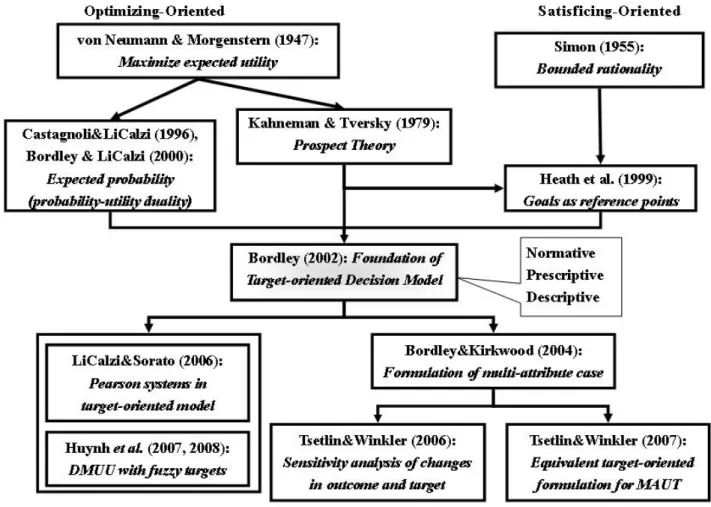
(13) Chapter 1 Introduction The study of decision analysis is part of many disciplines, including psychology, business, engineering, operations research, systems engineering, and management science. It is a scientistic discipline comprising a collection of principles and methods aiming to help individuals, groups of individuals, or organization in the performance of difficult decisions. In many decision problems, multiple attributes are of interest. A typical problem in multi-attribute decision analysis (MADA) is concerned with the task of ranking a finite number of decision alternatives, each of which is explicitly described in terms of different characteristics (also, often called attributes, decision criteria, or objectives), which have to be taken into account simultaneously [127]. Among various MADA methods, multi-attribute utility theory (MAUT) [75] is one widely used method to solve MADA problems. Other methods involving attributes, utility and relative measurement, include the analytical hierarchy process (AHP) [116] and the simple multi-attribute rating technique (SMART), which are simple versions of MAUT [6, 140]. In MAUT, by assuming the existence of a utility function, decision makers (DMs) try to maximize the utilities. However, substantial empirical evidence has shown that it is difficult to build mathematically rigorous utility functions based on attributes and the conventional attribute utility function often does not provide a good description of individual behavioral/psychological preferences [17, 70]. Recent research has shown that the behavioral aspects of decision analysis has grown, and this was recognized by the award of the 2002 Nobel Prize in Economics to Daniel Kahneman [135]. There are several decision theories focusing on DM’s psychological/behavioral preferences. In the next section, we will introduce some notable behavioral decision theories and the development of target-oriented decision analysis, which will be studied in this thesis.. 1.1 1.1.1. Development of Target-Oriented Decision Model Expected utility and prospect theory. In 1947, Von Neumann and Morgenstern [134] enunciated various axioms of rationality which implied that 1. For any rational individual, it was always possible to define the utility of a consequence as that probability p making the individual indifferent between receiving 1.
(14) that consequence and receiving a lottery with a probability p chance of leading to the best possible consequence and a (1 − p) chance of leading to the worst possible consequence. 2. The rational individual, when choosing among several possible decisions, would always choose that decision whose possible consequences have the maximum expected utility. Prospect theory by Kahneman and Tversky [70] has attracted a good deal of attention as an alternative to the well-established utility/value theory. The appeal of prospect theory stems from its descriptive power. Experiments support that prospect theory is consistent with the behavior of DMs [133]. Prospect theory also permits prediction and description of behavior that violates axioms of rationality, e.g., the transitivity axiom. There are some fundamental differences between prospect theory and utility/value theory. In the original prospect theory by Kahneman and Tversky [70], outcomes are expressed and evaluated as positive or negative deviations (gains and losses) from a reference alternative. Coding the outcomes as gains and losses is the most important part of the editing phase that consists of a preliminary analysis of the offered prospects. The other major operations (combination, segregation and cancelation) of the editing phase are of less importance for our purpose and are discussed by Kahneman and Tversky [70]. S-shaped marginal value functions (difference functions) are applied on the gains and losses. Another difference between the prospect theory and utility theory is that when evaluating gambles to form the functions, prospect theory uses weighting functions rather than probabilities, which may, but do not have to, coincide. The weighting function does not obey the axioms of probability theory and it measures the impact of probabilities on choices rather than the likelihood of the underlying events [70]. In addition to the original risky choice problem, Tversky and Kahneman [132] have also applied the concepts of reference alternatives and loss aversion to riskless choice. The idea is that a certain magnitude of loss is valued more than the same magnitude of gain. The marginal value of both gains and losses decreases by their size. These properties give again rise to an asymmetric S-shaped value function, concave above the reference point and convex below it.. 1.1.2. Optimizing and satisficing. Two of the most important approaches to decision analysis are optimizing and satisficing. Rational decision making is based on the optimizing principle. As Simon argued in [120], the traditional utility theory presumes that a rational DM was assumed to have “a well-organized and stable system of preferences, and a skill in computation”. However, there were serious costs associated with the memory and computations required to calculate the utility of various outcomes and choose the outcome of highest utility. Most decisions don’t seem to be worth the time and effort required to make such computations. Even for decisions which are worth such time and effort, few, if any, individuals seem oriented toward making such computations. For this reason, Simon [120] enunciated his famous behavioral model for rational choice, by enunciating the so-called theory of bounded rationality. In this theory, an individual has certain pre-specified requirements. If those requirements are met, the individual continues with his current decisions. When those requirements are not met, the individual 2.
(15) actively searches for alternative decisions. Instead of looking for the ‘optimum’ decision, the individual adopts the first alternative he discovers which satisfies the requirements. Simon’s work establishes that DMs consciously make decisions by satisficing targets and not by optimizing utility functions. Although simple and appealing from this targetoriented point of view, its resulted model is still not complete because there may be uncertainty about the target itself. In fact, decision analysis with targets/goals has a long history in the literature. Distance-based approach is one widely used method in decision analysis problems. However, different distances should have different impacts on DMs’ preferences, which is missed in the distance-based approach. In this sense, revisiting the targets/goals in decision analysis problems is essential to many decision problems.. 1.1.3. Target-oriented decision analysis: A behavioral decision model. Castagnoli and LiCalzi [25] show that for any utility function, there exists a random target with the utility being the cumulative distribution function (cdf) of the random target, see also Bordley [18]. Heath et al. [54] suggest that the inflection point in this S-shaped value function can be interpreted as a target. To develop this concept further, target-oriented decision analysis involves interpreting an increasing, bounded function, properly scaled, as a cdf and relating it to the probability of meeting or exceeding a target value [130]. As an emerging area considering the behavioral aspects of decision analysis, target-oriented decision analysis lies in the philosophical root of Simon’s bounded rationality as well as represents the S-shaped value function of Prospect Theory, i.e. it argues that target serves as reference point and alters outcomes in a manner consistent with the value function of Prospect Theory. In fact, there are three approaches to decision analysis in the literature, 1. Normative decision theory: Axioms of rationality. 2. Prescriptive approach: What people should do? 3. Descriptive approach: What people actually do? The first theory develops theories of coherent or rational behavior of decision analysis. Based on an axiomatic footing, certain principles of rationality are developed to which a rational DM has to adhere if he or she wants to reach the “best” decision. The second one, prescriptive approach, focuses on which principle people should follow. The last one, socalled psychological/behavioral decision theory, empirically investigates how the (na¨ıve) DMs really make their decisions and develops descriptive theories of decision behavior based on empirical findings. In fact, utility-maximization is only one way of modeling normatively rational behavior. Alternatively, there exists another valid way, so-called target-oriented approach. Consider the subjective expected utility theory perfected in Savage [117]. It provides an axiomatic foundation which implies that the DM should choose an action d which maximizes his expected utility Val(d) = EU(Xd ) with respect to a subjective probability distribution, where Xd denotes the random consequence associated with the decision d. As proved by Bordley and LiCalzi [18] and LiCalzi [88], the target-based model satisfies 3.
(16) the Savage axioms, thus there is no way to tell if an individual follows Savage’s axioms by maximizing his expected utility or is maximizing the probability of meeting his uncertain target. Due to the equivalence of utility-based decision theory and target-oriented decision theory, the target-oriented decision theory is a normative decision theory. Furthermore, in maximizing expected utility, a DM behaves as if maximizing the probability that performance is greater than or equal to a target, whether the target is real or just a convenient interpretation. In this sense, the target-oriented decision model is also a prescriptive approach to decision analysis. Although the Prospect Theory can better represent DMs’ behavioral preferences, the weighting function in Prospect Theory does not obey the axioms of probability theory and it measures the impact of probabilities on choices rather than the likelihood of the underlying events [84]. Therefore, prospect theory postulates a model which in general is not linear in the known probabilities. Whereas, the target-oriented decision model is equivalent to the expected utility theory. The target-oriented decision model argues that target serves as reference point and alters outcomes in a manner consistent with the value function of Prospect Theory. In this sense, the target-oriented decision model is a behavioral model for decision analysis. Due to the appealing features of target-oriented decision analysis, since its formulation by Bordley and LiCalzi [15, 18], it has received a lot of attention in the past nine years. Abbas and Howard [2] model target setting in organizations. They define “aspiration equivalents” for the alternatives under consideration based on the organization’s utility function, drawing an analogy with the notion of satisficing by seeking an alternative that meets or exceeds an aspiration level [120], and show that these aspiration equivalents can be used as targets. LiCalzi and Sorato [89] use the Pearson systems probability distributions to model the uncertain targets. Taking a different tack, instead of random uncertainty, Huynh et al. [61, 62] propose a target-oriented approach to decision analysis under uncertainty with fuzzy targets. 1 In many decision analysis situations, multiple attributes are of interest [75], thus it is important to extend basic target-oriented model to the multi-attribute case. Bordley and Kirkwood [17] consider situations in which a target-oriented approach is natural and define a target-oriented DM for a single attribute as one with a utility that depends only on whether a target for that attribute is achieved. They extend this definition to targets for multiple attributes, requiring that the DM’s utility for a multidimensional outcome depend only on the subset of attributes for which targets are met, and they develop a target-oriented approach to assess a multi-attribute preference function. Abbas and Howard [2] introduce a class of multi-attribute utility functions called attribute dominance utility functions that can be manipulated like joint probability distributions and allow the use of probability assessment methods in utility elicitation. Taking a different tack, Tsetlin and Winkler [131] consider decision analysis in a multi-attribute target-oriented setting and study the impact on changes of expected utility in a parameters of performance and target distributions via statistics technique. In addition, Tsetlin and Winkler [130] point out that a multi-attribute utility function cannot always be expressed in the form of the 1. It should be noted that target-oriented decision model is used in decision analysis under uncertainty (DAUU). In the literature, there two types of DAUU problems: no probability information is given and probability information is available (also called as decision analysis under risk) [20]. The probability information can be subjective or objective. In fact, when there is no probability information, we can use some kind of subjective probability, see [117].. 4.
(17) cdf. Fig. 1.1 shows the historical formulation and main development of target-oriented decision model.. Figure 1.1: History formulation and development of target-oriented decision model. 1.2. Problem Statement. We are highly motivated by the great appealing features of target-oriented decision model. After investigating and analyzing the current research on target-oriented decision model, our study focuses on three main problems: (1) single attribute target-oriented decision analysis; (2) multi-attribute target-oriented decision analysis; and (3) applications of target-oriented decision analysis. We will state our research problems in a great detail. 1. The first main problem investigated here is Target-oriented decision analysis with different types of target preferences and hybrid uncertain targets. The original target-oriented decision model presumes that the DM has a monotonically increasing target preference, e.g., the attribute/criterion wealth. However, there are three types of target preferences in most situations: “the more the better” (corresponding to benefit target preference), “the less the better” (corresponding to cost target preference), and range targets (too much or too little is not acceptable). These three target preferences are missed in the literature. Moreover, 5.
(18) target-oriented decision model views the cdf as the probability of meeting some target. Can the cdf be also used to model the other two types of target preferences? In addition, target-oriented decision model assumes that target has a random probability distribution function (pdf). Some researchers try to use different pdfs to model the uncertain target. For example, LiCalzi and Sorato [89] use the Pearson system probability distributions to model the uncertain target. Bordely and Kirkwood [18] and Tsetlin and Winkler [131] use the normal distribution to model the uncertain target. However, it is not so easy to define the suitable pdf for the uncertain target. It is also well known that all facets of uncertainty cannot be captured by a single probability distribution. In decision analysis, fuzzy set is often used by DMs to linguistically specify their uncertain requirements. Thus is is necessary to consider fuzzy target-oriented decision analysis. Although Huynh et al. [61, 62] consider fuzzy uncertainty in target-oriented decision model, they only consider the payoff variables. In fact, fuzzy decision analysis has received a lot of attention since their pioneering work on fuzzy decision analysis by Bellman and Zadeh [12], and the Bellman-Zadeh paradigm is still widely used in many studies and applications. Thus it is necessary to do a comparative analysis with Bellman-Zadeh paradigm. 2. The second main problem is to consider multiple attribute target-oriented decision analysis. In many situations, multiple attributes are of interest. Some researches have extended the target-oriented decision model into multi-attribute case. In their model, multi-additive value function (MAVF) is used to aggregate partial target achievements by presuming the independence between different targets, e.g. [17]. Although independence assumption leads to convenient and simple use in real applications, interdependence/interaction phenomena among the targets are quite natural. Toward this end, Tsetlin and Winkler [131] consider decision analysis in a multi-attribute target-oriented setting and study the impacts on changes of expected utility in a parameters of performance and target distributions via simple statistics techniques. They firstly assume targets have some predefined probability distribution (norma distribution), and then model the interaction phenomena between different targets by using a function of correlations. However, as targets may have different probability distributions, their approach is limited and too complex in real applications. Furthermore, even if, in an objective sense the targets are mutually independent (probabilistically mutually independent), they are not necessary considered to be independent from the DM’s subjective viewpoint. If the DM specifies fuzzy targets, Tsetlin and Winkler’s approach will not be suitable. In this regard, traditional analytic methods are inadequate and not applicable for modeling such complex situations. Another subproblem in this part is the prioritization of different targets. Consideration of different relative importance information of different targets is important as some targets are more important than others. In this case, the DM associates different importance weights with different targets. The importance information associated with different targets plays a fundamental role in the comparison between alternatives by overseeing tradeoffs between respective satisfactions of different targets. A concept closely related to the importance information is the priority, which does not allow the tradeoffs between different targets. In some cases, the DM may 6.
(19) have a prioritization between different targets. This type of multi-attribute targetoriented decision analysis is also missed in the literature. 3. Finally yet importantly, the third main problem is the Application of target-oriented decision model. Since its formulation, the research of target-oriented decision model mostly focuses on the theoretical part. In the literature, only one new product development example is studied. Due to the research context in Japan Advanced Institute of Science and Technology (JAIST), the Kansei evaluation problem will be studied as an application of target-oriented decision model. Many studies have attempted to solve Kansei evaluation in the literature. Generally speaking, there are two types of approaches to Kansei evaluation. Statistical methods: Statistical analysis plays an important role and is widely accepted as the most systematic tool for Kansei evaluation. Decision analysis methods: In addition to these methods, in closely similar and related studies on sensory evaluation or subjective evaluation, decision analysis has also been utilized in the evaluation problems. Previous studies have significantly advanced the issue of Kansei and Kansei-related evaluations. However, there are still two problems we need to solve. Firstly, consumers’ preferences on Kansei attributes vary from person to person according to character, feeling, aesthetic and so on. For example, a Kansei attribute fun having left and right Kansei words as <solemn, funny>. Some consumers may prefer solemn, others may prefer funny, and there are also some consumers preferring neither solemn nor funny. In this regard, we will have inconsistent order relations on Kansei attributes. Furthermore, a consumer usually may have a priority order of the Kansei attributes, i.e., some Kansei attributes may be necessary to be satisfied. The objective of this part is to consider Kansei evaluation based on target-oriented decision model.. 1.3. Main Contributions. All in all, the objective of this study is to include DMs’ behavioral/psychological preferences into MADA problems, and then apply the proposed models into Kansei evaluation problems. Although not all multi-attribute problems deal with risk, the shape of the value function of the target-oriented decision model is the same as the gain/loss function of Prospect Theory, which represents DMs’ behavioral preferences. Our research strategy is threefold. Firstly, single target-oriented decision model will be studied to discuss different target preferences and hybrid uncertain targets. Secondly, multi-attribute target-oriented decision analysis will be studied to model the non-additive representation and prioritized representation. Thirdly, we will develop a Kansei evaluation model based on prioritized multi-attribute target-oriented decision analysis and conduct a case study for Kansei evaluation of Japanese traditional crafts to illustrate the proposed model. The main contributions of this thesis are summarized as follows.. 7.
(20) 1. The first main contribution is that we propose two methods to targetoriented decision model with different types of target preferences and extend those two methods to fuzzy target-oriented decision analysis. (a) The first sub-contribution in this part is that we develop two methods for targetoriented decision analysis with different target preferences. In most studies on target-oriented decision analysis, monotonic assumptions are given in advance to simplify the problems, e.g., the attribute/criteria wealth. However, there are three types of target preferences. Thus two methods have been proposed to model the different target preference types: cdf based method and level set based method. No matter which method is selected, these two methods can both induce four shaped value functions: S-shaped, inverse Sshaped, convex shaped, and concave shaped, which represent DM’s psychological preference depending different target preferences. The main difference between these two methods is that the level set based model induces a stricter value function than the cdf based model. (b) The second sub-contribution in this part is that we extend those two random target-oriented decision analysis to fuzzy uncertain targets. Target-oriented decision model assumes that target has a random probability distribution. Fuzzy numbers are usually used by DMs to linguistically specify their uncertain targets. In this thesis, two methods of fuzzy target-oriented decision analysis with respect to different target preferences have been proposed. To do so, firstly, a thorough analysis of possibility-probability transformations is given, and then the proportional approach is properly used to transform a possibility distribution into its associated probability distribution. Secondly, two methods of fuzzy target-oriented decision analysis have been obtained based on the random target-oriented decision model. Finally, some widely used fuzzy targets used in the pioneering work on fuzzy decision analysis by Bellman and Zadeh [12] are selected to illustrate the fuzzy target-oriented model. Our research outperforms better in terms of three aspects. The publications related to this part are [153, 155, 157, 158, 159, 160]. 2. The second main contribution is that we develop a non-additive multiattribute target-oriented decision model based on fuzzy measure and fuzzy integral, and put forward a prioritized OWA aggregation operator to model the prioritization between targets/attributes. (a) The first sub-contribution in this part is that we model the interdependence between different targets based on λ-fuzzy measure and Choquet fuzzy integral. The use of fuzzy measures and fuzzy integral in MADA enables us to model some interaction phenomena existing among different attributes. As we shall see, multi-attribute target-oriented function has a similar structure with fuzzy measure, and fuzzy integral does not assume the independence. The fact that fuzzy integral model does not need to assume the independence of each target, means it can be used in non-linear situations. Thus we use fuzzy measure and fuzzy integral to model the interaction among targets. Since the specification. 8.
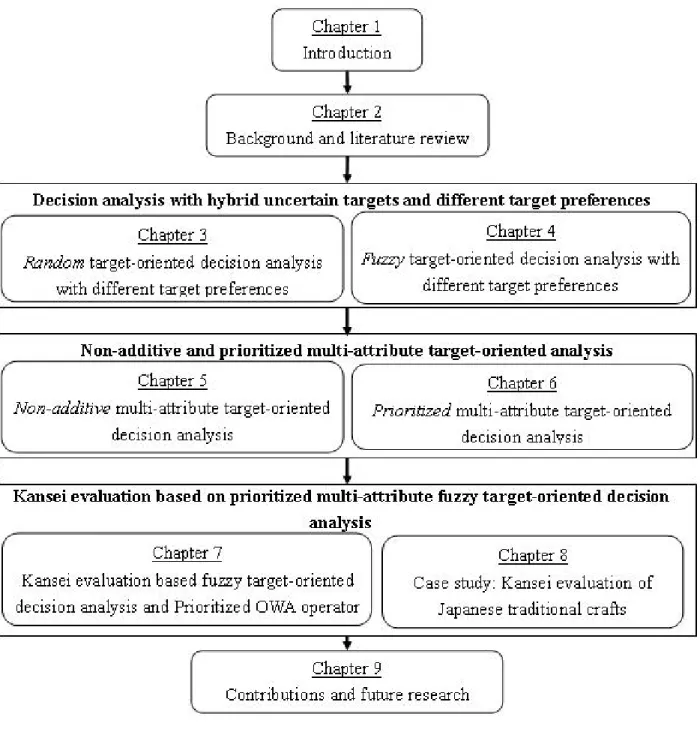
(21) for fuzzy measures requires the values of a fuzzy measure for all subsets, the λfuzzy measure is used in order to reduce the difficulty of collecting information and the Choquet fuzzy integral is used to model the dependence in multiattribute target-oriented decision analysis. A bisection search algorithm is also designed to identify the fuzzy measures of individual attributes group with a given λ value. (b) The second sub-contribution in this part is that we put forward a prioritized OWA aggregation operator to model the prioritization between different targets. To consider the prioritization between different targets, firstly the OWA operator is used to obtain the satisfaction degree for each priority level. To preserve the tradeoffs among the attributes in the same priority level, the degree of satisfaction for each priority level is viewed as a pseudo attribute. Secondly, we suggest that roughly speaking any t-norm can be used to model the priority relationships between the attributes in different priority levels. To keep the slight change of priority weight, strict Archimedean t-norms perform better in inducing priority weight. As Hamacher family of t-norms provide a wide class of strict Archimedean t-norms ranging from the product to weakest t-norm, Hamacher t-norms are selected to induce the priority weight for each priority level. Thirdly, considering DM’s requirement toward the higher priority levels, a benchmark based approach is proposed to induce priority weight for each priority level, i.e. “the satisfactions of the higher priority targets are larger than or equal to the DM’s requirements”. We suggest that the weights of lower priority level should depend on the benchmark achievement of all the higher priority levels. To illustrate the effectiveness and advantages of the prioritized OWA operator mentioned above, we conduct several comparative analysis with previous work on prioritized aggregation. The publications related to this part are [154, 159, 161]. 3. The third contribution is that we develop a Kansei evaluation model based on prioritized multi-attribute fuzzy target-oriented decision analysis. A case study is also conducted to illustrate the proposed Kansei evaluation model. To overcome the those two above-mentioned problems in current research on Kansei evaluation, we put forward a Kansei evaluation model based on fuzzy target-oriented decision analysis and prioritized OWA aggregation operator. Firstly, like the traditional Kansei evaluation method, a preparatory experiment study is conducted in advance to select Kansei attributes by means of semantic differential (SD) method. In order to obtain Kansei data of products, a number of people are selected to assess products regarding these Kansei attributes. Secondly, these Kansei data are used to generate Kansei profiles for evaluated products by making use of the voting statistics. Thirdly, according to consumer-specified preferences on Kansei attributes, three main types of fuzzy targets are defined, to represent the consumers’ preferences. Based on the principle of target-oriented decision analysis, we can obtain the satisfaction degrees (probabilities of meeting targets) regarding the Kansei attributes selected by consumers for all the evaluated products. Finally, considering 9.
(22) prioritization of the Kansei attributes, the prioritized OWA aggregation operator is used to aggregate the partial satisfaction degrees for the evaluated products. Kansei evaluation has been applied to consumer products with successful results, e.g., table glasses, housing assessment, telephones, cars, and mobile phones. However, Kansei evaluation of traditional crafts has not been addressed yet. In Japan, there are many traditional crafts such as fittings, textile, etc. These beautiful, elegant and delicate products are closely related to and have played an important role in Japanese culture and life. Evaluations of these traditional crafts would be of great help for marketing or recommendation purposes. Thus the Japanese traditional crafts are used as a case study to illustrate the proposed Kansei evaluation model. By using our model, consumers can choose their preferred crafts according to their preferences. The publications related to this part are [63, 152, 155, 156].. 1.4. Overview of the Thesis. As we shall see in the next chapter, MADA problems can be categorized into two main steps: (1) to transform the consequence data into values according to DM’s preferences; (2) to aggregate multiple scores into a global score. Thus, in this thesis the research topic, multi-attribute target-oriented decision analysis, is divided into two parts: (1) single attribute target-oriented decision analysis, which focuses on the transformations from the consequence data into target achievements/satisfaction degrees; (2) multi-attribute targetoriented decision analysis, which focuses on the aggregation of partial target achievements according to the principle of target-oriented decision analysis. Fig. 1.2 summaries of the organization of the thesis. A detailed explanation is as follows: • Chapter 1 describes the motivations and objectives of this thesis, including the development history of target-oriented decision model, problems statement, and the organization of the thesis. • Chapter 2 is a background and literature review of MADA problems, including the following aspects: structure of MADA, a summary of MADA methods, and the inclusion of DMs’ behavioral preferences into MADA. • Chapter 3 & Chapter 4 address decision analysis under hybrid uncertain performance targets with different target preferences. Chapter 3 deals with decision analysis under random uncertain target with different target preferences, where two approaches have been proposed. In Chapter 4, we also consider decision analysis under uncertainty with fuzzy targets. • Chapter 5 & Chapter 6 consider multi-attribute target-oriented decision model. Particularly, due to the similarity of structure between multi-attribute target-oriented model and non-additive fuzzy measure and fuzzy integral, λ-fuzzy integral is used to model the interdependence among different targets in Chapter 5. Furthermore, in most cases importance information and priority information play different role. 10.
(23) in aggregation step. To consider the prioritization among different targets, a prioritized Ordered Weighted Averaging (OWA) aggregation operator based on OWA operator and triangular norms (T-norms) has been proposed in Chapter 6. • As an application of the proposed prioritized multi-attribute target-oriented decision model, Kansei evaluation has been studied in Chapter 7. A case study of Japanese traditional crafts has also been conducted in Chapter 8 • Chapter 9 contains a summary of the main contributions of the research and suggestions for future work.. Figure 1.2: Content of this thesis. 11.
(24) Chapter 2 Background and Literature Review of Multi-Attribute Decision Analysis Abstract: In this chapter, a background and literature review of multi-attribute decision analysis (MADA) are presented to provide a foundation for the research in this thesis. We first provide some basic information about MADA and its related research. Secondly, the structure of MADA is presented. Thirdly, we classify different MADA methods from three aspects. Finally, two behavioral MADA methods are introduced and discussed.. 12.
(25) 2.1. Relationships Between MCDA, MADA, and MODA. Decision analysis is characterized by its involvement with information, value assessments, and optimization. Thus, whereas inventiveness seeks many possible answers and analysis seeks one actual answer, decision making seeks to choose the one best answer [38]. But the “one best answer” can be difficult to obtain, particularly when the decision is based on several objectives. Multi-criteria decision analysis (MCDA), sometimes called multi-criteria decision making (MCDM), is a discipline aimed at supporting decision makers (DMs) who are faced with making numerous and conflicting evaluations. MCDA is one of the most widely used decision methodologies in the sciences, business, and engineering worlds. Some applications of MCDA in engineering include the use on flexible manufacturing systems, layout design, integrated manufacturing systems. A typical problem in MCDA is concerned with the task of ranking a finite number of decision alternatives, each of which is explicitly described in terms of different characteristics (also, often called attributes, decision criteria, or objectives), which have to be taken into account simultaneously [128]. Attributes are generally defined as characteristics that describe in part the state of a product or system, while objectives are attributes with a goal and a direction “to do better” as perceived by the DM [64]. Specifically, goals are things desired by the DM expressed in terms of a specific state in space and time. Thus, while objectives give the desired direction, goals give a desired (or target) level to achieve [64]. In many cases, however, the terms “objective” and “goal” are used interchangeably. Ching-Lai Hwang has been on the forefront of the development of new techniques and the enhancement of existing ones that aid the DM. His two references [64, 65] list a multitude of techniques, grouped in two classes: the Multi-Attribute Decision Analysis (MADA) and Multi-Objective Decision Analysis (MODA) techniques. With the above-mentioned definition for objectives in mind, MODA problem involve the design of alternatives which optimize or “best satisfy” the objectives of the DM [64]. MADA problems involve the selection of the “best” alternative from a pool of preselected alternatives described in terms of their attributes” [64]. In other words, MODA problems are optimization problems (continuous MCDA), whereas MADA problems are product selection problems (discrete MCDA). Together all techniques for solving both problems can be classified as MCDA techniques. While criteria typically describe the standards of judgment or rules to test acceptability, here they simply indicate attributes and/or objectives. In this thesis, we use MADA to represent the discrete MCDA problems (product selection problems), MADA and MCDA are used interchangeably. Whereas MODA is used to denote the continuous MCDA problems.. 2.2. Structure of Multi-Criteria Decision Analysis. MCDA begins with a serial process of defining objectives, arranging them into criteria (attributes), identifying all possible alternatives, and then measuring consequences. Note that a consequence is a direct measurement of the succuss of an alternative according to a criterion, and it does not include preferential information. The process of structuring MCDA problems has received a great deal of attention. We follow the three steps of Roy’s general modeling methodology for decision analysis problems [114]: 13.
(26) 1. Object of decision. That is, defining the object upon which the decision has to be made and the rationale of the decision. 2. Family of criteria. That is, the identification and modeling of a set of criteria that affect the decision, and which are exhaustive and non-redundant. 3. Global preference model. That is, the definition of the function that aggregates the marginal preferences upon each criterion into the global preference of the DM about each alternative. We will explain these three aspects in a great detail. 1. Object of decision The first and the most important step for studying a multi-attribute decision problem is the identification of decision object. Roy [114] refers to the notion of the decision “problematic”. The four types of common decision problematics identified in MCDA literature are as follows: (a) Choice, which involves choosing one alternative from a set of alternatives. (b) Sorting, which involves classifying alternatives in predefined homogenous groups in a given preference order. (c) Ranking, which involves ranking alternatives from best to worst. (d) Description, which involves describing all the alternatives in terms of their major distinguishing features. 2. Family of criteria/attributes The set of all alternatives is analyzed in terms of multiple attributes, in order to model all possible impacts, consequences, or attributes. In MCDA, there types of criteria are formally used [66]: (a) Measurable, is a criterion that allows quantified measurement upon an evaluation scale. (b) Ordinal, is a criterion that defines an ordered set in the form of a qualitative or a descriptive scale. (c) Interval, probabilistic, fuzzy data. Sometimes uncertainty must be considered. The data may be expressed as interval data, probabilistic data, and fuzzy data. Probabilistic is a criterion that uses probability distributions to cover uncertainty in the evaluation of alternatives. Fuzzy is a criterion where evaluation of alternatives is represented in relationship to its possibility to belong in one of the intervals of a qualitative or descriptive evaluation scale. Generally speaking, the data used in MCDA can be divided into two large categories, numerical data and non-numerical data. With numerical data, information is conveyed using the known properties of numbers. Non-numerical data may use numbers, but only nominally, or may apply non-numerical structures. In this thesis, only the numerical data are considered.. 14.
(27) 3. Global preference model Throughout this step, the development of a global preference model provides a way to aggregate the values of each criterion in order to express the preferences between the different alternatives. MCDA literature identifies the following categories of preference modeling approaches: (a) Value-Focused models [73], where a value system for aggregating the user preferences on the different criteria is constructed. In such approaches, marginal preferences upon each criterion are synthesized into a total value using a synthesizing utility function. (b) Outranking Relations models [113], where preferences are expressed as a system of outranking relations between the alternatives, thus allowing the expression of incomparability. In such approaches, all alternatives are one-toone compared between them, and preference relations are provided as relations “a is preferred to b”, “a is equally preferred to b”, and “a is incomparable to b”. (c) Multi-Objective Optimization models [168], where criteria are expressed in the form of multiple constraints of a multi-objective optimization problem. In such approaches, usually the goal is to find a Pareto optimal solution for the original optimization problem. (d) Preference Disaggregation models [66], where the preference model is derived by analyzing past decisions. Such approaches build on the models proposed by the previous ones (thus they are sometimes considered as a subcategory of other modeling approaches’ categories), since they try to infer a preference model of a given form (e.g. value function) from some given preferential structures that have led to particular decisions in the past. Inferred preference models aim at producing decisions that are at least identical to the examined past ones.. 2.3. Multi-Attribute Decision Analysis Methods Based on Decision Makers’ Preference Expressions. During the last thirty years, a multitude of models has been developed to solve MADA problems. The value-focused thinking [73] method provides a systematics analysis method, which will be studied in this thesis. To better review different models of MADA, we shall discuss MADA from DMs’ preference information based on the work by Chen [32]. Generally speaking, there are three kinds of preference expressions: value functions (preferences on consequences), weights (preferences on criteria), and aggregation operators (preferences on aggregation modes). Common to all MADA techniques is the concept of a decision matrix. The basic structure of a decision matrix is an M-by-N matrix, as shown in Table 2.1. In this table, A = {A1 , A2 , · · · , Am , · · · , AM } is the set of alternatives, and X = {X1 , X2 , · · · , Xn , · · · , XN } is the set of attributes/criteria. The consequence on attribute Xn of alternative Am is expressed as Xn (Am ), which can be shortened to Xnm when there is no possibility of confusion. Note that there are M alternatives and N attributes altogether. 15.
(28) Table 2.1: Multi-attribute decision matrix Attributes Alternatives X1 · · · X n · · · X N. 2.3.1. A1. X11 · · ·. Xn1 · · · XN1. A2 .. .. X12 · · · .. .. . .. Xn2 · · · XN2 .. .. .. . . .. Am .. .. X1m · · · Xnm · · · XNm .. .. .. .. .. . . . . .. AM. X1M · · · XnM · · · XNM. Preferences on consequence data. There are several ways for a DM to express preferences based directly on consequences. Among them, the best known are utility theory-based definitions [75] and outranking based definitions [114]. Some normalization methods can be regarded as transformations from consequences to preferences. Definition The DM’s preference on consequence for attribute Xn of alternative Am is a value cn (Xnm ) = cm n . The DM’s preference on consequences over all attributes for alternative Am is the value vector m m cm = (cm 1 , · · · , cn , · · · , cN ) .. (2.1). Values are refined data obtained by processing consequences according to the needs and objectives of the DM. The relationship between consequences and values can be expressed as a value function as m (2.2) cm n = fn (Xn ) m m where cm n and Xn are a value and a consequence, respectively, and fn (Xn ) is a mapping function to realize the transformation from consequences to preferences. A commonly used mapping function is to as follows. fn (Xnm ) : Xnm → [0, 1]. (2.3). There are many approaches to generating values based on consequences. In this thesis, we consider two types of approaches based on Chen [32]: single alternative-based methods and binary alternative-based methods. 1. Single alternative-based methods Single alternative-based methods focus on the expressions of values according to one alternative, such methods are as follows. (a) Utility functions [75] In this method, a subset of alternatives are selected and ranked subjectively. 16.
(29) This subset of alternatives is further used to determine a utility function for all alternatives based on a monotonic piecewise linear utility function for the attributes and their subjective preferences. (b) Normalization functions [65] There are two types normalization functions: linear and non-linear. In both these two methods, the first step is to identify the maximum and minimum values for each attribute, denoted as Xnmin = and. Xnmax =. [Xnm ]. (2.4). max [Xnm ] .. (2.5). min. m=1,··· ,M. m=1,··· ,M. Two simple but frequently used linear transformation functions are shown in Table 2.2 Table 2.2: Two linear transformation functions Attribute type. Methods. Benefit attribute Method 1 Method 2. cm n =. m −X min Xn n max −X min Xn n. cm n =. m Xn max Xn. Cost attribute cm n =. max −X m Xn n max −X min Xn n. cm n =. min Xn m Xn. These two transformation methods assume that all consequences are real numbers. There are some drawbacks in method 2. When the consequence data is non-positive (negative and zero), the transformation method will not be suitable. However, in many MADA problems, the consequence data are given in positive real numbers. In addition, due to the simplicity of these two methods, they are are widely used in the literature. (c) Fuzzy set based approach [12] In their pioneering work on fuzzy decision making, Bellman and Zadeh [12] suggested that an attribute can be represented as a fuzzy subset over the alternatives. In particular, they modeled objectives and attributes together to form the decision space which is represented by a fuzzy set whose membership function is the degree to which each alternative is a solution. This method is widely used in fuzzy MADA problems. (d) Aspiration-level functions [93] The approach involves the user choosing levels of the objectives that he desires to achieve (levels of aspiration), and provides him with various kinds of feedback. 2. Binary alternative-based methods Binary relation-based models focus on expressions of values via comparisons of two 17.
(30) alternatives. The following binary relation-based methods employ numerical data to represent values. (a) Analytic Hierarchy Process Method [116] The Analytic Hierarchy Process (AHP) method was originally introduced by Saaty and is intended to solve such product selection problems that have a hierarchical structure of attributes. Attributes in one level are compared in terms of relative importance with respect to an element in the immediate higher level, treating the pairwise comparison with the eigenvector method as outlined in [119]. This process is executed from the top down starting with the overall goal as the single top element of the hierarchy and closing with the alternatives at the very bottom, ranking the attributes/alternatives at each level with respect to the overall goal. While AHP method is well known, it has several disadvantages as outlined in [119]. First, it requires attributes to be independent with respect to their preferences, which is rarely the case in product selection cases. Second, all attributes and alternatives are compared with each other (at a given level), which may cause a logical conflict of the kind: A > B and B > C but C > A. The likelihood of such conflicts occurring in the hierarchy tree increases dramatically with the number of alternatives and attributes. Last but not least, AHP has the potential of introducing a rank reversal of alternatives, depending on the number of alternatives assessed, which is particularly troublesome for normative decision making environments [119]. (b) ELECTRE [114] ELECTRE [114] is a family of MADA methods that originated in Europe in the mid-1960’s. The acronym ELECTRE stands for: ELimination Et Choix Traduisant la REalit´e (ELimination and Choice Expressing REality). The method was first proposed by Bernard Roy and his colleagues at SEMA consultancy company. A team at SEMA was working on the concrete, multiple criteria, real-world problem of how firms could decide on new activities and had encountered problems using a weighted sum technique. Bernard Roy was called in as a consultant and the group devised the ELECTRE method. As it was first applied in 1965, the ELECTRE method was to choose the best action(s) from a given set of actions, but it was soon applied to three main problems: choosing, ranking and sorting. ELECTRE employs concordance and discordance matrices to transform consequences to values. (c) The PROMETHEE method [21] The PROMETHEE (Preference Ranking Organization METHod for Enrichment Evaluation) is a MADA method developed by Brans and Vincke [21]. It is a quite simple ranking method in conception and application compared with other methods used for multi-attribute analysis. It is well adapted to problems where a finite number of alternatives are to be ranked according to several, sometimes conflicting criteria/attributes. The evaluation table is the starting point of the PROMETHEE method. In this table, the alternatives are evaluated on the different criteria. The implementation of PROMETHEE requires two additional types of information, namely: (1) Information on the relative importance that is the weights 18.
図


+7



関連したドキュメント
In real world, the company often makes use of supplier selection on fuzzy decision space to promote their commodities. The selection of supplier of enterprise
12―1 法第 12 条において準用する定率法第 20 条の 3 及び令第 37 条において 準用する定率法施行令第 61 条の 2 の規定の適用については、定率法基本通達 20 の 3―1、20 の 3―2
添付資料 4 SDC 3/INF.10: Information collected by the intersessional Correspondence Group on Intact Stability regarding second generation intact
学期 指導計画(学習内容) 小学校との連携 評価の観点 評価基準 主な評価方法 主な判定基準. (おおむね満足できる
廃棄物の排出量 A 社会 交通量(工事車両) B [ 評価基準 ]GR ツールにて算出 ( 一部、定性的に評価 )
定性分析のみ 1 検体あたり約 3~6 万円 定性及び定量分析 1 検体あたり約 4~10 万円
この標準設計基準に定めのない場合は,技術基準その他の関係法令等に
この標準設計基準に定めのない場合は,技術基準その他の関係法令等に
