Synthesis of Metal Oxides with Controllable
Morphology and Surface Charge and Their
Composites for Gas Sensor Application
著者
アンガ ヘルマワン
学位授与機関
Tohoku University
0
博士学位論文
Synthesis of Metal Oxides with Controllable Morphology
and Surface Charge and Their Composites for Gas Sensor
Application
形態と表面電荷を制御可能な金属酸化物の合 成と
それらの複合材料におけるガスセンサーへ の応用
A Thesis
Submitted for the Degree of
DOCTOR OF PHILOSOPHY (Ph.D.)
By:
Angga Hermawan (B7GD3501)
Supervisor: Prof. Shu Yin
東北大学環境科学研究科
先端環境創成学専攻
応用環境学コース
1
MOTIVATION
“Whoever follows a path in pursuit of knowledge, Allah
makes his way easy to paradise.” (A Hadith narrated by
Imaam Al Bukhari)
“When a man dies all his deeds comes to an end except for
three: an ongoing charity, beneficial knowledge and a
righteous son who prays for him.” (A Hadith narrated by
2
Acknowledgement
In the name of Allah, the most grateful and the most merciful.
First of all, I would like to express my deepest and sincere gratitude to my academicadvisor, Prof. Shu Yin for his exceptional guidance, patience, supports and encouragements. Hisbroad knowledge and valuable advice have been helping me to finish my doctoral thesis. I am deeply grateful to Assist. Prof. Yusuke Asakura and Assist. Prof. Takuya Hasegawa for his worthwhile suggestions,interests, and discussions in this research.
I wish to extend my warmest thanks to my past and currents colleagues in Environmental Inorganic Material Chemistry Laboratory: Ms. Shio Komatsuda, Mr. Masahito Hatsukano, Mr. Yuto Anada, Dr. Zhizuan Zhao, Dr. Jimin Fan, Dr. Honghong Chang, Mr. Mikihiko Kobayashi, Mr. YutoAnada, Dr. Anung Riapanitra, Ms.Chiaki Noda, Ms. Misuzu Nakamura, Ms. Yukiho Nishimura, Mr. Zhangyong Gu, Ms.Jinweng Wang, Ms. Mayu Otomo, Ms. Amiko Miyake, Mr. Biao Zhang, Mr. ArdiansyahTaufik, Ms. Jingdi Cao, Mr. Tingru Chen, Ms. Tomoyo Akahira, Ms. Nonoko Suzuki, Ms. Zijing Wang, Mr. Peng Sun, Mr. Namiki Uchiyama, Ms. Tetsuhiro Onodera, Mr. Hanyu Liu, Mr. Iimura and Mr. Yasuo Hangai for their cooperation, assists and friendly atmosphere.
I owe my thousands thanks to all of my Indonesian fellows in Indonesian Student Association in Sendai (PPI Sendai), without their presence, my life in Sendai have certainly been
less interesting.
I acknowledge the Ministry of Education, Culture, Sport, Science and Technology (MEXT) for providing the scholarship during my master study through the IELP Programs. Last but not the least, my greatest appreciation is reserved for my wife, Raras for her uninterruptedly prayer. She has been my inspiration and motivation to put my best effort for writing this thesis. I express my greatest love to my family for their sincere pray and motivations.
Without them, it would seem impossible for me to finish this work.
Angga Hermawan August 2020
3
Declaration Statement
1. I declare that this doctoral thesis was composed by myself, that the work contained herein is my own except where explicitly stated otherwise in the text, and that this work has not been submitted for any other degree or processional qualification except as specified. Parts of this work have been published in Ceram. Int., 45 (2019) 15435-15444, J. Mater. Sci. Tech. (2020), ACS Appl. Nano Mater. (2020) and Inorg. Chem. Front. (2020). Part of this works are under submission and/or under preparation of full publication in an international peer-review journal. 2. The density functional theory (DFT) calculation presented in this thesis was obtained in an experiment carried out by Mr. Adie Tri Hanindyo and Mr. Erland Rachmad Ramadhan in Japan Advanced Institute of Science and Technology (JAIST), Ishikawa, Japan. The analysis of DFT data was written by me with their supervision.
I am aware of and understand the university’s policy on plagiarism and I certify that this thesis is my own work, expect where indicated by referencing, and the work presented in it has not been submitted in support of another degree or qualification from this or any other university or institute of learning.
4
Abstract
Rapid globalization of industrial activities has led to the increase of released pollutants in the form of the gaseous and liquid state into our environment. The gaseous pollutants (CO2, CH4, NOx, CO, SO2, VOCs, etc.) which are produced from the combustion of fossil fuels, not only has become a major contributor to global warming and climate change, but also human respiratory problems. For example, volatile organic compounds (VOCs) and nitrogen oxides (NOx) induced by recent situations, including rapid industrialization, massive fuel combustion and utilization of chemical in many household products. In particular, VOCs are quickly evaporated at relatively low temperatures and therefore VOCs amount in the atmosphere can gradually increase over time making our environment and other living creatures endangered. Among various harmful VOCs, gaseous toluene (C7H8) is poisonous for both humans and the environment produced from paints, thinners, adhesives, cleaning agents, leather tanning processes. On the other side, NOx is a major residue from fuel burning from automotive and industrial. Both gases are eventually near to our daily life. Moreover, long and intense exposure to these gases can potentially harm the human body through inhalation. Therefore, VOCs and NOx should be immediately detected.
To detect toxic gases, semiconducting metal oxides material (SMOX) is one of the most explored compounds for chemiresistive gas sensors application. Because of their low cost and versatility of development, ease of use, wide range of observable gases/possible fields of use, they have drawn much interest in the field of gas sensing under atmospheric conditions. These materials exhibited exceptional sensing performances as compared to other types of sensors, e.g. catalytic-type and electrochemical-type gas sensors. However, they have some drawbacks such as their low sensitivity and selectivity to distinguish the toluene with other gases.
Fig. 1 (a) Organic molecules functionalization-induced unique surface charge,
(b) electrostatic self-assembly process.
5
In the present thesis, we successfully improved the SMOX gas sensing properties by (i) Precise control of morphology and facet, (ii) Fabrication of heterostructure p-n junction and (iii) Hybridization with 2D Ti3C2Tx MXene with metallic phase materials to introduce a Schottky Junction. The unique approach of this thesis is we have been able to combine two materials by harnessing their organic molecules functionalization-induced effective surface charge (Fig. 1 (a)). This approach enables the preparation of hybrid structures (p-n junction or Schottky M-S contact) at room temperature without damaging the structures and original properties may be preserved (Fig. 1 (b)). This is so-called electrostatic self-assembly method.
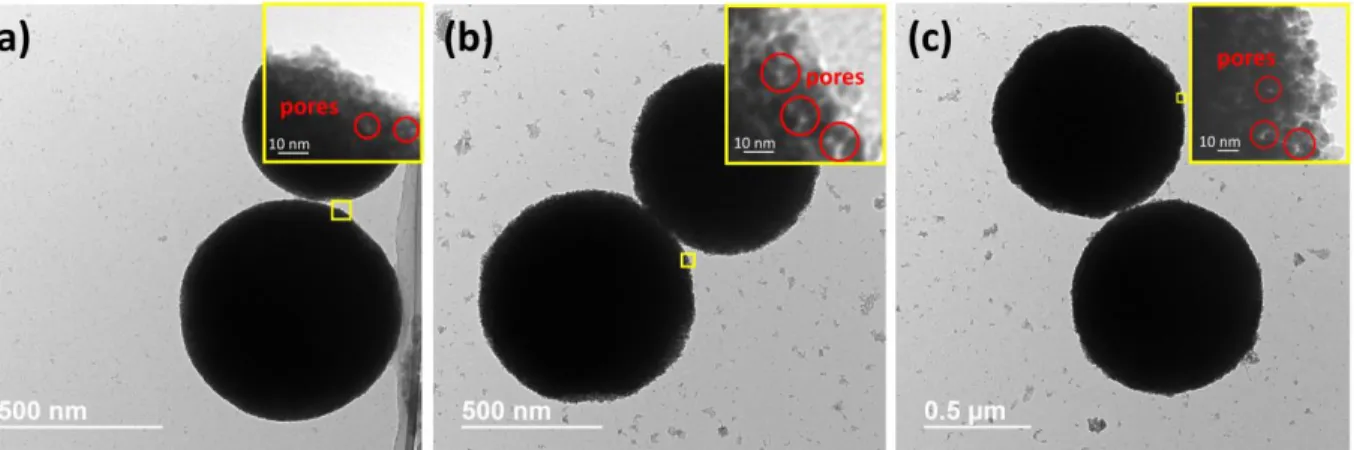
A facile solvothermal synthesis in an ethanol/acetic acid mixtures so-called “water controlled-release solvothermal process (WCRSP)” has been successfully utilized for fabrication of SnO2 with a controllable hierarchical spherical size and micro-/mesoporosity. The obtained SnO2 spheres exhibited a particle size in the range of 0.6 –1.6 m, a pore size of about 1.4–1.9
nm, and effective surface charge depending on the volume ratio of acetic acid to ethanol in the reaction mixture, and the spheres were constructed by nanoscale particles (Fig. 2). Due to its micro-/mesoporous structure, the SnO2 spheres exhibited large specific surface areas over 100 m2/g. When 10 vol. % of acetic acid at 200 oC for 20 h was used for the reaction, the obtained SnO2 possessed a high specific surface area of 145 m2/g (SnO2_10). The gas sensing property of SnO2_10 without an additional noble metal co-catalyst exhibited a large toluene sensing response (Ra/Rg) of 20.2 at 400 oC, which was about 6 times higher and acceptable selectivity compared to those of other samples. The study found that the sensing performance in the SnO2 hierarchical spheres was influenced by several factors e.g. particle morphology, pore size and specific surface area rather than only a single parameter. Therefore, a precise control of those influencing parameters may lead to the optimum sensing property.
Fig. 2 The formation mechanism of SnO2 spheres with mesoporous structure.
6
This method can also be applied to control the facet of metal oxides/hydroxides since it is an efficient approach to boost their gas sensing performance. Herein, we demonstrate the
successful synthesis of NiO with a dominantly (111) facet from the transformation of NiOHCl with a layered structure synthesized by WCSRP (Fig. 3). Among other crystal facets, NiO-Octa (111) exhibited the best NOx gas sensing response (16.5 %) to 300 pp b level and deNOx photocatalytic ability over 50% under UV irradiation. The DFT calculation revealed that the abundance of Ni atoms on the clean (111) surface layer allows the favorable adsorption of N adatoms, forming the Ni-N bond. The charge transfer took place from NiO to NO orbital has proven to be a cause of bond weakening and stretching from 1.1692 Å to 1.2231 Å, leading to NOx molecular decomposition, consistent with the experimental results.
A uniformly CuO nanoparticles decorated SnO2 (SnO2@CuO) is successfully prepared by electrostatic self-assembly, taking the benefit from opposed surface charges of a positively charged CuO and a negatively charged SnO2. The surface charge of oxides is tunable, depending on the solvent used during solvothermal treatment.
The toluene response (Rtoluene = Ra/Rg) and selectivity (S =
Rtoluene /Rothergas) of CuO/SnO2 based material toward the
exposure of 75 ppm toluene had reached to such high as 540 and 5, respectively due to the p-n heterojunction p-type CuO/n-type SnO2 (Fig. 4). The response/recovery times were 100/36 s. We found that CuO NPs was reduced to Cu metal NPs in high exposure of toluene concentration, forming metal-semiconductor (M-S) contact to greatly improve toluene
response. The limit of detection of SnO2@CuO can reach to around 1 ppm.
Fig. 4 Gas sensing performance
of SnO2@CuO
Fig. 3 The transformation mechanism of octahedral
morphology NiO with 111 facet from a hexagonal morphology NiOHCl
7
We have successfully coupled CuO with 2D Ti3C2Tx MXene. MXenes is a new family of 2D materials which offers more exceptional performances for energy storage, sensor, photocatalyst, functional flexible devices than other 2D materials. To date, the novel functionality of hybrid containing MXene and metal oxides starts being explored. As shown in Fig.
5, the CuO/Ti3C2Tx MXene exhibited the improved toluene gas sensing response (Rg/Ra) of
11.4, which is nearly 5 times higher than that of the pristine CuO nanoparticles (2.3) to 50 ppm of toluene. Due to the different work function (Φ), the Schottky junction was established at the interface of CuO/Ti3C2Tx MXene, acting as hole trapping region (HTR) at Ti3C2Tx MXene side. Compared to other hybrid 2D materials such as MoS2 and rGO, which have possessed a higher work function, the CuO/Ti3C2Tx MXene maintained better toluene sensing performance. Thus, the work function is critical for designing a high sensing performance of hybrid metal oxides/2D materials. The sensor showed fast responses (270 s) and recovery times (10 s) due to the high conductivity of the metallic phase in Ti3C2Tx MXene. Such excellent performance showed promising applications for VOCs gas sensing.
Fig. 5 Gas sensing performance of
8
Table of Content
Motivation ... 1 Acknowledgement ... 2 Declaration Statement ... 3 Abstract ... 4 Table of Content ... 8Chapter 1 General Introduction ... 12
1.1 Environmental gaseous pollutants ... 12
1.2 Gas sensing materials, working principle and influencing factor ... 14
1.2.1 Semiconducting metal oxides (SMOX) gas sensing material ... 14
1.2.2 Gas sensing working principle ... 16
1.2.3 Influencing factor on the improved gas sensing properties ... 20
1.2.3.1 Morphological control ... 20
1.2.3.2 Exposed facets design ... 24
1.2.3.3 Surface functionalization via noble metal decoration ... 26
1.2.3.4 Atomic doping ... 27
1.2.3.5 Heterojunction structures construction ... 29
1.3 Principle of non-hydrolytic synthesis of metal oxide semiconductor ... 33
1.4 Effective surface charge ... 37
1.5 Research objectives ... 38
1.6 References ... 39
Chapter 2 Materials and Methodology ... 51
2.1 Introduction ... 51
2.2 Chemical and reagents ... 51
2.3 Material characterizations ... 51
9
2.5 Gas sensing measurement system ... 53
2.6 References ... 54
Chapter 3 Synthesis process of n- and p-type metal oxide semiconductor with a controllable morphology, surface charge, and exposed facet for harmful gas detection 55 3.1 Synthesis of SnO2 microspheres via water-controlled release solvothermal process (WCSRP) with micro/mesoporosity for high temperatures toluene gas detection ... 55
3.1.1 Introduction ... 55
3.1.2 Experimental section ... 57
3.1.3 Results and discussion ... 57
3.1.4 Gas sensing properties ... 74
3.1.5 Gas sensing mechanism ... 79
3.2 Facet controlled synthesis of NiO nanostructures for NOx detection: Experiment and DFT calculation ... 83
3.2.1 Introduction ... 83
3.2.2 Experimental ... 84
3.2.3 Results and discussion ... 87
3.2.3.1 Crystal structure and morphology characterization ... 87
3.2.3.2 Electronic and optical properties……… ... 98
3.2.3.3 NOx gas sensing properties…………... ... 100
3.2.3.4 DFT calculation and gas sensing mechanism ... 103
3.3 Summary and conclusion ... 109
3.4 References ... 109
Chapter 4 Enhancement of toluene sensing property of n-type SnO2 porous microsphere by decorating with p-type CuO nanoparticles ... 116
4.1 Introduction ... 116
4.2 Experimental section ... 118
4.2.1 Preparation of CuO nanoparticles and spherical SnO2 ... 118
10
4.3 Results and discussion……… ... ……….119
4.3.1 Structure and morphology of CuO nanoparticles, spherical SnO2 and SnO2@CuO ... 119
4.3.2 Gas sensing properties of CuO nanoparticle, spherical SnO2 and SnO2@CuO ... 129
4.3.3 Gas sensing mechanism of SnO2@CuO ... 136
4.4 Conclusions ... 141
4.5 References ... 141
Chapter 5 CuO Nanoparticles/Ti3C2Tx MXene Hybrid Nanocomposites for Detection of Toluene Gas ... 145
5.1 Introduction ... 145
5.2 Experimental ... 147
5.2.1 CuO nanoparticles synthesis ... 147
5.2.2 Preparation of Ti3AlC2 MAX phase ... 148
5.2.3 Preparation of Ti3C2Tx MXene ... 148
5.2.4 CuO nanoparticles/Ti3C2Tx MXene ... 148
5.2.5 Fabrication and analysis of a gas sensing device ... 148
5.3 Results and discussion ... 150
5.3.1 Crystalline phase, morphology, and electronic structure ... 150
5.3.2 Gas sensing properties ... 156
5.3.3 Gas sensing mechanism ... 166
5.4. Conclusions ... 169
5.5 References ... 169
Chapter 6 Summary and Outlook ... 174
Publications ... 177
11
Awards ... 179 Postface Motivation ... 180
12
CHAPTER 1 General Introduction 1.1 Environmental gaseous pollutants
Progressive human and industrial activities have brought severe environmental downgrade besides their bringing to the economic cycle, well-being, wealthiness and human prosperity.1,2 Air quality worsening, one of the serious environmental issues caused by automotive engine and industrial exhaust gases has become an utmost concern for scientists, engineers, and environmentalists due to their effect on human health and surrounding eco-systems. Although the air quality in certain countries has improved in recent years due to the implementation of COP 21 (Paris Agreement) under the United Nations Framework Convention on Climate Change (UNFCCC) in late 2015. This framework aims to reduce carbon and greenhouse emission to a certain level and accelerate the sustainable development goals (SGDs) set by the United Nation.
Air pollution emissions includes carbon monoxide (CO), Nitrogen monoxide (NO), sulfur dioxides (SO2), volatile organic compounds (VOCs), ozone (O3)and many more are released from certain activities of human being such as the burning of non-renewable fossil fuels, thermal power plants or automobile combustions, and industrial activities-induced by-product gases. These harmful gases affect the respiratory and nervous systems in long-term exposure as illustrated in Scheme 1. Evidence of health risk exists associated with the air pollution such as low birth weight, increased infant and perinatal mortality, tuberculosis, cataract, and so on. Air pollution can be found in indoor or outdoor environments.
In particular, VOCs generated by recent situations including rapid industrialization, massive fuels combustion and utilization of chemical in many household products3–5 should be immediately detected because VOCs can potentially harm the human body through inhalation in the long-term exposure.4,6 Since VOCs are quickly evaporated at relatively low temperature, VOCs amount in the atmosphere can gradually increase over time making our environment and other living creatures endangered.4,7–9 Moreover, some VOCs are tasteless, colorless, odorless and exist in a very low concentration, making them more difficult to be detected by human sense. In all variety of harmful VOCs, toluene gas (C7H8) is a toxic gas and a cause of health problem in nervous systems including dizziness, headache, and unconsciousness to induce a permanent speech, hearing, and vision loss for the repeated exposure. It mostly comes from paints, thinners, adhesives, cleaning agents, leather tanning processes.10,11 Therefore, rapid
13
detection of these dangerous gas is of great importance to reduce health risk from its exposure and monitoring its concentration in the indoor and outdoor environment.
Another example of harmful gases beside VOCs is nitrogen oxides NOx. They are deadly atmospheric contaminants produced from hydrocarbons combustion processes such as vehicle engines or power plants which usually occur at high temperature.12–14 Not to mention electrical generation from non-renewable fuels, the massive use of vehicles, especially in the metropolitan city, has made the condition is getting worse by the time.15 A number of studies suggested that NO2 is a source for asthma or asthma symptoms.16
In this regard, there is an urgent need for the sensitive, robust, and fast detection of these severe gases, quantitively, to overcome human sense limitation and protect the larger community. Gas sensor device is a promising way to sense unseen gas threat. Moreover, it is predicted in the future that gas sensor devices can be fully integrated into a flexible, wearable, and smart system into our body making it very attractive to control the exposure of harmful pollutants to our body. It is also a great promise to monitor our health problem through biomarkers such as from breath or skin. Gas sensor device is formed by two main elements: Electrode device and sensing material. This thesis will mainly present the later element, that is gas sensing material.
Scheme 1. Air pollution source (Ref : https://www.idt.com/jp/en/application/iot-building-technology/outdoor-air-quality-sensor-oaq)
14
1.2 Gas sensing materials, working principle and influencing factor 1.2.1 Semiconducting Metal Oxides (SMOX) gas sensing material
Semiconductor metal oxides material, or well-known as SMOX, is one of the most explored compounds for chemiresistive gas sensors application. Because of their low cost and versatility of development, ease of use, wide range of observable gases/possible fields of use, they have drawn much interest in the field of gas sensing under atmospheric conditions. These materials exhibited exceptional sensing performances as compared to other types of sensors, e.g. catalytic-type and electrochemical-type gas sensors (Fig. 1.1).17 The detection of the gases can be determined by the change of resistance (Ω) conductance (Ω-1), capacitance (F), work function (Φ), optical properties, or the release of energy during gas-phase solid reaction. Numerous SMOX have been utilized to identify dangerous and poisonous gases. In general, there are two primary categories of semiconductor metal oxide sensors, namely n-type, the majority charge carrier of which is an electron (for example SnO2, ZnO, TiO2, WO3, W18O49, Fe2O3, Ga2O3, In2O3, and many more) and p-type, the majority charge carrier of which is a hole (such as NiO, CuO, CoO, Cr2O3, Mn3O4 and a few others). The first group is being widely investigated to explore their novel functionality for detecting the unwanted gases. In contrary, relatively little exposure has been given to the latter group, and relevant work into the manufacture of these chemiresistors is only in the preliminary stages of production. Table 1.1
summarized previous works on detecting VOCs gas based on SMOX material. Due to the very abundance work on this material, we have focused on the materials of which related to the present thesis.
Fig. 1.1 Gas concentration range of some common gas sensor.
15
Although, SMOX-based sensor obviously exhibited excellent gas sensing performance, it comes with limitation as well. Although SMOX shows an excellent gas sensing response, in practical, SMOX is sensitive to not only single target gas, but also other gases and moistures which could lead to the poor selectivity. SMOX could not bear the harsh environment and thus their long-term durability still lacks. To realize the robust gas sensing materials, some approaches are attempted by scientists. The improvement method based on gas sensing working prince is discussed in the following description.
Table 1.1 A brief summary of some SMOX-based gas sensing materials Sensor
Materials
Group Morphological structures
Target gas Operating temperature Ref. SnO2 n-type (Eg = 3.6 eV) Nanoparticles, Nanotubes, Nanowires, Hierarchical porous structures, Thin film, spherical, cubic, etc. Cl2, NO2, H2, CO, Benzene, Toluene, Ethylene, Xylene, Ethanol, Formaldehyde, etc. RT-400 18–25 CuO p-type (Eg = 1.2 eV) Nanoparticles Nanorods, Nanosheets, Thin Film, Urchin-like,
Nanowires,
Hollow spheres, etc.
Ethanol, H2, H2S, NH3, etc. RT-300 26–33 NiO p-type (Eg = 3.6-4.0 eV) Nanoflowers,
Nanotubes, Thin Film, Nanowires, Hollow spheres, Hierarchical structures Ethanol, Butanol, HCHO, NH3, CO, etc. RT-400 34–44
16
1.2.2 Gas sensing working principle
Prior to the explanation on how the gas sensing properties of certain material can be improved, it is crucial to discuss the sensing mechanism of chemiresistive SMOX-based gas sensors. Although exceptionally long history, there are still several debates among the researchers on the exact fundamental mechanism that causes a response if SMOX is exposed to target gas. However, in general, the accumulation of electrons in adsorbed molecules and the band bending caused by these charged molecules is responsible for an alteration in conductivity of the SMOX. The recent gas sensing mechanism proposed by Ji and co-workers,17 the adsorption models, the bulk resistance mechanism, and the gas diffusion control mechanism can provide sufficient explanation on physical phenomena such as bend bending, the formation of electron depletion layers (EDLs)/Hole Accumulation Layers (HALs), and grain boundary barrier change. Thus, this present thesis will emphasize these gas sensing mechanisms parameter.
The adsorption model is proposed because the physical or chemical adsorption/desorption on the gas sensing materials has caused the alteration in a sensor resistance, leading to the change in charge carrier concentration. At first, we took an example of n-type SnO2, as a common gas sensing material, to explain the adsorption model. The work from Li and the team,45 where they prepared hierarchical SnO2 nanostructures from assembled nanosheets, has theoretically proposed the oxygen vacancy formation at high temperatures in a reducing environment (Eq. 1.1).
Oo = Vo+ 2𝑒 + 1
2O2(g) (Eq. 1.1)
Where Oo represents O atom in O site and Vo represents oxygen vacancy. Fig. 1.2 shows an atomic model of SnO2 (left side) and their corresponding band structure (right side). Left side of Fig. 1.2 (a) displays a nonstoichiometric SnO2 surface with oxygen vacancies, where the pre-existed oxygen vacancies filled donor states which positions below the conduction band edge and thus there is a pre-existed energy barriers (𝑋1) (right side of Fig. 1.2 (a)). During the air injection process, the oxygen molecules were adsorbed on the SnO2 surface by inhabiting the pre-existed oxygen vacancies. Then, they capture the electrons near the conduction band leading to the formation of oxygen ions. Ionic oxygen species are temperature-dependent, means that the oxygen ion species at certain working temperature is specific. The temperature dependency of oxygen dissociation is shown below. (Eqs. 1.2 – 1.5).
17
O2(gas) → O2(ads) (Eq. 1.2)
O2(ads) + e–→ O2– (ads) (< 150 oC) (Eq. 1.3) O2– (ads) + e–→ 2O– (ads) (150 °C–400 °C) (Eq. 1.4)
O– (ads) +e– → O2− (ads) (> 400 °C) (Eq. 1.5) Due to the trapping of electrons at the conduction band, a typical formation of electron depletion layers (EDLs) occurred. This also caused in the change of band structure of SnO2. In short, the energy barriers (𝑋2) were formed, the Fermi energy went down and oppositely, conduction band moved upwards (Fig. 1.2 (b)).46 Accordingly, the sensor resistance became higher since the electron’s mobility was blocked by the EDLs. In the case of ethanol enters as a sensing gas, it undertakes a redox reaction with oxygen ions, as described in Eq. 1-6. This removal of oxygen ions by the reaction of ethanol from the surfaces caused the thinner size of
Fig. 1.2 (a–c) Schematic illustration and the corresponding energy band diagram of (a)
nonstoichiometric SnO2 surface with oxygen vacancies, (b) partially repopulated SnO2 with adsorbed oxygen and (c) reaction between C2H5OH and pre-adsorbed oxygen atoms. The gray, red, blue, black and white balls represent Sn, O, adsorbed O, C and H, respectively.
18
EDLs to decrease the potential barrier (𝑋3), move Fermi level upwards and conduction band edge downwards, resulting in the decrement of sensor resistance.
C5H2OH (gas) + 10.5 O2− (ads)→ 5 CO2 (gas) +1.5 H2O (gas) + 21 e– (Eq. 1.6) The above adsorption/desorption mechanism mainly discussed the interaction between oxygen species with analyte gas, without involving a direct contact between semiconductor surface with analyte gas. Although oxygen undergoes chemical adsorption/desorption, such mechanism is unsatisfactory to explain some interesting phenomenon at which a formation of by-product material can be found after the exposure of testing gas. This alone is a clear indication that not only oxygen species which interacted with SMOX surface, but also the testing gas itself. For example. Xiao et al. 47 prepared mesoporous SnO2 for the H2S gas detection. They interpreted the gas sensing mechanism by the oxygen adsorption models that adsorbed onto the grain of SnO2 (Fig. 1.3). EDLs formed and covered the grains, leading to the depleted region at the grain boundary and increment of gas sensor resistance. When 50 ppm of H2S was injected, the ionosorption oxygen was actively interact with the H2S gas, shrinking the depletion layer thickness and decreasing the sensor resistance. This process is a normal oxygen adsorption/desorption. However, they noticed the formation of SnS2 compound after the gas sensing evaluation as confirmed by the existence S 2p core level spectra in XPS scan. Thus, the H2S would eventually have direct interaction with SnO2 surface only after a complete removal of adsorbed oxygen ion species, but H2S flow still proceeded. The formation of SnS2 was described in Eq. 1.7
H2S + SnO2 → SnS2 +H2O (Eq. 1.7)
SnS2 is a well-known material for solar cell application due to its low band gap to effectively harvest the solar energy by adsorbing the wide range infrared spectrum. SnS2 exhibited higher conductivity than SnO2, and therefore its presence during the H2S exposure can further decrease the resistance, leading to the higher sensitivity of SnO2-based sensor.
19
The systematic concept of adsorption models in n-type SMOX, including both oxygen and chemical adsorption, is also applicable for its counterpart, namely p-type SMOX. Yakhmi et. al synthesized CuO thin film to detect various gases such as Cl2, H2S, NH3, CH4, CO and NO. It was found that the CuO thin film-based sensor exhibited a reasonable response (Rg/Ra) of 37.7 to 10 ppm H2S at 200 oC.48 It also shows a remarkable selectivity when it was exposed to other hazardous gases as mentioned above. They believe that the gas sensing mechanism of p-type CuO thin film sensor was similar to that of any n-type SMOX exposed in H2S, that is involving oxygen and chemical adsorption. When CuO is exposed to certain temperatures, CuO surface absorbs oxygen from air and created HALs, resulting in a low resistance value. Then, upon the flow of H2S at low concentration (<500 ppb), adsorbed oxygens on the CuO surface reacted with H2S, releasing electrons (Eq. 1.8). Then, it recombined with holes in VB caused an increase in sensor resistance. However, when high concentrated H2S (>50 ppm) were flown, the chemical oxidation of H2S occurred (Eq. 1.9). Subsequently, CuS layer formed and covered the entire CuO grains surface. CuS itself exhibit a metallic properties that enhances the connectivity between CuO interparticles, resulting a huge decrease in film resistance. The whole oxygen and chemical adsorption process were schematically illustrated in Fig. 1.4.
H2S(g)+3O2−(ads) → 2H2O(g)+2SO2(g)+3e− (Eq. 1.8) H2S(g)+CuO(s)→CuS(s)+H2O(g) (Eq. 1.9)
Fig. 1.3 Schematic diagram of the H2S-sensing mechanism of sensors based on mesoporous SnO2. Reproduced with permission from Ref. 47
20
1.2.3 Influencing factor on the improved gas sensing properties
For many decades, a lot of researchers worldwide have put their efforts to explore critical factors affecting gas sensing properties of semiconducting metal oxides SMOX, and the best way to explain how their performances can be enhanced is that by using a comprehensive gas sensing mechanism. According to the discussion in the previous section, the gas sensing mechanism can be improved by increasing the oxygen chemisorbed species and target gas molecules adsorption. Herein we discuss influencing factors which can effectively alter the gas sensing properties.
1.2.3.1 Morphological control
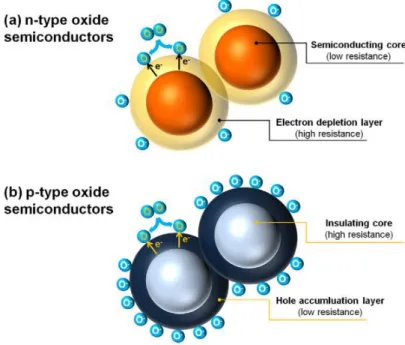
The sensitivity of the SMOX-based sensor can be increased significantly by changing their particle size and morphological structures, as have been reported by many publications .49 It is reasonable because the size of particle determines the core-shell structures of depleted regions, namely Electron Depletion layers (EDLs) and Hole Accumulation Layers (HALs) for n-type and p-type SMOX, respectively, as illustrated in Fig. 1.5.34,50 While the morphological
Fig. 1.4 Schematics and band diagrams showing various stages before and after the CuO
films were exposed to H2S gas of different concentrations. (a) In air, (2) in low H2S concentration and (3) in high H2S concentration. Reproduced from ref. 48 copyright Elsevier
21
structures govern the configuration of their assembly and interparticle contact.51–56 Both depleted regions are formed because of electrons drawing from the valence band of SMOX. However, they have opposite behaviors. EDLs, due to the high density of electrons, it has a high resistance. Consequently, n-type SMOX exhibited a high resistance in air atmosphere. HALs, in opposite, possessed a low resistance in the ambient atmosphere due to the accumulation of hole. The gas sensing response of SMOX, hypothetically, is depleted region dependent. The response will dramatically increase if SMOX particles is smaller than twice thickness of EDLs.50,51,57 As also illustrated in Fig. 1.6, three different models regarding the relation between particle size (D) and charge depletion layers thickness (L) can be explained. The L is formed around the surface due to oxygen ions adsorption and the size of L is expected to be 3 nm for standard SnO2 nanostructured materials.58–60 If the D much larger than 2L (D>>2L), the conductivity is governed by the inner mobile charge carriers and electrical resistivity depends largely on the height of potential barrier. If the D is larger or comparable to 2L (D ≥ 2L), there is a formation of interparticle space-charge layers, inhibiting the conduction channel within each particle. Therefore, the electrical resistivity not only depends on particle boundary, but also the space-charge contact on the particle neck and so it is so sensitive to charge reactions. When D is smaller than 2L (D<2L), the depleted layers dominates the particles and thus the bands are nearly flat in whole structures. The electrical resistivity is
Fig. 1.5. Formation of electronic core–shell structures in (a) n-type and (b) p-type oxide
22
controlled by the interparticle resistivity. Even only a few charges is transferred from the surface reactions can cause a significant changing in the electrical resistivity.61
The effect of morphology and particle size variation of n-type (SnO2 and ZnO) and p-type (CuO and NiO) on their gas sensing properties gathered from the literatures is summarized in Table 1.2. The table informs how the morphology can greatly tune the sensing responses.
Mostly, they attributed the enhanced gas sensing properties to the high specific surface area, interparticle contact and porous structures. Nevertheless, the relationship between morphological design and their gas sensing performance still remains difficult because different materials, although they have the same morphology, will exhibit different gas sensing properties.
Fig. 1.6 Schematic model of the effect of the crystallite size on the sensitivity of metal-oxide
gas sensors: (a) D >> 2L; (b) D ≥ 2L; (c) D < 2L.(D: particle size , L: charge depletion layers thickness) Reprinted from reference. 61
23
Table 1.2 Morphology-dependent gas sensing properties of semiconducting metal
oxide-based sensing materials
Sensor Materials
Morphology Target gas Working Temperature (oC) Response (Rg/Ra) or (Ra/Rg) Refs. SnO2 Hierarchical NSs Acetone 500 Rshuttle-shaped = 60 Rcone-shaped = 175 Rrod-shaped = 32 62 SnO2 Flower-like Sheet-like Nanoparticles CO 250 Rflower-like = 71.5 Rsheet-like = 17.7 Rnanoparticles = 16.3 63 ZnO Nanorods Nanoparticles NO2 100 Rnanorods = 34.8 Rnanoparticle = 1.02 64 ZnO Nanorods Needle-like Pencil-like NO2 80-400 Rnanorods = 624 Rneedle-like = 44.8 Rpencil-like = 206 65 CuO Hierarchical NSs H2 200 RHierarchical = 5.8 RNanorods = 3.4 66 CuO Hierarchical NSs H2S 190 RHierarchical = 4.5 RSolid spheres = 3.2 67 NiO Nanotubes Ethanol 250 RNanotubes = 4.2
RNanofibers = 1.4
68 NiO Hollow Spheres 1-Butanol 350 RHollow spheres = 2.55
RNanoparticles = 1.73 69 NSs = Nanostructures
Ra = Resistance in Air Rg = Resistance in gas
24
1.2.3.2 Exposed facets design
Gas adsorption/desorption during the sensing process mostly occurs on the surface of materials, and due to the fact that different exposed surface facet exhibit different surface adsorption-desorption abilities, gas sensing performances, in many cases, are largely affected by surface nature of the material. High-energy facets tend to show more excellent gas sensing properties because of higher surface energy and stronger interaction with analytes. In the reported literatures, the influence of exposed facets is always accompanied by first-principle calculation, besides the experimental work to gain a more comprehensive understanding about the surface nature and how they interact with the gas molecules. Therefore, a precise and facile design of a highly active surface facets is getting more popular in the gas sensing field.
We can take ZnO, a common and well-known gas sensing material, as a representative to observe crystal facet-dependent gas sensing properties. In one report,70 porous ZnO nanosheets with two well-defined facets were successfully synthesized, namely (0001) and (101̅0). They were used to detect ethanol vapors. Fig. 1.7 (a) illustrates crystal facet in ZnO porous nanosheet. The gas sensing results depicted in Fig. 1.7 (b-f) clearly shows the ZnO with (0001) surface facet exhibited a better ethanol sensing properties than ZnO with (101̅0) surface facet, at all operating temperatures. Not only its superior sensitivity, (0001) surface facet was found to be more selective than that of (101̅0) surface facet. They proposed that the (0001) surface facet exhibited a large amount of oxygen vacancy as well as unpaired dangling bonds, contributing much in gas molecular adsorption favorability, so that the gas sensing properties improved.
Fig. 1.8 (a) shows a crystal structure of hexagonal ZnO with both (0001) and (101̅0) crystal facets. It is obvious that on the surface of (0001) facet, two dangling bonds in 2-fold coordinated sites and one dangling bond in 3-fold are existed. On the other hands, only one dangling bond in 3-fold coordinated sites can be found in (101̅0) crystal facet. ZnO nanosheet with dominantly (0001)-exposed facet should be able to adsorb more ionized oxygen species and gas molecules greatly, leading to the better sensing performance than ZnO with dominantly (101̅0)-exposed facet.
The influence of facet can also be clarified by DFT calculation. Fig. Fig. 1.8 (b-f) display a model of O2 adsorption on the (0001) and (101̅0) crystal facets. From the calculation, adsorption energies (ΔEads) when O2 is added were -1.0665 eV and -0.5233 eV for (0001) and
25
(101̅0)-exposed crystal facet, respectively. It indicates that O2 easily be adsorbed on the (0001) than (101̅0) facet. It tracks well with the experimental evidence.
Fig. 1.7 (a) Schematic diagram of the crystal faces in ZnO nanosheets (b-f) gas sensing
properties of ZnO nanosheets with (0001) and (101̅0) facets to ethanol. Reproduced from reference.70
(a)
(b) (c)
(d) (e)
26
1.2.3.3 Surface functionalization via noble metal decoration
The noble metals surface-functionalized metal oxide semiconductors (MOS) can greatly boost the catalytic chemical reaction occurred at the surface. In this sense, the gas sensing performance can be also escalated because the greater reaction between ionized oxygen species and gas analytes. These following are most used noble metals: Au, Ag, Pt and Pd. Although there are several contributions of these metal precious for improving the gas sensing performance include the reduction of activation energy and Schottky barrier band depletion, the most critical role of the noble metal-loaded MOS is to introduce a spillover effect.71 The spillover phenomenon is explained by an improved oxygen molecules dissociation into oxygen ionic species, usually forming a weak bond between oxygen molecule and noble metal. As shown in Fig 1.9 (a-c), the dissociation of oxygen molecules was accelerated due to the high catalytic reaction. The electron amount and mobility were also increased, leading to not only high sensitivity but also faster response and recovery speed to allow a faster gas detection (Fig
1.9 (d)). This approach is also known as electronic sensitization. In some cases,
(a)
(b)
(c)
(d)
(e)
(f)
Fig. 1.8 (a) Atomic model of hexagonal wurtzite ZnO (b-f) oxygen adsorption model on
27
functionalization of noble metals also reduces the optimum working temperature due to the low potential barrier. This strategy, although shows a promising performance, potentially increases the cost of sensor device fabrication or poisoning, unless we can keep the performance high with a low amount of these noble metals.
1.2.3.4 Atomic Doping
Gas sensing mechanism involves heavily on the oxygen adsorption by taking electron near the valence band. Therefore, increasing charge carrier concentration can effectively improve the gas sensing performance of metal oxide semiconductor (MOS), because will be more oxygen species are adsorbed and the higher response can be expected. In fact, introducing an atomic doping into MOS crystal, in many cases, increased the charge carrier concentration. The addition of atomic doping also changes the particle size, porosity, specific surface area and crystal defect. Besides, band structures such as band gap and Fermi energy level will also be altered compared to pre-doping MOS. Normally, metal heteroatoms were used as atomic doping to replace a certain amount of metal in MOS crystal lattice.
Fig. 1.9 (a-c) Schematic diagram illustrating the sensitization mechanism of noble
metal-functionalized metal oxides and (d) their gas sensing performance. Reproduced from reference.71
28
DFT ab initio calculation is a conventional approach to elucidate the influence of metal doping on the band structure engineering and gas sensing properties and mechanism. Xue et
al.72 synthesized a flower-like SnO2 doped by Pt nanoparticles. It is different with that Pt-decoration strategies, because in this case, Pt has been incorporated into SnO2 crystal structures. They found that Pt-doped flower-like SnO2 not only give a significant improvement to the sensitivity, but also reduce the optimum working temperature, stability and selectivity compared to that of pristine SnO2 sensors. DFT calculation revealed that there are four sites (Sn5C, Sn6C, Ob and Op) on which CH4 molecules be adsorbed (Fig. 1.10 (a)). Moreover, the adsorption energy of methane after Pt doping reduced greatly. As shown in Fig. 1.10 (b)), the adsorption energy different of CH4 (with H3CH as a model) at the Op site is 4 times higher than in other sites and other models, revealing the H3CH adsorption model doped with Op adsorption
sites on Pt surface is more conducive to methane adsorption. As we discussed in previous part, the metal doping changes the band structure. Fig. 1.10 (c) shows total density of states of the
Fig. 1.10 (a) The computational model of Pt-doped SnO2, with the atoms of Pt doping, (b) The absolute values of the adsorption energy reduction after doping of three methane adsorption models of Sn5c, Ob and Op. (c) Density of states for undoped (top) and Pt-doped SnO2(110) surfaces (mid), and partial density of states of Pt (bottom). Reference 72
29
pristine and Pt-doped flower-like SnO2. After Pt doping, a new electrons state emerged around the Fermi level, which is attributed to 5d states of Pt. Thereafter, the electrical resistance would be lower, promoting the fast transfer of electrons and minimized the required energy for electron excitation. Besides Pt, other metals doping with lower costs such as Ce, Ni, Al, etc., can be used to enhance the gas sensing properties of metal oxide semiconductor (MOS), as listed in Table 1.4. The examples of such atomic doping approach, in conclusion, is an attractive strategy that can be further explored in the future.
1.2.3.5 Heterojunction structures construction
With all respect to the above-mentioned approaches, build a heterojunction structure by combining two or more MOS materials is a promising strategy, since each component give complementarily advantages to subsidize their drawbacks and eventually lead to the improvement of sensing properties. Examples of its advantages include increased catalytic reaction, formation of depleted regions, adsorption site abundant, and band structures
Table. 1.4 Metal-doped metal oxide semiconductor gas sensing materials Material Dopant Morphology Target gas
(concentration)
Sensitivity (Ra/Rg) or
(Rg/Ra)
Refs.
SnO2 Ce Nanoparticles Acetone (50 ppm) 33.4 (undoped) 50.5 (doped)
73 SnO2 Pt Flower-like Methane (500 ppm) 1.26 (undoped)
1.98 (doped)
72 SnO2 Ni Nanoparticles Acetone (100 ppm) 137 (undoped)
169 (doped)
74 ZnO Al Nanoparticles CO (50 ppm) 3 (undoped)
6.1 (doped) 75 ZnO Fe Porous Nanosheet Ethanol (500 ppm) 10.4 (undoped) 52.3 (doped) 76 CuO Cr Nanorod NO2 (100 ppm) 7.5 (undoped)
134.2 (doped)
77 CuO Mn Nanoflakes Ethanol (500 ppm) 3.9 (undoped)
8.0 (doped)
30
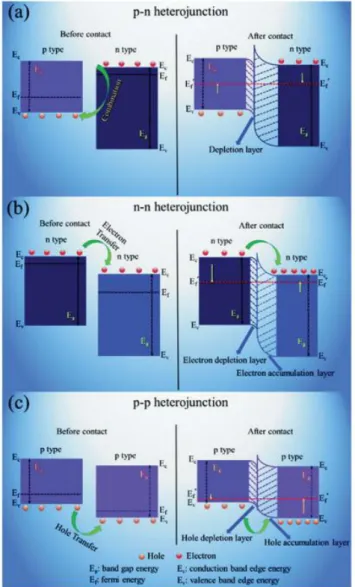
alteration.79 These reasons make the heterojunction structures an ideal approach if we consider the gas sensing mechanism. Based on the type of metal oxides, the hetero-contact can be classified into three cases, those are p-n heterojunction, n-n heterojunction and p-p heterojunction (Fig. 1.11).80
In a p-n heterojunction, due to their charge carrier density (Nd) characteristic, electrons flow from the n-type to the p-type, while holes move in back directions, that is from the p-type to the n-type until the fermi energy level is equalized. Therefore, an expansion of the depleted region at the interface of heterojunction will occur and electrical resistance would subsequently increase in the ambient air or when oxygen species adsorption. During the materials is under
the exposure of a reducing gas, the oxygen species on the surface reacts with the target gas and forced the electrons back to the conduction band of n-type and holes back to the p-type SMOX.
Fig. 1.11 Schematic illustrations of the energy band structures at hetero- junction interfaces of
31
This process causes a decrease in overall electrical resistivity of the p-n heterostructures due to reducing of the interface barrier. When the reducing gas flow is stopped and the air is flown, the potential barrier will again be established. In the case of both n-n and p-p heterojunction, they are built because of the work function difference between two or more SMOX. To balance the charge carrier in the n-n and p-p heterojunction, the charge carrier flow occurs, and flow direction depends on the work function and charge carrier density. The existence of p-p and n-n heterojun-nction-n, of course, can-n provide more gas adsorption-n an-nd better gas sen-nsin-ng performance compared to a single component.
In addition to above discussion, the metal oxides can also be combined with metallic phase materials to build the so-called Schottky and Ohmic junction for enhancing the gas sensing properties. Before their contact, metal and SMOX are electrically neutral with their respective work function level, φm (metallic work function) supposed to be higher than that of
φs (n-type semiconductor work function), as displayed in Fig. 1.12 A. When they are in electrically contact, the electron transfer from semiconductor into metal. This causes an excessive electrons on the metal and formation a depleted zone with a certain thickness (WS)
Fig. 1.12 Formation of a barrier between a metal and a semiconductor: (A) neutral and isolated;
(B) electrically connected; (C) in perfect n-type Schottky contact (φm >φs); (D) n-type ohmic contact (φm < φs); (E) p-type ohmic contact (φm > φs); (F) p-type Schottky contact (φm < φs). o denotes electron in conduction band; + denotes donor ion.
32
in the near surface of semiconductor (Fig. 1.12 B). This also cause a formation of an interface dipole and production an internal electric field which is directed from the semiconductor to the metallic phase material. When they are in physical contact, the gradient of potential barrier in the depletion layer governs the electric resistivity which induce a well-known band-bending. The band-bending direction and type of contact largely depend on the work function position and type of semiconductor. In the case of n-type, if the work function of metal is higher than that of semiconductor (φm > φs), the Schottky contact should be build (Fig. 1.12 C). In fact, otherwise, the contact is biased so that electrons flow from the semiconductor to the metal. They encounter no barrier due to the φm < φs. It is called by ohmic contact (Fig. 1.12 D). In a p-type, an ohmic contact, in contrary, is built when φm > φs as shown in Fig. 1.12 E and Schottky junction is formed if the φm falls behind φs (φm < φs) as shown in Fig. 1.12 F.
To get better understanding on how these heterojunction improve the gas sensing properties, one representative study is taken. Na et al.81 synthesized Mn3O4-decorated ZnO NBs for the detection of ethanol gas. The gas sensing properties of Mn3O4-decorated ZnO were compared to the pristine ZnO NBs or Mn3O4 NWs. Fig. 1.13 shows that both ZnO NBs and Mn3O4-decorated ZnO NBs behave like n-type semiconductor response. Meanwhile the ZnO− ZnMn2O4 core−shell NCs or Mn3O4 NWs showed p-type gas sensing behaviors. To note, both ZnMn2O4 and Mn3O4 are p-type semiconductors. This result indicates that the conduction and chemoresistive variation in are dominated by continuous p-type ZnMn2O4 shell layers. As we can see, the response of Mn3O4-decorated ZnO NBs exceeded the pristine ZnO NBs and Mn3O4 NWs. These results clearly demonstrate that gas response selectivity can be enhanced or tuned by the configurational design of radial p−n junctions in heterostructures.
Fig. 1.13. Sensing transients to 100 ppm C2H5OH at 400 oC: (a) ZnO NBs, (b) Mn3O4-decorated ZnO NBs, (c) ZnO−ZnMn2O4 NCs, and (d) Mn3O4 NWs. Reproduced from
33
In fact, the SMOX can also be combined with polymeric or organic semiconductors resulting a heterostructures. However, the corresponding discussion is beyond the thesis scope.
1.3 Principle of non-hydrolytic synthesis of metal oxide semiconductor
In general, semiconducting metal oxides can be synthesized by physical and chemical method.82,83 Physical methods consisted of pulsed laser deposition (PLD), physical or chemical vapor deposition (PVD or CVD), spray pyrolysis, etc., and chemical method or commonly well-known as wet-chemical method comprised of precipitation, sol–gel, reverse micelle, thermal decomposition, solvothermal, hydrothermal, microwave-assisted and flow reactor synthesis. Although physical method can produce a nearly perfect crystalline and amorphous SMOX nanostructures, due to its overly complex and expensive apparatus and time-consuming, it is not a favorable method, or it cannot be conducted by every scientist. Wet chemical approach can be an alternative synthetic method to fabricate nanostructured SMOX. Hydrothermal and solvothermal approaches are gaining popularity among other counterparts due to their controllability in the synthetic parameters, leading to the controllability of properties of the obtained materials.84–90 In a particular, hydrothermal method or some scientists call as “aqueous approach” is defined as the conversion of a precursor solution into a solid-state material by using water as a solvent. The precursors or the starting materials can be either metals salts such as chlorides, sulfates, nitrates or metal organic such as metal alkoxides. Due to the use of waters, the inorganic solids obtained from this process, are generally owing low amount of organic impurities and good surface accessibility.91–93 However, the morphological feature such as particle size and shape, cannot be easily controlled due to the fast polymerization or hydrolysis reaction. It is still possible to control their morphology by using surfactants, but once again, the morphology cannot be easily predicted since one surfactant is capable to shape a well-defined morphology of metal oxide but may not be work to other metal oxides.94 Meanwhile, its counterpart, solvothermal treatment or well-known as non-aqueous approach, the transformation of starting materials solution is induced in an organic or mixed organics solvents with the exclusion of water. The wide range of precursors is available not limited to metal salts and alkoxides but also acetates and acetylacetonates.95 The organic solvents act as an oxygen source during the transformation process and can influence the size, shape, sometime facet-selective, porosity and inorganic composition or crystal structures.96 Although the excellent control over crystal size of inorganic solids with
34
narrow size distribution and low agglomeration can be obtained, the large amount of organic impurities existed on the surface in addition to the potential toxicity of the solvents itself. A comparative literature of benefits and disbenefits of aqueous and non-aqueous method is listed in Table. 1.5. Another interesting feature of non-aqueous approach is the yield higher than 80% which make this approach economically preferable. From the scientific point of view, the absence of surfactant can simplify the chemical reaction pathway. As previously discussed, excellent control of the particle size and shaping down to nanometer scale are an important factor in improving the gas sensing properties, the synthesis process to produce metal oxide materials in this thesis will be based on non-aqueous approach. We will further discuss how the choice of solvent largely influences their crystal shape and size in detail.
Table 1.5 Benefits and disbenefits of Aqueous and Non-aqueous solvent approach88 Hydrothermal (Aqueous) Solvothermal (Non-Aqueous) Benefits Low amount of organic impurities
Nontoxic solvents
Simple, robust and widely applicable synthesis
Good accessibility of the nanoparticles surface
Excellent control over crystal size Narrow size distribution
Low agglomeration formation
Good redispersibility
Disbenefits Less control over crystallite size and
shape
Broader size distribution Agglomeration tendency Restricted redispersibility
Large amount of organic impurities Toxicity of solvents
Restricted accessibility of the nanoparticle surface
35
There are numerous reports on the synthesis of inorganic solids nanomaterials using nonaqueous process and the number are rapidly growing in a recent year, this alone indicates the potentiality of the process a versatile alternative to aqueous method.88,97–102 Based on these studies, the chemical pathway can be summarized into 5 major reactions (Fig. 1.14), accompanied by an example for each reaction. Alkyl halide elimination (reaction 1) is the polymerization reaction between metal salts and metal alkoxides under the use of alcohol
solvent. One of example is the condensation between TiCl4 and benzyl alcohol resulting in an TiO2 anatase nanostructures.103 Ether elimination (reaction 2) occurs when two metal oxides condensates with the release of organic ether. The mechanism worked for the synthesis of HfO2 nanoparticles.104 Ester elimination process (reaction 3) is the reaction between metal carboxylate and metal alkoxides or between metal carboxylates and alcohols solvents,
Fig. 1.14. Selected condensation steps in nonaqueous sol–gel processes together with one
example. 1) Alkyl halide elimination, 2) ether elimination, 3) ester elimination, 4) C-C bond formation between benzylic alcohols and alkoxides, 5) aldol-like condensation reactions. 88
36
exemplified by the synthesis of ZnO nanoparticles which involves the reaction between zinc acetate and benzyl alcohol.105 These first three routes are the most common reactions in nonaqueous method. C-C bond formation (reaction 4) is induced by the excellent catalytic activity of the metal centers in the alkoxy groups, as proven by the case of formation of Nb2O5 nanoparticles from Nb(OEt)5 in or BaTiO3 nanoparticles from Ti(iOPr)4 and Ba metal in benzyl alcohol solvent.106,107 Aldol condensation (reaction 5) involves the use of ketones as solvents and two carbonyl compounds with the release of water molecules. The well-known example is the formation of TiO2 in acetone solvent.108
As we can see from the above examples, almost all metal oxides, either binary or ternary system can be successfully obtained with a well-defined nanostructure. Fig. 1.15 shows TEM observation of some representative of metal oxides prepared by nonaqueous approaches.109 Well-dispersed nanostructured ranging from 2-5 nm was formed in the case of CeO2, ZrO2, HfO2, SnO2-doped In2O3, BaTiO3, and Fe3O4.
However, the critical drawback rises in this approach is that the existence of organic compound in the form of surface functional groups in the obtained nano-oxide particles. This can diminish the accessibility of the surface, that is a very critical issues when the metal oxides are applied as gas sensing materials which relies so much on the surface reaction. In fact, the surface functional groups come from excess organics solvent can give a different in the effective surface charges depends on the attached organic molecules. Therefore, in this point of view, the particular drawback can potentially be turned into benefits when we would like to combine two or more metal oxides. Ideally, two oxides with different surface charge (one negative and one positive), if they are self-assembled, the interface contacts should be very intimate due to electrostatic force. The interface contact is also a very crucial factor in designing an oxide nanocomposite-based gas sensing material.
37
1.4 Effective Surface charge
The effective surface charge and adsorption properties of the metal oxides nanostructure are two common parameters to be measured in surface chemistry. They are probed by means of (surface enhanced Raman spectroscopy (SERS) and Fourier transform infrared (FTIR) spectroscopy) and microscopic (scanning tunneling microscopy (STM) and atomic force microscopy (AFM)). One study 110 showed the detection of TMA+ and ClO4- in the TiO2 particles by using surface titration by internal reflection spectroscopy (STIRS). They suspected the remained charge impurities originated from tetramethylammonium hydroxide [TMAOH] and tetramethylammonium perchlorate [TMAP] used in the synthesis. To quantitively measure the exact value of the surface charge on the metal oxides material, zeta potential measurement is a very versatile method.111 The relation between zeta potential of oxide nanoparticles and electronegativity of a metal ion as well as the charging mechanism was previously studied.112,113 One of the examples113 is the case of ZnO with different surface charge. ZnO with negatively charge (-43.0 mV) can be obtained by dissolution in the citric acid or sodium citrate from the ZnO with neutral charge. Meanwhile, changing citrate into L-serine
Fig. 1.15 TEM overview images of various metal oxide nanoparticles obtained from
halide-free precursors in benzyl alcohol: (a) CeO2, (b) ZrO2, (c) HfO2, (d) SnO2-doped In2O3, (e) BaTiO3, and (f) Fe3O4. 109
38
or HEPES (4-(2-hydroxyethyl)-1-piperazineethanesulfonic acid), ZnO with positively charge (+26.3 mV) is achieved. They suggested that the attached organic molecules onto the ZnO surfaces is through either electrostatic interactions or partial coordination bonding. Also, the organic functionalization induced surface charge can also be found in the negatively charge Si as shown in Fig. 1.16. Silica particles was partially covered by aminopropyl groups and (trihydroxysilyl)-propylmethylphosphonate as the result of synthesis process using 3-aminopropyl-triethoxysilane. The surface charge was controlled by the organic molecules, instead of silica particles.
1.5 Research Objectives
As introduced above, the semiconducting metal oxides (SMOX) are very promising materials for sensor applications to detect various kinds of dangerous gases including VOCs and non-VOCs which are the major environmental air pollutants. The sensor development based on SMOX materials has been started over centuries and is still progressing since the environmental air pollutions remains a grand challenge. Practically, the SMOX should be precisely designed to meet the sensors' performance demand, such as outstanding responsivity, excellent selectivity, low detection limit, high durability and cost-effective. Moreover, a fabrication method largely influences the phase structures, physicochemical and electronic properties of the metal oxides. Solvothermal treatment, in some extent, is a non-aqueous approach to excellently control these properties because their controllability upon the chemical reaction. The knowledge development on this synthetic method is at an early stage, especially on how the various combination of the solvents is affecting the surface effective charge, surface facet, particle size and porous structure of metal oxides and on how the tunable surface charge
Fig. 1.16. Stabilization of nanoparticles by interaction between amine and phosphonate
39
can be beneficial for their hybridization with another metal oxides and/or non-oxides. In fact, although the combination of two or more sensing materials always lead to the enhancement of their gas sensing properties, the retention of their benefit from their original properties can be very difficult because the combination process involves chemical or physical reaction in a severe environment. Therefore, there are many opportunities that this thesis can contribute.
In short, the thesis focuses on 3 main research objectives:
1. Investigate the influence of mixed organic solvents on morphology, surface charge, and exposed facets of the metal oxides synthesized solvothermally and their gas sensing properties
2. Investigate the effect of the surface charge on the hybridization of metal oxides composites and their gas sensing performance
3. Develop a robust method for improving VOCs gas sensing performance of metal oxides and their hybrid with other oxides nanostructures or 2D materials.
1.6 References
1 K. Wetchakun, T. Samerjai, N. Tamaekong, C. Liewhiran, C. Siriwong, V. Kruefu, A. Wisitsoraat, A. Tuantranont and S. Phanichphant, Semiconducting metal oxides as sensors for environmentally hazardous gases, Sensors Actuators, B Chem., 2011, 160, 580–591.
2 J. Cherniwchan, Economic growth, industrialization, and the environment, Resour.
Energy Econ., 2012, 34, 442–467.
3 A. Esplugues, F. Ballester, M. Estarlich, S. Llop, V. Fuentes-Leonarte, E. Mantilla and C. Iñiguez, Indoor and outdoor air concentrations of BTEX and determinants in a cohort of one-year old children in Valencia, Spain, Sci. Total Environ., 2010, 409, 63–69. 4 E. Cetin, M. Odabasi and R. Seyfioglu, Ambient volatile organic compound (VOC)
concentrations around a petrochemical complex and a petroleum refinery, Sci. Total
Environ., 2003, 312, 103–112.
5 T. Ohura, T. Amagai, X. Shen, S. Li, P. Zhang and L. Zhu, Comparative study on indoor air quality in Japan and China: Characteristics of residential indoor and outdoor VOCs,
40
6 J. E. Colman Lerner, E. Y. Sanchez, J. E. Sambeth and A. A. Porta, Characterization and health risk assessment of VOCs in occupational environments in Buenos Aires, Argentina, Atmos. Environ., 2012, 55, 440–447.
7 T. Yang, P. Zhang, B. Xu and J. Xiong, Predicting VOC emissions from materials in vehicle cabins: Determination of the key parameters and the influence of environmental factors, Int. J. Heat Mass Transf., 2017, 110, 671–679.
8 W. P. L. Carter, Development of ozone reactivity scales for volatile organic compounds,
J. Air Waste Manag. Assoc., 1994, 44, 881–899.
9 J. N. Cape, Effects of airborne volatile organic compounds on plants, Environ. Pollut., 2003, 122, 145–157.
10 D. R. Brower, The effects of cocaine on the central nervous system, J. Am. Med. Assoc., 1886, VI, 59–62.
11 I. Kheirbek, S. Johnson, Z. Ross, G. Pezeshki, K. Ito, H. Eisl and T. Matte, Spatial variability in levels of benzene, formaldehyde, and total benzene, toluene, ethylbenzene and xylenes in New York City: A land-use regression study, Environ. Heal. A Glob.
Access Sci. Source, 2012, 11, 1.
12 N. Miura, T. Koga, M. Nakatou, P. Elumalai and M. Hasei, Electrochemical NOx sensors based on stabilized zirconia: Comparison of sensing performances of mixed-potential-type and impedancemetric NOx sensors, J. Electroceramics, 2006, 17, 979– 986.
13 A. Afzal, N. Cioffi, L. Sabbatini and L. Torsi, NO x sensors based on semiconducting metal oxide nanostructures: Progress and perspectives, Sensors Actuators, B Chem., 2012, 171–172, 25–42.
14 J. Liao, Z. Li, G. Wang, C. Chen, S. Lv and M. Li, ZnO nanorod/porous silicon nanowire hybrid structures as highly-sensitive NO2 gas sensors at room temperature, Phys. Chem.
Chem. Phys., 2016, 18, 4835–4841.
15 B. Son, W. Yang, P. Breysse, T. Chung and Y. Lee, Estimation of occupational and nonoccupational nitrogen dioxide exposure for Korean taxi drivers using a microenvironmental model, Environ. Res., 2004, 94, 291–296.
41
One material, multiple functions: Graphene/Ni(OH)2 thin films applied in batteries, electrochromism and sensors, Sci. Rep., 2016, 6, 1–14.
17 H. Ji, W. Zeng and Y. Li, Gas sensing mechanisms of metal oxide semiconductors: A focus review, Nanoscale, 2019, 11, 22664–22684.
18 P. H. Suman, A. A. Felix, H. L. Tuller, J. A. Varela and M. O. Orlandi, Comparative gas sensor response of SnO2, SnO and Sn3O4 nanobelts to NO2 and potential interferents,
Sensors Actuators, B Chem., 2015, 208, 122–127.
19 A. Hermawan, Y. Asakura, M. Inada and S. Yin, One-step synthesis of micro-/mesoporous SnO2 spheres by solvothermal method for toluene gas sensor, Ceram. Int., 2019, 45, 15435–15444.
20 W. Li, S. Ma, Y. Li, G. Yang, Y. Mao, J. Luo, D. Gengzang, X. Xu and S. Yan, Enhanced ethanol sensing performance of hollow ZnO-SnO2 core-shell nanofibers, Sensors
Actuators, B Chem., 2015, 211, 392–402.
21 A. Salehi, A highly sensitive self heated SnO2 carbon monoxide sensor, Sensors
Actuators, B Chem., 2003, 96, 88–93.
22 Y. J. Choi, I. S. Hwang, J. G. Park, K. J. Choi, J. H. Park and J. H. Lee, Novel fabrication of an SnO2 nanowire gas sensor with high sensitivity, Nanotechnology, 2008, 19, 095508.
23 N. Li, Y. Fan, Y. Shi, Q. Xiang, X. Wang and J. Xu, A low temperature formaldehyde gas sensor based on hierarchical SnO/SnO2 nano-flowers assembled from ultrathin nanosheets: Synthesis, sensing performance and mechanism, Sensors Actuators, B
Chem., 2019, 294, 106–115.
24 J. Tamaki, T. Maekawa, N. Miura and N. Yamazoe, CuO-SnO2 element for highly sensitive and selective detection of H2S, Sensors Actuators B. Chem., 1992, 9, 197–203. 25 J. Liu, X. Huang, G. Ye, W. Liu, Z. Jiao, W. Chao, Z. Zhou and Z. Yu, H2S detection
sensing characteristic of CuO/SnO2 sensor, Sensors, 2003, 3, 110–118.
26 X. Li, Y. Wang, Y. Lei and Z. Gu, Highly sensitive H 2S sensor based on template-synthesized CuO nanowires, RSC Adv., 2012, 2, 2302–2307.