背景と目的
脳血管内治療は,いうまでもなく新しい機器と技術の 開発と改良がその発展の原動力である.新しい医療機器 がなかなか承認されず,わが国への導入が遅れているこ とを示すデバイスラグ(device lag)という用語が過去の 連絡先:坂井信幸,〒 650 0047 神戸市中央区港島南町 2 1 1 神戸市立医療センター中央市民病院脳神経外科Address reprint requests to:Nobuyuki Sakai, M.D., Department of Neurosurgery, Kobe City Medical Center General Hospital, 2 1 1 Minatojima minamimachi, Chuo ku, Kobe shi, Hyogo 650 0047 Japan
脳血管内治療の近未来―機器の開発改良―
坂井 信幸,今村 博敏,坂井 千秋,足立 秀光,谷 正一,徳永 聡,船津 尭之,
別府 幹也,鈴木 啓太,足立 拓優,奥田 智裕,松井 雄一,吉田 泰規,川端 修平,
秋山 亮,堀内 一史
神戸市立医療センター中央市民病院脳神経外科
Future Direction of Neuro Endovascular Therapy
:Innovation in Device
Development and Improvement
Nobuyuki Sakai, M.D., Hirotoshi Imamura, M.D., Chiaki Sakai, M.D., Hidemitsu Adachi, M.D., Shoichi Tani, M.D., So Tokunaga, M.D., Takayuki Funatsu, M.D., Mikiya Beppu, M.D.,
Keita Suzuki, M.D., Hiromasa Adachi, M.D., Tomohiro Okuda, M.D., Yuichi Matsui, M.D.,
Yasunori Yoshida, M.D., Shuhei Kawabata, M.D., Ryo Akiyama, M.D., and Kazufumi Horiuchi, M.D.
Department of Neurosurgery, Kobe City Medical Center General Hospital
The continued development and improvement of devices is the most important factor to advance neuro endovascular therapy. The endovascular treatment of intracranial aneurysms started with detach-able coil technology and has been further developed with adjunctive device technology, including the hyper compliant balloon and the neck bridge stent. These technologies are all focused on tightly packing aneurysm with coils. The flow diverter operates on a totally different theory, whereby blood flow into the aneurysm is regulated with a fine mesh stent to achieve occlusion and shrinkage of the aneurysm. The Pipeline Flex was approved in 2015 and we have just started to evaluate this new technology in Japan. However, there will still remain some aneurysms that cannot be cured by the flow diverter. To treat these, we will have a new range of innovative devices, the PulseRider, WEB, Medina and others in the near future. In the field of carotid disease, carotid artery stenting has already overtaken endarterectomy in Japan with its acceptable results and patient desire for a less invasive modality. But, periprocedural isch-emic stroke is still more frequent in CAS. A new generation of micro mesh stents will hopefully resolve this problem beginning with the CASPER approved study just started in Japan. Average risk CEA patients can now enroll in this study and. Going forward, many new innovative devices will continue to be deployed in the field of neuro endovascular therapy. As always, we should safeguard both their appropri-ate use and patient safety in order to best contribute to the development of this field.
(Received November 18, 2016;accepted November 28, 2016) Key words:innovation, device, development, flow diverter, micro mesh stent
Jpn J Neurosurg(Tokyo)26:21 28, 2017
ものとなるほど,2010 年以降脳血管内治療領域ではわが 国に新しい機器が導入された(Table 1).一方,新規デバ イスはその安全性や有効性が未知であり,十分に検証さ れていない段階で導入すればその成績を検証することが 求められる.本稿では,脳動脈瘤と頚動脈狭窄症に焦点 を絞って,最近導入された機器に加えて今後導入される 機器について報告する.
脳動脈瘤
ガイディングシステムをはじめ多くの機器を使って血 管内から治療する脳動脈瘤であるが,離脱型コイルの開 発7)により本格的に始まった脳動脈瘤に対する血管内治 療は,バルーンやステントの開発と導入により大きく発 展してきた.2010 年に導入されたコイル塞栓術支援用ス テントは,自己拡張型ステントの開発により始まった. Neuroform(Stryker,Kalamazoo,MI,USA)は,2002 年に米国における HDE 承認,2005 年に欧州で CE マー クを取得し多くの経験が蓄積されている.その後, Enterprise VRD(Codman,Miami,FL,USA),LEO(Balt Extrusion,Montmorency,France),Solitaire AB(Covi-dien/Medtronic,Irvine, CA,USA),LVIS(MicroVention, Tustin,CA,USA),Liberty(Penumbra,Alameda,CA, USA)などが開発されている.わが国では 2010 年に脳動 脈治療用自己拡張型ステントとして Enterprise VRD が 承認されステント支援コイル塞栓術が始まり,2012 年には Neuroform EZ(Stryker)が,2015 年には LVIS が承認 された.これまではすべて瘤内にいかにコイルを充塡す るかが目標であったが,今,最も注目されている機器 flow diverter(以下 FD)は,動脈瘤内にカテーテルを誘 導しコイルなどの塞栓物質を充塡することなく母血管に 留置して,脳動脈瘤への血流を制御して動脈瘤の破裂や 増大を防ぎつつ,母血管を温存して脳動脈瘤を治療する 機器である.FD の代表は Pipeline(Covidien)で,Pipe-line for Uncoilable or Failed Aneurysms(PUFS)研究で は,大型または巨大(ドーム径 10 mm 以上),ワイドネッ ク(ネック部>4 mm),ICA(petrous,cavernous あるい は paraophthalmic 領域)にある単一脳動脈瘤が対象とさ れて実施された.主要有効性評価項目は,治療手技 180 日後に標的脳動脈瘤に完全閉塞がみられ,親血管に狭窄 (>50%)がなく代替治療も行われていなかった被験者 の割合,主要安全性評価項目は,治療後 180 日目までに 同側脳卒中や神経学的死亡の割合であった.その結果, 108例が登録され,脳動脈瘤の平均サイズは 18.2 mm, ネック部の平均サイズは 8.8 mm,85(78.7%)が大型 (10∼25 mm),22(20.4%)が巨大(≧25 mm)で,1 つ の脳動脈瘤に留置した Pipeline は平均 3.1(中央値 3,範 囲 1∼13)本,主要有効性評価項目では,集計対象の 104 例,106 の標的脳動脈瘤中 78 動脈瘤に Pipeline のみで狭 窄を起こさず,完全閉塞が得られた(73.6%,95%事後 信頼区間 64.4∼81.0%).安全性評価対象の 107 例中,主 要同側脳卒中/神経学的死亡が 6 例にみられた(5.6%,
Table 1 Approved devices for neuroendovascular treatment in Japan
Device Target 2005 2009 2010 2014 2015
IV rt PA(Alteplase) AIS 2005.10
Precise/Angioguard XP CAS 2007.9
Carotid Wallstent/Filter Wire EX CAS 2010.2
Carotid Guardwire CAS 2010.7
Protégé/Spider FX CAS 2011.2 MoMa CAS 2012.4 Onyx AVM 2009.6 Enterprise VRD AN 2010.1 Neuroform EZ AN 2012.9 Wingspan ICAD 2013.1 Merci AIS 2010.4 Penumbra AIS 2011.6 Solitaire AIS 2013.12 Trevo AIS 2014.4
EmboSphere Tumor, AVF 2014.9
LVIS AN 2015.4
Pipeline Flex AN 2015.4
REVIVE SE AIS 2016.1
95%事後信頼区間 2.6∼11.7%)3).その他にも Silk(Balt Extrusion),Surpass Flowdiverting Stent(Stryker),FRED (MicroVention)などが欧州で CE マークを取得し,すで に臨床応用されており,多くの企業が開発に取り組んで いる(Table 2).神経圧迫症状で発症した動脈瘤では,瘤 内異物のない FD 治療は圧迫症状の改善効果が高い が14)24),治療前から治療後も有効な抗血栓療法が必要 で11)23),相当の習熟を要し5),出血26)28)および血栓症6)12) などの合併症も少なくなく,自然歴や従来の治療法との 優劣は明らかになっていない機器である27). 本邦では,承認された Pipeline に加えて,Surpass と FREDの治験も行われた.Pipeline は delivery system を 改良した Pipeline Flex が 2015 年 4 月に承認された.3 つ の FD の機器の概要を示す(Table 2).Pipeline を除いて 個別の機器の治験結果の詳細は承認申請前のため報告で きないが,治験の概要は以下のとおりである.のべ 14 施 設で総計 79 例の被験者が FD 治療を受けた.治療後の脳 動脈瘤破裂 4 件(5.1%),治療後の死亡 4 件(5.1%),血 栓性閉塞 3 件(3.8%),虚血性脳卒中 5 件(6.3%)であっ た.治療後の脳動脈瘤破裂は FD 治療の大きな課題とし てすでに多くの報告があるが,大型のものではコイル併 用が有効と報告されている18).また治療前から治療後比 較的長期にわたって複数の抗血小板薬の投与が必要とさ れているが,clopidogrel の効果には個人差があるためそ の不応患者にはさまざまな対策が必要で,術前に血小板 凝集機能を測定しその値によって効果に個人差が少ない prasugrelを導入して効果を上げたという報告があり10), 国内の経験に基づくコンセンサスの形成が望まれる. Pipeline Flexの導入に際しては,日本脳神経外科学会が 主導するデータベース登録が進められており,市販後の 調査(post market surveillance:PMS)にそのデータを活 用することになっている.周術期の安全性をこれとは別 に集計したところ治験時とは異なり,治療後の破裂 1 件 (0.5%),死亡 1 件(0.5%),血栓性閉塞 1 件(0.5%), 虚血性脳卒中 3 件(1.5%),出血性脳卒中 2 件(1.0%), mass effectの悪化 4 件(2%)と良好であり,機器の改良 と習熟によって有効な FD 効果を得ることができたこと に加え,コイル併用や適切な抗血栓マネジメントを心が けた結果ではないかと考えている(Table 3). FD はこれまで治療困難であった大型,不規則形状の 脳動脈瘤を治療可能とする画期的な機器であるが,椎骨 脳底動脈の血栓化動脈瘤に対する効果は疑問視されてお り25),遠位動脈へのアクセスが困難な例ではそもそも技 術的に FD 治療を適用できない.また terminal type の大 型動脈瘤への効果も不確かであり,従来のコイル塞栓術 でも再開通が多いことが知られているこのカテゴリーに 対して,新しい機器の開発が進んでいる.当科では従来 の開頭手術でも脳血管内治療でも治療が難しい症例に 限って,すでに欧州で市販されいくつかの報告21)22)があ
る PulseRider(Pulsar Vascular,Los Gatos,CA,USA) を倫理委員会の許可のもと導入した.代表例を示す. 62 歳,男性の上方に向く最大径 10.5 mm の前交通動脈 瘤を,PulseRider 2.7 3.5/10 T を支えに Orbit Galaxy 8 mm 24 cmを framing coil として合計 16 本のコイルで塞
Table 2 Three flow diverter, approved or during study in Japan Pipeline
Covidien/Medtronic Surpass FDSStryker MicroVention/TerumoFRED
Mechanism Wire braded Wire braded Wire braded, double layer
Metal 2 different metal=platinum/ tangsten, cobalt/chrome/ nickel/moribuden
cobalt/chrome, 48 96 wires 2 layer of nickel/titan wire, con-nected by tantalum wire
Diameter 2.50 5.00 mm, 0.25 mm each 2.9, 3.5, 4.4, 5.3 mm 3.5 5.5 mm, 0.5 mm each Length 10 20 mm, 2 mm each
20 35 mm, 5 mm each 15, 20, 25, 30, 40, 50 mm D=3.5, L=13/7, 22/16∼D=5.5, L=22/14, 32/26 Delivery Microcatheter(Marksman27, ID
=0.027")recommended 3.7 Fr(OD=0.051")delibery system Microcatheter0.027")recommended(Headway27, ID= Approving study
栓を行い,6 カ月後の血管造影で完全閉塞を確認した (Fig. 1).抗血栓マネジメントは多数経験しているコイ ル塞栓術支援用頭蓋内ステントと同じとしたが,金属量 は少なく多剤併用の期間,服用期間とも短縮できるとい う印象である.これまで前交通動脈の他に脳底動脈分岐 部,内頚動脈分岐部に計 8 例使用し,合併症および再開 通はなく 6 例に完全閉塞を得ている. その他にも,母血管に機器を留置することなくこの再 開通が懸念されるネックの広い terminal type の脳動脈瘤 をターゲットに下 2 つの機器が注目されている,1 つは, WEB(Sequent Medical,Aliso Viejo,CA,USA)と呼ば れる機器で,極細のワイヤーを編み込んだ楕円球系のデ バイスで,径は 4∼11 mm,マイクロカテーテルを使っ て脳動脈瘤のネックをカバーするように脳動脈瘤内に留
Table 3 Periprocedural events of flow diverter treatment in Japan
Approving study in Japan Pipeline Classicin study Pipeline Flexpost market
Device Pipeline Classic
Surpass Streamline FRED
Pipeline Classic Pipeline Flex
n 79 22 200
Rupture 4(5.1%) 2(9.1%) 1(0.5%)
Death 4(5.1%) 3(13/6%) 1(0.5%)
Stroke, ischemic 5(6.3%) 2(9.1%) 3(1.5%)
Stroke, ICH 1(1.3%) 0 2(1.0%, unrelated)
Thrombotic occlusion 3(3.8%) 0 1(0.5%)
Worsened mass effect NA 2(9.1%) 4(2.0%)
A BB
C D
Fig. 1 A case of PulseRider assisted coil embolization
A:DSA AP view, before the treatment.
B: Xper CT, PulseRider open and cover the neck of Acom aneurysm.
C:DSA AP view, right after the treatment.
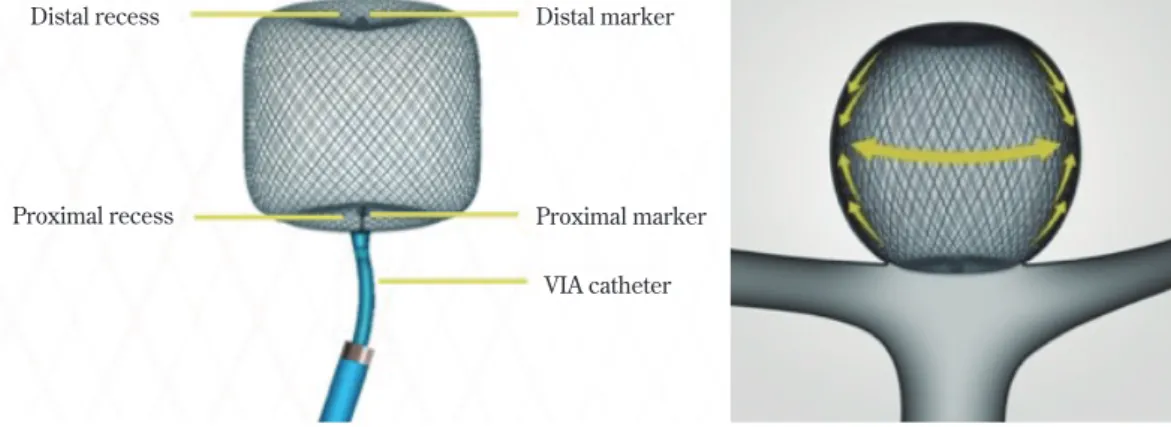
置する(Fig. 2).1 つの機器で脳動脈瘤を充塡し,ネッ クを中から有効にカバーする機構であり,適切なサイズ の選択,そして適確な留置技術を要する.すでに欧州で は数千例の使用経験が蓄積されており WENCAST およ び French Observatory study で,合わせて 113 例の前向き 登録が行われ,技術的成功 96.5%,1 年後の閉塞が 82%, 安定が 98%,治療および機器に関連する死亡 0 件,mRS 2以上の悪化は 30 日以内で 2.7%,その後 1 年までに 1% と,その安全性と有効性が示された16)17).米国では治験 が行われ被験者の登録は終了した.本機器は機器の細径 化などの改良に合わせて本邦への導入が検討されてい る.もう 1 つの機器は MEDINA(Medtronic)である, ナイチノールでできた葉状の petal を連ねたデバイスで, 球形になる形状記憶を有し,径は 4∼9 mm である(Fig. 3).WEB とは異なり複数のデバイスを使用することが 想定されているが1),ネック部をカバーする網状の petal が瘤内に流入する血流を制御することにより治療効果を 得ることが期待されている.日米の治験が今後計画され る予定である.
頚動脈狭窄症
2006 年の第 1 次「医療ニーズの高い医療機器」に評価 AA(疾病の重篤性が高く,当該医療機器等の医療上の有 用性が高い)とされた頚動脈ステントは,2007 年 9 月に Preciseと Angioguard XP(当時 Johnson & Johnson/Cor-dis,Miami,FL,USA)が承認され,わが国でも正式に 頚動脈ステント留置術(carotid artery stenting:CAS)が 開始された.その根拠となった SAPPHIRE(Stent and Angioplasty with Patients at High Risk for Endarterec-tomy)研究29)に基づき,CAS は頚動脈内膜剝離術(carotid endarterectomy:CEA)の高危険群に適用するとされ,脳卒中合同ガイドライン 201515)でも,症候性 50%以上ま
たは無症候性 80%以上の狭窄を有し,CEA の危険因子 を伴うことが CAS の条件とされている.2010 年に発表 された CREST(Carotid Revascularization Endarterectomy vs Stenting Trial)研究では CEA の normal/average risk 群 を対象に CAS と CEA の比較を行い,両者が同等の周術 期合併症率および同側脳卒中の発生率であることを示し ている4).これに伴い米国のガイドラインでは,CAS は CEAに代わり得る頚動脈狭窄症に対する血行再建術で あり,CAS の危険が通常程度の患者に対する CAS は,術 者が十分にトレーニングを積み,症候性 6%・無症候性 3%を超えなければ考慮すべき治療法であると位置づけ ている9).CREST では CAS に周術期の脳卒中が多く, Distal marker Distal recess
Proximal recess Proximal marker
VIA catheter
Fig. 2 Schema of WEB (Courtesy by Sequent Medical)
Fig. 3 Picture of MEDINA(Courtesy
CEAに心筋梗塞が多かった.これは多くの比較研究でも 同じような傾向が確認されているため,CAS および CEA 後の心筋梗塞が欧米より少ないわが国では留意すべき点 である.現在わが国では,2 つのステント:Carotid WALLSTENT(Boston Scientific,Marlborough,MA, USA),Protégé(Medtronic)と 3 つの遠位型塞栓防止機 器:FilterWire EZ(Boston Scientific),Carotid GuardWire (Medtronic),Spider(Medtronic),そして近位で遠位塞 栓を防ぐ MoMa Ultra(Medtronic)が承認され,Cello(富 士システムズ),Optimo(東海メディカルプロダクツ)な どのバルーン付きガイディングカテーテルを加え本格的 な複数デバイス時代を迎えた.繰り返し行われている多 くの登録研究や調査で,proximal protection 法やプラー ク診断の活用などの工夫により,安全に CAS を行うため の環境が整ってきたことが示されている13). CAS 後の虚血性脳卒中が多いことの原因の 1 つに, plaqueが stent により有効にカバーされていない可能性 が示唆されてきた2).その欠点を克服する機器として, メッシュ状の層と拡張力を発揮する層を併せ持つ新世代 の micro mesh stent が相次いで開発された(Table 4). C Guardはメッシュ層に PET が使われており20),GORE Carotid Stentでは Goretex が使われている19).そして欧 州では Roadsaver,日米では CASPER と呼ばれている MicroVentionの double layer stent はナイチノールのメッ シュと拡張力を有するナイチノールワイヤーが組み合わ されている.不安定プラークでも留置後の in stent pro-trusionがほとんどみられない(Fig. 4).CASPER は 2016 年から国内治験が開始されており,その適格基準に CEA
Table 4 Micro mesh carotid stent
Gore Carotid Stent Roadsaver(CASPER) C Guard
Gore MicroVention/Terumo InspireMD
Aperture size 500μ 375 500μ 150 180μ
Materials PTFE mesh(Heparin coated)on nitinol stent Nitinol on nitinol PET MicroNeton nitinol stent Delivery system/
Min Guide Cath 5 F/7 F 5 F/7 F 6 F/8 F
A B
C C
Fig. 4 A case of carotid artery stenting using CASPER
A:DA lateral view, before treatment.
B:DA lateral view, after stenting.
の average risk も含まれている.結果次第では CAS の適 応が拡大される可能性があるため大きな関心が寄せられ ている.
結 語
脳動脈瘤と頚動脈狭窄症を中心に機器の開発と導入に 関する最新情報を報告した.機器の開発と改良によって 劇的に変化してきた脳血管内治療であるが,その発展の ためには適切な使用法の開発,術者教育をはじめとする 治療環境の整備,そして結果検証が重要であることはい うまでもない.常に改良が加えられる医療機器では,適 応を守り,安全に使用することを心がけ,結果を正直に 公表しながら治療成績の向上に努めることが必要であ る.企業が行う市販後調査への協力,学会が主導する登 録研究などにも積極的に貢献しなければならない. 著者全員は日本脳神経外科学会への COI 自己申告の登録を 完了しており,筆頭著者が過去 3 年間に本論文に関して開示 すべき COI は下記のとおりです. テルモ社より寄付金(年間合計 200 万円以上),日本ストラ イカー社,ジョンソンエンドジョンソンより講演料(年間合 計 100 万円以上)を受領しています. 文 献1) Aguilar Perez M, Bhogal P, Martinez Moreno R, Bäzner H, Ganslandt O, Henkes H:The Medina Embolic Device: early clinical experience from a single center. J Neurointerv Surg 2016.[Epub ahead of print]
2) Aikawa H, Kodama T, Nii K, Tsutsumi M, Onizuka M, Iko M, Matsubara S, Etou H, Sakamoto K, Kazekawa K :Intrapro-cedural plaque protrusion resulting in cerebral embolism during carotid angioplasty with stenting. Radiat Med 26: 318 323, 2008.
3) Becske T, Kallmes DF, Saatci I, McDougall CG, Szikora I, Lanzino G, Moran CJ, Woo HH, Lopes DK, Berez AL, Cher DJ, Siddiqui AH, Levy EI, Albuquerque FC, Fiorella DJ, Berentei Z, Marosfoi M, Cekirge SH, Nelson PK:Pipeline for uncoilable or failed aneurysms:results from a multi-center clinical trial. Radiology 267:858 868, 2013. 4) Brott TG, Hobson RW 2nd, Howard G, Roubin GS, Clark
WM, Brooks W, Mackey A, Hill MD, Leimgruber PP, Sheffet AJ, Howard VJ, Moore WS, Voeks JH, Hopkins LN, Cutlip DE, Cohen DJ, Popma JJ, Ferguson RD, Cohen SN, Blacks-hear JL, Silver FL, Mohr JP, Lal BK, Meschia JF;CREST Investigators:Stenting versus endarterectomy for treat-ment of carotid artery stenosis. N Eng J Med 363:11 23, 2010.
5) Colby GP, Gomez JF, Lin LM, Paul AR, Coon AL:In situ removal of the pipeline embolization device:the‘corking’ and‘pseudo corking’techniques. J NeuroInterv Surg 5: e6, 2012.
6) Fiorella D, Hsu D, Woo HH, Tarr RW, Nelson PK:Very late thrombosis of a pipeline embolization device construct:
case report. Neurosurgery 67(3 Suppl Operative):E313 314, 2010.
7) Guglielmi G, Vinuela F, Dion J, Duckwiler G:Electrothrom-bosis of saccular aneurysms via endovascular approach, Part 2:Preliminary clinical experience. J Neurosurg 75:8 14, 1991.
8) Hopf Jensen S, Marques L, Preiß M, Müller Hülsbeck S: Initial clinical experience with the micromesh Roadsaver carotid artery stent for the treatment of patients with symp-tomatic carotid artery disease. J Endovasc Ther 22:220 225, 2015.
9) Kernan WN, Ovbiagele B, Black HR, Bravata DM, Chimow-itz MI, EzekowChimow-itz MD, Fang MC, Fisher M, Furie KL, Heck DV, Johnston SC, Kasner SE, Kittner SJ, Mitchell PH, Rich MW, Richardson D, Schwamm LH, Wilson JA;American Heart Association Stroke Council, Council on Cardiovascu-lar and Stroke Nursing, Council on Clinical Cardiology, and Council on Peripheral Vascular Disease:Guidelines for the Prevention of Stroke in Patients With Stroke and Transient Ischemic Attack. Stroke 45:2160 2236, 2014.
10) Levitt MR, Ghodke BV, Hallam DK, Sekhar LN, Kim LJ: Incidence of microemboli and correlation with platelet inhi-bition in aneurysmal flow diversion. AJNR Am J Neuroradiol 34:2321 2325, 2013.
11) Lylyk P, Miranda C, Ceratto R, Ferrario A, Scrivano E, Luna HR, Berez AL, Tran Q, Nelson PK, Fiorella D:Curative endovascular reconstruction of cerebral aneurysms with the pipeline embolization device:the Buenos Aires experience. Neurosurgery 64:632 642, 2009.
12) McAuliffe W, Wycoco V, Rice H, Phatouros C, Singh TJ, Wen-deroth J:Immediate and midterm results following treat-ment of unruptured intracranial aneurysms with the pipeline embolization device. AJNR Am J Neuroradiol 33:164 170, 2012.
13) Miyachi S, Taki W, Sakai N, Nakahara I;Japanese CAS Sur-vey Investigators:Historical perspective of carotid artery stenting in Japan:analysis of 8,092 cases in The Japanese CAS survey. Acta Neurochir(Wien) 154:2127 2137, 2012.
14) Moon K, Albuquerque FC, Ducruet AF, Crowley RW, McDougall CG:Resolution of cranial neuropathies following treatment of intracranial aneurysms with the Pipeline Embolization Device. J Neurosurg 121:1085 1092, 2014. 15) 日本脳卒中学会,脳卒中ガイドライン委員会編:脳卒中
治療ガイドライン 2015.東京,協和企画,2015. 16) Pierot L, Costalat V, Moret J, Szikora I, Klisch J, Herbreteau
D, Holtmannspötter M, Weber W, Januel AC, Liebig T, Sychra V, Strasilla C, Cognard C, Bonafé A, Molyneux A, Byrne JV, Spelle L:Safety and efficacy of aneurysm treat-ment with WEB:results of the WEBCAST study. J Neuro- surg 124:1250 1256, 2016.
17) Pierot L, Spelle L, Molyneux A, Byrne J;WEBCAST and French Observatory Investigators:Clinical and anatomical follow up in patients with aneurysms treated with the WEB device:1 year follow up report in the cumulated popula-tion of 2 prospective, multicenter series(WEBCAST and French Observatory). Neurosurgery 78:133 141, 2016. 18) Rouchaud A, Brinjikji W, Lanzino G, Cloft HJ, Kadirvel R,
Kallmes DF:Delayed hemorrhagic complications after flow diversion for intracranial aneurysms:a literature overview. Neuroradiology 58:171 177, 2016.
Guima-raes M:First in man implantation of a new hybrid carotid stent to prevent periprocedural neurological events during carotid artery stenting. J Endovasc Ther 21:601 604, 2014.
20) Setacci C, Speziale F, De Donato G, Sirignano P, Setacci F, Capoccia L, Galzerano G, Mansour W;IRON Guard Study Group:Physician initiated prospective Italian Registry of carotid stenting with the C Guard mesh stent:the IRON Guard registry. Rationale and design. J Cardiovasc Surg (Torino) 56:787 791, 2015.
21) Sheth SA, Patel NS, Ismail AF, Freeman D, Duckwiler G, Tateshima S:Treatment of wide necked basilar tip aneu-rysm not amenable to Y stenting using the PulseRider device. BMJ Case Rep doi:10.1136/bcr 2015 011836, 2015.
22) Spiotta AM, Chaudry MI, Turk AS, Turner RD:Initial expe-rience with the PulseRider for the treatment of bifurcation aneurysms:report of first three cases in the USA. J Neuro-interv Surg 8:186 189, 2016.
23) Szikora I, Berentei Z, Kulcsar Z, Marosfoi M, Vajda ZS, Lee W, Berez A, Nelson PK:Treatment of intra cranial aneu-rysms by functional reconstruction of the parent artery:the Budapest experience with the pipeline embolization device. AJNR Am J Neuroradiol 31:1139 1147, 2010.
24) Szikora I, Marosfoi M, Salomvary B, Berentei Z, Gubucz I: Resolution of mass effect and compression symptoms fol-lowing endoluminal flow diversion for the treatment of
intracranial aneurysms. AJNR Am J Neuroradiol 34:935 939, 2013.
25) Toth G, Bain M, Hussain MS, Moskowitz S, Masaryk T, Ras-mussen P, Hui:Posterior circulation flow diversion:a sin-gle center experience and literature review. J Neurointerv Surg 7:574 583, 2015.
26) Turowski B, Macht S, Kulcsár Z, Hänggi D, Stummer W: Early fatal hemorrhage after endovascular cerebral aneu-rysm treatment with a flow diverter(SILK Stent). Neuro- radiology 53:37 41, 2011.
27) van Rooij WJ, Sluzewski M, van der Laak C:Flow diverters for unruptured internal carotid artery aneurysms :danger-ous and not yet an alternative for conventional endovascular techniques. AJNR Am J Neuroradiol 34:3 4, 2013. 28) Velat GJ, Fargen KM, Lawson MF, Hoh BL, Fiorella D,
Mocco J:Delayed intraparenchymal hemorrhage following pipeline embolization device treatment for a giant recana-lized ophthalmic aneurysm. J NeuroIntervent Surg 4:e24, 2012.
29) Yadav JS, Wholey MH, Kuntz RE, Fayad P, Katzen BT, Mish-kel GJ, Bajwa TK, Whitlow P, Strickman NE, Jaff MR, Popma JJ, Snead DB, Cutlip DE, Firth BG, Ouriel K ;Stent-ing and Angioplasty with Protection in Patients at High Risk for Endarterectomy Investigators:Protected carotid artery stenting versus endarterectomy in high risk patients. N Engl J Med 351:1493 1501, 2004. 脳血管内治療の近未来―機器の開発改良― 坂井 信幸 今村 博敏 坂井 千秋 足立 秀光 谷 正一 徳永 聡 船津 尭之 別府 幹也 鈴木 啓太 足立 拓優 奥田 智裕 松井 雄一 吉田 泰規 川端 修平 秋山 亮 堀内 一史 脳血管内治療は,いうまでもなく新しい機器と技術の開発と改良がその発展の原動力である.離脱 型コイルの開発により本格的に始まった脳動脈瘤に対する血管内治療は,バルーンやステントの開発 と導入により大きく発展してきたが,すべて瘤内にいかにコイルを充塡するかが目標であった.Flow diverterはそれとは大きく異なり,脳動脈瘤へ流入する血流を制御するメカニズムを基に開発された 機器である.これによりこれまで治療が難しかった大型,不規則形状の脳動脈瘤の治療が可能になっ た,しかし,分岐部の大型瘤や遠位アクセスが難しい症例の flow diverter 治療は困難であり,Pul-seRider,WEB,MEDINA などの新しい機器が開発されている.頚動脈ステント留置術は CEA に代わ る治療として本邦では広く活用されているが,術後の脳卒中を防ぐために細かい網状のストラットを 有する次世代ステント micro mesh stent が開発された.本邦では CASPER の治験が始まっており, その適格基準に CEA normal risk も含まれており,結果次第では CAS の適応が拡大される可能性があ るため大きな関心が寄せられている.その他の治療でも機器の開発と改良は止まることはなく,適切 な適応判断,技術の習熟,結果の検証を通じて,新しい機器の開発と改良が脳血管内治療の発展に貢 献するよう努めねばならない.
脳外誌 26:21⊖28,2017 要 旨