• 検索結果がありません。

41ψ ・ 芳 ヌ誕

N/A
N/A
Protected

Academic year: 2021

シェア "41ψ ・ 芳 ヌ誕"

Copied!
188
0
0

読み込み中.... (全文を見る)

全文

(1)

[5

t

,

1ヤ.

'

1

ヒ﹁

}

F7

q

̀

F

(2)

感 覚 一運 動系 の随意運動制御 にお ける交感神 経皮膚反応 と 事 象関連電位 の関係(英 文)

審査担 当者

i田 政 冑

/努 守 司 潅こ

ナ じ 一?,i

41ψ ・ 芳 ヌ誕

\ わ 手 努/15

上 記 の 論 文 を 合 格 と判 定 す る

平成 之 年3月/6日

東京都立大学大学院理学研究科教授会

聯 長桑r冷 禍

(3)

DISSERTATION FOR A DEGREE OF DOCTOR OF SCIENCE

TOKYO METROPOLITAN UNIVERSITY

TITLE: The relationship between the sympathetic skin response and event-related brain potentials in sensorimotor

control of human voluntary movements

AUTHOR:

r t (-

EXAMINED BY

Examiner in chief

Examiner ;9 / 7 /

Examiner

Examiner

„X ,

QUALIFIED BY THE GRADUATE SCHOOL OF SCIENCE TOKYO METROPOLITAN UNIVERSITY

Dean

Date /41(eLk 2....c,c5o

(4)

HUMAN VOL UNTARYMOVEMENTS

2000

Masahiro Shimoda M. P.

Department of Ecoregion Science, Faculty of Agriculture,

Tokyo University of Agriculture and Technology

3-5-8 Saiwai-Cho, Fuchu-City 183-8509,

Japan

(5)

This thesis describes original research carried out by the author whilst enrolled in the doctoral program in the Graduate School of Science at the Tokyo Metropolitan University from April 1996 to May 1998. The experiments reported in this thesis were conducted by the author at the Institute of Health and Sport Science of the University of Tsukuba.

M Shimo da

(6)

I would first like to express many thanks to my supervisor, Professor Kuniyasu Imanaka, Department of Kinesiology, Graduate School of Science, Tokyo Metropolitan University, for his encouragement, detailed guidance and comprehensive suggestions throughout the course of this dissertation. I would also like to express my gratitude to Dr.

Yoshiaki Nishihira, Institute of Sport Sciences, University of Tsukuba, for his orientation and encouragement in the beginning of my course of study. My thanks go to Dr. Ichiro Kita, Department of Kinesiology, and Dr. Yoshio Sugiura, Department of Urban and Human Geography, Graduate School of Science, Tokyo Metropolitan University, for their helpful comments on this thesis.

A special thanks is also extended to my colleagues at Tokyo University of Agriculture and Technology, particularly to Dr. Teruo Uetake, Department of Ecoregion Science, Faculty of Agriculture, for his support during the preparation of my dissertation at T.U.A.T. Without him this dissertation would not have been possible.

I also wish to extend my thanks to my colleagues at University of Tsukuba for

their assistance, encouragement and suggestions throughout the experiments reported in

this dissertation.

(7)

Table of Contents

TABLE OF CONTENTS

ACKNOWLEDGMENTS TABLE OF CONTENTS . LIST OF TABLES

11

LIST OF FIGURES ABSTRACT

.. VI

viii .. ix

CHAPTER 1 INTRODUCTION...

1.1 THE AUTONOMIC AND CENTRAL NERVOUS SYSTEMS 1.2 TERMINOLOGY...

1.2.1 Emotional Sweating

1.2.2 Electrodermal Activity (EDA) 1.2.3 Orienting Response (OR)

1.2.4 Sympathetic Skin Response (SSR) 1.2.5 Event-Related Brain Potentials (ERPs) 1.2.6 N140...

1.2.7P300...

1.3 LIMITATIONS OF THIS STUDY 1.3.1 Sympathetic Innervation

1.3.2 Averaging Method 1.3.3 Subjects

1.3.4 Emotions of Subjects...

1.4 SIGNIFICANCE OF THIS STUDY

1 1 6 6 6 7 7 7 7 7 8

8 8 9 10 10

CHAPTER 2 REVIEW OF LITERATURE...

2.1 SYMPATHETIC NERVOUS SYSTEM AND ELECTRODERMAL ACTIVITY...

2.1.1 Emotional Sweating and Electrodermal Activity...

2.1.2 Neural Control of the Electrodermal Activity...

2.1.2.1 Spinal and reticular control of the electrodermal activity...

2.1.2.2 Hypothalamo-limbic control of the electrodermal activity...

2.1.2.3 Cortical control of the electrodermal activity ...

2.1.3 Behavioral Correlates of the Electrodermal Activity...

2.1.3.1 Orienting response (OR)...

2.1.3.2 2.1.3.3

Emotions

Voluntary movements

2.1.4 Sympathetic Skin Response (SSR)...

2.2 INFORMATION PROCESSING IN THE SENSORY-MOTOR SYSTEM OF THE BRAIN...

11 11 11 12 13 14 16 19 20 25 26 27

2.2.1 Reaction Time (RT) and Electroencephalogram (EEG) 2.2.2 Event-Related Potentials (ERPs) .

2.2.2.1 N140 component of somat 2.2.2.2 P300 components of ERPs 2.2.2.3 Significance of P300...

2.2.2.4

N140 component of osensory ERPs

Significance of P300 Go- and NoGo-P300

28

29

30

31

33

41

42

(8)

2.3 SYMPATHETIC SKIN RESPONSE AND P300: INTEGRATION BETWEEN THE SYMPATHETIC NERVOUS SYSTEM AND THE BRAIN...

2.3.1 EDA and P300 as OR

2.3.2 SSR and Automatic Processing.

2.3.3 SSR and Controlled Processing

2.3.4 Does SSR Have the Relations with Voluntary Movements?

44 45 46 47 49

CHAPTER 3 ISSUES TO BE INVESTIGATED, PARAMETERS, AND

METHODS IN THIS STUDY...54

3.1 AIMS, ISSUES AND RATIONALES IN THIS STUDY...54

... 54 3.1.1 Experiment 1

3.1.2 Experiment 2 3.1.3 Experiment 3 3.1.4 Experiment 4 3.2 PARAMETERS 3.3 METHODS AN

METHODS D DATA ANALYSES

3.3.1 Subjects and Apparatus 3.3.2 Stimulation

3.3.3 Recording Analogue Data for Each Parameter

3.3.3.1 3.3.3.2 3.3.3.3 3.3.3.4 3.3.3.5

3.3.4 Data Storage

Electroencephalogram (EEG) Electro-oculogam (EOG) Electromyogram (EMG)

Sympathetic skin response (SSR).

intervals (only Experiment 3)

3.3.5 Data Analyses 3.3.5.1

J ..

1140 and P300

3.3.5.3 SSR 3.3.6 Statistics....

57 59 61 63 64 64 65 66 66 66 66 66 66 66 66 67 67 67 67 CHAPTER 4 EXPERIMENTS

4.1 EFFECTIVENESS OF THE S'

68

EFFECTIVENESS OF THE STIMULUS NOVELTY AND THE TASK RELEVANCE

OF TARGET STIMULUS ON ELICITATION OF SYMPATHETIC SKIN

RESPONSE (EXPERIMENT 1)...68

4.1.1 Introduction 4.1.2 Methods

4.1.2.1 4.1.2.2 4.1.2.3 4.1.2.4 4.1.2.5 4.1.3 Results .

ubjects

ecordings of EEG, EMG, and SSR rocedures

nalyses of N140, P300, and SSR tatistics

4.1.4 N140 components 4.1.4.1

4.1.4.2

P300 components Difference waves 4.1.4.3 _ _ -

4.1.5 Discussion SSR

68

69

69

69

69

70

70

70

70

71

72

72

83

(9)

Table of Contents

4.2 EFFECTS OF VOLUNTARY MOVEMENTS ON SYMPATHETIC SKIN

RESPONSE UNDER ATTENTIVE CONDITIONS (EXPERIMENT 2)

4.2.1 Introduction...

4.2.2 Methods 4.2.2.1 4.2.2.2 4.2.2.3 4.2.2.4 4.2.2.5 4.2.3 Results .,

ubjects

ecordings of EEG, EMG, and SSR rocedures

nalyses of N140, P300, and SSR Statistics...

4.2.3.1 4.2.3.2 4.2.3.3

4.2.4 Discussion 4.: EFFECTS Of

40 components

•0 components

SSR...

88 88 88 88 88 89 89 89 90 90 90 91

100

3 EFFECTS OF THE WARING SIGNAL USED IN A REACTION TIME PARADIGM

ON SYMPATHETIC SKIN RESPONSE (EXPERIMENT 3)...106

4.3.1 Introduction...

4.3.2 Methods 4.3.2.1 4.3.2.2 4.3.2.3 4.3.2.4 4.3.2.5 4.3.3 Results .,

ubjects

ecordings of EEG, EMG, SSR, and ECG rocedures...

nalyses of N140, P300, EMG-RT, SSR, and R-R Intervals tatistics...

4.3.3.1 4.3.3.2 4.3.3.3 SSR

4.3.3.4 4.3.3.5

4.3.4 Discussion.

4.4 EFFECS OF

•0 components

J components Intervals

•i -RT

OF MOTOR PRODUCTION AND INHIBITORY AVOIDANCE ON SYMPATHETIC SKIN RESPONSE UNDER DIFFERENT VOLUNTARY

OUTPUT CONDITIONS (EXPERIMENT 4)...

4.4.1 Introduction...

107 107 107 107 107 108 108 108 109 109 109 109 119

4.4.2 Methods 4.4.2.1 4.4.2.2 4.4.2.3 4.4.2.4 4.4.2.5 4.4.3 Results ..

ubjects

ecordings of EEG, EMG, and SSR rocedures

nalyses of N140, P300, and SSR tatistics

4.4.3.1 4.4.3.2 4.4.3.3

4.4.3.4 SSR 4.4.4 Discussion.•

0 components

components Difference waves.

123

123

124

124

124

124

125

125

125

125

126

126

126

137

(10)

CHAPTER 5 SUMMARY AND CONCLUSIONS...

APPENDIX A: Changes in Autonomic and Cortical Activities Before the Onset of

Voluntary Movements

141

APPENDIX B: Somatosensory N250 REFERENCES

149

152

153

(11)

List of Tables

LIST OF TABLES

Table 1: The amplitudes of N140 ('V) for the standard, nontarget, and target stimuli

Table 2:for the standard, nontarget,

Ignore and Attend -- The amplitudes of P31 condition...

in Ignore and Attend conditions Elle latencies of N140 (msec) fo Ignore and Attend conditions....

75 and target stimuli in

Table 3:

Table 4:

Table 5:

Table 6:

00 (pV) for the nontarget and target stimuli in Attend The latencies of P300 (msec) for the nontarget an

condition...

d target stimuli in Attend

The amplitudes (pV) and latencies (sec) of SSR for the nontarget and target stimuli in Attend condition...

The amplitudes of N140(µV)for the standard an Reaction conditions...

d target stimuli in Count a

Table 7: The latencies of N140 (msec) for the standard an

Reaction conditions Theamplitudes

d target stimuli in Count and

Table 8:T

Table 9:Thelatenci conditions.

Table 10:Theampl conditions.

Table 11:Theampli andWS-IS Table 12:

andWS-IS Table 13:

andWS-IS Table 14:

andWS-IS Table 15:Theampl

Table 16

Table 1'7:

Table 18:

MVC40co Table 19:Latencies

'300 (µV) for the target stimulus in Count and Reaction Thelatencies of P300 (msec) for the target stimulus in Count and Reaction

Theitudes of SSR (mV) to the target stimuli in Count and Reaction

Theamplitudes of N140 (µV) for andWS-ISparadigms

andWS-ISparadigms andWS-ISparadigms

andWS-ISparadigms

intervals(

itudes (m

76 nd 77 nd 78 get 82 nd 94 nd 95 on 97 on 98 on 99 the standard and target stimuli in Oddball

Thelatenc0 (msec) for the standar

... 111 d and target stimuli in Oddball

... 112

Theampli300 (tV) for the standard and target stimuli in Oddball Thelatenc0 (msec) for the standar d and target stimuli in Oddball

V) and latencies (sec) of SSR for the target stimuli Oddballanparadigms...

:TheR-Rmsec) prior to

Oddballanparadigms...

7:TheEN(msec) for the

each stimulus (target and warning

target stimuli in Oddball and Ws

Amplitudes of N140 conditions..

: Latencies of N140 MVC40 conditions..

(.V) for the NoGo and Go stimuli in MVC20

(msec) for the NoGo and Go stimuli in MVC20

113

114 in 116 in 117

118

and

129

and

130

(12)

Table 20: Amplitudes of 1'31 MVC40 conditions..

Table 21: Latencies of P300 MVC40 conditions..

Table 22: SSR amplitudes (m conditions. ...

Amplitudes of P300 (tV) for the NoGo and Go stimuli in MVC20

(msec) for the NoGo and Go stimuli in MVC20

SSR amplitudes V) for the NoGo and Go stimuli in MVC20 and MV(

Table 23 : Explanations for each parameter of the ERP components used in this study (A), and the processing mode reflected in two subcomponents of P300 (B)

and 131 and 133

136 udy 1.

141

(13)

List of Figures

LIST OF FIGURES

Figure

Figure

1: The waveforms of ERPs (grand target stimuli in Ignore condition...

2: The waveforms of ERPs (grand av target stimuli in Attend condition. ...

3: The difference waveforms of ERPs target stimuli in Ignore condition...

4: The difference waveforms of ERPs target stimuli in Attend condition. ...

erage) for the standard, nontarget, and erage)

73 for the standard, nontarget, and

Figure of ERPs (grand

74

average) for the nontarget and

Figure

79

(grand average) for the nontarget and

Figure 5: The waveforms

Attend conditions Figure 6: Typical recordin

The waveforms of SSR for the nontarget an

80 d target stimuli in Ignore and 81

Figure

;s of ERPs for the standard and target stimuli in Count and Reaction conditions...

7: Typical recordings of SSRs for the target stimuli in Count and conditions. ...

92 Reaction

Figure 8: Mean amplitudes and latencies of P300 for Reaction conditions as a function of coronal central, and parietal electrode positions. ...

93 target stimuli in Count and electrode site for the frontal,

Figure 9: The waveforms of E and WS-IS paradigms Figure 10: The waveforms of S.

and WS-IS paradigms Figure 11: Typical recordings

MVC40 conditions....

The waveforms of ERPs (grand average) for the target stimulus in and WS-IS naradigms...

96 Oddball

The waveforms of SSRs (grand average) for

110 the target stimulus in Oddball

Typical recordings of ERPs for the NoGo

115 and Go stimuli in MVC20 and

Figure 12: Typical recordit4 MVC40 conditions.

13

MVC40 conditions central, and parietal 14

MVC40 conditions central, and parietal 15

recordingsTypical of SSRs for the NoGo and Go

127 stimuli in MVC20 and

Figure

Figure

Figure

128

amplitudes for each stimulus (NoGo and Go) in MVC20 and MVC40 conditions as a function of coronal electrode site for the frontal, central, and parietal electrode positions. ...132

latencies for each stimulus (NoGo and Go) in MVC20 and MVC40 conditions as a function of coronal electrode site for the frontal, central, and parietal electrode positions. ...134

waveforms of ERP ([NoGo — Go], grand average) in MVC20

and MVC40 conditions. ...135

(14)

ABSTRACT

The autonomic nervous system (ANS) maintains the internal environment of the human body. It has recently been suggested that the ANS also contributes to the control of voluntary movements. Especially, the sympathetic nervous system in the ANS plays an important role in subserving voluntary movements. Many researchers have become to be interested in the neuro-behavioral relationship between the ANS and the cortical motor areas, such as the primary motor area, supplementary motor area, and cingulate motor areas. However, this issue has not yet been well examined.

Sympathetic skin response (SSR) is a type of the electrodermal activity (EDA), which reflects electrical activity of the sweat glands in the skin. The SSR is usually used as an index of activation of the SNS, which controls the activity of the sweat glands. The SSR appears when a stimulus is presented without any anticipation for the stimulus, therefore suggesting that the SSR is a manifestation of orienting response (OR) of the ANS. The orienting response (OR) is made through a series of processes that one's attention is automatically attracted to a startling (or novel) stimulus and that the content or information conveyed by the stimulus is then analyzed. Such a type of information processing is called the automatic mode of information processing. These facts suggest that the SSR (and EDAs) occurs when a given stimulus is involuntarily processed in the automatic mode of information processing.

The EDAs including SSR have also been suggested to appear when one is required to respond to a given stimulus. Given that the performers have to pay attention to the stimulus in order to do a particular response, the given stimulus is assumed to have the task relevance. Information processing of this type of stimulus is called the controlled mode of information processing. Therefore, it is likely that the SSR is also mediated by the controlled mode of information processing as well as the automatic mode of information processing.

Event-related brain potentials (ERPs) are used to investigate information processing in the sensory-motor system of the brain. A P300 component of the ERPs is used to evaluate the higher brain functions such as cognition, decision-making, discrimination, etc. The P300 component has two sub-types, P3a (or novelty P3) and P3b.

P3a (or novelty P3) is suggested to reflect that a given stimulus is processed in the

automatic mode of information processing, while the P3b is to reflect that a given stimulus

(15)

Abstract

is processed in the controlled mode. Accordingly, the neuro-behavioral relationship between the SNS and the sensory-motor system can be examined using dual-recordings of both the SSR and ERPs.

In the present study, the relationship between the SNS and the voluntary movement was examined from the viewpoint of information processing in the sensory- motor system, by means of the dual recording of both SSR and ERPs.

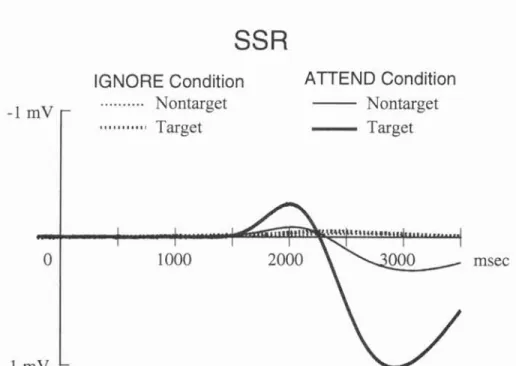
Experiment 1 examined whether the SSR is mediated equally by both the two modes of information processing, that is, the automatic mode and the controlled mode of information processing. In the present experiment, two types of rare stimulus, that is, target and nontarget, and frequent standard stimulus were presented to subjects. Subjects were asked to respond to the target stimulus by movement production and to ignore to both the nontarget and standard stimuli. In such a three-stimulus paradigm, it was assumed that the nontarget stimulus was processed in the automatic mode, and the target stimulus was processed in the controlled mode. Results showed that the amplitudes of both SSR and P300 (i.e., P3b) were larger for the target stimuli than those for the nontarget stimuli. P3a (or novelty P3) was not evoked by either rare stimulus. Therefore, it was suggested that the SSR might arise when a given stimulus was processed in the controlled, rather than the automatic, mode of information processing.

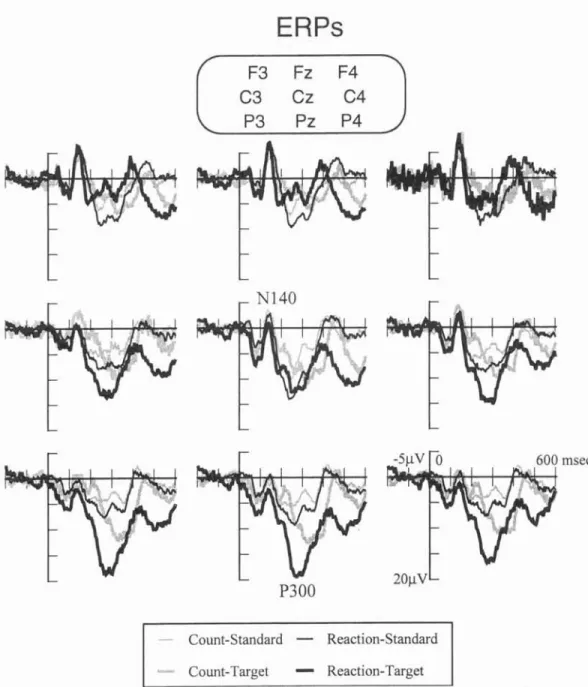
The results of Experiment 1 suggested that the SSR is primarily mediated by the controlled mode of information processing. The controlled mode of information processing is also activated during voluntary movements as a response to task-relevant stimuli. The task-relevant stimulus means a stimulus which requires subjects to both consciously detect the target stimulus and respond to it by movement production. Some previous studies have conducted experiments in which subjects were asked to respond by performing a voluntary movement to target stimuli, suggesting that the EDAs fluctuate when the subjects detected given target stimuli. However, in these studies, factors relating to voluntary movement have not yet been examined. In Experiment 2, the effectiveness of voluntary movement on elicitation of SSR was therefore examined under two conditions.

In one condition (Count condition), subjects were asked to detect target stimuli, while in

the other condition (Reaction condition), they were asked to respond by performing an arm

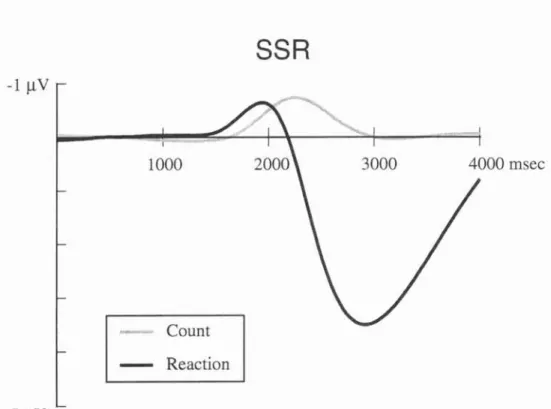
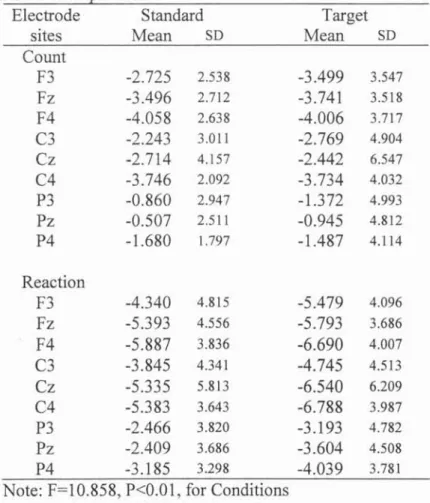
movement to each target stimulus. Main results of Experiment 2 showed that the

amplitudes of SSR occurring at the target stimuli were larger in the Reaction condition

than in the Count condition and that the amplitudes of P300 did not differ between both

(16)

conditions. It was therefore suggested that the elicitation of SSR was affected by some factors relating to the production of voluntary movement.

Movement production may be mediated by information processing for evaluating given stimuli (i.e., stimulus evaluation processes) as well as for producing motor responses (i.e., movement-related processes). The two processes are suggested to progress in serial in the sensory-motor system of the brain. In a reaction-time experiment, when a warning stimulus (WS) is given to subject prior to the appearance of imperative stimulus (IS) to which the subject are asked to respond, both the latency of P300 and the reaction time usually shorten. This is because subjects can anticipate the forthcoming IS and make a preparation for the desired motor response, resulting in quick processing of stimulus evaluation. In Experiment 3, the stimulus evaluation processes of a given stimulus was manipulated by either the presentation (i.e., WS-IS condition) or withdrawal of WS (i.e., Oddball condition), and then SSR for the IS was examined. Results showed that the latencies of P300 for the IS were shorter under the WS-IS condition than those under the Oddball condition, while the amplitudes of SSR for the IS did not differ between both conditions. It was therefore suggested that the SSR was not affected by the presentation of WS.

Because of findings of Experiment 3, the SSR was suggested to relate to the

movement-related processes. In such movement-related processes, various regions of the

brain, such as the primary and supplementary motor areas and cingulate motor area, are

suggested to be activated. Activities of these brain regions differ between when subjects

perform movements and when the subjects avoid the execution of movements. The brain

regions are also suggested to control of activities of the sweat glands (e.g., SSR), because

the regions have direct neural connections with the limbic system, which plays an

important role in controlling the autonomic nervous system. In Experiment 4, the SSR and

P300 were examined by means of a paradigm in which two types of target stimulus, that is,

Go and NoGo stimuli, were presented to require subjects to either produce or avoid the

desired movements. Results showed that both the latencies and the scalp distribution of

P300 did not differ for the Go and NoGo stimuli, while the amplitudes of SSR for the Go

stimuli was larger than those for the NoGo stimuli. Furthermore, a negative deflection of

ERPs appeared, indicating activation of the brain regions arising in the processes of

movement inhibition. Therefore, it was suggested that the SSR was enhanced when

subjects actually perform movements, while the SSR was rather suppressed when subjects

(17)

Abstract

have to avoid the execution of a prepared movement.

In conclusion, the main findings in the present study are that the SSR is mediated

by the controlled mode of information processing (Experiment 1) and is affected by

voluntary movements (Experiment 2). Regarding factors relevant to voluntary movement,

the movement production per se, rather than the stimulus evaluation, as well as the neural

activities in various movement-related brain regions should be suggested to affect the SSR

elicitation (Experiments 3 and 4). Furthermore, all the experiments conducted in this study

clearly demonstrated significance of the dual recordings of ERP and SSR in examining the

behavioral functions of cortical and sympathetic nerve activities in sensorimotor control of

human voluntary movement.

(18)

CHAPTER 1 INTRODUCTION

1.1 THE AUTONOMIC AND CENTRAL NERVOUS SYSTEMS

In our daily life, humans always maintain a certain relationship between themselves and the surrounding environment, which must be cooperative for successful human behavior. Various human behaviors necessarily include responses which are physiological (such as blood circulation, respiration, and regulation of body temperature), instinctive or emotional (e.g., feeding, sleeping, sexual behavior, fear, rage, motivation), and psychological (e.g., learning, memorization, judgment, thinking, discrimination). In general, the term human behavior does not mean the functions of specific cells and/or organs but rather means the integrative interaction with the environment. Irrespective of the microscopic or macroscopic point of view, human behavior is a type of communication

between humans and their environment.

The environment surrounding the humans is generally categorized into the internal and external environment. In brief, the internal environment (i.e., the internal milieu) means the physiological states of circulatory, respiratory, digestive, and metabolic systems of the human body. The external environment (i.e., the external milieu) includes the physical (e.g., atmospheric temperature, humidity, sound, light, vibration, hypoxia, smell, pain), biological (e.g., virus, bacterium, germ), and physiological (e.g., exercise) factors. Changes and conditions in both the internal and external milieu are detected by sensory organs of the body. Various types of information about the internal and external environment are detected through sensory organs and input into the central nervous system (CNS), where information of various requisites for the humans to exist in the external environment is processed and integrated. Integrated information is used to make a plan or program producing a `goal-directed' behavior, which meets our instincts and the environmental requisites. Most human behavior, particularly goal-directed behavior, is necessarily subjected to the plan or program, and is produced more or less by `voluntary' movements with the intervention of muscular contraction. The functions of transmitting/integrating information and making behavioral programs as well as activating the sensory organs and the muscles are all mediated by the nervous system. That is, the nervous system of the human body has essential roles for human behavior.

The nervous system of the human body consists of the central and peripheral

(19)

Chapter 1 Introduction

nervous systems, which include the somatic and autonomic nervous systems. The autonomic nervous system (ANS), composed of two sub-systems (the sympathetic and parasympathetic nervous system), controls the autonomic functions, such as cardiovascular and digestive functions, through the cooperation of the two sub-systems (see Chapter 2).

The ANS is considered to be closely related with unconscious and involuntary functions of the body and is therefore often called the vegetative system. The somatic nervous system controls both motor and sensory activities and primarily mediates conscious and voluntary functions.

A fundamental function of the ANS is to maintain the internal milieu of the human body, that is, the homeostasis (Cannon, 1929), and is in general automatically controlled in a reflex form by the brainstem and the hypothalamus (e.g., Hess, 1954).

Furthermore, it has recently been suggested that the functions of brain structures higher than the hypothalamus, such as the limbic region, neocortex, and cerebellum, are also important for the ANS activities. The limbic regions including the hypothalamus have direct neural connections with the primary (MI) and supplementary motor areas (SMA) through the cingulate motor cortex, which are all characterized as having important roles in producing movement. Furthermore, it has already been shown (Barker & Saito, 1981;

Saito et al., 1990) that, during voluntary movements, the activities of the sympathetic nerves innervating the relevant skeletal muscles are controlled by central neural commands. Such sympathetic activities increase the blood flow to supply oxygen for the relevant muscles, thus subserving the production of goal-directed behavior by maintaining the homeostasis. These findings suggest that the neurophysiological functions and neural structures of the ANS are closely related with those of the CNS. Koizumi and Brooks (1972) have stated that "the central nervous system controls both autonomic and somatic responses and relates them as needed to effect a specific purpose."

However, likely neuro-behavioral relationships between the ANS and CNS have

not yet been well examined. To examine the behavioral functions of the ANS, the

electrodermal activity (EDA) has been used as a measure of the activities of the ANS. The

EDA reflects electrical excitation of the sweat glands in the skin, which is evoked by

activation of the sympathetic nervous system. In studies of human behavior, relationships

between the EDA and orienting response (OR) have been focussed upon. The OR is a

series of processes in which the individual's attention is automatically attracted to a

startling (or novel) stimulus and the content or information conveyed by the stimulus is

(20)

then analyzed (Sokolov, 1963). Such a type of information processing is called the 'automatic mode' of information processing (Schneider & Shiff

rin, 1977; Shiffrin &

Schneider, 1977). Since the EDA occurs with the OR, it has been suggested that the EDA appears when a given stimulus is involuntarily processed in the automatic mode (Lagopoulos et al., 1997; Lagopoulos et al., 1998). Namely, the EDA has a relationship with the automatic mode of information processing.

The EDA also appears when one is required to respond to a given stimulus (Siddle et al., 1979; Woestenburg et al., 1981; Woestenburg et al., 1983). Given that the performers have to pay attention to the stimulus in order to make a particular response, the given stimulus is assumed to have task relevance. Information processing of this type of stimulus is voluntary, being called the `controlled mode' of information processing (Schneider & Shiffrin, 1977; Shiffrin & Schneider, 1977). Therefore, the controlled mode differs from the automatic mode in terms of the requisite for attention (Imanaka et al., 1993). Collectively, it is also likely that the EDA has some relationships with the controlled mode of information processing. However, this notion has not yet been widely accepted.

Furthermore, a relationship between the EDA and voluntary movement is also suggested to exist (Siddle et al., 1979). It has already been shown that reaction movements to a given stimulus are performed faster when the arousal level (or consciousness) of performers is higher, which reflects on the enhancement of EDA (Freeman, 1940), and that performers who show a high activation level of spontaneous EDAs tend to respond faster with short reaction times (RT) than those who show a low activation level of EDAs (Surwillo & Quilter, 1965).

The reaction time (RT) reflects the total time spent for information processing

during the interval from the onset of a given stimulus to the production of a motor

response. The nature of information processing in the sensory-motor system of the brain

has recently been investigated in detail by recording the event-related potentials (ERPs) on

the human scalp. It is suggested that the ERPs consist of various components

corresponding to various stages of information processing, such as identification of the

stimulus, judgment, decision-making, and execution of response (Tadai et al., 1986). For

example, the appearance of the P300 component of ERPs signals the completion of

information processing of a given stimulus. Subcomponents of the P300, that is,

P3a/Novelty P3 and P3b, are suggested to correlate with the automatic and controlled

(21)

Chapter 1 Introduction

modes of information processing, respectively (Squires et al., 1975b). Accordingly, the neuro-behavioral relationships between the ANS and CNS can be examined using dual- recordings of both the EDA and ERPs.

Some researchers have investigated the behavioral functions of the ANS for human behavior using dual-recordings of both EDA and ERPs. Roth (1983) suggested that cortical (i.e., P300) and sympathetic (i.e., EDA) activities may be related with some or all of the processes of a given stimulus, and that such processing (i.e., automatic processing) was associated with the processing of an orienting response (OR). Recent studies (Miyakawa et al., 1992; Deguchi et al., 1996; Ito et al., 1996; Knight, 1996; Lagopoulos et al., 1997) have further shown that the sympathetic skin response (SSR), a type of EDAs, appears with P3a and/or Novelty P3, suggesting that the EDAs are the manifestations of OR in the autonomic nervous system.

In contrast, Osada et al. (1998a) have shown that SSR appears with the P250 component of ERPs when the performer voluntarily responds to a given stimulus. The P250 component is suggested to indicate the attentional state (or awareness) of the performer (Hatakeyama et al., 1998b; Hatakeyama et al., 1998a). Osada et al. have therefore suggested that the SSR (i.e., EDA) is affected by subjects' attention.

Furthermore, Aihara et al. (1998) have also shown that the SSR appears when subjects voluntarily produce a movement at their own pace. In the light of the fact (Sequeira &

Roy, 1993) that electrical stimulations at the motor cortex in the cat invoke the EDA responses with muscular contraction, the findings of Osada et al. and Aihara et al. suggest that sympathetic nerve activities are mediated by movement production. However, this issue has not yet been sufficiently examined.

On the basis of the recent findings regarding the SSR and ERPs, the present study further examined the relationship between sympathetic nerve activity and voluntary movement from the viewpoint of information processing in the sensory-motor system, by means of the dual-recording of both SSR and ERPs.

In Experiment 1, the relationship between the two modes of information

processing and the sympathetic nerve activity (i.e., SSR) was examined. As suggested by

Roth (1983), both the automatic and controlled information processing in the sensory-

motor system and EDA are influenced by the nature of a given stimulus. Especially, a

novel stimulus is processed in the automatic mode and invokes EDAs which are

characterized as the OR (Miyakawa et al., 1992; Deguchi et al., 1996; Ito et al., 1996;

(22)

Knight, 1996). In contrast, the stimulus nature of task relevance may also affect the EDAs (Siddle et al., 1979; Woestenburg et al., 1981; Woestenburg et al., 1983). Human behavior is inherently characterized by `goal-directed' voluntary movements, which are often performed in response to a task-relevant stimulus. Such a task-relevant stimulus is processed in the controlled mode of information processing. Therefore, it is likely that the EDAs are also mediated by the controlled mode of information processing for the task- relevant stimulus. In Experiment 1, both the automatic and controlled modes of information processing were identified by means of ERPs and the changes in SSR corresponding to the two modes of information processing were then examined.

In Experiment 2, the effectiveness of a task-relevant stimulus (processed in the controlled mode) on the sympathetic nerve activity (SSR) was examined. Generally, in studies of P300, subjects are asked to either detect or respond to a target stimulus. This means that the target stimulus should have two types of task relevance, that is, conscious detection and movement production. Both are suggested to enhance the amplitude of P300 (Johnson, 1988a). However, it has not yet been investigated which of conscious detection or movement production is more effective in evoking the sympathetic nerve activity (i.e., SSR). Therefore, Experiment 2 examined this issue.

In Experiment 3, the relationship between the two activities, that is, the sensory-

motor activity and sympathetic nerve activity (SSR), in information processing was

examined. Information processing in the sensory-motor system includes the stimulus

evaluation (or stimulus processing) and movement preparation (or response). The stimulus

evaluation processes consist of stimulus identification, decision-making, and context

updating (i.e., updating the memory of a given stimulus after the evaluation of incoming

information on the stimulus). The movement-related processes consist of response

selection, response programming, and response execution (Hiramatsu et al., 1985a; Tadai

et al., 1986). The P300 reflects the stimulus evaluation processes alone, while the reaction

time (RT) should be mediated by both processes (Kutas et al., 1977; Pfefferbaum et al.,

1983; Tadai et al., 1986). In a reaction-time experiment, when a warning stimulus is

presented prior to the imperative stimulus to which the subjects are asked to respond, both

the latency of P300 and RT of the subjects shorten. This suggests that the warning

stimulus affects the stimulus evaluation processes. However, it has not yet been examined

whether or not the presentation of a warning stimulus influences the sympathetic nerve

activity (i.e., SSR). In Experiment 3, the stimulus evaluation processes of a given stimulus

(23)

Chapter 1 Introduction

were manipulated by either the presentation or withdrawal of a warning stimulus , and then the SSR for the stimulus was examined.

Furthermore, in Experiment 4, the effect of activation of the movement-related processes on sympathetic nerve activity (SSR) was examined. Voluntary movements were produced by activating the movement-related processes in various brain regions, such as the MI, SMA, and cingulate motor cortex. It has recently been suggested that the movement-related brain regions are also activated with the control of EDA (Sequeira &

Roy, 1993, see Chapter 2; Devinski et al., 1995; Fredrikson et al., 1998). Therefore, it is predicted that the activation of these brain regions also affect the SSR during the production of motor activities. In Experiment 4, this prediction was examined by means of a paradigm in which two types of stimulus, that is, Go and NoGo stimuli, were presented to require the subjects to either produce or avoid the desired movements.

In the conclusion of this section, to investigate the relationship between the ANS and CNS during the production of voluntary movements, we conducted four experiments examining the effects on SSR of i) the automatic and controlled processing, ii) conscious detection and movement production, iii) the stimulus evaluation and movement-related processes, and iv) the effectiveness of movement-related brain activities. The rationale and details of each experiment are described in Chapter 3.

1.2 TERMINOLOGY

1.2.1 EMOTIONAL SWEATING

Emotional sweating is the increment of perspiration in the sweat glands with psychological excitation and emotional stimulation. Activation of the sweat glands refers to the electrodermal activity.

1.2.2 ELECTRODERMAL ACTIVITY (EDA)

Electrical activity of the skin occurring with emotional sweating. There are two

basic methods for the measurement of EDA: the recording of skin conductance (SC) and

skin potential (SP). Both activities are mediated by the same afferent and efferent

pathways, with the difference being only in the mode of measurement. The SC is recorded

through bipolar electrodes and SP is recorded with a unipolar arrangement.

(24)

1.2.3 ORIENTING RESPONSE (OR)

The orienting response (OR) was first discovered by Pavlov (1927) as a reflex elicited by an environmental change. The biological significance of the OR is to let the organism turn toward the source of stimulation in order to analyze its content or meaning (Sokolov, 1963).

1.2.4 SYMPATHETIC SKIN RESPONSE (SSR)

Sympathetic skin response, which is a type of SP, appears as the response to a startling stimulus. The SSR has previously been described in the literature (Shahani et al.,

1984) on sudomotor sympathetic functions using a simple and non-invasive test (see later Section 2.1.4).

1.2.5 EVENT-RELATED BRAIN POTENTIALS (ERPs)

The event-related brain potentials (ERPs), recorded on the scalp, are suggested to be related with various psychological and physiological events of information processing occurring in the brain structure (see later Section 2.2.2).

1.2.6 N140

A negative component of ERPs peaking at about 140 msec after the onset of a given stimulus. The N140 is suggested to be sensitive to the attentional state of the subject (see later Section 2.2.2.1).

1.2.7 P300

A positive component of ERPs peaking at about 300 msec after the onset of a

given stimulus. The P300 often appears as the third positive deflection after the stimulus

presentation, being called the P3. The P300 is recorded from the scalp in the visual,

auditory, and somatosensory stimulations. In contrast to the early component of the ERPs

(e.g., N140), it has been shown that the scalp distribution of P300 reveals no substantial

differences among the three modalities (i.e., visual, auditory, and somatosensory, Snyder et

al., 1980). The P300 is generally recorded using a version of the `oddball paradigm' (see

later Section 2.2.2.2).

(25)

Chapter 1 Introduction

1.3 LIMITATIONS OF THIS STUDY

The experimental results of this study are subjected to the following methodological limitations.

1.3.1 SYMPATHETIC I NNER VA TION

Sympathetic nerves innervate the skin, muscle, and other visceral organs. The sympathetic nerves in the skin innervate both the sweat glands and vessels (Hagbarth et al., 1972). Two components, sudomotor and vasomotor, work independently of each other (Arunodaya & Taly, 1995). Therefore, the SSR is limited to relate to the sudomotor component of skin sympathetic nerve activity alone.

1.3.2 A VERAGING METHOD

In this study, the averaging method was used to examine changes in both sympathetic (SSR) and cortical activities (i.e., ERPs). Using this method, it is possible to extract physiological phenomena repeatedly elicited with a particular event, such as the onset of EMG, given signal/stimulus, from the raw electrical potentials, by canceling noise components which are not synchronized with the event. This method is therefore usually used for recording ERPs.

However, there is some disadvantage to this method. First, the SSR tends to be subjected to habituation phenomena. Namely, SSR becomes weaker with an increase in number of repetitions of the presentation of a particular stimulus, because of habituation gradually developed through a long-term experiment (Mimori & Tanaka, 1992; Arunodaya

& Taly, 1995). In attempting to avoid such a habituation phenomenon, particularly in clinical diagnosis, each SSR waveform is often examined (Shahani et al., 1984; Yokota et al., 1993a; Yokota et al., 1993b; Rousseaux et al., 1996). Otherwise, the largest four (Andary et al., 1993) or five (Watahiki, 1987a; Baba et al., 1988) SSR waveforms are selected from all the SSR recordings obtained under a given condition to be examined.

As another likely disadvantage, the averaging method needs many trial data to be

averaged under a certain condition. This means that the participants are usually asked to

repeatedly perform the desired task, with their arousal and attention being maintained at a

certain level. Therefore, the experimenter should consider both whether or not the time

length of experiments is too long for the subjects and also whether or not the number of

trials is large enough to obtain a significant waveform or not.

(26)

In spite of those disadvantages of the averaging method, Aramaki et al. (1997) have recommended an alternative averaging method which is useful in recording the SSR without causing habituation phenomena. In his method, both target and standard stimuli that differ in the probability of their presentation are used. The target stimuli, which subjects are required to detect, are presented at a low probability, such as 20% of all stimuli presented in an experimental session, and are thus called 'rare target stimuli.' The standard stimuli, which the subjects were asked to ignore, are presented at a high probability (e.g., 80%). Using this sequence, the SSR wave constantly appears with the target stimuli. This method is the same as the stimulation sequence used for the `oddball paradigm' which is a typical paradigm to record the P300. In fact, some studies of SSR have used the averaging method with target and standard stimuli, such as those used in the oddball paradigm (Deguchi et al., 1996; Ito et al., 1996; Knight, 1996). This type of averaging method was also used in all the experiments of this study to record both SSR and ERPs.

Another limitation existing in the averaging method is as follows. Any meaningful signals embedded in a single trial can not be detected by the averaging method.

Mimori and Tanaka (1992) have suggested that if the experimenter uses the averaging method to evaluate SSR waves, it could fail to pick up in each single trial some meaningful, but temporary phasic activity in the sympathetic nervous system. Such a limitation has often been discussed in studies on ERPs using the averaging method.

Although some researchers (Ritter et al., 1979; Hiramatsu et al., 1985b; Ito, 1993) have attempted to analyze the P300 by examining each single waveform, a number of researchers have still used the traditional averaging method, because of difficulties in using the single-trial analysis of ERPs. In the present study, because both the SSR and ERPs should be recorded at the same time, the traditional averaging method was used.

1.3.3 SUBJECTS

Neurological studies on ERPs and SSR have often used experimental animals or

patients with neurological disorders, in order to discuss (a) possible neural network(s)

corresponding to elicitation of both responses (i.e., ERPs and SSR). In contrast, the

experiments conducted in this study used healthy adult volunteers as subjects. This is

because the subjects were required to correctly understand the given stimuli and to perform

the required reaction time (RT) tasks.

(27)

Chapter 1 Introduction

1.3.4 EMOTIONS OF SUBJECTS

It is plausible that the stimulus to which the subjects are asked to perform a motor response could activate emotional states of the subjects, such as happiness, surprise, anger, fear, sadness and disgust. The activation of autonomic responses underlying such emotions has often been investigated (e.g., Collet et al., 1997, see also Chapter 2). In this study, although the emotions of subjects were not manipulated during the experiments, the subjects were instructed to keep their emotion stable. Therefore, the effect of emotions on SSR was not discussed in this study, on the assumption that the emotional conditions of the subjects were constant during the experiments.

1.4 SIGNIFICANCE OF THIS STUDY

As previously mentioned (see Section 1.1), the relationships between information processing in the sensory-motor system and autonomic nerve activities during voluntary movements have not yet been fully investigated. In the present study, SSR and ERPs were simultaneously recorded as indices of the two systems (i.e., sympathetic and cortical) under various task conditions in which subjects were asked to perform a voluntary movement. This enables us to discuss both the sensory-motor system of the brain during voluntary movements and changes in the sympathetic nerve activities corresponding to movement production.

Furthermore, all the experiments conducted in the present study clearly

demonstrate a methodological significance of dual recordings of both ERPs and SSRs for

the investigation and evaluation of the roles of cortical and sympathetic nerve activities.

(28)

CHAPTER 2 REVIEW OF LITERATURE

2.1 SYMPATHETIC NERVOUS SYSTEM AND ELECTRODERMAL ACTIVITY

Sympathetic skin response (SSR) is one type of the electrodermal activity (EDA) and is used as an index of activities of the sympathetic nervous system. The sympathetic nervous system (SNS) is one of the sub-systems of autonomic nervous system (ANS).

Another sub-system is called the parasympathetic nervous system (PNS). The two sub- systems differ in several points. First, neuro-anatomical distributions of the nerve fibers differ for the two sub-systems (i.e., SNS and PNS). The sympathetic nerves originate in the spinal cord, whereas the parasympathetic nerves originate mainly in the tenth cranial nerve, which is the vagus nerve. Second, the nature of stimulatory effects of the two sub- systems on effector organs is often antagonistic to each other. Third, the types of hormonal transmitter substances secreted at nerve endings are usually different between the two systems, with some exceptions. These differences between the SNS and PNS are closely described in a number of textbooks on physiology (e.g., Ciriello et al., 1986; Ganong, 1991). The details of them are therefore not described in this chapter. In the following section, an overview of the EDA is first examined and the literature on the neurophysiological correlates of EDA is then reviewed.

2.1.1 EMOTIONAL SWEATING AND ELECTRODERMAL ACTIVITY

Sympathetic impulses originating from the central nervous system (CNS) are delivered to the sweat glands in the skin. This causes `emotional sweating.' This phenomenon is seen as an electric activity of the skin. Charles Fere, a French neurologist, reported in 1888 the observation that the changes in electric activity of the skin can be enhanced by various physical and emotional stimuli. In 1890, a Russian physiologist, Tarchanoff, observed similar electrical changes in the skin.

The techniques used by the two scientists differed to each other. Fere's

procedures involved the loading of weak electric current between two electrodes on the

skin surface. This method enabled the EDA to appear when a person was provided with

various stimuli. In this method, a galvanometer was used to measure skin conductance

changing when a visual or auditory emotion-provoked stimulus was presented. This

phenomenon was named the psychogalvanic reflex (PGR) and was later called the galvanic

(29)

Chapter 2 Review of Literature

skin response (GSR). Fere concluded, on the basis of his findings, that the responses indicated the excitation of central nervous system, or "arousal."

In contrast, Tarchanoff measured electric potential rather than conductance to examine galvanometer deflections similar to the Fere's findings, without any loading of electric current. Electric potential of the skin normally changes whenever subjects are stimulated with any stimulation. Both Fere and Tarchanoff thus contributed to establishing the basic methods for measuring EDA, that is, the skin conductance (SC) and skin potential (SP).

An interesting aspect of these sweating phenomena is that this is not only thermoregulatory but also emotional. This fact developed the basis of research strategies used for examining behavioral phenomena. Sweating, or sweat gland activity, can be observed as a change in SP and SC in a variety of situations, such as those that emotionally arise. For example, the eccrine glands in the palms and fingers of the hand respond strongly to psychological and sensory stimuli but only weakly respond to heat. We often experience wet or `clammy' palms in the conditions of fear or anxiety but not in warm conditions. The sweating with psychological stimuli is sometimes termed 'arousal' sweating, and some researchers believe it is adaptive. Darrow (1933) suggested that the sweating of palms and soles may be an adaptive response that have persisted over the course of evolution and that it aided in grasping objects, such as a weapon in a fight and branches of trees during flight, and etc. Wilcott (1967) assumed that the arousal sweating in any part of the body may cover the skin so as to protect it from mechanical injury.

Suggestion by Edelberg (1972) is that sweat gland activities may decrease the body temperature in emergency situations that require a great deal of physical effort (e.g., running or fighting). According to these notions, the sweat gland activity may be characterized as adaptive functions of body efficiency in emergency.

2.1.2 NEURAL CONTROL OF THE ELECTRODERMAL ACTIVITY

To investigate physiological functions of emotional sweating (i.e., EDA), neural

mechanisms of EDA should be examined. Both a number of psychophysiologists and

neurologists have discussed the neural mechanisms of EDA, concluding that the EDA is

controlled by both excitatory and inhibitory mechanisms which probably act upon

autonomic neurons, such as sympathetic preganglionic neurons, in the spinal cord. The

neural structures responsible for controlling the EDA are the spinal cord, reticular

(30)

formation, hypothalamus, limbic system, and cerebral cortex of the brain.

2.1.2.1 Spinal and reticular control of the electrodermal activity

The systems controlling the EDA in the lower level of CNS are located in the spinal cord and reticular formation in the brain stern. At the spinal level, the sudomotor neurons are influenced by excitatory and inhibitory impulses from the supraspinal centers, such as the reticular formation, hypothalamus, limbic system, and cerebral cortex. In fact, when the spinal cord is injured, sweating of the skin temporally becomes inactive.

Moreover, the sweat glands receive only the sympathetic innervation. The spinal neurons are therefore considered as a primary `final common pathway' for the control of sweating, although the ganglionic neurons are the actual final controlling neurons (Roy et al., 1993).

The supraspinal mechanisms responsible for controlling the EDA may be the reticular formation of the brain stem. Although the reticular formation has been thought to influence the cerebral cortex to increase the arousal level (e.g., Moruzzi & Magoun, 1949), it is not seen anymore as a unitary non-specific arousal system. That is, many nuclei in the reticular formation mediate either specific excitatory or inhibitory functions of the EDA as well as motor and sensory neural activities (Wang, 1957).

A function mediating excitatory effects on EDA has been thought to exist in the brain stem. The reticular activation is linked with arousal of the cerebral cortex. EDAs arising with various stimulation are thought of as indices of excitability of the reticulo- cortical system. The intrareticular excitability changes according to various conditions, such as deep sleep and careful attention. Lindsley (1960) suggested that the ascending reticular activating system (ARAS), involving the pons, the mesencephalon, and the medulla, plays an important role in regulating neural conditions of attention, consciousness, sleep, and wakefulness. The Lindsley's suggestion on the ARAS supports the activation theory (Freeman, 1940, see later) that describes the relationships between the levels of physiological activity and physical performance. It is therefore suggested that the ARAS activates the autonomic nerve activities.

In contrast, the medial ventral nuclei at bulbar inhibit the EDA (Wang, 1957).

Wang (1958) described that, in anesthetized cats, the skin potential responses (SPRs)

evoked by electric stimulation at cutaneous nerves were enhanced when the reticular

formation became inactive by either cooling or a lesion of the medulla. It has been

reported that SPRs mediated by reticular formation were also inhibited by stimulation of

(31)

Chapter 2 Review of Literature

the ventro-medial reticular formation (Yokota et al., 1963a).

Generally, the EDA is mediated by both the sympathetic nerve activities in the ANS and the reticular formation, which is thought of as a neural center controlling the autonomic activities. In addition, the hypothalamo-limbic structures also play an important role for autonomic activities. This is examined in the following section.

2.1.2.2 Hypothalamo-limbic control of the electrodermal activity 2.1.2.2.1 Hypothalamus

Since the classical research work of Hess (1954), the hypothalamus has been thought to be involved in controlling the autonomic system and thus to subserve the sympathetic control of both movements and emotional expressions. For example, when a monkey finds a natural enemy, the monkey would automatically do either fight with or run away from the enemy (i.e., 'fight or flight reaction,' Cannon, 1929). In such a situation, the ANS would be activated to increase both blood flow in musculature and sweating on palms and soles. This activation could enable the monkey to move quickly (i.e., fight behavior) or to jump away from one tree to another by hanging on a branch of trees (i.e., flight behavior). Karplus and Kreidle (1909, cited in Wang, 1964) demonstrated that stimulation at the 'tuber cinereum' (medial hypothalamus) in the cat caused sweating on the pads of all paws. Other early studies (Wang & Richter, 1928; Hasama, 1929) also demonstrated the hypothalamic activation arising with sweat gland activity. These findings indicated that the hypothalamus plays an important role in thermoregulation, thus mediating the EDA.

2.1.2.2.2 Limbic system

Showers and Crosby (1958) examined, using cats and monkeys, physiological mechanisms of the limbic system in relation to the EDA, showing that the cingulate gyms mediates the control of sweating. Since then, a number of researchers (Yokota et al., 1963b; Lang et al., 1964; Kimble et al., 1965; Bagshaw & Benzies, 1968) have focussed on the EDA control and specific limbic regions, such as hippocampus, amygdala, and limbic cortex.

Regarding the hippocampus functions, Yokota et al. (1963b) examined non-

anaesthetized curarized cats by stimulating the hippocampus, reporting inhibition of SPR

(a type of EDA). This finding indicated an excitatory effect of the hippocampus on EDA.

(32)

Pribram and McGuiness (1975) examined habituation in EDAs using monkeys with hippocampectomy. In normal conditions, the EDA is gradually diminished when a stimulus is repeatedly presented. This is the habituation phenomenon in EDA. Pribram and McGuiness found less habituation in skin conductance responses (SCRs, a type of EDA) for the hippocampectomized monkeys, suggesting that the hippocampus had excitatory effects on EDAs. Furthermore, Hazlett et al. (1993) recently showed, using positron emission tomography (PET) to test schizophrenics, that the hippocampus facilitates EDA. However, Bagshaw et al. (1965) found that, using monkeys, bilateral lesions of the hippocampus did not influence the feature of EDA. Similarly, in humans, Tranel et al (1990) also showed that lesions at hippocampus in the limbic system did not affect SCRs. According to these findings, the effect of hippocampus activities on the EDA seems to be equivocal.

In contrast to the findings on hippocampus, the amygdala has generally been considered to have only an excitatory but not inhibitory influence on EDA. Lang et al.

(1964) and Yokota et al. (1963b) showed that the stimulation at the amygdala produced SPRs in cats. Bagshaw et al. (1965) found that monkeys with bilateral amygdalectomy showed a decreased EDA to both frequent and novel tones, whereas normal monkeys showed habituation of EDA (measured by SPRs) to frequent tones but not to the novel tones. Similarly, Bagshaw and Benzies (1968), using monkeys, also found that the EDA normally arising with a surprising stimulus disappeared with bilateral amygdalectomy.

These findings on animals all indicated that the amygdala has an excitatory effect on the EDA. In humans, Dallakyan et al. (1970) reported that the destruction of both the amygdala and the medio-basal parts of the temporal lobe resulted in an inhibition of SCRs, suggesting excitatory influences of amygdala on SCRs. Recently, Raine et al. (1991) showed, using a magnetic resonance image (MRI) technique, that large SCRs arising with orienting stimuli were significantly associated with a large area of left temporal/amygdala regions. Furthermore, a psychopathological study (Raine & Lencz, 1993) using schizophrenics supports, in part, the findings of the excitatory effect of amygdala on the EDA. These studies indicated the excitatory effects of amygdala on EDAs. In contrast to these findings, Tranel and his colleagues (Tranel & Damasio, 1989; Tranel et al., 1990) showed that patients "whose entire amygdaloid complex had been destroyed bilaterally"

(1989, p.381) or patients showing "a bilateral mineralization of the amygdala, possibly

including the amygdala-hippocampal transition area" (1990, p.350) generated normal

Table  of  Contents TABLE  OF  CONTENTS ACKNOWLEDGMENTS  TABLE  OF  CONTENTS  . LIST  OF  TABLES 11 LIST  OF  FIGURES ABSTRACT .
Table  of Contents
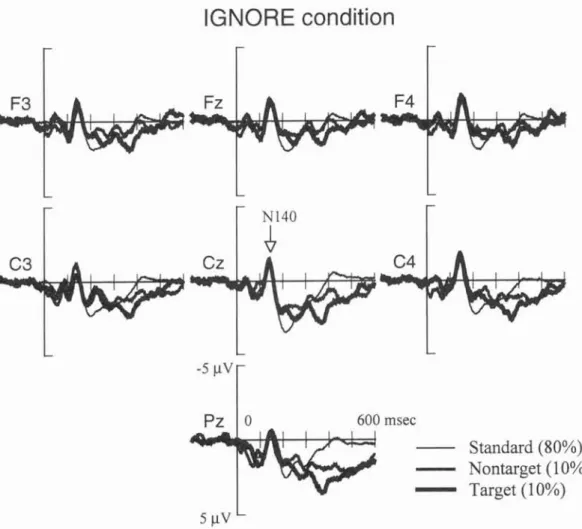
Figure  1: The waveforms of ERPs (grand average) for  the standard,        target stimuli in Ignore condition.
Table  1: The amplitudes of N140 (11V)  for the standard,  nontarget,  and target        stimuli in Ignore and Attend conditions
+7

参照

関連したドキュメント

This paper is devoted to the investigation of the global asymptotic stability properties of switched systems subject to internal constant point delays, while the matrices defining

In this paper, we focus on the existence and some properties of disease-free and endemic equilibrium points of a SVEIRS model subject to an eventual constant regular vaccination

Then it follows immediately from a suitable version of “Hensel’s Lemma” [cf., e.g., the argument of [4], Lemma 2.1] that S may be obtained, as the notation suggests, as the m A

Classical definitions of locally complete intersection (l.c.i.) homomor- phisms of commutative rings are limited to maps that are essentially of finite type, or flat.. The

Yin, “Global existence and blow-up phenomena for an integrable two-component Camassa-Holm shallow water system,” Journal of Differential Equations, vol.. Yin, “Global weak

We study the classical invariant theory of the B´ ezoutiant R(A, B) of a pair of binary forms A, B.. We also describe a ‘generic reduc- tion formula’ which recovers B from R(A, B)

For X-valued vector functions the Dinculeanu integral with respect to a σ-additive scalar measure on P (see Note 1) is the same as the Bochner integral and hence the Dinculeanu

Finally, in Figure 19, the lower bound is compared with the curves of constant basin area, already shown in Figure 13, and the scatter of buckling loads obtained