A study on the Quality of Medicines in
Community Pharmacies in Riyadh, Saudi Arabia
著者 コージャ ハーニ マフムード ジェイ
著者別表示 Khojah Hani Mahmoud J journal or
publication title
博士論文本文Full 学位授与番号 13301甲第3969号
学位名 博士(薬学)
学位授与年月日 2013‑09‑26
URL http://hdl.handle.net/2297/39372
doi: 10.4236/pp.2013.47074
Creative Commons : 表示 ‑ 非営利 ‑ 改変禁止 http://creativecommons.org/licenses/by‑nc‑nd/3.0/deed.ja
A Study on the Quality of Medicines in Community Pharmacies
in Riyadh, Saudi Arabia
Khojah, Hani Mahmoud J
July, 2013
Dissertation
A Study on the Quality of Medicines in Community Pharmacies
in Riyadh, Saudi Arabia
Graduate School of
Natural Science and Technology
Major Subject:
Division of Life Sciences
Course:
Molecular Effects
School Registration No.:
1023032531 Name:
Khojah, Hani Mahmoud J
Chief Advisor:
Prof. Kazuko Kimura
iii
Dedication
To my beloved mother, the soul of my great father,
and my beloved family…
iv
v
Acknowledgments
I would like to express my deep and warm thanks to my chief advisor, Professor Kazuko Kimura, for her valuable advice, constructive criticism
and encouragement.
I also thank the following co-advisors, who offered all kinds of support and guidance: Associate Professor Henrik Pallos, Professor Manabu Akazawa, Associate Professor Hirohito Tsuboi, and Associate Professor
Shimizu Sakae.
Many thanks are also to Assistant Professor Naoko Yoshida, Professor Hisham S. Abou-Auda, and all my colleagues in the Department of Drug
Management and Policy for their continuous help in the laboratory.
Thanks are also offered to the Saudi Food and Drug Authority and the Saudi Ministry of Health for facilitating the survey procedures.
Finally I would like to thank the Heiwa Nakajima Foundation and the
Prioritized Research Programs at Kanazawa University for funding.
vi
vii
Table of Contents
List of Figures ‒ ix List of Tables ‒ x
List of Abbreviations ‒ xi Abstract ‒ xiii
Reference Theses ‒ xvii
Chapter 1
The Quality of Amoxicillin Capsules and Tablets in Community
Pharmacies in Riyadh, Saudi Arabia: A Lot Quality Assurance Sampling (LQAS) Survey ‒ 1
Introduction ‒ 2
Background ‒ 2 Objectives ‒ 5
The Null Hypothesis ‒ 5 Methods ‒ 6
Selection of Pharmacies ‒ 6 Amoxicillin Sampling ‒ 11
Amoxicillin Authenticity Investigations ‒ 13 Analysis and Materials ‒ 13
Results ‒ 20 Discussion ‒ 25
Limitations ‒ 28 Conclusions ‒ 30 References ‒ 31
Annex 1.1. Maps ‒ 38
Annex 1.2. Sampling form ‒ 40
Annex 1.3. Manufacturer authenticity check form ‒ 41
viii
Annex 1.4. Samples information ‒ 46
Annex 1.5. Summary of the sample analysis results ‒ 48 Annex 1.6. Pharmacies information ‒ 52
Chapter 2
Adherence of Community Pharmacies in Riyadh, Saudi Arabia, to Optimal Conditions for Keeping and Selling Good-Quality Medicines ‒ 55
Introduction ‒ 56
Background ‒ 56 Objectives ‒ 57 Methods ‒ 58
Selection of Pharmacies ‒ 58 Study Materials ‒ 58
The Interviewers ‒ 59 Results ‒ 60
Discussion ‒ 66 Conclusions ‒ 68 References ‒ 69
Annex 2.1. Maps ‒ 72
Annex 2.2. Pharmacy distribution table ‒ 74
Annex 2.3. The questionnaire and its Arabic translation ‒ 76
Annex 2.4. The inspection form and its Arabic translation ‒ 90
Annex 2.5. The observations form and its Arabic translation ‒ 94
Annex 2.6. Training and survey schedule ‒ 98
ix
List of Figures
Figure
Number Figure Caption
Page Number
1.1 LQAS equations. 7
1.2 Retention times of amoxicillin and cefadroxil peaks (6 and 8 minutes, respectively). Amox = amoxicillin, and Cefd = cfadroxil.
15
1.3 Linearity of amoxicillin solution, using cefadroxil as an internal standard.
16
1.4 Linearity of cefadroxil solution. 16
1.5 Daily preparation of amoxicillin calibration curve using cefadroxil as an internal standard. Amox = amoxicillin, Cefd = cefadroxil, STD = standard solution.
17
1.6 Steps for sample analysis. Cefd= cefadroxil. 18 1.7 Steps for the accuracy test. Amox = amoxicillin, Cefd =
cefadroxil, RS = reference standard.
19
1.8 Distribution of failed samples. 23
1.9 Content distribution of all samples. 24
x
List of Tables
Table
Number Table Title Page Number
1.1 Part of the calculation process for deciding the required number of subject pharmacies and the decision rule.
10
1.2 Sampling information. 13
1.3 Distribution of samples and batches. 21
1.4 Batches that passed in some pharmacies but failed in others.
23
2.1 Background characteristics of pharmacists. 60 2.2 Pharmacist knowledge about the local regulations of
community pharmacy practice.
62 2.3 Pharmacists’ opinions on the adherence of their
pharmacies and distributors to the regulations.
63
2.4 Pharmacy inspection results and observations. 65
xi
List of Abbreviations
Amox Amoxicillin AV Acceptance Value BP British Pharmacopeia
CD Compact Disc
Cefd Cefadroxil
GPP Good Pharmacy Practice
HPLC High-Performance Liquid Chromatography KSA Kingdom of Saudi Arabia
LQAS Lot Quality Assurance Sampling MOH Ministry of Health
MS Microsoft
OTC Over-the-Counter
PTP/SP Push-Through Package/Strip Package RS Reference Standard
SFDA Saudi Food and Drug Authority STD Standard
USA United States of America WHO World Health Organization USP United States Pharmacopeia
USPRS United States Pharmacopeia Reference Standard
xii
xiii
Abstract
Poor-quality medicines are real threats to individuals and health systems worldwide. In developing countries, life-saving medicines, such as antibiotics, are the main target of counterfeiters. Substandard medicines are extremely prevalent due to poor manufacturing, distribution, and/or storage conditions. Data on the quality of medicines in Arab countries are very limited. This thesis is divided into two major parts.
The first part investigated the quality of amoxicillin capsules and tablets sold in community pharmacies (CPs) in Riyadh, Saudi Arabia, as an indicator of the quality of medicines sold in them. It estimated the proportion of pharmacies that were selling poor-quality medicines relative to a predetermined threshold (20%). It also field tested an economical sampling method for classifying the CPs according to the quality of their medicines in order to help decision makers with resource allocation.
Sampling was performed with the “mystery shopper” technique in 72 randomly selected CPs in Riyadh. The number of pharmacies for inclusion was calculated with Lot Quality Assurance Sampling (LQAS) method. The initial 1367 pharmacies were divided into two lots: chain and independent pharmacies (869 and 498, respectively).
From each lot, 36 pharmacies were randomly selected, and 80 dosage units of a randomly selected amoxicillin brand were purchased from each selected pharmacy. If this brand was from more than one batch, the batches were considered different samples purchased from the same pharmacy. If samples from the same batch were purchased from different pharmacies, the samples were also considered different. The samples were checked for authenticity and analyzed for their drug content and content uniformity (CU) according to the United States Pharmacopeia (USP) by a validated high-performance liquid chromatographic (HPLC) method. If a sample from a pharmacy was found to be of poor quality, that pharmacy was considered a failed
xiv
pharmacy. If the number of failed pharmacies exceeded a predetermined decision value (three) in any lot, the lot was rejected and the proportion of pharmacies selling poor- quality amoxicillin was classified as higher than the predetermined threshold.
A total of 83 samples from 72 pharmacies were collected and analyzed (41 samples from chain pharmacies and 42 from independent pharmacies). The samples were found to be authentic, but 9 were substandard because they failed the CU test, with 6 of the 9 averaging less than 90% of the labeled content (the lowest was 80.7%). The content of the approved samples ranged from 90.6% to 104.2%. Certain batches passed the test in certain pharmacies and failed in others, indicating a possible degradation. The 9 failed samples were purchased from 4 chain and 5 independent pharmacies. Both lots were rejected because the predetermined decision value was exceeded, indicating that more than 20% of the pharmacies in each lot were selling poor-quality amoxicillin.
A problem existed with the quality of an essential drug in Riyadh’s CPs.
Exposure to excessive temperature during distribution or storage has unfavorable consequences on the quality of medicines, particularly in hot climates. This could be one of the possible reasons behind the existence of substandard amoxicillin in Riyadh’s CPs. However, inefficient quality control at the manufacturing stage cannot be excluded.
The second part of the thesis explored the conditions under which medicines were kept in a random sample of 181 CPs in Riyadh. The pharmacist in charge in each pharmacy was interviewed and observations about the quality of storage were recorded.
The inspection revealed that in 9% of the CPs the readings of the existing room thermometers were more than 25 °C, and that 13% of the CPs lacked thermometers.
Also in 33% of the CPs the readings of the refrigerator thermometers were outside the accepted range, and 7% of the CPs lacked refrigerator thermometers. About 15% of pharmacists were not informed about the local regulations of community pharmacy
xv
practice, neither before nor after taking up their current positions. Surprisingly, incorrect answers to simple questions about the system were frequently given by the informed pharmacists. Certain aspects of substandard storage conditions existed, in varying degrees, in significant percentages of pharmacies regardless of the pharmacists’
qualifications, experience, or awareness about the local regulations of community pharmacy practice.
Stricter monitoring of the supply chain in Riyadh is necessary. More studies to monitor the quality of medicines and pharmacies are recommended, together with improvements in the education of pharmacists and distributors about the importance of adhering to optimal conditions of keeping and selling medicines.
xvii
Reference Theses
H. Khojah, H. Pallos, H. Tsuboi, N. Yoshida, H. Abou-Auda and K.
Kimura, "Adherence of Community Pharmacies in Riyadh, Saudi Arabia, to Optimal Conditions for Keeping and Selling Good-Quality Medicines,"
Pharmacology & Pharmacy, Vol. 4 No. 5, 2013, pp. 431-437.
doi: 10.4236/pp.2013.45061.
H. Khojah, H. Pallos, N. Yoshida, M. Akazawa, H. Tsuboi and K. Kimura,
“The Quality of Medicines in Community Pharmacies in Riyadh, Saudi Arabia: A Lot Quality Assurance Sampling (LQAS)-Based Survey.”
Accepted for publication in Pharmacology & Pharmacy Journal, Scientific
Research Open Access, August 2013.
xviii
Chapter 1
The Quality of Amoxicillin Capsules and Tablets in Community Pharmacies in Riyadh, Saudi
Arabia: A Lot Quality Assurance Sampling (LQAS) Survey
1
Introduction
Background
Poor-quality medicines could be counterfeit or substandard. Counterfeit medicines are “deliberately and fraudulently mislabeled with respect to identity and/or source. Counterfeiting can apply to both branded and generic products and counterfeit products may include products with the correct ingredients or with the wrong ingredients, without active ingredients, with insufficient active ingredient or with fake packaging”.[1] In contrast, substandard medicines are “genuine medicines produced by legitimate manufacturers that do not meet the quality specifications that the producer says they meet. For example, they may contain less (or more) active ingredient than written on the package. This may not be an intention to cheat, but may be due to problems with the manufacturing process”.[2] Degraded medicines may be considered substandard, although they were originally genuine and of good quality. These medicines show deterioration subsequent to their expiration date or deterioration due to exposure to harsh environmental conditions during distribution and/or storage.[3,4]
The use of poor-quality medicines, especially counterfeits, may lead to a wide variety of health risks, including therapeutic failure, toxicity, bacterial resistance, and even death.[5] Moreover, the economic consequences of this situation are undesirable.
Furthermore, people may lose their trust in health systems.[6]
Counterfeit medicines have become a global issue because of the continuing growth in the market for these products and because of the consequences of their use.[7]
Although developing countries are the principal target of counterfeiters,[8,9] developed countries face many of the same risks.[9,10] Sadly, essential medicines (e.g., antimicrobials) are the most frequently targeted products of this type in developing
2
countries.[11] For example, counterfeit anthelminthics have been reported in Cambodia,[12] counterfeit antimalarials in several African countries,[13] and substandard antibiotics in India.[14] One study reported substandard amoxicillin in four Arab countries (Lebanon, Jordan, Egypt and Saudi Arabia).[15] In that study, the content of amoxicillin in capsules and suspensions was investigated, although the number of samples collected from each country and the methodology of sample collection were not specified in detail. However, the authors concluded that the prevalence of substandard amoxicillin products in these Arab countries was high.
Studies with sound and reproducible methodology on the quality of medicines in developing countries are very limited. Convenience sampling is widely used for this purpose, even though bias is clearly introduced because usually only accessible pharmacies or outlets are selected. Formal random sampling generally requires a larger sample, longer surveying time, and more resources. For these reasons, Lot Quality Assurance Sampling (LQAS) has been proposed as an economical technique to survey the quality of medicines sold in community pharmacies.[3] LQAS was developed in the 1920s to assess the quality of industrial products by inspecting random samples.[16] It was later adapted and successfully used in a variety of health care surveys and settings,[17] such as the rapid assessment of the prevalence of active trachoma,[18]
assessing the prevalence of acute malnutrition,[19] evaluation of the polio eradication initiative,[20] and identifying inadequately performing areas for health services.[21]
However, it was not used for surveying the quality of medicines in the supply chain.
Because LQAS uses a relatively small sample, it cannot determine the prevalence (rate) of outlets that sell low-quality medicines, but rather provides a way to classify the rate as either acceptable or unacceptable in terms of predetermined criteria. Thus, it may be
3
helpful to enable decision makers to properly allocate and distribute resources among various supervisory areas, and also provides an indication as to whether or not larger- scale, randomized surveys are required.
In Saudi Arabia antibiotics are very commonly prescribed.[22–29] Self-medication is a common practice, and several prescription medicines, including antibiotics, can be purchased without a prescription despite the government’s regulations.[22,23] Drug regulation in this country was originally the duty of the Ministry of Health (MOH), which established a strict system for pharmaceutical facilities and products. That system included detailed standards intended to ensure the best quality of medicines at all stages, from manufacturing to dispensing, if applied appropriately.[30] Recently, the Saudi Food and Drug Authority (SFDA) was established as an independent corporate body that reports directly to the President of the Council of Ministers. It is responsible for ensuring the safety of food and drugs for human and veterinary use and the safety of biological and chemical substances and medical devices. The establishment of the SFDA is still in its initial stage. By the end of this stage, all matters relating to drug regulation will be delegated to this authority.[31]
Amoxicillin is widely used because it is included in the list of essential drugs issued by the World Health Organization (WHO).[32] It is also considered an essential drug in primary health care in Saudi Arabia.[33] It is also among the most widely counterfeited medicines in developing countries.[9,11] Substandard amoxicillin has already been identified in Saudi Arabia in one study.[15] Furthermore, amoxicillin products, including suspensions and capsules, are sensitive to heat and may degrade easily at temperatures above 30 °C.[34] Therefore, amoxicillin was selected as an
4
indicator of the quality of medicines in the supply chain in Saudi Arabia, where high temperatures are common.
Objectives
One of the aims of this study is to field test an economical, easily reproducible and statistically valid method for monitoring the quality of medicines in community pharmacies in Riyadh, the capital of Saudi Arabia. This method estimates the proportion of pharmacies that sell poor-quality medicines relative to a predefined threshold. A finding that this threshold is exceeded is interpreted to indicate a significant problem that requires intervention by the SFDA. In addition, the results obtained with this method can help decision makers classify the quality of the provision of medicines and can therefore help with the allocation of resources. This method could be the first step in determining whether large-scale, randomized surveys are required and can serve as a baseline for future studies using the same sampling methodology. The study also provides reliable data about the quality of amoxicillin capsules and tablets sold in community pharmacies in Riyadh, as a model of an essential drug and a medicine quality indicator.
The Null Hypothesis
Based on a review of the literature on the quality of amoxicillin in developing countries[9,11,15,35,36]
and considering the possible differences between these countries and Saudi Arabia (e.g., the economy and the regulatory environment), the null hypothesis was formulated that > 20% of the community pharmacies in Riyadh, either chain or independent, sell poor-quality amoxicillin.
5
Methods
The design of this study and the sampling technique were approved by the Ethical Committee of Kanazawa University, as well as by the SFDA. Samples were collected between September 21 and October 3, 2010, in the city of Riyadh. The samples were shipped to Kanazawa University, Japan, in temperature-preserving containers on a secure courier after obtaining the necessary clearance documents from the SFDA and the Japanese Customs Department. The analysis was performed in the Department of Drug Management and Policy at Kanazawa University between May 25, 2011 and February 7, 2012 before the expiration dates of all samples, which were kept in their original packaging under controlled room temperature of 22 °C until analysis.
Because two levels of sampling (the selection of pharmacies and the selection of amoxicillin brands) were included in this study and to avoid any confusion, the term
“sample” was used to indicate amoxicillin samples and the term “subject” for the pharmacies selected for the study. The term “target pharmacy” refers to pharmacies that sell poor-quality amoxicillin.
Selection of Pharmacies
A list of registered community pharmacies and their addresses in Riyadh was obtained from the SFDA by July 2010 (1367 pharmacies). The pharmacies were then divided into two lots, chain and independent (869 and 498 pharmacies, respectively, with a total number of 82 chains). These two lots represented the sampling frames. A pharmacy was considered independent if it belonged to a group of ≤ 3 pharmacies, whereas a chain pharmacy was considered to belong to a group of ≥ 4 pharmacies.[37]
These lots, rather than geographical lots, were created to assess whether the quality of
6
medicines in pharmacies differs according to an economy of scale and to check the possible impact of the supply chain on the quality of medicines.
The required number of pharmacies required for the investigation was calculated according to the Lot Quality Assurance Sampling (LQAS) technique. LQAS employs a binomial formula (Figure 1.1) that requires predefined upper and lower prevalence (or rate) thresholds for the target subjects in a lot to classify the lot as a high- or a low- prevalence lot in terms of the proportion of target subjects. The formula must be applied for both thresholds to calculate the probability of correctly classifying a lot at both thresholds (sensitivity and specificity) and the associated alpha and beta errors (chances or risks) of misclassification. Probability (or error) calculation is performed for all possible combinations of the numbers of subjects (target and non-target), increasing the
P = the probability calculated at p.
x = decision rule (i.e., number of target pharmacies out of n).
n = required number of subject pharmacies.
p = the predefined prevalence (rate) threshold of target pharmacies.
q = the predefined prevalence (rate) threshold of non-target pharmacies (i.e., 1 ‒ p).
Figure 1.1. LQAS equations.
S = predefined number of target pharmacies out of N (i.e., p × N).
N = population size of a lot.
Γ(a) = the gamma function of a.
The binomial formula The hypergeometric formula
The factorial of a fraction
7
total number of subjects by 1 after each round of combinations of each total, until the minimum number of total subjects coinciding with the lowest possible combination of actual errors (≤ the predefined errors) and their sum is reached at both thresholds simultaneously. At this latter combination, the total number of subjects represents the number of subjects required for the study, and the number of target subjects (associated with the condition being studied) represents the decision rule. If this decision rule is exceeded, the lot is classified as a high-prevalence lot relative to the condition under study. Otherwise, the lot is classified as a low-prevalence lot. The probabilities (or errors) obtained at each combination must be cumulative (the sum of the current and the previous values in the same round of combinations). Finally, the condition under study determines whether the lot is accepted or rejected if it is classified as either high- or low-prevalence. A consumer risk occurs when a lot is misclassified as “good” (i.e., misclassified as having a high rate of good subjects or a low rate of bad subjects), and a provider risk occurs when a lot is misclassified as “bad” (i.e., misclassified as having a high rate of bad subjects or a low rate of good subjects). The classification of an error (alpha or beta) as either a consumer risk or a provider risk depends on the formulation of the null hypothesis and, consequently, on the definitions of the thresholds.
In this study, the target subjects are the pharmacies that sell poor-quality amoxicillin. Ideally, no pharmacy in any lot would sell poor-quality medicines.
However, studies from developing countries have reported a variety of rates of counterfeit and substandard antimicrobials ranging from 2.8% to more than 50%, with the majority of the rates within a range of 30‒40%.[9] In addition, a variable content of amoxicillin, ranging from 0% to 85%, was reported in several studies that documented poor-quality amoxicillin.[9,11,15,35,36]
Based on those studies and the specific economy
8
and regulatory environment in Saudi Arabia, the following upper and lower prevalence thresholds were adopted in this study: a lot with a rate of target pharmacies > 20% was classified as a high-prevalence lot (and hence rejected), whereas a lot with a rate of target pharmacies ≤ 5% was classified as a low-prevalence lot. This classification is not ideal. However, it is acceptable because it requires minimal resources relative to those needed to improve high-prevalence lots. The LQAS decision rule only classifies the rate as either > the predefined upper threshold or ≤ the predefined lower threshold. It is not sensitive to rates between these thresholds. The consumer risk (alpha error) was specified as a predetermined value of ≤ 0.05. This value represents the probability of rejecting a true null hypothesis (classifying a high-prevalence lot as low-prevalence).
The provider risk (beta error) was specified as a predetermined value of ≤ 0.10. This value represents the probability of failing to reject a false null hypothesis (classifying a low-prevalence lot as high-prevalence).
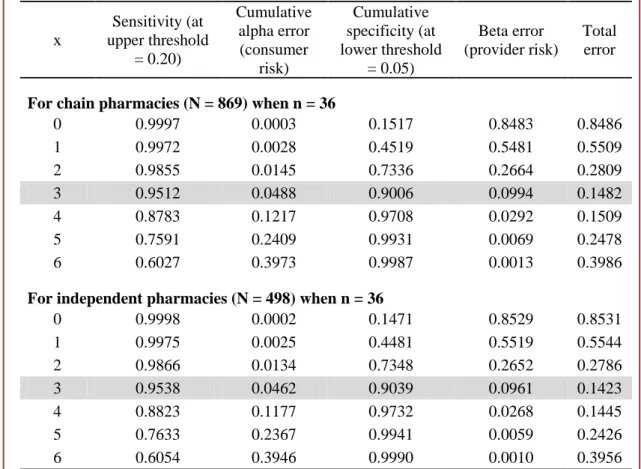
The binomial LQAS formula is preferred if the population size is either unknown or very large.[38] However, the hypergeometric model of LQAS was used in this study for sample size and decision rule calculation (Figure 1.1) because each subject pharmacy was included only once and because the population size of pharmacies in each lot was known and relatively small. These characteristics allow the actual errors to be calculated more accurately.[39,40] In this model, the gamma function is used for the calculation of factorials of fractions (Figure 1.1). The minimum number of subject pharmacies that produced the lowest combination of errors at both thresholds was 36 pharmacies from each lot, with 3 as the value for the decision rule. Table 1.1 shows a part of the calculation process. If the number of pharmacies that sell poor- quality amoxicillin exceeds the decision rule, the entire lot is classified as a lot with a
9
high prevalence of pharmacies that sell poor-quality amoxicillin and will therefore be rejected. This outcome implies that more resources must be directed toward the lot to investigate and correct the situation. Otherwise, the lot will be classified as a low- prevalence lot, one requiring fewer resources. A calculator that uses this calculation method is available online.[41]
x
Sensitivity (at upper threshold
= 0.20)
Cumulative alpha error
(consumer risk)
Cumulative specificity (at lower threshold
= 0.05)
Beta error (provider risk)
Total error
For chain pharmacies (N = 869) when n = 36
0 0.9997 0.0003 0.1517 0.8483 0.8486
1 0.9972 0.0028 0.4519 0.5481 0.5509
2 0.9855 0.0145 0.7336 0.2664 0.2809
3 0.9512 0.0488 0.9006 0.0994 0.1482
4 0.8783 0.1217 0.9708 0.0292 0.1509
5 0.7591 0.2409 0.9931 0.0069 0.2478
6 0.6027 0.3973 0.9987 0.0013 0.3986
For independent pharmacies (N = 498) when n = 36
0 0.9998 0.0002 0.1471 0.8529 0.8531
1 0.9975 0.0025 0.4481 0.5519 0.5544
2 0.9866 0.0134 0.7348 0.2652 0.2786
3 0.9538 0.0462 0.9039 0.0961 0.1423
4 0.8823 0.1177 0.9732 0.0268 0.1445
5 0.7633 0.2367 0.9941 0.0059 0.2426
6 0.6054 0.3946 0.9990 0.0010 0.3956
The first 7 rows of probability combinations are shown. x = decision rule, N = population size, n = required number of subject pharmacies, sensitivity = 1 – cumulative alpha error, Beta error = 1 – cumulative specificity.
Minimum accepted errors (and their sum) occur when x = 3 in the round of n when n = 36 for each lot (shaded areas of the table). This indicates that the smallest required number of subject pharmacies is 36. If the calculation continues, other good combinations will be obtained. However, this would require additional pharmacies. At n = 36, the finding of ≤ 3 target pharmacies indicates that their rate in the corresponding lot is ≤ 5%. However, this rate is acceptable according to the predefined thresholds in this study. The finding of
> 3 target pharmacies means that their rate is > 20%. Because this rate is unacceptable, the corresponding lot (i.e., category of pharmacy) is rejected.
Table 1.1. Part of the calculation process for deciding the required number of subject pharmacies and the decision rule.
10
It is worth mentioning that formal random sampling would have required a 4- to 5-fold larger number of pharmacies in each category, and therefore the resources required would have been 4- to 5-fold greater. This represents a significant advantage for LQAS, especially in developing countries.
An initial alphabetical list of pharmacies in each lot was created, and each pharmacy was given a special code. Each coded list was then scrambled, and 45 (36+9) pharmacies were randomly selected from each list by one of the co-investigators with MS Excel 2010 (Microsoft Co., USA). The additional 9 pharmacies represented a reserve for an estimated dropout rate of 25%. A pharmacy could be excluded, and replaced by one from the reserve list, for any of the following reasons: (a) the pharmacy was closed on the second visit, (b) the pharmacy was out of business, (c) the pharmacy did not have a sufficient number of amoxicillin dosage units (80 units from the available brands), or (d) the pharmacy refused to sell amoxicillin without a prescription. The randomly selected pharmacies from both lots were grouped by districts to facilitate sample collection. The same district distribution used in the list of pharmacies provided by the SFDA, in which the total number of districts was 114, was followed in this study (Annex 1.1). Sampling continued until samples had been purchased from 36 pharmacies in each lot.
Amoxicillin Sampling
The “mystery shopper” technique was used in the purchasing of the samples because an unwanted change in the seller’s behavior might result if the identity of the investigator was known to the seller.[42,43] Such behavioral changes might include non- cooperation or hiding poor-quality products available at the pharmacy. The investigator,
11
a Saudi Arabian citizen, played the role of the mystery shopper and was accompanied by two co-investigators in the field. This sampling technique was field tested prior to actual sampling and was standardized using the same scenario in each pharmacy. In this scenario, the sampler asked the seller to show him all brands of amoxicillin capsules and tablets available in 4‒5 packs (80 dosage units) because one of the sampler’s friends wanted the medicine. The sampler also told the seller that he would call his friend to tell him about the available brands and strengths to allow the friend to select the product to be purchased. Then, all brands and strengths that were available in sufficient quantities were numbered in a list reflecting the order in which the seller presented them, excluding any clavulanate-containing products. Each strength of a given brand was treated as a separate brand. A mobile telephone operated by Windows Mobile was used to rapidly generate a random number between 1 and the highest number on the list from Excel Mobile. This procedure was conducted while the sampler appeared to be making the call. In this way, one brand of amoxicillin capsules or tablets was randomly purchased from each randomly selected pharmacy.
If the 80 dosage units were from more than one batch, they were considered different samples purchased from the same pharmacy (i.e., a sample was a number of dosage units of the same batch purchased from a single pharmacy). Samples from the same batch of the same brand purchased from different pharmacies were considered different samples. If a sample from a pharmacy was found to be of poor quality, the pharmacy was considered a failed pharmacy.
After sampling from each pharmacy, the sampler and one of the co-investigators immediately completed the sampling form outside the pharmacy. The contents of the sampling form are shown in Table 1.2 and the sampling form is available in Annex 1.2.
12
Samples were immediately placed in a temperature-preserving container. The car air conditioner was operating effectively during all sampling trips. Amoxicillin brands were coded with the letters A–P.
Amoxicillin Authenticity Investigations
Dosage units, strips, boxes, and package inserts of all samples were visually inspected. Parts of all those items were sent to the corresponding manufacturers for authenticity confirmation including a special form (Annex 1.3). The SFDA was contacted to verify the registration status of the products.
Analysis and Materials
The content uniformity test was performed using high-performance liquid chromatography (HPLC) according to the 34th edition of the United States
Pharmacy code and type Batch number
Sample code Manufacture date
Sampling date Expiration date
Package condition and type Price
Trade name Pharmacy name
Manufacturer’s name Pharmacy type
Manufacturer’s country Pharmacy address
Distributor in Saudi Arabia Pharmacy general neatness
Dosage form Exposure of shelves to sunlight
Strength Quality of air-conditioning
Package size Pharmacist nationality and qualification
Registration number in Saudi Arabia Willingness of selling unregistered drugs Table 1.2. Sampling information.
13
Pharmacopeia (USP 34).[44,45] The only difference was using a shorter HPLC column (15 cm instead of 25 cm). However, the use of the shorter column would not affect the results as long as the method was validated. All samples were submitted to the first stage of the test, which involved 10 dosage units of each sample. Failed samples were challenged at the second stage, which involved 20 additional units. However, samples that were outside the deviation range of the first stage were treated as permanently failed without the need for a second stage of testing, as indicated by the USP. For every sample the amoxicillin content, which should range from 90.0%‒120.0% for capsules and 90.0%‒110.0% for tablets, according to the USP, was calculated by averaging the content of the dosage units analyzed in the content uniformity test.
All chemicals used were of analytical grade. Acetonitrile, potassium dihydrogen phosphate, and potassium hydroxide were purchased from Nakalai Tesque (Kyoto, Japan). The diluent was prepared by accurately dissolving 13.6 g of potassium dihydrogen phosphate in 2000 mL of distilled water adjusted with potassium hydroxide solution to a pH of 5. The mobile phase was prepared by mixing acetonitrile and the diluent in a ratio of 4:96.
The HPLC system consisted of the following components from JASCO (Tokyo, Japan): a pump (PU–2080 Plus), a UV detector (UV–2075 Plus) set at 230 nm, a column thermostat (CO–1560), a degasser (DG–980‒50), a system controller (LC–Net II/ADC), and an autosampler (AS–950). The system was equipped with a Shim‒pack CLC–ODS (M) column—a 4.6 × 150 mm column filled with 70% methanol from Shimadzu (Kyoto, Japan). The system was linked with a computer running ChromNav software from JASCO (Tokyo, Japan) for interpreting the results and plotting curves and peaks.
14
Standard amoxicillin, conforming to the USP Reference Standard (USPRS), was obtained from the Department of Medical Sciences, Bureau of Drug and Narcotic, Ministry of Public Health, Thailand. Standard cefadroxil, from Sigma (St Louis, MO, USA), was used as the internal standard.
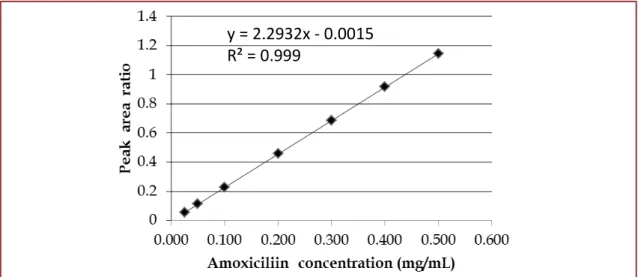
Peaks of amoxicillin and cefadroxil were observed at 6 and 8 minutes, respectively, with a flow rate of 0.6 mL/min (Figure 1.2). The linearity of the standard amoxicillin/diluent solution was maintained between 0.025 and 0.5 mg/mL and the analytical range was 0.05‒0.4 mg/mL (Figure 1.3). The linearity of the standard cefadroxil/diluent solution was maintained between 0.025 and 0.2 mg/mL and the analytical range was 0.05‒0.15 mg/mL (Figure 1.4).
A daily calibration curve was produced by 3 concentrations of standard amoxicillin (0.05, 0.10, and 0.2 mg/mL) prepared from a freshly prepared stock solution of 1 mg/mL (on anhydrous base). A daily stock solution of standard cefadroxil (0.2 mg/mL on anhydrous base) was freshly prepared and was added to all sample and
Figure 1.2. Retention times of amoxicillin and cefadroxil peaks (6 and 8 minutes, respectively). Amox = amoxicillin, and Cefd = cefadroxil.
15
calibration solutions to obtain a final concentration of 0.1 mg/mL in each solution (Figure 1.5).
The samples were analyzed in the order of their expiration dates. Each capsule was completely emptied, and the powder was dissolved in 200 or 400 mL of the diluent according to the capsule strength (250 or 500 mg, respectively). The flask was shaken
Figure 1.3. Linearity of amoxicillin solution, using cefadroxil as an internal standard.
Figure 1.4. Linearity of cefadroxil solution.
y = 2.2932x - 0.0015 R² = 0.999
Area
16
vigorously 20 times and sonicated for 20 minutes. All tablets were of 500 mg strength.
Each tablet was ground to fine powder in a mortar and was then dissolved in 400 mL of the diluent, shaken vigorously 20 times, sonicated for 5 minutes, and stirred for 30 minutes. Part of the solution was then centrifuged and the supernatant was used for analysis. The necessary dilution was then made for each sample solution with the diluent and the internal standard solution so that the theoretical concentration of amoxicillin would fall within the analytical range (Figure 1.6).
The final sample and calibration solutions were filtered through 0.2 µm Minisart RC 4 syringe filters from Sartorius Stedim (Dublin, Ireland). All solutions were used within 6 hours of preparation and analyzed in triplicate.
For method validation, Intra- and inter-day precision were determined by analyzing three solutions of standard amoxicillin of different concentrations (0.06, 0.12,
Figure 1.5. Daily preparation of amoxicillin calibration curve using cefadroxil as an internal standard. Amox = amoxicillin, Cefd = cefadroxil, STD = standard solution.
17
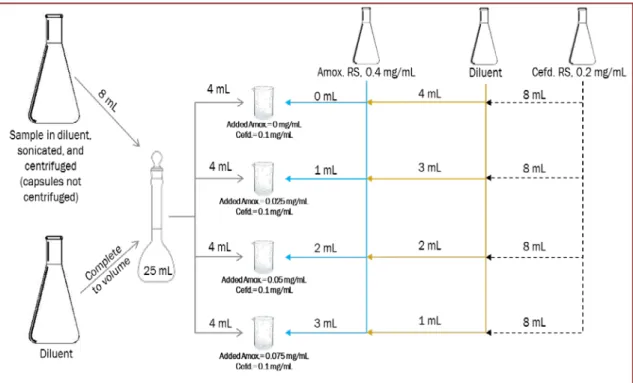
and 0.18 mg/mL) over a period of three days. An accuracy test for the method was performed by applying the standard-addition (spiking) recovery technique. Using this technique, one dosage unit from each strength of each brand of amoxicillin tablets and capsules was analyzed for amoxicillin content. Standard amoxicillin was then added to three aliquots of the pre-analyzed solution in three different concentrations (0.025, 0.05, 0.075 mg/mL), and the solutions were analyzed again to determine the total amoxicillin concentration. Finally, the recovered amount of added amoxicillin was calculated. This test was repeated three times using three dosage units, and the average recovery was calculated (Figure 1.7). All values of standard deviation, relative standard deviation, and relative error for both precision and accuracy were less than 2%, based on a 95%
confidence interval. These values were considered satisfactory.
Figure 1.6. Steps for sample analysis. Cefd= cefadroxil.
18
Figure 1.7. Steps for the accuracy test. Amox = amoxicillin, Cefd = cefadroxil, RS = reference standard.
19
Results
Eighty-five pharmacies (43 chain and 42 independent) were visited during the sampling period in 53 of the 114 districts of Riyadh. The dropout was 7 and 6 for chain and independent pharmacies, respectively. Dropouts occurred for reasons a, b, and c, mentioned above (5, 4, and 4 pharmacies, respectively). No major differences for dropping out were found between the independent and chain lots. No pharmacies were excluded because they refused to sell amoxicillin without a prescription.
In all, 83 samples were collected from 72 randomly selected subject pharmacies.
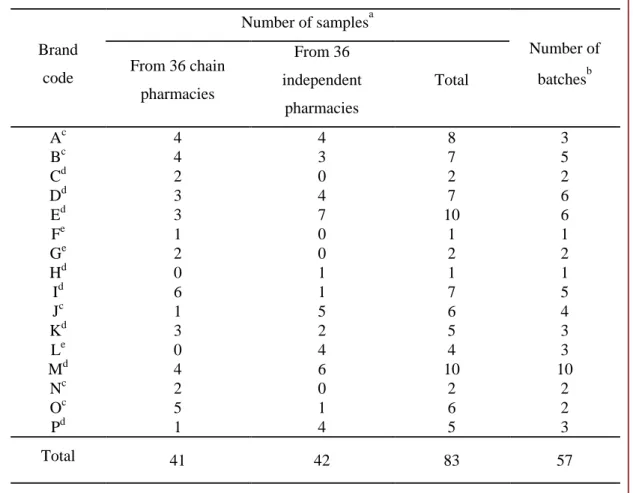
Of these samples, 41 were collected from chain pharmacies and 42 from independent pharmacies (Table 1.3 and Annex 1.4). Six samples (7%) were tablets, two of which were purchased from chain pharmacies and the rest from independent pharmacies. The remaining samples were all capsules. Twenty-eight samples (35%) were locally manufactured, 47 (57%) were imported from other Arab countries, and 7 (8%) were imported from Europe. The samples included 16 brands produced by 10 manufacturers.
These samples represented all the manufacturers registered by the SFDA at the time of sampling.
Visual inspection revealed that all the samples were neatly packaged in boxes containing push-through strips and a pamphlet. All samples and packaging of each brand were identical and included the registration code in Saudi Arabia, as well as the price and the name of the distributor. The price was identical for each sample of the same brand. The batch numbers, manufacturing dates and expiration dates on the boxes and strips were found to match. Authenticity was confirmed by all manufacturers, seven of whom responded in writing and three by telephone. However, their responses to the
20
attached questionnaire were not complete. Finally, the registration status of each product and manufacturer was confirmed by the SFDA.
One sample was outside the deviation range of the first stage of the content uniformity test and failed the test for this reason. Fourteen samples failed the first-stage acceptance value (AV = 15%). Eight of these samples failed the second stage and hence
Table 1.3. Distribution of samples and batches.
Brand code
Number of samplesa
Number of batchesb From 36 chain
pharmacies
From 36 independent
pharmacies
Total
Ac 4 4 8 3
Bc 4 3 7 5
Cd 2 0 2 2
Dd 3 4 7 6
Ed 3 7 10 6
Fe 1 0 1 1
Ge 2 0 2 2
Hd 0 1 1 1
Id 6 1 7 5
Jc 1 5 6 4
Kd 3 2 5 3
Le 0 4 4 3
Md 4 6 10 10
Nc 2 0 2 2
Oc 5 1 6 2
Pd 1 4 5 3
Total 41 42 83 57
a A sample is a batch purchased from a single pharmacy. If the same batch is purchased at another pharmacy, it is considered as a different sample. Different batches of the same brand purchased from the same pharmacy are also considered as different samples.
b The number of batches of the corresponding brand purchased from all pharmacies without repetition.
c Manufactured in Saudi Arabia.
d Imported from other Arab countries.
e Imported from Europe.
21
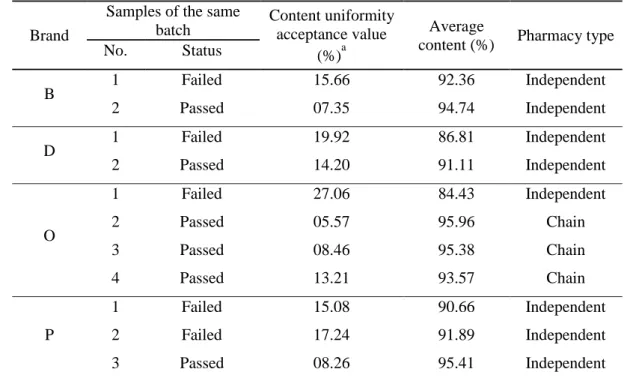
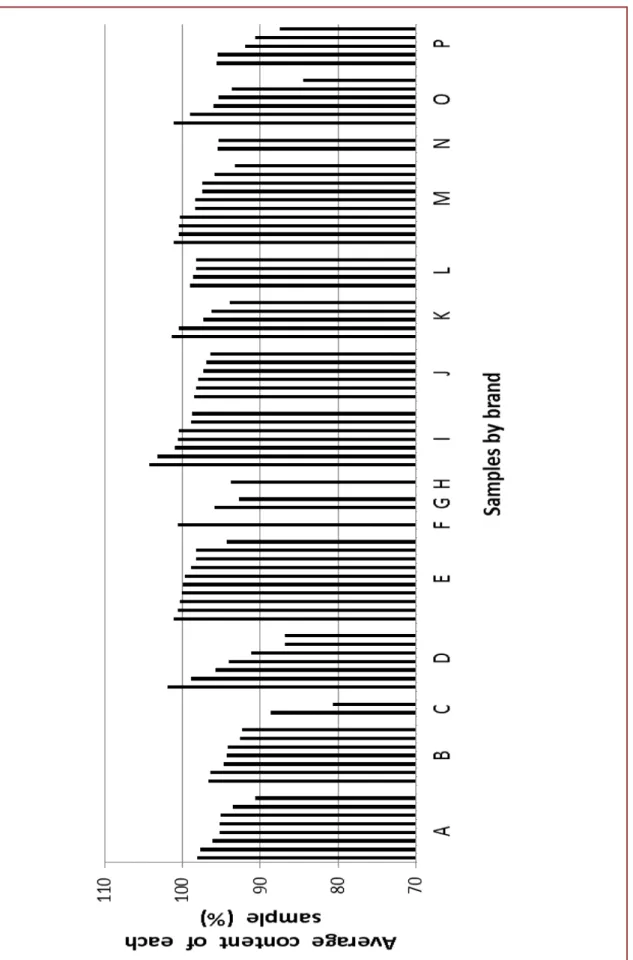
failed the test. In all, a total of 9 samples (11%) failed the test. All of these samples were capsules. The failed samples were purchased from 9 pharmacies (4 chain and 5 independent) that belonged to different chains or owners and included five brands from four manufacturers (Figure 1.8). However, no sample for brand C was purchased from any independent pharmacy. The content of 6 of the failed samples was below 90%. The lowest content was 80.7%. The content of the approved samples ranged from 90.6% to 104.2% (Figure 1.9). Interestingly, certain batches of certain brands passed the content and/or content uniformity tests in some pharmacies, but failed in others (Table 1.4). A summary of the sample analyses can be found in Annex 1.5.
The number of pharmacies that sold poor-quality amoxicillin in each lot of pharmacies was greater than the decision value of 3. For this reason, both the chain and independent lots were rejected. As a result, the null hypothesis failed to be rejected, and both lots were classified as high-prevalence lots. This result shows that more than 20%
of the pharmacies in each lot sell poor-quality amoxicillin, an outcome suggestive of a significant problem with important public health implications.
The following observations were recorded while visiting the pharmacies for sampling. The air-conditioning was totally unsatisfactory in one independent pharmacy and one medicine shelf was exposed to direct sunlight in another independent pharmacy.
Neatness and cleanliness was satisfactory in all pharmacies. Surprisingly a prescription was not requested by all pharmacies, and instructions about the use of amoxicillin were not offered by all of them. It was also noted that in some pharmacies there were certain signs stating clearly that prescription-only medicines cannot be sold without prescriptions. This sign was not seen in 8 (22%) chain pharmacies and 11 (31%)
22
independent pharmacies. All pharmacists in the visited pharmacies were non-Saudis.
Tabulated pharmacy information can be found in Annex 1.6.
Figure 1.8. Distribution of failed samples.
Brand
Samples of the same
batch Content uniformity acceptance value
(%)a
Average
content (%) Pharmacy type No. Status
B 1 Failed 15.66 92.36 Independent
2 Passed 07.35 94.74 Independent
D 1 Failed 19.92 86.81 Independent
2 Passed 14.20 91.11 Independent
O
1 Failed 27.06 84.43 Independent
2 Passed 05.57 95.96 Chain
3 Passed 08.46 95.38 Chain
4 Passed 13.21 93.57 Chain
P
1 Failed 15.08 90.66 Independent
2 Failed 17.24 91.89 Independent
3 Passed 08.26 95.41 Independent
a Acceptance value must be ≤ 15%.
Table 1.4. Batches that passed in some pharmacies but failed in others.
23
Figure 1.9. Content distribution of all samples.
24
Discussion
Although counterfeit products were not identified by this survey, substandard samples represented 11% of the total samples. This result may indicate a high prevalence of substandard amoxicillin products in community pharmacies in Riyadh.
This finding is consistent with the findings of Kyriacos et al.,[15] although the sample size for the amoxicillin products purchased in Saudi Arabia was not specified in that study. It was also found in this study, as in that previous study, that all European samples passed the quality tests used. In addition, all tablet forms passed the quality tests. However, it is difficult to perform a valid comparison due to the small percentage of European samples (8%). Similarly, it cannot be stated conclusively that tablet forms are more stable than capsules because of the small percentage of tablets (7%). However, small percentages of tablet forms and European products were expected to be found in Saudi Arabia because the sales of these items during the second quarter of 2009, expressed as percentages of the total sale of amoxicillin capsules and tablets, were 3.96% and 4.32%, respectively, according to the SFDA (personal communication).
In this study it was also found that certain batches passed the content and/or content uniformity test in certain pharmacies and failed in others. This result suggests the occurrence of degraded products that were originally of good quality and suggests that degradation may have occurred due to poor storage and/or distribution conditions (Table 1.4). In general, Riyadh climate is arid with extreme increase of temperature in summer and decrease in winter. The samples were collected during a very hot season, when the outside temperature in Riyadh during the daytime reached approximately 45 °C. Poor temperature control in the distributors’ facilities, such as warehouses and delivery vehicles, could have been resulted in the degradation of amoxicillin. Also,
25
although the air conditioning in the vast majority of the visited pharmacies was satisfactory during sampling, the possibility that the air conditioners failed or were not used in certain pharmacies at certain times cannot be excluded. In addition, possible poor quality control practices during the manufacturing of several other batches that totally failed cannot be excluded. This hypothesis is supported by the appearance of the powder of the capsules of several failed samples from a certain manufacturer. The powder was in the form of a hard mass that appeared to have formed when the sample became dry after having been in a hygroscopic state. This observation suggests that the problem was caused by poor packaging.
The average content of the active ingredient in the failed samples was greater than 80%. This value contrasts with the low values found by Kyriacos et al. (59%).[15] A lower content of amoxicillin was also reported in another study in Nigeria. Only 24% of the amount shown on the label was found in that study.[35] Counterfeit or substandard amoxicillin was found in several countries. The reported amoxicillin content of these products varied, reaching zero in certain cases.[9] However, the results of this study seem consistent with the findings of a study conducted in Indonesia, where 20% of the amoxicillin tablets analyzed contained an amount of active ingredient slightly below the lower acceptable range according to the British Pharmacopeia (BP).[36] It should be noted that in this study, based on the content range of 92.5‒110% specified in the BP 2012,[46] two more samples would have failed the content test (one sample from each lot).
Nevertheless, the existence of a substandard essential medicine in community pharmacies in Riyadh, a capital city where inspection and monitoring are expected to be relatively strict, suggests that poor-quality medicines with a lower content of the active
26
ingredient would be prevalent in other cities or in remote areas of the country due to less strict monitoring and control and less satisfactory storage and/or distribution conditions.
In addition, the problem appears to exist regardless of the economy of scale of pharmacies (chain or independent). The number of pharmacies selling poor-quality amoxicillin exceeded the decision value in both lots. For this reason, the lots were both considered to have high prevalence rates. This finding suggests that possible intervention strategies should target both types of community pharmacies, regardless of the anticipated quality of the service provided.
The LQAS technique with a mystery shopper provided a readily reproducible and statistically valid sample collection method that requires a small sample. The use of this method is recommend for future monitoring by the SFDA or other investigators in Saudi Arabia. It is also recommended that that this methodology be followed as a model for investigating the quality of other medicines and pharmacies in Saudi Arabia, and probably other countries. This methodology can be also used as a follow-up technique to monitor the changes that may occur following suitable intervention. However, the medicine selected as an indicator of the quality of medicines may need to be changed according to the geographical area surveyed. In this study, amoxicillin was selected because it is widely used, widely counterfeited, and heat-labile (Riyadh is very hot during summer), and also because substandard amoxicillin was reported in Saudi Arabia in one study.
In theory, LQAS sampling can be terminated if the decision rule is exceeded at an early stage of the survey. In this way, the target can be achieved with minimal cost and time. The termination of sampling at an early stage was not possible in this study, but this outcome may be achieved for other analytical procedures that can be conducted
27
in the field. In addition, the results of the survey could indicate whether large-scale, randomized surveys are required for further investigation of the problem.
Limitations
The following limitations may have affected the extent to which the results of this study can be generalized. First, only capsule and tablet dosage forms were sampled because suspension bottles are bulky and may break easily during shipping to Japan, where the analysis was performed. Therefore, the findings of this study cannot be expanded to other amoxicillin dosage forms.
Second, it was not possible to collect samples of a single batch from each pharmacy because asking the seller about batches would have revealed that the pharmacy was under investigation. As a result, more than one sample was obtained from several pharmacies. However, if a sample from a given pharmacy failed in the analysis, then the pharmacy failed in the lot, regardless of the quality of the other sample(s) purchased from the same pharmacy.
Third, samples were analyzed in the order of their expiration dates by the investigator, who was not blinded as to the samples being analyzed, but was blinded as to the pharmacies from which the sample(s) were obtained. Unintentional expectation bias might have been introduced because the investigator is a Saudi Arabian clinical pharmacist. However, this factor is unlikely to have affected the results of the study because several samples failed from certain pharmacies but passed from others and because the samples were repeatedly measured with a validated method.
Fourth, only content and content uniformity tests were applied in this study. The analysis of impurities or excipients was not performed, nor the dissolution test.
28
Therefore, “quality” in this study refers only to the acceptable amount and uniformity of the active ingredient in terms of the range specified by the USP. If the amount of active ingredient was outside the range, it was concluded that the sample failed, irrespective of other quality parameters. Moreover, degradation products were not analyzed for characterizing the failed samples as substandard or degraded. However, some samples passed the tests while other samples from the same batch but purchased from different pharmacies failed them, a finding suggestive of the degradation issues. There are several methods that can differentiate between degraded and originally substandard amoxicillin.[47,48] These methods may be used in future studies.
Finally, because LQAS requires smaller sample sizes, this study does not provide an accurate estimate of the prevalence of poor-quality amoxicillin or of poor- quality pharmacies. However, the objective was not to provide an accurate prevalence rate but to classify reliably whether the prevalence rate of poor-quality medicines or pharmacies was above or below the threshold defined in the null hypothesis. With a larger sample size, which requires more resources for sampling and analysis, stratified random sampling is still the best method for accurate prevalence estimation. However, the LQAS method could help decision makers with limited resources to classify health system services, such as the provision of medicines in community pharmacies, according to a predetermined threshold. The results of such analyses could help decision makers allocate the resources intended for improvement accordingly even if the number of rejected pharmacies in any lot is less than the decision rule.
29
Conclusions
Although this study has several limitations, it can be concluded from its results that deficiencies in the quality control of the supply chain and/or storage exist in Riyadh, either at the level of wholesalers or pharmacies, in addition to possible manufacturing defects for certain brands of amoxicillin. Based on this conclusion, the SFDA is advised to perform routine monitoring of wholesalers and pharmacy storage facilities, distribution facilities, and environmental settings inside pharmacies (e.g., temperature, humidity and exposure to sunlight). In addition, distributors, pharmacy owners, and pharmacists should be educated about the possible consequences of failing to adhere to appropriate distribution and storage conditions for the provision of medicines.
Quality inspection at the level of manufacturing must also be strengthened, and optimal conditions must be maintained during the clearance of imported medicines.
Finally, it is strongly recommend that additional research similar to the current study be conducted to investigate the quality of provision for other medicines in Riyadh and other areas of Saudi Arabia, as well as the quality of community pharmacies in terms of their adherence to the optimal conditions for keeping and selling medicines and the services provided by these pharmacies. Larger-scale randomized surveys would be helpful to further delineate the scale of the quality-control problem in Saudi Arabia.
30
References
1. WHO. Counterfeit drugs: guidelines for the development of measures to combat counterfeit drugs. World Health Organization (1999).
http://whqlibdoc.who.int/hq/1999/WHO_EDM_QSM_99.1.pdf (accessed 3 September 2011).
2. WHO. Counterfeit medicines: some frequently asked questions. World Health Organization.
http://www.wpro.who.int/mediacentre/factsheets/fs_20050506/en/index.html (accessed 3 September 2011).
3. Newton PN, Lee SJ, Goodman C, et al. Guidelines for field surveys of the quality of medicines: a proposal. PLoS Med 2009; 6(3): e1000052.
4. Fernandez FM, Hostetler D, Powell K, et al. Poor quality drugs: grand challenges in high throughput detection, countrywide sampling, and forensics in developing countries. Analyst 2011; 136 (15): 3073-3082.
5. ten Ham M. Health risks of counterfeit pharmaceuticals. Drug Saf 2003; 26(14):
991-997.
6. Nsimba SE. Problems associated with substandard and counterfeit drugs in developing countries: a review article on global implications of counterfeit drugs in the era of antiretroviral (ARVs) drugs in a free market economy. East Afr J Public Health 2008; 5(3): 205-210.
7. Seiter A. Health and economic consequences of counterfeit drugs. Clin Pharmacol Ther 2009; 85 (6): 576-578.
31
8. Gautam CS, Utreja A, Singal GL. Spurious and counterfeit drugs: a growing industry in the developing world. Postgrad Med J 2009; 85 (1003): 251-256.
9. Kelesidis T, Kelesidis I, Rafailidis PI, et al. Counterfeit or substandard
antimicrobial drugs: a review of the scientific evidence. J Antimicrob Chemother 2007; 60(2): 214-236.
10. Watson R. European Union prepares to tackle counterfeit drugs. BMJ 2010; 340:
c2425.
11. WHO. Counterfeit and Substandard Drugs in Myanmar and Viet Nam: report of a study carried out in cooperation with the governments of Myanmar and Viet Nam.
World Health Organization 1999.
http://apps.who.int/medicinedocs/pdf/s2276e/s2276e.pdf (accessed 3 September 2011).
12. Khan MH, Okumura J, Sovannarith T, et al. Prevalence of counterfeit
anthelminthic medicines: a cross-sectional survey in Cambodia. Trop Med Int Health 2010; 15(5): 639-644.
13. Newton PN, Green MD, Mildenhall DC, et al. Poor quality vital anti-malarials in Africa - an urgent neglected public health priority. Malar J 2011; 10: 352.
14. Seear M, Gandhi D, Carr R, et al. The need for better data about counterfeit drugs in developing countries: a proposed standard research methodology tested in Chennai, India. J Clin Pharm Ther 2011; 36 (4): 488-495
32
15. Kyriacos S, Mroueh M, Chahine RP, et al. Quality of amoxicillin formulations in some Arab countries. J Clin Pharm Ther 2008; 33(4): 375-379.
16. Reinke WA. Applicability of industrial sampling techniques to epidemiologic investigations: examination of an underutilized resource. Am J Epidemiol 1991;
134(10): 1222-1232.
17. Robertson SE, Valadez JJ. Global review of health care surveys using lot quality assurance sampling (LQAS), 1984‒2004. Soc Sci Med 2006; 63(6): 1648-1660.
18. Myatt M, Limburg H, Minassian D, et al. Field trial of the applicability of lot quality assurance sampling survey method for rapid assessment of prevalence of active trachoma. Bull World Health Organ 2003; 81 (12): 877-885.
19. Deitchler M, Valadez JJ, Egge K, et al. A field test of three LQAS designs to assess the prevalence of acute malnutrition. Int J Epidemiol 2007; 36 (4): 858-864.
20. Mushtaq MU, Majrooh MA, Sana Ullah MZ, et al. Are we doing enough?
Evaluation of the Polio Eradication Initiative in a district of Pakistan’s Punjab province: a LQAS study. BMC Public Health 2010; 10: 60.
21. Bhuiya A, Hanifi SMA, Roy N, et al. Performance of the lot quality assurance sampling method compared to surveillance for identifying inadequately-
performing areas in Matlab, Bangladesh. J Health Popul Nutr 2007; 25(1): 37-46.
22. Bawazir SA. Prescribing pattern at community pharmacies in Saudi Arabia. Int Pharm J 1992; 6(5): 222-224.
33
23. Bin Abdulhak AA, Altannir MA, Almansor MA, et al. Non prescribed sale of antibiotics in Riyadh, Saudi Arabia: A Cross Sectional Study. BMC Public Health 2011; 11:538.
24. Irshaid YM, Al-Homrany MA, Hamdi AA, et al. A pharmacoepidemiological study of prescription pattern in outpatient clinics in southwestern Saudi Arabia.
Saudi Med J 2004; 25 (12): 1864-1870.
25. Al-Humayyd MS, Babay ZH. Pattern of drug prescribing during pregnancy in Saudi women: a retrospective study. Saudi Pharm J 2006; 14 (3,4): 201-207.
26. Bawazir SA. Prescribing patterns of ambulatory care physicians in Saudi Arabia.
Ann Saudi Med 1993; 13 (2): 172-177.
27. Abou-Auda HS. An economic assessment of the extent of medication use and wastage among families in Saudi Arabia and Arabian Gulf countries. Clin Ther 2003; 25 (4): 1276-1292.
28. James E, Assawaf K, Zarie AH, et al. Factors influencing rational drug use in primary health care centres in Qassim Region, Saudi Arabia. Saudi Pharm J 2003;
11 (3): 126-135.
29. Ahmed KZ, Al-Saadi AR. A survey of multiple prescriptions dispensed in Saudi Arabia. Pak J Pharm Sci 2005; 18 (2): 1-2.
30. Saudi Ministry of Health. Regulations of the system for pharmaceutical facilities and products [in Arabic] [online]. Available from URL:
34