Economics & Management Series EMS-2016-11
CREATING SHARED VALUE IN THE PRESENCE OF CONFLICTS AND TRADEOFFS: A PARADOX PERSPECTIVE ON BUSINESS AND SOCIETY
Karen LaPierre
Leading Coach K.K.
Naomi Wakayama
The University of Tokyo
Toshiro Wakayama
International University of Japan
September 2016
IUJ Research Institute
International University of Japan
These working papers are preliminary research documents published by the IUJ research institute. To facilitate prompt distribution, they have not been formally reviewed and edited. They are circulated in order to stimulate discussion and critical comment and may be revised. The views and interpretations expressed in these papers are those of the author(s). It is expected that the working papers will be published in some other form.
1
CREATING SHARED VALUE IN THE PRESENCE OF CONFLICTS AND TRADEOFFS: A PARADOX PERSPECTIVE ON BUSINESS AND SOCIETY
Karen LaPierre Leading Coach K.K.
Naomi Wakayama The University of Tokyo
Toshiro Wakayama International University of Japan
While business and society may engage in mutually beneficial, synergistic interactions, they also face the challenge of managing contentious, tradeoff interactions when their objectives are not aligned. In the diverse fields of studies in business and society, these two modes of business-society interactions have been conceptualized rather separately: mutual gains and synergies in concepts such as social innovation and shared value creation on one hand, and tensions and tradeoffs in studies that involve, for example, competing dimensions of corporate sustainability, conflicting priorities of various stakeholders, and opposing institutional logics in hybrid organizations on the other hand. Grounded in paradox theory, which views contentious and synergistic relationships of dual elements such as business and society as two sides of the same coin, we develop a framework for capturing the two types of business-society interactions at the fine-grained micro level. Our extensive case studies, based on publicly available information, illustrate the framework in detail, i.e., how contentious and synergistic interactions occur and their interplay over time within a context of a specific firm and its interactions with the society around it. Our key observation is that synergy creation and tension management are mutually-influencing and tightly integrated processes in the discourse of fine-grained, business-society interactions.
Introduction
In the diverse fields of business and society, in response to the either-or logic on economic gains vs. societal concerns, an increasing stream of research takes a more integrative stance and searches for perspectives that help balance or ‘embrace tensions’ that occur among competing demands of business and society (Freeman, 1984; Donaldson and Preston, 1994; Margolis and Walsh, 2003; Hahn and Figge, 2011). More recently, an emergent strand of research deploys paradox theory to refine the notion of ‘embracing tensions’ and work out the both-and logic of business and society (Gao and Bansal, 2013; Jay, 2013; Van der Byl and Slawinski, 2015;
Hahn et al., 2015; Slawinski and Bansal, 2015; Battilana et al., 2015). Paradox is the coexistence of opposing dual elements which are also complementary (Poole and van de Ven, 1989) and synergistic (Smith and Lewis, 2011). Hence their effective management must operate “in a creative way that captures both extremes”
(Eisenhardt, 2000, p. 703), while coping with the conflicts and tradeoffs that the opposing demands of the two extremes might impose. As an example, at the micro level of individual behavior, work vs. family can be viewed as a paradox (Smith and Lewis, 2011). Namely, while the two sides compete for time allocation (greater work time generally implies less family time and vice versa), work and family may also exhibit a synergistic
2 relationship via positive spillover of desirable skills and behavior from one side to the other (Edwards and Rothbard, 2000; Ilies, Wilson and Wagner, 2009). Thus, similarly, business and society, seen as a paradox, may engage in contentious and tradeoff interactions while at the same time exploit mutually beneficial and synergistic opportunities. The prior research on the paradox perspective of business and society, however, tends to focus on the tensions among competing demands of the two sides and falls short on inquiries into how business and society, while dealing with tensions, co-create mutual benefits at the same time. Note that in the above example of work-family paradox, a point of contention appears with respect to the theme of time allocation whereas a point of synergy emerges with respect to a different theme, namely, positive spillover of desirable skills and behavior. This and similar observations suggest that a study of thematically differentiated, fine-grained interactions of business and society may lead to a more comprehensive picture of synergistic as well as contentious nature of business-society relationship. Hence, our research aims to gain new insights on the complexity of business and society seen as a paradox through the analysis of thematically differentiated, fine- grained business-society interactions at the micro level. More specifically, we formulate our research question as follows: How do firms engage in mutually beneficial interactions with society at the micro level while managing conflicts and tradeoffs that might arise when their economic pressures contradict with social demands?
Our approach to the research consists of three phases: (1) preliminary yet extensive case studies of seven companies based on publicly available documents (Nestle in India, Walmart in West Virginia, Chevron in Nigeria, Coca Cola in Brazil, Grameen Bank in Bangladesh, Range Resources in Pennsylvania, SABMiller and DADTCO in Africa); (2) construction of a conceptual framework for capturing the dynamics of business-society interaction at the micro level based on (1) and conceptual constructs associated with paradox theory; and (3) in- depth analysis of two cases (Range Resources in Pennsylvania and SABMiller and DADTCO in Africa) for illustration of the framework developed in (2) and also for further insights on the complexity of business-society interaction.
Conceptual Background
Opportunities for Mutual Benefits
In studies of corporate social responsibility (CSR), a large body of empirical research suggests, on the basis of moderately positive association, that a firm’s CSR activities tend to contribute to corporate financial performance (CFP) (e.g. Margolis and Walsh, 2003, Orlitzky et al., 2003; Godfrey et al., 2009; Lev at al., 2010).
Conversely, empirical evidence also indicates some likelihood that better CFP results in improved corporate
3 social performance (CSP). Building on this two-way association, Waddock and Graves (1997) argue that CSP and CFP form a ‘virtuous circle’, suggesting the possibility that CSP and CFP are mutually reinforcing and synergistic (Surroca, Tribo and Waddock, 2010). However, though specific societal benefits may be presumed, CSP is often assessed at the aggregate level through measures such as reputation rating by Fortune magazine and KLD data, and CSP’s actual outcomes to the society are typically left unspecified (Wood, 2010). Hence, CSP-CFP association (at the aggregate level) may not immediately imply synergistic interactions between business and society.
At finer-grained levels, however, mutual benefits and synergies between business and society are well conceptualized in ideas such as ‘social innovation’ (Kanter, 1999), ‘bottom of the pyramid’ (Prahalad and Hammond, 2002) and ‘creating shared value’ (Porter and Kramer, 2011). For instance, cases of such mutual benefits include P&G’s successful business in Africa that provides affordable water purification to the poor (Christensen et al., 2015), Becton Dickinson’s new business that provides needleless injection systems that protect health workers (Pfitzer et al., 2013), and Marriot’s employment program that significantly reduces employee turnover rates while improving job prospects in inner cities (Kanter, 1999).
Challenges of Competing Demands
While opportunities for mutual gains abound, business and society also face a range of challenges in managing and coping with tensions and tradeoffs when their objectives conflict. In the face of such challenges, many authors, economists or management scholars, prioritize shareholder value over interests and concerns of other stakeholders as the definitive corporate objective (e.g., Friedman, 1970; Sundaram and Inkpen, 2004). On the other hand, other scholars theorize the value and logic of corporate commitment to non-economic issues (e.g., Donaldson and Preston, 1995; Margolis and Walsh, 2003).
In fact, faced with tensions and tough tradeoff decisions in specific situations, firms may prioritize business pressures over societal concerns, or vice versa. As a case in point, Hart’s (2013) delves into the events of a fatal helicopter crash to explore the complexity of business interests and safety concerns. Hart (2013) suggests that the accident, at least in part, stemmed from prioritizing, over timely safety measures, the stark economic realities of grounding a fleet worldwide, disrupting client’s off-shore oil production and potentially impacting future contracts. Similarly, Slawinski and Bansal (2015) found in their study of firms in Canada’s oil sands, that some companies, when faced with the tension between uncertain long-term benefits of investing in high-cost technologies that reduce greenhouse emissions and certain short-term financial gains from less-environmentally friendly production, chose to prioritize the latter.
4 Some firms in other situations, however, are motived by moral or ethical concerns and may opt to prioritize societal concerns instead. For example, in the 1980’s a majority of American MNCs with affiliates in South Africa in response to apartheid withdrew from the country despite reduction in stockholder wealth (Meznar et al.
1994). In another study, Bruyaka et al. (2013) found that in the challenge of developing ‘orphan drugs’ (drugs for rare diseases) some firms, even those grappling with negative profits, chose to engage in the production of such drugs despite their weak commercial value.
Business and Society as a Paradox
As some researchers focus on mutual benefits and others on competing demands, a growing stream of research has moved towards the paradox perspective. In paradox theory, paradox is defined as “contradictory yet interrelated elements that exist simultaneously and persist over time” (Smith and Lewis, 2011, p.382). Such contradictory yet interrelated elements are also complementary (Poole and Van de Ven, 1989; Lewis, 2000;
Luscher and Lewis, 2008; Andriopoulos and Lewis, 2009), mutually beneficial (Smith and Tushman, 2005) and synergistic (Smith and Tushman, 2005; Andriopoulos and Lewis, 2009; Smith and Lewis, 2011). Thus, effective governance of business and society seen as a paradox must address the challenge of meeting conflicting demands of the two sides while also “seeking synergistic opportunities to further both purposes”
(Smith and Lewis, 2011, p.393).
In reviewing the research in corporate sustainability, Van der Byl and Slawinski (2015) find paradox theory to be a promising, emergent framework for understanding the nature of tensions among competing sustainability demands, namely, economic, social and environmental objectives. For instance, Slawinski and Bansal (2015) claim that “if the many tensions [i.e., competing demands] surrounding sustainability are juxtaposed [rather than prioritized] and treated as a paradox, then alignment between business goals and societal needs will more likely emerge in the long run” (p. 546). In fact, some of the firms they studied in Alberta’s oil sands engaged in a range of practices that favor the strategy of embracing sustainability tensions, rather than framing the sustainability issue as a narrowly defined economic tradeoff problem. Similarly, Hahn et al. (2015), critical of the instrumental view of corporate sustainability that prioritizes the economic dimension over the other two dimensions, turned to the paradox framework for constructing prescriptive strategies for embracing and managing sustainability tensions. In crafting strategies to preserve the legitimacy of business organizations in the society, Scherer et al. (2013) argue that such strategies are best framed through the tension-embracing logic of paradox thinking. Going beyond the embrace-and-manage view of paradox, Gao and Bansal (2013), through their empirical study of 738 firms using KLD data, showed that all three measures of corporate financial, social
5 and environmental performance were simultaneously determined and argue that this simultaneity “suggests the presence of potential synergies [among the three sustainability dimensions]” (p. 251). Similarly, adopting the paradox framework in capturing the sustainability practices of four companies with high sustainability profile, Epstein et al. (2015) found that the companies were well aware of the complementarity among the competing sustainability dimensions. For instance, a mid-level manager they interviewed at P&G stated: “The question is:
can we turn the tension between financial and social/environmental into synergy?” (as quoted in Epstein et al., 2015, p. 38).
Additionally, studies on hybrid organizations (social enterprises) also apply the paradox lens to better understand how these organizations grapple with competing institutional logics that are organizationally imbedded under one roof, namely the commercial logic and the social welfare logic. In a study of WISE organizations (work integration social enterprise), Battilana et al. (2015), describes organizational members’
efforts to mitigate paradoxical tensions by, for example, creating a set of new practices that encourage discussion, negotiation and coordination among those members with competing concerns and responsibilities.
Jay (2013), studying a hybrid organization in Boston, Massachusetts, found that the paradox lens helped organizational members make sense of the competing institutional logics, navigate forward and thereby better enable the capacity for innovation.
In sum, at higher aggregate or conceptual levels, many authors subscribe to the idea that business and society benefit from win-win and synergistic opportunities while other researchers point to the hard realities of conflicting and tradeoff tensions between the two. In parallel to these two competing views at large, business and society at finer-grained levels also exhibit both contentious and mutually beneficial interactions: namely the two sides often manage to create mutual gains in specific situations, yet in other situations they seem to face tough either-or tradeoff decisions. Countering the either-or logic that seems rather prevalent in literatures on business and society, the paradox lens offers a perspective that embraces the both-and logic and the tensions inherent between competing demands because these demands, however contradictory, are also interrelated in a way that makes it difficult to favor one side at the expense of the other over a long period of time. Thus, it seems prudent to adopt paradox thinking to issues of business and society, and we are witnessing an emergent stream of research with this approach. However, it appears that this strand of research is largely interested in scrutinizing how firms embrace and navigate paradoxical tensions in the effort to move away from the shortcomings of the either-or logic. In contrast, given the synergy-seeking affinities of paradoxical elements such as business and society, our aim is to understand how the firm, together with the surrounding communities,
6 exploits mutually beneficial and synergistic opportunities while also attending to conflicts and tradeoffs that might arise when its economic pressure contradicts with the demands of the society.
Framework
The conceptual framework presented here is to capture fine-grained interactions between the commercial interests of a firm and the concerns for social wellbeing of the surrounding communities of the firm. Throughout, when clear from the context, we use the term ‘business’ synonymously with commercial interests of the firm although individual business organizations, particularly when they are hybrid social enterprises, may exhibit and act on genuine concerns for the wellbeing of their communities.
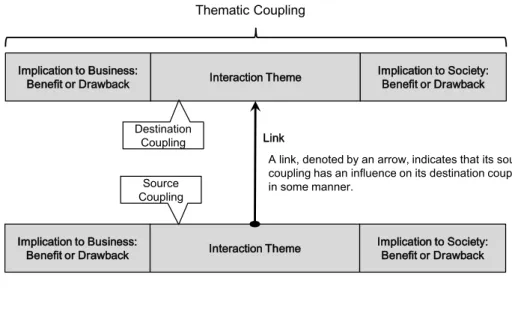
Drawing from paradox theory, a key conceptualization here is that business and society engage in a range of fine-grained, paradox-enacting interactions, i.e., interactions that involve conflicting as well as positively interrelated concerns and interests of the two sides. We capture such a fine-grained interaction in terms of an interaction theme and a pair of its implications, one to the business and the other to the society (See Fig. 1). An interaction theme may be a specific action taken by the business, a joint initiative between the business and its community, or a policy imposed by a local government. Given such an interaction theme, its implication to the business can be a benefit to the company such as a revenue increase, enhanced employee retention, greater consumer trust, and access to critical supplies enabled by a new technology, or can be a drawback to the company such as added logistical cost, damage to the company reputation, increased risk in payment collection, and fees to compensate for environmental damage. Similarly an implication of an interaction theme to the society can be a benefit to the communities such as a new source of income for a certain population, enhanced environmental protection, new opportunities for skill development, and empowerment of a disadvantaged segment of the society, or a drawback to the communities such as local businesses closing down due to competition, depletion of natural resources, extra wear and tear on the public infrastructure, and lost employment opportunities.
It should be noted here that a single interaction theme may have different implications to the business depending on its functions, competitive issues or managerial concerns. For instance, consider the interaction theme of a company offering educational programs to its local residents for the development of skills the company needs. The theme may have a negative implication with respect to the company’s cash flow concern and a positive implication with respect to the company’s hiring interest. Similarly, an interaction theme may have varying implications to the society depending on its population segments, social issues or domains of what constitute societal wellbeing. For instance, consider a Walmart store opening in the community as an interaction
7 theme. The theme is likely to have a positive implication to a certain population, but at the same time a negative implication to a transportation-disadvantaged population if nearby local retailers close down due to the competition from Walmart.
Thus, in order to capture interactions at this micro-level of fine-grained implications, we consider a thematic coupling, which is a pair of implications, one to the business and the other to the society that share a common interaction theme (Fig. 1).
Interaction Theme Implication to Society:
Benefit or Drawback Implication to Business:
Benefit or Drawback
Thematic Coupling
No-collateral lending practice The poor segment having access to credit without
collateral Higher risk due to absence
of collateral
Benefit to Society Drawback to Business
Coupling Example: Grameen Bank
Interaction Theme Implication to Society:
Benefit or Drawback Implication to Business:
Benefit or Drawback
A link, denoted by an arrow, indicates that its source coupling has an influence on its destination coupling in some manner.
Destination Coupling
Source Coupling
Link
Fig. 1 Thematic couplings and links among them
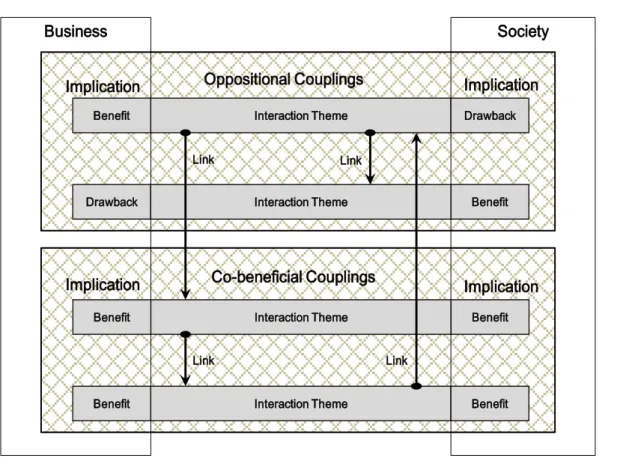
A thematic coupling is an oppositional coupling when one of its implications is a benefit and the other a drawback, whereas it is a co-beneficial coupling when both implications are benefits. Thus, in this framework, the business-society interaction as a whole at the aggregate level is to be represented as a bundle of fine-grained oppositional and co-beneficial couplings (See Fig. 2). Moreover, our preliminary case studies of seven companies show that these couplings, oppositional or co-beneficial, are interrelated to one another in various manners. For instance, one coupling may causally influence another over time, or may be counteracted by a societal concern when it has a negative social impact and lead to a corrective coupling. Such relationships
8 among couplings are captured as links (represented as arrows in Fig. 1 and Fig. 2) and may serve as an additional analytical tool to uncover the structural complexity of the business-society interaction.
Putting all of these conceptual constructs together, the paradox-enacting dynamics of business-society interaction refers to the interplay between commercial and societal concerns and interests that manifests in conflicting as well as mutually beneficial fine-grained interactions (represented as thematic couplings) and relationships among such interactions (captured as links).
… …
Business Society
Interaction Theme Drawback
Benefit
Drawback Interaction Theme Benefit
Interaction Theme Benefit
Benefit
Interaction Theme Benefit
Benefit
Oppositional Couplings
Co-beneficial Couplings
Implication Implication
Implication Implication
Link Link
Link Link
Fig. 2 Business-society interaction as a bundle of linked thematic couplings Case Illustrations
We introduce two case studies to illustrate the framework presented in the previous section and to gain further insights on the complexity of business-society interaction.
Range Resources in Washington and other counties in Pennsylvania
Brief background. The Marcellus Shale is the largest shale formationin the United States (Cruz et al., 2014), running under significant portions of several northeastern states, most notably Pennsylvania, where
9 approximately 64 percent of the geographic area contains large deposits of shale (Curtis, 2011).Thirty years of cooperative efforts between government agencies, universities and private companies led to crucial advancements in gas extraction technologies which greatly fueled the growth of the shale industry (Shellenberger et al., 2012). In 2007, Range Resources, a Texas-based oil and gas extraction company, was the first company to successfully drill into the Marcellus shale by combining the techniques of horizontal drilling and hydraulic fracturing (fracking) and thereby successfully demonstrating the economic viability of shale-gas mining in the area (Kusic, 2014; Range Resources (n.d.- b); Governor’s Marcellus Shale Advisory Commission Report, 2011). Range Resources quickly became the state’s most prolific shale driller (Conti, 2015),and by 2015 the company owned approximately 922 active wells (ACT 13 Pennsylvania Public Utility Commission),a large majority located in Washington County, which is also home to their regional headquarters.
Both contention and synergy. It follows then that due these expansive drilling activities, Range Resources engaged in extensive interactions with its neighboring communities. Table 1 captures such interactions through a list of thematic couplings, both oppositional and co-beneficial, and Table 2 shows the links between them.
Note first that both contention and synergy are observable between the business pressure of Range Resources and the wellbeing of the surrounding communities. Regarding business-society contention, coupling T2 (Table 1), for instance, shows the environment-impacting operations of shale gas extraction. The process of extracting the gas, especially with the method of ‘fracking’, is fairly involved and requires drilling through permeable rock and then pumping in water, sand, chemical lubricants, and ‘proppants’ to keep the fractures open for gas recovery (Shellenberger et al. 2012).Given this complex process, some negative impacts on the environment are not uncommon. Range Resources, in fact, has been subject to heavy fines from the Pennsylvania Department of Environmental Protection (DEP) for environmental damages. In one such case, a leaky pipe resulted in a number of dead crayfish and other small creatures in Cross Creek Lake (Miller, 2013; Cross Creek Park Gas Wells, 2009). Thus as T2 shows, a point of contention was quite pronounced between Range Resources’
commercial activities and the wellbeing of public lands.
On the other hand, coupling S4, illustrates an interaction that is mutually beneficial. Range Resources successful operations helped attract a long list of complementary and related businesses such as water and drilling bit providers, hydraulic rig accessories, trucking services, consulting services and safety supplies (Stouffer, 2007; Czebiniak, 2014)thereby contributing to new economic activities in the area. Range Resources benefited from the buildup of such supporting businesses possibly through more timely inbound logistics and other collaborative opportunities. Additionally, the company’s presence and operations enhanced opportunities
10 for other local businesses such as hotels and restaurants(Wolfgang, 2011; Seaver, 2015) as well. Thus, the cluster development of complementary and related businesses represents a point of synergy between Range Resources’ operations and the economic wellbeing of the neighboring communities. Thus the case clearly illustrates that Range Resources and the surrounding communities (as T2 and S4 show) engaged in both contentious and synergistic (i.e., paradox-enacting) interactions, supporting the paradox-based framework presented earlier.
11 Table 1 Thematic couplings at Range Resources in Washington and other counties in Pennsylvania (see Appendix A for data sources)
Oppositional Couplings
Code Implications to Business Interaction Theme Implications to Society
T1
Benefits
Hiring skilled and experienced workers from outside the State
Drawbacks Skilled workforce employed
to expand well production in a rapidly-increasing
competitive environment:
In 2007, Marcellus Shale was estimated to contain 80 to 250 times more than previous government assessment.1 Given this new estimate, Ray Walker, vice president of Range Resources’ Marcellus Shale division, said: "That's when the bull’s eye got painted on Pennsylvania" (as quoted in [1]). Suddenly investors and producers from all over the country and abroad swarmed into the state to lease land and to drill wells, more than 300 by 2008.1
Employment opportunities lost for local residents:
Many locals lacked the necessary skills, knowledge and experience for shale gas industry.2,3,4 The surge in the industry brought “… a significant number of workers, engineers, and service professionals from traditional oil- and gas-producing states such as California, Colorado, Louisiana, Oklahoma, and Texas, who had experience working in the unconventional gas industry, were brought to Pennsylvania…”(as quoted in [2]).
T2
Benefits
Environment-impacting operations
of shale gas extraction
Drawbacks A large quantity of shale gas
extracted for distribution:
In 2013, greatly due to the Marcellus Shale, Range Resources claims production volumes for the second quarter jumped 27% from the previous year levels.5
Net income in the third quarter of 2014 surges to
$146.4 million up from $19.2 million in the same quarter of 2013.6 And in 2015 a new well for Range Resources in Washington County achieves the highest production to date.7
Environments in the vicinity of the operations impacted negatively:
Communities experience negative environmental impacts on water, soil, air, and noise pollution, etc., with spillovers into public health such as premature births.8,9
Range Resources notified the State Department of Environmental Protection in 2009 about a pipe leak carrying brine that killed crayfish, salamanders and water bugs and fish in Cross Creek Lake.
Range agreed to pay a civil penalty of
$23,500.8
In Lycoming County in 2015, “The company [Range Resources] is fined 8.9 million for faulty cement jobs on gas wells [causing] methane to migrate into private drinking water supplies” (as quoted in [10]).
T3
Benefits
Heavily utilizing public transportation
infrastructure and public services
Drawback Access to public
transportation infrastructure and important public services for a range of operations of the company.
Increased strain on local infrastructure and public services in some
communities:
Local impacts of drilling and related operations were observed in increased
12 In a presentation to
Burgettstown, Washington County, prior to the start company operations, Carl Carlson, Range Resources director of community and government relations, spoke about noise and light as well as increased traffic, as workers and materials moved to and from the sites, noting that heavy trucks could damage the roads.11
traffic of heavy trucks, wear and tear on state and local roads and bridges, more demands on public services such as sewers, police, and fire
departments.11,12,13
Small towns such as Blaine and Dunlevy in Washington County were struggling.
B. Black, solicitor for Dunlevy, noted that small towns face the same problem in how to accommodate the logistics of the gas industry when local
infrastructure is lacking.12
T4
Drawbacks
Regulations by Pennsylvania State Department of
Environmental Protection (DEP)
Benefits Added expenses associated
with compliance to DEP regulations:
“Before a well is even drilled, thousands of pages of documentation are filed and submitted to state regulators for review and approval” (as quoted in [14]).
In 2014, Wastewater
impoundments in Washington County leaked into soil and groundwater. The company paid a $4.15 million fine, was required to close the troubled facilities and to build two impoundments using what DEP regulators call “next generation technology” (as quoted in [15]).
“…Our compliance with [DEP water management]
regulations requires a complete analysis and reporting of all water usage, transportation, recycling and reuse, and disposal if warranted” (as quoted in [16]).
Protection of public environment and health in drilling areas:
In regards to regulation enforcement (2014), Abruzzo, DEP Secretary, said,
“[the $4.15 million penalty to Range Resources] reaffirms the administration’s unwavering commitment to protecting Pennsylvania’s soil and water resources” (as quoted in [15]).
In 2015, J. Quigley, DEP Secretary stated on the 8.9 million fine to Range Resources for water contamination: “The essential message is that pollution of the waterways is not something we’re going to allow” (as quoted in [10]).
In April, 2016, DEP announces it will install new monitors to measure emissions. DEP Secretary J. Quigley notes, “We need to get better data to understand air quality in the different regions….If we determine from that data that there have been [emissions]
violations, we’ll deal with that” (as quoted in [17]).
T5
Drawback
Impact fees imposed by State law ACT 13 (February 14, 2012)
Benefit Paying Impact Fees:
In 2014 Range Resources paid about $28 millionin impact fees to counties and municipalities in
southwestern Pennsylvania, much of it going to Washington and Greene counties.18
Repair and enhancement of public infrastructure (roads, sewers, housingand improvement of public services such as fire department, police, etc.)7,19
“We’re really pleased with the numbers,”
said Washington County Commission Chairman Larry Maggi. “It gives us and the municipalities an opportunity to do projects we might not otherwise be able to do. We’re taking care of our bridges, rehabbing roads and rehabbing
infrastructure, including water and sewers, the county airport and the court system” (as quoted in [19]).
13 Co-Beneficial Couplings
Code Implications to Business Interaction Theme Implications to Society
S1
Benefits
The Marcellus Shale found economically viable through newer extraction technologies4,20
Benefits Texas-based Range
Resources expanding its operations into
Pennsylvania:22,23
Range Resources combines the techniques of hydraulic fracturing with horizontal drilling in the Marcellus Shale formation and saw “a dramatic increase in production” (as quoted in [1]).
New employment and other economic prospects:9,23
"One drilling rig in this area [in Washington and surrounding counties]
accounts for 150 full-time jobs, and we look to have six rigs up and operating by the end of next year," said Range Resources spokesman Matt Pitzarella.
"That's almost 1,000 jobs -- and that's not counting positions with affiliated companies” (as quoted in [21]).
S2
Benefits
Land Leasing for Mineral Rights
Benefits Mineral rights obtained for
natural gas development
Private & public landowners receiving leasing fees & bonuses for mineral rights:
Since 2008 Range Resources made about $800 million payments to over 10,000 landowners in Washington Co., averaging about $80,000 per
leaseholder.12
In 2014, Washington County received total of $864,000 plus 18.25% royalty for the drilling under the county airport.24
S3
Benefits
Selling of Extracted Shale Gas Respecting Royalty Contracts
Benefits Revenue from shale gas
selling:
The revenues in 2015, for example, totaled $1.6 billion.25
Jeff Ventura, the Company's CEO, said in 2016, "As a result of excellent well performance, reduced capital and operating costs and improved differentials across all products, Range [Resources] continues to achieve accretive returns on our Marcellus acreage” (as quoted in [25]).
Royalty income to both public and private landowners: 24,26,27
From 2009 to 2014, Washington County has collected about $11 million from drilling deals on public properties.
Commissioner L. Maggi stated: “It helps us keep the county taxes low” (as quoted in [24]).
M. Tudor, owner of Weatherbury Farm, Washington County, reports that
thousands of dollars in monthly royalties from Range Resources has “allowed us to keep farming” (as quoted in [28]).
14 S4
Benefits
Expansions in
complementary and related businesses in the region
Benefits Advantage due to the
buildup of the business cluster for shale operations:4,30
For instance, Shale Energy Institute issues certificates for commercial drivers with a focus on oil and gas,30 and Alex Paris Contracting Company provides site development, foundations, buildings, undergrounds, process piping, installation and construction
management.32,33 Marcellus Shale Coalition reports a “cascading and positive impact” in the industry supply chain with businesses such as engineering firms, employment firms and environmental consulting firms.30
Enhancement in local and state economic wellbeing: 31,33,11,2,
“Each of the large, horizontal wells Range [Resources] is using takes a number of auxiliary personnel and companies to provide needed services, companies providing fracturing services, water providers since fracturing uses tremendous water pressure, drilling bit providers, even truckers to haul equipment, and aggregate companies to provide stone for service roads” (as quoted in [9]).
Paul Battista, owner of Sunnyside Supply Co, in Washington County revamped his manufacturing supply company to cater to the shale industry with Range Resources as one of his clients. The business grew from $1 million to $6 million in sales from 2008 to 2013.10
S5
Benefits
Educational programs related to the shale industry
Benefits Access to qualified in-state
labor:36
According to Range Resources, “We have also partnered with a variety of public and private institutions, including the US Department of Labor, Employment and Training Administration’s ShaleNET program, to foster workforce training initiatives and spur local hiring. Our efforts, and those industry-wide, are succeeding. We also work with existing state and national industry
organizations on workforce development programs” (as quoted in [29]).
Employment opportunities related to the shale industry realized for in-state residents through the educational programs29,34,35,36,37
According to The Washington Times,
“Schools also are jumping on the bandwagon, offering training programs for their students to lead them into jobs where they often earn $75,000 a year or more. The drilling companies recruit many of those students before they graduate” (as quoted in [11]).
15 Table 2 Links among thematic couplings at Range Resources in Washington and other counties in Pennsylvania (see Appendix A for data sources)
Links among couplings Source Coupling
Destination
Coupling Description
S1 T1 S1 (shale gas extraction through new technologies),1,4,19 encouraged T1 (shale-related labor inflow from other states)2,3,4 due to lack of significant numbers of in-state residents who had the specialized skills immediately required in the industry.2,3,4
T1 S5
T1 (hiring skilled, experienced workers from out-of-state)2,3,4 was a response to the great surge in activity of a rapidly expanding business that overwhelmed Washington County’s labor force.2 Range Resources desire for local, skilled labor29 and the potential for new, local employment opportunities spurred cooperative efforts between the Range Resources, other industry players and educational institutions29,36 soon resulting in S5 (educational and training programs).11,29,34,35,36,37
S1 T2
S1 (shale gas extraction through new technologies) made the extraction of the tremendous abundance of shale gas1 commercially viable with net income of $19.2 million6 in the third quarter of 2013 shooting up to 146.4 million6 in the same quarter of 2014 and providing new local economic opportunities. Yet drilling into the earth with these same extraction activities (fracking) which utilize water and chemicals and produces waste resulted in T2 (damage to the environment and health).8,9,10 T2 T4
T2 (environmental impacts of shale extraction)8,9,10 motivated T4 (strict enforcement and new State regulations for environmental protection from shale operations) to help protect the interests of public wellbeing10,15,17 from an industry that is now embedded in the state and local economies.
S1 T3
S1 (shale gas extraction through new technologies),1 requires an abundance of heavy trucks and other mobile equipment 38 and resulted in T3 (added burden to local infrastructure) where small communities were unprepared for the sudden and added burden on infrastructure and public services.11,12,13
T3 T5 T3 (public infrastructure burdens from shale operations)11,12,13 triggered T5 (impact fees to offset the added costs to communities) due to the tremendous cost of maintaining public infrastructure in a shale extraction area which communities have been able to use towards many public projects that needed funds.7,19
S1 S2 S1 (shale gas extraction through new technologies),1 enabled S2 (monetary gains for public and private landowners) due to the potential abundance of shale gas beneath the land.
S1 S3
S1 (shale gas extraction through new technologies),1 was a boon for Range Resources revenues 25 and also enabled S3 (royalty payments to landowners) due to the
economically viable extraction of the gas which literally enabled some landowners to save the farm.24,26,27,28
S1 S4
S1 (shale gas extraction through new technologies),1 stimulated S4 (local economic growth) due to new business opportunities directly and indirectly related to the shale industry2,9,10,11,31,33. For Range Resources, a buildup of the local business cluster provided advantages with local sourcing and contracts.4,30
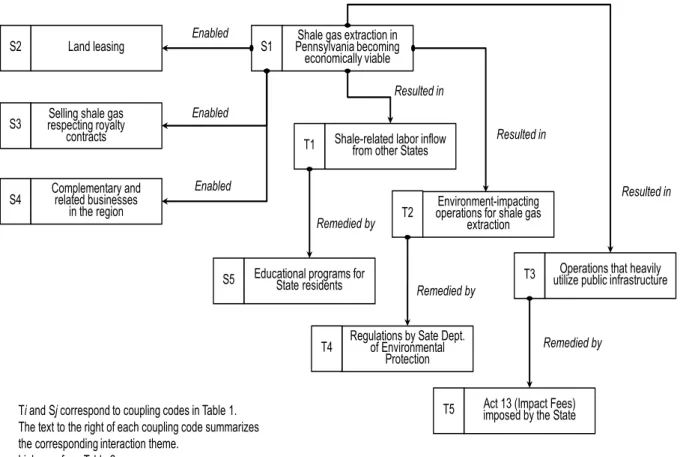
Dynamics of business-society interaction. Figure 3 below summarizes the overall dynamics of the fine-grained co-beneficial and oppositional interactions (Table 1), and the interplay (links) among them (Table 2). The dynamics of the competing forces of commercial interest and societal wellbeing were set into motion with Range Resources’ innovative use of technologies (S1) that helped assure the potential commercial success of the Marcellus Shale formation. The company did so well, in fact, that in 2015 it directed approximately 95% of its capital budget towards the Marcellus (Range Resources, n.d.-b). This tremendous activity benefited the surrounding communities as well, yet also had some negative implications.
16 First, as Range Resources’ well-drilling operations pressed ahead, multiple, co-beneficial interactions ensued as the fine-grained interactions in the tables illustrate. For instance, while Range Resources profited from revenue of extracted gas (S3), in 2015 for example it totaled $1.6 billion, (Range Resources, n.d.-a), private landowners leveraged royalty incomes to ‘save the farm’ (Fleisher, 2014) and local governments kept taxes low (Cato, 01/09/2014; Fleisher, 2014). Mutually beneficial interactions were also realized through the buildup of local businesses. Range Resources benefited from a cluster advantage of nearby contracting and supply companies, while local businesses simultaneously flourished by fulfilling those industry-related needs (S4). One local business owner, for example, revamped his supply company in order to accommodate Range Resources and other drillers and in five years grew from $1 million in sales to $6 million (Czebiniak, 2014).
Yet, while Range Resources and its communities both benefited, the company’s operations also played out through oppositional interactions as well. Pennsylvania has a long history as a coal-producing state and thus was no stranger to the impacts from mining. Yet, the sudden boom of the shale industry coupled with the unexpected impacts from drilling operations, especially fracking, caught communities unprepared and unable to sufficiently cope. In Washington County, Range Resources’ ‘epicenter’ and a valuable shale ‘hot-spot’ among drillers (Wang et al., 2015), the driving forces of commercial interests at times seemed to overwhelm social response (Wang et al., 2015). So while Range Resources reported surging profits in 2014 (Conti, 2014),for example, this was in stark contrast to some communities’ struggle with the fallout of this expansion on the surrounding environment. One such point of contention occurred over faulty cement casings on several wells that contaminated private drinking water supplies(Conti, 2015) which resulted in a heavy $8.9 million fine against Range Resources (T2). Notably, in response to such drawbacks to the society, the forces for social wellbeing seemed to push back. For instance, the environmental point of contention in T2, then, was substantially remedied by State government regulations (T4). Furthermore, when infrastructure was overburdened (T3), ACT 13 was passed to impose impact fees on Range Resources and other drillers (T5). Finally, the lack of skilled labor (T1) was actively addressed through the collaborative efforts of Range Resources, industry-wide initiatives, educational institutions and government programs (S5), resulting in the increase of an in-state workforce prepared for shale industry. Hence, remedying is a critical part of the overall dynamics of the company and its communities. The dynamics of all these interactions can only be captured, however, when multiple fine-grained interactions are observed over time together with the links among them.
17 Land leasing
S2
Educational programs for State residents S5
T2 Environment-impacting operations for shale gas
extraction S3
Remedied by
Operations that heavily utilize public infrastructure T3
Shale-related labor inflow from other States T1
Act 13 (Impact Fees) imposed by the State T5
Resulted in Resulted in
Enabled
Enabled
Remedied by
Resulted in Complementary and
related businesses in the region
S4 Enabled
Shale gas extraction in Pennsylvania becoming economically viable S1
Regulations by Sate Dept.
of Environmental Protection T4
Remedied by
• Tiand Sjcorrespond to coupling codes in Table 1.
• The text to the right of each coupling code summarizes the corresponding interaction theme.
• Links are from Table 2.
Selling shale gas respecting royalty
contracts
Fig. 3 The dynamics of fine-grained interactions of business and society at Range Resources in Washington and other counties in Pennsylvania
18 SABMiller and DADTCO in Mozambique and other countries in Africa
Brief background. SABMiller is the second largest brewery in the world (Maritz, 2012) established in 1895 (“SABMiller: About Us”, n.d.) as South African Breweries in South Africa (Hesse, 2015). In 2011, SABMiller partnered with Dutch Agricultural Development and Trading Company (DADTCO) (Sutherland & Ismail, 2014), a social enterprise, whose mission is to “initiate a cassava revolution across Africa” (“The Dutch Agricultural”, n.d.). Cassava is a starchy root with high water density (“Rooting for Impala”, 2015) and is heavily farmed in Mozambique and elsewhere in Africa (“Mine’s a Pint!”, 2015) as a subsistence crop for the farmers’ own consumption (“International Institute of Tropical Agriculture”, n.d.). Due to its quick-to-rot characteristics after harvesting (Maritz, 2012), cassava was not a reliable source of income for most farmers (“Reducing post-harvest loss”, 2015). On the other hand, cassava was used to make homebrewn beer (“Commercial cassava beer”, 2015).
Many people in Africa, such as those in Mozambique have a “party culture” and indulge in beer at social gatherings (“SABMiller”, 2015; “Beer in Africa”, 2012), and given the high price of beer made from imported barley (Barbier, 2015) homebrewn beer was widespread in many regions in Africa (Sutherland & Ismail, 2014).
However, this homebrew was often health-hazardous and sometimes even fatal (Mullen & Brocchetto, 2015).
SABMiller and DADTCO wanted to produce cassava-based beer for multiple reasons: creating an opportunity for smallholder farmers to sell cassava as a cash crop (Chakravorti, 2015; “SABMiller Launches”, IFDC Perspectives, 2011), providing safe and affordable beer (“Commercial cassava beer”, 2015; Vallie, 2012), and tapping into the billion-dollar homebrew beer market in Africa (Sutherland & Ismail, 2014; “Beer made from Cassava”, 2015). Yet the challenge was to scale up their operations for economic viability as smallholder farmers are widely dispersed and suffered from post-harvest loss due to the perishable nature of the roots (“Africa loses food valued”, 2013). Towards a solution to the challenge, DADTCO invented the Autonomous Mobile Processing Unit (AMPU) which can be relocated for cassava processing at sites closer to smallholder farmers (Hesse, 2015; “DADTCO – Our Technology”, n.d.). The unit processes the fresh cassava into high quality cakes which can be preserved for at least one year (“DADTCO – Our Technology”, n.d.).
Both contention and synergy. Table 3 captures a range of fine-grained business-society interactions at SABMiller and DADTCO in Mozambique and elsewhere in Africa, through oppositional and co-beneficial couplings. Note first that both contention and synergy are observable between the business pressure of SABMiller/DADTCO and the wellbeing of the surrounding communities. Regarding business-society contention, coupling T3 (Table 3), for instance, shows that a point of contention exists in the farmers’
19 accessibility to cassava-processing sites, which is determined by the number of AMPUs deployed and how frequently they are relocated. Namely, if the accessibility gets higher, the farmers benefit but the cost for SABMiller/DADTCO to operate and relocate AMPUs gets correspondingly higher, and vice versa. This logic of contention inevitably persists, and the tradeoff there is rather challenging to manage as each AMPU costs
$500,000 to $600,000 (Speckman, 2011) and its operation requires up to 40 people including 19 trained personnel of which one is a lab technician and 14 casual hires (Vallie, 2012; “Creating the Cassava”, n.d.). A point of contention in general can be latent or salient (Smith and Lewis, 2011). It seems that SABMiller/DADTCO was able to keep this specific point of contention acceptably balanced and hence latent, although it was initially salient. With this contention reasonably well managed, a point of synergy emerged as attested in coupling S3 and its consequences (Table 3 and Figure 4). Namely, SABMiller and DADTCO successfully achieved the needed scale of cassava beer production for economic viability (S3), which in turn contributed to the economic and social wellbeing of the region (T4, S4 and S5 in Table 3) as well as to the commercial success of SABMiller (Sutherland & Ismail, 2014). Thus the case clearly illustrates that SABMiller/DADTCO and the society around them engaged in both contentious and synergistic (i.e., paradox- enacting) interactions, supporting the paradox-based framework presented earlier.
20 Table 3 Thematic couplings at SABMiller and DADTCO in Mozambique and other countries in Africa (see Appendix B for data sources)
Oppositional Couplings
Code Implications to Business Interaction Theme Implications to Society
T1
Benefits Beer production that relies on costly imported, raw ingredients such as barley:2,3
“[About] $50 million of barley is brought in [by SABMiller] to supply Mozambican breweries each year”.4
Drawbacks Continuing growth in sales
in the higher-income target segments in Mozambique.1
Safe beer available in the market but too expensive5 for low-income social segments:6
Due to the high price, many locals resorted to consuming potentially health-hazardous homebrewn beer.2,3,7
T2
Drawbacks SABMiller initiating a centralized operation for beer production5 that uses locally sourced (highly perishable) cassava roots.9,10,11
Benefits SABMiller unable to secure
sufficient, stable supply of fresh cassava roots5,8 to scale up their operation for economic viability:
SABMiller was unable to source sufficient volumes from geographically dispersed farmers5 to make centralized factories economically viable.8 Garry van den Houten, SABMiller Africa’s Director of Enterprise
Development5 stated: “I had done the economics for that…it just didn’t work out” (as quoted in [5]).
A new opportunity for farmers to sell cassava as a cash crop:
“Farmers produced cassava mostly for subsistence purposes and had difficulty finding markets for their produce; as a result only [about]15% of the cassava crop in Mozambique is sold in local markets”.8
“Local market players demand relatively small quantities of fresh cassava, making it difficult for smallholders to rely on them as their primary income source”. 8
T3
Drawbacks Enhanced accessibility to cassava-processing sites through relocatable AMPUs:5,6,10,17,18,19 AMPUs are available for onsite processing at various
locations5,6,8,10,17,18,19 and each location has a 3-4 month cycle.19 Farmers within 20-30km of the AMPU processing site will take their cassava to process.19
Benefits Costs for the operation of
13m longAMPUs12 and the relocation logistics to accommodate the widely dispersed smallholder farmers:5
SABMiller’s managing director, Mark
Bowman5,9,13,14, noted costs accrued for the procurement of AMPUs to process the cassava “at the farmer’s doorstep” (as quoted in [15]).
Each plant costs $500,000 to 600,000 (2011).15 Each site employs about 40 people11 including 19 trained personnel of which one is a lab technician and 14 casuals to operate the AMPU.16
Greatly improved opportunities for a considerably larger number of
smallholder farmers to sell cassava as a cash crop:20
The close proximity of AMPUs to the farmers reduced “the need and cost for farmers to transport the easily
perishable [cassava] over long distances.”19
Previously, many farmers suffered from post-harvest loss of cassava, leaving farmers with little fresh cassava to sell to the local markets.8,21
Peter Bolt, DADTCO’s Managing Director22 said, “…farmers have previously struggled to sell more than a bag of cassava every two weeks.” (as quoted in [22]).